Etsy seller profit guides
Last updated: 2026-07-12
Maintained under the Seller Profit Guard editorial policy.
This guide hub connects source-backed seller decisions to working tools and complete support clusters. Start with the exact decision—formula, evidence, example, discount, threshold, error, comparison, routine, interpretation, or audit—then verify current marketplace records before changing price, shipping, promotion, or operations.
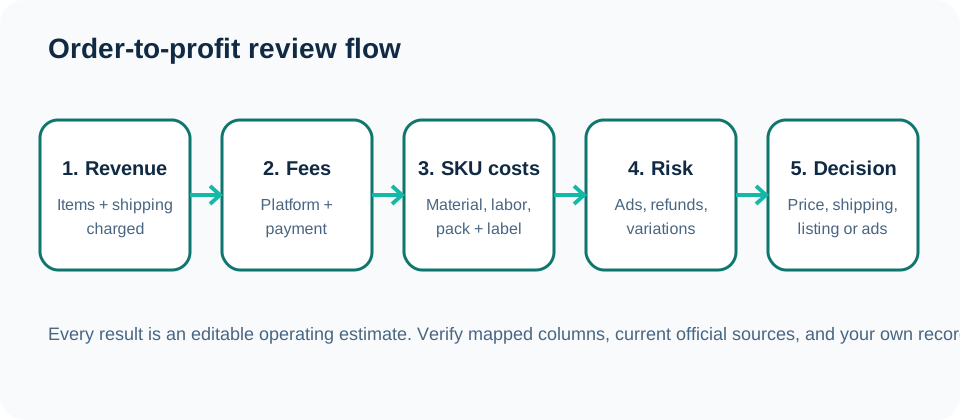
Start with the decision you need to make
A seller rarely needs a generic definition of profit. The useful question is usually specific: can this listing survive a 15% Offsite Ads fee, why does the deposit differ from order sales, which variation is missing a cost record, or how much did a refund really cost after shipping and replacement work? Choose the guide that matches that decision and use the linked calculator as a private worksheet.
Each guide uses editable assumptions because marketplace fees, payment processing, shipping labels, labor rates, packaging, return patterns, and country-specific rules can differ. The examples show the calculation structure; they are not a substitute for the seller's own export, statement, invoices, label costs, or current official Etsy documentation.
Core Etsy profit guides
- What is an Etsy SKU?: Build a short, unique SKU system that connects variations, costs, inventory, and fulfillment.
- Etsy Offsite Ads fee profit examples: Stress-test a sale with 12% and 15% ad-fee scenarios.
- Etsy Payment Account reconciliation guide: Separate order sales, fees, refunds, adjustments, and deposits.
- Calculate SKU-level Etsy profit: Assign material, labor, packaging, shipping, and fee costs to sellable SKUs.
- Etsy shipping cost mistakes: Review label, packaging, free-shipping, replacement, and return costs.
- Etsy variation SKU checklist: Catch missing or inconsistent variant SKUs before they corrupt cost review.
- Etsy refund and fee impact: Include revenue reversal, shipping loss, replacement cost, labor, and support time.
- Shopify fees and app cost calculator: Allocate nine product, provider, software, shipping, advertising, and return cost layers.
- TikTok Shop profit calculator: Separate referral fees, creator commission, discounts, ads, fulfillment, and return loss.
- Break-even ROAS calculator: Turn nine non-ad costs and expected return loss into an allowable CPA and required ROAS.
- Etsy Profit Formula: Inputs Small Sellers Must Track: Build an Etsy contribution formula from settled revenue, official fee evidence, SKU costs, fulfillment, ads, returns, and a dated target.
- Etsy Profit Example: Trace a $74 Order Step by Step: Follow a complete Etsy order contribution example from CSV revenue and fee evidence through SKU cost, labor, shipping, risk, and decision.
- Etsy Discount Profit: Test Coupons and Free Shipping: Model an Etsy discounted order after seller-funded coupons, shipping subsidy, fees, SKU cost, labor, ads, returns, and target contribution.
- Etsy Profit Calculator Mistakes: 12 Cost Traps: Find Etsy profit errors caused by wrong revenue, deposits, missing labor, repeated fees, discount double counts, averages, returns, and stale costs.
- Etsy Profit Data Sources: Build a Defensible Record: Map Etsy revenue, fees, SKU costs, labor, packaging, shipping, ads, refunds, and assumptions to reliable first-party or seller evidence.
- Etsy Profit Thresholds: Break-Even Is Not Enough: Set Etsy break-even, minimum, target, and stress-safe contribution thresholds using costs, overhead reserve, uncertainty, capacity, and risk.
- Etsy Full Price vs Discount: Compare Contribution: Compare one Etsy SKU at full price and under a seller-funded discount using the same costs, fee evidence, shipping, risk, and target.
- Weekly Etsy Profit Review: A 60-Minute Control Loop: Run a weekly Etsy profit review from exports and mapping through exceptions, SKU contribution, actions, evidence archive, and follow-up.
- Interpret Etsy Profit Results Without False Precision: Read Etsy contribution estimates by scope, evidence quality, sensitivity, uncertainty, grain, target, cash timing, and reversible next action.
- Etsy Profit Audit Checklist and Change Log Template: Use a repeatable Etsy profit audit checklist for sources, mappings, formulas, costs, scenarios, decisions, changes, reviewers, and rollback.
- Etsy Payment Reconciliation: Inputs and Match Rules: Map Etsy order exports, Payment Account activity, fees, refunds, deposits, dates, signs, and references into a traceable reconciliation.
- Etsy Deposit Reconciliation: A Weekly Worked Example: Trace one illustrative Etsy payout week across orders, Payment Account sales, fees, a refund, a shipping label, and a bank deposit.
- Etsy Month-End Reconciliation: Close Without Guessing: Build an Etsy month-end close with opening and closing balances, sales, fees, refunds, reserves, deposits, and dated exceptions.
- Etsy Payment Reconciliation: 12 Errors to Fix: Correct amount-only matches, repeated totals, sign errors, date-window drift, deposit-as-revenue mistakes, and hidden unresolved rows.
- Etsy Reconciliation Data: Which Export Proves What?: Map Etsy order, transaction, Payment Account, monthly statement, deposit, bank, refund, fee, and private-cost evidence by purpose.
- Etsy Reconciliation Thresholds: When to Investigate: Set evidence-based Etsy reconciliation thresholds for direct matches, timing differences, unresolved rows, aging, and escalation.
- Weekly Payout vs Month-End Etsy Reconciliation: Compare weekly Etsy payout checks with month-end reconciliation by scope, source cut-off, balance bridge, exceptions, and decisions.
- Weekly Etsy Payment Reconciliation in 45 Minutes: Run a repeatable Etsy payment reconciliation routine: preserve exports, validate mappings, match rows, bridge deposits, and close exceptions.
- Read Etsy Reconciliation Results Without False Certainty: Interpret direct, grouped, fallback, timing, ambiguous, and unresolved Etsy payment rows without confusing cash, revenue, or profit.
- Etsy Payment Reconciliation Audit Checklist: Use a source, mapping, match, balance, deposit, exception, privacy, approval, and change-log checklist for Etsy reconciliation.
- SKU Cost Formula: 8 Inputs Etsy Sellers Need: Build a reusable Etsy SKU cost record from materials, labor, packaging, fulfillment, variable extras, allocation, risk, and evidence dates.
- Etsy SKU Cost Example: A $18.35 Handmade Item: Trace an illustrative handmade SKU through material, labor, packaging, fulfillment preparation, overhead allocation, and target review.
- Etsy Variation Costs: Stop Averaging Every Option: Build separate cost records for size, material, personalization, weight, packaging, and fulfillment differences across Etsy variations.
- SKU Costing Mistakes: 12 Errors That Hide Margin: Fix pack-price, unit, labor, waste, shipping, overhead, duplicate SKU, version, and missing-cost errors in a reusable cost library.
- SKU Cost Data Sources: Invoice to Time Study: Map materials, labor, packaging, fulfillment, shipping, waste, allocation, and SKU identity to defensible seller-owned evidence.
- SKU Cost Confidence: When a Record Is Ready: Set evidence, freshness, coverage, unit, version, and stress thresholds before using a SKU cost record for pricing or margin decisions.
- Handmade SKU vs Variation Cost Library: Compare one handmade SKU with a multi-variation listing using the same material, labor, packaging, fulfillment, and version controls.
- Weekly SKU Cost Review: A 45-Minute Routine: Maintain an Etsy SKU cost library with weekly exception review, source refresh, version control, backups, and downstream join checks.
- Read SKU Cost Records Without False Precision: Interpret observed, measured, allocated, estimated, stale, missing, and versioned SKU cost layers before changing Etsy prices.
- SKU Cost Library Audit Checklist and Change Log: Audit SKU identity, units, sources, layers, versions, imports, joins, privacy, approvals, and rollback with a reusable template.
- Etsy Variant Risk: 5 Checks Before Margin Review: Map Etsy variation names, SKUs, quantity, order count, and SKU cost coverage into five deterministic risk checks before pricing or margin analysis.
- Etsy Size Variation Audit: One SKU, Two Labels: Follow a complete Etsy size-variation example that exposes one SKU mapped to two labels, a missing SKU, and a high-volume cost gap.
- Etsy Material Variations: One Label, Two SKUs: Audit a material-based Etsy variation where one item-and-option label maps to multiple SKUs and material cost coverage differs.
- Etsy Variant Audit: 12 Mistakes That Hide Risk: Correct twelve Etsy variation and SKU audit mistakes involving mapping, normalization, thresholds, historical identity, cost coverage, and interpretation.
- Etsy Variant Audit Data: 6 Sources to Reconcile: Map Etsy sold transactions, active listings, Shop Manager, SKU costs, fulfillment records, and change logs to variant-risk inputs.
- Etsy Variant Risk Thresholds: Use, Hold, Escalate: Set evidence-based use, hold, and escalation thresholds for missing SKUs, variation collisions, and high-volume cost gaps.
- Etsy Size vs Material Variants: Two Risk Patterns: Compare a size-label collision with a material SKU-version collision at the same order-item grain and choose the correct remediation.
- Weekly Etsy Variant Audit: A 40-Minute Routine: Run a repeatable weekly Etsy variation and SKU review with bounded exports, fixtures, exception ownership, reruns, and rollback.
- Read Etsy Variant Warnings Without False Precision: Interpret five Etsy variant and SKU warning families by evidence, scope, threshold, root cause, and responsible next action.
- Etsy Variant Audit Checklist and Change Log: Audit Etsy variation identity, SKU relationships, cost coverage, fixtures, privacy, corrections, approvals, and rollback with a reusable template.
- Free Shipping Threshold Formula: 6 Inputs: Calculate a margin-safe free-shipping order threshold from four dollar costs, a fee rate, and a target margin without confusing it with Etsy's $35 rule.
- Free Shipping Threshold: $26.32 Example: Follow a domestic parcel example from product, label, packaging, fees, and target margin to a rounded $27 free-shipping order rule.
- Mixed-Cart Free Shipping Threshold: $37.75: Calculate a mixed-cart threshold from two product costs, combined packaging, parcel shipping, fees, and target margin without reusing a one-item average.
- Free Shipping Threshold: 12 Costly Mistakes: Avoid denominator errors, missing fees, false zero costs, mixed-cart averages, wrong shipping scope, unsafe rounding, and platform-rule confusion.
- Free Shipping Threshold Data: 7 Sources: Map product cost, postage, packaging, fixed and percentage fees, margin targets, cart mix, and offer rules to reliable seller and Etsy evidence.
- Free Shipping Rules: Break-Even vs Target: Separate break-even, target-margin, stress, and rollback thresholds so a free-shipping offer is not approved from one optimistic estimate.
- Free Shipping Threshold: Parcel vs Cart: Compare a $26.32 domestic parcel threshold with a $37.75 mixed-cart threshold at consistent cost, fee, margin, and package grain.
- Weekly Free Shipping Audit: 45 Minutes: Run a weekly 45-minute control loop for shipping costs, qualifying cart mix, fees, thresholds, exceptions, actions, and rollback evidence.
- Read a Free Shipping Threshold Correctly: Interpret the calculated order floor, denominator, cost total, score, assumptions, sensitivity, and next action without false precision.
- Free Shipping Threshold Audit Template: Audit formula, source evidence, offer scope, fixtures, cart mix, configuration, live outcomes, approvals, exceptions, and rollback.
- Return Loss Formula: 10 Inputs Explained: Calculate expected return loss per order from ten scoped inputs, distinguish refund cash from retained cost, and derive a target-safe return rate.
- Return Loss Example: Resellable Item: Follow a complete resellable-return example from contribution and recovery through expected loss, adjusted margin, and a target-safe return rate.
- Return Loss for an Unsellable Item: Model an unsellable return with zero product recovery, higher handling, and seller-funded shipping without reusing a resellable-item average.
- 12 Return Loss Calculator Mistakes: Fix twelve return-loss errors involving denominators, fee credits, recovery, shipping, cohorts, policy scope, timing, and false precision.
- Return Loss Data: 8 Reliable Sources: Map every return-loss input to first-party seller records, Etsy policy, shipping evidence, recovery outcomes, and privacy-safe aggregates.
- Set a Safe Return Loss Threshold: Separate break-even, target, stress, evidence, and rollback thresholds for return loss without turning a model into a universal benchmark.
- Resellable vs Unsellable Return Loss: Compare resellable and unsellable returns at the same order grain to isolate recovery, handling, shipping, and frequency drivers.
- Weekly Return Loss Review in 45 Minutes: Run a weekly evidence-preserving return-loss review across mature cohorts, costs, recovery, decisions, exceptions, and rollback.
- Interpret Return Loss Without False Precision: Read expected loss, incident severity, adjusted contribution, margin, safe return rate, score, uncertainty, and next action responsibly.
- Return Loss Audit Checklist and Log: Audit cohort scope, ten inputs, source maturity, calculations, privacy, policy boundaries, fixtures, approval, feedback, and rollback.
- Etsy Ads Break-Even Formula: 12 Inputs: Calculate Etsy Ads break-even and target-safe spend, ACOS, and ROAS from twelve scoped revenue, cost, fee, return, and ad inputs.
- Etsy Ads Break-Even Example: Low-Cost Item: Follow a $36 low-cost Etsy listing from non-ad costs to $8.28 target-safe ad spend, 23.0% ACOS, and 4.35 target ROAS with reproducible math.
- Etsy Ads Break-Even for a High-Return Item: Model a $48 high-return Etsy listing where $4.20 expected return loss leaves no target-safe spend at a 25% target and 4.83x break-even ROAS.
- Etsy Ads Break-Even: 12 Costly Mistakes: Correct twelve Etsy Ads break-even errors involving attribution, denominators, Offsite Ads, returns, fees, listing mix, targets, and rounding.
- Etsy Ads Break-Even Data: Source Map: Map every Etsy Ads break-even input to Ads dashboard, Payment account, listing, cost, shipping, return, and seller-policy evidence.
- Set a Safe Etsy Ads ACOS and ROAS Target: Set break-even, target, stress, evidence, and rollback thresholds for Etsy Ads spend per order, ACOS, ROAS, and retained contribution.
- Etsy Ads ACOS: Low-Cost vs High-Return: Compare low-cost and high-return Etsy listings at the same revenue, fee, attribution, and target grain to isolate the variable driving ad room.
- Weekly Etsy Ads Break-Even Routine: Run a 45-minute weekly Etsy Ads control loop for spend, attribution maturity, listing economics, ACOS, ROAS, exceptions, and rollback.
- Interpret Etsy Ads ACOS and ROAS Safely: Read Etsy Ads contribution, ad ceilings, ACOS, ROAS, attribution, uncertainty, and next actions without confusing attributed revenue with profit.
- Etsy Ads Break-Even Audit and Change Log: Audit Etsy Ads scope, source maturity, costs, formulas, fixtures, privacy, attribution language, approval, live configuration, and rollback.
- Etsy Title Checker: Five Inputs That Matter: Use five evidence-backed Etsy title inputs to review item clarity, objective traits, mobile scanning, repetition, and change context.
- Etsy Title Checker Example: Personalized Item: Rewrite a 21-word personalized necklace title into a clear 10-word version while preserving facts, tags, baseline evidence, and rollback.
- Etsy Title Checker for Material-Led Products: Review a material-led moonstone ring title where verified stone, metal, color, and construction matter more than generic gifting language.
- 12 Etsy Title Checker Mistakes to Correct: Correct twelve Etsy title review mistakes involving limits, nouns, traits, gifting, evidence, Shop Stats, mobile scans, and causal claims.
- Etsy Title Checker Data Sources Map: Map Etsy title inputs to listings, product records, attributes, Shop Stats, search visibility, first photos, policies, and change logs.
- Safe Etsy Title Change Decision Thresholds: Use accuracy, readability, evidence, stability, headroom, and rollback thresholds to decide whether an Etsy title change is ready.
- Etsy Title Checker: Personalization vs Material: Compare personalized and material-led Etsy titles at the same evidence grain to see how noun, traits, variations, and rollback differ.
- Weekly Etsy Title Review Routine: Run a 40-minute weekly Etsy title review that preserves baselines, selects candidates, verifies facts, controls changes, and closes feedback.
- Interpret Etsy Title Checker Results Safely: Interpret title score, character count, noun and trait coverage, mobile preview, flags, and evidence notes without false ranking precision.
- Etsy Title Audit Checklist and Change Log: Audit Etsy title facts, fields, checker rules, mobile rendering, privacy, approval, publication, evidence feedback, and rollback.
- Etsy Tag Checker: Six Inputs That Matter: Review six evidence-backed Etsy tag inputs to check 13-slot use, 20-character limits, phrase variety, listing-field overlap, and change context.
- Etsy Tag Checker Example: Gift Listing: Follow a 13-slot gift-listing tag review that removes exact duplication, protects product truth, adds regional and recipient variety, and preserves a baseline.
- Etsy Tag Checker for a Style-Led Listing: Build a style-led Etsy tag set for a linen table runner by separating visual style, use, material, size, recipient, and structured attribute coverage.
- 9 Etsy Tag Checker Mistakes to Avoid: Avoid nine Etsy tag checker mistakes involving separators, character counts, duplicate fields, false facts, shop language, timing, and performance claims.
- Reliable Data for an Etsy Tag Checker: Map Etsy tag checker inputs to the listing editor, category and attribute fields, product records, Shop Stats, search visibility, and controlled notes.
- Safe Thresholds for Etsy Tag Changes: Use hard, review, evidence, and rollback thresholds to decide when an Etsy tag set is ready, uncertain, or blocked without inventing ranking precision.
- Etsy Tag Sets: Gift vs Style Intent: Compare gift-oriented necklace tags with style-oriented linen-runner tags at the same evidence grain to see how product facts change phrase selection.
- Weekly Etsy Tag Review Routine: Run a weekly Etsy tag review from candidate selection and fact validation through bounded publication, Shop Stats feedback, exception handling, and rollback.
- Interpret Etsy Tag Checker Results: Interpret slot count, phrase mix, duplicate, field-overlap, repeated-term, product-fact, title-context, and evidence outputs without false precision.
- Etsy Tag Audit Checklist and Log: Audit Etsy tag scope, product facts, field coverage, checker rules, privacy, approval, publication, Shop Stats feedback, exceptions, and rollback.
- Creator Commission Formula: 14 Inputs: Build a TikTok Shop creator commission estimate from 14 labeled inputs, two commission paths, retained orders, and a target contribution threshold.
- Creator Commission Example: Standard Rate: Follow a complete TikTok Shop Standard commission example from eligible base and sample allocation to retained contribution and target-margin decision.
- Shop Ads Commission: Margin Scenario: Model TikTok Shop Ads commission separately from Standard commission, ad spend, authorization, attribution, and regional account rules.
- 9 Creator Commission Calculator Errors: Correct nine creator commission errors involving bases, rates, samples, attribution, returns, discounts, advertising, timing, and interpretation.
- Creator Commission Data: Source Map: Map every creator commission calculator input to TikTok first-party reports, seller cost records, retained-order evidence, and explicit assumptions.
- Safe Creator Commission Margin Thresholds: Set break-even, target, stress, and evidence thresholds for a TikTok Shop creator commission offer without false precision.
- Standard vs Shop Ads Commission Math: Compare Standard and Shop Ads commission at one order grain while preserving advertising, attribution, authorization, and rate-priority differences.
- Weekly Creator Commission Review Routine: Run a weekly creator commission evidence loop covering rates, retained orders, samples, advertising, returns, contribution, exceptions, and rollback.
- Read Creator Contribution Without Hype: Interpret creator commission outputs as bounded operating estimates, not payout statements, incremental lift, accounting profit, or guaranteed margin.
- Creator Commission Audit and Change Log: Audit creator commission formulas, source versions, fixtures, privacy, approval, publication, feedback, exceptions, and rollback.
- Coupon Stack Formula: 12 Inputs That Matter: Build a coupon-stack contribution formula from 12 explicit seller inputs while separating platform rules, funding, bases, and assumptions.
- Coupon Stack Example: From $60 to Contribution: Follow a complete $60 coupon-stack example through sequential discounts, fees, shipping, affiliate commission, costs, and target comparison.
- Coupon Plus Free Shipping and Affiliate Fees: Model a coupon with free shipping and affiliate commission without hiding application order, funding, fee bases, or acquisition cost.
- 10 Coupon Stack Mistakes That Hide Losses: Diagnose ten coupon-stack errors involving sequence, bases, funding, shipping, fees, commission, ads, returns, scope, and interpretation.
- Coupon Stack Data Sources: Field by Field: Map every coupon-stack input to first-party checkout, promotion, settlement, cost, advertising, shipping, and return evidence.
- Set a Safe Coupon Stack Margin Threshold: Separate break-even, target, stress, and evidence thresholds before approving a coupon, shipping, affiliate, and advertising promotion stack.
- Single Coupon vs Full Promotion Stack: Compare one order coupon with item discount, free shipping, affiliate commission, fees, ads, and returns at the same order grain.
- Weekly Coupon Stack Review Routine: Run a repeatable weekly promotion review covering configuration, checkout, funding, orders, fees, shipping, ads, returns, action, and rollback.
- Read Coupon Stack Results Without False Precision: Interpret coupon-stack contribution as a bounded estimate rather than checkout proof, accounting profit, demand lift, or guaranteed margin.
- Coupon Stack Audit Checklist and Change Log: Audit promotion scope, rules, funding, formula, sources, fixtures, privacy, approval, release, feedback, exceptions, and rollback.
- Etsy Attribute Coverage Formula: Exact Inputs: Build an exact Etsy attribute coverage formula from relevant category fields, selected values, verified facts, variations, titles, and tags.
- Etsy Attribute Checker: A 4/4 Jewelry Example: Follow a 4/4 pendant-necklace attribute review through category scope, exact pairs, product facts, title and tag visibility, and variations.
- Etsy Attribute Audit for a Wall Hanging: Audit a home-decor wall hanging with category-specific material, color, room, dimensions, natural variation, and a documented hold decision.
- 10 Etsy Attribute Coverage Mistakes to Correct: Diagnose ten Etsy attribute errors involving denominators, stale categories, unsupported values, fact conflicts, variations, duplication, and scope.
- Etsy Attribute Data Sources, Field by Field: Map Etsy attribute fields to the live editor, product specification, measurements, photos, supplier evidence, SKU records, and a dated change log.
- Set Safe Etsy Attribute Decision Thresholds: Define pass, correct, hold, and block thresholds for Etsy attribute coverage, factual conflicts, evidence maturity, and variation overlap.
- Jewelry vs Decor: Etsy Attribute Coverage: Compare jewelry and home-decor attribute reviews across category scope, exact values, evidence, variations, visibility, and release decisions.
- A Weekly Etsy Attribute Audit Routine: Run a weekly Etsy attribute audit with sampling, evidence refresh, exception ownership, bounded corrections, public-view checks, and rollback.
- Interpret Etsy Attribute Coverage Carefully: Read exact coverage, missing fields, conflicts, unsupported selections, variation overlap, and fact visibility without false precision or ranking claims.
- Etsy Attribute Audit Checklist and Change Log: Use a reusable Etsy attribute checklist and change log for scope, evidence, fixtures, approval, publication verification, feedback, and rollback.
- Etsy Category Fit Formula: Exact Inputs: Build an Etsy category-fit formula from item format, product identity, material or files, buyer use, variations, and dated editor evidence.
- Etsy Category Fit: Physical Jewelry Example: Follow a handmade pendant necklace through category path, physical format, identity, materials, use, options, evidence, and release checks.
- Etsy Category Fit for a Digital Download: Review a seller-designed digital invitation across file format, product identity, instant or made-to-order delivery, category scope, and evidence.
- 12 Etsy Category Fit Mistakes to Avoid: Diagnose twelve Etsy category errors involving format, nouns, materials, use, attributes, variations, keyword substitution, and stale evidence.
- Etsy Category Fit Evidence Sources: Map category decisions to the live editor, public category path, product specification, file manifest, photos, variations, and policy sources.
- Etsy Category Fit Pass and Block Rules: Set pass, correct, hold, and block rules for Etsy category format, product identity, material or file scope, use, options, and evidence.
- Physical vs Digital Etsy Category Fit: Compare a handmade pendant and digital invitation with the same five category-fit dimensions while preserving their different evidence and delivery.
- Weekly Etsy Category Fit Audit Routine: Run a risk-based Etsy category audit with change sampling, source refresh, fixtures, bounded edits, public verification, and rollback.
- Interpret Etsy Category Fit Results: Read five Etsy category-fit checks without treating token overlap as taxonomy proof, policy certification, ranking probability, or sales evidence.
- Etsy Category Fit Audit Template: Use a privacy-safe Etsy category fit checklist with before state, five checks, sources, fixtures, approval, public verification, and rollback.
- Etsy Description Clarity Formula: 10 Inputs: Define the exact inputs, coverage checks, evidence requirements, and precedence rules for a reproducible Etsy description clarity review.
- Etsy Description Checker: Personalized Example: Follow a personalized sterling-silver necklace from product evidence through description checks, buyer instructions, release, and rollback.
- Etsy Description Checker for Made-to-Order Items: Review a made-to-order ceramic sign with production stages, personalization inputs, proof decisions, dimensions, care, and timing evidence.
- 12 Etsy Description Mistakes That Create Risk: Diagnose twelve Etsy description defects involving buried facts, units, timing, customization, care, policies, claims, and rollback.
- Evidence Sources for Etsy Listing Descriptions: Map every description claim to the product record, measurement sheet, processing profile, care test, policy, editor, and official source.
- Etsy Description Ready, Revise, Hold, Block: Set explicit ready, revise, hold, and block thresholds for buyer information, evidence, contradictions, and unsupported claims.
- Personalized vs Made-to-Order Description QA: Compare a personalized necklace and made-to-order ceramic sign at the same buyer-question grain without erasing their different workflows.
- Weekly Etsy Description Evidence Routine: Operate a risk-based description review using changed-listing sampling, source refresh, fixtures, bounded edits, public checks, and rollback.
- How to Read Etsy Description Checker Results: Interpret six clarity checks and ready, revise, hold, or block decisions without claiming truth, compliance, ranking, or conversion.
- Etsy Description Audit Checklist and Log: Use a privacy-safe checklist for before copy, evidence, six checks, unsupported claims, approval, public verification, and rollback.
- Etsy Photo Coverage Formula: 10 Inputs: Define the gallery inventory, seven buyer-evidence checks, known-gap gate, provenance note, and deterministic decision logic.
- Etsy Photo Checklist: Variation-Heavy Example: Follow a personalized necklace with finish and chain options from product evidence through gallery mapping, checks, release, and recovery.
- Etsy Photo Checklist for Size-Sensitive Art: Build a materially different size-sensitive wall-art gallery with room scale, exact dimensions, crop boundaries, packaging, and frame exclusions.
- 12 Etsy Photo Coverage Mistakes to Fix: Diagnose denominator, evidence, mockup, variation, scale, package, crop, and release errors that distort an Etsy gallery plan.
- Evidence Sources for Etsy Listing Photos: Map every photo requirement to product, measurement, variation, packaging, permission, policy, and public-gallery evidence without private data.
- Etsy Photo Coverage: Ready, Revise, Hold, Block: Set non-compensating release thresholds for complete coverage, missing buyer evidence, stale authority, and known inaccurate images.
- Variation Photos vs Size-Sensitive Photos: Compare a variation-heavy necklace and size-sensitive art print at the same buyer-question grain while preserving different evidence needs.
- Weekly Etsy Photo Evidence Routine: Operate a risk-based gallery review using changed-listing sampling, source refresh, fixtures, bounded releases, buyer-view checks, and rollback.
- How to Read Etsy Photo Checklist Results: Interpret seven coverage checks, the known-gap gate, evidence status, sensitivity, limitations, and the correct next seller action.
- Etsy Photo Audit Checklist and Change Log: Use a standalone before-state, evidence, fixture, approval, public-verification, measurement, and rollback template for gallery changes.
- Etsy Variation Naming Formula and Inputs: Define axes, values, selector text, photo and total-price maps, complete SKU combinations, known issues, and a dated evidence contract.
- Etsy Variation Names: Size and Color Example: Follow a tote bag with three sizes and two colors from the product option contract through photos, total prices, six SKUs, release, and recovery.
- Etsy Material and Personalization Options: Separate set-list material choices from buyer-entered engraving instructions, then audit photos, prices, SKUs, processing, and public behavior.
- 12 Etsy Variation Naming Mistakes: Diagnose ambiguous axes, mixed values, unit drift, stale selectors, wrong photos, add-on prices, missing combinations, duplicate SKUs, and unsafe releases.
- Evidence Sources for Etsy Variations: Map axes, values, measurements, photos, prices, quantities, processing, SKU combinations, editor state, and buyer behavior to current authority.
- Etsy Variation Naming: Ready to Block: Apply non-compensating Ready, Revise, Hold, and Block gates to axes, values, selector parity, photos, total prices, SKUs, and evidence.
- Etsy Size and Color vs Material and Personalization: Compare a Cartesian size-and-color matrix with fixed material choices plus buyer-entered engraving at the same evidence grain.
- Weekly Etsy Variation Naming Routine: Turn product, editor, buyer-view, photo, price, processing, and SKU changes into a risk-based evidence, release, and recovery loop.
- How to Read an Etsy Variation Naming Report: Interpret seven structural checks, combination counts, mapping states, decisions, uncertainty, and next actions without false precision.
- Etsy Variation Naming Audit Template: Use a privacy-safe before-state, evidence, fixture, release, public verification, exception, rollback, and measurement record.
- Etsy Personalization Instructions: Inputs and Checks: Define customization scope, focused fields, buyer instructions, format limits, examples, proofing, exceptions, processing, issues, and evidence.
- Etsy Engraving Instructions Worked Example: Build a two-field engraved-name workflow with exact text, font options, limits, examples, no-proof handling, processing, release, and recovery.
- Etsy Custom Portrait Input Instructions: Translate a custom portrait workflow into subject, composition, file, approval, revision, missing-input, processing, and privacy-safe controls.
- 12 Etsy Personalization Instruction Mistakes: Diagnose overloaded prompts, missing format limits, unsafe data requests, contradictory examples, proof ambiguity, timing drift, and untested public fields.
- Evidence Sources for Etsy Personalization Instructions: Map product scope, field definitions, examples, production templates, proof rules, processing, platform behavior, and public feedback to accountable sources.
- Etsy Personalization Instructions: Ready to Block: Apply non-compensating Ready, Revise, Hold, and Block gates to field scope, limits, examples, proofing, exceptions, processing, and evidence.
- Etsy Engraving vs Custom Portrait Instructions: Compare a two-field text-and-font engraving workflow with a multi-stage file, composition, proof, and revision portrait workflow.
- Weekly Etsy Personalization Instruction Routine: Turn product, field, example, pricing, proof, exception, processing, and public-state changes into a bounded weekly evidence loop.
- How to Read an Etsy Personalization Instruction Report: Interpret eight checks, field count, Ready, Revise, Hold, Block, limitations, evidence gaps, and the next repair without false precision.
- Etsy Personalization Instruction Audit Template: Record scope, fields, limits, examples, proofing, exceptions, processing, fixtures, release, public observations, rollback, and privacy controls.
- Etsy Production Partner Disclosure Inputs: Define item path, seller design, partner production, public identity and location, relationship copy, listing links, dispatch origin, issues, and evidence.
- Etsy POD Production Partner Example: Follow an original botanical tote through print-on-demand production, partner profile, listing links, dispatch origin, release, and recovery.
- Etsy Specialist Fabrication Partner Example: Model seller-designed jewelry made by a specialist fabricator, with drawings, samples, finishing boundaries, public disclosure, and dispatch evidence.
- 13 Etsy Production Partner Disclosure Mistakes: Diagnose supplier misclassification, vague roles, stale locations, missing listing links, wrong origins, unsupported claims, and unsafe edits.
- Evidence Sources for Etsy Production Partners: Map original design, product specifications, partner work, public profile, listing associations, dispatch origin, and feedback to accountable sources.
- Etsy Production Partner: Ready to Block: Apply non-compensating Ready, Revise, Hold, and Block gates to item path, seller role, partner work, public disclosure, listing links, origin, and evidence.
- Etsy POD vs Specialist Fabrication Disclosure: Compare original-art print on demand with specialist fabrication across authorship, production, public profile, listing scope, origin, and rollback.
- Weekly Etsy Production Partner Routine: Turn design, product, partner, facility, listing, About, fulfillment, policy, and public changes into a bounded evidence and recovery loop.
- How to Read an Etsy Production Partner Report: Interpret eight checks, Ready, Revise, Hold, Block, known issues, evidence gaps, limitations, and the next responsible action without false precision.
- Etsy Production Partner Audit Template: Record item path, seller design, partner work, public profile, listings, origin, sources, fixtures, approval, verification, rollback, and privacy controls.
- Etsy Digital File Checker Inputs: Define delivery mode, file manifest, package contents, compatibility, license, preview match, support, known issues, and current evidence.
- Etsy Printable PDF File Example: Follow a four-file printable package through naming, limits, clean-device tests, previews, license, buyer instructions, release, and recovery.
- Etsy Design Template Bundle QA: Model a ZIP-based design-template bundle with source formats, fonts, links, versions, extraction, licensing, previews, and failure recovery.
- 14 Etsy Digital File Listing Mistakes: Diagnose excess files, unsupported formats, invalid names, corrupt archives, missing contents, preview mismatch, vague licensing, and unsafe releases.
- Reliable Etsy Digital File QA Sources: Map platform limits, source exports, manifests, clean-device tests, previews, licenses, buyer notes, synthetic purchase paths, and public feedback.
- Etsy Digital File QA Decision Thresholds: Apply Ready, Revise, Hold, and Block to file count, type, size, names, contents, compatibility, license, previews, support, issues, and evidence.
- Etsy Printable vs Template File QA: Compare a printable PDF set and editable template bundle at the same delivery, manifest, dependency, preview, license, test, and recovery grain.
- Weekly Etsy Digital File QA Routine: Run a trigger-based observe, classify, select, test, back up, release, verify, measure, and recover loop for digital listing packages.
- How to Read an Etsy Digital File QA Report: Interpret eight checks, Ready, Revise, Hold, Block, manifest counts, issue precedence, uncertainty, and responsible next evidence actions.
- Etsy Digital File Package Audit Template: Record listing, manifest, package, dependencies, license, previews, instructions, fixtures, approval, release, buyer-path observations, and rollback.
- Etsy Listing Claims Checker: 9 Inputs: Define the listing boundary, claim rows, evidence families, visual reconciliation, qualifications, risk review, and approval record.
- Etsy Material Claim: A Component Example: Follow a pendant, chain, size, and engraving statement from component records through public wording, images, approval, and rollback.
- Etsy Compatibility Claim: A Sleeve Example: Test a laptop-sleeve fit statement without turning one measured envelope into universal compatibility, waterproofing, or shock protection.
- 14 Etsy Listing Claim Mistakes to Block: Find material, performance, image, environmental, origin, health, certification, qualification, and evidence defects before publication.
- Etsy Claim Evidence: Source Hierarchy: Choose product records, measurements, tests, public surfaces, current platform policy, regulator guidance, and human approval at the right grain.
- Etsy Claim Decisions: Ready to Block: Set non-compensating Ready, Revise, Hold, and Block thresholds for claim rows, evidence, qualifications, visuals, risk, and approval.
- Material vs Compatibility Claims on Etsy: Compare a mixed-metal necklace and measured laptop-sleeve fit statement at the same claim, evidence, qualification, review, and rollback grain.
- A Weekly Etsy Claim Review Routine: Run trigger-based evidence refresh, fixtures, approval, bounded release, public verification, correction, and measurement without rewriting stable listings.
- How to Read an Etsy Claim Score: Interpret eight checks, claim count, decision, evidence status, issue list, and next actions without treating the result as truth or legal certification.
- Etsy Claim Audit Template and Fields: Record listing identity, claims, evidence, tests, visuals, qualifications, risk, approval, release, public observation, rollback, and review triggers.
- Etsy Seasonal Readiness: 9 Inputs and Formula: Define the dated window, capacity, processing, seller cutoff, listing alignment, variation, photo, promotion, and approval inputs.
- Etsy Holiday Listing Cutoff: Worked Example: Calculate and audit a personalized ornament listing from inventory and production capacity through a dated seller cutoff and public verification.
- Etsy Wedding-Season Listing Readiness: Plan a wedding-favor listing around event lead time, proof approval, batch production, color variants, and a staged order window.
- 12 Etsy Seasonal Listing Mistakes to Block: Diagnose stale cutoffs, mixed calendars, capacity errors, oversold variants, misleading images, and promotions detached from fulfillment controls.
- Reliable Data for Etsy Seasonal Readiness: Map every seasonal input to Etsy help, public listing observations, inventory and production records, seller assumptions, and dated approvals.
- Etsy Seasonal Readiness Thresholds: Apply Ready, Revise, Hold, and Block thresholds to dated windows, capacity, processing, cutoffs, listing evidence, and promotion stops.
- Holiday Gift vs Wedding-Season Etsy Plan: Compare a fixed holiday need-by window with event-specific wedding orders at the same evidence grain and decision columns.
- Weekly Etsy Seasonal Readiness Routine: Run a trigger-based weekly loop for dates, inventory, capacity, profiles, public estimates, listing evidence, promotion stops, and rollback.
- How to Read an Etsy Seasonal Readiness Result: Interpret eight checks, dates, issue precedence, decision, uncertainty, and next actions without treating readiness as a delivery or demand guarantee.
- Etsy Seasonal Listing Audit Template: Record dates, capacity, processing, cutoff math, listing surfaces, options, media, promotion, approval, release, public verification, and rollback.
- Etsy Fee Stack Formula and Input Contract: Model account context, listing events, transaction, processing, ads, currency, regulatory, tax, cost, and reconciliation layers.
- Etsy Fees on a $45 Order: Worked Example: Reproduce a domestic US planning fixture from order revenue through listing, transaction, processing, cost, and contribution rows.
- Etsy Cross-Currency Fee Example: Separate listing currency, Payment account currency, bank-country processing, conversion, regulatory, and statement exchange-rate evidence.
- 12 Etsy Fee Calculation Mistakes: Block wrong fee bases, stale country rates, double-counted shipping, missing attribution, quantity renewals, currency, VAT, refunds, and credits.
- Reliable Sources for Every Etsy Fee Input: Map each fee rate, base, currency, attribution, quantity, tax, cost, refund, and credit to the authority that owns it and its refresh trigger.
- Etsy Fee Stack Decision Thresholds: Separate break-even, target contribution, adverse fee cases, unresolved evidence, and actual-statement reconciliation before acting.
- Domestic vs Cross-Currency Etsy Fees: Compare domestic and cross-currency orders with identical revenue, fee, cost, currency, evidence, decision, and cash-bridge columns.
- Weekly Etsy Fee Stack Reconciliation: Run a trigger-based loop for official rate sources, account settings, sample orders, cost records, calculator fixtures, statement rows, and corrections.
- How to Read an Etsy Fee Stack Result: Interpret itemized fees, contribution, margin, target gap, decision, rounding, assumptions, exclusions, and next action without false precision.
- Etsy Fee Stack Audit Template and Log: Record order scope, fee bases, rates, fixed amounts, currencies, sources, costs, fixtures, actual rows, differences, approvals, and rollback.
- Etsy Offsite Ads Margin Formula and Inputs: Calculate an attributed Etsy order with the applicable rate, cap, fee base, other fees, direct costs, return loss, and contribution target.
- Etsy Offsite Ads 15% Fee: Worked Example: Reproduce a $45 attributed Etsy order under the 15% rate, then trace the ad fee, other fees, direct costs, contribution, margin, and target gap.
- Etsy Offsite Ads 12% Margin Scenario: Model the same attributed Etsy order at the current 12% rate, document eligibility evidence, and compare contribution without assuming opt-out rights.
- 12 Etsy Offsite Ads Margin Mistakes: Diagnose attribution, rate, fee-base, cap, currency, other-fee, shipping, refund, cost, rounding, target, and incrementality errors.
- Reliable Etsy Offsite Ads Margin Data: Map attribution, applicable rate, fee base, cap, actual ad fee, other Etsy fees, direct costs, returns, and target to accountable sources.
- Etsy Offsite Ads Margin Decision Thresholds: Set break-even, target, stress, and evidence thresholds for attributed Etsy orders without treating a positive contribution as automatic approval.
- Etsy Offsite Ads Margin: 15% vs 12%: Compare Etsy Offsite Ads 15% and 12% attributed-order scenarios at identical revenue, fee base, cap, other fees, costs, and target.
- Weekly Etsy Offsite Ads Margin Routine: Run a privacy-safe weekly loop for attributed orders, sources, rates, costs, refunds, calculator fixtures, statement reconciliation, and action logs.
- How to Read Etsy Offsite Ads Margin: Interpret fee base, uncapped fee, cap, contribution, margin, target gap, Ready, Revise, Stop, and Block without claiming profit or incrementality.
- Etsy Offsite Ads Margin Audit Template: Use a field-level audit checklist and change log for attribution, rates, fee base, cap, fees, costs, returns, expected output, actual rows, and rollback.
- Etsy Transaction vs Processing Fee Formula: Separate Etsy transaction and payment-processing fees with their correct revenue, tax, country, percentage, fixed-fee, currency, and evidence inputs.
- Etsy Transaction vs Processing Fee Example: Reproduce a US Etsy order with a $45 transaction base, 6.5% transaction fee, 3% plus $0.25 processing fee, and separate statement rows.
- UK Etsy Transaction vs Processing Fees: Model a £45 UK Etsy Payments order with the current 6.5% transaction fee and 4% plus £0.20 processing schedule without mixing currencies.
- 11 Etsy Transaction and Processing Fee Mistakes: Fix the eleven most damaging Etsy transaction-versus-processing errors involving bases, tax, country, order type, fixed fees, currency, and refunds.
- Etsy Transaction and Processing Fee Sources: Map every Etsy transaction and payment-processing input to current policy, country-rate tables, Payment account rows, tax treatment, and private evidence.
- Safe Etsy Fee Reconciliation Thresholds: Set arithmetic, currency, evidence, and reconciliation thresholds for Etsy transaction and processing fees without hiding meaningful differences.
- US vs UK Etsy Transaction and Processing Fees: Compare US and UK Etsy fee pairs at the same 45-unit order value to isolate processing percentage, fixed-fee currency, and country-schedule effects.
- Weekly Etsy Fee Reconciliation Routine: Run a privacy-safe weekly routine for Etsy transaction and processing rates, country schedules, tax bases, actual rows, differences, correction, and rollback.
- How to Read Etsy Transaction and Processing Fees: Interpret two Etsy fee bases, modeled fees, combined estimate, fee share, actual-row differences, Ready, Reconcile, and Block without false precision.
- Etsy Transaction and Processing Fee Audit: Audit transaction and processing bases, country rates, fixed-fee currency, tax, expected and actual rows, correction, approval, and rollback.
- Etsy Listing Renewal Cost Formula: Allocate Etsy listing and renewal fees with event counts, actual sold units, expected sales, Payment account evidence, currency, period, and target.
- Slow-Moving Etsy Listing Renewal Example: Trace a slow Etsy listing through one initial fee, one expired renewal, one sale, a USD 0.40 subtotal, and a USD 0.40 cost per sold unit.
- Multi-Quantity Etsy Listing Fee Example: Allocate one listing fee plus nine reconciled multi-quantity events across ten units without adding unsupported auto-renew or expiry events.
- 12 Etsy Listing Renewal Cost Mistakes: Correct Etsy listing-fee allocation errors involving quantity, renewal triggers, zero sales, period alignment, currency, credits, taxes, and fee scope.
- Etsy Listing and Renewal Fee Data Sources: Map Etsy listing fees, renewal triggers, sold units, currency, statement rows, taxes, credits, periods, and targets to reliable evidence.
- Safe Etsy Listing Renewal Cost Thresholds: Set event, reconciliation, sold-unit, target, zero-sale, currency, period, and evidence thresholds for Etsy listing renewal decisions.
- Slow vs Fast Etsy Listing Renewal Costs: Compare a slow listing and a multi-quantity bestseller at the same fee-row grain to isolate expiry exposure, sell-through, and cost per sold unit.
- Weekly Etsy Listing Renewal Cost Routine: Run a privacy-safe routine for listing events, renewal settings, sold units, Payment account fees, zero-sale exposure, decisions, and rollback.
- How to Read Etsy Listing Renewal Cost: Interpret fee events, subtotals, actual differences, sold-unit allocations, planning ratios, targets, and decisions without false precision.
- Etsy Listing Renewal Cost Audit: Audit listing event rows, sold units, currency, period, modeled and actual fees, decisions, corrections, approvals, and rollback evidence.
- Etsy Multi-Quantity Fee Formula: Calculate Etsy extra-quantity and auto-renew-sold fee rows from one order pattern, current fee, actual statement evidence, currency, and target.
- Two-Unit Etsy Multi-Quantity Fee Example: Trace a two-unit Etsy order that sells out active quantity, creates one extra-quantity fee, and allocates USD 0.20 across two units.
- Etsy Quantity-Ten Fee Worked Example: Reproduce Etsy's current quantity-ten example with nine extra-quantity events, USD 1.80 incremental fees, and USD 0.18 per sold unit.
- 12 Etsy Multi-Quantity Fee Mistakes: Correct extra-quantity fee errors involving the first item, order grouping, remaining quantity, event labels, channel, currency, credits, and scope.
- Etsy Multi-Quantity Fee Data Sources: Map units sold, active and remaining quantity, event labels, channel, currency, actual fees, credits, tolerance, and targets to reliable evidence.
- Safe Etsy Multi-Quantity Fee Thresholds: Set quantity, channel, row-reconciliation, per-order target, currency, and evidence gates for Etsy multi-quantity fee decisions.
- Etsy Multi-Quantity vs Auto-Renew-Sold Fees: Compare an order that sells out a listing with one that leaves quantity active, using identical fee, currency, evidence, and statement columns.
- Weekly Etsy Multi-Quantity Fee Routine: Run a privacy-safe routine for quantity patterns, multi-quantity and auto-renew rows, channel, currency, decisions, correction, and rollback.
- How to Read Etsy Multi-Quantity Fees: Interpret quantity equations, expected events, actual differences, per-order and per-unit allocations, target, channel, and evidence state.
- Etsy Multi-Quantity Fee Audit Checklist: Audit order quantity, active and remaining listing state, expected and actual fee rows, differences, correction, approval, and rollback evidence.
- Etsy Currency Conversion Fee Formula: Calculate Etsy's seller conversion fee, converted gross, retained amount, rate differences, and evidence decision when shop and account currencies differ.
- Etsy Currency Conversion Fee Example: Trace EUR 100 through a 1.10 USD-per-EUR applied rate, Etsy's editable 2.5% seller conversion fee, and a USD 107.25 retained result.
- Etsy Adverse Exchange-Rate Scenario: Stress-test EUR 100 at 0.95 USD per EUR, a USD 2.375 conversion fee, USD 92.625 retained, and a seller-owned USD 100 review threshold.
- 12 Etsy Currency Conversion Mistakes: Correct shop-versus-account currency, rate direction, fee-base, rounding, buyer-currency, tax, refund, bank-fee, and Payment account errors.
- Etsy Currency Conversion Data Sources: Map shop amount, shop and account currencies, Etsy's applied rate, converted gross, conversion fee, refunds, credits, and bank scope to evidence.
- Safe Etsy Conversion Fee Thresholds: Set currency, rate, row-reconciliation, full-precision, retained-amount, conflict, and recovery gates for Etsy conversion decisions.
- Etsy Exchange-Rate Scenario Comparison: Compare EUR 100 at 1.10 versus 0.95 USD per EUR with the same 2.5% fee, currency pair, evidence grain, and retained target.
- Weekly Etsy Currency Conversion Routine: Run a privacy-safe weekly routine for current Etsy sources, applied rates, converted amounts, fee rows, thresholds, corrections, and rollback.
- How to Read Etsy Conversion Results: Interpret conversion-required state, applied rate, converted gross, fee, retained funds, actual differences, threshold, scope, and uncertainty.
- Etsy Currency Conversion Audit Template: Audit source versions, currency identities, rate units, modeled and actual conversion rows, differences, correction, approval, rollback, and review.
- Etsy Regulatory Operating Fee Formula: Calculate Etsy Regulatory Operating fees from seller region, item, shipping, gift-wrap and personalization charges, fee tax, and actual rows.
- Canada Etsy Regulatory Fee Example: Trace a CAD 50 Canada Etsy order through the current 0.50% Regulatory Operating fee, 13% fee-tax assumption, and Payment account reconciliation.
- UK Etsy Regulatory Fee Example: Calculate a UK Etsy order with item, shipping and personalization charges, the current 0.48% operating fee, and a separate VAT assumption.
- 12 Etsy Regulatory Fee Mistakes: Correct Etsy Regulatory Operating fee errors involving seller location, rate, order base, buyer tax, VAT, currency, refunds, credits, and scope.
- Etsy Regulatory Fee Data Sources: Map seller region, current percentage, item, shipping, gift wrap, personalization, buyer-tax exclusion, fee tax, and actual rows to evidence.
- Safe Etsy Regulatory Fee Thresholds: Set seller-region, fee-base, rate, VAT, reconciliation, total-debit, conflict, and recovery gates for Etsy Regulatory Operating fees.
- Etsy Regulatory Fee Country Comparison: Compare current Canada, UK, Hungary and other Etsy Regulatory Operating fee percentages on one aligned eligible order base.
- Weekly Etsy Regulatory Fee Routine: Run a privacy-safe weekly routine for current Etsy country rates, eligible bases, seller-fee tax, Payment account rows, corrections, and rollback.
- How to Read Etsy Regulatory Fee Results: Interpret seller region, reference rate, eligible base, modeled and actual fee, seller-fee tax, differences, threshold, scope, and uncertainty.
- Etsy Regulatory Fee Audit Template: Audit seller region, current percentage, base components, buyer-tax exclusion, fee tax, actual rows, differences, correction, approval, and rollback.
- Etsy VAT on Seller Fees Formula and Inputs: Calculate Etsy seller-fee VAT from eligible fee lines, invoice treatment, tax rate, credit note, actual invoice rows, and reconciliation tolerance.
- Etsy Seller-Fee VAT Worked Example: Trace one synthetic Etsy fee packet through a EUR 5.57 eligible subtotal, 20% VAT, exact invoice reconciliation, and release decision.
- Monthly Etsy Seller-Fee VAT and Credit Note Example: Calculate a monthly GBP seller-fee VAT invoice with seven fee categories, a GBP 1.20 credit note, and separate subtotal and net-tax checks.
- 12 Etsy Seller-Fee VAT Mistakes: Correct seller-fee VAT errors involving tax status assumptions, eligible fee lines, buyer tax, processing fees, credits, periods, currencies, and rounding.
- Etsy Seller-Fee VAT Data Sources: Map each seller-fee VAT input to current Etsy policy, VAT invoice, Payment account, VAT-ID treatment, credit note, and privacy-safe evidence.
- Safe Etsy Seller-Fee VAT Decision Thresholds: Set non-compensating Block, Reconcile, Review, and Ready gates for fee eligibility, invoice treatment, VAT credits, actual rows, and net-tax exposure.
- Compare Etsy Seller-Fee VAT Scenarios: Compare charged, no-charge, credit-note, and changed-fee-mix Etsy invoice scenarios without turning them into universal tax advice.
- Monthly Etsy Seller-Fee VAT Reconciliation Routine: Run a repeatable monthly routine from invoice collection and fee-line classification through VAT credits, reconciliation, approval, and rollback.
- How to Read Etsy Seller-Fee VAT Results: Interpret the calculator decision, invoice treatment, fee-line tax, eligible subtotal, gross VAT, credit, net VAT, differences, threshold, and limits.
- Etsy Seller-Fee VAT Audit Template: Audit seller location, invoice treatment, eligible fee lines, VAT rate, credit note, actual rows, tolerance, decision, correction, approval, and rollback.
- Etsy Deposit Fee Formula and Inputs: Classify an Etsy Payments deposit from Available Funds, country minimum, fee threshold, fixed fee, tax, schedule, actual rows, and evidence.
- Malaysia Etsy Deposit Fee Worked Example: Trace a synthetic Malaysia weekly deposit through the current MYR 9 minimum, MYR 400 threshold, MYR 8 fee, and monthly exposure.
- Monthly Etsy Deposit Fee Scenario: Compare the same synthetic monthly Available Funds under one monthly deposit and show when aggregation moves above the fee threshold.
- 12 Etsy Deposit Fee Errors and Fixes: Correct Etsy deposit errors involving bank country, Available Funds, minimums, thresholds, schedules, taxes, reserves, holds, refunds, and timing.
- Etsy Deposit Fee Evidence Sources: Map bank country, Available Funds, minimum, threshold, fee, tax, schedule, reserves, holds, and actual rows to reliable evidence.
- Safe Etsy Deposit Fee Decision Thresholds: Set non-compensating Block, Reconcile, Hold, Review, and Ready gates for Etsy deposit table, amount, rows, and monthly exposure.
- Weekly vs Monthly Etsy Deposit Fees: Compare weekly and monthly Etsy deposit-fee scenarios at the same monthly Available Funds and identify which boundary drives the result.
- Monthly Etsy Deposit Fee Review Routine: Run a repeatable deposit review from Etsy table and schedule evidence through Available Funds, actual rows, comparison, approval, and rollback.
- How to Read Etsy Deposit Fee Results: Interpret deposit band, modeled fee and tax, bank deposit, actual differences, monthly exposure, schedule comparison, savings, and limits.
- Etsy Deposit Fee Audit Template: Audit country table, Available Funds, schedule, fee band, tax, actual rows, comparison, correction, approval, release, and rollback.
- Etsy Refund Fee Reconciliation Formula: Reconcile original revenue, buyer refund, cancellation, four fee-credit rows, retained costs, inventory recovery, and final contribution.
- Full Etsy Refund Fee Worked Example: Trace a synthetic USD 88 full refund through fee credits, cancellation, retained costs, inventory recovery, and contribution impact.
- Partial Etsy Refund Fee Scenario: Model a USD 40 item-only partial refund with proportional fee credits, no cancellation, retained revenue, and final contribution.
- 12 Etsy Refund Reconciliation Errors: Correct errors involving order grain, components, cancellation, four fee-credit rows, retained costs, inventory recovery, timing, and privacy.
- Etsy Refund Fee Evidence Sources: Map original order, refund, cancellation, fee credits, tax, retained costs, inventory recovery, channel, currency, and period to evidence.
- Safe Etsy Refund Decision Thresholds: Set non-compensating Block, Reconcile, Review, and Ready gates for refund amounts, cancellation, fee credits, costs, recovery, and loss.
- Full vs Partial Etsy Refund Comparison: Compare full and partial refunds on one synthetic order and isolate refund amount, cancellation, fee credits, retained revenue, and recovery.
- Weekly Etsy Refund Reconciliation Routine: Run a repeatable refund review from order and refund evidence through fee credits, costs, contribution, approval, and recovery.
- How to Read Etsy Refund Results: Interpret decision, refund type and share, four fee-credit differences, retained revenue, fees, costs, final contribution, impact, and limits.
- Etsy Refund Reconciliation Audit Template: Audit original order, refund, cancellation, expected and actual fee credits, retained fees, costs, recovery, contribution, approval, and rollback.
- Contribution Margin Formula and Inputs: Define ecommerce net revenue, every order-variable cost, contribution amount, margin percentage, target gap, and stress case without mixing fixed overhead.
- Single-Item Contribution Margin Example: Trace a complete USD 50 single-item ecommerce order from revenue and variable-cost inputs to USD 11 contribution, 22% margin, target, and stress result.
- Multi-Item Contribution Margin Example: Model a three-unit USD 88 ecommerce order with shared shipping, per-unit costs, order fees, acquisition cost, return allowance, and an 11% contribution margin.
- Contribution Margin Calculation Mistakes: Diagnose denominator, quantity, fee-base, shipping, acquisition, return-loss, overhead, reconciliation, and interpretation errors in ecommerce contribution.
- Contribution Margin Data Sources: Map every ecommerce contribution input to checkout, order, payment, shipping, advertising, product-cost, labor, return, warranty, and seller-owned evidence.
- Safe Contribution Margin Thresholds: Separate validity, booked-cost reconciliation, break-even, seller target, and variable-cost stress thresholds before acting on ecommerce contribution.
- Single vs Multi-Item Contribution Margin: Compare single-item and three-unit ecommerce orders to isolate quantity, shared shipping, packaging, fixed fees, acquisition, and return-risk drivers.
- Weekly Contribution Margin Routine: Run a weekly contribution review with evidence dates, representative orders, source checks, fixtures, exceptions, owner, feedback, and rollback criteria.
- How to Interpret Contribution Margin: Interpret contribution amount, percentage, target gap, booked-cost difference, and stress results without false precision or claims about accounting profit.
- Contribution Margin Audit Template: Use a dated checklist and change log for net revenue, every variable cost, contribution, margin, target, reconciliation, stress, approval, and rollback.
- Product Price Floor Formula and Inputs: Derive a target list-price floor from variable costs, seller-funded discount, buyer shipping, fee and target bases, and expected loss.
- Standard Product Price Floor Example: Trace a synthetic standard order from USD 36 variable costs through required charged revenue to a USD 43.65 target list-price floor.
- Promotion Product Price Floor Example: Show why a 20% promotion raises the same synthetic order's required list price from USD 43.65 to USD 54.56 before discount.
- Product Price Floor Calculation Mistakes: Correct errors involving cost grain, quantity, fee denominator, buyer shipping, discount reversal, expected loss, rounding, and market interpretation.
- Product Price Floor Data Sources: Map price, discount, shipping, product, packaging, labor, fee, acquisition, return-loss, target, period, and currency inputs to reliable evidence.
- Safe Product Price Floor Thresholds: Apply non-compensating validity, break-even, target, current-price, and evidence gates before using a calculated product price floor.
- Standard vs Promotion Price Floors: Compare standard and 20% promotion orders at one cost grain to isolate charged revenue, discount reversal, list-price floor, and price gap.
- Weekly Product Price Floor Routine: Run a weekly price-floor evidence review with representative orders, source dates, fixtures, exceptions, owner, feedback, and rollback criteria.
- How to Interpret a Product Price Floor: Interpret target floor, break-even floor, required charged revenue, current contribution, and price gap without false market or profit claims.
- Product Price Floor Audit Template: Use a dated checklist and change log for cost inputs, fee and discount denominators, target and break-even floors, decision, approval, and rollback.
- Markup vs Margin Formulas and Inputs: Define cost, price, gross-profit amount, denominator, equivalent rate, converted price, evidence scope, and validation boundaries.
- Markup vs Margin Worked Example: Trace USD 40 cost and USD 60 price through USD 20 gross profit, 50% markup, 33.33% margin, price reconstruction, and a Ready decision.
- Price-Based Margin Conversion Example: Convert a 40% margin on USD 40 cost into 66.67% markup and a USD 66.67 price, then compare a USD 60 current price and decision.
- Markup vs Margin Conversion Mistakes: Diagnose swapped denominators, mixed grains, hidden discounts, cost omissions, percentage-point errors, invalid margins, and rounding drift.
- Reliable Markup and Margin Data Sources: Map cost basis, selling price, discount state, currency, period, scope, and rate intent to seller-owned or first-party evidence.
- Safe Markup and Margin Decision Thresholds: Apply structural, denominator, evidence, converted-price, price-gap, sensitivity, review, and approval gates before acting on a result.
- Markup vs Margin Scenario Comparison: Compare 50% markup with 40% margin at the same USD 40 cost to isolate denominator, equivalent rate, price, and current-price gap.
- Weekly Markup and Margin Review Routine: Run a dated cost-price review with source updates, denominator checks, fixtures, exceptions, approval, feedback, and rollback.
- How to Interpret Markup and Margin Results: Read gross-profit amount, observed rates, equivalent rate, converted price, price gap, and decision without false precision.
- Markup vs Margin Audit Template: Record cost basis, price state, rate denominator, equations, outputs, decision, source changes, approval, feedback, and rollback.
- Bundle Margin Formula and Inputs: Define component quantities, bundle-level costs, discounted revenue, contribution, target margin, and target-safe discount headroom.
- Fixed Bundle Margin Worked Example: Trace a four-piece fixed bundle from USD 34 component cost and USD 55 variable-cost pool to USD 15.84 contribution and 10.76% safe discount.
- Mix-and-Match Bundle Margin Example: Replace the fixed composition with a USD 38 mix-and-match component basket and trace the resulting USD 11.84 contribution and Review decision.
- Product Bundle Margin Mistakes: Correct quantity, component, packaging, fulfillment, discount, fee, expected-loss, scenario, rounding, and interpretation errors.
- Reliable Product Bundle Margin Data: Map component costs, quantities, price, discount, packaging, labor, fulfillment, fees, acquisition, expected loss, and target to evidence.
- Safe Bundle Margin Decision Thresholds: Apply component, quantity, rate, denominator, contribution, target, discount-headroom, evidence, and sensitivity gates before acting.
- Fixed vs Mix-and-Match Bundle Margin: Compare fixed and selected component baskets at one commercial grain to isolate component cost, contribution, margin, and discount headroom.
- Weekly Bundle Margin Review Routine: Run a recurring composition, cost, discount, fulfillment, expected-loss, fixture, exception, approval, feedback, and rollback review.
- How to Interpret Bundle Margin Results: Read component cost, fixed pool, charged revenue, contribution, target gap, safe discount, and headroom without false precision.
- Product Bundle Margin Audit Template: Record composition, quantities, cost versions, commercial terms, equations, outputs, decision, changes, verification, feedback, and rollback.
- Volume Discount Formula and Inputs: Define increasing quantity rows, proposed discounts, unit and per-order costs, fees, contribution targets, and tier-safe discount equations.
- Three-Unit Volume Discount Example: Trace a three-unit tier from USD 90 full-list revenue and USD 43 variable cost to USD 31.52 contribution and a 33.64% safe discount.
- Wholesale-Size Volume Discount Tier: Model a twelve-unit or larger tier with changed packaging, handling, freight, payment terms, loss severity, capacity, and discount evidence.
- Volume Discount Calculation Mistakes: Correct tier-row, fixed-cost, unit-cost, discount, fee-base, fulfillment, expected-loss, rounding, comparison, and interpretation defects.
- Reliable Volume Discount Data Sources: Map unit price, unit costs, tier quantities, discounts, handling, fulfillment, fees, expected loss, and target margin to traceable evidence.
- Safe Volume Discount Decision Thresholds: Apply row, quantity, cost, rate, denominator, evidence, contribution, target, headroom, capacity, and reversibility gates.
- Three-Unit vs Twelve-Unit Discounts: Compare three-unit and twelve-unit tiers at one unit-cost and order-cost grain to isolate fixed-cost spreading and discount headroom.
- Weekly Volume Discount Review Routine: Run a recurring tier roster, source refresh, fixture, exception, capacity, approval, feedback, closure, and rollback process.
- How to Interpret Volume Discount Results: Read tier revenue, cost pool, contribution, margin, safe discount, break-even rate, and headroom without false precision.
- Volume Discount Audit Template: Record tier identity, cost roles, revenue, equations, outputs, boundaries, source evidence, approval, verification, feedback, and rollback.
- Wholesale Price Formula and Inputs: Define landed unit cost, direct labor, packaging, MOQ, order costs, payment fees, target margin, and target-safe wholesale price equations.
- Small-Retailer Wholesale Price Example: Trace a twelve-unit retailer order from USD 13 unit cost and USD 196.30 order cost to USD 22.72 target-safe price and USD 71.42 contribution.
- Distributor Wholesale Price Scenario: Model a sixty-unit distributor order with separate handling, freight, payment fees, expected loss, payment terms, target, and capacity evidence.
- Wholesale Pricing Calculation Mistakes: Correct cost-role, MOQ, freight, fee, payment-term, loss, suggested-retail, denominator, rounding, comparison, and interpretation defects.
- Reliable Wholesale Pricing Data: Map landed cost, labor, packaging, MOQ, prices, handling, freight, fees, expected loss, payment terms, and target to traceable evidence.
- Safe Wholesale Pricing Thresholds: Apply cost, MOQ, price, rate, denominator, evidence, contribution, retailer-comparison, payment-term, capacity, and reversibility gates.
- Retailer vs Distributor Wholesale Pricing: Compare a twelve-unit small-retailer order and sixty-unit distributor contract without mixing MOQ, freight, fee, loss, payment, or target evidence.
- Weekly Wholesale Pricing Routine: Run a recurring customer-class roster, cost and freight refresh, fixture, quote, exception, capacity, credit, feedback, and rollback process.
- How to Interpret Wholesale Price Results: Read unit cost, order cost, contribution, margin, target-safe price, break-even price, headroom, retailer comparison, and payment days responsibly.
- Wholesale Pricing Audit Template: Record customer-class scope, unit costs, MOQ, prices, order costs, fees, loss, target, payment terms, equations, decisions, verification, and rollback.
- Custom Order Quote Formula and Inputs: Define custom scope, materials, production and design time, revisions, rush cost, fulfillment, reserve, fees, target margin, deposit, and quote equations.
- Standard Custom Order Quote Example: Trace a standard request from USD 206 direct cost and USD 20.60 reserve to a USD 315.14 target-safe quote and USD 93.20 contribution.
- Rush Custom Order Quote Scenario: Model a five-day rush request with different material, production, design, revision, shipping, expedite, reserve, fee, and target evidence.
- Custom Order Quote Calculation Mistakes: Correct scope, material, active-time, design, revision, rush, fulfillment, reserve, fee, target, deposit, delivery, rounding, and interpretation defects.
- Reliable Custom Order Quote Data: Map specification, materials, production and design time, revisions, rush cost, fulfillment, reserve, fees, target, deposit, and lead time to evidence.
- Safe Custom Order Quote Thresholds: Apply scope, cost, time, reserve, fee, denominator, deposit, delivery, evidence, contribution, rush, approval, capacity, and reversibility gates.
- Standard vs Rush Custom Order Quotes: Compare standard and rush commission packets without mixing scope, materials, production, design, revisions, fulfillment, reserve, fees, target, or delivery.
- Weekly Custom Order Quote Routine: Run a recurring intake, specification, source, time, reserve, fixture, exception, capacity, approval, quote, feedback, closure, and rollback process.
- How to Interpret Custom Order Quote Results: Read direct cost, labor roles, reserve, cost pool, contribution, margin, target-safe and break-even quotes, headroom, deposit, lead time, and status.
- Custom Order Quote Audit Template: Record scope, materials, production, design, revisions, rush, fulfillment, reserve, fees, target, quote, deposit, delivery, equations, approval, and rollback.
- Handmade Labor Cost Formula and Inputs: Define active minutes, setup, attempted and sellable counts, rework, hourly rate, unit labor cost, throughput, target, and evidence boundaries.
- One-Off Handmade Labor Cost Example: Calculate a one-off hand-finished unit from 45 active minutes, 20 setup minutes, 10% rework, USD 24 per hour, one sellable unit, and an USD 30 target.
- Batch Handmade Labor Cost Scenario: Allocate setup and rework across twelve sellable units using 18 active minutes per unit, 30 setup minutes, 8% rework, USD 24 per hour, and an USD 10 target.
- Handmade Labor Cost Calculation Mistakes: Correct active-time, elapsed-time, setup, batch, sellable denominator, rework, rate, rounding, scope, privacy, target, and interpretation defects.
- Reliable Handmade Labor Cost Data: Map task minutes, setup, attempted and sellable counts, rework, rate, target, period, quality, and scope to traceable sources.
- Safe Handmade Labor Cost Thresholds: Apply task, time, setup, batch, rework, rate, target, context, quality, evidence, interpretation, and reversibility gates.
- One-Off vs Batch Handmade Labor Cost: Compare a one-off and twelve-unit batch at the same product and quality grain without hiding setup, active time, rework, rate, output, or target changes.
- Weekly Handmade Labor Cost Routine: Run a repeatable task-version, time-study, setup, quality, rework, rate, fixture, exception, decision, correction, and rollback cycle.
- How to Interpret Handmade Labor Cost: Read setup, repeated task, rework, batch minutes, batch cost, unit allocation, effective output, target headroom, and decision without false precision.
- Handmade Labor Cost Audit Template: Use a dated checklist and change log for task identity, time, setup, sellable units, rework, rate, target, privacy, release, monitoring, and rollback.
- Packaging Cost per Order Formula and Inputs: Define direct materials, waste allowance, shared batch cost, completed-order denominator, target, context, and packaging decision boundaries.
- Lightweight Packaging Cost per Order Example: Reproduce a lightweight 50-order parcel example with USD 0.85 direct materials, 5% waste, USD 6 shared cost, and a USD 1.25 target.
- Gift-Ready Packaging Cost Scenario: Model a 40-order rigid gift package with USD 2.75 direct materials, 10% waste, USD 12 shared cost, and a USD 3.50 target.
- Packaging Cost per Order Calculation Mistakes: Correct duplicate components, omitted waste, false denominators, mixed packages, postage leakage, early rounding, privacy, and interpretation errors.
- Reliable Packaging Cost per Order Data: Map package specifications, component unit cost, waste, shared batch resources, completed orders, quality, target, currency, and period to evidence.
- Safe Packaging Cost per Order Thresholds: Apply package, component, waste, batch, denominator, target, context, quality, evidence, interpretation, and rollback gates.
- Lightweight vs Gift-Ready Packaging Cost: Compare lightweight and gift-ready parcels without hiding specification, component, waste, batch, denominator, quality, target, or rounding changes.
- Packaging Cost per Order Operating Routine: Run a recurring packaging evidence workflow for specifications, suppliers, usage, waste, shared batches, completed orders, targets, QA, and correction.
- How to Interpret Packaging Cost Results: Read unit cost, batch total, direct share, waste share, shared share, target headroom, decision state, uncertainty, and limitations safely.
- Packaging Cost per Order Audit Template: Audit package scope, direct materials, waste, shared batches, denominator, context, quality, privacy, formulas, routes, tests, release, and rollback.
- Seller Overhead Allocation Formula and Inputs: Define recurring monthly cost categories, completed orders, active SKUs, target, currency, evidence month, scope, and allocation boundaries.
- Low-Volume Seller Overhead Allocation Example: Reproduce USD 750 of recurring monthly overhead across 120 completed orders and 24 active SKUs, with a USD 7 per-order target.
- High-Volume Seller Overhead Allocation: Allocate the same USD 750 monthly recurring overhead across 600 completed orders and 30 active SKUs with a USD 2 per-order target.
- Seller Overhead Allocation Mistakes: Correct direct-cost leakage, mixed periods, duplicate invoices, personal use, false denominators, stale forecasts, double allocation, and overclaims.
- Reliable Seller Overhead Allocation Data: Map recurring categories, business-use scope, monthly normalization, completed orders, active SKUs, target, currency, and period to evidence.
- Safe Seller Overhead Allocation Thresholds: Apply business scope, classification, category, denominator, target, context, concentration, uncertainty, privacy, and rollback gates.
- Low- vs High-Volume Overhead Allocation: Compare 120-order and 600-order months without hiding recurring-cost, step-cost, active-SKU, target, forecast, or business-scope changes.
- Seller Overhead Allocation Operating Routine: Run a recurring intake, classification, source, denominator, forecast, exception, approval, release, correction, and month-close control loop.
- How to Interpret Seller Overhead Allocation: Read total overhead, per-order and per-SKU allocations, orders per SKU, category shares, target headroom, decision state, and uncertainty safely.
- Seller Overhead Allocation Audit Template: Audit business scope, cost categories, business use, monthly normalization, denominators, targets, privacy, formulas, content, release, and rollback.
- Shipping Subsidy Formula and Inputs: Define postage, packaging, buyer-paid shipping, credits, seller-entered fee effects, target, currency, period, and comparable shipment scope.
- Shipping Subsidy Worked Example: Reproduce a partially buyer-funded parcel with USD 6.50 postage, USD 1.20 packaging, USD 4 buyer shipping, and a 6.5% fee effect.
- Free Shipping Subsidy Scenario: Model a fully seller-funded free-shipping parcel without treating zero buyer charge as zero shipping cost or guaranteed commercial benefit.
- Shipping Subsidy Calculator Mistakes: Find scope, sign, fee, credit, packaging, adjustment, refund, privacy, rounding, target, and interpretation errors before release.
- Shipping Subsidy Evidence Sources: Build protected source lineage for postage, packaging, buyer charges, credits, fee rules, targets, scope, periods, and corrections.
- Shipping Subsidy Decision Thresholds: Apply Block, Review, and Ready gates to shipment evidence, fee effects, credits, target headroom, recovery surplus, privacy, and release.
- Partially Paid vs Free Shipping Subsidy: Bridge partially paid and free-shipping cases without hiding item-price, fee-base, service, package, credit, or conversion differences.
- Shipping Subsidy Operating Routine: Run a recurring label, package, buyer-charge, credit, fee-policy, exception, approval, release, correction, and close control loop.
- How to Interpret Shipping Subsidy: Read gross cost, fee effect, net recovery, subsidy, surplus, recovery rate, target headroom, decision state, and uncertainty safely.
- Shipping Subsidy Audit Template: Audit evidence lineage, formula identity, fee-policy applicability, scenarios, privacy, accessibility, release, production, correction, and rollback.
- Dimensional Weight Formula and Inputs: Define outer dimensions, actual weight, unit system, divisors, dimension rounding, billable rounding, carrier rule, target, and scope.
- Dimensional Weight Worked Example: Reproduce a compact dense 10 × 8 × 4 inch, 5 pound parcel under seller-entered 139 and 166 divisor scenarios with explicit rounding.
- Large Light Parcel Dimensional Weight: Model a 20 × 16 × 12 inch, 5 pound parcel whose dimensional weights and rounded billable scenarios exceed actual scale weight.
- Dimensional Weight Calculator Mistakes: Find outer-measurement, scale, unit, divisor, rounding-order, service, rate-type, threshold, privacy, and interpretation defects.
- Dimensional Weight Evidence Sources: Build protected source lineage for dimensions, scale weight, divisors, unit conventions, rounding rules, services, rate types, targets, and corrections.
- Dimensional Weight Decision Thresholds: Apply Block, Review, and Ready gates to dimensions, actual weight, divisors, units, rounding, carrier context, target, sensitivity, and release.
- Actual vs Dimensional Weight Comparison: Compare compact dense and large light parcels plus divisor, package, rounding, and actual-weight scenarios without hiding rule differences.
- Dimensional Weight Operating Routine: Run recurring package measurement, scale, carrier-rule, divisor, rounding, exception, approval, release, adjustment, and correction controls.
- How to Interpret Dimensional Weight: Read raw and rounded dimensions, volume, actual weight, two dimensional and billable scenarios, premium, target headroom, decision, and uncertainty.
- Dimensional Weight Audit Template: Audit physical evidence, unit and formula identity, carrier-rule applicability, rounding, scenarios, privacy, accessibility, release, correction, and rollback.
- Combined Shipping Margin Formula and Inputs: Define item groups, package evidence, buyer shipping, postage, packaging, handling, fees, comparison postage, target, and scope.
- Combined Shipping Margin Worked Example: Reproduce two similar USD 25 items in one parcel with buyer shipping, postage, package, handling, fees, comparison postage, and target.
- Combined Shipping Margin for Mixed-Size Items: Model a small item and a larger item whose one-parcel contribution is positive while the shipping-side subledger remains negative.
- Combined Shipping Margin Calculator Mistakes: Find quantity, item-cost, package-weight, postage, fee-base, comparison, allocation, privacy, and interpretation defects.
- Combined Shipping Margin Data Sources: Build protected lineage for item economics, weights, package, buyer shipping, postage, packaging, handling, fees, targets, and comparisons.
- Combined Shipping Margin Decision Thresholds: Separate structural Block, contribution, shipping funding, minimum postage saving, maximum packaging-weight share, stress, and rollback thresholds.
- Similar vs Mixed-Size Combined Shipping: Compare two similar items with a mixed-size order at the same ledger grain and attribute contribution, funding, package, and postage drivers.
- Combined Shipping Margin Operating Routine: Run an evidence-controlled routine for item groups, parcel records, postage, comparisons, allocations, exceptions, approvals, corrections, and close.
- How to Interpret Combined Shipping Margin: Interpret contribution, margin, per-unit result, shipping funding, savings, headroom, package evidence, uncertainty, and next action.
- Combined Shipping Margin Audit Template: Audit order grain, item economics, physical parcel, postage, fees, comparisons, formula, privacy, accessibility, release, correction, and rollback.
- International Landed Cost Formula and Inputs: Define parcel quantity, seller costs, fee base, customs assumptions, border responsibility, returns, target, evidence, and exclusions.
- International Landed Cost Worked Example: Reproduce a low-value seller-paid parcel with product, shipping, insurance, package, fees, duty, import tax, brokerage, returns, and target.
- Higher-Value International Landed Cost: Model a higher-value parcel whose product, shipping, protection, border-charge, fee, and return assumptions exceed the seller target.
- International Landed Cost Planner Mistakes: Find valuation, classification, origin, responsibility, fee, tax, brokerage, return, currency, duplication, privacy, and interpretation defects.
- International Landed Cost Data Sources: Build protected lineage for order values, costs, carrier evidence, classification, origin, border assumptions, fees, returns, targets, and corrections.
- International Landed Cost Decision Thresholds: Separate structural Block, seller-cost target, buyer-paid responsibility, return sensitivity, freshness, confidence, and rollback thresholds.
- Low-Value vs Higher-Value Landed Cost: Compare low-value and higher-value parcels using common currency, fee, responsibility, evidence, and formula boundaries.
- International Landed Cost Operating Routine: Run a controlled routine for sources, parcel samples, classifications, responsibility, estimates, invoices, exceptions, approvals, correction, and close.
- How to Interpret International Landed Cost: Interpret seller cost, buyer charges, border assumptions, return loss, contribution, target, confidence, exclusions, and next evidence.
- International Landed Cost Audit Template: Audit parcel, seller costs, fee base, customs context, responsibility, border assumptions, returns, privacy, accessibility, release, correction, and rollback.
- Shipping Zone Margin Formula and Inputs: Define frozen order fields, zone evidence, postage, fees, contribution, shipping funding, targets, and Block or Review rules.
- Shipping Zone Margin Worked Example: Reconstruct a nearby-zone order from synthetic inputs through fees, shared cost, postage, contribution, funding, and target headroom.
- Shipping Zone Margin for a Remote Zone: Model a remote destination by changing qualified postage only, then explain target failure, funding pressure, and evidence limits.
- Shipping Zone Margin Calculator Mistakes: Diagnose mixed parcels, wrong zones, stale rates, hidden surcharges, fee errors, privacy leaks, false precision, and decision overreach.
- Shipping Zone Margin Data Sources: Build protected lineage for orders, parcels, zones, rates, labels, invoices, fees, targets, conflicts, and corrections safely.
- Shipping Zone Margin Decision Thresholds: Separate structural Block, contribution targets, shipping-funding Review, source freshness, exposure, confidence, and rollback thresholds.
- Shipping Zone Margin: Nearby vs Remote: Bridge an unchanged nearby and remote parcel scenario, reconcile postage to contribution, and attribute every difference.
- Shipping Zone Margin Operating Routine: Run a repeatable zone review across source intake, parcel sampling, exceptions, invoice variance, approvals, close, and reopening.
- How to Interpret Shipping Zone Margin: Write bounded result statements, separate contribution from profit, explain uncertainty, and route each driver to a reversible action.
- Shipping Zone Margin Audit Template: Audit fixed order and parcel identity, zones, rates, formulas, decisions, privacy, accessibility, static SEO, release, correction, and rollback.
- Refund vs Replacement Formula and Inputs: Define original contribution, refund cash, return costs, fee credits, recoveries, replacement costs, targets, and decision precedence.
- Refund vs Replacement Worked Example: Reconstruct a low-cost order through original contribution, full refund loss, replacement loss, remaining contribution, and target headroom.
- Refund vs Replacement With High Shipping: Stress a high-shipping replacement, preserve the refund baseline, explain target Review, and separate cost from remedy authority.
- Refund vs Replacement Calculator Mistakes: Diagnose double-counted sunk cost, unsupported credits, inflated recovery, mixed cases, privacy leaks, false precision, and remedy overreach.
- Refund vs Replacement Data Sources: Build protected lineage for original orders, refunds, returns, fee credits, recovered inventory, replacements, claims, targets, and corrections.
- Refund vs Replacement Decision Thresholds: Separate structural Block, loss targets, tie Review, evidence confidence, timing, exposure, authority, and rollback thresholds.
- Refund vs Replacement Scenario Comparison: Bridge a low-cost and high-shipping case at consistent grain, attribute each changed input, and explain why the preferred cost path moves.
- Refund vs Replacement Operating Routine: Run a repeatable case review across intake, evidence freeze, calculations, exceptions, approvals, communication, close, and reopening.
- How to Interpret Refund vs Replacement: Write bounded cost statements, separate modeled loss from remedy authority, explain uncertainty, and route each driver to a reversible action.
- Refund vs Replacement Audit Template: Audit order, policy, agreement, refund, return, credits, inventory recovery, replacement, coverage, formula, release, and rollback.
- Damaged Order Loss Formula and Inputs: Define original contribution, one frozen damage remedy, shared recovery, insured claim recovery, uninsured recovery, and target headroom.
- Insured Damaged Order Worked Example: Work a complete insured damage case from original contribution through remedy cost, verified recovery, recognized claim proceeds, and target headroom.
- Uninsured and Denied Damage Scenario: Model an uninsured or denied-claim damage case without inventing carrier recovery, then compare response loss, remaining contribution, and target risk.
- Damaged Order Loss Calculation Mistakes: Diagnose double-counted costs, invented recovery, inflated salvage, mixed incidents, stale claim states, privacy leaks, and false remedy conclusions.
- Damaged Order Loss Data Sources: Map each damage-loss input to protected order, cost, remedy, inspection, carrier, claim, fee-credit, salvage, platform, and payment evidence.
- Damaged Order Loss Decision Thresholds: Set structural, evidence, recovery-state, seller-loss, contribution, recurrence, and escalation thresholds without turning cost into remedy authority.
- Insured vs Uninsured Damage Loss: Compare one frozen damaged-order remedy under insured and uninsured recovery states and isolate premium, filing, recognized recovery, and target effects.
- Weekly Damaged Order Loss Routine: Run a repeatable damage-case control loop for intake, privacy, evidence, remedy freeze, claim state, calculation, triage, correction, and prevention.
- Interpret Damaged Order Loss Results: Read incremental loss, remaining contribution, recovery state, difference, and target headroom without claiming liability, eligibility, or remedy proof.
- Damaged Order Loss Audit Template: Audit damage-case grain, original economics, remedy, recoveries, coverage, claim states, formulas, privacy, sources, tests, release, and rollback.
- Restocking Decision Formula and Inputs: Define condition grade, markdown, resale probability, fees, shipping subsidy, labor, supplies, storage, failure recovery, alternative, and target.
- Like-New Restocking Worked Example: Work a complete like-new return from a comparable price and markdown through resale probability, fees, process cost, alternative recovery, and target.
- Damaged Return Restocking Scenario: Model a damaged or lower-grade return with deeper markdown, lower resale probability, longer processing, and a verified alternative recovery.
- Restocking Decision Calculation Mistakes: Diagnose mixed grades, retail-price salvage, lifetime probability, free labor, omitted storage, duplicated recovery, unsafe inventory, and false certainty.
- Restocking Decision Data Sources: Map condition, comparable price, resale outcome, fee, shipping, time, labor, supplies, storage, failure, alternative, and target inputs to evidence.
- Restocking Decision Thresholds: Set safety blocks, condition controls, minimum recovery, alternative advantage, probability confidence, storage limits, and escalation thresholds.
- Like-New vs Damaged Restocking: Compare like-new and damaged return grades at their own price, probability, labor, supplies, storage, and alternative recovery assumptions.
- Weekly Restocking Decision Routine: Run a repeatable returned-inventory loop for receipt, privacy, inspection, condition grading, evidence, calculation, routing, realization, and prevention.
- Interpret Restocking Decision Results: Read expected recovery, process cost, alternative, advantage, total, target headroom, and uncertainty without claiming safety or guaranteed resale.
- Restocking Decision Audit Template: Audit return grain, condition, safety, price, probability, fees, shipping, labor, supplies, storage, alternatives, formulas, privacy, release, and rollback.
- Return Shipping Cost Formula and Inputs: Define cohort return rate, used-label cost, handling labor, packaging, pickup, customer fee recovery, buyer-paid residual cost, adjustments, and target.
- Seller-Paid Return Shipping Worked Example: Work a complete 10% return-rate example from used-label, labor, packaging, pickup, and recovery through seller-paid expected cost and target.
- Buyer-Paid Return Shipping Scenario: Model buyer-purchased return postage while retaining seller handling, supplies, support, exception, fallback-label, and policy costs.
- Return Shipping Cost Calculation Mistakes: Diagnose wrong denominators, issued-versus-used labels, estimated charges, free labor, missing exceptions, false recovery, and mixed responsibility.
- Return Shipping Cost Data Sources: Map return rate, label lifecycle, final charge, handling, packaging, pickup, customer recovery, buyer-paid residual cost, policy, and target to evidence.
- Return Shipping Cost Decision Thresholds: Set evidence blocks, maximum cost, scenario difference, uncertainty, carrier-adjustment, capacity, customer-impact, policy-review, and rollback thresholds.
- Seller-Paid vs Buyer-Paid Return Shipping: Compare seller-paid and buyer-paid return shipping at one return rate, package cohort, labor rate, responsibility boundary, adjustment convention, and target.
- Weekly Return Shipping Cost Routine: Run a privacy-safe weekly loop for order denominator, return states, label charges, handling, supplies, recovery, exceptions, reconciliation, and policy review.
- Interpret Return Shipping Cost Results: Read per-return and expected per-order cost, scenario difference, target headroom, evidence state, and uncertainty without turning cost into policy authority.
- Return Shipping Cost Audit Template: Audit cohort, return states, label lifecycle, final charges, labor, supplies, recovery, buyer-paid residual cost, formulas, privacy, release, and rollback.
- Exchange Order Loss Formula and Inputs: Define original contribution, exchange response cost, verified recovery, remaining contribution, evidence states, decision target, and authority boundaries.
- Size Exchange Loss Worked Example: Work a size-exchange example from original contribution through second fulfillment, inventory recovery, remaining contribution, and target headroom.
- Product Exchange Cost Scenario: Model a higher-cost product exchange with a different SKU, parcel, handling load, fee debit, verified customer payment, recovery, and target outcome.
- Exchange Order Loss Calculation Mistakes: Diagnose mixed packets, rewritten costs, duplicate shipping, free handling, premature credits, unpaid balances, false recovery, and authority errors.
- Exchange Order Loss Data Sources: Map every exchange-loss input to original order, shipment, fee, return, new-item, payment, refund, inventory, policy, and workflow evidence.
- Exchange Loss Decision Thresholds: Set evidence blocks, maximum loss, remaining-contribution, uncertainty, payment, recovery, inventory, service, policy, release, and rollback controls.
- Size vs Product Exchange Cost Comparison: Compare size and product exchanges at the same original-order grain while isolating new-item cost, parcel, handling, balance, recovery, and target differences.
- Weekly Exchange Loss Review Routine: Run a privacy-safe exchange loop for packet creation, item mapping, shipping, balances, inventory, calculation, correction, release, and rollback.
- Interpret Exchange Order Loss Results: Read original contribution, response cost, verified recovery, incremental loss, remaining contribution, target headroom, evidence state, and uncertainty safely.
- Exchange Loss Audit Checklist and Change Log: Use an exchange packet checklist and dated change log for evidence, formulas, fixtures, privacy, release, live checks, corrections, and rollback.
- Maximum Discount Formula and Inputs: Calculate a target-safe merchandise discount from price, shipping, costs, fees, expected loss, contribution target, and promotion evidence.
- Maximum Discount Worked Example: Follow a USD 50 sitewide-sale example through charged revenue, variable cost, target-required revenue, discount limit, and headroom.
- Maximum Discount for Targeted Coupons: Model a targeted coupon using its exact eligibility, redemption, stacking, merchandise basis, order economics, and target outcome.
- Maximum Discount Calculator Mistakes: Fix discount-basis, denominator, fee, shipping, return-loss, stacking, price, rounding, and authority errors before launching a sale.
- Maximum Discount Evidence Sources: Map every maximum-discount input to price, cost, shipping, fee, return-loss, promotion, checkout, settlement, and target evidence.
- Set a Safe Maximum Discount Threshold: Separate target-safe, break-even, stress, and stop-loss discount thresholds while preserving evidence uncertainty and seller governance.
- Sitewide Sale vs Targeted Coupon: Compare sitewide sales and targeted coupons at the same order-economics grain without confusing exposure, redemption, and contribution.
- Weekly Maximum Discount Review: Run a repeatable maximum-discount review from source refresh and fixtures through approval, checkout QA, observation, correction, and rollback.
- Interpret Maximum Discount Results: Read discount amount, rate, required revenue, contribution, break-even, headroom, and price shortfall without false precision.
- Maximum Discount Audit Checklist: Audit price, costs, fees, expected loss, targets, mechanics, fixtures, privacy, release, checkout, corrections, and rollback in one log.
- Break-Even ROAS Formula and Inputs: Derive break-even and target ROAS from retained revenue, conversion value, variable order costs, expected loss, contribution target, and ad spend.
- Break-Even ROAS Prospecting Example: Follow a USD 100 prospecting cohort through retained revenue, cost layers, contribution before ads, spend ceilings, ROAS thresholds, and headroom.
- Break-Even ROAS for Retargeting: Model a retargeting cohort without reusing prospecting attribution, audience, conversion value, product mix, or spend assumptions.
- Break-Even ROAS Calculation Mistakes: Fix numerator, denominator, attribution, fee, refund, return-loss, product-mix, timing, target, and false-profit errors before using ROAS.
- Break-Even ROAS Evidence Sources: Map every ROAS input to advertising reports, retained-order records, cost libraries, fee statements, return cohorts, target policy, and delay evidence.
- Set a Safe ROAS Decision Threshold: Separate break-even, target, stress, warning, and stop thresholds while preserving attribution uncertainty and seller governance.
- Prospecting vs Retargeting ROAS: Compare prospecting and retargeting at one economic grain while keeping audience, attribution, exposure, product mix, and incrementality questions separate.
- Weekly Break-Even ROAS Review Cycle: Run a repeatable ROAS review from source refresh and cohort closure through calculation, approval, observation, correction, and rollback.
- Interpret Break-Even ROAS Results: Read contribution, spend ceilings, break-even ROAS, target ROAS, planned ROAS, post-ad margin, and headroom without false precision.
- Break-Even ROAS Audit Checklist: Audit cohort scope, values, costs, attribution, delays, formulas, fixtures, privacy, release evidence, corrections, and rollback in one log.
- Paid CPA Limit Formula and Inputs: Calculate a target-safe paid CPA from retained first-order contribution, measured repeat contribution, recognition policy, and acquisition evidence.
- Paid CPA Limit First-Order Example: Follow an USD 80 first order through variable costs, contribution reserve, first-order CPA limit, recognized repeat value, and paid CPA headroom.
- Paid CPA Limit with Measured Repeat Value: Use mature repeat-purchase contribution without turning revenue forecasts, returning-customer share, or generic lifetime value into acquisition capacity.
- Paid CPA Limit Calculation Mistakes: Correct conversion denominators, gross-margin shortcuts, repeat-value inflation, attribution mixing, delay, fee, refund, target, and payback errors.
- Paid CPA Limit Evidence Sources: Map paid CPA inputs to ad-cost reports, new-customer reconciliation, retained orders, cost libraries, mature repeat cohorts, and target policy.
- Set a Safe Paid CPA Decision Threshold: Separate break-even, first-order target, recognized-repeat, stress, warning, and stop thresholds with explicit maturity and ownership.
- First-Order vs Repeat-Funded Paid CPA: Compare a self-funding first-order CPA limit with a conditional repeat-funded limit at one acquisition cohort grain and maturity horizon.
- Weekly Paid CPA Evidence Review Cycle: Run a repeatable paid CPA review from cohort closure and contribution refresh through recognition policy, action, observation, correction, and rollback.
- Interpret Maximum Paid CPA Results: Read first-order contribution, target reserve, repeat recognition, maximum paid CPA, planned headroom, dependence, and decision state without false precision.
- Paid CPA Limit Audit Checklist: Audit acquisition scope, new-customer rules, first-order contribution, repeat cohorts, recognition, thresholds, fixtures, privacy, release, and rollback.
- Affiliate Commission Formula and Inputs: Calculate contribution after percentage commission or flat bounty from one retained-order evidence packet, target, and mature cost record.
- Affiliate Commission Percentage Example: Follow a synthetic USD 85 retained order through a 12% commission, processing cost, contribution, margin, and target headroom.
- Affiliate Commission Flat-Bounty Model: Test a fixed bounty per retained order without disguising order-value, return, processing, attribution, agreement, and eligibility risk.
- Affiliate Commission Calculation Mistakes: Correct commission-base, refund, processing-fee, order-grain, attribution, double-counting, maturity, and false-comparison errors.
- Affiliate Commission Evidence Sources: Map every input to agreements, retained-order reports, cost libraries, mature adverse outcomes, invoices, and seller policy.
- Safe Affiliate Commission Thresholds: Separate break-even, contribution-target, stress, warning, and stop thresholds for percentage and flat-bounty structures.
- Percentage Commission vs Flat Bounty: Compare percentage and flat-bounty affiliate compensation at one retained-order grain without changing the economic denominator or target.
- Weekly Affiliate Commission Review: Run a repeatable evidence cycle from agreement and retained-order reconciliation through stress testing, action, correction, and rollback.
- Interpret Affiliate Contribution: Read contribution, margin, target headroom, scenario difference, and maximum rates without false precision or causal claims.
- Affiliate Commission Audit Template: Use a standalone checklist and dated change log for agreement terms, retained economics, scenarios, decision, release, and rollback.
- Creator Sample Payback Formula and Inputs: Calculate creator-sample investment, retained-order contribution, payback orders, allocation, and campaign recovery from mature evidence.
- Creator Sample Payback Micro-Creator Example: Follow five synthetic samples and paid amplification through campaign investment, retained-order contribution, and payback.
- Creator Sample Payback for Larger Campaigns: Model a larger creator campaign with more samples, fixed fees, usage rights, paid amplification, and a longer recovery path.
- Creator Sample Payback Calculation Mistakes: Correct sample-state, retail-value, gross-order, commission, return, attribution, paid-spend, and double-counting errors.
- Creator Sample Payback Evidence Sources: Map sample, shipping, handling, creator, rights, ad, commission, order, return, and contribution inputs to first-party records.
- Safe Creator Sample Payback Thresholds: Set whole-order payback, progress, stress, warning, stop, scale, release, and rollback thresholds for creator sample campaigns.
- Micro-Creator vs Larger Creator Sample Payback: Compare small and large creator sample campaigns at one retained-order contribution grain without hiding fixed-cost differences.
- Weekly Creator Sample Payback Review: Run a repeatable cycle from sample and creative status through order maturity, contribution, payback, correction, and rollback.
- Interpret Creator Sample Payback Results: Read payback orders, cost per retained order, recovery progress, remaining orders, and contribution without false precision.
- Creator Sample Payback Audit Template: Use a standalone checklist and dated change log for sample status, campaign investment, mature orders, contribution, release, and rollback.
- Ad Attribution Reconciliation Formula and Inputs: Classify platform-attributed order rows into retained, excluded, ambiguous, and gap outcomes with aggregate seller evidence.
- Ad Attribution Click Reconciliation Example: Follow 100 synthetic platform rows through click matches, view matches, exclusions, ambiguity, tolerance, and decision state.
- Ad Attribution View Reconciliation: Reconcile view-through attributed orders with shorter windows, precedence, source conflicts, and stronger interpretation limits.
- Ad Attribution Reconciliation Mistakes: Correct denominator, overlapping-bucket, window, timezone, refund, duplicate, source, report-date, and causal-claim errors.
- Ad Attribution Reconciliation Data Sources: Map platform reports, order status, timestamps, source fields, windows, refunds, duplicates, and corrections to authorized evidence.
- Safe Ad Attribution Reconciliation Thresholds: Set classification-gap, ambiguity, retained-rate, excluded-rate, maturity, correction, stop, and restoration controls for attribution evidence.
- Click vs View Attribution Reconciliation: Compare click and view attribution at the same report grain while preserving window, precedence, maturity, and ambiguity differences.
- Weekly Ad Attribution Reconciliation Routine: Run a repeatable cycle from platform report closure through seller matching, classification, correction, release, and rollback.
- Interpret Ad Attribution Reconciliation: Read retained, excluded, ambiguous, gap, click/view mix, and seller exceptions without false precision or causal claims.
- Ad Attribution Reconciliation Audit Template: Use a standalone checklist and dated change log for report scope, rules, buckets, exceptions, correction, release, and rollback.
- Seasonal Promotion Margin Formula and Inputs: Build plan and stress contribution formulas from retained orders, discount, mix, shipping, ads, returns, commission, and capacity.
- Holiday Weekend Promotion Margin Example: Follow a 200-order synthetic holiday weekend through retained revenue, campaign costs, capacity, contribution, and target headroom.
- Month-Long Seasonal Promotion Stress Test: Stress a month-long campaign with more orders, weaker retention and mix, deeper discount, shipping pressure, and higher ad spend.
- Seasonal Promotion Margin Mistakes: Correct order-grain, stacking, mix, budget, fee, commission, return, capacity, timing, and false-precision errors before launch.
- Seasonal Promotion Margin Data Sources: Map promotion mechanics, order outcomes, revenue mix, shipping, ads, commissions, returns, costs, and capacity to dated evidence.
- Safe Seasonal Promotion Margin Thresholds: Set break-even, target-margin, stress-decline, capacity, evidence, stop, correction, release, and restoration thresholds for promotions.
- Holiday Weekend vs Month-Long Promotion: Compare a holiday weekend and month-long promotion at the same economic grain to isolate volume, retention, mix, shipping, and ads.
- Weekly Seasonal Promotion Margin Routine: Run a repeatable cycle from campaign packet and source refresh through stress testing, approval, monitoring, correction, and rollback.
- Interpret Seasonal Promotion Margin Results: Read plan and stress contribution, target headroom, capacity, discount boundary, sensitivity, and uncertainty without false precision.
- Seasonal Promotion Margin Audit Template: Use a standalone checklist and dated change log for campaign scope, formulas, sources, scenarios, thresholds, release, and rollback.
- BOGO Margin Formula, Inputs, and Assumptions: Build a Buy X Get Y contribution formula from paid and reward units, reward discount, retained outcomes, costs, fees, and target headroom.
- BOGO Margin Example: Buy One Get One Free: Follow a 100-order synthetic buy-one-get-one-free offer through retained revenue, two-unit cost, fees, setup, contribution, and target headroom.
- BOGO Margin for Buy Two Get One 50% Off: Model a materially different buy-two-get-one-half-off offer with three fulfilled units, higher collected merchandise, cost, fees, and target headroom.
- BOGO Margin Mistakes That Hide Reward Cost: Correct paid-unit, reward-unit, discount-base, product-cost, postage, return, fee, denominator, platform, and false-precision errors.
- Reliable Data Sources for BOGO Margin: Map offer mechanics, quantities, prices, costs, shipping, fees, mature outcomes, setup expense, currency, period, and target to reliable evidence.
- BOGO Contribution Thresholds and Safe Reward Discounts: Separate break-even, target-safe, and stress thresholds for reward discount, contribution per retained order, and target headroom.
- BOGO Comparison: 1 + 1 Free vs 2 + 1 Half Off: Compare buy-one-get-one-free with buy-two-get-one-half-off at equal placed-order volume and expose revenue, fulfilled units, costs, and limits.
- A Weekly BOGO Margin Review Routine: Operate a repeatable BOGO review across configuration, price, cost, postage, retained outcomes, fees, contribution, thresholds, and rollback.
- How to Interpret BOGO Margin Without False Precision: Interpret effective discount, collected revenue, contribution, per-order economics, target headroom, reward boundary, and uncertainty responsibly.
- BOGO Margin Audit Checklist and Change Log: Use a standalone checklist and dated change log for offer mechanics, formulas, sources, fixtures, thresholds, release evidence, and rollback.
- Free Gift Margin Formula and Inputs: Build gift-with-purchase economics from audience, baseline and scenario conversion, retained orders, gift cost, contribution, and payback.
- Free Gift Margin Example: Lightweight Sample: Follow a synthetic lightweight sample through promoted retained orders, added product and parcel cost, contribution, target, and payback.
- Free Gift Margin for a Full-Size Gift: Model a materially different full-size gift with more assumed conversion, product cost, weight, packaging, pick-pack, shipping, and loss.
- Free Gift Margin Mistakes That Hide Cost: Correct baseline, denominator, all-order gift cost, weight, separate-shipment, returns, inventory, threshold, fee, and causality errors.
- Reliable Data for Free Gift Margin: Map eligibility, threshold, audience, conversion, retention, revenue, pre-gift contribution, gift, parcel, return, and setup inputs to evidence.
- Free Gift Contribution and Payback Thresholds: Separate contribution target, incremental payback, required conversion lift, gift-cost ceiling, evidence maturity, inventory, and rollback thresholds.
- Free Gift Comparison: Sample vs Full-Size Gift: Compare a lightweight sample and full-size gift at equal audience and baseline while exposing gift cost, lift assumption, contribution, and payback.
- A Weekly Free Gift Margin Routine: Operate a repeatable gift review across configuration, audience, baseline, retained outcomes, gift cost, parcel cost, stock, thresholds, and rollback.
- How to Interpret Free Gift Margin: Interpret promoted and incremental retained orders, gift cost, contribution, target headroom, payback, required lift, and uncertainty responsibly.
- Free Gift Margin Audit Checklist: Use a standalone checklist and dated change log for gift mechanics, baseline, formulas, sources, fixtures, thresholds, release, and rollback.
- Influencer Campaign Payback Formula and Inputs: Build fixed-fee influencer payback from complete investment, approved assets, retained contribution, reuse recognition, and target headroom.
- Influencer Campaign Payback Example: One Sponsored Post: Follow one sponsored post through creator fee, rights, sample, media, retained contribution, recognized reuse, and target payback.
- Influencer Campaign Payback for a Multi-Asset Campaign: Model a four-asset campaign with larger creator fee, rights, samples, paid amplification, approved assets, reuse, and target recovery.
- Influencer Campaign Payback Mistakes and Corrections: Correct fixed-fee campaign errors involving incomplete costs, gross orders, disputed assets, speculative reuse, attribution, and target math.
- Influencer Campaign Payback Data Sources: Map creator fees, rights, assets, samples, media, retained contribution, attribution, reuse, and maturity to reviewable evidence.
- Influencer Campaign Payback Decision Thresholds: Separate cash break-even, buffered target payback, order-only recovery, reusable-asset credit, and evidence failure thresholds.
- Influencer Payback: One Post vs Multi-Asset Campaign: Compare one sponsored post with a four-asset campaign at the same contribution, attribution, maturity, rights, and target grain.
- Weekly Influencer Campaign Payback Routine: Run a repeatable fixed-fee campaign review across assets, rights, costs, attribution, returns, contribution, reuse, exceptions, and rollback.
- How to Interpret Influencer Campaign Payback: Read payback orders, target headroom, cost per retained order, cost per asset, and reuse value without causal or accounting overclaim.
- Influencer Campaign Payback Audit Template: Audit fixed compensation, rights, deliverables, samples, media, attribution, contribution, reuse, thresholds, disclosure, and change history.
- SKU Naming Generator Formula and Inputs: Build reversible canonical SKUs from a codebook, variant attributes, sequence, length limits, reserved values, and optional channel aliases.
- SKU Naming Generator Worked Example: Follow a simple tote-bag variant from codebook and attributes to TB-C-N-L-007, decoding, uniqueness review, and approval evidence.
- SKU Naming for a Multi-Channel Catalog: Create one canonical variant code plus Etsy and Shopify aliases without duplicating the underlying inventory identity or counts.
- SKU Naming Mistakes and Corrections: Correct duplicate, unmapped, overlong, location-bound, channel-fragmented, ambiguous, recycled, and private-data SKU patterns.
- SKU Naming Generator Data Sources: Map product attributes, codebook, existing identifiers, aliases, platform limits, labels, integrations, and history to reviewable evidence.
- Safe SKU Naming Decision Thresholds: Separate blocking identity failures, readability review, target-system compatibility, uniqueness, mapping, migration, and release thresholds.
- SKU Naming: Simple vs Multi-Channel: Compare one canonical-only catalog with a canonical-plus-alias catalog at the same codebook, variant, sequence, length, and evidence grain.
- Weekly SKU Naming Operating Routine: Run a repeatable catalog review across missing codes, duplicates, mappings, aliases, retired values, labels, integrations, exceptions, and rollback.
- How to Interpret SKU Naming Results: Read canonical codes, aliases, mappings, lengths, reserved checks, and status without claiming catalog, barcode, or integration proof.
- SKU Naming Generator Audit Template: Audit variant identity, codebook, canonical codes, channel aliases, uniqueness, length, history, integrations, labels, migration, and restoration.
- Variation SKU Formula and Input Rules: Expand parent and option codes into unique variation SKUs with explicit row limits, length rules, reserved values, evidence, and rollback.
- Variation SKU Worked Example: Size and Color: Expand three sizes and two colors into six traceable T-shirt SKUs, then verify counts, decoding, length, uniqueness, and reserved values.
- Variation SKU Sets for Material and Finish: Generate and review four pen variants from walnut or maple materials crossed with matte or gloss finishes and one parent code.
- Variation SKU Collision Mistakes and Fixes: Correct duplicate option codes, incomplete matrices, impossible pairs, overlong rows, retired collisions, segment drift, and unsafe imports.
- Variation SKU Evidence and Data Sources: Source parent products, options, value dictionaries, existing identifiers, platform constraints, operational mappings, and migration evidence.
- Variation SKU Acceptance and Import Gates: Separate option completeness, row-count, uniqueness, reserved, length, readability, sellability, integration, and rollback thresholds.
- Variation SKU Matrices: Options Compared: Compare a six-row size-color matrix with a four-row material-finish matrix at the same parent, mapping, length, and evidence grain.
- Weekly Variation SKU Control Routine: Operate a repeatable review for parent changes, option dictionaries, matrix counts, collisions, mappings, imports, exceptions, and restoration.
- How to Interpret Variation SKU Sets: Read combination counts, generated identifiers, collisions, length, reserved checks, and status without claiming catalog or import proof.
- Variation SKU Audit and Change Log Template: Audit parents, option dictionaries, combination counts, generated rows, collisions, mappings, operational tests, migration, and restoration.
- Reorder Point Formula and Input Rules: Define SKU-location demand, lead time, safety stock, inventory position, seasonality, evidence, and trigger-date assumptions.
- Reorder Point Worked Example: Stable Demand: Calculate a 66-unit reorder point and dated trigger for a stable SKU with four daily units, twelve lead-time days, and safety stock.
- Seasonal Reorder Point Worked Example: Convert monthly demand, apply a 1.40 seasonal factor, and calculate a 182-unit threshold for a longer replenishment lead time.
- Reorder Point Mistakes That Cause Stockouts: Correct mixed locations, sales-window bias, missing commitments, false inbound, stale lead time, double-counted buffers, and wrong date labels.
- Reorder Point Data Sources and Evidence: Source SKU-location demand, stockouts, receipts, safety stock, on hand, inbound, commitments, supplier rules, and inventory policy evidence.
- Reorder Point Decision and Release Gates: Separate data-validity, model, trigger, time-phased receipt, purchasing, approval, monitoring, rollback, and exception gates.
- Stable vs Seasonal Reorder Points Compared: Compare a 66-unit stable threshold with a 182-unit seasonal threshold at one SKU-location, evidence, and inventory-position grain.
- Weekly Reorder Point Review Routine: Run a repeatable SKU-location review for counts, commitments, receipts, demand windows, safety stock, alerts, exceptions, and restoration.
- How to Interpret Reorder Point Results: Read lead-time demand, safety stock, inventory position, headroom, trigger days, and status without claiming forecast or order proof.
- Reorder Point Audit and Change Log: Audit SKU-location grain, demand, lead time, safety stock, inventory position, trigger, purchasing action, monitoring, and restoration.
- Safety Stock Formula and Input Rules: Define SKU-location demand, variability, lead-time samples, service z-scores, population formulas, evidence windows, and rounding.
- Safety Stock Worked Example: Stable Lead Time: Calculate a nine-unit buffer from four daily units, 1.50 demand deviation, twelve-day lead time, zero timing deviation, and 95% service.
- Safety Stock Example with Variable Lead Time: Calculate a 41-unit buffer when six-unit demand, demand deviation, receipt timing deviation, and a 98% service target interact.
- Safety Stock Mistakes and Corrections: Correct missing zero days, stockout bias, mixed SKU locations, sample-vs-population errors, weak receipt pairs, z-score misuse, and double buffers.
- Safety Stock Data Sources and Lineage: Map demand calendars, stockouts, order-to-receipt pairs, locations, service targets, formula versions, and policy approvals to authoritative fields.
- Safety Stock Decision and Approval Gates: Separate population validity, statistical fit, service ownership, capacity, carrying exposure, replenishment integration, monitoring, and rollback.
- Stable vs Variable Lead-Time Safety Stock: Compare nine-unit and 41-unit buffers at the same SKU-location grain and isolate demand, receipt-timing, and service-target drivers.
- Weekly Safety Stock Review Routine: Run a repeatable SKU-location cycle for demand calendars, stockouts, receipt pairs, deviations, service policy, sensitivity, exceptions, and restoration.
- How to Interpret Safety Stock Results: Read variance components, combined deviation, z-score, rounded units, equivalent days, and status without claiming optimal service or protection.
- Safety Stock Audit and Change Log: Audit population scope, demand calendars, stockouts, receipt pairs, deviations, service policy, sensitivity, approval, monitoring, and rollback.
- Inventory Carrying Cost Formula and Inputs: Define average inventory value, annual capital, storage, insurance, shrink, obsolescence, administration, carrying rate, and evidence rules.
- Inventory Carrying Cost Worked Example: Calculate USD 4,750 annual carrying cost and a 19% rate for fast-moving inventory with explicit capital, storage, loss, and aging inputs.
- Inventory Carrying Cost for Slow-Moving Stock: Calculate USD 19,800 annual carrying cost and a 33% rate for slow-moving inventory with higher storage, loss, and obsolescence exposure.
- Inventory Carrying Cost Mistakes: Correct ending-balance denominators, period mismatch, duplicate costs, hidden loss netting, unsupported capital rates, and accounting confusion.
- Inventory Carrying Cost Data Sources: Map average inventory values, capital assumptions, warehouse costs, insurance, losses, write-offs, and administration to authoritative evidence.
- Inventory Carrying Cost Decision Gates: Separate arithmetic readiness from valuation, allocation, threshold, service, cash, accounting, approval, monitoring, and rollback gates.
- Fast vs Slow Inventory Carrying Cost: Compare 19% and 33% carrying rates at normalized scope and isolate capital, storage, loss, obsolescence, and denominator drivers.
- Inventory Carrying Cost Operating Routine: Run a monthly evidence close and quarterly rate review across valuation, cost components, aging, turns, exceptions, approvals, and rollback.
- How to Interpret Inventory Carrying Cost: Read annual amount, monthly equivalent, carrying rate, cost shares, threshold, and status without claiming optimal stock or accounting treatment.
- Inventory Carrying Cost Audit Template: Audit valuation, component lineage, allocations, annualization, arithmetic, accounting boundaries, approvals, monitoring, and restoration.
- Dead Stock Markdown Formula and Inputs: Define markdown price, sell-through probability, selling costs, storage, disposal recovery, cost basis, and expected net recovery.
- Dead Stock Markdown Worked Example: Reperform a moderate markdown example from aged inventory through expected units, selling costs, storage, disposal, and recovery rate.
- Clearance Markdown Recovery Scenario: Reperform a clearance markdown example with higher expected sell-through, lower storage, deeper price reduction, and unsold-unit recovery.
- Dead Stock Markdown Modeling Mistakes: Find population, probability, fee, storage, disposal, cost-basis, accounting, privacy, and decision errors in markdown recovery models.
- Dead Stock Markdown Data Sources: Map inventory age, on-hand units, cost, price, sell-through, fees, fulfillment, storage, and disposal recovery to controlled evidence.
- Dead Stock Markdown Decision Threshold: Set a seller-owned recovery threshold, evidence floor, sensitivity range, approval boundary, stop rule, and restoration trigger.
- Moderate vs Clearance Markdown: Compare moderate and clearance markdowns across price, expected units, costs, storage, disposal, recovery, uncertainty, and reversibility.
- Weekly Dead Stock Markdown Routine: Run a weekly age review, source reconciliation, scenario comparison, approval, monitoring, exception, and restoration routine.
- Interpret Markdown Recovery Results: Interpret expected units, recovery, rate, threshold, uncertainty, operating boundaries, and actual-versus-expected results without false precision.
- Dead Stock Markdown Audit Template: Audit inventory scope, price, sell-through, costs, storage, disposal, formula, approvals, execution, monitoring, privacy, and rollback.
- Stockout Cost Formula and Inputs: Define affected demand, stockout days, substitution, delayed recovery, contribution, response costs, scope, and evidence.
- Stockout Cost Calculator Worked Example: Reperform a three-day interruption through affected demand, substitution, delayed recovery, permanent loss, and total cost.
- Seasonal Stockout Cost Scenario: Reperform a seasonal stockout with elevated demand, lower substitution and recovery, contribution loss, remediation, and mitigation.
- Stockout Cost Modeling Mistakes: Find availability, demand, substitution, recovery, contribution, duplication, duration, privacy, and decision errors with corrections.
- Stockout Cost Calculator Data Sources: Map availability days, in-stock demand, substitution, delayed recovery, contribution, remediation, and mitigation to controlled evidence.
- Stockout Cost Decision Threshold: Set a seller-owned cost threshold, evidence floor, sensitivity range, approval boundary, monitoring rule, and restoration trigger.
- Short vs Seasonal Stockout Cost: Compare short and seasonal stockouts across demand, duration, substitution, recovery, contribution, response cost, uncertainty, and controls.
- Weekly Stockout Cost Review Routine: Run a weekly availability reconciliation, scenario update, review, mitigation, monitoring, exception, and rollback cycle.
- Interpret Stockout Cost Results: Interpret affected demand, substitution, recovery, permanent loss, contribution, cost per day, status, and uncertainty without false precision.
- Stockout Cost Calculator Audit Template: Audit availability, demand, substitution, recovery, contribution, costs, formula, approvals, monitoring, privacy, and rollback.
- Bundle Component Capacity Formula: Define Available, additional reservations, commitments, recipe quantities, locations, variants, bottlenecks, and competing allocation.
- Bundle Component Worked Example: Reperform a three-component fixed bundle from inventory states through tied bottlenecks, maximum complete sets, and ties.
- Competing Bundle Component Scenario: Allocate a shared component to priority Bundle X, then calculate Bundle Y capacity from shared and unique constraints and controls.
- Bundle Component Inventory Mistakes: Find inventory-state, duplicate-commitment, recipe, location, variant, unit, allocation, report, and privacy errors with fixes.
- Bundle Component Inventory Data Sources: Map Available, reservations, commitments, recipes, variants, locations, compatibility, and order demand to controlled evidence.
- Bundle Capacity Decision Threshold: Set a minimum complete-set threshold with evidence, compatibility, allocation, approval, monitoring, stop, and restoration controls.
- Fixed vs Competing Bundle Capacity: Compare a single recipe with a priority allocation across shared and unique components without collapsing their assumptions.
- Weekly Bundle Component Review: Run a weekly inventory-state, recipe, commitment, capacity, exception, monitoring, and restoration cycle for shared components and competing bundles.
- Interpret Bundle Capacity Results: Read maximum bundles, component quotients, ties, allocation dependence, threshold status, and uncertainty without false precision.
- Bundle Component Capacity Audit: Audit inventory states, reservations, commitments, recipes, locations, variants, allocations, formulas, privacy, approvals, monitoring, and rollback.
- Supplier MOQ Formula and Inputs: Define MOQ, purchase unit, landed costs, lead time, demand, existing availability, stock months, storage, thresholds, and evidence.
- Low MOQ Supplier Worked Example: Reperform a 120-unit supplier offer through cash commitment, landed unit cost, coverage, lead-time exposure, and storage.
- High MOQ Lower-Price Supplier Scenario: Reperform a lower-price 360-unit offer through higher cash exposure, stock months, lead time, storage, and review thresholds.
- Supplier MOQ Modeling Mistakes: Find quote, purchase-unit, freight, landed-cost, lead-time, demand, inventory-state, storage, threshold, and privacy errors.
- Supplier MOQ Data Sources and Evidence: Map MOQ, multiple, cost, freight, terms, lead time, demand, inventory, storage, currency, and evidence to controlled sources.
- Supplier MOQ Decision Threshold: Set cash and stock-month thresholds with evidence, liquidity, shelf-life, concentration, approval, monitoring, stop, and restoration controls.
- Low vs High Supplier MOQ Comparison: Compare low- and high-MOQ offers across cash, landed cost, lead time, stock months, storage, uncertainty, and decision authority.
- Weekly Supplier MOQ Review Routine: Run a weekly quote, cost, lead-time, demand, inventory, threshold, approval, monitoring, exception, and restoration cycle.
- Interpret Supplier MOQ Results: Interpret cash commitment, landed cost, sell-through months, total coverage, lead-time gap, storage, threshold status, and uncertainty.
- Supplier MOQ Audit Checklist Template: Audit quote terms, units, MOQ, multiples, costs, freight, lead time, demand, inventory, storage, formula, approvals, privacy, and rollback.
- Purchase Quantity Formula and Inputs: Define one review period, demand plan, Available inventory, eligible inbound, safety stock, MOQ, case pack, evidence, and controls.
- Monthly Purchase Quantity Example: Reperform a monthly review from demand and inventory netting through MOQ, case-pack rounding, closing stock, and decision status.
- Seasonal Purchase Quantity Scenario: Reperform a seasonal buy with a larger demand plan, eligible inbound, safety stock, MOQ, case pack, overage, and review threshold.
- Purchase Quantity Planning Mistakes: Find horizon, forecast, inventory-state, inbound, safety-stock, MOQ, case-pack, rounding, threshold, authority, and privacy errors.
- Purchase Quantity Data and Evidence: Map period, forecast, inventory state, inbound supply, safety stock, MOQ, case pack, threshold, ownership, and privacy to controlled evidence.
- Purchase Quantity Review Thresholds: Set maximum-order, evidence, concentration, storage, cash, approval, monitoring, stop, and restoration controls without inventing universal limits.
- Monthly vs Seasonal Purchase Quantity: Compare monthly and seasonal periods at one SKU-location grain and isolate the effects of demand, inbound, safety stock, MOQ, case pack, and threshold.
- Weekly Purchase Quantity Review Routine: Run a weekly forecast, inventory, inbound, safety-stock, constraint, review, approval, exception, monitoring, and restoration cycle.
- Interpret Purchase Quantity Results: Interpret net need, constrained recommendation, overage, closing stock, threshold status, sensitivity, evidence quality, and remaining authority.
- Purchase Quantity Audit Checklist: Audit period, forecast, inventory, inbound, safety stock, MOQ, case pack, formula, threshold, approval, privacy, monitoring, and rollback.
- CSV Validator Fields and Checks: Define two synthetic fixtures, delimiters, required headers, unique IDs, numeric columns, tolerance, period, scope, privacy, and decisions.
- Seller Order CSV Worked Example: Validate a synthetic Etsy-like order fixture with quoted commas, required headers, row width, unique IDs, numbers, privacy, and a Ready result.
- Marketplace Payout CSV Scenario: Validate a synthetic payout fixture with transaction types, negative refund values, numeric fields, schema boundaries, privacy, and a Ready result.
- CSV Import Validation Mistakes: Find raw-data exposure, delimiter, quote, header, width, ID, number, formula, semantic, tolerance, authority, and rollback mistakes.
- CSV Schema Data Sources and Evidence: Map source version, delimiter, encoding, grain, headers, types, IDs, signs, units, exclusions, privacy, owners, and rollback evidence.
- CSV Validation Decision Thresholds: Set zero-defect, review-tolerance, privacy, evidence, scope, approval, stop, restoration, and drift controls without weakening import safety.
- Order vs Payout CSV Validation: Compare order and payout fixtures at their correct grains and isolate schema, identifiers, numeric signs, privacy, mapping, and reconciliation differences.
- Weekly CSV Import Validation Routine: Run source, schema, synthetic-fixture, privacy, counterexample, backup, test-import, reconciliation, monitoring, and restoration checks on a schedule.
- How to Interpret CSV Validator Results: Read rows, columns, structural errors, identifiers, numbers, formula flags, unsafe headers, evidence, and decision boundaries without overclaiming.
- CSV Import Validation Audit Template: Audit schema provenance, parsing, privacy, fixtures, counterexamples, mapping, backup, authorization, monitoring, and restoration evidence.
- CSV Column Mapping Fields and Rules: Define synthetic headers, invented samples, one-to-one mappings, required targets, currency, date semantics, coverage, evidence, privacy, and decisions.
- Order-Item CSV Mapping Example: Map a synthetic order-item export to stable identifiers, SKU, quantity, amount, and order-created timestamp fields with complete evidence.
- Payment Statement CSV Column Mapping: Map a synthetic payment statement to transaction reference, type, gross, fee, net, and occurred timestamp without collapsing financial grain.
- Seller CSV Column Mapping Mistakes: Find source-version, grain, collision, required-field, sample, type, currency, date, transformation, privacy, authority, and rollback errors.
- CSV Mapping Data Sources and Evidence: Map source documentation, fingerprints, dictionaries, canonical definitions, receiving requirements, samples, owners, and rollback evidence.
- CSV Mapping Decision Thresholds: Set required-target, coverage, collision, drift, test, reconciliation, approval, stop, and restoration controls without weakening semantic quality.
- Order vs Payment CSV Column Mapping: Compare order-item and payment schemas while preserving distinct grains, identifiers, measures, timestamps, transformations, and authority.
- Weekly Seller CSV Mapping Routine: Run source fingerprint, schema, synthetic mapping, privacy, transformation, backup, test, reconciliation, drift, and restoration checks weekly.
- How to Interpret CSV Mapping Results: Read header counts, valid mappings, coverage, required gaps, collisions, privacy findings, errors, and decisions without overstating semantic proof.
- CSV Column Mapping Audit Template: Audit source and canonical versions, grain, mappings, definitions, types, units, currency, dates, transformations, privacy, tests, approval, and restoration.
- Duplicate Order Checker Formula and Inputs: Define the exact fingerprint, probable-match, repeated-key, and split-shipment logic for synthetic seller rows, including thresholds and privacy boundaries.
- Duplicate Import Worked Example: Work through one invented repeated-file import and one unrelated order row without using customer or production data, then document review controls.
- Split Shipment Duplicate Check: Preserve legitimate shipment rows that share an order reference while exposing why order-level uniqueness would be unsafe.
- Duplicate Order Checker Mistakes: Diagnose grain, fingerprint, threshold, provenance, privacy, exception, and destructive-action mistakes that create false duplicate claims.
- Duplicate Order Check Data Sources: Map duplicate-review inputs to first-party export documentation, protected source pointers, canonical dictionaries, and versioned synthetic fixtures.
- Duplicate Candidate Thresholds: Set bounded timestamp, amount, expected-group, and exception thresholds without converting uncertain candidates into automatic deletions.
- Duplicate Imports vs Split Shipments: Compare repeated file imports and legitimate split shipments at a consistent evidence level without collapsing their different grains.
- Weekly Duplicate Review Routine: Turn duplicate candidate review into a repeatable weekly control with versioned fixtures, protected dispositions, reconciliation, monitoring, and restoration.
- Interpret Duplicate Check Results: Read exact groups, probable groups, repeated keys, split-shipment groups, unexpected counts, and decisions without claiming production identity.
- Duplicate Review Audit Template: Use a checklist and change log for source, grain, fingerprint, thresholds, exceptions, dispositions, reconciliation, authority, monitoring, and restoration.
- Payout Anomaly Formula and Input Controls: Define the balance bridge, sign convention, source windows, reserve movements, tolerance, evidence packet, and reviewer controls.
- Weekly Payout Anomaly Worked Example: Reperform a weekly aggregate bridge with complete numbers, intermediate balances, residual, classification, and next action.
- Month-End Payout Anomaly Close: Close a calendar month without forcing reserve, refund, holiday, deposit, or subsequent-event timing differences into zero.
- Payout Anomaly Mistakes and Corrections: Diagnose sign, double-netting, balance-definition, reserve, refund, deposit, currency, and timing errors with corrected counterexamples.
- Marketplace Payout Data Source Map: Map each bridge input to current first-party reports and protected seller evidence without copying private rows into public tools.
- Safe Payout Anomaly Decision Thresholds: Set currency-precision, timing, recurrence, age, evidence, and materiality controls without hiding unresolved sources or escalation.
- Weekly vs Month-End Payout Review: Compare payout-centered and period-centered windows at the same currency, formula, and evidence grain with distinct cutoff controls.
- Weekly Payout Control Routine Checklist: Turn aggregate payout review into a repeatable source-preservation, bridge, exception, approval, monitoring, and restoration cycle.
- Interpret Payout Differences Carefully: Explain what positive, negative, zero, aged, recurring, or timing-classified residuals can and cannot prove, then define the next evidence action.
- Payout Anomaly Audit and Change Log: Provide a standalone source, formula, balance, threshold, exception, approval, monitoring, and restoration checklist for repeatable seller review.
- Fee Anomaly Formula and Input Contract: Define fee family, event grain, base, percentage rate, fixed amount, expected line count, observed evidence, tolerances, and rule scope.
- Fee Anomaly Worked Example: Changed Rate: Reperform a percentage-fee example, change only the observed amount, and trace the resulting effective-rate difference and review decision.
- Fee Anomaly Review for a Duplicate Line: Use a fixed-fee event to distinguish a true duplicate candidate from a legitimate second trigger, credit, renewal, or quantity event.
- Fee Anomaly Mistakes and Corrections: Diagnose mixed fee families, wrong event grain, stale rates, fixed-fee omissions, currency conversion, credits, rounding, and duplicate assumptions.
- Marketplace Fee Evidence Source Map: Map rule snapshots and protected statement evidence to every checker input without exposing private orders or payment data.
- Safe Fee Anomaly Decision Thresholds: Set minor-unit, rounding, rate-point, count, recurrence, age, materiality, and source-confidence controls without hiding a wrong rule.
- Changed Rate vs Duplicate Fee Line: Compare a percentage-rate difference and an extra fixed-fee line at the same evidence grain, then show why their investigation paths diverge.
- Weekly Marketplace Fee Review Routine: Turn rule preservation, fee classification, synthetic regression, exception ownership, approval, monitoring, and restoration into a repeatable control.
- Interpret Fee Anomalies Without False Precision: Explain what zero, positive, negative, rate-only, count-only, recurring, and aged fee differences prove, cannot prove, and require next.
- Fee Anomaly Audit and Change Log: Provide a standalone rule, input, source, exception, correction, monitoring, and restoration record for repeatable marketplace fee review.
- Missing SKU Cost Formula and Input Contract: Define sold-item grain, normalized keys, dated cost records, exact, missing, ambiguous and stale joins, thresholds, and evidence.
- Missing SKU Cost Worked Example: Renamed SKU: Trace a legacy SKU through a dated alias to one canonical SKU and current cost record, including the failing no-alias case.
- Missing SKU Cost Checker for an Unmapped Variation: Use listing, option, variation and SKU evidence to resolve a child item without applying an unsafe parent-listing average cost.
- Missing SKU Cost Checker Mistakes and Corrections: Diagnose grain mismatches, blank SKUs, alias collisions, reused SKUs, stale costs, overlapping dates, currencies, and zero-cost fallbacks.
- Reliable Data Sources for Missing SKU Cost Checks: Map sold lines, listings, variations, SKUs, aliases, costs, dates and currencies to protected, versioned first-party evidence.
- Safe Thresholds for Missing and Ambiguous Cost Joins: Set zero-tolerance, operational, age, recurrence, materiality, source-confidence and stop controls without normalizing unknown costs.
- Renamed SKU vs Unmapped Variation Cost Joins: Compare alias resolution and variation resolution at the same sold-item grain and show why their evidence and repair owners differ.
- Weekly Missing SKU Cost Review Routine: Turn exports, schema checks, normalization, alias and variation review, cost dating, exceptions, approval, monitoring and restoration into a weekly control.
- Interpret Missing Cost Joins Without False Precision: Explain what exact coverage and each unresolved cost-join reason proves, cannot prove, and requires as the next seller action.
- Missing SKU Cost Audit Checklist and Change Log: Provide a standalone source, key, alias, variation, cost-date, classification, correction, approval, monitoring and restoration record.
- CSV Privacy Redactor Formula and Input Contract: Define purpose, source, grain, header-only input, required allowlist, keep, remove, review, retention, ownership, and restoration.
- CSV Privacy Redactor Worked Example: Order Export: Reduce an invented Shopify-like order schema to item-level profit fields while removing contact, address, notes, payment-reference, and device columns.
- CSV Privacy Redactor for a Support-Ticket Export: Build an aggregate refund-reason schema without carrying buyer contacts, messages, attachment links, or secrets into profit analysis.
- CSV Privacy Redactor Mistakes and Corrections: Diagnose sample-value exposure, purpose creep, sensitive fields, unknown-column auto-keep, identifiers, free text, and false deletion claims.
- Reliable Sources for CSV Privacy Minimization: Map purpose, platform schema, column meaning, private source, field owner, obligation, retention, transformation, and restoration evidence.
- Safe Decision Thresholds for CSV Privacy Review: Set zero-unresolved, temporary review, schema-age, drift, recurrence, source-confidence, transformation, disposal, and stop controls.
- Order Export vs Support-Ticket Privacy Schemas: Compare a structured financial order export with a free-text-heavy support export at the same field-classification grain and privacy boundary.
- Weekly Seller CSV Privacy Review Routine: Run a repeatable schema-control cycle for purpose, allowlist, field triage, protected transformation, validation, retention, monitoring, and restoration.
- Interpret a Minimized CSV Schema Responsibly: Explain what keep, remove, review, minimized share, Ready, Review, and Block can prove, cannot prove, and require as the next protected action.
- CSV Privacy Redactor Audit Checklist and Change Log: Provide a standalone purpose, source, allowlist, classification, exception, transformation, validation, retention, disposal, monitoring, and restoration record.
- Date and Currency Normalizer Formula Contract: Define source pattern, calendar validation, UTC offset, decimal convention, currencies, rate direction, observation date, rounding, and evidence.
- Date and Currency Normalizer US Worked Example: Reperform one MM/DD/YYYY event, negative UTC offset, comma-grouped decimal-point amount, USD source, EUR target, and dated rate.
- Mixed-Locale Date and Currency Normalization: Resolve a DD.MM.YYYY event, positive UTC offset, period-grouped decimal-comma amount, EUR source, USD target, and dated rate.
- Date and Currency Normalization Mistakes: Diagnose ambiguous dates, alphabetic zones, rollover dates, mixed separators, unit loss, inverse rates, stale observations, and premature rounding.
- Reliable Date, Time Zone, and Currency Sources: Map every rule to ISO, IETF, IANA, Unicode, currency-code, rate-source, platform-schema, seller-record, and version evidence.
- Safe Rate-Age and Parsing Thresholds: Set zero-tolerance structural blocks, rate-age review, source freshness, precision, drift, exception, monitoring, stop, and restoration controls.
- US vs Mixed-Locale Normalization: Compare slash and dot date orders, negative and positive offsets, decimal-point and decimal-comma text, rate directions, and target outputs.
- Date and Currency Normalization Operating Routine: Build a repeatable date-and-currency workflow for schema checks, protected conversion, reconciliation, monitoring, exceptions, and rollback.
- Interpret Normalized Timestamps and Amounts: Explain what UTC output, normalized source amount, converted target amount, rate age, Ready, Review, and Block prove and cannot prove.
- Date and Currency Normalization Audit Template: Provide a standalone source-value, pattern, zone, decimal, currency, rate, precision, transformation, exception, monitoring, and restoration record.
- Refund to Order Matcher Formula Contract: Define direct references, UTC events, currency, original and refund components, prior refunds, line coverage, tolerance, match window, and evidence.
- Refund to Order Matcher Full-Refund Example: Reperform a 94.00 USD original order and full refund using direct reference, UTC events, components, zero prior refunds, and complete line coverage.
- Partial Multi-Item Refund Matching: Match a 32.40 EUR partial refund to an 89.00 EUR three-line order while preserving allocation, remaining eligibility, and future events.
- Refund Matching Mistakes That Create False Links: Diagnose nearest-amount guesses, omitted prior refunds, mixed grain or currency, reversed signs, duplicate events, and chargeback confusion.
- Reliable Refund and Order Matching Sources: Map each field to first-party order, refund, transaction, statement, line, status, currency, and schema evidence without exposing private records.
- Safe Refund Matching Thresholds: Set structural blocks, amount tolerance, match-window review, cumulative-refund limits, line coverage, exceptions, monitoring, and rollback.
- Full vs Partial Refund Matching: Compare closure, component allocation, line coverage, remaining eligibility, later-event risk, match class, monitoring, and restoration.
- Refund Matching Operating Routine: Build a repeatable workflow for source intake, normalization, direct matching, component reconciliation, exception review, monitoring, and rollback.
- Interpret Refund Matcher Results: Explain what full, partial, review-candidate, unresolved, remaining amount, event gap, line coverage, Ready, Review, and Block prove and cannot prove.
- Refund to Order Match Audit Template: Provide a standalone order, refund, reference, time, currency, component, cumulative, line, source, exception, monitoring, and restoration record.
- Export Schema Contract: 9 Inputs Before Automation: Define expected and observed headers, types, required fields, aliases, additions, version dates, row grain, and rollback before automating an export.
- Export Schema Checker Example: One Added Column: Work a complete export schema example where an optional field is added without breaking a name-based parser or exposing seller rows.
- Required Column Renamed: Controlled Alias Example: Handle a renamed required export column with an explicit one-to-one alias, affected-consumer tests, version evidence, and rollback.
- 11 Export Schema Checks That Fail Quietly: Diagnose schema-check mistakes involving normalization, duplicates, aliases, types, row grain, versions, privacy, and false compatibility.
- Export Schema Evidence Without Sharing Private Rows: Build a reliable source register for expected contracts, observed header fingerprints, types, versions, consumers, privacy, and restoration.
- Ready, Review, or Block for Schema Drift: Define decision thresholds for additive fields, optional omissions, type changes, required fields, aliases, version age, and governance gaps.
- Added Column vs Renamed Required Column: Compare additive and rename drift at the same contract grain so field count, required coverage, aliases, and consumer risk remain visible.
- Weekly Export Schema Drift Routine: Turn schema compatibility into a recurring header-fingerprint, consumer-test, exception, monitoring, and restoration workflow.
- Read a Schema Compatibility Report Correctly: Interpret field counts, missing required fields, aliases, additions, type drift, version age, and decision state without claiming row correctness.
- Export Schema Audit Checklist and Change Log: Provide a reusable audit checklist and dated change log for source fingerprints, contracts, aliases, consumers, exceptions, approvals, and rollback.
- Shopify Plan Fee Allocation Formula and Inputs: Define the fixed plan charge, billing cycle, closed period, two cost centers, allocation basis, aggregates, thresholds, and evidence before assigning cost.
- Shopify Plan Fee Allocation Example for a Low-Volume Group: Calculate a low-volume cost center's share, allocated charge, per-order amount, per-unit amount, threshold state, and reconciliation.
- Shopify Plan Fee Allocation for a High-Volume Group: Allocate the same fixed charge to a high-volume cost center and explain scale, mixed baskets, reversals, and basis sensitivity.
- Shopify Plan Fee Allocation Mistakes and Corrections: Diagnose billing-cycle, denominator, overlap, row-grain, reversal, currency, fee-stack, precision, authority, and history errors.
- Reliable Data Sources for Shopify Plan Fee Allocation: Map the plan charge, cycle, dates, orders, net sales, units, channel or product grain, currency, reversals, and ownership to primary evidence.
- Decision Thresholds for Shopify Plan Cost per Order: Separate complete reconciliation, seller-planned target, stress, review, and block conditions without inventing a Shopify threshold.
- Shopify Plan Fee Allocation: Low Volume vs High Volume: Compare both cost centers at the same grain under order, net-sales, and retained-unit methods and identify the variable that changes the result.
- A Repeatable Shopify Plan Fee Allocation Routine: Turn the allocator into a dated close process with evidence capture, exception aging, review, downstream staging, monitoring, and restoration.
- How to Interpret Shopify Plan Cost Allocation: Explain what allocation shares and cost-per-order results mean, what they cannot prove, and how sensitivity and uncertainty affect the next action.
- Shopify Plan Fee Allocation Audit Checklist and Change Log: Provide a standalone bill, period, cost-center, aggregate, formula, decision, approval, deployment, monitoring, and restoration checklist.
- Shopify Payment and Transaction Fee Formula: Define the shared order base, two payment paths, provider processing rates, Shopify transaction rates, source context, thresholds, and limitations.
- Shopify Payments Fee Example Without a Third-Party Fee: Calculate processing and Shopify transaction components for a sole-Shopify-Payments path using one editable same-order fixture.
- Third-Party Shopify Payment Fee Example: Calculate a direct provider's processing fee and the additional Shopify third-party transaction component on the same invented order.
- Shopify Payment Fee Comparison Mistakes: Diagnose provider, plan, market, card, fee-base, exemption, refund, currency, source, privacy, and authority errors before choosing a payment path.
- Reliable Sources for Shopify Payment Fees: Map Shopify Payments rates, plan transaction rates, provider processing terms, order bases, exemptions, and observed checks to current primary records.
- Decision Thresholds for Shopify Payment Fees: Separate structural validity, combined-fee review, scenario choice, downstream contribution, and unsupported-provider conditions.
- Shopify Payments vs Third-Party Provider Fees: Compare both paths at the same order base, plan, market, currency, card context, source date, threshold, and component definitions.
- A Shopify Payment Fee Review Routine: Turn the calculator into a dated payment-rate review with source capture, exceptions, observed reconciliation, downstream staging, monitoring, and restoration.
- How to Interpret Shopify Payment Fee Results: Explain processing, Shopify transaction, combined amount, effective share, and difference without turning arithmetic into a provider recommendation.
- Shopify Payment Fee Audit Checklist and Change Log: Provide a standalone order-base, plan, market, provider, rate, exemption, result, approval, monitoring, and restoration record.
- Shopify App Cost per Order Formula: Define app identities, independent cycles, recurring, usage, one-time, credit, external-charge, retained-order, threshold, and evidence inputs.
- Shopify App Cost per Order Worked Example: Calculate a small app stack from recurring, usage, normalized one-time, credit, external, retained-order, and review inputs.
- Expanded Shopify App Stack Cost Example: Model a larger stack with separate recurring, usage, one-time, credit, external, and retained-order evidence under the same period.
- Shopify App Cost per Order Mistakes: Diagnose missing external bills, mixed cycles, duplicate charges, wrong credits, denominator drift, private data, and unsupported ROI conclusions.
- Reliable Sources for Shopify App Costs: Map app identity, plan, cycle, recurring, usage, one-time, credit, external bill, and retained-order inputs to protected primary records.
- Decision Thresholds for Shopify App Cost per Order: Separate structural validity, seller threshold review, downstream contribution, unsupported ROI, and operational authority.
- Small vs Expanded Shopify App Stack Costs: Compare two app stacks at the same closed period, currency, charge taxonomy, one-time policy, retained-order definition, and evidence standard.
- A Shopify App Cost Review Routine: Turn app-cost allocation into a dated review of cycles, charges, credits, external bills, orders, exceptions, consumers, monitoring, and restoration.
- How to Interpret Shopify App Cost per Order: Explain component totals, credits, denominator sensitivity, threshold state, and limitations without making app-value or cancellation claims.
- Shopify App Cost Audit Checklist and Change Log: Provide a standalone app, cycle, bill, charge, credit, external, order, result, approval, monitoring, and restoration record.
- Shopify Product Page QA Inputs and Decision Logic: Define product, variant, media, price, shipping, returns, trust, claims, search, storefront, and governance fields.
- Shopify Product Page QA Single-Variant Example: Work a complete one-configuration product through every critical and advisory check.
- Shopify Product Page QA Multi-Variant Example: Review option structure and per-variant SKU, price, and media coverage without reusing the single-product logic.
- Shopify Product Page QA Mistakes: Diagnose admin-only review, invented platform limits, hidden variant gaps, policy drift, unsupported claims, and stale storefront evidence.
- Reliable Shopify Product Page QA Sources: Map every input to a protected Shopify admin surface, theme preview, policy record, or explicit seller assumption.
- Ready Review and Block for Shopify Product QA: Separate structural release blockers from editable completeness thresholds and unsupported platform conclusions.
- Single vs Multi-Variant Shopify Product QA: Compare two packets under the same evidence date, theme, market, policy, and review authority.
- Shopify Product Page QA Operating Routine: Turn product QA into a repeatable pre-release and change-triggered evidence cycle.
- How to Interpret Shopify Product Page QA: Explain what Ready, Review, and Block can and cannot establish without false precision.
- Shopify Product Page QA Audit Template: Provide a standalone dated record for product facts, variants, media, policies, storefront parity, decisions, changes, and restoration.
- Shopify Discount Stack Formula and Inputs: Define a same-cart model for product, order, and shipping discounts, eligibility, fees, costs, target, and evidence.
- Shopify Automatic Product Discount Example: Work one automatic 10% eligible-product discount through cart total, fee, contribution, margin, and decision.
- Shopify Discount Plus Free Shipping Example: Add an eligible order discount and one shipping discount after the product discount under the same cart.
- Shopify Discount Stack Mistakes: Diagnose wrong class order, invalid eligibility, duplicate shipping, mixed carts, fee-base drift, and unsupported campaign conclusions.
- Reliable Shopify Discount Stack Sources: Map discount classes, methods, eligibility, cart, costs, fee base, checkout observation, and analytics follow-up to protected primary evidence.
- Shopify Discount Stack Decision Thresholds: Separate structural combination validity, break-even contribution, seller target, sensitivity, and operational authority.
- Automatic Discount vs Discount Plus Shipping: Compare two eligible packets on the same cart, costs, fee base, currency, period, and review standard.
- Shopify Discount Stack Operating Routine: Turn promotion modeling into a pre-launch, live-check, exception, measurement, and restoration cycle.
- How to Interpret Shopify Discount Stack Results: Explain contribution, margin, signed difference, sequence, evidence, and limitations without false precision.
- Shopify Discount Stack Audit Template: Provide a standalone record for cart grain, discount versions, combinations, calculations, checkout observation, decision, changes, and restoration.
- Shopify Free Shipping Threshold Formula: Derive a zone-specific threshold from retained contribution, shipping, handling, payment fees, target margin, and documented Shopify scope.
- Shopify Domestic Free Shipping Example: Work the domestic USD 28 threshold from a documented zone packet, then test an entered USD 35 proposal.
- Shopify International Shipping Threshold: Solve the international USD 69 threshold while separating market, currency, duties, package, and destination evidence.
- Shopify Free Shipping Threshold Mistakes: Diagnose denominator, profile, zone, market, currency, package, rate-method, checkout, and interpretation failures.
- Shopify Threshold Data Source Map: Map every cost, rate, profile, origin, zone, market, package, currency, checkout, and average-cart input to protected evidence.
- Shopify Shipping Threshold Decisions: Separate structural Block rules, algebraic Review, merchandising gap, operational approval, and rollback authority.
- Domestic vs International Thresholds: Compare domestic and international packets at the same cost, fee, margin, currency, period, and evidence grain.
- Shopify Shipping Threshold Routine: Turn threshold maintenance into a profile inventory, cost refresh, boundary test, approval, monitoring, and restoration cycle.
- How to Read Shopify Threshold Results: Explain solved amount, proposal, retained rate, contribution, average-cart gap, zone difference, evidence, and limitations.
- Shopify Free Shipping Audit Template: Provide a standalone packet for formula, costs, profile, origin, zone, market, currency, package, tests, decisions, changes, and restoration.
- Shopify Refund Loss Formula and Inputs: Define the bounded refund-loss equation, payment-cost recovery, fulfillment and return costs, recovered inventory, evidence states, and exclusions.
- Shopify Full Refund Loss: A Worked Example: Work a complete invented full-refund packet with cash, retained fee, shipping, handling, app cost, inventory recovery, result, and decision.
- Shopify Partial Refund Loss Example: Model a partial refund without disguising it as a scaled full refund, including retained fees, consumed fulfillment, handling, and no-return evidence.
- 9 Shopify Refund Loss Mistakes to Correct: Diagnose cash, fee-credit, fulfillment, return, inventory, app, scope, authority, and interpretation errors with corrected fixtures.
- Shopify Refund Data: A Source Map: Map every input to protected Shopify admin, provider, carrier, billing, inventory, labor, and recovery evidence without publishing customer data.
- Set a Shopify Refund Loss Review Threshold: Separate structural Block rules, seller-owned Review thresholds, recovery uncertainty, policy authority, and narrow Ready status.
- Shopify Full vs Partial Refund Loss: Compare full and partial packets at one evidence grain while explaining which cash, shipping, handling, app, and recovery variables drive the gap.
- A Weekly Shopify Refund Loss Routine: Turn refund-loss measurement into a repeatable exception log, source refresh, actual-versus-estimate review, owner sign-off, and restoration cycle.
- Read Shopify Refund Loss Without False Precision: Explain net refund loss, scenario difference, threshold headroom, recognized versus pending recovery, exclusions, and the next bounded action.
- Shopify Refund Loss Audit Checklist: Provide a standalone checklist and dated change log for refund, provider, fulfillment, return, fees, costs, recoveries, decisions, monitoring, and restoration.
- Shopify Bundle Margin Formula and Inputs: Define fixed-bundle and separate subscription-product price, discount, component, payment, fulfillment, app, return, compatibility, and margin evidence.
- Shopify Fixed Bundle Margin: A Worked Example: Work an invented fixed-bundle packet with component value, discount, selling price, costs, inventory, payment, result, target, and decision.
- Shopify Subscription Product Margin Without Bundle Conflict: Model one recurring order as a separate subscription product and selling-plan packet rather than claiming a native Shopify bundle supports subscriptions.
- 10 Shopify Bundle Margin Mistakes to Correct: Diagnose price, discount, component, inventory, payment, fulfillment, app, return, compatibility, scope, and interpretation errors.
- Shopify Bundle Data: A Protected Source Map: Map each input to product, bundle, component, inventory, discount, payment, app, fulfillment, return, subscription, checkout, and cost evidence.
- Set a Shopify Bundle Contribution Threshold: Separate structural Block rules, seller-owned target Review, configuration compatibility, inventory evidence, and narrow Ready status.
- Shopify Fixed Bundle vs Subscription Product Margin: Compare a fixed bundle and separate recurring product at one order grain while keeping platform compatibility and lifetime value outside the result.
- A Weekly Shopify Bundle Margin Routine: Turn offer measurement into a repeatable component, inventory, price, discount, checkout, cost, exception, owner, and restoration cycle.
- Read Shopify Bundle Margin Without False Precision: Explain contribution, margin, target headroom, scenario difference, compatibility, inventory, exclusions, and the next bounded action.
- Shopify Bundle Margin Audit Checklist: Use a standalone change log for bundle type, subscription product, components, inventory, price, discount, costs, checkout, decision, and restoration.
- Shopify Subscription Margin Formula and Inputs: Define monthly and prepaid price, fulfillment, product, payment, app, reserve, churn, CAC, policy, and evidence inputs safely.
- Monthly Shopify Subscription Margin: Worked Example: Calculate one invented pay-as-you-go packet from recurring charge through churn-based expected shipments and CAC payback.
- Prepaid Shopify Subscription Margin by Fulfillment: Allocate one prepaid charge across six scheduled fulfillments without treating checkout cash as first-shipment revenue or profit.
- 10 Subscription Margin Mistakes That Break Payback: Correct charge-event, fulfillment-grain, churn, prepaid revenue, CAC, reserve, inventory, policy, and contract-state errors.
- Shopify Subscription Data Source Map: Map every input to protected selling-plan, product, contract, order, payment, fulfillment, app, inventory, policy, cohort, and CAC evidence.
- Set Subscription Margin and CAC Payback Limits: Separate structural Block conditions from contribution-margin and payback Review thresholds, then define a narrow evidence-based Ready status.
- Monthly vs Prepaid Shopify Subscription Economics: Compare recognized shipment revenue, payment allocation, contribution, term economics, obligations, and CAC payback at one grain.
- Weekly Shopify Subscription Margin Review: Turn contract, renewal, prepaid fulfillment, churn, CAC, inventory, exception, and restoration evidence into a recurring control loop.
- Interpret Subscription Contribution Without False LTV: Explain what modeled term contribution and CAC payback can and cannot establish before a pricing, inventory, acquisition, or operating decision.
- Subscription Margin Audit and Change Log: Provide a reusable evidence checklist for selling plans, billing models, fulfillment, retention, costs, CAC, policy, decisions, and rollback.
- Shopify Multi-Currency Margin Formula and Inputs: Define the rate directions, price transformation, capture event, fees, duties, refund reserve, costs, threshold, and evidence before comparing markets.
- Shopify Multi-Currency Margin: Stable Pair Example: Reperform a complete stable USD-to-EUR packet from local display price through contribution, threshold testing, and a documented evidence decision.
- Shopify Multi-Currency Margin Under an Adverse Move: Stress the settlement rate and seller-absorbed duty packet without pretending that a fixed customer price protects contribution.
- Shopify Multi-Currency Margin Mistakes: Diagnose reversed rates, mixed events, duplicated conversion costs, wrong fee methods, hidden duties, false refund recovery, and privacy failures.
- Shopify Multi-Currency Margin Data Sources: Map each calculator input to a first-party Shopify view, payout transaction, seller cost record, customs packet, or explicit versioned assumption.
- Safe Multi-Currency Margin Decision Thresholds: Separate structural blocks, contribution break-even, target margin, and stress tolerance before changing a market price.
- Stable vs Adverse Shopify Currency Margin: Compare two packets at the same order grain and isolate whether pricing, settlement, fee, duty, or refund assumptions drive the difference.
- Weekly Shopify Multi-Currency Margin Review: Turn Markets, capture, payout, fee, duty, refund, owner, exception, and restoration evidence into a repeatable weekly operating review.
- Interpret Shopify Currency Margin Without False Precision: Explain what the calculated margin proves, what remains an assumption, what it cannot establish, and which evidence-backed operational action should follow.
- Shopify Multi-Currency Margin Audit Template: Provide a reusable checklist and change log for currencies, markets, rates, events, fees, costs, duties, refunds, decisions, and rollback.
- TikTok Shop Listing QA Formula and Inputs: Define the PDP, category, title, description, image, attribute, variation, package, contents, claim, approval, and evidence checks.
- TikTok Shop Listing QA: Beauty Example: Reperform a complete invented beauty-product packet with ingredient, quantity, shade, media, package, contents, and claim controls.
- TikTok Shop Listing QA: Home Product Example: Audit a distinct home-product packet emphasizing material, dimensions, capacity, assembly, use environment, package, hardware, and claims.
- TikTok Shop Listing QA Mistakes: Diagnose title stuffing, wrong category, repeated images, thin descriptions, missing attributes, merged products, package errors, and unsupported claims.
- TikTok Shop Listing QA Data Sources: Map every QA field to Seller Center, policy, product specification, media manifest, SKU matrix, package test, claim file, or explicit assumption.
- Safe TikTok Shop Listing QA Thresholds: Separate prohibited and approval Blocks, completeness Review items, and narrowly defined Ready evidence before a product packet moves forward.
- Beauty vs Home TikTok Shop Listing QA: Compare category-specific evidence at one PDP grain while preserving the distinct facts, claims, package data, and qualification needs of each product.
- Weekly TikTok Shop Listing QA Review: Turn listing edits, policy versions, category changes, media, attributes, SKU, package, claims, exceptions, and restoration into a recurring control loop.
- Interpret TikTok Shop Listing QA Without False Approval: Explain what Ready, Review, Block, and completeness scores establish, which claims remain unverified, and when a seller must escalate the evidence.
- TikTok Shop Listing QA Audit Template: Provide a reusable checklist and change log for PDP facts, category, media, attributes, variations, package, claims, decisions, and rollback.
- TikTok Shop Fee Calculator Formula and Inputs: Define the referral base, category rate, invoice lines, affiliate commission, costs, reserve, threshold, and evidence required for a review.
- TikTok Shop Fee Calculator: Organic Order Example: Reperform an invented organic self-selling order from customer payment and platform discount through fees, costs, reserve, and contribution.
- TikTok Shop Fee Calculator: Affiliate Order Example: Model a distinct affiliate-attributed order with protected creator rate, actual-paid-price base, refunds, invoice lines, and contribution.
- TikTok Shop Fee Calculator Mistakes: Diagnose wrong categories, mixed discount funding, tax inside the base, invented payment fees, attribution errors, refunds, and duplicated costs.
- TikTok Shop Fee Calculator Data Sources: Map each calculator field to current Academy policy, order breakdown, Invoice Center, Finance, Affiliate Center, fulfillment, cost, or assumption evidence.
- TikTok Shop Fee Calculator Decision Thresholds: Separate structural Blocks, contribution-margin Review cases, and narrow Ready evidence without treating a model as an invoice or approval.
- Organic vs Affiliate TikTok Shop Fees: Compare organic and affiliate orders at the same transaction grain and isolate which verified fee or commission line drives the contribution gap.
- Weekly TikTok Shop Fee Reconciliation Routine: Turn category, transaction, invoice, affiliate, promotion, fulfillment, refund, cost, exception, and restoration evidence into a recurring review.
- Interpret TikTok Shop Fee Results Without False Precision: Explain what referral base, fee totals, contribution, margin, and Ready, Review, or Block can establish—and what remains unverified.
- TikTok Shop Fee Audit Template: Provide a reusable control sheet and change log for market, category, transaction, invoice lines, affiliate basis, costs, decisions, and rollback.
- How do you calculate a TikTok Shop Ads CPA limit?: Calculate pre-ad contribution from retained revenue minus verified non-ad variable costs. Break-even CPA equals pre-ad contribution per attributed retained purchase. Target CPA subtracts required contribution dollars, while minimum platform gross-revenue ROAS equals attributed gross revenue divided by total allowable advertising spend.
- What is a safe TikTok Shop Ads CPA for a product-card order?: In the invented product-card packet, USD 61 retained revenue minus USD 34.66 of non-ad variable cost leaves USD 26.34 pre-ad contribution. A 20% target margin leaves USD 14.14 target CPA and requires about 4.60 gross-revenue ROAS on USD 65 attributed revenue.
- How does affiliate creative change TikTok Shop Ads CPA?: The invented affiliate-creative packet adds USD 5.60 creator commission while holding attributed revenue, refund, purchases, fees, and seller costs constant. Pre-ad contribution falls to USD 20.74, target CPA falls to USD 8.54, and the minimum platform gross-revenue ROAS rises to approximately 7.61.
- What makes a TikTok Shop Ads CPA estimate wrong?: Common errors include mixing purchases with orders or items, treating attributed gross revenue as payout, ignoring refund lag, forcing shop-level attribution onto one SKU, subtracting ad spend twice, omitting creator commission, comparing different windows, and reading platform ROAS as profit.
- Where do TikTok Shop Ads CPA inputs come from?: Use the named Seller Center or Ads Manager report for spend, purchases, gross revenue, attribution setting, and data-through date; Finance and order evidence for fees and refunds; Affiliate Center for commission; and seller records for product, fulfillment, reserve, target, ownership, and restoration.
- What is a safe TikTok Shop Ads CPA threshold?: Block unresolved report, attribution, grain, refund, fee, commission, cost, purchase, spend, ownership, or restoration evidence. Review a valid packet when observed CPA exceeds target CPA or platform ROAS misses the modeled floor. Ready requires both declared packets to clear seller-owned targets.
- How should product-card and affiliate-creative CPA be compared?: Hold market, currency, report, attribution window, retained revenue, purchases, fees, seller costs, reserve, and target margin constant. Then add only the documented creator commission and related attribution evidence. Label every other packet difference before interpreting target CPA or platform ROAS.
- How often should TikTok Shop Ads CPA be reviewed?: Review matured CPA and ROAS weekly and after a report, attribution, optimization, product mix, price, refund, fee, creator, cost, or target change. Preserve prior packets, assign an owner and reviewer, respect learning periods, and test the stop and restoration path.
- What does a TikTok Shop Ads CPA result prove?: It proves only that seller-entered aggregate advertising reports and retained-order contribution values reconcile under the declared formula, attribution, and evidence controls. It does not prove incrementality, future conversion, scalable spend, creator quality, platform settlement, payout, tax treatment, or a campaign recommendation.
- What belongs in a TikTok Shop Ads CPA audit?: Record market, currency, named report, optimization goal, attribution window, data-through date, retained-order grain, attributed gross and retained revenue, purchases, observed spend, fees, creator commission, seller costs, reserve, target, owner, independent reviewer, prior result, exception, protected backup, stop rule, and tested restoration.
- How do you calculate TikTok Shop GMV versus profit?: Start with one named platform revenue definition, then separate customer payment, platform-funded discounts, tax, matured refunds, fees, creator commission, ads, product cost, fulfillment, other variable cost, and return reserve. The remainder is contribution, not accounting net profit, payout, tax income, or proof of incremental sales.
- What does a TikTok Shop GMV-to-profit example look like?: In the invented Seller Center packet, USD 100 customer payment plus USD 8 platform discount minus USD 6 tax produces USD 102 calculated platform revenue. After a USD 5 refund and USD 68 of fees, ads, and seller costs, retained contribution is USD 29.
- How should Ads Manager gross revenue be reconciled to profit?: Treat Ads Manager gross revenue as a named attribution report, not payout or profit. Align market, currency, attribution window, reporting date, order grain, discount and tax scope, then bridge matured refunds, fees, commission, ads, and seller costs to contribution under a dated evidence packet.
- What makes a TikTok Shop GMV-to-profit bridge wrong?: Frequent errors include calling GMV profit, comparing different periods, hiding discount funding, mixing tax treatments, ignoring refund maturity, forcing shop attribution onto one SKU, omitting commission, subtracting ads twice, blending order and item grains, and treating payout as contribution without reconciling the underlying evidence.
- Where do TikTok Shop GMV-to-profit inputs come from?: Use a named Seller Center or Ads Manager report for the reporting numerator and attribution settings; order and Finance evidence for payment, discounts, tax, refunds, and fees; Affiliate Center for commission; and seller ledgers for ads, product, fulfillment, reserve, and targets.
- What is a safe TikTok Shop GMV reconciliation threshold?: Block incomplete definitions or evidence. Review a complete packet when calculated platform revenue differs beyond the entered tolerance or contribution misses the seller target. Ready means both declared packets reconcile and meet the target; it does not certify settlement, tax, incrementality, or future profit.
- Can Seller Center GMV and Ads Manager revenue be compared directly?: Only after normalization. Align market, currency, date range, report data-through date, attribution window, tax and discount scope, refund maturity, order grain, and product allocation. Then compare bridge lines and retain unexplained differences as reconciliation gaps rather than inventing a cause.
- How often should TikTok Shop GMV versus profit be reviewed?: Review a matured bridge weekly and after a report-definition, attribution, discount, tax, refund, fee, creator, ad-spend, product-mix, cost, or target change. Preserve prior packets, assign an owner and reviewer, log exceptions, and test stop and restoration paths before accepting the revised result.
- What does a TikTok Shop GMV-to-profit result prove?: It proves only that seller-entered aggregate report and cost values reconcile under the displayed definitions, tolerance, and controls. It does not prove platform settlement, accounting net income, tax treatment, incrementality, future conversion, scalable ads, creator performance, or a pricing recommendation.
- What belongs in a TikTok Shop GMV reconciliation audit?: Record market, currency, report name, definition, date range, data-through date, attribution, order grain, customer payment, discounts, tax, refunds, fees, commission, ads, seller costs, reserve, declared report value, tolerance, target, owner, reviewer, conflicts, backup, stop rule, and documented tested restoration result.
- How do you calculate a TikTok Shop return reserve?: Calculate loss per return from seller refund responsibility, forward-shipping loss, seller-paid return shipping, handling, product write-down after recovery, commission effects, and other nonrecoverable cost. Multiply that loss by a matured return rate to estimate reserve per delivered order, then multiply by delivered orders for the cohort.
- What is a TikTok Shop return reserve for a low-return category?: In the invented low-return packet, a 5% matured rate and USD 75 loss per return produce USD 3.75 expected loss per delivered order. Across 100 delivered orders, the modeled reserve is USD 375. A separate 8% stress rate raises reserve to USD 6 per order.
- How does a high-return category change the TikTok Shop reserve?: In the invented high-return packet, a 20% matured rate and USD 96 loss per return produce USD 19.20 reserve per delivered order and USD 1,920 for 100 delivered orders. Lower product recovery, full return-shipping responsibility, and higher handling make this scenario economically distinct.
- What makes a TikTok Shop return reserve estimate wrong?: Common errors include using an immature cohort, mixing delivered orders with returned items, substituting NBFR for total economic returns, hard-coding one responsibility rate, assuming subsidy receipt, duplicating refund loss, ignoring product recovery, omitting handling or commission, and reading a reserve as guaranteed future cash loss.
- Where do TikTok Shop return reserve inputs come from?: Use matured delivered-order and return records for frequency; return-reason, responsibility, and subsidy evidence for refund and shipping shares; Finance and Ads reporting for nonrefunded costs; Affiliate Center for commission; warehouse records for handling and recovery; and seller policy for target, stress, ownership, and restoration.
- What is a safe TikTok Shop return reserve threshold?: Block incomplete denominator, maturity, responsibility, recovery, cost, ownership, or restoration evidence. Review a structurally valid packet when base or stress reserve exceeds the seller's maximum per delivered order. Ready means both declared scenarios remain within that limit; it does not certify future returns or policy responsibility.
- How should low-return and high-return reserves be compared?: Align market, currency, period, maturation, delivered-order grain, return definition, product-cost scope, and evidence quality. Then compare return rate, refund responsibility, shipping shares, handling, recovery, commission, other cost, and stress rate separately. Do not attribute the entire reserve difference to category name.
- How often should a TikTok Shop return reserve be reviewed?: Review the monitoring packet weekly, but update the accepted reserve only when the declared cohort matures or a material policy, category, logistics, return-reason, subsidy, recovery, commission, cost, product-mix, or threshold change is verified. Preserve prior values, owner approval, stop criteria, and restoration evidence.
- What does a TikTok Shop return reserve result prove?: It proves only that seller-entered aggregate return frequency and loss assumptions reconcile under the displayed formula and evidence controls. It does not prove future return rate, customer eligibility, seller responsibility, platform subsidy, reimbursement, appeal outcome, Shop Performance Score, settlement, accounting treatment, or a policy recommendation.
- What belongs in a TikTok Shop return reserve audit?: Record market, category, currency, period, delivered orders, matured returns, return definition, maturation rule, fault mix, refund share, shipping responsibility, handling, product cost, recovery, commission, other loss, base and stress rates, reserve threshold, sources, owner, reviewer, conflicts, prior result, backup, stop rule, realized variance, and restoration.
- How do you calculate TikTok Shop seller-funded shipping?: Reconcile listed shipping with buyer payment, platform checkout support, and seller checkout discount. Then calculate net retained platform funding from verified shipping credits minus offsets. Seller-funded shipping equals actual shipping plus packaging minus retained buyer shipping and net platform funding. Keep checkout and settlement evidence separate.
- How does a platform-supported TikTok Shop shipment affect margin?: In the invented supported packet, USD 6 platform checkout support and USD 2 seller checkout support explain an USD 8 free-shipping display. A separately verified USD 4 retained platform credit reduces USD 8 of shipping and packaging cost to USD 4 seller-funded shipping, producing USD 25 contribution.
- What happens when a TikTok Shop seller funds all shipping?: In the invented seller-funded packet, the shop waives the full USD 8 listed shipping amount and receives no platform shipping credit. USD 7 actual shipping plus USD 1 packaging creates USD 8 seller-funded shipping and USD 21 contribution, four dollars below the otherwise matched supported packet.
- What makes a TikTok Shop shipping subsidy calculation wrong?: Common errors include treating a buyer discount as seller-retained cash, counting the same platform support twice, ignoring offset debits, substituting listed shipping for actual logistics cost, mixing FBT with seller shipping, omitting package cost, using stale program rules, and calling an estimated promotion a settled reimbursement.
- Where should TikTok Shop shipping subsidy inputs come from?: Use current Seller Center shipping and promotion settings for checkout rules; completed checkout evidence for buyer, platform, and seller funding; Finance or billing lines for retained credits and offsets; carrier, TikTok Shipping, Seller Shipping, or FBT records for actual charges; and seller ledgers for packaging and other costs.
- When should a TikTok Shop shipping packet be blocked or reviewed?: Block when checkout funding, settlement lines, fulfillment path, evidence ownership, or restoration does not reconcile. Review a complete packet when seller-funded shipping exceeds the declared limit or contribution margin misses target. Ready only means the entered packet passes those seller-owned controls; it does not prove program eligibility.
- How should platform-supported and seller-funded TikTok Shop shipping be compared?: Hold item revenue, actual logistics charge, packaging, fees, commission, ads, product cost, return reserve, currency, period, and package constant. Change only checkout funding, retained shipping credits, and offsets. Compare seller-funded shipping and contribution, then identify whether platform funding is truly retained or only displayed.
- How often should TikTok Shop shipping subsidies be reconciled?: Review active shipping settings and program notices weekly, then reconcile completed checkout funding with settled Finance credits, offsets, and logistics charges on a documented maturity cadence. Segment by fulfillment path, package, region, threshold, and promotion; log owners, exceptions, realized variance, stop rules, and restoration tests.
- What does a TikTok Shop shipping subsidy result prove?: It proves only that entered checkout funding, settlement lines, shipping charges, seller costs, thresholds, and evidence controls reconcile under the displayed formula. It does not prove promotion eligibility, reimbursement, permanence, payout, conversion lift, accounting profit, tax treatment, or authority to change fulfillment or free-shipping settings.
- What belongs in a TikTok Shop shipping subsidy audit?: Record market, fulfillment path, product and package scope, region, threshold, listed shipping, buyer payment, platform and seller checkout support, retained shipping credits, offset debits, actual shipping, packaging, fees, costs, return reserve, contribution target, sources, owner, reviewer, conflicts, prior result, backup, stop rule, realized variance, and restoration.
- How do you calculate a TikTok Shop promotion stack?: Reconcile customer item payment to original item amount less seller product discount, seller coupon, platform incentive, and platform coupon. Reconcile listed shipping to buyer, platform, and seller funding. Then add only verified platform settlement credits, subtract promotion fees and every seller cost, and calculate retained contribution.
- What is the contribution after an organic TikTok Shop promotion stack?: In the invented organic packet, USD 30 of seller and platform item discounts reduce USD 100 to USD 70 customer item payment. Platform shipping support covers USD 5. A verified USD 20 platform promotion credit less USD 1 fee produces USD 89 retained revenue and USD 34 contribution.
- How does a creator-led TikTok Shop promotion stack change margin?: In the invented creator packet, customer item payment is USD 75 after USD 20 seller and USD 5 platform item discounts. Shipping support is split USD 2 platform and USD 3 seller. USD 7 platform credit less USD 1 fee, plus USD 10 commission and USD 8 ads, leaves USD 14 contribution.
- What makes a TikTok Shop promotion stack calculation wrong?: Common errors include assuming every available promotion stacks, subtracting the same discount twice, treating a customer-facing platform discount as seller expense or income, ignoring program fees, using list price for creator commission, mixing gross revenue with retained revenue, omitting refunds, and failing to preserve the completed checkout.
- Where should TikTok Shop promotion stack inputs come from?: Use the current Promotion Simulator and promotion settings for compatibility; completed checkout for discounts and customer payment; Finance for retained platform credits, fees, and offsets; Affiliate Center for creator commission; Ads reporting and Finance for ad cost; fulfillment records for shipping; and seller ledgers for product and return cost.
- When should a TikTok Shop promotion stack be blocked or reviewed?: Block when the declared item or shipping stack does not reconcile, settlement evidence is incomplete, costs are invalid, or ownership and restoration are missing. Review a complete packet when contribution margin misses the seller target. Ready only means the entered observed stack passes those controls; it does not prove future eligibility.
- How should organic and creator-led TikTok Shop promotions be compared?: Hold original item amount, listed shipping, currency, period, fulfillment, product cost, return reserve, and definitions constant. Isolate seller and platform discounts, retained platform funding, promotion fees, creator commission, and ads. Compare retained revenue and contribution, then identify the line that actually drives the decision.
- How often should a TikTok Shop promotion stack be reconciled?: Review active promotion rules before launch, preserve a Promotion Simulator result, and reconcile completed checkout with Finance, Affiliate Center, ads, fulfillment, and matured refund evidence after settlement. Segment by campaign, product, creator, audience, and period; log owners, exceptions, variance, stop rules, and restoration tests.
- What does a TikTok Shop promotion stack result prove?: It proves only that entered checkout discounts, shipping funding, settlement credits and fees, commission, ads, seller costs, thresholds, and evidence controls reconcile under the displayed formula. It does not prove future stacking, eligibility, reimbursement, payout, incremental sales, conversion lift, accounting profit, tax treatment, or campaign authority.
- What belongs in a TikTok Shop promotion stack audit?: Record market, campaign, product, audience, period, original amount, every seller and platform discount, customer payment, shipping funding, platform settlement credit, promotion fee, platform fees, creator commission, ads, fulfillment, product cost, return reserve, target, sources, owner, reviewer, conflicts, prior result, backup, stop rule, variance, and restoration.
- How do you reconcile a TikTok Shop payout?: Rebuild the statement from gross sales less refunds and seller discounts, plus discount refunds and retained shipping, less verified fees, plus net adjustments and reserve releases, less new reserves. Compare that result with the observed statement, then compare initiated payout less failed amounts with the bank receipt.
- How does a weekly TikTok Shop payout reconcile?: In the invented weekly packet, USD 100 gross sales less USD 10 refund and USD 5 seller discount, plus USD 5 shipping, less USD 9 total fees, plus USD 2 adjustment credit, produces USD 83 expected settlement. The observed statement, initiated payout, and bank receipt are each USD 83.
- How does a month-end TikTok Shop payout reconcile?: In the invented month-end packet, gross sales, refunds, discounts, shipping, platform and affiliate fees, adjustment credits and debits, and reserve held and released produce USD 358 expected settlement. The observed statement and mature payout both equal USD 358, and the bank receipt matches at the declared cutoff.
- What makes a TikTok Shop payout reconciliation wrong?: Common errors include subtracting negative export values twice, mixing order and settlement dates, deducting a refund in two places, hiding unrelated fees or adjustments in one net line, treating on-hold reserve as missing cash, calling a processing payout paid, ignoring failed transfers, and equating bank receipt with profit.
- Which sources should a TikTok Shop payout reconciliation use?: Use Finance Statements for settled components; Payments for initiated payout, status, and payment grouping; transaction and order detail for disputed fees or refunds; reserve exports for held and released amounts; Earnings Analytics for investigation; and a dated bank aggregate for receipt. Preserve source grain, timezone, currency, owner, and cutoff.
- When should a TikTok Shop payout reconciliation be blocked or reviewed?: Block when currency, source grain, cutoff, configuration, ownership, or restoration evidence is missing. Review a complete packet when the expected statement differs from the observed statement or expected mature payout differs from the bank beyond tolerance. Ready only means both entered aggregate bridges pass those declared controls.
- How should weekly and month-end TikTok Shop payouts be compared?: Keep the formula, currency, sign convention, source definitions, tolerance, and evidence rules constant. Let statement windows, volume, fees, adjustments, reserve movements, payment groupings, and bank cutoffs differ explicitly. Compare absolute and relative gaps, unresolved movements, aging, and ownership rather than assuming the larger close is less accurate.
- How often should TikTok Shop payouts be reconciled?: Reconcile each mature payout and run a period close after refund, reserve, adjustment, and bank cutoffs are declared. Export statement and payment aggregates, normalize signs and timezones, rebuild settlement, bridge mature payouts to bank receipts, investigate gaps, assign owners, preserve evidence, and retest after corrections.
- What does a TikTok Shop payout reconciliation result prove?: It proves only that entered aggregate statement components and mature payout-to-bank amounts reconcile within the displayed tolerance under the declared cutoff and evidence controls. It does not prove order-level completeness, future payout finality, accounting income, tax treatment, fraud absence, bank correctness, or authority to edit platform records.
- What belongs in a TikTok Shop payout reconciliation audit?: Record shop scope, currency, timezone, statement and payout windows, source versions, sales, refunds, discounts, shipping, every fee class, adjustment credits and debits, reserve held and released, observed statement, payout status, failed amounts, bank cutoff and receipt, tolerance, gaps, owner, reviewer, conflicts, backup, stop rule, correction, and restoration.
- How do you calculate TikTok LIVE shopping margin?: Reconcile customer payment to original item amount less seller LIVE deal, seller coupon, and platform incentive. Add buyer shipping and only verified platform settlement funding. Then subtract platform fees, creator commission, ads, samples, giveaways, host and production allocation, fulfillment, product cost, return reserve, and other variable cost per retained order.
- What is the margin on an owned TikTok LIVE stream?: In the invented owned stream, USD 65 original item amount becomes USD 55 customer payment after seller and platform promotions. A USD 2 verified platform credit produces USD 57 retained revenue. Allocating USD 220 of ads, samples, giveaway, and production across 50 retained orders leaves USD 27.60 contribution per retained order.
- What is the margin on a creator-hosted TikTok LIVE?: In the invented creator-hosted stream, USD 65 original item amount becomes USD 55 customer payment after a USD 8 deal and USD 2 coupon. USD 8 creator commission and USD 480 of activation costs allocated across 40 retained orders leave USD 10 contribution per retained order after all entered costs.
- What makes a TikTok LIVE margin calculation wrong?: Common errors include forcing every LIVE promotion into one checkout, dividing session cost by placed rather than retained orders, omitting creator commission, samples, giveaways, or host time, copying platform discounts into settlement funding, using attributed gross revenue as retained revenue, ignoring refunds, and claiming an observed stream caused incremental profit.
- Where should TikTok LIVE margin inputs come from?: Use current LIVE Manager and promotion records for observed deal configuration; completed checkout for customer payment; Finance for retained funding, fees, and commission; Ads reporting and Finance for ad cost; sample, giveaway, host, and production ledgers for session allocation; fulfillment records for delivery cost; and matured cohorts for returns.
- When should a TikTok LIVE margin packet be blocked or reviewed?: Block when checkout, retained-order denominator, allocation, cost, configuration, source, owner, or restoration evidence is invalid. Review a complete packet when contribution margin misses the seller target. Ready only means the entered observed stream passes those controls; it does not prove promotion eligibility, future sales, creator performance, payout, or incrementality.
- How should owned and creator-hosted TikTok LIVEs be compared?: Hold product, original item amount, currency, retained-order definition, fulfillment, product cost, return reserve, and formulas constant. Isolate seller discount, platform funding, creator commission, attributed ads, samples, giveaways, host and production cost, and retained-order count. Compare allocated activation cost, retained revenue, contribution, margin, and evidence maturity.
- How often should TikTok LIVE margin be reviewed?: Create a pre-LIVE packet, preserve the observed promotion and session setup, then reconcile completed checkout, Finance, commission, ads, samples, giveaways, host and production costs, fulfillment, and matured returns after the cohort closes. Segment by stream, creator, product, deal, and period; log owners, variance, stop rules, and restoration.
- What does a TikTok LIVE shopping margin result prove?: It proves only that entered checkout, settlement funding, commission, session-cost allocations, fulfillment, product cost, return reserve, target, and evidence controls reconcile under the displayed formula. It does not prove promotion eligibility, future sales, payout, incrementality, creator quality, ad scalability, audience value, accounting profit, tax treatment, or LIVE authority.
- What belongs in a TikTok LIVE margin audit?: Record market, currency, stream, creator scope, product, promotion window, original amount, deal, coupon, platform incentive, customer payment, shipping, verified platform funding, fees, commission, retained orders, ads, samples, giveaway, host and production, fulfillment, product cost, return reserve, target, sources, owner, reviewer, conflicts, backup, stop rule, variance, and restoration.
- How do you calculate break-even ROAS for TikTok GMV Max?: Reconcile reported Gross Revenue to customer payment after sales tax plus platform price discount. Build retained revenue from customer payment and verified settlement credit, subtract seller costs to get contribution before ads, then divide Gross Revenue by break-even or target ad capacity. Keep platform attribution and seller economics separate.
- What is a TikTok GMV Max catalog break-even example?: An invented catalog packet reports USD 1,100 Gross Revenue and retains USD 1,080. After USD 630 non-ad costs, contribution before ads is USD 450. A 15% target leaves USD 288 target ad spend and a 3.82× target Gross Revenue ROAS; USD 250 observed cost remains Ready.
- What is a TikTok GMV Max product break-even example?: An invented product packet reports USD 660 Gross Revenue and retains USD 650. After USD 450 non-ad costs, contribution before ads is USD 200. A 15% target leaves USD 102.50 target ad spend and a 6.44× target Gross Revenue ROAS; USD 90 observed cost remains Ready.
- What makes a TikTok GMV Max break-even calculation wrong?: Common errors include treating Gross Revenue as retained cash, counting a platform discount as seller funding, calling blended paid-and-organic ROI incremental ROAS, mixing time windows, omitting commission or returns, dividing by the wrong ad cost, copying TikTok's recommendation into a profit target, and acting on an unreconciled packet.
- Where should TikTok GMV Max break-even inputs come from?: Use Ads Manager for Gross Revenue and ad cost, the official metric definition for its bridge, Seller Center and Finance for customer payment and retained credits, invoices for fees and commission, seller ledgers for fulfillment and product cost, mature cohorts for returns, and an approved planning record for the contribution target.
- When should a TikTok GMV Max break-even packet be blocked?: Block when Gross Revenue, attribution, settlement, costs, target capacity, source, owner, or restoration evidence fails. Review when the packet reconciles but observed ad cost exceeds seller target capacity. Ready only means the entered packet passes those controls; it does not approve a TikTok target or predict delivery.
- How should catalog and product GMV Max economics be compared?: Align market, currency, reporting dates, attribution window, settlement cutoff, Gross Revenue definition, return maturity, and seller target. Then isolate product mix, platform credit, fees, creator commission, fulfillment, product cost, returns, and observed ad cost. Compare target spend, target ROAS, headroom, and the variable that drives the decision.
- How often should TikTok GMV Max break-even be reviewed?: Review one accepted packet after the reporting, settlement, and return windows are sufficiently mature, and whenever a material product, target, fee, commission, cost, attribution, or optimization-mode change occurs. Preserve the prior result, record the owner and reviewer, and use a stop rule rather than changing targets from intraday noise.
- What does TikTok GMV Max break-even ROAS actually mean?: It is the platform-reported Gross Revenue divided by the seller's calculated advertising capacity for one declared packet. It translates retained economics into a reporting ratio, but it does not prove incremental ad return, payout, accounting profit, target eligibility, future delivery, or that TikTok's recommended ROI should equal the seller target.
- What belongs in a TikTok GMV Max break-even audit?: Record market, currency, campaign and product scope, reporting and attribution dates, customer payment, sales tax treatment, platform discount, Gross Revenue, retained credit, fees, commission, fulfillment, product cost, returns, ad cost, seller target, formulas, outputs, conflicts, owner, reviewer, prior result, backup, stop rule, and restoration test.
- How do you compare marketplace fees correctly?: Align one product, currency, customer-revenue definition, evidence period, product cost, fulfillment, and mature returns. Then calculate each channel's marketplace, payment, creator, advertising, and allocated fixed costs from explicit bases and rates. Compare retained contribution and margin—not one headline fee percentage.
- What is an Etsy versus Shopify fee comparison example?: An invented USD 65 order carries USD 30 of common seller costs. Editable Etsy transaction and payment charges leave about USD 27.88 contribution, while editable Shopify payment and allocated fixed costs leave about USD 31.32. The USD 3.44 difference is conditional on the entered packet.
- How can Shopify and TikTok Shop fees be compared?: Align the same customer revenue and seller costs, then separate Shopify payment, advertising, and fixed allocation from TikTok Shop funding, marketplace fee, creator commission, advertising, and fixed allocation. The invented defaults illustrate contribution mechanics; they are not a current universal rate card.
- What makes a marketplace fee comparison misleading?: Common errors include comparing different prices or products, multiplying every rate by one base, using outdated country or category rates, omitting payment or creator charges, calling customer discounts seller funding, ignoring returns and ads, dividing fixed costs by an arbitrary order count, and treating contribution as net profit.
- Where should marketplace comparison inputs come from?: Use official fee documentation for categories and definitions, current account or contract evidence for applicable rates, payment statements for processing charges, platform reports for verified funding and ads, seller ledgers for costs, mature cohorts for return loss, and an approved planning record for the target.
- When should a marketplace comparison be blocked?: Block when currency, comparable scope, fee bases, rates, configuration, evidence, ownership, or restoration fails. Review when the packet reconciles but any channel misses the seller's contribution target. Ready only means the entered assumptions pass those gates; it does not authorize a channel migration.
- How do you make marketplace scenarios comparable?: Align currency, product, customer revenue, seller discount, evidence dates, product cost, fulfillment scope, and return maturity. Change one declared channel variable at a time, preserve the prior packet, and explain its effect on retained revenue, channel cost, contribution, margin, and the decision.
- How often should marketplace fees be compared?: Review after a fee, plan, payment-provider, category, campaign, funding, fulfillment, return, or product-cost change, and on a bounded monthly or quarterly cadence. Use mature data, preserve the prior packet, name the owner and reviewer, and restore prior settings if a controlled change regresses.
- What does a marketplace fee comparison result mean?: It estimates retained-order contribution under one declared packet. A positive left-minus-right difference favors the left input only under those assumptions. It does not predict sales volume, conversion, lifetime value, payout timing, tax, accounting income, customer behavior, or the universally best platform.
- What belongs in a marketplace fee comparison audit?: Record market, currency, product, price, seller discount, fee bases, rates, fixed charges, payment path, verified funding, commission, ads, common costs, return maturity, allocation denominator, source versions, formulas, outputs, target, conflicts, owner, independent reviewer, prior packet, stop rule, and restoration test.
- How do you calculate marketplace price parity?: Hold the product, currency, common costs, and contribution target constant. For each channel, subtract the target share of verified funding from fixed costs, divide by one minus target margin and percentage costs, subtract buyer shipping, then reverse the seller discount. Reperform contribution before interpreting the price.
- What is an Etsy versus TikTok Shop price parity example?: An invented packet targets a 20% retained-revenue contribution margin. Editable Etsy costs solve to about USD 44.57 list price, while a TikTok Shop packet with discount, funding, commission, ads, and other editable costs solves to about USD 58.75. The difference is conditional, not a universal rate claim.
- How do you compare marketplace and owned-store prices?: Use the same product, currency, common cost, return, and target definitions. Solve the marketplace price with its fees, then solve the owned-store price with payment, advertising, and allocated plan and app costs. Keep demand, conversion, customer acquisition, tax, and overhead outside the arithmetic unless modeled explicitly.
- What makes marketplace price parity misleading?: Common errors include copying one sticker price, using gross markup instead of retained contribution, omitting payment or creator costs, treating customer discounts as funding, applying every rate to the wrong base, ignoring shipping and returns, allocating fixed costs arbitrarily, rounding inside the formula, and calling an economic price a demand forecast.
- Where should price parity inputs come from?: Use official documentation for fee definitions, current account or contract evidence for applicable rates, payment statements for processing costs, platform reports for funding and ads, creator records for commission, seller ledgers for product and fulfillment costs, mature cohorts for return loss, and an approved record for the contribution target.
- When should a marketplace price target be blocked?: Block when scope, currency, target, denominator, discount, rate, context, configuration, ownership, or restoration fails. Review when both prices solve but their gap exceeds the seller's tolerance. Ready only means the entered economic packets reconcile; it does not approve a live price or prove customer acceptance.
- How should channel price scenarios be compared?: Align product, currency, cost, fulfillment, return maturity, target, and evidence dates. Change one declared channel variable at a time, preserve the prior packet, and explain its effect on charged revenue, product revenue after discount, required list price, contribution, margin, price gap, and decision.
- How often should marketplace price parity be reviewed?: Review after a material fee, plan, provider, discount, funding, commission, ad, shipping, return, product-cost, or contribution-target change, and on a bounded monthly or quarterly cadence. Preserve the prior price packet, name the owner and reviewer, and restore prior settings after a controlled-test regression.
- What does a marketplace price parity result mean?: It is the channel-specific list price required by one entered economic packet to reproduce the target contribution margin. It is not a recommended public price, competitor benchmark, demand forecast, conversion prediction, payout statement, accounting result, tax conclusion, or guarantee that identical products should carry identical prices.
- What belongs in a price parity audit?: Record product and offer identity, market, currency, common costs, return maturity, target, discounts, buyer shipping, verified funding, fee and commission rates and bases, fixed charges, ads, allocations, formulas, required prices, gaps, conflicts, source versions, owner, reviewer, prior prices, stop rule, monitoring, and restoration test.
- How do you calculate sales channel contribution?: For one closed, mature cohort, subtract product cost, platform and payment fees, acquisition and commission, fulfillment, return loss, software, support labor, and other declared channel costs from retained net revenue. Divide contribution by retained revenue for margin and by retained orders for a comparable unit result.
- What is an organic marketplace contribution example?: An invented closed Etsy cohort retains USD 6,000 across 100 orders. After USD 4,100 of product, fee, fulfillment, mature return, software, support, and other costs, contribution is USD 1,900, margin is 31.67%, and contribution per retained order is USD 19.00.
- How do you calculate paid owned-store contribution?: An invented closed Shopify cohort retains USD 6,400 across 80 paid orders. After USD 5,000 of product, payment, attributable acquisition, fulfillment, mature return, plan and app, support, and other costs, contribution is USD 1,400, margin is 21.88%, and contribution per retained order is USD 17.50.
- What makes a channel contribution comparison wrong?: Common errors include comparing different date or maturity windows, using GMV instead of retained net revenue, dividing by placed orders, omitting acquisition or commission, ignoring return severity, calling an owned store fee-free, allocating software arbitrarily, excluding support labor, mixing payout with contribution, and inferring causality from two cohorts.
- Where should channel contribution data come from?: Use closed marketplace or storefront reports for aggregate revenue and retained orders, settlement and payment statements for fees, ad and affiliate reports for acquisition, fulfillment invoices and seller ledgers for delivery and product cost, mature cohorts for return loss, bills for software, and time records for attributable support labor.
- When should a channel contribution packet be blocked?: Block when dates, currency, retained revenue, retained orders, costs, allocations, context, ownership, or restoration fail. Review when a reconciled channel misses the seller's margin or per-order contribution target. Ready only means the entered cohorts pass those controls; it does not recommend a channel or prove future performance.
- How should organic marketplace and paid-store cohorts be compared?: Align currency, closed dates, retained revenue, retained-order definition, settlement cutoff, return maturity, product scope, cost rules, and allocations. Then compare total contribution, margin, contribution per retained order, cohort volume, and every cost component without calling observed differences causal or permanent.
- How often should channel contribution be reviewed?: Review after the reporting, settlement, and return windows close, and whenever a material fee, acquisition, fulfillment, product-cost, software, support, or definition change occurs. Preserve the prior packet, assign an owner and reviewer, document exceptions, and restore a controlled channel change after a verified regression.
- What does a channel contribution result mean?: It describes one declared closed cohort. Total contribution reflects both unit economics and retained volume; contribution per order normalizes cohort size; margin normalizes retained revenue. None proves incremental demand, customer lifetime value, future volume, payout timing, accounting income, tax, or that one channel should replace another.
- What belongs in a channel contribution audit?: Record channel and product scope, currency, cohort and settlement dates, return maturity, retained net revenue and order definitions, product cost, fees, acquisition, commission, fulfillment, return loss, software allocation, support labor, other costs, formulas, outputs, targets, conflicts, owner, reviewer, prior packet, stop rule, monitoring, and restoration test.
- How do you normalize channel contribution across currencies?: For each closed cohort, subtract source-currency refunds, fees, and deductions from gross retained revenue; subtract the explicitly modeled conversion fee; multiply by base-currency units per source unit; then subtract costs already in the base currency. Compare normalized contribution, margin, and contribution per mature retained order.
- What is a same-day channel currency conversion example?: An invented EUR 10,000 Etsy cohort has EUR 500 of non-conversion deductions and a 2.5% editable fee on the EUR 10,000 sale amount. At 1.08 USD per EUR, normalized revenue is USD 9,990; after USD 1,000 of base-currency costs, normalized contribution is USD 8,990.
- How does delayed payout conversion change normalized contribution?: An invented EUR 10,000 Shopify cohort has EUR 500 of non-conversion deductions and a 2% editable fee on the post-April 6, 2026 gross-order base. At 1.03 USD per EUR, normalized revenue is USD 9,579; after USD 1,000 of base costs, contribution is USD 8,579.
- What makes a multi-channel currency comparison wrong?: Common errors include reversing rate direction, mixing presentment with payout currency, applying a fee to the wrong base, double-counting embedded conversion, using a later market quote instead of the settlement rate, ignoring refund timing, converting costs twice, rounding early, mixing order denominators, and treating normalization as an FX forecast.
- Where should multi-channel currency data come from?: Use platform transaction or payout records for source and payout amounts, order timelines for applied rates, official help for definitions and fee bases, aggregate refund records for reversals, bank statements for any second conversion, seller ledgers for base-currency costs, and dated owner-review records for accepted assumptions and restoration.
- When should a currency normalization packet be blocked?: Block invalid currency codes, nonpositive rates, impossible deductions, missing timestamps, incomplete context, unconfirmed evidence, or open conflicts. Review reconciled cohorts below the normalized-contribution floor or above the entered rate-gap threshold. Ready only describes the entered packet; it does not recommend conversion, payout timing, hedging, or a channel.
- How should same-day and delayed conversions be compared?: Align cohort scope, source and base currencies, gross retained revenue, source deductions, conversion-fee base, retained orders, base-currency costs, rounding, and evidence rules. Then isolate the entered fee and timestamped exchange-rate differences without claiming that timing caused every contribution difference or predicts a future rate.
- How often should multi-channel currency packets be reviewed?: Review after transaction, payout, refund, and chargeback windows close and whenever a platform, bank, payout currency, fee base, conversion path, or material rate changes. Preserve the prior packet, assign an owner and reviewer, document exceptions, monitor a declared threshold, and test restoration before any authorized live setting change.
- What does normalized currency contribution mean?: It restates one declared closed cohort in the selected base currency under entered deductions, fee base, rate, timestamp, and costs. It does not determine cash timing, accounting functional currency, realized gain or loss, tax treatment, future exchange rates, hedging value, channel superiority, demand, conversion, or lifetime value.
- What belongs in a multi-channel currency audit?: Record channel and cohort identity, every currency role, gross retained revenue, source deductions, conversion-fee rate and base, exchange-rate direction and timestamp, normalized revenue, base-currency costs, contribution, retained orders, rounding policy, source versions, conflicts, owner, reviewer, prior packet, decision, monitoring trigger, stop rule, and restoration test.
- How do you separate marketplace-collected tax from seller-retained revenue?: Reconcile buyer total to merchandise and shipping plus separately identified marketplace-remitted and seller-collected tax. Subtract merchandise refunds to calculate retained revenue. Keep net marketplace tax outside revenue and payout; show net seller-collected tax as a cash liability; then reconcile retained revenue, liability, fees, and adjustments to payout.
- How do you read a tax-inclusive marketplace export?: An invented USD 10,800 buyer total contains USD 10,000 of merchandise and shipping plus USD 800 of marketplace tax. After USD 500 of merchandise refunds and USD 40 of tax refunds, retained revenue is USD 9,500 and net marketplace tax is USD 760, which remains outside seller payout.
- How do you read a separate-tax marketplace export?: An invented export shows USD 10,000 merchandise and shipping plus USD 1,000 seller-collected tax. After USD 400 merchandise refunds and USD 40 seller-tax refunds, retained revenue is USD 9,600 and USD 960 remains liability cash. After USD 900 of non-tax fees, expected payout is USD 9,660.
- What makes marketplace tax separation wrong?: Common errors include treating buyer tax as revenue, excluding seller-tax liability from a cash bridge, mixing marketplace and seller collection, ignoring tax refunds, combining tax on seller fees with buyer tax, hiding withholding, using mismatched payout cutoffs, forcing a report definition into accounting revenue, publishing order rows, and treating reconciliation as tax advice.
- Where should marketplace tax reconciliation data come from?: Use marketplace order and tax reports for buyer totals and tax lines, platform guidance and reporting markers for collection roles, refund records for merchandise and tax reversals, settlement details for fees and adjustments, payout records for cash, qualified tax and accounting review for treatment, and dated owner-review records for accepted mappings.
- When should a marketplace tax packet be blocked?: Block when totals, tax roles, remittance flags, refunds, fee classes, payout cutoffs, context, or evidence do not reconcile. Review structurally valid packets that miss retained-revenue or payout-gap thresholds. Ready only describes the entered aggregate bridge; it does not decide taxability, nexus, registration, filing, remittance, exemption, or accounting.
- How should tax-inclusive and separate-tax exports be compared?: Map each export to the same conceptual layers: buyer total, merchandise and shipping, marketplace tax, seller tax, corresponding refunds, non-tax fees, adjustments, retained revenue, and payout. Compare after the mapping, not by raw column totals, and do not infer tax obligations from presentation differences.
- How often should marketplace tax separation be reviewed?: Review after order, refund, settlement, and payout windows close and whenever a channel, jurisdiction, product classification, tax flag, export layout, import setting, or accounting mapping changes. Preserve the prior packet, assign an owner and reviewer, document exceptions, obtain qualified advice where needed, and test restoration.
- What does a marketplace tax separator result mean?: It explains one aggregate payout bridge under entered tax roles. Marketplace-remitted tax is informational and outside seller revenue; seller-collected tax can be cash and liability without being revenue. The result does not determine taxability, nexus, registration, remittance, filing, taxable income, accounting presentation, legal compliance, or future obligation.
- What belongs in a marketplace-collected tax audit?: Record market, channel, currency, cohort dates, export version, buyer total, merchandise and shipping, marketplace and seller tax, remittance evidence, each refund layer, fee classes, signed adjustments, expected and actual payout, gap tolerance, source versions, conflicts, owner, reviewer, qualified-advice boundary, prior mapping, stop rule, and restoration test.
- How do you compare self-fulfillment with third-party fulfillment?: Use the same mature retained orders, retained revenue, product mix, zones, package profile, service level, currency, and return window. For each option, add pick-pack, packaging, shipping, storage, software, minimums, receiving, returns, and other documented costs; subtract product and fulfillment cost from retained revenue; then review contribution and practical capacity.
- What is a complete self-fulfillment cost example?: An invented 100-retained-order cohort has USD 12,000 retained revenue, USD 4,000 product cost, and USD 3,000 fulfillment cost after valued seller labor, packaging, shipping, space, software, receiving, returns, and other costs. Contribution is USD 5,000, or USD 50 per retained order, at 83.3% capacity utilization.
- What is a complete third-party fulfillment cost example?: An invented provider packet uses the same 100 retained orders and USD 12,000 retained revenue. USD 4,000 product cost plus USD 3,200 fulfillment cost leaves USD 4,800 contribution, or USD 48 per retained order. Forecast utilization is 50% of declared practical provider capacity, preserving more headroom than the self-fulfilled fixture.
- What makes a fulfillment comparison unreliable?: Common errors include comparing different order mixes, treating owner time as free, substituting customer shipping charges for carrier cost, hiding storage or inbound work, assuming minimums are consumed, ignoring returns and surcharges, mismatching denominators, accepting a headline provider rate, overstating capacity, and treating the result as contract approval.
- Where should fulfillment comparison inputs come from?: Use mature order and refund aggregates, time studies and loaded labor rates, packaging purchases, carrier invoices, allocated facility records, software bills, provider rate cards and quotes, receiving and return reports, contract terms, capacity observations, source versions, and independent review. Keep private rows and confidential provider documents out of public pages.
- When should a fulfillment comparison be blocked?: Block when options use different retained-order or revenue scope, cost layers are negative or unsupported, forecast exceeds capacity, provider or labor evidence is unconfirmed, or material conflicts remain. Review comparable options that miss contribution or capacity thresholds. Ready only means the entered packet is comparable; it does not recommend outsourcing or approve a provider contract.
- How should self-fulfillment and a 3PL be compared?: Hold product mix, retained orders, destination zones, package profile, service level, currency, and return maturity constant. Value self labor and space; expand the provider quote into pick-pack, receiving, storage, minimums, packaging, shipping, surcharges, software, returns, and exclusions. Compare contribution and capacity, then vary one driver at a time.
- How often should fulfillment economics be reviewed?: Review after a mature order and return window closes and whenever volume, zone mix, weight, packaging, carrier rates, wages, space, provider pricing, minimums, storage age, service level, return policy, integration, or contract terms change. Preserve the prior packet, assign an owner and reviewer, log exceptions, define stop conditions, and test restoration.
- What does a fulfillment comparison result mean?: It estimates retained-order contribution and capacity under the entered aggregate packet. A higher contribution does not prove better delivery, accuracy, damage performance, customer support, inventory control, brand experience, scalability, or contract protection. Ready does not quote a provider, guarantee performance, approve migration, or replace operational, legal, tax, accounting, insurance, and contract review.
- What belongs in a fulfillment comparison audit?: Record currency, cohort dates, product and zone mix, package and service level, retained orders and revenue, product cost, every fulfillment cost, denominator, practical capacity, forecast, formulas, rate and quote versions, contract exclusions, owner, reviewer, conflicts, sensitivity cases, prior packet, authorized change, expected result, realized variance, stop rule, and restoration test.
- How do you allocate limited inventory across channels?: Reconcile one physical whole-unit SKU pool, exclude unavailable and protected reserve units, and estimate every channel on the same forecast horizon. Give each channel a demand-capped service floor, then allocate remaining units either equally or by contribution per retained unit. Compare projected contribution, unmet demand, evidence, and restoration before any live change.
- What is a complete equal inventory allocation example?: An invented SKU has 300 physical units, 30 protected reserve units, and 270 allocatable units. Three channels demand 150, 120, and 100 units with 40-unit floors. After floors, the remaining 150 units are distributed evenly, producing 90 units per channel, 100 unmet units, and USD 4,050 projected contribution.
- What is a contribution-priority inventory allocation example?: Using the same 270 allocatable units and 40-unit channel floors, assign the remaining stock by USD 20, USD 15, and USD 10 contribution per retained unit. The result is 150, 80, and 40 units, with 100 unmet units and USD 4,600 modeled contribution while the lowest-contribution channel retains its service floor.
- What makes a multi-channel inventory allocation unreliable?: Common errors include double-counting one SKU across listings, allocating committed or locked units, counting inbound stock as available, mixing forecast horizons, using placed-order demand, comparing gross revenue instead of contribution, setting unaffordable floors, allocating fractions, ignoring demand caps, confusing allocation with routing, overlooking platform reallocation, and treating modeled units as authorized live quantities.
- Where should inventory allocation inputs come from?: Use a dated physical or reconciled inventory count; order, pick, transfer, damage, quarantine, campaign, and provider records for unavailable units; mature channel sales and returns for demand; retained contribution packets for economics; documented service obligations for floors; active listing and fulfillment evidence; platform guidance; and owner-reviewed prior-allocation and restoration records.
- When should an inventory allocation be blocked?: Block when physical availability, duplicate listings, unavailable or locked units, reserve, demand, contribution, service floors, channel eligibility, ownership, or restoration evidence does not reconcile. Review valid strategies that miss contribution or unmet-demand thresholds. Ready only means the planning packet is internally valid; it does not authorize platform changes or prevent overselling.
- How should equal and contribution-priority allocation be compared?: Use the same reconciled physical pool, reserve, channels, forecast horizon, demand caps, contribution estimates, service floors, listing availability, and whole-unit rules. Equal allocation spreads residual stock across unmet channels; contribution priority fills higher-contribution demand first. Compare projected contribution, channel coverage, unmet units, sensitivity, monitoring, and rollback rather than choosing one rule universally.
- How often should channel inventory allocation be reviewed?: Review after the inventory cutoff and whenever sales velocity, returns, stock receipts, transfers, campaign locks, listing status, channel contribution, service obligations, fulfillment availability, or platform shared-inventory behavior changes. Preserve the prior quantities and routing packet, assign an owner and reviewer, authorize outside the calculator, monitor oversell and floor breaches, and test restoration.
- What does an inventory allocation result mean?: It distributes one entered whole-unit pool under two deterministic rules and reports modeled contribution and unmet demand. It cannot prove demand, forecast cancellations or returns, see hidden commitments, prevent overselling, control platform reallocation, guarantee service, or authorize quantity changes. A Ready packet still requires current system checks, ownership, monitoring, and rollback.
- What belongs in an inventory allocation audit?: Record the physical SKU and unit, cutoff, counted stock, commitments, picks, transfers, damage, quarantine, inbound exclusion, campaign locks, reserve purpose, forecast horizon, channel demand, contribution, floors, listing and fulfillment state, formulas, whole-unit allocations, unmet demand, thresholds, sources, owner, reviewer, authorization, realized variance, stop rule, prior quantities, and restoration test.
- How do you calculate product launch break-even units?: Add only documented one-time development, sample, creative, setup, initial advertising, inventory write-off, and other launch costs. Estimate contribution before return loss per placed unit, subtract mature return-rate loss, divide by retained rate, then divide launch cost by contribution per retained unit and round up. Keep forecast, evidence, thresholds, monitoring, and restoration explicit.
- What is a complete marketplace launch break-even example?: An invented marketplace launch totals USD 3,300. Contribution before return loss is USD 18 per placed unit; a 10% mature return rate and USD 8 returned-unit loss produce USD 17.20 net placed-unit contribution and USD 19.11 per retained unit. The quotient rounds up to 173 retained units; 220 forecast retained units leave about USD 904.44.
- What is a multi-channel launch break-even example?: An invented multi-channel rollout totals USD 6,300. Contribution before return loss is USD 24 per placed unit; a 12% mature return rate and USD 10 returned-unit loss produce USD 22.80 net placed-unit contribution and USD 25.91 per retained unit. The quotient rounds up to 244 retained units; 300 forecast retained units leave about USD 1,472.73.
- What makes a product launch break-even estimate unreliable?: Common errors include mixing one-time and recurring costs, counting inventory twice, omitting prototypes or setup, treating platform gross revenue as contribution, using open orders, ignoring return severity, dividing by placed rather than mature retained units, rounding down, treating forecast as evidence, comparing different products, hiding unresolved costs, and interpreting Ready as permission to launch.
- Where should product launch break-even inputs come from?: Use approved project ledgers for development; sample and freight records; creative scopes; platform bills and setup records; billed or approved launch advertising; inventory disposition evidence; mature retained-order contribution packets; return and recovery records; documented forecasts and capacity; official platform definitions; and owner-reviewed prior, monitoring, stop, and restoration packets.
- When should a product launch break-even packet be blocked?: Block invalid currency, negative or duplicate costs, a return rate at or above 100%, nonpositive effective contribution, incomplete evidence, ambiguous scope, duplicate scenario labels, or open conflicts. Review valid scenarios below the retained-unit contribution floor, above the break-even-volume limit, or below forecast recovery. Ready confirms only the entered planning packet.
- How should two launch break-even scenarios be compared?: Use one currency, product definition, contribution convention, return maturity rule, retained-unit denominator, forecast horizon, evidence standard, and rounding method. Let one-time development, samples, creative, setup, initial advertising, inventory write-off, and channel scope differ transparently. Compare total investment, contribution per retained unit, whole-unit break-even, forecast recovery, capacity, uncertainty, monitoring, and rollback.
- How often should product launch break-even be reviewed?: Review when launch cost, platform billing, creative scope, ad spend, product or fulfillment cost, fee treatment, mature returns, forecast, capacity, or a stop trigger changes. Preserve the prior packet, recalculate one variable at a time, assign an owner and reviewer, authorize outside the calculator, and test restoration.
- What does a product launch break-even result mean?: It reports how many mature retained units recover the entered one-time investment under the entered recurring contribution and return assumptions. It cannot prove demand, conversion, capacity, cash timing, attribution, incrementality, product safety, tax treatment, inventory recovery, or launch success. A Ready packet still requires current source checks, authorization, monitoring, stop conditions, and rollback.
- What belongs in a product launch break-even audit?: Record product and market, channel scope, currency, launch dates, development, sample, creative, setup, initial advertising, inventory write-off, other cost lines, recurring contribution definition, mature return rate, returned-unit loss, retained rate, contribution per retained unit, whole-unit break-even, forecast recovery, thresholds, sources, owner, reviewer, authorization, actual variance, stop rule, prior configuration, and restoration test.
- How do you calculate customer acquisition payback?: Divide attributable acquisition cost by confirmed new customers under one rule, then compare that cost with mature refund-adjusted first-order contribution. If the first order does not recover cost, add probability-weighted repeat-order contribution by declared cycle, reduce probability with an explicit retention factor, stop at a finite horizon, and report the first payback cycle and day.
- What is a complete first-order acquisition payback example?: An invented cohort assigns USD 45 acquisition cost per confirmed new customer. First-order contribution is USD 55 before refund loss; a 10% mature refund rate and USD 50 loss reduce it to USD 50. The first retained order covers acquisition cost, so modeled payback is cycle zero, day zero, with USD 5 headroom.
- What is a repeat-supported acquisition payback example?: An invented cohort starts with USD 80 acquisition cost and USD 30 net first-order contribution. Repeat contribution is USD 25 after mature refunds. A 60% first repeat probability retains 80% each 30-day cycle. Cumulative expected contribution first exceeds acquisition cost in cycle five, day 150, and reaches about USD 85.34 after six cycles.
- What makes customer acquisition payback unreliable?: Common errors include dividing spend by all orders, changing the new-customer rule, treating attribution as incrementality, using gross revenue or conversion value, ignoring mature refunds, reusing first-order economics for repeats, applying repeat rate forever, counting subscriptions twice, mixing cohort dates, using customer-level predictions, extending the horizon to force payback, and interpreting Ready as bidding authority.
- Where should acquisition payback inputs come from?: Use billed acquisition spend; a documented first-purchase or approved new-customer rule; platform attribution settings and reconciliation; mature first-order revenue, cost, and refund aggregates; first-purchase cohort reports for repeat intervals and orders; separate repeat-order contribution packets; source dates; and owner-reviewed prior, monitoring, stop, correction, and restoration records.
- When should customer acquisition payback be blocked?: Block invalid currency, negative costs, rates outside 0–100%, nonpositive net contribution, invalid cycle or horizon, missing cohort evidence, ambiguous new-customer or attribution definitions, duplicate scenario labels, or open conflicts. Review valid packets that miss payback within the horizon, exceed the day limit, or fall below minimum headroom. Ready is not bidding authority.
- How should first-order and repeat-supported payback be compared?: Use one currency, acquisition-cost rule, new-customer definition, attribution boundary, product-mix scope, refund maturity, contribution convention, and evidence standard. Expose different first-order contribution, repeat economics, probability, decay, cycle length, and horizon. Compare payback cycle, days, expected orders, horizon contribution, headroom, sensitivity, uncertainty, monitoring, and rollback.
- How often should acquisition payback be reviewed?: Review after acquisition spend closes and when new-customer classification, attribution settings, conversion reporting, product mix, fees, discounts, fulfillment, refunds, repeat behavior, subscription treatment, cycle timing, or capacity changes. Preserve the prior packet, mature the cohort, recalculate one variable at a time, authorize outside the tool, monitor actual recovery, and test restoration.
- What does a customer acquisition payback result mean?: It reports when cumulative expected contribution crosses the entered acquisition cost under a finite aggregate cohort model. It cannot prove attribution or incrementality, predict an individual customer, value an infinite lifetime, guarantee repeats, determine cash timing, authorize advertising, or establish accounting profit. Ready still requires current sources, ownership, monitoring, stop conditions, and restoration.
- What belongs in an acquisition payback audit?: Record campaign and channel, dates, spend, confirmed new customers, acquisition-cost denominator, attribution window and model, product mix, first contribution, first refunds, repeat contribution, repeat refunds, initial probability, probability retention, cycle days, finite horizon, payback cycle and day, expected orders, horizon headroom, thresholds, sources, owner, reviewer, authorization, actual variance, stop rule, prior configuration, and restoration test.
- How do you calculate marketplace migration cost?: Add loaded labor cost, one-time tools and setup, creative adaptation, old-and-new platform overlap, and modeled lost contribution. Divide labor hours by approved weekly capacity for implementation time. Divide total migration cost by post-migration contribution per mature retained order and round up for payback volume.
- What is a complete add-an-owned-store migration cost example?: An invented plan has 160 labor hours at USD 40, USD 1,600 of one-time nonlabor cost, USD 200 of overlap, and USD 500 of lost contribution. Total migration cost is USD 8,700. At 20 hours per week it takes 8.00 weeks; at USD 30 contribution it requires 290 retained orders.
- What is a move-between-marketplaces migration cost example?: An invented move uses 210 labor hours at USD 45, USD 1,950 of one-time nonlabor cost, USD 750 of overlap, and USD 1,200 of lost contribution. Total migration cost is USD 13,350. At 25 hours per week it takes 8.40 weeks; at USD 35 contribution it requires 382 retained orders.
- What makes a marketplace migration cost estimate unreliable?: Common errors include counting only software fees, omitting owner labor, mixing ongoing subscriptions with one-time work, ignoring catalog exceptions, skipping URL mapping and test orders, assuming exports are complete, publishing private data, using gross order value as contribution, understating overlap, excluding lost contribution, inflating weekly capacity, and treating Ready as cutover authority.
- Where should marketplace migration cost inputs come from?: Use an approved catalog and variant inventory, permitted-field map, source and target requirements, URL inventory, integration register, current provider quotes, internal time estimates, loaded rates, platform bills, overlap plan, mature retained-order contribution, demand forecast, test matrix, owner review, protected prior state, stop conditions, and restoration evidence.
- When should marketplace migration planning be blocked?: Block invalid currency, negative costs, nonpositive capacity or contribution, fractional forecast orders, missing evidence, incomplete privacy or URL scope, duplicate scenarios, or open conflicts. Review valid packets that exceed retained-order or implementation limits or have negative forecast headroom. Ready is planning arithmetic, not migration authority.
- How should two marketplace migration scenarios be compared?: Use one declared currency, product set, retained-order contribution convention, forecast horizon, evidence standard, and privacy boundary where comparison requires them. Expose differences in catalog, cleanup, storefront, integration, URL, training, test, rate, fee, creative, overlap, lost contribution, capacity, payback, uncertainty, and restoration.
- How often should a marketplace migration estimate be reviewed?: Review when catalog size, variant complexity, data permissions, target requirements, domain plan, integrations, provider pricing, team capacity, contribution, forecast, overlap, or cutover scope changes. Preserve the prior packet, recalculate one variable at a time, authorize outside the tool, test privately, monitor after cutover, and retain restoration.
- What does a marketplace migration cost result mean?: It reports deterministic planning arithmetic for the entered scope. It cannot prove export completeness, transfer eligibility, privacy compliance, provider compatibility, redirect availability, indexation, traffic preservation, demand, cash timing, accounting profit, or implementation success. Ready still requires current sources, authorization, private testing, monitoring, stop conditions, and restoration.
- What belongs in a marketplace migration audit?: Record source and target channels, products, variants, markets, permitted fields, exclusions, export and import methods, URL mapping, redirects, integrations, labor categories, loaded rate, tools, setup, creative, overlap, lost contribution, capacity, retained-order contribution, forecast, thresholds, sources, owner, reviewer, authorization, tests, actual variance, stop rule, prior state, and restoration result.
A reliable order-to-profit review sequence
Begin with the order export and confirm which columns represent item revenue, buyer-paid shipping, quantity, SKU, transaction identifiers, and fee amounts. Remove or ignore buyer identity fields because they are not needed for margin review. Then connect each sellable SKU or variation to material, packaging, labor, shipping, and other direct costs.
Next, reconcile the order rows with Payment Account or monthly statement activity. Keep sales, fees, refunds, adjustments, and deposits separate. A deposit is a cash transfer after account activity; it is not an order-level profit figure. Finally, apply advertising and return scenarios, compare the result with the target margin, and export a private review list.
| Review layer | Primary evidence | Question answered |
|---|---|---|
| Order | Order item CSV | What sold, in what quantity, and for how much? |
| Cost | SKU cost record, labor and shipping records | What did the item and fulfillment consume? |
| Account | Payment Account or monthly statement | Which fees, refunds, adjustments, and deposits occurred? |
| Risk | Ad attribution, return and replacement assumptions | What can turn a positive order into a low-margin or loss order? |
| Decision | Target margin and seller records | Should price, shipping, ads, listing structure, or cost data be reviewed? |
Which calculator supports each guide?
Use the Etsy CSV profit calculator for order and SKU contribution, the reconciliation tool for statement differences, the SKU cost library for repeatable cost assumptions, and the variant risk checker for missing or inconsistent variation records. Shipping, return, and advertising helpers are useful stress tests when the source export does not contain every future cost.
A calculator result should point to evidence, not end the investigation. If an order looks wrong, inspect the mapped columns and source rows. If a fee or program rule matters, open the official source. If the decision affects bookkeeping, tax, legal obligations, or financial reporting, use an appropriate professional.
Related local-first tools
- Etsy CSV profit calculator: Run a local order profit check with editable fee and SKU cost assumptions.
- Payment reconciliation tool: Compare order rows with statement activity and flag unmatched rows.
- SKU cost library: Save or import material, labor, packaging, shipping, and target margin assumptions.
- Variant risk checker: Find missing SKUs and variation cost risks before a listing scales.
- Etsy title checker: Review listing-title clarity, repetition, keyword chains, and mobile scanning.
- Etsy tag checker: Review all 13 tag slots for duplicates, repeated meaning, and truthful coverage.
- Free shipping threshold calculator: Estimate when a shipping subsidy can still meet a target margin.
- Return window loss estimator: Model expected reverse shipping, restock work, recovery, and replacement loss.
- Etsy Ads break-even calculator: Estimate target-safe Etsy Ads spend, ACOS, and ROAS after fees, fulfillment, and expected return loss.
- CSV data privacy: Understand what the local-first workflow needs and what it does not need.
Privacy, freshness, and corrections
Raw order files are designed to stay in the browser for the free workflow. Do not send buyer names, delivery addresses, private messages, payment credentials, marketplace passwords, or complete order exports when asking for help. A public dummy file, redacted column list, and description of the mapping problem are normally enough.
Every evergreen guide displays a review date and links to official Etsy sources where possible. External rules can change after that date. The editorial policy explains source selection, AI assistance, corrections, and independence; the methodology page explains the calculation boundary.
Related resources
- Calculation methodology: Understand formulas, assumptions, and result limits.
- Editorial and corrections policy: Understand sourcing, reviews, corrections, and AI assistance.
- CSV data privacy: Understand which data is needed and which data should stay private.
Related Seller Profit Guard tools
- What is an Etsy SKU?: Build a short, unique SKU system that connects variations, costs, inventory, and fulfillment.
- Etsy Offsite Ads fee profit examples: Stress-test a sale with 12% and 15% ad-fee scenarios.
- Etsy Payment Account reconciliation guide: Separate order sales, fees, refunds, adjustments, and deposits.
- Calculate SKU-level Etsy profit: Assign material, labor, packaging, shipping, and fee costs to sellable SKUs.
- Etsy shipping cost mistakes: Review label, packaging, free-shipping, replacement, and return costs.
- Etsy variation SKU checklist: Catch missing or inconsistent variant SKUs before they corrupt cost review.
- Etsy refund and fee impact: Include revenue reversal, shipping loss, replacement cost, labor, and support time.
- Shopify fees and app cost calculator: Allocate nine product, provider, software, shipping, advertising, and return cost layers.
- TikTok Shop profit calculator: Separate referral fees, creator commission, discounts, ads, fulfillment, and return loss.
- Break-even ROAS calculator: Turn nine non-ad costs and expected return loss into an allowable CPA and required ROAS.
- Etsy Profit Formula: Inputs Small Sellers Must Track: Build an Etsy contribution formula from settled revenue, official fee evidence, SKU costs, fulfillment, ads, returns, and a dated target.
- Etsy Profit Example: Trace a $74 Order Step by Step: Follow a complete Etsy order contribution example from CSV revenue and fee evidence through SKU cost, labor, shipping, risk, and decision.
- Etsy Discount Profit: Test Coupons and Free Shipping: Model an Etsy discounted order after seller-funded coupons, shipping subsidy, fees, SKU cost, labor, ads, returns, and target contribution.
- Etsy Profit Calculator Mistakes: 12 Cost Traps: Find Etsy profit errors caused by wrong revenue, deposits, missing labor, repeated fees, discount double counts, averages, returns, and stale costs.
- Etsy Profit Data Sources: Build a Defensible Record: Map Etsy revenue, fees, SKU costs, labor, packaging, shipping, ads, refunds, and assumptions to reliable first-party or seller evidence.
- Etsy Profit Thresholds: Break-Even Is Not Enough: Set Etsy break-even, minimum, target, and stress-safe contribution thresholds using costs, overhead reserve, uncertainty, capacity, and risk.
- Etsy Full Price vs Discount: Compare Contribution: Compare one Etsy SKU at full price and under a seller-funded discount using the same costs, fee evidence, shipping, risk, and target.
- Weekly Etsy Profit Review: A 60-Minute Control Loop: Run a weekly Etsy profit review from exports and mapping through exceptions, SKU contribution, actions, evidence archive, and follow-up.
- Interpret Etsy Profit Results Without False Precision: Read Etsy contribution estimates by scope, evidence quality, sensitivity, uncertainty, grain, target, cash timing, and reversible next action.
- Etsy Profit Audit Checklist and Change Log Template: Use a repeatable Etsy profit audit checklist for sources, mappings, formulas, costs, scenarios, decisions, changes, reviewers, and rollback.
- Etsy Payment Reconciliation: Inputs and Match Rules: Map Etsy order exports, Payment Account activity, fees, refunds, deposits, dates, signs, and references into a traceable reconciliation.
- Etsy Deposit Reconciliation: A Weekly Worked Example: Trace one illustrative Etsy payout week across orders, Payment Account sales, fees, a refund, a shipping label, and a bank deposit.
- Etsy Month-End Reconciliation: Close Without Guessing: Build an Etsy month-end close with opening and closing balances, sales, fees, refunds, reserves, deposits, and dated exceptions.
- Etsy Payment Reconciliation: 12 Errors to Fix: Correct amount-only matches, repeated totals, sign errors, date-window drift, deposit-as-revenue mistakes, and hidden unresolved rows.
- Etsy Reconciliation Data: Which Export Proves What?: Map Etsy order, transaction, Payment Account, monthly statement, deposit, bank, refund, fee, and private-cost evidence by purpose.
- Etsy Reconciliation Thresholds: When to Investigate: Set evidence-based Etsy reconciliation thresholds for direct matches, timing differences, unresolved rows, aging, and escalation.
- Weekly Payout vs Month-End Etsy Reconciliation: Compare weekly Etsy payout checks with month-end reconciliation by scope, source cut-off, balance bridge, exceptions, and decisions.
- Weekly Etsy Payment Reconciliation in 45 Minutes: Run a repeatable Etsy payment reconciliation routine: preserve exports, validate mappings, match rows, bridge deposits, and close exceptions.
- Read Etsy Reconciliation Results Without False Certainty: Interpret direct, grouped, fallback, timing, ambiguous, and unresolved Etsy payment rows without confusing cash, revenue, or profit.
- Etsy Payment Reconciliation Audit Checklist: Use a source, mapping, match, balance, deposit, exception, privacy, approval, and change-log checklist for Etsy reconciliation.
- SKU Cost Formula: 8 Inputs Etsy Sellers Need: Build a reusable Etsy SKU cost record from materials, labor, packaging, fulfillment, variable extras, allocation, risk, and evidence dates.
- Etsy SKU Cost Example: A $18.35 Handmade Item: Trace an illustrative handmade SKU through material, labor, packaging, fulfillment preparation, overhead allocation, and target review.
- Etsy Variation Costs: Stop Averaging Every Option: Build separate cost records for size, material, personalization, weight, packaging, and fulfillment differences across Etsy variations.
- SKU Costing Mistakes: 12 Errors That Hide Margin: Fix pack-price, unit, labor, waste, shipping, overhead, duplicate SKU, version, and missing-cost errors in a reusable cost library.
- SKU Cost Data Sources: Invoice to Time Study: Map materials, labor, packaging, fulfillment, shipping, waste, allocation, and SKU identity to defensible seller-owned evidence.
- SKU Cost Confidence: When a Record Is Ready: Set evidence, freshness, coverage, unit, version, and stress thresholds before using a SKU cost record for pricing or margin decisions.
- Handmade SKU vs Variation Cost Library: Compare one handmade SKU with a multi-variation listing using the same material, labor, packaging, fulfillment, and version controls.
- Weekly SKU Cost Review: A 45-Minute Routine: Maintain an Etsy SKU cost library with weekly exception review, source refresh, version control, backups, and downstream join checks.
- Read SKU Cost Records Without False Precision: Interpret observed, measured, allocated, estimated, stale, missing, and versioned SKU cost layers before changing Etsy prices.
- SKU Cost Library Audit Checklist and Change Log: Audit SKU identity, units, sources, layers, versions, imports, joins, privacy, approvals, and rollback with a reusable template.
- Etsy Variant Risk: 5 Checks Before Margin Review: Map Etsy variation names, SKUs, quantity, order count, and SKU cost coverage into five deterministic risk checks before pricing or margin analysis.
- Etsy Size Variation Audit: One SKU, Two Labels: Follow a complete Etsy size-variation example that exposes one SKU mapped to two labels, a missing SKU, and a high-volume cost gap.
- Etsy Material Variations: One Label, Two SKUs: Audit a material-based Etsy variation where one item-and-option label maps to multiple SKUs and material cost coverage differs.
- Etsy Variant Audit: 12 Mistakes That Hide Risk: Correct twelve Etsy variation and SKU audit mistakes involving mapping, normalization, thresholds, historical identity, cost coverage, and interpretation.
- Etsy Variant Audit Data: 6 Sources to Reconcile: Map Etsy sold transactions, active listings, Shop Manager, SKU costs, fulfillment records, and change logs to variant-risk inputs.
- Etsy Variant Risk Thresholds: Use, Hold, Escalate: Set evidence-based use, hold, and escalation thresholds for missing SKUs, variation collisions, and high-volume cost gaps.
- Etsy Size vs Material Variants: Two Risk Patterns: Compare a size-label collision with a material SKU-version collision at the same order-item grain and choose the correct remediation.
- Weekly Etsy Variant Audit: A 40-Minute Routine: Run a repeatable weekly Etsy variation and SKU review with bounded exports, fixtures, exception ownership, reruns, and rollback.
- Read Etsy Variant Warnings Without False Precision: Interpret five Etsy variant and SKU warning families by evidence, scope, threshold, root cause, and responsible next action.
- Etsy Variant Audit Checklist and Change Log: Audit Etsy variation identity, SKU relationships, cost coverage, fixtures, privacy, corrections, approvals, and rollback with a reusable template.
- Free Shipping Threshold Formula: 6 Inputs: Calculate a margin-safe free-shipping order threshold from four dollar costs, a fee rate, and a target margin without confusing it with Etsy's $35 rule.
- Free Shipping Threshold: $26.32 Example: Follow a domestic parcel example from product, label, packaging, fees, and target margin to a rounded $27 free-shipping order rule.
- Mixed-Cart Free Shipping Threshold: $37.75: Calculate a mixed-cart threshold from two product costs, combined packaging, parcel shipping, fees, and target margin without reusing a one-item average.
- Free Shipping Threshold: 12 Costly Mistakes: Avoid denominator errors, missing fees, false zero costs, mixed-cart averages, wrong shipping scope, unsafe rounding, and platform-rule confusion.
- Free Shipping Threshold Data: 7 Sources: Map product cost, postage, packaging, fixed and percentage fees, margin targets, cart mix, and offer rules to reliable seller and Etsy evidence.
- Free Shipping Rules: Break-Even vs Target: Separate break-even, target-margin, stress, and rollback thresholds so a free-shipping offer is not approved from one optimistic estimate.
- Free Shipping Threshold: Parcel vs Cart: Compare a $26.32 domestic parcel threshold with a $37.75 mixed-cart threshold at consistent cost, fee, margin, and package grain.
- Weekly Free Shipping Audit: 45 Minutes: Run a weekly 45-minute control loop for shipping costs, qualifying cart mix, fees, thresholds, exceptions, actions, and rollback evidence.
- Read a Free Shipping Threshold Correctly: Interpret the calculated order floor, denominator, cost total, score, assumptions, sensitivity, and next action without false precision.
- Free Shipping Threshold Audit Template: Audit formula, source evidence, offer scope, fixtures, cart mix, configuration, live outcomes, approvals, exceptions, and rollback.
- Return Loss Formula: 10 Inputs Explained: Calculate expected return loss per order from ten scoped inputs, distinguish refund cash from retained cost, and derive a target-safe return rate.
- Return Loss Example: Resellable Item: Follow a complete resellable-return example from contribution and recovery through expected loss, adjusted margin, and a target-safe return rate.
- Return Loss for an Unsellable Item: Model an unsellable return with zero product recovery, higher handling, and seller-funded shipping without reusing a resellable-item average.
- 12 Return Loss Calculator Mistakes: Fix twelve return-loss errors involving denominators, fee credits, recovery, shipping, cohorts, policy scope, timing, and false precision.
- Return Loss Data: 8 Reliable Sources: Map every return-loss input to first-party seller records, Etsy policy, shipping evidence, recovery outcomes, and privacy-safe aggregates.
- Set a Safe Return Loss Threshold: Separate break-even, target, stress, evidence, and rollback thresholds for return loss without turning a model into a universal benchmark.
- Resellable vs Unsellable Return Loss: Compare resellable and unsellable returns at the same order grain to isolate recovery, handling, shipping, and frequency drivers.
- Weekly Return Loss Review in 45 Minutes: Run a weekly evidence-preserving return-loss review across mature cohorts, costs, recovery, decisions, exceptions, and rollback.
- Interpret Return Loss Without False Precision: Read expected loss, incident severity, adjusted contribution, margin, safe return rate, score, uncertainty, and next action responsibly.
- Return Loss Audit Checklist and Log: Audit cohort scope, ten inputs, source maturity, calculations, privacy, policy boundaries, fixtures, approval, feedback, and rollback.
- Etsy Ads Break-Even Formula: 12 Inputs: Calculate Etsy Ads break-even and target-safe spend, ACOS, and ROAS from twelve scoped revenue, cost, fee, return, and ad inputs.
- Etsy Ads Break-Even Example: Low-Cost Item: Follow a $36 low-cost Etsy listing from non-ad costs to $8.28 target-safe ad spend, 23.0% ACOS, and 4.35 target ROAS with reproducible math.
- Etsy Ads Break-Even for a High-Return Item: Model a $48 high-return Etsy listing where $4.20 expected return loss leaves no target-safe spend at a 25% target and 4.83x break-even ROAS.
- Etsy Ads Break-Even: 12 Costly Mistakes: Correct twelve Etsy Ads break-even errors involving attribution, denominators, Offsite Ads, returns, fees, listing mix, targets, and rounding.
- Etsy Ads Break-Even Data: Source Map: Map every Etsy Ads break-even input to Ads dashboard, Payment account, listing, cost, shipping, return, and seller-policy evidence.
- Set a Safe Etsy Ads ACOS and ROAS Target: Set break-even, target, stress, evidence, and rollback thresholds for Etsy Ads spend per order, ACOS, ROAS, and retained contribution.
- Etsy Ads ACOS: Low-Cost vs High-Return: Compare low-cost and high-return Etsy listings at the same revenue, fee, attribution, and target grain to isolate the variable driving ad room.
- Weekly Etsy Ads Break-Even Routine: Run a 45-minute weekly Etsy Ads control loop for spend, attribution maturity, listing economics, ACOS, ROAS, exceptions, and rollback.
- Interpret Etsy Ads ACOS and ROAS Safely: Read Etsy Ads contribution, ad ceilings, ACOS, ROAS, attribution, uncertainty, and next actions without confusing attributed revenue with profit.
- Etsy Ads Break-Even Audit and Change Log: Audit Etsy Ads scope, source maturity, costs, formulas, fixtures, privacy, attribution language, approval, live configuration, and rollback.
- Etsy Title Checker: Five Inputs That Matter: Use five evidence-backed Etsy title inputs to review item clarity, objective traits, mobile scanning, repetition, and change context.
- Etsy Title Checker Example: Personalized Item: Rewrite a 21-word personalized necklace title into a clear 10-word version while preserving facts, tags, baseline evidence, and rollback.
- Etsy Title Checker for Material-Led Products: Review a material-led moonstone ring title where verified stone, metal, color, and construction matter more than generic gifting language.
- 12 Etsy Title Checker Mistakes to Correct: Correct twelve Etsy title review mistakes involving limits, nouns, traits, gifting, evidence, Shop Stats, mobile scans, and causal claims.
- Etsy Title Checker Data Sources Map: Map Etsy title inputs to listings, product records, attributes, Shop Stats, search visibility, first photos, policies, and change logs.
- Safe Etsy Title Change Decision Thresholds: Use accuracy, readability, evidence, stability, headroom, and rollback thresholds to decide whether an Etsy title change is ready.
- Etsy Title Checker: Personalization vs Material: Compare personalized and material-led Etsy titles at the same evidence grain to see how noun, traits, variations, and rollback differ.
- Weekly Etsy Title Review Routine: Run a 40-minute weekly Etsy title review that preserves baselines, selects candidates, verifies facts, controls changes, and closes feedback.
- Interpret Etsy Title Checker Results Safely: Interpret title score, character count, noun and trait coverage, mobile preview, flags, and evidence notes without false ranking precision.
- Etsy Title Audit Checklist and Change Log: Audit Etsy title facts, fields, checker rules, mobile rendering, privacy, approval, publication, evidence feedback, and rollback.
- Etsy Tag Checker: Six Inputs That Matter: Review six evidence-backed Etsy tag inputs to check 13-slot use, 20-character limits, phrase variety, listing-field overlap, and change context.
- Etsy Tag Checker Example: Gift Listing: Follow a 13-slot gift-listing tag review that removes exact duplication, protects product truth, adds regional and recipient variety, and preserves a baseline.
- Etsy Tag Checker for a Style-Led Listing: Build a style-led Etsy tag set for a linen table runner by separating visual style, use, material, size, recipient, and structured attribute coverage.
- 9 Etsy Tag Checker Mistakes to Avoid: Avoid nine Etsy tag checker mistakes involving separators, character counts, duplicate fields, false facts, shop language, timing, and performance claims.
- Reliable Data for an Etsy Tag Checker: Map Etsy tag checker inputs to the listing editor, category and attribute fields, product records, Shop Stats, search visibility, and controlled notes.
- Safe Thresholds for Etsy Tag Changes: Use hard, review, evidence, and rollback thresholds to decide when an Etsy tag set is ready, uncertain, or blocked without inventing ranking precision.
- Etsy Tag Sets: Gift vs Style Intent: Compare gift-oriented necklace tags with style-oriented linen-runner tags at the same evidence grain to see how product facts change phrase selection.
- Weekly Etsy Tag Review Routine: Run a weekly Etsy tag review from candidate selection and fact validation through bounded publication, Shop Stats feedback, exception handling, and rollback.
- Interpret Etsy Tag Checker Results: Interpret slot count, phrase mix, duplicate, field-overlap, repeated-term, product-fact, title-context, and evidence outputs without false precision.
- Etsy Tag Audit Checklist and Log: Audit Etsy tag scope, product facts, field coverage, checker rules, privacy, approval, publication, Shop Stats feedback, exceptions, and rollback.
- Creator Commission Formula: 14 Inputs: Build a TikTok Shop creator commission estimate from 14 labeled inputs, two commission paths, retained orders, and a target contribution threshold.
- Creator Commission Example: Standard Rate: Follow a complete TikTok Shop Standard commission example from eligible base and sample allocation to retained contribution and target-margin decision.
- Shop Ads Commission: Margin Scenario: Model TikTok Shop Ads commission separately from Standard commission, ad spend, authorization, attribution, and regional account rules.
- 9 Creator Commission Calculator Errors: Correct nine creator commission errors involving bases, rates, samples, attribution, returns, discounts, advertising, timing, and interpretation.
- Creator Commission Data: Source Map: Map every creator commission calculator input to TikTok first-party reports, seller cost records, retained-order evidence, and explicit assumptions.
- Safe Creator Commission Margin Thresholds: Set break-even, target, stress, and evidence thresholds for a TikTok Shop creator commission offer without false precision.
- Standard vs Shop Ads Commission Math: Compare Standard and Shop Ads commission at one order grain while preserving advertising, attribution, authorization, and rate-priority differences.
- Weekly Creator Commission Review Routine: Run a weekly creator commission evidence loop covering rates, retained orders, samples, advertising, returns, contribution, exceptions, and rollback.
- Read Creator Contribution Without Hype: Interpret creator commission outputs as bounded operating estimates, not payout statements, incremental lift, accounting profit, or guaranteed margin.
- Creator Commission Audit and Change Log: Audit creator commission formulas, source versions, fixtures, privacy, approval, publication, feedback, exceptions, and rollback.
- Coupon Stack Formula: 12 Inputs That Matter: Build a coupon-stack contribution formula from 12 explicit seller inputs while separating platform rules, funding, bases, and assumptions.
- Coupon Stack Example: From $60 to Contribution: Follow a complete $60 coupon-stack example through sequential discounts, fees, shipping, affiliate commission, costs, and target comparison.
- Coupon Plus Free Shipping and Affiliate Fees: Model a coupon with free shipping and affiliate commission without hiding application order, funding, fee bases, or acquisition cost.
- 10 Coupon Stack Mistakes That Hide Losses: Diagnose ten coupon-stack errors involving sequence, bases, funding, shipping, fees, commission, ads, returns, scope, and interpretation.
- Coupon Stack Data Sources: Field by Field: Map every coupon-stack input to first-party checkout, promotion, settlement, cost, advertising, shipping, and return evidence.
- Set a Safe Coupon Stack Margin Threshold: Separate break-even, target, stress, and evidence thresholds before approving a coupon, shipping, affiliate, and advertising promotion stack.
- Single Coupon vs Full Promotion Stack: Compare one order coupon with item discount, free shipping, affiliate commission, fees, ads, and returns at the same order grain.
- Weekly Coupon Stack Review Routine: Run a repeatable weekly promotion review covering configuration, checkout, funding, orders, fees, shipping, ads, returns, action, and rollback.
- Read Coupon Stack Results Without False Precision: Interpret coupon-stack contribution as a bounded estimate rather than checkout proof, accounting profit, demand lift, or guaranteed margin.
- Coupon Stack Audit Checklist and Change Log: Audit promotion scope, rules, funding, formula, sources, fixtures, privacy, approval, release, feedback, exceptions, and rollback.
- Etsy Attribute Coverage Formula: Exact Inputs: Build an exact Etsy attribute coverage formula from relevant category fields, selected values, verified facts, variations, titles, and tags.
- Etsy Attribute Checker: A 4/4 Jewelry Example: Follow a 4/4 pendant-necklace attribute review through category scope, exact pairs, product facts, title and tag visibility, and variations.
- Etsy Attribute Audit for a Wall Hanging: Audit a home-decor wall hanging with category-specific material, color, room, dimensions, natural variation, and a documented hold decision.
- 10 Etsy Attribute Coverage Mistakes to Correct: Diagnose ten Etsy attribute errors involving denominators, stale categories, unsupported values, fact conflicts, variations, duplication, and scope.
- Etsy Attribute Data Sources, Field by Field: Map Etsy attribute fields to the live editor, product specification, measurements, photos, supplier evidence, SKU records, and a dated change log.
- Set Safe Etsy Attribute Decision Thresholds: Define pass, correct, hold, and block thresholds for Etsy attribute coverage, factual conflicts, evidence maturity, and variation overlap.
- Jewelry vs Decor: Etsy Attribute Coverage: Compare jewelry and home-decor attribute reviews across category scope, exact values, evidence, variations, visibility, and release decisions.
- A Weekly Etsy Attribute Audit Routine: Run a weekly Etsy attribute audit with sampling, evidence refresh, exception ownership, bounded corrections, public-view checks, and rollback.
- Interpret Etsy Attribute Coverage Carefully: Read exact coverage, missing fields, conflicts, unsupported selections, variation overlap, and fact visibility without false precision or ranking claims.
- Etsy Attribute Audit Checklist and Change Log: Use a reusable Etsy attribute checklist and change log for scope, evidence, fixtures, approval, publication verification, feedback, and rollback.
- Etsy Category Fit Formula: Exact Inputs: Build an Etsy category-fit formula from item format, product identity, material or files, buyer use, variations, and dated editor evidence.
- Etsy Category Fit: Physical Jewelry Example: Follow a handmade pendant necklace through category path, physical format, identity, materials, use, options, evidence, and release checks.
- Etsy Category Fit for a Digital Download: Review a seller-designed digital invitation across file format, product identity, instant or made-to-order delivery, category scope, and evidence.
- 12 Etsy Category Fit Mistakes to Avoid: Diagnose twelve Etsy category errors involving format, nouns, materials, use, attributes, variations, keyword substitution, and stale evidence.
- Etsy Category Fit Evidence Sources: Map category decisions to the live editor, public category path, product specification, file manifest, photos, variations, and policy sources.
- Etsy Category Fit Pass and Block Rules: Set pass, correct, hold, and block rules for Etsy category format, product identity, material or file scope, use, options, and evidence.
- Physical vs Digital Etsy Category Fit: Compare a handmade pendant and digital invitation with the same five category-fit dimensions while preserving their different evidence and delivery.
- Weekly Etsy Category Fit Audit Routine: Run a risk-based Etsy category audit with change sampling, source refresh, fixtures, bounded edits, public verification, and rollback.
- Interpret Etsy Category Fit Results: Read five Etsy category-fit checks without treating token overlap as taxonomy proof, policy certification, ranking probability, or sales evidence.
- Etsy Category Fit Audit Template: Use a privacy-safe Etsy category fit checklist with before state, five checks, sources, fixtures, approval, public verification, and rollback.
- Etsy Description Clarity Formula: 10 Inputs: Define the exact inputs, coverage checks, evidence requirements, and precedence rules for a reproducible Etsy description clarity review.
- Etsy Description Checker: Personalized Example: Follow a personalized sterling-silver necklace from product evidence through description checks, buyer instructions, release, and rollback.
- Etsy Description Checker for Made-to-Order Items: Review a made-to-order ceramic sign with production stages, personalization inputs, proof decisions, dimensions, care, and timing evidence.
- 12 Etsy Description Mistakes That Create Risk: Diagnose twelve Etsy description defects involving buried facts, units, timing, customization, care, policies, claims, and rollback.
- Evidence Sources for Etsy Listing Descriptions: Map every description claim to the product record, measurement sheet, processing profile, care test, policy, editor, and official source.
- Etsy Description Ready, Revise, Hold, Block: Set explicit ready, revise, hold, and block thresholds for buyer information, evidence, contradictions, and unsupported claims.
- Personalized vs Made-to-Order Description QA: Compare a personalized necklace and made-to-order ceramic sign at the same buyer-question grain without erasing their different workflows.
- Weekly Etsy Description Evidence Routine: Operate a risk-based description review using changed-listing sampling, source refresh, fixtures, bounded edits, public checks, and rollback.
- How to Read Etsy Description Checker Results: Interpret six clarity checks and ready, revise, hold, or block decisions without claiming truth, compliance, ranking, or conversion.
- Etsy Description Audit Checklist and Log: Use a privacy-safe checklist for before copy, evidence, six checks, unsupported claims, approval, public verification, and rollback.
- Etsy Photo Coverage Formula: 10 Inputs: Define the gallery inventory, seven buyer-evidence checks, known-gap gate, provenance note, and deterministic decision logic.
- Etsy Photo Checklist: Variation-Heavy Example: Follow a personalized necklace with finish and chain options from product evidence through gallery mapping, checks, release, and recovery.
- Etsy Photo Checklist for Size-Sensitive Art: Build a materially different size-sensitive wall-art gallery with room scale, exact dimensions, crop boundaries, packaging, and frame exclusions.
- 12 Etsy Photo Coverage Mistakes to Fix: Diagnose denominator, evidence, mockup, variation, scale, package, crop, and release errors that distort an Etsy gallery plan.
- Evidence Sources for Etsy Listing Photos: Map every photo requirement to product, measurement, variation, packaging, permission, policy, and public-gallery evidence without private data.
- Etsy Photo Coverage: Ready, Revise, Hold, Block: Set non-compensating release thresholds for complete coverage, missing buyer evidence, stale authority, and known inaccurate images.
- Variation Photos vs Size-Sensitive Photos: Compare a variation-heavy necklace and size-sensitive art print at the same buyer-question grain while preserving different evidence needs.
- Weekly Etsy Photo Evidence Routine: Operate a risk-based gallery review using changed-listing sampling, source refresh, fixtures, bounded releases, buyer-view checks, and rollback.
- How to Read Etsy Photo Checklist Results: Interpret seven coverage checks, the known-gap gate, evidence status, sensitivity, limitations, and the correct next seller action.
- Etsy Photo Audit Checklist and Change Log: Use a standalone before-state, evidence, fixture, approval, public-verification, measurement, and rollback template for gallery changes.
- Etsy Variation Naming Formula and Inputs: Define axes, values, selector text, photo and total-price maps, complete SKU combinations, known issues, and a dated evidence contract.
- Etsy Variation Names: Size and Color Example: Follow a tote bag with three sizes and two colors from the product option contract through photos, total prices, six SKUs, release, and recovery.
- Etsy Material and Personalization Options: Separate set-list material choices from buyer-entered engraving instructions, then audit photos, prices, SKUs, processing, and public behavior.
- 12 Etsy Variation Naming Mistakes: Diagnose ambiguous axes, mixed values, unit drift, stale selectors, wrong photos, add-on prices, missing combinations, duplicate SKUs, and unsafe releases.
- Evidence Sources for Etsy Variations: Map axes, values, measurements, photos, prices, quantities, processing, SKU combinations, editor state, and buyer behavior to current authority.
- Etsy Variation Naming: Ready to Block: Apply non-compensating Ready, Revise, Hold, and Block gates to axes, values, selector parity, photos, total prices, SKUs, and evidence.
- Etsy Size and Color vs Material and Personalization: Compare a Cartesian size-and-color matrix with fixed material choices plus buyer-entered engraving at the same evidence grain.
- Weekly Etsy Variation Naming Routine: Turn product, editor, buyer-view, photo, price, processing, and SKU changes into a risk-based evidence, release, and recovery loop.
- How to Read an Etsy Variation Naming Report: Interpret seven structural checks, combination counts, mapping states, decisions, uncertainty, and next actions without false precision.
- Etsy Variation Naming Audit Template: Use a privacy-safe before-state, evidence, fixture, release, public verification, exception, rollback, and measurement record.
- Etsy Personalization Instructions: Inputs and Checks: Define customization scope, focused fields, buyer instructions, format limits, examples, proofing, exceptions, processing, issues, and evidence.
- Etsy Engraving Instructions Worked Example: Build a two-field engraved-name workflow with exact text, font options, limits, examples, no-proof handling, processing, release, and recovery.
- Etsy Custom Portrait Input Instructions: Translate a custom portrait workflow into subject, composition, file, approval, revision, missing-input, processing, and privacy-safe controls.
- 12 Etsy Personalization Instruction Mistakes: Diagnose overloaded prompts, missing format limits, unsafe data requests, contradictory examples, proof ambiguity, timing drift, and untested public fields.
- Evidence Sources for Etsy Personalization Instructions: Map product scope, field definitions, examples, production templates, proof rules, processing, platform behavior, and public feedback to accountable sources.
- Etsy Personalization Instructions: Ready to Block: Apply non-compensating Ready, Revise, Hold, and Block gates to field scope, limits, examples, proofing, exceptions, processing, and evidence.
- Etsy Engraving vs Custom Portrait Instructions: Compare a two-field text-and-font engraving workflow with a multi-stage file, composition, proof, and revision portrait workflow.
- Weekly Etsy Personalization Instruction Routine: Turn product, field, example, pricing, proof, exception, processing, and public-state changes into a bounded weekly evidence loop.
- How to Read an Etsy Personalization Instruction Report: Interpret eight checks, field count, Ready, Revise, Hold, Block, limitations, evidence gaps, and the next repair without false precision.
- Etsy Personalization Instruction Audit Template: Record scope, fields, limits, examples, proofing, exceptions, processing, fixtures, release, public observations, rollback, and privacy controls.
- Etsy Production Partner Disclosure Inputs: Define item path, seller design, partner production, public identity and location, relationship copy, listing links, dispatch origin, issues, and evidence.
- Etsy POD Production Partner Example: Follow an original botanical tote through print-on-demand production, partner profile, listing links, dispatch origin, release, and recovery.
- Etsy Specialist Fabrication Partner Example: Model seller-designed jewelry made by a specialist fabricator, with drawings, samples, finishing boundaries, public disclosure, and dispatch evidence.
- 13 Etsy Production Partner Disclosure Mistakes: Diagnose supplier misclassification, vague roles, stale locations, missing listing links, wrong origins, unsupported claims, and unsafe edits.
- Evidence Sources for Etsy Production Partners: Map original design, product specifications, partner work, public profile, listing associations, dispatch origin, and feedback to accountable sources.
- Etsy Production Partner: Ready to Block: Apply non-compensating Ready, Revise, Hold, and Block gates to item path, seller role, partner work, public disclosure, listing links, origin, and evidence.
- Etsy POD vs Specialist Fabrication Disclosure: Compare original-art print on demand with specialist fabrication across authorship, production, public profile, listing scope, origin, and rollback.
- Weekly Etsy Production Partner Routine: Turn design, product, partner, facility, listing, About, fulfillment, policy, and public changes into a bounded evidence and recovery loop.
- How to Read an Etsy Production Partner Report: Interpret eight checks, Ready, Revise, Hold, Block, known issues, evidence gaps, limitations, and the next responsible action without false precision.
- Etsy Production Partner Audit Template: Record item path, seller design, partner work, public profile, listings, origin, sources, fixtures, approval, verification, rollback, and privacy controls.
- Etsy Digital File Checker Inputs: Define delivery mode, file manifest, package contents, compatibility, license, preview match, support, known issues, and current evidence.
- Etsy Printable PDF File Example: Follow a four-file printable package through naming, limits, clean-device tests, previews, license, buyer instructions, release, and recovery.
- Etsy Design Template Bundle QA: Model a ZIP-based design-template bundle with source formats, fonts, links, versions, extraction, licensing, previews, and failure recovery.
- 14 Etsy Digital File Listing Mistakes: Diagnose excess files, unsupported formats, invalid names, corrupt archives, missing contents, preview mismatch, vague licensing, and unsafe releases.
- Reliable Etsy Digital File QA Sources: Map platform limits, source exports, manifests, clean-device tests, previews, licenses, buyer notes, synthetic purchase paths, and public feedback.
- Etsy Digital File QA Decision Thresholds: Apply Ready, Revise, Hold, and Block to file count, type, size, names, contents, compatibility, license, previews, support, issues, and evidence.
- Etsy Printable vs Template File QA: Compare a printable PDF set and editable template bundle at the same delivery, manifest, dependency, preview, license, test, and recovery grain.
- Weekly Etsy Digital File QA Routine: Run a trigger-based observe, classify, select, test, back up, release, verify, measure, and recover loop for digital listing packages.
- How to Read an Etsy Digital File QA Report: Interpret eight checks, Ready, Revise, Hold, Block, manifest counts, issue precedence, uncertainty, and responsible next evidence actions.
- Etsy Digital File Package Audit Template: Record listing, manifest, package, dependencies, license, previews, instructions, fixtures, approval, release, buyer-path observations, and rollback.
- Etsy Listing Claims Checker: 9 Inputs: Define the listing boundary, claim rows, evidence families, visual reconciliation, qualifications, risk review, and approval record.
- Etsy Material Claim: A Component Example: Follow a pendant, chain, size, and engraving statement from component records through public wording, images, approval, and rollback.
- Etsy Compatibility Claim: A Sleeve Example: Test a laptop-sleeve fit statement without turning one measured envelope into universal compatibility, waterproofing, or shock protection.
- 14 Etsy Listing Claim Mistakes to Block: Find material, performance, image, environmental, origin, health, certification, qualification, and evidence defects before publication.
- Etsy Claim Evidence: Source Hierarchy: Choose product records, measurements, tests, public surfaces, current platform policy, regulator guidance, and human approval at the right grain.
- Etsy Claim Decisions: Ready to Block: Set non-compensating Ready, Revise, Hold, and Block thresholds for claim rows, evidence, qualifications, visuals, risk, and approval.
- Material vs Compatibility Claims on Etsy: Compare a mixed-metal necklace and measured laptop-sleeve fit statement at the same claim, evidence, qualification, review, and rollback grain.
- A Weekly Etsy Claim Review Routine: Run trigger-based evidence refresh, fixtures, approval, bounded release, public verification, correction, and measurement without rewriting stable listings.
- How to Read an Etsy Claim Score: Interpret eight checks, claim count, decision, evidence status, issue list, and next actions without treating the result as truth or legal certification.
- Etsy Claim Audit Template and Fields: Record listing identity, claims, evidence, tests, visuals, qualifications, risk, approval, release, public observation, rollback, and review triggers.
- Etsy Seasonal Readiness: 9 Inputs and Formula: Define the dated window, capacity, processing, seller cutoff, listing alignment, variation, photo, promotion, and approval inputs.
- Etsy Holiday Listing Cutoff: Worked Example: Calculate and audit a personalized ornament listing from inventory and production capacity through a dated seller cutoff and public verification.
- Etsy Wedding-Season Listing Readiness: Plan a wedding-favor listing around event lead time, proof approval, batch production, color variants, and a staged order window.
- 12 Etsy Seasonal Listing Mistakes to Block: Diagnose stale cutoffs, mixed calendars, capacity errors, oversold variants, misleading images, and promotions detached from fulfillment controls.
- Reliable Data for Etsy Seasonal Readiness: Map every seasonal input to Etsy help, public listing observations, inventory and production records, seller assumptions, and dated approvals.
- Etsy Seasonal Readiness Thresholds: Apply Ready, Revise, Hold, and Block thresholds to dated windows, capacity, processing, cutoffs, listing evidence, and promotion stops.
- Holiday Gift vs Wedding-Season Etsy Plan: Compare a fixed holiday need-by window with event-specific wedding orders at the same evidence grain and decision columns.
- Weekly Etsy Seasonal Readiness Routine: Run a trigger-based weekly loop for dates, inventory, capacity, profiles, public estimates, listing evidence, promotion stops, and rollback.
- How to Read an Etsy Seasonal Readiness Result: Interpret eight checks, dates, issue precedence, decision, uncertainty, and next actions without treating readiness as a delivery or demand guarantee.
- Etsy Seasonal Listing Audit Template: Record dates, capacity, processing, cutoff math, listing surfaces, options, media, promotion, approval, release, public verification, and rollback.
- Etsy Fee Stack Formula and Input Contract: Model account context, listing events, transaction, processing, ads, currency, regulatory, tax, cost, and reconciliation layers.
- Etsy Fees on a $45 Order: Worked Example: Reproduce a domestic US planning fixture from order revenue through listing, transaction, processing, cost, and contribution rows.
- Etsy Cross-Currency Fee Example: Separate listing currency, Payment account currency, bank-country processing, conversion, regulatory, and statement exchange-rate evidence.
- 12 Etsy Fee Calculation Mistakes: Block wrong fee bases, stale country rates, double-counted shipping, missing attribution, quantity renewals, currency, VAT, refunds, and credits.
- Reliable Sources for Every Etsy Fee Input: Map each fee rate, base, currency, attribution, quantity, tax, cost, refund, and credit to the authority that owns it and its refresh trigger.
- Etsy Fee Stack Decision Thresholds: Separate break-even, target contribution, adverse fee cases, unresolved evidence, and actual-statement reconciliation before acting.
- Domestic vs Cross-Currency Etsy Fees: Compare domestic and cross-currency orders with identical revenue, fee, cost, currency, evidence, decision, and cash-bridge columns.
- Weekly Etsy Fee Stack Reconciliation: Run a trigger-based loop for official rate sources, account settings, sample orders, cost records, calculator fixtures, statement rows, and corrections.
- How to Read an Etsy Fee Stack Result: Interpret itemized fees, contribution, margin, target gap, decision, rounding, assumptions, exclusions, and next action without false precision.
- Etsy Fee Stack Audit Template and Log: Record order scope, fee bases, rates, fixed amounts, currencies, sources, costs, fixtures, actual rows, differences, approvals, and rollback.
- Etsy Offsite Ads Margin Formula and Inputs: Calculate an attributed Etsy order with the applicable rate, cap, fee base, other fees, direct costs, return loss, and contribution target.
- Etsy Offsite Ads 15% Fee: Worked Example: Reproduce a $45 attributed Etsy order under the 15% rate, then trace the ad fee, other fees, direct costs, contribution, margin, and target gap.
- Etsy Offsite Ads 12% Margin Scenario: Model the same attributed Etsy order at the current 12% rate, document eligibility evidence, and compare contribution without assuming opt-out rights.
- 12 Etsy Offsite Ads Margin Mistakes: Diagnose attribution, rate, fee-base, cap, currency, other-fee, shipping, refund, cost, rounding, target, and incrementality errors.
- Reliable Etsy Offsite Ads Margin Data: Map attribution, applicable rate, fee base, cap, actual ad fee, other Etsy fees, direct costs, returns, and target to accountable sources.
- Etsy Offsite Ads Margin Decision Thresholds: Set break-even, target, stress, and evidence thresholds for attributed Etsy orders without treating a positive contribution as automatic approval.
- Etsy Offsite Ads Margin: 15% vs 12%: Compare Etsy Offsite Ads 15% and 12% attributed-order scenarios at identical revenue, fee base, cap, other fees, costs, and target.
- Weekly Etsy Offsite Ads Margin Routine: Run a privacy-safe weekly loop for attributed orders, sources, rates, costs, refunds, calculator fixtures, statement reconciliation, and action logs.
- How to Read Etsy Offsite Ads Margin: Interpret fee base, uncapped fee, cap, contribution, margin, target gap, Ready, Revise, Stop, and Block without claiming profit or incrementality.
- Etsy Offsite Ads Margin Audit Template: Use a field-level audit checklist and change log for attribution, rates, fee base, cap, fees, costs, returns, expected output, actual rows, and rollback.
- Etsy Transaction vs Processing Fee Formula: Separate Etsy transaction and payment-processing fees with their correct revenue, tax, country, percentage, fixed-fee, currency, and evidence inputs.
- Etsy Transaction vs Processing Fee Example: Reproduce a US Etsy order with a $45 transaction base, 6.5% transaction fee, 3% plus $0.25 processing fee, and separate statement rows.
- UK Etsy Transaction vs Processing Fees: Model a £45 UK Etsy Payments order with the current 6.5% transaction fee and 4% plus £0.20 processing schedule without mixing currencies.
- 11 Etsy Transaction and Processing Fee Mistakes: Fix the eleven most damaging Etsy transaction-versus-processing errors involving bases, tax, country, order type, fixed fees, currency, and refunds.
- Etsy Transaction and Processing Fee Sources: Map every Etsy transaction and payment-processing input to current policy, country-rate tables, Payment account rows, tax treatment, and private evidence.
- Safe Etsy Fee Reconciliation Thresholds: Set arithmetic, currency, evidence, and reconciliation thresholds for Etsy transaction and processing fees without hiding meaningful differences.
- US vs UK Etsy Transaction and Processing Fees: Compare US and UK Etsy fee pairs at the same 45-unit order value to isolate processing percentage, fixed-fee currency, and country-schedule effects.
- Weekly Etsy Fee Reconciliation Routine: Run a privacy-safe weekly routine for Etsy transaction and processing rates, country schedules, tax bases, actual rows, differences, correction, and rollback.
- How to Read Etsy Transaction and Processing Fees: Interpret two Etsy fee bases, modeled fees, combined estimate, fee share, actual-row differences, Ready, Reconcile, and Block without false precision.
- Etsy Transaction and Processing Fee Audit: Audit transaction and processing bases, country rates, fixed-fee currency, tax, expected and actual rows, correction, approval, and rollback.
- Etsy Listing Renewal Cost Formula: Allocate Etsy listing and renewal fees with event counts, actual sold units, expected sales, Payment account evidence, currency, period, and target.
- Slow-Moving Etsy Listing Renewal Example: Trace a slow Etsy listing through one initial fee, one expired renewal, one sale, a USD 0.40 subtotal, and a USD 0.40 cost per sold unit.
- Multi-Quantity Etsy Listing Fee Example: Allocate one listing fee plus nine reconciled multi-quantity events across ten units without adding unsupported auto-renew or expiry events.
- 12 Etsy Listing Renewal Cost Mistakes: Correct Etsy listing-fee allocation errors involving quantity, renewal triggers, zero sales, period alignment, currency, credits, taxes, and fee scope.
- Etsy Listing and Renewal Fee Data Sources: Map Etsy listing fees, renewal triggers, sold units, currency, statement rows, taxes, credits, periods, and targets to reliable evidence.
- Safe Etsy Listing Renewal Cost Thresholds: Set event, reconciliation, sold-unit, target, zero-sale, currency, period, and evidence thresholds for Etsy listing renewal decisions.
- Slow vs Fast Etsy Listing Renewal Costs: Compare a slow listing and a multi-quantity bestseller at the same fee-row grain to isolate expiry exposure, sell-through, and cost per sold unit.
- Weekly Etsy Listing Renewal Cost Routine: Run a privacy-safe routine for listing events, renewal settings, sold units, Payment account fees, zero-sale exposure, decisions, and rollback.
- How to Read Etsy Listing Renewal Cost: Interpret fee events, subtotals, actual differences, sold-unit allocations, planning ratios, targets, and decisions without false precision.
- Etsy Listing Renewal Cost Audit: Audit listing event rows, sold units, currency, period, modeled and actual fees, decisions, corrections, approvals, and rollback evidence.
- Etsy Multi-Quantity Fee Formula: Calculate Etsy extra-quantity and auto-renew-sold fee rows from one order pattern, current fee, actual statement evidence, currency, and target.
- Two-Unit Etsy Multi-Quantity Fee Example: Trace a two-unit Etsy order that sells out active quantity, creates one extra-quantity fee, and allocates USD 0.20 across two units.
- Etsy Quantity-Ten Fee Worked Example: Reproduce Etsy's current quantity-ten example with nine extra-quantity events, USD 1.80 incremental fees, and USD 0.18 per sold unit.
- 12 Etsy Multi-Quantity Fee Mistakes: Correct extra-quantity fee errors involving the first item, order grouping, remaining quantity, event labels, channel, currency, credits, and scope.
- Etsy Multi-Quantity Fee Data Sources: Map units sold, active and remaining quantity, event labels, channel, currency, actual fees, credits, tolerance, and targets to reliable evidence.
- Safe Etsy Multi-Quantity Fee Thresholds: Set quantity, channel, row-reconciliation, per-order target, currency, and evidence gates for Etsy multi-quantity fee decisions.
- Etsy Multi-Quantity vs Auto-Renew-Sold Fees: Compare an order that sells out a listing with one that leaves quantity active, using identical fee, currency, evidence, and statement columns.
- Weekly Etsy Multi-Quantity Fee Routine: Run a privacy-safe routine for quantity patterns, multi-quantity and auto-renew rows, channel, currency, decisions, correction, and rollback.
- How to Read Etsy Multi-Quantity Fees: Interpret quantity equations, expected events, actual differences, per-order and per-unit allocations, target, channel, and evidence state.
- Etsy Multi-Quantity Fee Audit Checklist: Audit order quantity, active and remaining listing state, expected and actual fee rows, differences, correction, approval, and rollback evidence.
- Etsy Currency Conversion Fee Formula: Calculate Etsy's seller conversion fee, converted gross, retained amount, rate differences, and evidence decision when shop and account currencies differ.
- Etsy Currency Conversion Fee Example: Trace EUR 100 through a 1.10 USD-per-EUR applied rate, Etsy's editable 2.5% seller conversion fee, and a USD 107.25 retained result.
- Etsy Adverse Exchange-Rate Scenario: Stress-test EUR 100 at 0.95 USD per EUR, a USD 2.375 conversion fee, USD 92.625 retained, and a seller-owned USD 100 review threshold.
- 12 Etsy Currency Conversion Mistakes: Correct shop-versus-account currency, rate direction, fee-base, rounding, buyer-currency, tax, refund, bank-fee, and Payment account errors.
- Etsy Currency Conversion Data Sources: Map shop amount, shop and account currencies, Etsy's applied rate, converted gross, conversion fee, refunds, credits, and bank scope to evidence.
- Safe Etsy Conversion Fee Thresholds: Set currency, rate, row-reconciliation, full-precision, retained-amount, conflict, and recovery gates for Etsy conversion decisions.
- Etsy Exchange-Rate Scenario Comparison: Compare EUR 100 at 1.10 versus 0.95 USD per EUR with the same 2.5% fee, currency pair, evidence grain, and retained target.
- Weekly Etsy Currency Conversion Routine: Run a privacy-safe weekly routine for current Etsy sources, applied rates, converted amounts, fee rows, thresholds, corrections, and rollback.
- How to Read Etsy Conversion Results: Interpret conversion-required state, applied rate, converted gross, fee, retained funds, actual differences, threshold, scope, and uncertainty.
- Etsy Currency Conversion Audit Template: Audit source versions, currency identities, rate units, modeled and actual conversion rows, differences, correction, approval, rollback, and review.
- Etsy Regulatory Operating Fee Formula: Calculate Etsy Regulatory Operating fees from seller region, item, shipping, gift-wrap and personalization charges, fee tax, and actual rows.
- Canada Etsy Regulatory Fee Example: Trace a CAD 50 Canada Etsy order through the current 0.50% Regulatory Operating fee, 13% fee-tax assumption, and Payment account reconciliation.
- UK Etsy Regulatory Fee Example: Calculate a UK Etsy order with item, shipping and personalization charges, the current 0.48% operating fee, and a separate VAT assumption.
- 12 Etsy Regulatory Fee Mistakes: Correct Etsy Regulatory Operating fee errors involving seller location, rate, order base, buyer tax, VAT, currency, refunds, credits, and scope.
- Etsy Regulatory Fee Data Sources: Map seller region, current percentage, item, shipping, gift wrap, personalization, buyer-tax exclusion, fee tax, and actual rows to evidence.
- Safe Etsy Regulatory Fee Thresholds: Set seller-region, fee-base, rate, VAT, reconciliation, total-debit, conflict, and recovery gates for Etsy Regulatory Operating fees.
- Etsy Regulatory Fee Country Comparison: Compare current Canada, UK, Hungary and other Etsy Regulatory Operating fee percentages on one aligned eligible order base.
- Weekly Etsy Regulatory Fee Routine: Run a privacy-safe weekly routine for current Etsy country rates, eligible bases, seller-fee tax, Payment account rows, corrections, and rollback.
- How to Read Etsy Regulatory Fee Results: Interpret seller region, reference rate, eligible base, modeled and actual fee, seller-fee tax, differences, threshold, scope, and uncertainty.
- Etsy Regulatory Fee Audit Template: Audit seller region, current percentage, base components, buyer-tax exclusion, fee tax, actual rows, differences, correction, approval, and rollback.
- Etsy VAT on Seller Fees Formula and Inputs: Calculate Etsy seller-fee VAT from eligible fee lines, invoice treatment, tax rate, credit note, actual invoice rows, and reconciliation tolerance.
- Etsy Seller-Fee VAT Worked Example: Trace one synthetic Etsy fee packet through a EUR 5.57 eligible subtotal, 20% VAT, exact invoice reconciliation, and release decision.
- Monthly Etsy Seller-Fee VAT and Credit Note Example: Calculate a monthly GBP seller-fee VAT invoice with seven fee categories, a GBP 1.20 credit note, and separate subtotal and net-tax checks.
- 12 Etsy Seller-Fee VAT Mistakes: Correct seller-fee VAT errors involving tax status assumptions, eligible fee lines, buyer tax, processing fees, credits, periods, currencies, and rounding.
- Etsy Seller-Fee VAT Data Sources: Map each seller-fee VAT input to current Etsy policy, VAT invoice, Payment account, VAT-ID treatment, credit note, and privacy-safe evidence.
- Safe Etsy Seller-Fee VAT Decision Thresholds: Set non-compensating Block, Reconcile, Review, and Ready gates for fee eligibility, invoice treatment, VAT credits, actual rows, and net-tax exposure.
- Compare Etsy Seller-Fee VAT Scenarios: Compare charged, no-charge, credit-note, and changed-fee-mix Etsy invoice scenarios without turning them into universal tax advice.
- Monthly Etsy Seller-Fee VAT Reconciliation Routine: Run a repeatable monthly routine from invoice collection and fee-line classification through VAT credits, reconciliation, approval, and rollback.
- How to Read Etsy Seller-Fee VAT Results: Interpret the calculator decision, invoice treatment, fee-line tax, eligible subtotal, gross VAT, credit, net VAT, differences, threshold, and limits.
- Etsy Seller-Fee VAT Audit Template: Audit seller location, invoice treatment, eligible fee lines, VAT rate, credit note, actual rows, tolerance, decision, correction, approval, and rollback.
- Etsy Deposit Fee Formula and Inputs: Classify an Etsy Payments deposit from Available Funds, country minimum, fee threshold, fixed fee, tax, schedule, actual rows, and evidence.
- Malaysia Etsy Deposit Fee Worked Example: Trace a synthetic Malaysia weekly deposit through the current MYR 9 minimum, MYR 400 threshold, MYR 8 fee, and monthly exposure.
- Monthly Etsy Deposit Fee Scenario: Compare the same synthetic monthly Available Funds under one monthly deposit and show when aggregation moves above the fee threshold.
- 12 Etsy Deposit Fee Errors and Fixes: Correct Etsy deposit errors involving bank country, Available Funds, minimums, thresholds, schedules, taxes, reserves, holds, refunds, and timing.
- Etsy Deposit Fee Evidence Sources: Map bank country, Available Funds, minimum, threshold, fee, tax, schedule, reserves, holds, and actual rows to reliable evidence.
- Safe Etsy Deposit Fee Decision Thresholds: Set non-compensating Block, Reconcile, Hold, Review, and Ready gates for Etsy deposit table, amount, rows, and monthly exposure.
- Weekly vs Monthly Etsy Deposit Fees: Compare weekly and monthly Etsy deposit-fee scenarios at the same monthly Available Funds and identify which boundary drives the result.
- Monthly Etsy Deposit Fee Review Routine: Run a repeatable deposit review from Etsy table and schedule evidence through Available Funds, actual rows, comparison, approval, and rollback.
- How to Read Etsy Deposit Fee Results: Interpret deposit band, modeled fee and tax, bank deposit, actual differences, monthly exposure, schedule comparison, savings, and limits.
- Etsy Deposit Fee Audit Template: Audit country table, Available Funds, schedule, fee band, tax, actual rows, comparison, correction, approval, release, and rollback.
- Etsy Refund Fee Reconciliation Formula: Reconcile original revenue, buyer refund, cancellation, four fee-credit rows, retained costs, inventory recovery, and final contribution.
- Full Etsy Refund Fee Worked Example: Trace a synthetic USD 88 full refund through fee credits, cancellation, retained costs, inventory recovery, and contribution impact.
- Partial Etsy Refund Fee Scenario: Model a USD 40 item-only partial refund with proportional fee credits, no cancellation, retained revenue, and final contribution.
- 12 Etsy Refund Reconciliation Errors: Correct errors involving order grain, components, cancellation, four fee-credit rows, retained costs, inventory recovery, timing, and privacy.
- Etsy Refund Fee Evidence Sources: Map original order, refund, cancellation, fee credits, tax, retained costs, inventory recovery, channel, currency, and period to evidence.
- Safe Etsy Refund Decision Thresholds: Set non-compensating Block, Reconcile, Review, and Ready gates for refund amounts, cancellation, fee credits, costs, recovery, and loss.
- Full vs Partial Etsy Refund Comparison: Compare full and partial refunds on one synthetic order and isolate refund amount, cancellation, fee credits, retained revenue, and recovery.
- Weekly Etsy Refund Reconciliation Routine: Run a repeatable refund review from order and refund evidence through fee credits, costs, contribution, approval, and recovery.
- How to Read Etsy Refund Results: Interpret decision, refund type and share, four fee-credit differences, retained revenue, fees, costs, final contribution, impact, and limits.
- Etsy Refund Reconciliation Audit Template: Audit original order, refund, cancellation, expected and actual fee credits, retained fees, costs, recovery, contribution, approval, and rollback.
- Contribution Margin Formula and Inputs: Define ecommerce net revenue, every order-variable cost, contribution amount, margin percentage, target gap, and stress case without mixing fixed overhead.
- Single-Item Contribution Margin Example: Trace a complete USD 50 single-item ecommerce order from revenue and variable-cost inputs to USD 11 contribution, 22% margin, target, and stress result.
- Multi-Item Contribution Margin Example: Model a three-unit USD 88 ecommerce order with shared shipping, per-unit costs, order fees, acquisition cost, return allowance, and an 11% contribution margin.
- Contribution Margin Calculation Mistakes: Diagnose denominator, quantity, fee-base, shipping, acquisition, return-loss, overhead, reconciliation, and interpretation errors in ecommerce contribution.
- Contribution Margin Data Sources: Map every ecommerce contribution input to checkout, order, payment, shipping, advertising, product-cost, labor, return, warranty, and seller-owned evidence.
- Safe Contribution Margin Thresholds: Separate validity, booked-cost reconciliation, break-even, seller target, and variable-cost stress thresholds before acting on ecommerce contribution.
- Single vs Multi-Item Contribution Margin: Compare single-item and three-unit ecommerce orders to isolate quantity, shared shipping, packaging, fixed fees, acquisition, and return-risk drivers.
- Weekly Contribution Margin Routine: Run a weekly contribution review with evidence dates, representative orders, source checks, fixtures, exceptions, owner, feedback, and rollback criteria.
- How to Interpret Contribution Margin: Interpret contribution amount, percentage, target gap, booked-cost difference, and stress results without false precision or claims about accounting profit.
- Contribution Margin Audit Template: Use a dated checklist and change log for net revenue, every variable cost, contribution, margin, target, reconciliation, stress, approval, and rollback.
- Product Price Floor Formula and Inputs: Derive a target list-price floor from variable costs, seller-funded discount, buyer shipping, fee and target bases, and expected loss.
- Standard Product Price Floor Example: Trace a synthetic standard order from USD 36 variable costs through required charged revenue to a USD 43.65 target list-price floor.
- Promotion Product Price Floor Example: Show why a 20% promotion raises the same synthetic order's required list price from USD 43.65 to USD 54.56 before discount.
- Product Price Floor Calculation Mistakes: Correct errors involving cost grain, quantity, fee denominator, buyer shipping, discount reversal, expected loss, rounding, and market interpretation.
- Product Price Floor Data Sources: Map price, discount, shipping, product, packaging, labor, fee, acquisition, return-loss, target, period, and currency inputs to reliable evidence.
- Safe Product Price Floor Thresholds: Apply non-compensating validity, break-even, target, current-price, and evidence gates before using a calculated product price floor.
- Standard vs Promotion Price Floors: Compare standard and 20% promotion orders at one cost grain to isolate charged revenue, discount reversal, list-price floor, and price gap.
- Weekly Product Price Floor Routine: Run a weekly price-floor evidence review with representative orders, source dates, fixtures, exceptions, owner, feedback, and rollback criteria.
- How to Interpret a Product Price Floor: Interpret target floor, break-even floor, required charged revenue, current contribution, and price gap without false market or profit claims.
- Product Price Floor Audit Template: Use a dated checklist and change log for cost inputs, fee and discount denominators, target and break-even floors, decision, approval, and rollback.
- Markup vs Margin Formulas and Inputs: Define cost, price, gross-profit amount, denominator, equivalent rate, converted price, evidence scope, and validation boundaries.
- Markup vs Margin Worked Example: Trace USD 40 cost and USD 60 price through USD 20 gross profit, 50% markup, 33.33% margin, price reconstruction, and a Ready decision.
- Price-Based Margin Conversion Example: Convert a 40% margin on USD 40 cost into 66.67% markup and a USD 66.67 price, then compare a USD 60 current price and decision.
- Markup vs Margin Conversion Mistakes: Diagnose swapped denominators, mixed grains, hidden discounts, cost omissions, percentage-point errors, invalid margins, and rounding drift.
- Reliable Markup and Margin Data Sources: Map cost basis, selling price, discount state, currency, period, scope, and rate intent to seller-owned or first-party evidence.
- Safe Markup and Margin Decision Thresholds: Apply structural, denominator, evidence, converted-price, price-gap, sensitivity, review, and approval gates before acting on a result.
- Markup vs Margin Scenario Comparison: Compare 50% markup with 40% margin at the same USD 40 cost to isolate denominator, equivalent rate, price, and current-price gap.
- Weekly Markup and Margin Review Routine: Run a dated cost-price review with source updates, denominator checks, fixtures, exceptions, approval, feedback, and rollback.
- How to Interpret Markup and Margin Results: Read gross-profit amount, observed rates, equivalent rate, converted price, price gap, and decision without false precision.
- Markup vs Margin Audit Template: Record cost basis, price state, rate denominator, equations, outputs, decision, source changes, approval, feedback, and rollback.
- Bundle Margin Formula and Inputs: Define component quantities, bundle-level costs, discounted revenue, contribution, target margin, and target-safe discount headroom.
- Fixed Bundle Margin Worked Example: Trace a four-piece fixed bundle from USD 34 component cost and USD 55 variable-cost pool to USD 15.84 contribution and 10.76% safe discount.
- Mix-and-Match Bundle Margin Example: Replace the fixed composition with a USD 38 mix-and-match component basket and trace the resulting USD 11.84 contribution and Review decision.
- Product Bundle Margin Mistakes: Correct quantity, component, packaging, fulfillment, discount, fee, expected-loss, scenario, rounding, and interpretation errors.
- Reliable Product Bundle Margin Data: Map component costs, quantities, price, discount, packaging, labor, fulfillment, fees, acquisition, expected loss, and target to evidence.
- Safe Bundle Margin Decision Thresholds: Apply component, quantity, rate, denominator, contribution, target, discount-headroom, evidence, and sensitivity gates before acting.
- Fixed vs Mix-and-Match Bundle Margin: Compare fixed and selected component baskets at one commercial grain to isolate component cost, contribution, margin, and discount headroom.
- Weekly Bundle Margin Review Routine: Run a recurring composition, cost, discount, fulfillment, expected-loss, fixture, exception, approval, feedback, and rollback review.
- How to Interpret Bundle Margin Results: Read component cost, fixed pool, charged revenue, contribution, target gap, safe discount, and headroom without false precision.
- Product Bundle Margin Audit Template: Record composition, quantities, cost versions, commercial terms, equations, outputs, decision, changes, verification, feedback, and rollback.
- Volume Discount Formula and Inputs: Define increasing quantity rows, proposed discounts, unit and per-order costs, fees, contribution targets, and tier-safe discount equations.
- Three-Unit Volume Discount Example: Trace a three-unit tier from USD 90 full-list revenue and USD 43 variable cost to USD 31.52 contribution and a 33.64% safe discount.
- Wholesale-Size Volume Discount Tier: Model a twelve-unit or larger tier with changed packaging, handling, freight, payment terms, loss severity, capacity, and discount evidence.
- Volume Discount Calculation Mistakes: Correct tier-row, fixed-cost, unit-cost, discount, fee-base, fulfillment, expected-loss, rounding, comparison, and interpretation defects.
- Reliable Volume Discount Data Sources: Map unit price, unit costs, tier quantities, discounts, handling, fulfillment, fees, expected loss, and target margin to traceable evidence.
- Safe Volume Discount Decision Thresholds: Apply row, quantity, cost, rate, denominator, evidence, contribution, target, headroom, capacity, and reversibility gates.
- Three-Unit vs Twelve-Unit Discounts: Compare three-unit and twelve-unit tiers at one unit-cost and order-cost grain to isolate fixed-cost spreading and discount headroom.
- Weekly Volume Discount Review Routine: Run a recurring tier roster, source refresh, fixture, exception, capacity, approval, feedback, closure, and rollback process.
- How to Interpret Volume Discount Results: Read tier revenue, cost pool, contribution, margin, safe discount, break-even rate, and headroom without false precision.
- Volume Discount Audit Template: Record tier identity, cost roles, revenue, equations, outputs, boundaries, source evidence, approval, verification, feedback, and rollback.
- Wholesale Price Formula and Inputs: Define landed unit cost, direct labor, packaging, MOQ, order costs, payment fees, target margin, and target-safe wholesale price equations.
- Small-Retailer Wholesale Price Example: Trace a twelve-unit retailer order from USD 13 unit cost and USD 196.30 order cost to USD 22.72 target-safe price and USD 71.42 contribution.
- Distributor Wholesale Price Scenario: Model a sixty-unit distributor order with separate handling, freight, payment fees, expected loss, payment terms, target, and capacity evidence.
- Wholesale Pricing Calculation Mistakes: Correct cost-role, MOQ, freight, fee, payment-term, loss, suggested-retail, denominator, rounding, comparison, and interpretation defects.
- Reliable Wholesale Pricing Data: Map landed cost, labor, packaging, MOQ, prices, handling, freight, fees, expected loss, payment terms, and target to traceable evidence.
- Safe Wholesale Pricing Thresholds: Apply cost, MOQ, price, rate, denominator, evidence, contribution, retailer-comparison, payment-term, capacity, and reversibility gates.
- Retailer vs Distributor Wholesale Pricing: Compare a twelve-unit small-retailer order and sixty-unit distributor contract without mixing MOQ, freight, fee, loss, payment, or target evidence.
- Weekly Wholesale Pricing Routine: Run a recurring customer-class roster, cost and freight refresh, fixture, quote, exception, capacity, credit, feedback, and rollback process.
- How to Interpret Wholesale Price Results: Read unit cost, order cost, contribution, margin, target-safe price, break-even price, headroom, retailer comparison, and payment days responsibly.
- Wholesale Pricing Audit Template: Record customer-class scope, unit costs, MOQ, prices, order costs, fees, loss, target, payment terms, equations, decisions, verification, and rollback.
- Custom Order Quote Formula and Inputs: Define custom scope, materials, production and design time, revisions, rush cost, fulfillment, reserve, fees, target margin, deposit, and quote equations.
- Standard Custom Order Quote Example: Trace a standard request from USD 206 direct cost and USD 20.60 reserve to a USD 315.14 target-safe quote and USD 93.20 contribution.
- Rush Custom Order Quote Scenario: Model a five-day rush request with different material, production, design, revision, shipping, expedite, reserve, fee, and target evidence.
- Custom Order Quote Calculation Mistakes: Correct scope, material, active-time, design, revision, rush, fulfillment, reserve, fee, target, deposit, delivery, rounding, and interpretation defects.
- Reliable Custom Order Quote Data: Map specification, materials, production and design time, revisions, rush cost, fulfillment, reserve, fees, target, deposit, and lead time to evidence.
- Safe Custom Order Quote Thresholds: Apply scope, cost, time, reserve, fee, denominator, deposit, delivery, evidence, contribution, rush, approval, capacity, and reversibility gates.
- Standard vs Rush Custom Order Quotes: Compare standard and rush commission packets without mixing scope, materials, production, design, revisions, fulfillment, reserve, fees, target, or delivery.
- Weekly Custom Order Quote Routine: Run a recurring intake, specification, source, time, reserve, fixture, exception, capacity, approval, quote, feedback, closure, and rollback process.
- How to Interpret Custom Order Quote Results: Read direct cost, labor roles, reserve, cost pool, contribution, margin, target-safe and break-even quotes, headroom, deposit, lead time, and status.
- Custom Order Quote Audit Template: Record scope, materials, production, design, revisions, rush, fulfillment, reserve, fees, target, quote, deposit, delivery, equations, approval, and rollback.
- Handmade Labor Cost Formula and Inputs: Define active minutes, setup, attempted and sellable counts, rework, hourly rate, unit labor cost, throughput, target, and evidence boundaries.
- One-Off Handmade Labor Cost Example: Calculate a one-off hand-finished unit from 45 active minutes, 20 setup minutes, 10% rework, USD 24 per hour, one sellable unit, and an USD 30 target.
- Batch Handmade Labor Cost Scenario: Allocate setup and rework across twelve sellable units using 18 active minutes per unit, 30 setup minutes, 8% rework, USD 24 per hour, and an USD 10 target.
- Handmade Labor Cost Calculation Mistakes: Correct active-time, elapsed-time, setup, batch, sellable denominator, rework, rate, rounding, scope, privacy, target, and interpretation defects.
- Reliable Handmade Labor Cost Data: Map task minutes, setup, attempted and sellable counts, rework, rate, target, period, quality, and scope to traceable sources.
- Safe Handmade Labor Cost Thresholds: Apply task, time, setup, batch, rework, rate, target, context, quality, evidence, interpretation, and reversibility gates.
- One-Off vs Batch Handmade Labor Cost: Compare a one-off and twelve-unit batch at the same product and quality grain without hiding setup, active time, rework, rate, output, or target changes.
- Weekly Handmade Labor Cost Routine: Run a repeatable task-version, time-study, setup, quality, rework, rate, fixture, exception, decision, correction, and rollback cycle.
- How to Interpret Handmade Labor Cost: Read setup, repeated task, rework, batch minutes, batch cost, unit allocation, effective output, target headroom, and decision without false precision.
- Handmade Labor Cost Audit Template: Use a dated checklist and change log for task identity, time, setup, sellable units, rework, rate, target, privacy, release, monitoring, and rollback.
- Packaging Cost per Order Formula and Inputs: Define direct materials, waste allowance, shared batch cost, completed-order denominator, target, context, and packaging decision boundaries.
- Lightweight Packaging Cost per Order Example: Reproduce a lightweight 50-order parcel example with USD 0.85 direct materials, 5% waste, USD 6 shared cost, and a USD 1.25 target.
- Gift-Ready Packaging Cost Scenario: Model a 40-order rigid gift package with USD 2.75 direct materials, 10% waste, USD 12 shared cost, and a USD 3.50 target.
- Packaging Cost per Order Calculation Mistakes: Correct duplicate components, omitted waste, false denominators, mixed packages, postage leakage, early rounding, privacy, and interpretation errors.
- Reliable Packaging Cost per Order Data: Map package specifications, component unit cost, waste, shared batch resources, completed orders, quality, target, currency, and period to evidence.
- Safe Packaging Cost per Order Thresholds: Apply package, component, waste, batch, denominator, target, context, quality, evidence, interpretation, and rollback gates.
- Lightweight vs Gift-Ready Packaging Cost: Compare lightweight and gift-ready parcels without hiding specification, component, waste, batch, denominator, quality, target, or rounding changes.
- Packaging Cost per Order Operating Routine: Run a recurring packaging evidence workflow for specifications, suppliers, usage, waste, shared batches, completed orders, targets, QA, and correction.
- How to Interpret Packaging Cost Results: Read unit cost, batch total, direct share, waste share, shared share, target headroom, decision state, uncertainty, and limitations safely.
- Packaging Cost per Order Audit Template: Audit package scope, direct materials, waste, shared batches, denominator, context, quality, privacy, formulas, routes, tests, release, and rollback.
- Seller Overhead Allocation Formula and Inputs: Define recurring monthly cost categories, completed orders, active SKUs, target, currency, evidence month, scope, and allocation boundaries.
- Low-Volume Seller Overhead Allocation Example: Reproduce USD 750 of recurring monthly overhead across 120 completed orders and 24 active SKUs, with a USD 7 per-order target.
- High-Volume Seller Overhead Allocation: Allocate the same USD 750 monthly recurring overhead across 600 completed orders and 30 active SKUs with a USD 2 per-order target.
- Seller Overhead Allocation Mistakes: Correct direct-cost leakage, mixed periods, duplicate invoices, personal use, false denominators, stale forecasts, double allocation, and overclaims.
- Reliable Seller Overhead Allocation Data: Map recurring categories, business-use scope, monthly normalization, completed orders, active SKUs, target, currency, and period to evidence.
- Safe Seller Overhead Allocation Thresholds: Apply business scope, classification, category, denominator, target, context, concentration, uncertainty, privacy, and rollback gates.
- Low- vs High-Volume Overhead Allocation: Compare 120-order and 600-order months without hiding recurring-cost, step-cost, active-SKU, target, forecast, or business-scope changes.
- Seller Overhead Allocation Operating Routine: Run a recurring intake, classification, source, denominator, forecast, exception, approval, release, correction, and month-close control loop.
- How to Interpret Seller Overhead Allocation: Read total overhead, per-order and per-SKU allocations, orders per SKU, category shares, target headroom, decision state, and uncertainty safely.
- Seller Overhead Allocation Audit Template: Audit business scope, cost categories, business use, monthly normalization, denominators, targets, privacy, formulas, content, release, and rollback.
- Shipping Subsidy Formula and Inputs: Define postage, packaging, buyer-paid shipping, credits, seller-entered fee effects, target, currency, period, and comparable shipment scope.
- Shipping Subsidy Worked Example: Reproduce a partially buyer-funded parcel with USD 6.50 postage, USD 1.20 packaging, USD 4 buyer shipping, and a 6.5% fee effect.
- Free Shipping Subsidy Scenario: Model a fully seller-funded free-shipping parcel without treating zero buyer charge as zero shipping cost or guaranteed commercial benefit.
- Shipping Subsidy Calculator Mistakes: Find scope, sign, fee, credit, packaging, adjustment, refund, privacy, rounding, target, and interpretation errors before release.
- Shipping Subsidy Evidence Sources: Build protected source lineage for postage, packaging, buyer charges, credits, fee rules, targets, scope, periods, and corrections.
- Shipping Subsidy Decision Thresholds: Apply Block, Review, and Ready gates to shipment evidence, fee effects, credits, target headroom, recovery surplus, privacy, and release.
- Partially Paid vs Free Shipping Subsidy: Bridge partially paid and free-shipping cases without hiding item-price, fee-base, service, package, credit, or conversion differences.
- Shipping Subsidy Operating Routine: Run a recurring label, package, buyer-charge, credit, fee-policy, exception, approval, release, correction, and close control loop.
- How to Interpret Shipping Subsidy: Read gross cost, fee effect, net recovery, subsidy, surplus, recovery rate, target headroom, decision state, and uncertainty safely.
- Shipping Subsidy Audit Template: Audit evidence lineage, formula identity, fee-policy applicability, scenarios, privacy, accessibility, release, production, correction, and rollback.
- Dimensional Weight Formula and Inputs: Define outer dimensions, actual weight, unit system, divisors, dimension rounding, billable rounding, carrier rule, target, and scope.
- Dimensional Weight Worked Example: Reproduce a compact dense 10 × 8 × 4 inch, 5 pound parcel under seller-entered 139 and 166 divisor scenarios with explicit rounding.
- Large Light Parcel Dimensional Weight: Model a 20 × 16 × 12 inch, 5 pound parcel whose dimensional weights and rounded billable scenarios exceed actual scale weight.
- Dimensional Weight Calculator Mistakes: Find outer-measurement, scale, unit, divisor, rounding-order, service, rate-type, threshold, privacy, and interpretation defects.
- Dimensional Weight Evidence Sources: Build protected source lineage for dimensions, scale weight, divisors, unit conventions, rounding rules, services, rate types, targets, and corrections.
- Dimensional Weight Decision Thresholds: Apply Block, Review, and Ready gates to dimensions, actual weight, divisors, units, rounding, carrier context, target, sensitivity, and release.
- Actual vs Dimensional Weight Comparison: Compare compact dense and large light parcels plus divisor, package, rounding, and actual-weight scenarios without hiding rule differences.
- Dimensional Weight Operating Routine: Run recurring package measurement, scale, carrier-rule, divisor, rounding, exception, approval, release, adjustment, and correction controls.
- How to Interpret Dimensional Weight: Read raw and rounded dimensions, volume, actual weight, two dimensional and billable scenarios, premium, target headroom, decision, and uncertainty.
- Dimensional Weight Audit Template: Audit physical evidence, unit and formula identity, carrier-rule applicability, rounding, scenarios, privacy, accessibility, release, correction, and rollback.
- Combined Shipping Margin Formula and Inputs: Define item groups, package evidence, buyer shipping, postage, packaging, handling, fees, comparison postage, target, and scope.
- Combined Shipping Margin Worked Example: Reproduce two similar USD 25 items in one parcel with buyer shipping, postage, package, handling, fees, comparison postage, and target.
- Combined Shipping Margin for Mixed-Size Items: Model a small item and a larger item whose one-parcel contribution is positive while the shipping-side subledger remains negative.
- Combined Shipping Margin Calculator Mistakes: Find quantity, item-cost, package-weight, postage, fee-base, comparison, allocation, privacy, and interpretation defects.
- Combined Shipping Margin Data Sources: Build protected lineage for item economics, weights, package, buyer shipping, postage, packaging, handling, fees, targets, and comparisons.
- Combined Shipping Margin Decision Thresholds: Separate structural Block, contribution, shipping funding, minimum postage saving, maximum packaging-weight share, stress, and rollback thresholds.
- Similar vs Mixed-Size Combined Shipping: Compare two similar items with a mixed-size order at the same ledger grain and attribute contribution, funding, package, and postage drivers.
- Combined Shipping Margin Operating Routine: Run an evidence-controlled routine for item groups, parcel records, postage, comparisons, allocations, exceptions, approvals, corrections, and close.
- How to Interpret Combined Shipping Margin: Interpret contribution, margin, per-unit result, shipping funding, savings, headroom, package evidence, uncertainty, and next action.
- Combined Shipping Margin Audit Template: Audit order grain, item economics, physical parcel, postage, fees, comparisons, formula, privacy, accessibility, release, correction, and rollback.
- International Landed Cost Formula and Inputs: Define parcel quantity, seller costs, fee base, customs assumptions, border responsibility, returns, target, evidence, and exclusions.
- International Landed Cost Worked Example: Reproduce a low-value seller-paid parcel with product, shipping, insurance, package, fees, duty, import tax, brokerage, returns, and target.
- Higher-Value International Landed Cost: Model a higher-value parcel whose product, shipping, protection, border-charge, fee, and return assumptions exceed the seller target.
- International Landed Cost Planner Mistakes: Find valuation, classification, origin, responsibility, fee, tax, brokerage, return, currency, duplication, privacy, and interpretation defects.
- International Landed Cost Data Sources: Build protected lineage for order values, costs, carrier evidence, classification, origin, border assumptions, fees, returns, targets, and corrections.
- International Landed Cost Decision Thresholds: Separate structural Block, seller-cost target, buyer-paid responsibility, return sensitivity, freshness, confidence, and rollback thresholds.
- Low-Value vs Higher-Value Landed Cost: Compare low-value and higher-value parcels using common currency, fee, responsibility, evidence, and formula boundaries.
- International Landed Cost Operating Routine: Run a controlled routine for sources, parcel samples, classifications, responsibility, estimates, invoices, exceptions, approvals, correction, and close.
- How to Interpret International Landed Cost: Interpret seller cost, buyer charges, border assumptions, return loss, contribution, target, confidence, exclusions, and next evidence.
- International Landed Cost Audit Template: Audit parcel, seller costs, fee base, customs context, responsibility, border assumptions, returns, privacy, accessibility, release, correction, and rollback.
- Shipping Zone Margin Formula and Inputs: Define frozen order fields, zone evidence, postage, fees, contribution, shipping funding, targets, and Block or Review rules.
- Shipping Zone Margin Worked Example: Reconstruct a nearby-zone order from synthetic inputs through fees, shared cost, postage, contribution, funding, and target headroom.
- Shipping Zone Margin for a Remote Zone: Model a remote destination by changing qualified postage only, then explain target failure, funding pressure, and evidence limits.
- Shipping Zone Margin Calculator Mistakes: Diagnose mixed parcels, wrong zones, stale rates, hidden surcharges, fee errors, privacy leaks, false precision, and decision overreach.
- Shipping Zone Margin Data Sources: Build protected lineage for orders, parcels, zones, rates, labels, invoices, fees, targets, conflicts, and corrections safely.
- Shipping Zone Margin Decision Thresholds: Separate structural Block, contribution targets, shipping-funding Review, source freshness, exposure, confidence, and rollback thresholds.
- Shipping Zone Margin: Nearby vs Remote: Bridge an unchanged nearby and remote parcel scenario, reconcile postage to contribution, and attribute every difference.
- Shipping Zone Margin Operating Routine: Run a repeatable zone review across source intake, parcel sampling, exceptions, invoice variance, approvals, close, and reopening.
- How to Interpret Shipping Zone Margin: Write bounded result statements, separate contribution from profit, explain uncertainty, and route each driver to a reversible action.
- Shipping Zone Margin Audit Template: Audit fixed order and parcel identity, zones, rates, formulas, decisions, privacy, accessibility, static SEO, release, correction, and rollback.
- Refund vs Replacement Formula and Inputs: Define original contribution, refund cash, return costs, fee credits, recoveries, replacement costs, targets, and decision precedence.
- Refund vs Replacement Worked Example: Reconstruct a low-cost order through original contribution, full refund loss, replacement loss, remaining contribution, and target headroom.
- Refund vs Replacement With High Shipping: Stress a high-shipping replacement, preserve the refund baseline, explain target Review, and separate cost from remedy authority.
- Refund vs Replacement Calculator Mistakes: Diagnose double-counted sunk cost, unsupported credits, inflated recovery, mixed cases, privacy leaks, false precision, and remedy overreach.
- Refund vs Replacement Data Sources: Build protected lineage for original orders, refunds, returns, fee credits, recovered inventory, replacements, claims, targets, and corrections.
- Refund vs Replacement Decision Thresholds: Separate structural Block, loss targets, tie Review, evidence confidence, timing, exposure, authority, and rollback thresholds.
- Refund vs Replacement Scenario Comparison: Bridge a low-cost and high-shipping case at consistent grain, attribute each changed input, and explain why the preferred cost path moves.
- Refund vs Replacement Operating Routine: Run a repeatable case review across intake, evidence freeze, calculations, exceptions, approvals, communication, close, and reopening.
- How to Interpret Refund vs Replacement: Write bounded cost statements, separate modeled loss from remedy authority, explain uncertainty, and route each driver to a reversible action.
- Refund vs Replacement Audit Template: Audit order, policy, agreement, refund, return, credits, inventory recovery, replacement, coverage, formula, release, and rollback.
- Damaged Order Loss Formula and Inputs: Define original contribution, one frozen damage remedy, shared recovery, insured claim recovery, uninsured recovery, and target headroom.
- Insured Damaged Order Worked Example: Work a complete insured damage case from original contribution through remedy cost, verified recovery, recognized claim proceeds, and target headroom.
- Uninsured and Denied Damage Scenario: Model an uninsured or denied-claim damage case without inventing carrier recovery, then compare response loss, remaining contribution, and target risk.
- Damaged Order Loss Calculation Mistakes: Diagnose double-counted costs, invented recovery, inflated salvage, mixed incidents, stale claim states, privacy leaks, and false remedy conclusions.
- Damaged Order Loss Data Sources: Map each damage-loss input to protected order, cost, remedy, inspection, carrier, claim, fee-credit, salvage, platform, and payment evidence.
- Damaged Order Loss Decision Thresholds: Set structural, evidence, recovery-state, seller-loss, contribution, recurrence, and escalation thresholds without turning cost into remedy authority.
- Insured vs Uninsured Damage Loss: Compare one frozen damaged-order remedy under insured and uninsured recovery states and isolate premium, filing, recognized recovery, and target effects.
- Weekly Damaged Order Loss Routine: Run a repeatable damage-case control loop for intake, privacy, evidence, remedy freeze, claim state, calculation, triage, correction, and prevention.
- Interpret Damaged Order Loss Results: Read incremental loss, remaining contribution, recovery state, difference, and target headroom without claiming liability, eligibility, or remedy proof.
- Damaged Order Loss Audit Template: Audit damage-case grain, original economics, remedy, recoveries, coverage, claim states, formulas, privacy, sources, tests, release, and rollback.
- Restocking Decision Formula and Inputs: Define condition grade, markdown, resale probability, fees, shipping subsidy, labor, supplies, storage, failure recovery, alternative, and target.
- Like-New Restocking Worked Example: Work a complete like-new return from a comparable price and markdown through resale probability, fees, process cost, alternative recovery, and target.
- Damaged Return Restocking Scenario: Model a damaged or lower-grade return with deeper markdown, lower resale probability, longer processing, and a verified alternative recovery.
- Restocking Decision Calculation Mistakes: Diagnose mixed grades, retail-price salvage, lifetime probability, free labor, omitted storage, duplicated recovery, unsafe inventory, and false certainty.
- Restocking Decision Data Sources: Map condition, comparable price, resale outcome, fee, shipping, time, labor, supplies, storage, failure, alternative, and target inputs to evidence.
- Restocking Decision Thresholds: Set safety blocks, condition controls, minimum recovery, alternative advantage, probability confidence, storage limits, and escalation thresholds.
- Like-New vs Damaged Restocking: Compare like-new and damaged return grades at their own price, probability, labor, supplies, storage, and alternative recovery assumptions.
- Weekly Restocking Decision Routine: Run a repeatable returned-inventory loop for receipt, privacy, inspection, condition grading, evidence, calculation, routing, realization, and prevention.
- Interpret Restocking Decision Results: Read expected recovery, process cost, alternative, advantage, total, target headroom, and uncertainty without claiming safety or guaranteed resale.
- Restocking Decision Audit Template: Audit return grain, condition, safety, price, probability, fees, shipping, labor, supplies, storage, alternatives, formulas, privacy, release, and rollback.
- Return Shipping Cost Formula and Inputs: Define cohort return rate, used-label cost, handling labor, packaging, pickup, customer fee recovery, buyer-paid residual cost, adjustments, and target.
- Seller-Paid Return Shipping Worked Example: Work a complete 10% return-rate example from used-label, labor, packaging, pickup, and recovery through seller-paid expected cost and target.
- Buyer-Paid Return Shipping Scenario: Model buyer-purchased return postage while retaining seller handling, supplies, support, exception, fallback-label, and policy costs.
- Return Shipping Cost Calculation Mistakes: Diagnose wrong denominators, issued-versus-used labels, estimated charges, free labor, missing exceptions, false recovery, and mixed responsibility.
- Return Shipping Cost Data Sources: Map return rate, label lifecycle, final charge, handling, packaging, pickup, customer recovery, buyer-paid residual cost, policy, and target to evidence.
- Return Shipping Cost Decision Thresholds: Set evidence blocks, maximum cost, scenario difference, uncertainty, carrier-adjustment, capacity, customer-impact, policy-review, and rollback thresholds.
- Seller-Paid vs Buyer-Paid Return Shipping: Compare seller-paid and buyer-paid return shipping at one return rate, package cohort, labor rate, responsibility boundary, adjustment convention, and target.
- Weekly Return Shipping Cost Routine: Run a privacy-safe weekly loop for order denominator, return states, label charges, handling, supplies, recovery, exceptions, reconciliation, and policy review.
- Interpret Return Shipping Cost Results: Read per-return and expected per-order cost, scenario difference, target headroom, evidence state, and uncertainty without turning cost into policy authority.
- Return Shipping Cost Audit Template: Audit cohort, return states, label lifecycle, final charges, labor, supplies, recovery, buyer-paid residual cost, formulas, privacy, release, and rollback.
- Exchange Order Loss Formula and Inputs: Define original contribution, exchange response cost, verified recovery, remaining contribution, evidence states, decision target, and authority boundaries.
- Size Exchange Loss Worked Example: Work a size-exchange example from original contribution through second fulfillment, inventory recovery, remaining contribution, and target headroom.
- Product Exchange Cost Scenario: Model a higher-cost product exchange with a different SKU, parcel, handling load, fee debit, verified customer payment, recovery, and target outcome.
- Exchange Order Loss Calculation Mistakes: Diagnose mixed packets, rewritten costs, duplicate shipping, free handling, premature credits, unpaid balances, false recovery, and authority errors.
- Exchange Order Loss Data Sources: Map every exchange-loss input to original order, shipment, fee, return, new-item, payment, refund, inventory, policy, and workflow evidence.
- Exchange Loss Decision Thresholds: Set evidence blocks, maximum loss, remaining-contribution, uncertainty, payment, recovery, inventory, service, policy, release, and rollback controls.
- Size vs Product Exchange Cost Comparison: Compare size and product exchanges at the same original-order grain while isolating new-item cost, parcel, handling, balance, recovery, and target differences.
- Weekly Exchange Loss Review Routine: Run a privacy-safe exchange loop for packet creation, item mapping, shipping, balances, inventory, calculation, correction, release, and rollback.
- Interpret Exchange Order Loss Results: Read original contribution, response cost, verified recovery, incremental loss, remaining contribution, target headroom, evidence state, and uncertainty safely.
- Exchange Loss Audit Checklist and Change Log: Use an exchange packet checklist and dated change log for evidence, formulas, fixtures, privacy, release, live checks, corrections, and rollback.
- Maximum Discount Formula and Inputs: Calculate a target-safe merchandise discount from price, shipping, costs, fees, expected loss, contribution target, and promotion evidence.
- Maximum Discount Worked Example: Follow a USD 50 sitewide-sale example through charged revenue, variable cost, target-required revenue, discount limit, and headroom.
- Maximum Discount for Targeted Coupons: Model a targeted coupon using its exact eligibility, redemption, stacking, merchandise basis, order economics, and target outcome.
- Maximum Discount Calculator Mistakes: Fix discount-basis, denominator, fee, shipping, return-loss, stacking, price, rounding, and authority errors before launching a sale.
- Maximum Discount Evidence Sources: Map every maximum-discount input to price, cost, shipping, fee, return-loss, promotion, checkout, settlement, and target evidence.
- Set a Safe Maximum Discount Threshold: Separate target-safe, break-even, stress, and stop-loss discount thresholds while preserving evidence uncertainty and seller governance.
- Sitewide Sale vs Targeted Coupon: Compare sitewide sales and targeted coupons at the same order-economics grain without confusing exposure, redemption, and contribution.
- Weekly Maximum Discount Review: Run a repeatable maximum-discount review from source refresh and fixtures through approval, checkout QA, observation, correction, and rollback.
- Interpret Maximum Discount Results: Read discount amount, rate, required revenue, contribution, break-even, headroom, and price shortfall without false precision.
- Maximum Discount Audit Checklist: Audit price, costs, fees, expected loss, targets, mechanics, fixtures, privacy, release, checkout, corrections, and rollback in one log.
- Break-Even ROAS Formula and Inputs: Derive break-even and target ROAS from retained revenue, conversion value, variable order costs, expected loss, contribution target, and ad spend.
- Break-Even ROAS Prospecting Example: Follow a USD 100 prospecting cohort through retained revenue, cost layers, contribution before ads, spend ceilings, ROAS thresholds, and headroom.
- Break-Even ROAS for Retargeting: Model a retargeting cohort without reusing prospecting attribution, audience, conversion value, product mix, or spend assumptions.
- Break-Even ROAS Calculation Mistakes: Fix numerator, denominator, attribution, fee, refund, return-loss, product-mix, timing, target, and false-profit errors before using ROAS.
- Break-Even ROAS Evidence Sources: Map every ROAS input to advertising reports, retained-order records, cost libraries, fee statements, return cohorts, target policy, and delay evidence.
- Set a Safe ROAS Decision Threshold: Separate break-even, target, stress, warning, and stop thresholds while preserving attribution uncertainty and seller governance.
- Prospecting vs Retargeting ROAS: Compare prospecting and retargeting at one economic grain while keeping audience, attribution, exposure, product mix, and incrementality questions separate.
- Weekly Break-Even ROAS Review Cycle: Run a repeatable ROAS review from source refresh and cohort closure through calculation, approval, observation, correction, and rollback.
- Interpret Break-Even ROAS Results: Read contribution, spend ceilings, break-even ROAS, target ROAS, planned ROAS, post-ad margin, and headroom without false precision.
- Break-Even ROAS Audit Checklist: Audit cohort scope, values, costs, attribution, delays, formulas, fixtures, privacy, release evidence, corrections, and rollback in one log.
- Paid CPA Limit Formula and Inputs: Calculate a target-safe paid CPA from retained first-order contribution, measured repeat contribution, recognition policy, and acquisition evidence.
- Paid CPA Limit First-Order Example: Follow an USD 80 first order through variable costs, contribution reserve, first-order CPA limit, recognized repeat value, and paid CPA headroom.
- Paid CPA Limit with Measured Repeat Value: Use mature repeat-purchase contribution without turning revenue forecasts, returning-customer share, or generic lifetime value into acquisition capacity.
- Paid CPA Limit Calculation Mistakes: Correct conversion denominators, gross-margin shortcuts, repeat-value inflation, attribution mixing, delay, fee, refund, target, and payback errors.
- Paid CPA Limit Evidence Sources: Map paid CPA inputs to ad-cost reports, new-customer reconciliation, retained orders, cost libraries, mature repeat cohorts, and target policy.
- Set a Safe Paid CPA Decision Threshold: Separate break-even, first-order target, recognized-repeat, stress, warning, and stop thresholds with explicit maturity and ownership.
- First-Order vs Repeat-Funded Paid CPA: Compare a self-funding first-order CPA limit with a conditional repeat-funded limit at one acquisition cohort grain and maturity horizon.
- Weekly Paid CPA Evidence Review Cycle: Run a repeatable paid CPA review from cohort closure and contribution refresh through recognition policy, action, observation, correction, and rollback.
- Interpret Maximum Paid CPA Results: Read first-order contribution, target reserve, repeat recognition, maximum paid CPA, planned headroom, dependence, and decision state without false precision.
- Paid CPA Limit Audit Checklist: Audit acquisition scope, new-customer rules, first-order contribution, repeat cohorts, recognition, thresholds, fixtures, privacy, release, and rollback.
- Affiliate Commission Formula and Inputs: Calculate contribution after percentage commission or flat bounty from one retained-order evidence packet, target, and mature cost record.
- Affiliate Commission Percentage Example: Follow a synthetic USD 85 retained order through a 12% commission, processing cost, contribution, margin, and target headroom.
- Affiliate Commission Flat-Bounty Model: Test a fixed bounty per retained order without disguising order-value, return, processing, attribution, agreement, and eligibility risk.
- Affiliate Commission Calculation Mistakes: Correct commission-base, refund, processing-fee, order-grain, attribution, double-counting, maturity, and false-comparison errors.
- Affiliate Commission Evidence Sources: Map every input to agreements, retained-order reports, cost libraries, mature adverse outcomes, invoices, and seller policy.
- Safe Affiliate Commission Thresholds: Separate break-even, contribution-target, stress, warning, and stop thresholds for percentage and flat-bounty structures.
- Percentage Commission vs Flat Bounty: Compare percentage and flat-bounty affiliate compensation at one retained-order grain without changing the economic denominator or target.
- Weekly Affiliate Commission Review: Run a repeatable evidence cycle from agreement and retained-order reconciliation through stress testing, action, correction, and rollback.
- Interpret Affiliate Contribution: Read contribution, margin, target headroom, scenario difference, and maximum rates without false precision or causal claims.
- Affiliate Commission Audit Template: Use a standalone checklist and dated change log for agreement terms, retained economics, scenarios, decision, release, and rollback.
- Creator Sample Payback Formula and Inputs: Calculate creator-sample investment, retained-order contribution, payback orders, allocation, and campaign recovery from mature evidence.
- Creator Sample Payback Micro-Creator Example: Follow five synthetic samples and paid amplification through campaign investment, retained-order contribution, and payback.
- Creator Sample Payback for Larger Campaigns: Model a larger creator campaign with more samples, fixed fees, usage rights, paid amplification, and a longer recovery path.
- Creator Sample Payback Calculation Mistakes: Correct sample-state, retail-value, gross-order, commission, return, attribution, paid-spend, and double-counting errors.
- Creator Sample Payback Evidence Sources: Map sample, shipping, handling, creator, rights, ad, commission, order, return, and contribution inputs to first-party records.
- Safe Creator Sample Payback Thresholds: Set whole-order payback, progress, stress, warning, stop, scale, release, and rollback thresholds for creator sample campaigns.
- Micro-Creator vs Larger Creator Sample Payback: Compare small and large creator sample campaigns at one retained-order contribution grain without hiding fixed-cost differences.
- Weekly Creator Sample Payback Review: Run a repeatable cycle from sample and creative status through order maturity, contribution, payback, correction, and rollback.
- Interpret Creator Sample Payback Results: Read payback orders, cost per retained order, recovery progress, remaining orders, and contribution without false precision.
- Creator Sample Payback Audit Template: Use a standalone checklist and dated change log for sample status, campaign investment, mature orders, contribution, release, and rollback.
- Ad Attribution Reconciliation Formula and Inputs: Classify platform-attributed order rows into retained, excluded, ambiguous, and gap outcomes with aggregate seller evidence.
- Ad Attribution Click Reconciliation Example: Follow 100 synthetic platform rows through click matches, view matches, exclusions, ambiguity, tolerance, and decision state.
- Ad Attribution View Reconciliation: Reconcile view-through attributed orders with shorter windows, precedence, source conflicts, and stronger interpretation limits.
- Ad Attribution Reconciliation Mistakes: Correct denominator, overlapping-bucket, window, timezone, refund, duplicate, source, report-date, and causal-claim errors.
- Ad Attribution Reconciliation Data Sources: Map platform reports, order status, timestamps, source fields, windows, refunds, duplicates, and corrections to authorized evidence.
- Safe Ad Attribution Reconciliation Thresholds: Set classification-gap, ambiguity, retained-rate, excluded-rate, maturity, correction, stop, and restoration controls for attribution evidence.
- Click vs View Attribution Reconciliation: Compare click and view attribution at the same report grain while preserving window, precedence, maturity, and ambiguity differences.
- Weekly Ad Attribution Reconciliation Routine: Run a repeatable cycle from platform report closure through seller matching, classification, correction, release, and rollback.
- Interpret Ad Attribution Reconciliation: Read retained, excluded, ambiguous, gap, click/view mix, and seller exceptions without false precision or causal claims.
- Ad Attribution Reconciliation Audit Template: Use a standalone checklist and dated change log for report scope, rules, buckets, exceptions, correction, release, and rollback.
- Seasonal Promotion Margin Formula and Inputs: Build plan and stress contribution formulas from retained orders, discount, mix, shipping, ads, returns, commission, and capacity.
- Holiday Weekend Promotion Margin Example: Follow a 200-order synthetic holiday weekend through retained revenue, campaign costs, capacity, contribution, and target headroom.
- Month-Long Seasonal Promotion Stress Test: Stress a month-long campaign with more orders, weaker retention and mix, deeper discount, shipping pressure, and higher ad spend.
- Seasonal Promotion Margin Mistakes: Correct order-grain, stacking, mix, budget, fee, commission, return, capacity, timing, and false-precision errors before launch.
- Seasonal Promotion Margin Data Sources: Map promotion mechanics, order outcomes, revenue mix, shipping, ads, commissions, returns, costs, and capacity to dated evidence.
- Safe Seasonal Promotion Margin Thresholds: Set break-even, target-margin, stress-decline, capacity, evidence, stop, correction, release, and restoration thresholds for promotions.
- Holiday Weekend vs Month-Long Promotion: Compare a holiday weekend and month-long promotion at the same economic grain to isolate volume, retention, mix, shipping, and ads.
- Weekly Seasonal Promotion Margin Routine: Run a repeatable cycle from campaign packet and source refresh through stress testing, approval, monitoring, correction, and rollback.
- Interpret Seasonal Promotion Margin Results: Read plan and stress contribution, target headroom, capacity, discount boundary, sensitivity, and uncertainty without false precision.
- Seasonal Promotion Margin Audit Template: Use a standalone checklist and dated change log for campaign scope, formulas, sources, scenarios, thresholds, release, and rollback.
- BOGO Margin Formula, Inputs, and Assumptions: Build a Buy X Get Y contribution formula from paid and reward units, reward discount, retained outcomes, costs, fees, and target headroom.
- BOGO Margin Example: Buy One Get One Free: Follow a 100-order synthetic buy-one-get-one-free offer through retained revenue, two-unit cost, fees, setup, contribution, and target headroom.
- BOGO Margin for Buy Two Get One 50% Off: Model a materially different buy-two-get-one-half-off offer with three fulfilled units, higher collected merchandise, cost, fees, and target headroom.
- BOGO Margin Mistakes That Hide Reward Cost: Correct paid-unit, reward-unit, discount-base, product-cost, postage, return, fee, denominator, platform, and false-precision errors.
- Reliable Data Sources for BOGO Margin: Map offer mechanics, quantities, prices, costs, shipping, fees, mature outcomes, setup expense, currency, period, and target to reliable evidence.
- BOGO Contribution Thresholds and Safe Reward Discounts: Separate break-even, target-safe, and stress thresholds for reward discount, contribution per retained order, and target headroom.
- BOGO Comparison: 1 + 1 Free vs 2 + 1 Half Off: Compare buy-one-get-one-free with buy-two-get-one-half-off at equal placed-order volume and expose revenue, fulfilled units, costs, and limits.
- A Weekly BOGO Margin Review Routine: Operate a repeatable BOGO review across configuration, price, cost, postage, retained outcomes, fees, contribution, thresholds, and rollback.
- How to Interpret BOGO Margin Without False Precision: Interpret effective discount, collected revenue, contribution, per-order economics, target headroom, reward boundary, and uncertainty responsibly.
- BOGO Margin Audit Checklist and Change Log: Use a standalone checklist and dated change log for offer mechanics, formulas, sources, fixtures, thresholds, release evidence, and rollback.
- Free Gift Margin Formula and Inputs: Build gift-with-purchase economics from audience, baseline and scenario conversion, retained orders, gift cost, contribution, and payback.
- Free Gift Margin Example: Lightweight Sample: Follow a synthetic lightweight sample through promoted retained orders, added product and parcel cost, contribution, target, and payback.
- Free Gift Margin for a Full-Size Gift: Model a materially different full-size gift with more assumed conversion, product cost, weight, packaging, pick-pack, shipping, and loss.
- Free Gift Margin Mistakes That Hide Cost: Correct baseline, denominator, all-order gift cost, weight, separate-shipment, returns, inventory, threshold, fee, and causality errors.
- Reliable Data for Free Gift Margin: Map eligibility, threshold, audience, conversion, retention, revenue, pre-gift contribution, gift, parcel, return, and setup inputs to evidence.
- Free Gift Contribution and Payback Thresholds: Separate contribution target, incremental payback, required conversion lift, gift-cost ceiling, evidence maturity, inventory, and rollback thresholds.
- Free Gift Comparison: Sample vs Full-Size Gift: Compare a lightweight sample and full-size gift at equal audience and baseline while exposing gift cost, lift assumption, contribution, and payback.
- A Weekly Free Gift Margin Routine: Operate a repeatable gift review across configuration, audience, baseline, retained outcomes, gift cost, parcel cost, stock, thresholds, and rollback.
- How to Interpret Free Gift Margin: Interpret promoted and incremental retained orders, gift cost, contribution, target headroom, payback, required lift, and uncertainty responsibly.
- Free Gift Margin Audit Checklist: Use a standalone checklist and dated change log for gift mechanics, baseline, formulas, sources, fixtures, thresholds, release, and rollback.
- Influencer Campaign Payback Formula and Inputs: Build fixed-fee influencer payback from complete investment, approved assets, retained contribution, reuse recognition, and target headroom.
- Influencer Campaign Payback Example: One Sponsored Post: Follow one sponsored post through creator fee, rights, sample, media, retained contribution, recognized reuse, and target payback.
- Influencer Campaign Payback for a Multi-Asset Campaign: Model a four-asset campaign with larger creator fee, rights, samples, paid amplification, approved assets, reuse, and target recovery.
- Influencer Campaign Payback Mistakes and Corrections: Correct fixed-fee campaign errors involving incomplete costs, gross orders, disputed assets, speculative reuse, attribution, and target math.
- Influencer Campaign Payback Data Sources: Map creator fees, rights, assets, samples, media, retained contribution, attribution, reuse, and maturity to reviewable evidence.
- Influencer Campaign Payback Decision Thresholds: Separate cash break-even, buffered target payback, order-only recovery, reusable-asset credit, and evidence failure thresholds.
- Influencer Payback: One Post vs Multi-Asset Campaign: Compare one sponsored post with a four-asset campaign at the same contribution, attribution, maturity, rights, and target grain.
- Weekly Influencer Campaign Payback Routine: Run a repeatable fixed-fee campaign review across assets, rights, costs, attribution, returns, contribution, reuse, exceptions, and rollback.
- How to Interpret Influencer Campaign Payback: Read payback orders, target headroom, cost per retained order, cost per asset, and reuse value without causal or accounting overclaim.
- Influencer Campaign Payback Audit Template: Audit fixed compensation, rights, deliverables, samples, media, attribution, contribution, reuse, thresholds, disclosure, and change history.
- SKU Naming Generator Formula and Inputs: Build reversible canonical SKUs from a codebook, variant attributes, sequence, length limits, reserved values, and optional channel aliases.
- SKU Naming Generator Worked Example: Follow a simple tote-bag variant from codebook and attributes to TB-C-N-L-007, decoding, uniqueness review, and approval evidence.
- SKU Naming for a Multi-Channel Catalog: Create one canonical variant code plus Etsy and Shopify aliases without duplicating the underlying inventory identity or counts.
- SKU Naming Mistakes and Corrections: Correct duplicate, unmapped, overlong, location-bound, channel-fragmented, ambiguous, recycled, and private-data SKU patterns.
- SKU Naming Generator Data Sources: Map product attributes, codebook, existing identifiers, aliases, platform limits, labels, integrations, and history to reviewable evidence.
- Safe SKU Naming Decision Thresholds: Separate blocking identity failures, readability review, target-system compatibility, uniqueness, mapping, migration, and release thresholds.
- SKU Naming: Simple vs Multi-Channel: Compare one canonical-only catalog with a canonical-plus-alias catalog at the same codebook, variant, sequence, length, and evidence grain.
- Weekly SKU Naming Operating Routine: Run a repeatable catalog review across missing codes, duplicates, mappings, aliases, retired values, labels, integrations, exceptions, and rollback.
- How to Interpret SKU Naming Results: Read canonical codes, aliases, mappings, lengths, reserved checks, and status without claiming catalog, barcode, or integration proof.
- SKU Naming Generator Audit Template: Audit variant identity, codebook, canonical codes, channel aliases, uniqueness, length, history, integrations, labels, migration, and restoration.
- Variation SKU Formula and Input Rules: Expand parent and option codes into unique variation SKUs with explicit row limits, length rules, reserved values, evidence, and rollback.
- Variation SKU Worked Example: Size and Color: Expand three sizes and two colors into six traceable T-shirt SKUs, then verify counts, decoding, length, uniqueness, and reserved values.
- Variation SKU Sets for Material and Finish: Generate and review four pen variants from walnut or maple materials crossed with matte or gloss finishes and one parent code.
- Variation SKU Collision Mistakes and Fixes: Correct duplicate option codes, incomplete matrices, impossible pairs, overlong rows, retired collisions, segment drift, and unsafe imports.
- Variation SKU Evidence and Data Sources: Source parent products, options, value dictionaries, existing identifiers, platform constraints, operational mappings, and migration evidence.
- Variation SKU Acceptance and Import Gates: Separate option completeness, row-count, uniqueness, reserved, length, readability, sellability, integration, and rollback thresholds.
- Variation SKU Matrices: Options Compared: Compare a six-row size-color matrix with a four-row material-finish matrix at the same parent, mapping, length, and evidence grain.
- Weekly Variation SKU Control Routine: Operate a repeatable review for parent changes, option dictionaries, matrix counts, collisions, mappings, imports, exceptions, and restoration.
- How to Interpret Variation SKU Sets: Read combination counts, generated identifiers, collisions, length, reserved checks, and status without claiming catalog or import proof.
- Variation SKU Audit and Change Log Template: Audit parents, option dictionaries, combination counts, generated rows, collisions, mappings, operational tests, migration, and restoration.
- Reorder Point Formula and Input Rules: Define SKU-location demand, lead time, safety stock, inventory position, seasonality, evidence, and trigger-date assumptions.
- Reorder Point Worked Example: Stable Demand: Calculate a 66-unit reorder point and dated trigger for a stable SKU with four daily units, twelve lead-time days, and safety stock.
- Seasonal Reorder Point Worked Example: Convert monthly demand, apply a 1.40 seasonal factor, and calculate a 182-unit threshold for a longer replenishment lead time.
- Reorder Point Mistakes That Cause Stockouts: Correct mixed locations, sales-window bias, missing commitments, false inbound, stale lead time, double-counted buffers, and wrong date labels.
- Reorder Point Data Sources and Evidence: Source SKU-location demand, stockouts, receipts, safety stock, on hand, inbound, commitments, supplier rules, and inventory policy evidence.
- Reorder Point Decision and Release Gates: Separate data-validity, model, trigger, time-phased receipt, purchasing, approval, monitoring, rollback, and exception gates.
- Stable vs Seasonal Reorder Points Compared: Compare a 66-unit stable threshold with a 182-unit seasonal threshold at one SKU-location, evidence, and inventory-position grain.
- Weekly Reorder Point Review Routine: Run a repeatable SKU-location review for counts, commitments, receipts, demand windows, safety stock, alerts, exceptions, and restoration.
- How to Interpret Reorder Point Results: Read lead-time demand, safety stock, inventory position, headroom, trigger days, and status without claiming forecast or order proof.
- Reorder Point Audit and Change Log: Audit SKU-location grain, demand, lead time, safety stock, inventory position, trigger, purchasing action, monitoring, and restoration.
- Safety Stock Formula and Input Rules: Define SKU-location demand, variability, lead-time samples, service z-scores, population formulas, evidence windows, and rounding.
- Safety Stock Worked Example: Stable Lead Time: Calculate a nine-unit buffer from four daily units, 1.50 demand deviation, twelve-day lead time, zero timing deviation, and 95% service.
- Safety Stock Example with Variable Lead Time: Calculate a 41-unit buffer when six-unit demand, demand deviation, receipt timing deviation, and a 98% service target interact.
- Safety Stock Mistakes and Corrections: Correct missing zero days, stockout bias, mixed SKU locations, sample-vs-population errors, weak receipt pairs, z-score misuse, and double buffers.
- Safety Stock Data Sources and Lineage: Map demand calendars, stockouts, order-to-receipt pairs, locations, service targets, formula versions, and policy approvals to authoritative fields.
- Safety Stock Decision and Approval Gates: Separate population validity, statistical fit, service ownership, capacity, carrying exposure, replenishment integration, monitoring, and rollback.
- Stable vs Variable Lead-Time Safety Stock: Compare nine-unit and 41-unit buffers at the same SKU-location grain and isolate demand, receipt-timing, and service-target drivers.
- Weekly Safety Stock Review Routine: Run a repeatable SKU-location cycle for demand calendars, stockouts, receipt pairs, deviations, service policy, sensitivity, exceptions, and restoration.
- How to Interpret Safety Stock Results: Read variance components, combined deviation, z-score, rounded units, equivalent days, and status without claiming optimal service or protection.
- Safety Stock Audit and Change Log: Audit population scope, demand calendars, stockouts, receipt pairs, deviations, service policy, sensitivity, approval, monitoring, and rollback.
- Inventory Carrying Cost Formula and Inputs: Define average inventory value, annual capital, storage, insurance, shrink, obsolescence, administration, carrying rate, and evidence rules.
- Inventory Carrying Cost Worked Example: Calculate USD 4,750 annual carrying cost and a 19% rate for fast-moving inventory with explicit capital, storage, loss, and aging inputs.
- Inventory Carrying Cost for Slow-Moving Stock: Calculate USD 19,800 annual carrying cost and a 33% rate for slow-moving inventory with higher storage, loss, and obsolescence exposure.
- Inventory Carrying Cost Mistakes: Correct ending-balance denominators, period mismatch, duplicate costs, hidden loss netting, unsupported capital rates, and accounting confusion.
- Inventory Carrying Cost Data Sources: Map average inventory values, capital assumptions, warehouse costs, insurance, losses, write-offs, and administration to authoritative evidence.
- Inventory Carrying Cost Decision Gates: Separate arithmetic readiness from valuation, allocation, threshold, service, cash, accounting, approval, monitoring, and rollback gates.
- Fast vs Slow Inventory Carrying Cost: Compare 19% and 33% carrying rates at normalized scope and isolate capital, storage, loss, obsolescence, and denominator drivers.
- Inventory Carrying Cost Operating Routine: Run a monthly evidence close and quarterly rate review across valuation, cost components, aging, turns, exceptions, approvals, and rollback.
- How to Interpret Inventory Carrying Cost: Read annual amount, monthly equivalent, carrying rate, cost shares, threshold, and status without claiming optimal stock or accounting treatment.
- Inventory Carrying Cost Audit Template: Audit valuation, component lineage, allocations, annualization, arithmetic, accounting boundaries, approvals, monitoring, and restoration.
- Dead Stock Markdown Formula and Inputs: Define markdown price, sell-through probability, selling costs, storage, disposal recovery, cost basis, and expected net recovery.
- Dead Stock Markdown Worked Example: Reperform a moderate markdown example from aged inventory through expected units, selling costs, storage, disposal, and recovery rate.
- Clearance Markdown Recovery Scenario: Reperform a clearance markdown example with higher expected sell-through, lower storage, deeper price reduction, and unsold-unit recovery.
- Dead Stock Markdown Modeling Mistakes: Find population, probability, fee, storage, disposal, cost-basis, accounting, privacy, and decision errors in markdown recovery models.
- Dead Stock Markdown Data Sources: Map inventory age, on-hand units, cost, price, sell-through, fees, fulfillment, storage, and disposal recovery to controlled evidence.
- Dead Stock Markdown Decision Threshold: Set a seller-owned recovery threshold, evidence floor, sensitivity range, approval boundary, stop rule, and restoration trigger.
- Moderate vs Clearance Markdown: Compare moderate and clearance markdowns across price, expected units, costs, storage, disposal, recovery, uncertainty, and reversibility.
- Weekly Dead Stock Markdown Routine: Run a weekly age review, source reconciliation, scenario comparison, approval, monitoring, exception, and restoration routine.
- Interpret Markdown Recovery Results: Interpret expected units, recovery, rate, threshold, uncertainty, operating boundaries, and actual-versus-expected results without false precision.
- Dead Stock Markdown Audit Template: Audit inventory scope, price, sell-through, costs, storage, disposal, formula, approvals, execution, monitoring, privacy, and rollback.
- Stockout Cost Formula and Inputs: Define affected demand, stockout days, substitution, delayed recovery, contribution, response costs, scope, and evidence.
- Stockout Cost Calculator Worked Example: Reperform a three-day interruption through affected demand, substitution, delayed recovery, permanent loss, and total cost.
- Seasonal Stockout Cost Scenario: Reperform a seasonal stockout with elevated demand, lower substitution and recovery, contribution loss, remediation, and mitigation.
- Stockout Cost Modeling Mistakes: Find availability, demand, substitution, recovery, contribution, duplication, duration, privacy, and decision errors with corrections.
- Stockout Cost Calculator Data Sources: Map availability days, in-stock demand, substitution, delayed recovery, contribution, remediation, and mitigation to controlled evidence.
- Stockout Cost Decision Threshold: Set a seller-owned cost threshold, evidence floor, sensitivity range, approval boundary, monitoring rule, and restoration trigger.
- Short vs Seasonal Stockout Cost: Compare short and seasonal stockouts across demand, duration, substitution, recovery, contribution, response cost, uncertainty, and controls.
- Weekly Stockout Cost Review Routine: Run a weekly availability reconciliation, scenario update, review, mitigation, monitoring, exception, and rollback cycle.
- Interpret Stockout Cost Results: Interpret affected demand, substitution, recovery, permanent loss, contribution, cost per day, status, and uncertainty without false precision.
- Stockout Cost Calculator Audit Template: Audit availability, demand, substitution, recovery, contribution, costs, formula, approvals, monitoring, privacy, and rollback.
- Bundle Component Capacity Formula: Define Available, additional reservations, commitments, recipe quantities, locations, variants, bottlenecks, and competing allocation.
- Bundle Component Worked Example: Reperform a three-component fixed bundle from inventory states through tied bottlenecks, maximum complete sets, and ties.
- Competing Bundle Component Scenario: Allocate a shared component to priority Bundle X, then calculate Bundle Y capacity from shared and unique constraints and controls.
- Bundle Component Inventory Mistakes: Find inventory-state, duplicate-commitment, recipe, location, variant, unit, allocation, report, and privacy errors with fixes.
- Bundle Component Inventory Data Sources: Map Available, reservations, commitments, recipes, variants, locations, compatibility, and order demand to controlled evidence.
- Bundle Capacity Decision Threshold: Set a minimum complete-set threshold with evidence, compatibility, allocation, approval, monitoring, stop, and restoration controls.
- Fixed vs Competing Bundle Capacity: Compare a single recipe with a priority allocation across shared and unique components without collapsing their assumptions.
- Weekly Bundle Component Review: Run a weekly inventory-state, recipe, commitment, capacity, exception, monitoring, and restoration cycle for shared components and competing bundles.
- Interpret Bundle Capacity Results: Read maximum bundles, component quotients, ties, allocation dependence, threshold status, and uncertainty without false precision.
- Bundle Component Capacity Audit: Audit inventory states, reservations, commitments, recipes, locations, variants, allocations, formulas, privacy, approvals, monitoring, and rollback.
- Supplier MOQ Formula and Inputs: Define MOQ, purchase unit, landed costs, lead time, demand, existing availability, stock months, storage, thresholds, and evidence.
- Low MOQ Supplier Worked Example: Reperform a 120-unit supplier offer through cash commitment, landed unit cost, coverage, lead-time exposure, and storage.
- High MOQ Lower-Price Supplier Scenario: Reperform a lower-price 360-unit offer through higher cash exposure, stock months, lead time, storage, and review thresholds.
- Supplier MOQ Modeling Mistakes: Find quote, purchase-unit, freight, landed-cost, lead-time, demand, inventory-state, storage, threshold, and privacy errors.
- Supplier MOQ Data Sources and Evidence: Map MOQ, multiple, cost, freight, terms, lead time, demand, inventory, storage, currency, and evidence to controlled sources.
- Supplier MOQ Decision Threshold: Set cash and stock-month thresholds with evidence, liquidity, shelf-life, concentration, approval, monitoring, stop, and restoration controls.
- Low vs High Supplier MOQ Comparison: Compare low- and high-MOQ offers across cash, landed cost, lead time, stock months, storage, uncertainty, and decision authority.
- Weekly Supplier MOQ Review Routine: Run a weekly quote, cost, lead-time, demand, inventory, threshold, approval, monitoring, exception, and restoration cycle.
- Interpret Supplier MOQ Results: Interpret cash commitment, landed cost, sell-through months, total coverage, lead-time gap, storage, threshold status, and uncertainty.
- Supplier MOQ Audit Checklist Template: Audit quote terms, units, MOQ, multiples, costs, freight, lead time, demand, inventory, storage, formula, approvals, privacy, and rollback.
- Purchase Quantity Formula and Inputs: Define one review period, demand plan, Available inventory, eligible inbound, safety stock, MOQ, case pack, evidence, and controls.
- Monthly Purchase Quantity Example: Reperform a monthly review from demand and inventory netting through MOQ, case-pack rounding, closing stock, and decision status.
- Seasonal Purchase Quantity Scenario: Reperform a seasonal buy with a larger demand plan, eligible inbound, safety stock, MOQ, case pack, overage, and review threshold.
- Purchase Quantity Planning Mistakes: Find horizon, forecast, inventory-state, inbound, safety-stock, MOQ, case-pack, rounding, threshold, authority, and privacy errors.
- Purchase Quantity Data and Evidence: Map period, forecast, inventory state, inbound supply, safety stock, MOQ, case pack, threshold, ownership, and privacy to controlled evidence.
- Purchase Quantity Review Thresholds: Set maximum-order, evidence, concentration, storage, cash, approval, monitoring, stop, and restoration controls without inventing universal limits.
- Monthly vs Seasonal Purchase Quantity: Compare monthly and seasonal periods at one SKU-location grain and isolate the effects of demand, inbound, safety stock, MOQ, case pack, and threshold.
- Weekly Purchase Quantity Review Routine: Run a weekly forecast, inventory, inbound, safety-stock, constraint, review, approval, exception, monitoring, and restoration cycle.
- Interpret Purchase Quantity Results: Interpret net need, constrained recommendation, overage, closing stock, threshold status, sensitivity, evidence quality, and remaining authority.
- Purchase Quantity Audit Checklist: Audit period, forecast, inventory, inbound, safety stock, MOQ, case pack, formula, threshold, approval, privacy, monitoring, and rollback.
- CSV Validator Fields and Checks: Define two synthetic fixtures, delimiters, required headers, unique IDs, numeric columns, tolerance, period, scope, privacy, and decisions.
- Seller Order CSV Worked Example: Validate a synthetic Etsy-like order fixture with quoted commas, required headers, row width, unique IDs, numbers, privacy, and a Ready result.
- Marketplace Payout CSV Scenario: Validate a synthetic payout fixture with transaction types, negative refund values, numeric fields, schema boundaries, privacy, and a Ready result.
- CSV Import Validation Mistakes: Find raw-data exposure, delimiter, quote, header, width, ID, number, formula, semantic, tolerance, authority, and rollback mistakes.
- CSV Schema Data Sources and Evidence: Map source version, delimiter, encoding, grain, headers, types, IDs, signs, units, exclusions, privacy, owners, and rollback evidence.
- CSV Validation Decision Thresholds: Set zero-defect, review-tolerance, privacy, evidence, scope, approval, stop, restoration, and drift controls without weakening import safety.
- Order vs Payout CSV Validation: Compare order and payout fixtures at their correct grains and isolate schema, identifiers, numeric signs, privacy, mapping, and reconciliation differences.
- Weekly CSV Import Validation Routine: Run source, schema, synthetic-fixture, privacy, counterexample, backup, test-import, reconciliation, monitoring, and restoration checks on a schedule.
- How to Interpret CSV Validator Results: Read rows, columns, structural errors, identifiers, numbers, formula flags, unsafe headers, evidence, and decision boundaries without overclaiming.
- CSV Import Validation Audit Template: Audit schema provenance, parsing, privacy, fixtures, counterexamples, mapping, backup, authorization, monitoring, and restoration evidence.
- CSV Column Mapping Fields and Rules: Define synthetic headers, invented samples, one-to-one mappings, required targets, currency, date semantics, coverage, evidence, privacy, and decisions.
- Order-Item CSV Mapping Example: Map a synthetic order-item export to stable identifiers, SKU, quantity, amount, and order-created timestamp fields with complete evidence.
- Payment Statement CSV Column Mapping: Map a synthetic payment statement to transaction reference, type, gross, fee, net, and occurred timestamp without collapsing financial grain.
- Seller CSV Column Mapping Mistakes: Find source-version, grain, collision, required-field, sample, type, currency, date, transformation, privacy, authority, and rollback errors.
- CSV Mapping Data Sources and Evidence: Map source documentation, fingerprints, dictionaries, canonical definitions, receiving requirements, samples, owners, and rollback evidence.
- CSV Mapping Decision Thresholds: Set required-target, coverage, collision, drift, test, reconciliation, approval, stop, and restoration controls without weakening semantic quality.
- Order vs Payment CSV Column Mapping: Compare order-item and payment schemas while preserving distinct grains, identifiers, measures, timestamps, transformations, and authority.
- Weekly Seller CSV Mapping Routine: Run source fingerprint, schema, synthetic mapping, privacy, transformation, backup, test, reconciliation, drift, and restoration checks weekly.
- How to Interpret CSV Mapping Results: Read header counts, valid mappings, coverage, required gaps, collisions, privacy findings, errors, and decisions without overstating semantic proof.
- CSV Column Mapping Audit Template: Audit source and canonical versions, grain, mappings, definitions, types, units, currency, dates, transformations, privacy, tests, approval, and restoration.
- Duplicate Order Checker Formula and Inputs: Define the exact fingerprint, probable-match, repeated-key, and split-shipment logic for synthetic seller rows, including thresholds and privacy boundaries.
- Duplicate Import Worked Example: Work through one invented repeated-file import and one unrelated order row without using customer or production data, then document review controls.
- Split Shipment Duplicate Check: Preserve legitimate shipment rows that share an order reference while exposing why order-level uniqueness would be unsafe.
- Duplicate Order Checker Mistakes: Diagnose grain, fingerprint, threshold, provenance, privacy, exception, and destructive-action mistakes that create false duplicate claims.
- Duplicate Order Check Data Sources: Map duplicate-review inputs to first-party export documentation, protected source pointers, canonical dictionaries, and versioned synthetic fixtures.
- Duplicate Candidate Thresholds: Set bounded timestamp, amount, expected-group, and exception thresholds without converting uncertain candidates into automatic deletions.
- Duplicate Imports vs Split Shipments: Compare repeated file imports and legitimate split shipments at a consistent evidence level without collapsing their different grains.
- Weekly Duplicate Review Routine: Turn duplicate candidate review into a repeatable weekly control with versioned fixtures, protected dispositions, reconciliation, monitoring, and restoration.
- Interpret Duplicate Check Results: Read exact groups, probable groups, repeated keys, split-shipment groups, unexpected counts, and decisions without claiming production identity.
- Duplicate Review Audit Template: Use a checklist and change log for source, grain, fingerprint, thresholds, exceptions, dispositions, reconciliation, authority, monitoring, and restoration.
- Payout Anomaly Formula and Input Controls: Define the balance bridge, sign convention, source windows, reserve movements, tolerance, evidence packet, and reviewer controls.
- Weekly Payout Anomaly Worked Example: Reperform a weekly aggregate bridge with complete numbers, intermediate balances, residual, classification, and next action.
- Month-End Payout Anomaly Close: Close a calendar month without forcing reserve, refund, holiday, deposit, or subsequent-event timing differences into zero.
- Payout Anomaly Mistakes and Corrections: Diagnose sign, double-netting, balance-definition, reserve, refund, deposit, currency, and timing errors with corrected counterexamples.
- Marketplace Payout Data Source Map: Map each bridge input to current first-party reports and protected seller evidence without copying private rows into public tools.
- Safe Payout Anomaly Decision Thresholds: Set currency-precision, timing, recurrence, age, evidence, and materiality controls without hiding unresolved sources or escalation.
- Weekly vs Month-End Payout Review: Compare payout-centered and period-centered windows at the same currency, formula, and evidence grain with distinct cutoff controls.
- Weekly Payout Control Routine Checklist: Turn aggregate payout review into a repeatable source-preservation, bridge, exception, approval, monitoring, and restoration cycle.
- Interpret Payout Differences Carefully: Explain what positive, negative, zero, aged, recurring, or timing-classified residuals can and cannot prove, then define the next evidence action.
- Payout Anomaly Audit and Change Log: Provide a standalone source, formula, balance, threshold, exception, approval, monitoring, and restoration checklist for repeatable seller review.
- Fee Anomaly Formula and Input Contract: Define fee family, event grain, base, percentage rate, fixed amount, expected line count, observed evidence, tolerances, and rule scope.
- Fee Anomaly Worked Example: Changed Rate: Reperform a percentage-fee example, change only the observed amount, and trace the resulting effective-rate difference and review decision.
- Fee Anomaly Review for a Duplicate Line: Use a fixed-fee event to distinguish a true duplicate candidate from a legitimate second trigger, credit, renewal, or quantity event.
- Fee Anomaly Mistakes and Corrections: Diagnose mixed fee families, wrong event grain, stale rates, fixed-fee omissions, currency conversion, credits, rounding, and duplicate assumptions.
- Marketplace Fee Evidence Source Map: Map rule snapshots and protected statement evidence to every checker input without exposing private orders or payment data.
- Safe Fee Anomaly Decision Thresholds: Set minor-unit, rounding, rate-point, count, recurrence, age, materiality, and source-confidence controls without hiding a wrong rule.
- Changed Rate vs Duplicate Fee Line: Compare a percentage-rate difference and an extra fixed-fee line at the same evidence grain, then show why their investigation paths diverge.
- Weekly Marketplace Fee Review Routine: Turn rule preservation, fee classification, synthetic regression, exception ownership, approval, monitoring, and restoration into a repeatable control.
- Interpret Fee Anomalies Without False Precision: Explain what zero, positive, negative, rate-only, count-only, recurring, and aged fee differences prove, cannot prove, and require next.
- Fee Anomaly Audit and Change Log: Provide a standalone rule, input, source, exception, correction, monitoring, and restoration record for repeatable marketplace fee review.
- Missing SKU Cost Formula and Input Contract: Define sold-item grain, normalized keys, dated cost records, exact, missing, ambiguous and stale joins, thresholds, and evidence.
- Missing SKU Cost Worked Example: Renamed SKU: Trace a legacy SKU through a dated alias to one canonical SKU and current cost record, including the failing no-alias case.
- Missing SKU Cost Checker for an Unmapped Variation: Use listing, option, variation and SKU evidence to resolve a child item without applying an unsafe parent-listing average cost.
- Missing SKU Cost Checker Mistakes and Corrections: Diagnose grain mismatches, blank SKUs, alias collisions, reused SKUs, stale costs, overlapping dates, currencies, and zero-cost fallbacks.
- Reliable Data Sources for Missing SKU Cost Checks: Map sold lines, listings, variations, SKUs, aliases, costs, dates and currencies to protected, versioned first-party evidence.
- Safe Thresholds for Missing and Ambiguous Cost Joins: Set zero-tolerance, operational, age, recurrence, materiality, source-confidence and stop controls without normalizing unknown costs.
- Renamed SKU vs Unmapped Variation Cost Joins: Compare alias resolution and variation resolution at the same sold-item grain and show why their evidence and repair owners differ.
- Weekly Missing SKU Cost Review Routine: Turn exports, schema checks, normalization, alias and variation review, cost dating, exceptions, approval, monitoring and restoration into a weekly control.
- Interpret Missing Cost Joins Without False Precision: Explain what exact coverage and each unresolved cost-join reason proves, cannot prove, and requires as the next seller action.
- Missing SKU Cost Audit Checklist and Change Log: Provide a standalone source, key, alias, variation, cost-date, classification, correction, approval, monitoring and restoration record.
- CSV Privacy Redactor Formula and Input Contract: Define purpose, source, grain, header-only input, required allowlist, keep, remove, review, retention, ownership, and restoration.
- CSV Privacy Redactor Worked Example: Order Export: Reduce an invented Shopify-like order schema to item-level profit fields while removing contact, address, notes, payment-reference, and device columns.
- CSV Privacy Redactor for a Support-Ticket Export: Build an aggregate refund-reason schema without carrying buyer contacts, messages, attachment links, or secrets into profit analysis.
- CSV Privacy Redactor Mistakes and Corrections: Diagnose sample-value exposure, purpose creep, sensitive fields, unknown-column auto-keep, identifiers, free text, and false deletion claims.
- Reliable Sources for CSV Privacy Minimization: Map purpose, platform schema, column meaning, private source, field owner, obligation, retention, transformation, and restoration evidence.
- Safe Decision Thresholds for CSV Privacy Review: Set zero-unresolved, temporary review, schema-age, drift, recurrence, source-confidence, transformation, disposal, and stop controls.
- Order Export vs Support-Ticket Privacy Schemas: Compare a structured financial order export with a free-text-heavy support export at the same field-classification grain and privacy boundary.
- Weekly Seller CSV Privacy Review Routine: Run a repeatable schema-control cycle for purpose, allowlist, field triage, protected transformation, validation, retention, monitoring, and restoration.
- Interpret a Minimized CSV Schema Responsibly: Explain what keep, remove, review, minimized share, Ready, Review, and Block can prove, cannot prove, and require as the next protected action.
- CSV Privacy Redactor Audit Checklist and Change Log: Provide a standalone purpose, source, allowlist, classification, exception, transformation, validation, retention, disposal, monitoring, and restoration record.
- Date and Currency Normalizer Formula Contract: Define source pattern, calendar validation, UTC offset, decimal convention, currencies, rate direction, observation date, rounding, and evidence.
- Date and Currency Normalizer US Worked Example: Reperform one MM/DD/YYYY event, negative UTC offset, comma-grouped decimal-point amount, USD source, EUR target, and dated rate.
- Mixed-Locale Date and Currency Normalization: Resolve a DD.MM.YYYY event, positive UTC offset, period-grouped decimal-comma amount, EUR source, USD target, and dated rate.
- Date and Currency Normalization Mistakes: Diagnose ambiguous dates, alphabetic zones, rollover dates, mixed separators, unit loss, inverse rates, stale observations, and premature rounding.
- Reliable Date, Time Zone, and Currency Sources: Map every rule to ISO, IETF, IANA, Unicode, currency-code, rate-source, platform-schema, seller-record, and version evidence.
- Safe Rate-Age and Parsing Thresholds: Set zero-tolerance structural blocks, rate-age review, source freshness, precision, drift, exception, monitoring, stop, and restoration controls.
- US vs Mixed-Locale Normalization: Compare slash and dot date orders, negative and positive offsets, decimal-point and decimal-comma text, rate directions, and target outputs.
- Date and Currency Normalization Operating Routine: Build a repeatable date-and-currency workflow for schema checks, protected conversion, reconciliation, monitoring, exceptions, and rollback.
- Interpret Normalized Timestamps and Amounts: Explain what UTC output, normalized source amount, converted target amount, rate age, Ready, Review, and Block prove and cannot prove.
- Date and Currency Normalization Audit Template: Provide a standalone source-value, pattern, zone, decimal, currency, rate, precision, transformation, exception, monitoring, and restoration record.
- Refund to Order Matcher Formula Contract: Define direct references, UTC events, currency, original and refund components, prior refunds, line coverage, tolerance, match window, and evidence.
- Refund to Order Matcher Full-Refund Example: Reperform a 94.00 USD original order and full refund using direct reference, UTC events, components, zero prior refunds, and complete line coverage.
- Partial Multi-Item Refund Matching: Match a 32.40 EUR partial refund to an 89.00 EUR three-line order while preserving allocation, remaining eligibility, and future events.
- Refund Matching Mistakes That Create False Links: Diagnose nearest-amount guesses, omitted prior refunds, mixed grain or currency, reversed signs, duplicate events, and chargeback confusion.
- Reliable Refund and Order Matching Sources: Map each field to first-party order, refund, transaction, statement, line, status, currency, and schema evidence without exposing private records.
- Safe Refund Matching Thresholds: Set structural blocks, amount tolerance, match-window review, cumulative-refund limits, line coverage, exceptions, monitoring, and rollback.
- Full vs Partial Refund Matching: Compare closure, component allocation, line coverage, remaining eligibility, later-event risk, match class, monitoring, and restoration.
- Refund Matching Operating Routine: Build a repeatable workflow for source intake, normalization, direct matching, component reconciliation, exception review, monitoring, and rollback.
- Interpret Refund Matcher Results: Explain what full, partial, review-candidate, unresolved, remaining amount, event gap, line coverage, Ready, Review, and Block prove and cannot prove.
- Refund to Order Match Audit Template: Provide a standalone order, refund, reference, time, currency, component, cumulative, line, source, exception, monitoring, and restoration record.
- Export Schema Contract: 9 Inputs Before Automation: Define expected and observed headers, types, required fields, aliases, additions, version dates, row grain, and rollback before automating an export.
- Export Schema Checker Example: One Added Column: Work a complete export schema example where an optional field is added without breaking a name-based parser or exposing seller rows.
- Required Column Renamed: Controlled Alias Example: Handle a renamed required export column with an explicit one-to-one alias, affected-consumer tests, version evidence, and rollback.
- 11 Export Schema Checks That Fail Quietly: Diagnose schema-check mistakes involving normalization, duplicates, aliases, types, row grain, versions, privacy, and false compatibility.
- Export Schema Evidence Without Sharing Private Rows: Build a reliable source register for expected contracts, observed header fingerprints, types, versions, consumers, privacy, and restoration.
- Ready, Review, or Block for Schema Drift: Define decision thresholds for additive fields, optional omissions, type changes, required fields, aliases, version age, and governance gaps.
- Added Column vs Renamed Required Column: Compare additive and rename drift at the same contract grain so field count, required coverage, aliases, and consumer risk remain visible.
- Weekly Export Schema Drift Routine: Turn schema compatibility into a recurring header-fingerprint, consumer-test, exception, monitoring, and restoration workflow.
- Read a Schema Compatibility Report Correctly: Interpret field counts, missing required fields, aliases, additions, type drift, version age, and decision state without claiming row correctness.
- Export Schema Audit Checklist and Change Log: Provide a reusable audit checklist and dated change log for source fingerprints, contracts, aliases, consumers, exceptions, approvals, and rollback.
- Shopify Plan Fee Allocation Formula and Inputs: Define the fixed plan charge, billing cycle, closed period, two cost centers, allocation basis, aggregates, thresholds, and evidence before assigning cost.
- Shopify Plan Fee Allocation Example for a Low-Volume Group: Calculate a low-volume cost center's share, allocated charge, per-order amount, per-unit amount, threshold state, and reconciliation.
- Shopify Plan Fee Allocation for a High-Volume Group: Allocate the same fixed charge to a high-volume cost center and explain scale, mixed baskets, reversals, and basis sensitivity.
- Shopify Plan Fee Allocation Mistakes and Corrections: Diagnose billing-cycle, denominator, overlap, row-grain, reversal, currency, fee-stack, precision, authority, and history errors.
- Reliable Data Sources for Shopify Plan Fee Allocation: Map the plan charge, cycle, dates, orders, net sales, units, channel or product grain, currency, reversals, and ownership to primary evidence.
- Decision Thresholds for Shopify Plan Cost per Order: Separate complete reconciliation, seller-planned target, stress, review, and block conditions without inventing a Shopify threshold.
- Shopify Plan Fee Allocation: Low Volume vs High Volume: Compare both cost centers at the same grain under order, net-sales, and retained-unit methods and identify the variable that changes the result.
- A Repeatable Shopify Plan Fee Allocation Routine: Turn the allocator into a dated close process with evidence capture, exception aging, review, downstream staging, monitoring, and restoration.
- How to Interpret Shopify Plan Cost Allocation: Explain what allocation shares and cost-per-order results mean, what they cannot prove, and how sensitivity and uncertainty affect the next action.
- Shopify Plan Fee Allocation Audit Checklist and Change Log: Provide a standalone bill, period, cost-center, aggregate, formula, decision, approval, deployment, monitoring, and restoration checklist.
- Shopify Payment and Transaction Fee Formula: Define the shared order base, two payment paths, provider processing rates, Shopify transaction rates, source context, thresholds, and limitations.
- Shopify Payments Fee Example Without a Third-Party Fee: Calculate processing and Shopify transaction components for a sole-Shopify-Payments path using one editable same-order fixture.
- Third-Party Shopify Payment Fee Example: Calculate a direct provider's processing fee and the additional Shopify third-party transaction component on the same invented order.
- Shopify Payment Fee Comparison Mistakes: Diagnose provider, plan, market, card, fee-base, exemption, refund, currency, source, privacy, and authority errors before choosing a payment path.
- Reliable Sources for Shopify Payment Fees: Map Shopify Payments rates, plan transaction rates, provider processing terms, order bases, exemptions, and observed checks to current primary records.
- Decision Thresholds for Shopify Payment Fees: Separate structural validity, combined-fee review, scenario choice, downstream contribution, and unsupported-provider conditions.
- Shopify Payments vs Third-Party Provider Fees: Compare both paths at the same order base, plan, market, currency, card context, source date, threshold, and component definitions.
- A Shopify Payment Fee Review Routine: Turn the calculator into a dated payment-rate review with source capture, exceptions, observed reconciliation, downstream staging, monitoring, and restoration.
- How to Interpret Shopify Payment Fee Results: Explain processing, Shopify transaction, combined amount, effective share, and difference without turning arithmetic into a provider recommendation.
- Shopify Payment Fee Audit Checklist and Change Log: Provide a standalone order-base, plan, market, provider, rate, exemption, result, approval, monitoring, and restoration record.
- Shopify App Cost per Order Formula: Define app identities, independent cycles, recurring, usage, one-time, credit, external-charge, retained-order, threshold, and evidence inputs.
- Shopify App Cost per Order Worked Example: Calculate a small app stack from recurring, usage, normalized one-time, credit, external, retained-order, and review inputs.
- Expanded Shopify App Stack Cost Example: Model a larger stack with separate recurring, usage, one-time, credit, external, and retained-order evidence under the same period.
- Shopify App Cost per Order Mistakes: Diagnose missing external bills, mixed cycles, duplicate charges, wrong credits, denominator drift, private data, and unsupported ROI conclusions.
- Reliable Sources for Shopify App Costs: Map app identity, plan, cycle, recurring, usage, one-time, credit, external bill, and retained-order inputs to protected primary records.
- Decision Thresholds for Shopify App Cost per Order: Separate structural validity, seller threshold review, downstream contribution, unsupported ROI, and operational authority.
- Small vs Expanded Shopify App Stack Costs: Compare two app stacks at the same closed period, currency, charge taxonomy, one-time policy, retained-order definition, and evidence standard.
- A Shopify App Cost Review Routine: Turn app-cost allocation into a dated review of cycles, charges, credits, external bills, orders, exceptions, consumers, monitoring, and restoration.
- How to Interpret Shopify App Cost per Order: Explain component totals, credits, denominator sensitivity, threshold state, and limitations without making app-value or cancellation claims.
- Shopify App Cost Audit Checklist and Change Log: Provide a standalone app, cycle, bill, charge, credit, external, order, result, approval, monitoring, and restoration record.
- Shopify Product Page QA Inputs and Decision Logic: Define product, variant, media, price, shipping, returns, trust, claims, search, storefront, and governance fields.
- Shopify Product Page QA Single-Variant Example: Work a complete one-configuration product through every critical and advisory check.
- Shopify Product Page QA Multi-Variant Example: Review option structure and per-variant SKU, price, and media coverage without reusing the single-product logic.
- Shopify Product Page QA Mistakes: Diagnose admin-only review, invented platform limits, hidden variant gaps, policy drift, unsupported claims, and stale storefront evidence.
- Reliable Shopify Product Page QA Sources: Map every input to a protected Shopify admin surface, theme preview, policy record, or explicit seller assumption.
- Ready Review and Block for Shopify Product QA: Separate structural release blockers from editable completeness thresholds and unsupported platform conclusions.
- Single vs Multi-Variant Shopify Product QA: Compare two packets under the same evidence date, theme, market, policy, and review authority.
- Shopify Product Page QA Operating Routine: Turn product QA into a repeatable pre-release and change-triggered evidence cycle.
- How to Interpret Shopify Product Page QA: Explain what Ready, Review, and Block can and cannot establish without false precision.
- Shopify Product Page QA Audit Template: Provide a standalone dated record for product facts, variants, media, policies, storefront parity, decisions, changes, and restoration.
- Shopify Discount Stack Formula and Inputs: Define a same-cart model for product, order, and shipping discounts, eligibility, fees, costs, target, and evidence.
- Shopify Automatic Product Discount Example: Work one automatic 10% eligible-product discount through cart total, fee, contribution, margin, and decision.
- Shopify Discount Plus Free Shipping Example: Add an eligible order discount and one shipping discount after the product discount under the same cart.
- Shopify Discount Stack Mistakes: Diagnose wrong class order, invalid eligibility, duplicate shipping, mixed carts, fee-base drift, and unsupported campaign conclusions.
- Reliable Shopify Discount Stack Sources: Map discount classes, methods, eligibility, cart, costs, fee base, checkout observation, and analytics follow-up to protected primary evidence.
- Shopify Discount Stack Decision Thresholds: Separate structural combination validity, break-even contribution, seller target, sensitivity, and operational authority.
- Automatic Discount vs Discount Plus Shipping: Compare two eligible packets on the same cart, costs, fee base, currency, period, and review standard.
- Shopify Discount Stack Operating Routine: Turn promotion modeling into a pre-launch, live-check, exception, measurement, and restoration cycle.
- How to Interpret Shopify Discount Stack Results: Explain contribution, margin, signed difference, sequence, evidence, and limitations without false precision.
- Shopify Discount Stack Audit Template: Provide a standalone record for cart grain, discount versions, combinations, calculations, checkout observation, decision, changes, and restoration.
- Shopify Free Shipping Threshold Formula: Derive a zone-specific threshold from retained contribution, shipping, handling, payment fees, target margin, and documented Shopify scope.
- Shopify Domestic Free Shipping Example: Work the domestic USD 28 threshold from a documented zone packet, then test an entered USD 35 proposal.
- Shopify International Shipping Threshold: Solve the international USD 69 threshold while separating market, currency, duties, package, and destination evidence.
- Shopify Free Shipping Threshold Mistakes: Diagnose denominator, profile, zone, market, currency, package, rate-method, checkout, and interpretation failures.
- Shopify Threshold Data Source Map: Map every cost, rate, profile, origin, zone, market, package, currency, checkout, and average-cart input to protected evidence.
- Shopify Shipping Threshold Decisions: Separate structural Block rules, algebraic Review, merchandising gap, operational approval, and rollback authority.
- Domestic vs International Thresholds: Compare domestic and international packets at the same cost, fee, margin, currency, period, and evidence grain.
- Shopify Shipping Threshold Routine: Turn threshold maintenance into a profile inventory, cost refresh, boundary test, approval, monitoring, and restoration cycle.
- How to Read Shopify Threshold Results: Explain solved amount, proposal, retained rate, contribution, average-cart gap, zone difference, evidence, and limitations.
- Shopify Free Shipping Audit Template: Provide a standalone packet for formula, costs, profile, origin, zone, market, currency, package, tests, decisions, changes, and restoration.
- Shopify Refund Loss Formula and Inputs: Define the bounded refund-loss equation, payment-cost recovery, fulfillment and return costs, recovered inventory, evidence states, and exclusions.
- Shopify Full Refund Loss: A Worked Example: Work a complete invented full-refund packet with cash, retained fee, shipping, handling, app cost, inventory recovery, result, and decision.
- Shopify Partial Refund Loss Example: Model a partial refund without disguising it as a scaled full refund, including retained fees, consumed fulfillment, handling, and no-return evidence.
- 9 Shopify Refund Loss Mistakes to Correct: Diagnose cash, fee-credit, fulfillment, return, inventory, app, scope, authority, and interpretation errors with corrected fixtures.
- Shopify Refund Data: A Source Map: Map every input to protected Shopify admin, provider, carrier, billing, inventory, labor, and recovery evidence without publishing customer data.
- Set a Shopify Refund Loss Review Threshold: Separate structural Block rules, seller-owned Review thresholds, recovery uncertainty, policy authority, and narrow Ready status.
- Shopify Full vs Partial Refund Loss: Compare full and partial packets at one evidence grain while explaining which cash, shipping, handling, app, and recovery variables drive the gap.
- A Weekly Shopify Refund Loss Routine: Turn refund-loss measurement into a repeatable exception log, source refresh, actual-versus-estimate review, owner sign-off, and restoration cycle.
- Read Shopify Refund Loss Without False Precision: Explain net refund loss, scenario difference, threshold headroom, recognized versus pending recovery, exclusions, and the next bounded action.
- Shopify Refund Loss Audit Checklist: Provide a standalone checklist and dated change log for refund, provider, fulfillment, return, fees, costs, recoveries, decisions, monitoring, and restoration.
- Shopify Bundle Margin Formula and Inputs: Define fixed-bundle and separate subscription-product price, discount, component, payment, fulfillment, app, return, compatibility, and margin evidence.
- Shopify Fixed Bundle Margin: A Worked Example: Work an invented fixed-bundle packet with component value, discount, selling price, costs, inventory, payment, result, target, and decision.
- Shopify Subscription Product Margin Without Bundle Conflict: Model one recurring order as a separate subscription product and selling-plan packet rather than claiming a native Shopify bundle supports subscriptions.
- 10 Shopify Bundle Margin Mistakes to Correct: Diagnose price, discount, component, inventory, payment, fulfillment, app, return, compatibility, scope, and interpretation errors.
- Shopify Bundle Data: A Protected Source Map: Map each input to product, bundle, component, inventory, discount, payment, app, fulfillment, return, subscription, checkout, and cost evidence.
- Set a Shopify Bundle Contribution Threshold: Separate structural Block rules, seller-owned target Review, configuration compatibility, inventory evidence, and narrow Ready status.
- Shopify Fixed Bundle vs Subscription Product Margin: Compare a fixed bundle and separate recurring product at one order grain while keeping platform compatibility and lifetime value outside the result.
- A Weekly Shopify Bundle Margin Routine: Turn offer measurement into a repeatable component, inventory, price, discount, checkout, cost, exception, owner, and restoration cycle.
- Read Shopify Bundle Margin Without False Precision: Explain contribution, margin, target headroom, scenario difference, compatibility, inventory, exclusions, and the next bounded action.
- Shopify Bundle Margin Audit Checklist: Use a standalone change log for bundle type, subscription product, components, inventory, price, discount, costs, checkout, decision, and restoration.
- Shopify Subscription Margin Formula and Inputs: Define monthly and prepaid price, fulfillment, product, payment, app, reserve, churn, CAC, policy, and evidence inputs safely.
- Monthly Shopify Subscription Margin: Worked Example: Calculate one invented pay-as-you-go packet from recurring charge through churn-based expected shipments and CAC payback.
- Prepaid Shopify Subscription Margin by Fulfillment: Allocate one prepaid charge across six scheduled fulfillments without treating checkout cash as first-shipment revenue or profit.
- 10 Subscription Margin Mistakes That Break Payback: Correct charge-event, fulfillment-grain, churn, prepaid revenue, CAC, reserve, inventory, policy, and contract-state errors.
- Shopify Subscription Data Source Map: Map every input to protected selling-plan, product, contract, order, payment, fulfillment, app, inventory, policy, cohort, and CAC evidence.
- Set Subscription Margin and CAC Payback Limits: Separate structural Block conditions from contribution-margin and payback Review thresholds, then define a narrow evidence-based Ready status.
- Monthly vs Prepaid Shopify Subscription Economics: Compare recognized shipment revenue, payment allocation, contribution, term economics, obligations, and CAC payback at one grain.
- Weekly Shopify Subscription Margin Review: Turn contract, renewal, prepaid fulfillment, churn, CAC, inventory, exception, and restoration evidence into a recurring control loop.
- Interpret Subscription Contribution Without False LTV: Explain what modeled term contribution and CAC payback can and cannot establish before a pricing, inventory, acquisition, or operating decision.
- Subscription Margin Audit and Change Log: Provide a reusable evidence checklist for selling plans, billing models, fulfillment, retention, costs, CAC, policy, decisions, and rollback.
- Shopify Multi-Currency Margin Formula and Inputs: Define the rate directions, price transformation, capture event, fees, duties, refund reserve, costs, threshold, and evidence before comparing markets.
- Shopify Multi-Currency Margin: Stable Pair Example: Reperform a complete stable USD-to-EUR packet from local display price through contribution, threshold testing, and a documented evidence decision.
- Shopify Multi-Currency Margin Under an Adverse Move: Stress the settlement rate and seller-absorbed duty packet without pretending that a fixed customer price protects contribution.
- Shopify Multi-Currency Margin Mistakes: Diagnose reversed rates, mixed events, duplicated conversion costs, wrong fee methods, hidden duties, false refund recovery, and privacy failures.
- Shopify Multi-Currency Margin Data Sources: Map each calculator input to a first-party Shopify view, payout transaction, seller cost record, customs packet, or explicit versioned assumption.
- Safe Multi-Currency Margin Decision Thresholds: Separate structural blocks, contribution break-even, target margin, and stress tolerance before changing a market price.
- Stable vs Adverse Shopify Currency Margin: Compare two packets at the same order grain and isolate whether pricing, settlement, fee, duty, or refund assumptions drive the difference.
- Weekly Shopify Multi-Currency Margin Review: Turn Markets, capture, payout, fee, duty, refund, owner, exception, and restoration evidence into a repeatable weekly operating review.
- Interpret Shopify Currency Margin Without False Precision: Explain what the calculated margin proves, what remains an assumption, what it cannot establish, and which evidence-backed operational action should follow.
- Shopify Multi-Currency Margin Audit Template: Provide a reusable checklist and change log for currencies, markets, rates, events, fees, costs, duties, refunds, decisions, and rollback.
- TikTok Shop Listing QA Formula and Inputs: Define the PDP, category, title, description, image, attribute, variation, package, contents, claim, approval, and evidence checks.
- TikTok Shop Listing QA: Beauty Example: Reperform a complete invented beauty-product packet with ingredient, quantity, shade, media, package, contents, and claim controls.
- TikTok Shop Listing QA: Home Product Example: Audit a distinct home-product packet emphasizing material, dimensions, capacity, assembly, use environment, package, hardware, and claims.
- TikTok Shop Listing QA Mistakes: Diagnose title stuffing, wrong category, repeated images, thin descriptions, missing attributes, merged products, package errors, and unsupported claims.
- TikTok Shop Listing QA Data Sources: Map every QA field to Seller Center, policy, product specification, media manifest, SKU matrix, package test, claim file, or explicit assumption.
- Safe TikTok Shop Listing QA Thresholds: Separate prohibited and approval Blocks, completeness Review items, and narrowly defined Ready evidence before a product packet moves forward.
- Beauty vs Home TikTok Shop Listing QA: Compare category-specific evidence at one PDP grain while preserving the distinct facts, claims, package data, and qualification needs of each product.
- Weekly TikTok Shop Listing QA Review: Turn listing edits, policy versions, category changes, media, attributes, SKU, package, claims, exceptions, and restoration into a recurring control loop.
- Interpret TikTok Shop Listing QA Without False Approval: Explain what Ready, Review, Block, and completeness scores establish, which claims remain unverified, and when a seller must escalate the evidence.
- TikTok Shop Listing QA Audit Template: Provide a reusable checklist and change log for PDP facts, category, media, attributes, variations, package, claims, decisions, and rollback.
- TikTok Shop Fee Calculator Formula and Inputs: Define the referral base, category rate, invoice lines, affiliate commission, costs, reserve, threshold, and evidence required for a review.
- TikTok Shop Fee Calculator: Organic Order Example: Reperform an invented organic self-selling order from customer payment and platform discount through fees, costs, reserve, and contribution.
- TikTok Shop Fee Calculator: Affiliate Order Example: Model a distinct affiliate-attributed order with protected creator rate, actual-paid-price base, refunds, invoice lines, and contribution.
- TikTok Shop Fee Calculator Mistakes: Diagnose wrong categories, mixed discount funding, tax inside the base, invented payment fees, attribution errors, refunds, and duplicated costs.
- TikTok Shop Fee Calculator Data Sources: Map each calculator field to current Academy policy, order breakdown, Invoice Center, Finance, Affiliate Center, fulfillment, cost, or assumption evidence.
- TikTok Shop Fee Calculator Decision Thresholds: Separate structural Blocks, contribution-margin Review cases, and narrow Ready evidence without treating a model as an invoice or approval.
- Organic vs Affiliate TikTok Shop Fees: Compare organic and affiliate orders at the same transaction grain and isolate which verified fee or commission line drives the contribution gap.
- Weekly TikTok Shop Fee Reconciliation Routine: Turn category, transaction, invoice, affiliate, promotion, fulfillment, refund, cost, exception, and restoration evidence into a recurring review.
- Interpret TikTok Shop Fee Results Without False Precision: Explain what referral base, fee totals, contribution, margin, and Ready, Review, or Block can establish—and what remains unverified.
- TikTok Shop Fee Audit Template: Provide a reusable control sheet and change log for market, category, transaction, invoice lines, affiliate basis, costs, decisions, and rollback.
- How do you calculate a TikTok Shop Ads CPA limit?: Calculate pre-ad contribution from retained revenue minus verified non-ad variable costs. Break-even CPA equals pre-ad contribution per attributed retained purchase. Target CPA subtracts required contribution dollars, while minimum platform gross-revenue ROAS equals attributed gross revenue divided by total allowable advertising spend.
- What is a safe TikTok Shop Ads CPA for a product-card order?: In the invented product-card packet, USD 61 retained revenue minus USD 34.66 of non-ad variable cost leaves USD 26.34 pre-ad contribution. A 20% target margin leaves USD 14.14 target CPA and requires about 4.60 gross-revenue ROAS on USD 65 attributed revenue.
- How does affiliate creative change TikTok Shop Ads CPA?: The invented affiliate-creative packet adds USD 5.60 creator commission while holding attributed revenue, refund, purchases, fees, and seller costs constant. Pre-ad contribution falls to USD 20.74, target CPA falls to USD 8.54, and the minimum platform gross-revenue ROAS rises to approximately 7.61.
- What makes a TikTok Shop Ads CPA estimate wrong?: Common errors include mixing purchases with orders or items, treating attributed gross revenue as payout, ignoring refund lag, forcing shop-level attribution onto one SKU, subtracting ad spend twice, omitting creator commission, comparing different windows, and reading platform ROAS as profit.
- Where do TikTok Shop Ads CPA inputs come from?: Use the named Seller Center or Ads Manager report for spend, purchases, gross revenue, attribution setting, and data-through date; Finance and order evidence for fees and refunds; Affiliate Center for commission; and seller records for product, fulfillment, reserve, target, ownership, and restoration.
- What is a safe TikTok Shop Ads CPA threshold?: Block unresolved report, attribution, grain, refund, fee, commission, cost, purchase, spend, ownership, or restoration evidence. Review a valid packet when observed CPA exceeds target CPA or platform ROAS misses the modeled floor. Ready requires both declared packets to clear seller-owned targets.
- How should product-card and affiliate-creative CPA be compared?: Hold market, currency, report, attribution window, retained revenue, purchases, fees, seller costs, reserve, and target margin constant. Then add only the documented creator commission and related attribution evidence. Label every other packet difference before interpreting target CPA or platform ROAS.
- How often should TikTok Shop Ads CPA be reviewed?: Review matured CPA and ROAS weekly and after a report, attribution, optimization, product mix, price, refund, fee, creator, cost, or target change. Preserve prior packets, assign an owner and reviewer, respect learning periods, and test the stop and restoration path.
- What does a TikTok Shop Ads CPA result prove?: It proves only that seller-entered aggregate advertising reports and retained-order contribution values reconcile under the declared formula, attribution, and evidence controls. It does not prove incrementality, future conversion, scalable spend, creator quality, platform settlement, payout, tax treatment, or a campaign recommendation.
- What belongs in a TikTok Shop Ads CPA audit?: Record market, currency, named report, optimization goal, attribution window, data-through date, retained-order grain, attributed gross and retained revenue, purchases, observed spend, fees, creator commission, seller costs, reserve, target, owner, independent reviewer, prior result, exception, protected backup, stop rule, and tested restoration.
- How do you calculate TikTok Shop GMV versus profit?: Start with one named platform revenue definition, then separate customer payment, platform-funded discounts, tax, matured refunds, fees, creator commission, ads, product cost, fulfillment, other variable cost, and return reserve. The remainder is contribution, not accounting net profit, payout, tax income, or proof of incremental sales.
- What does a TikTok Shop GMV-to-profit example look like?: In the invented Seller Center packet, USD 100 customer payment plus USD 8 platform discount minus USD 6 tax produces USD 102 calculated platform revenue. After a USD 5 refund and USD 68 of fees, ads, and seller costs, retained contribution is USD 29.
- How should Ads Manager gross revenue be reconciled to profit?: Treat Ads Manager gross revenue as a named attribution report, not payout or profit. Align market, currency, attribution window, reporting date, order grain, discount and tax scope, then bridge matured refunds, fees, commission, ads, and seller costs to contribution under a dated evidence packet.
- What makes a TikTok Shop GMV-to-profit bridge wrong?: Frequent errors include calling GMV profit, comparing different periods, hiding discount funding, mixing tax treatments, ignoring refund maturity, forcing shop attribution onto one SKU, omitting commission, subtracting ads twice, blending order and item grains, and treating payout as contribution without reconciling the underlying evidence.
- Where do TikTok Shop GMV-to-profit inputs come from?: Use a named Seller Center or Ads Manager report for the reporting numerator and attribution settings; order and Finance evidence for payment, discounts, tax, refunds, and fees; Affiliate Center for commission; and seller ledgers for ads, product, fulfillment, reserve, and targets.
- What is a safe TikTok Shop GMV reconciliation threshold?: Block incomplete definitions or evidence. Review a complete packet when calculated platform revenue differs beyond the entered tolerance or contribution misses the seller target. Ready means both declared packets reconcile and meet the target; it does not certify settlement, tax, incrementality, or future profit.
- Can Seller Center GMV and Ads Manager revenue be compared directly?: Only after normalization. Align market, currency, date range, report data-through date, attribution window, tax and discount scope, refund maturity, order grain, and product allocation. Then compare bridge lines and retain unexplained differences as reconciliation gaps rather than inventing a cause.
- How often should TikTok Shop GMV versus profit be reviewed?: Review a matured bridge weekly and after a report-definition, attribution, discount, tax, refund, fee, creator, ad-spend, product-mix, cost, or target change. Preserve prior packets, assign an owner and reviewer, log exceptions, and test stop and restoration paths before accepting the revised result.
- What does a TikTok Shop GMV-to-profit result prove?: It proves only that seller-entered aggregate report and cost values reconcile under the displayed definitions, tolerance, and controls. It does not prove platform settlement, accounting net income, tax treatment, incrementality, future conversion, scalable ads, creator performance, or a pricing recommendation.
- What belongs in a TikTok Shop GMV reconciliation audit?: Record market, currency, report name, definition, date range, data-through date, attribution, order grain, customer payment, discounts, tax, refunds, fees, commission, ads, seller costs, reserve, declared report value, tolerance, target, owner, reviewer, conflicts, backup, stop rule, and documented tested restoration result.
- How do you calculate a TikTok Shop return reserve?: Calculate loss per return from seller refund responsibility, forward-shipping loss, seller-paid return shipping, handling, product write-down after recovery, commission effects, and other nonrecoverable cost. Multiply that loss by a matured return rate to estimate reserve per delivered order, then multiply by delivered orders for the cohort.
- What is a TikTok Shop return reserve for a low-return category?: In the invented low-return packet, a 5% matured rate and USD 75 loss per return produce USD 3.75 expected loss per delivered order. Across 100 delivered orders, the modeled reserve is USD 375. A separate 8% stress rate raises reserve to USD 6 per order.
- How does a high-return category change the TikTok Shop reserve?: In the invented high-return packet, a 20% matured rate and USD 96 loss per return produce USD 19.20 reserve per delivered order and USD 1,920 for 100 delivered orders. Lower product recovery, full return-shipping responsibility, and higher handling make this scenario economically distinct.
- What makes a TikTok Shop return reserve estimate wrong?: Common errors include using an immature cohort, mixing delivered orders with returned items, substituting NBFR for total economic returns, hard-coding one responsibility rate, assuming subsidy receipt, duplicating refund loss, ignoring product recovery, omitting handling or commission, and reading a reserve as guaranteed future cash loss.
- Where do TikTok Shop return reserve inputs come from?: Use matured delivered-order and return records for frequency; return-reason, responsibility, and subsidy evidence for refund and shipping shares; Finance and Ads reporting for nonrefunded costs; Affiliate Center for commission; warehouse records for handling and recovery; and seller policy for target, stress, ownership, and restoration.
- What is a safe TikTok Shop return reserve threshold?: Block incomplete denominator, maturity, responsibility, recovery, cost, ownership, or restoration evidence. Review a structurally valid packet when base or stress reserve exceeds the seller's maximum per delivered order. Ready means both declared scenarios remain within that limit; it does not certify future returns or policy responsibility.
- How should low-return and high-return reserves be compared?: Align market, currency, period, maturation, delivered-order grain, return definition, product-cost scope, and evidence quality. Then compare return rate, refund responsibility, shipping shares, handling, recovery, commission, other cost, and stress rate separately. Do not attribute the entire reserve difference to category name.
- How often should a TikTok Shop return reserve be reviewed?: Review the monitoring packet weekly, but update the accepted reserve only when the declared cohort matures or a material policy, category, logistics, return-reason, subsidy, recovery, commission, cost, product-mix, or threshold change is verified. Preserve prior values, owner approval, stop criteria, and restoration evidence.
- What does a TikTok Shop return reserve result prove?: It proves only that seller-entered aggregate return frequency and loss assumptions reconcile under the displayed formula and evidence controls. It does not prove future return rate, customer eligibility, seller responsibility, platform subsidy, reimbursement, appeal outcome, Shop Performance Score, settlement, accounting treatment, or a policy recommendation.
- What belongs in a TikTok Shop return reserve audit?: Record market, category, currency, period, delivered orders, matured returns, return definition, maturation rule, fault mix, refund share, shipping responsibility, handling, product cost, recovery, commission, other loss, base and stress rates, reserve threshold, sources, owner, reviewer, conflicts, prior result, backup, stop rule, realized variance, and restoration.
- How do you calculate TikTok Shop seller-funded shipping?: Reconcile listed shipping with buyer payment, platform checkout support, and seller checkout discount. Then calculate net retained platform funding from verified shipping credits minus offsets. Seller-funded shipping equals actual shipping plus packaging minus retained buyer shipping and net platform funding. Keep checkout and settlement evidence separate.
- How does a platform-supported TikTok Shop shipment affect margin?: In the invented supported packet, USD 6 platform checkout support and USD 2 seller checkout support explain an USD 8 free-shipping display. A separately verified USD 4 retained platform credit reduces USD 8 of shipping and packaging cost to USD 4 seller-funded shipping, producing USD 25 contribution.
- What happens when a TikTok Shop seller funds all shipping?: In the invented seller-funded packet, the shop waives the full USD 8 listed shipping amount and receives no platform shipping credit. USD 7 actual shipping plus USD 1 packaging creates USD 8 seller-funded shipping and USD 21 contribution, four dollars below the otherwise matched supported packet.
- What makes a TikTok Shop shipping subsidy calculation wrong?: Common errors include treating a buyer discount as seller-retained cash, counting the same platform support twice, ignoring offset debits, substituting listed shipping for actual logistics cost, mixing FBT with seller shipping, omitting package cost, using stale program rules, and calling an estimated promotion a settled reimbursement.
- Where should TikTok Shop shipping subsidy inputs come from?: Use current Seller Center shipping and promotion settings for checkout rules; completed checkout evidence for buyer, platform, and seller funding; Finance or billing lines for retained credits and offsets; carrier, TikTok Shipping, Seller Shipping, or FBT records for actual charges; and seller ledgers for packaging and other costs.
- When should a TikTok Shop shipping packet be blocked or reviewed?: Block when checkout funding, settlement lines, fulfillment path, evidence ownership, or restoration does not reconcile. Review a complete packet when seller-funded shipping exceeds the declared limit or contribution margin misses target. Ready only means the entered packet passes those seller-owned controls; it does not prove program eligibility.
- How should platform-supported and seller-funded TikTok Shop shipping be compared?: Hold item revenue, actual logistics charge, packaging, fees, commission, ads, product cost, return reserve, currency, period, and package constant. Change only checkout funding, retained shipping credits, and offsets. Compare seller-funded shipping and contribution, then identify whether platform funding is truly retained or only displayed.
- How often should TikTok Shop shipping subsidies be reconciled?: Review active shipping settings and program notices weekly, then reconcile completed checkout funding with settled Finance credits, offsets, and logistics charges on a documented maturity cadence. Segment by fulfillment path, package, region, threshold, and promotion; log owners, exceptions, realized variance, stop rules, and restoration tests.
- What does a TikTok Shop shipping subsidy result prove?: It proves only that entered checkout funding, settlement lines, shipping charges, seller costs, thresholds, and evidence controls reconcile under the displayed formula. It does not prove promotion eligibility, reimbursement, permanence, payout, conversion lift, accounting profit, tax treatment, or authority to change fulfillment or free-shipping settings.
- What belongs in a TikTok Shop shipping subsidy audit?: Record market, fulfillment path, product and package scope, region, threshold, listed shipping, buyer payment, platform and seller checkout support, retained shipping credits, offset debits, actual shipping, packaging, fees, costs, return reserve, contribution target, sources, owner, reviewer, conflicts, prior result, backup, stop rule, realized variance, and restoration.
- How do you calculate a TikTok Shop promotion stack?: Reconcile customer item payment to original item amount less seller product discount, seller coupon, platform incentive, and platform coupon. Reconcile listed shipping to buyer, platform, and seller funding. Then add only verified platform settlement credits, subtract promotion fees and every seller cost, and calculate retained contribution.
- What is the contribution after an organic TikTok Shop promotion stack?: In the invented organic packet, USD 30 of seller and platform item discounts reduce USD 100 to USD 70 customer item payment. Platform shipping support covers USD 5. A verified USD 20 platform promotion credit less USD 1 fee produces USD 89 retained revenue and USD 34 contribution.
- How does a creator-led TikTok Shop promotion stack change margin?: In the invented creator packet, customer item payment is USD 75 after USD 20 seller and USD 5 platform item discounts. Shipping support is split USD 2 platform and USD 3 seller. USD 7 platform credit less USD 1 fee, plus USD 10 commission and USD 8 ads, leaves USD 14 contribution.
- What makes a TikTok Shop promotion stack calculation wrong?: Common errors include assuming every available promotion stacks, subtracting the same discount twice, treating a customer-facing platform discount as seller expense or income, ignoring program fees, using list price for creator commission, mixing gross revenue with retained revenue, omitting refunds, and failing to preserve the completed checkout.
- Where should TikTok Shop promotion stack inputs come from?: Use the current Promotion Simulator and promotion settings for compatibility; completed checkout for discounts and customer payment; Finance for retained platform credits, fees, and offsets; Affiliate Center for creator commission; Ads reporting and Finance for ad cost; fulfillment records for shipping; and seller ledgers for product and return cost.
- When should a TikTok Shop promotion stack be blocked or reviewed?: Block when the declared item or shipping stack does not reconcile, settlement evidence is incomplete, costs are invalid, or ownership and restoration are missing. Review a complete packet when contribution margin misses the seller target. Ready only means the entered observed stack passes those controls; it does not prove future eligibility.
- How should organic and creator-led TikTok Shop promotions be compared?: Hold original item amount, listed shipping, currency, period, fulfillment, product cost, return reserve, and definitions constant. Isolate seller and platform discounts, retained platform funding, promotion fees, creator commission, and ads. Compare retained revenue and contribution, then identify the line that actually drives the decision.
- How often should a TikTok Shop promotion stack be reconciled?: Review active promotion rules before launch, preserve a Promotion Simulator result, and reconcile completed checkout with Finance, Affiliate Center, ads, fulfillment, and matured refund evidence after settlement. Segment by campaign, product, creator, audience, and period; log owners, exceptions, variance, stop rules, and restoration tests.
- What does a TikTok Shop promotion stack result prove?: It proves only that entered checkout discounts, shipping funding, settlement credits and fees, commission, ads, seller costs, thresholds, and evidence controls reconcile under the displayed formula. It does not prove future stacking, eligibility, reimbursement, payout, incremental sales, conversion lift, accounting profit, tax treatment, or campaign authority.
- What belongs in a TikTok Shop promotion stack audit?: Record market, campaign, product, audience, period, original amount, every seller and platform discount, customer payment, shipping funding, platform settlement credit, promotion fee, platform fees, creator commission, ads, fulfillment, product cost, return reserve, target, sources, owner, reviewer, conflicts, prior result, backup, stop rule, variance, and restoration.
- How do you reconcile a TikTok Shop payout?: Rebuild the statement from gross sales less refunds and seller discounts, plus discount refunds and retained shipping, less verified fees, plus net adjustments and reserve releases, less new reserves. Compare that result with the observed statement, then compare initiated payout less failed amounts with the bank receipt.
- How does a weekly TikTok Shop payout reconcile?: In the invented weekly packet, USD 100 gross sales less USD 10 refund and USD 5 seller discount, plus USD 5 shipping, less USD 9 total fees, plus USD 2 adjustment credit, produces USD 83 expected settlement. The observed statement, initiated payout, and bank receipt are each USD 83.
- How does a month-end TikTok Shop payout reconcile?: In the invented month-end packet, gross sales, refunds, discounts, shipping, platform and affiliate fees, adjustment credits and debits, and reserve held and released produce USD 358 expected settlement. The observed statement and mature payout both equal USD 358, and the bank receipt matches at the declared cutoff.
- What makes a TikTok Shop payout reconciliation wrong?: Common errors include subtracting negative export values twice, mixing order and settlement dates, deducting a refund in two places, hiding unrelated fees or adjustments in one net line, treating on-hold reserve as missing cash, calling a processing payout paid, ignoring failed transfers, and equating bank receipt with profit.
- Which sources should a TikTok Shop payout reconciliation use?: Use Finance Statements for settled components; Payments for initiated payout, status, and payment grouping; transaction and order detail for disputed fees or refunds; reserve exports for held and released amounts; Earnings Analytics for investigation; and a dated bank aggregate for receipt. Preserve source grain, timezone, currency, owner, and cutoff.
- When should a TikTok Shop payout reconciliation be blocked or reviewed?: Block when currency, source grain, cutoff, configuration, ownership, or restoration evidence is missing. Review a complete packet when the expected statement differs from the observed statement or expected mature payout differs from the bank beyond tolerance. Ready only means both entered aggregate bridges pass those declared controls.
- How should weekly and month-end TikTok Shop payouts be compared?: Keep the formula, currency, sign convention, source definitions, tolerance, and evidence rules constant. Let statement windows, volume, fees, adjustments, reserve movements, payment groupings, and bank cutoffs differ explicitly. Compare absolute and relative gaps, unresolved movements, aging, and ownership rather than assuming the larger close is less accurate.
- How often should TikTok Shop payouts be reconciled?: Reconcile each mature payout and run a period close after refund, reserve, adjustment, and bank cutoffs are declared. Export statement and payment aggregates, normalize signs and timezones, rebuild settlement, bridge mature payouts to bank receipts, investigate gaps, assign owners, preserve evidence, and retest after corrections.
- What does a TikTok Shop payout reconciliation result prove?: It proves only that entered aggregate statement components and mature payout-to-bank amounts reconcile within the displayed tolerance under the declared cutoff and evidence controls. It does not prove order-level completeness, future payout finality, accounting income, tax treatment, fraud absence, bank correctness, or authority to edit platform records.
- What belongs in a TikTok Shop payout reconciliation audit?: Record shop scope, currency, timezone, statement and payout windows, source versions, sales, refunds, discounts, shipping, every fee class, adjustment credits and debits, reserve held and released, observed statement, payout status, failed amounts, bank cutoff and receipt, tolerance, gaps, owner, reviewer, conflicts, backup, stop rule, correction, and restoration.
- How do you calculate TikTok LIVE shopping margin?: Reconcile customer payment to original item amount less seller LIVE deal, seller coupon, and platform incentive. Add buyer shipping and only verified platform settlement funding. Then subtract platform fees, creator commission, ads, samples, giveaways, host and production allocation, fulfillment, product cost, return reserve, and other variable cost per retained order.
- What is the margin on an owned TikTok LIVE stream?: In the invented owned stream, USD 65 original item amount becomes USD 55 customer payment after seller and platform promotions. A USD 2 verified platform credit produces USD 57 retained revenue. Allocating USD 220 of ads, samples, giveaway, and production across 50 retained orders leaves USD 27.60 contribution per retained order.
- What is the margin on a creator-hosted TikTok LIVE?: In the invented creator-hosted stream, USD 65 original item amount becomes USD 55 customer payment after a USD 8 deal and USD 2 coupon. USD 8 creator commission and USD 480 of activation costs allocated across 40 retained orders leave USD 10 contribution per retained order after all entered costs.
- What makes a TikTok LIVE margin calculation wrong?: Common errors include forcing every LIVE promotion into one checkout, dividing session cost by placed rather than retained orders, omitting creator commission, samples, giveaways, or host time, copying platform discounts into settlement funding, using attributed gross revenue as retained revenue, ignoring refunds, and claiming an observed stream caused incremental profit.
- Where should TikTok LIVE margin inputs come from?: Use current LIVE Manager and promotion records for observed deal configuration; completed checkout for customer payment; Finance for retained funding, fees, and commission; Ads reporting and Finance for ad cost; sample, giveaway, host, and production ledgers for session allocation; fulfillment records for delivery cost; and matured cohorts for returns.
- When should a TikTok LIVE margin packet be blocked or reviewed?: Block when checkout, retained-order denominator, allocation, cost, configuration, source, owner, or restoration evidence is invalid. Review a complete packet when contribution margin misses the seller target. Ready only means the entered observed stream passes those controls; it does not prove promotion eligibility, future sales, creator performance, payout, or incrementality.
- How should owned and creator-hosted TikTok LIVEs be compared?: Hold product, original item amount, currency, retained-order definition, fulfillment, product cost, return reserve, and formulas constant. Isolate seller discount, platform funding, creator commission, attributed ads, samples, giveaways, host and production cost, and retained-order count. Compare allocated activation cost, retained revenue, contribution, margin, and evidence maturity.
- How often should TikTok LIVE margin be reviewed?: Create a pre-LIVE packet, preserve the observed promotion and session setup, then reconcile completed checkout, Finance, commission, ads, samples, giveaways, host and production costs, fulfillment, and matured returns after the cohort closes. Segment by stream, creator, product, deal, and period; log owners, variance, stop rules, and restoration.
- What does a TikTok LIVE shopping margin result prove?: It proves only that entered checkout, settlement funding, commission, session-cost allocations, fulfillment, product cost, return reserve, target, and evidence controls reconcile under the displayed formula. It does not prove promotion eligibility, future sales, payout, incrementality, creator quality, ad scalability, audience value, accounting profit, tax treatment, or LIVE authority.
- What belongs in a TikTok LIVE margin audit?: Record market, currency, stream, creator scope, product, promotion window, original amount, deal, coupon, platform incentive, customer payment, shipping, verified platform funding, fees, commission, retained orders, ads, samples, giveaway, host and production, fulfillment, product cost, return reserve, target, sources, owner, reviewer, conflicts, backup, stop rule, variance, and restoration.
- How do you calculate break-even ROAS for TikTok GMV Max?: Reconcile reported Gross Revenue to customer payment after sales tax plus platform price discount. Build retained revenue from customer payment and verified settlement credit, subtract seller costs to get contribution before ads, then divide Gross Revenue by break-even or target ad capacity. Keep platform attribution and seller economics separate.
- What is a TikTok GMV Max catalog break-even example?: An invented catalog packet reports USD 1,100 Gross Revenue and retains USD 1,080. After USD 630 non-ad costs, contribution before ads is USD 450. A 15% target leaves USD 288 target ad spend and a 3.82× target Gross Revenue ROAS; USD 250 observed cost remains Ready.
- What is a TikTok GMV Max product break-even example?: An invented product packet reports USD 660 Gross Revenue and retains USD 650. After USD 450 non-ad costs, contribution before ads is USD 200. A 15% target leaves USD 102.50 target ad spend and a 6.44× target Gross Revenue ROAS; USD 90 observed cost remains Ready.
- What makes a TikTok GMV Max break-even calculation wrong?: Common errors include treating Gross Revenue as retained cash, counting a platform discount as seller funding, calling blended paid-and-organic ROI incremental ROAS, mixing time windows, omitting commission or returns, dividing by the wrong ad cost, copying TikTok's recommendation into a profit target, and acting on an unreconciled packet.
- Where should TikTok GMV Max break-even inputs come from?: Use Ads Manager for Gross Revenue and ad cost, the official metric definition for its bridge, Seller Center and Finance for customer payment and retained credits, invoices for fees and commission, seller ledgers for fulfillment and product cost, mature cohorts for returns, and an approved planning record for the contribution target.
- When should a TikTok GMV Max break-even packet be blocked?: Block when Gross Revenue, attribution, settlement, costs, target capacity, source, owner, or restoration evidence fails. Review when the packet reconciles but observed ad cost exceeds seller target capacity. Ready only means the entered packet passes those controls; it does not approve a TikTok target or predict delivery.
- How should catalog and product GMV Max economics be compared?: Align market, currency, reporting dates, attribution window, settlement cutoff, Gross Revenue definition, return maturity, and seller target. Then isolate product mix, platform credit, fees, creator commission, fulfillment, product cost, returns, and observed ad cost. Compare target spend, target ROAS, headroom, and the variable that drives the decision.
- How often should TikTok GMV Max break-even be reviewed?: Review one accepted packet after the reporting, settlement, and return windows are sufficiently mature, and whenever a material product, target, fee, commission, cost, attribution, or optimization-mode change occurs. Preserve the prior result, record the owner and reviewer, and use a stop rule rather than changing targets from intraday noise.
- What does TikTok GMV Max break-even ROAS actually mean?: It is the platform-reported Gross Revenue divided by the seller's calculated advertising capacity for one declared packet. It translates retained economics into a reporting ratio, but it does not prove incremental ad return, payout, accounting profit, target eligibility, future delivery, or that TikTok's recommended ROI should equal the seller target.
- What belongs in a TikTok GMV Max break-even audit?: Record market, currency, campaign and product scope, reporting and attribution dates, customer payment, sales tax treatment, platform discount, Gross Revenue, retained credit, fees, commission, fulfillment, product cost, returns, ad cost, seller target, formulas, outputs, conflicts, owner, reviewer, prior result, backup, stop rule, and restoration test.
- How do you compare marketplace fees correctly?: Align one product, currency, customer-revenue definition, evidence period, product cost, fulfillment, and mature returns. Then calculate each channel's marketplace, payment, creator, advertising, and allocated fixed costs from explicit bases and rates. Compare retained contribution and margin—not one headline fee percentage.
- What is an Etsy versus Shopify fee comparison example?: An invented USD 65 order carries USD 30 of common seller costs. Editable Etsy transaction and payment charges leave about USD 27.88 contribution, while editable Shopify payment and allocated fixed costs leave about USD 31.32. The USD 3.44 difference is conditional on the entered packet.
- How can Shopify and TikTok Shop fees be compared?: Align the same customer revenue and seller costs, then separate Shopify payment, advertising, and fixed allocation from TikTok Shop funding, marketplace fee, creator commission, advertising, and fixed allocation. The invented defaults illustrate contribution mechanics; they are not a current universal rate card.
- What makes a marketplace fee comparison misleading?: Common errors include comparing different prices or products, multiplying every rate by one base, using outdated country or category rates, omitting payment or creator charges, calling customer discounts seller funding, ignoring returns and ads, dividing fixed costs by an arbitrary order count, and treating contribution as net profit.
- Where should marketplace comparison inputs come from?: Use official fee documentation for categories and definitions, current account or contract evidence for applicable rates, payment statements for processing charges, platform reports for verified funding and ads, seller ledgers for costs, mature cohorts for return loss, and an approved planning record for the target.
- When should a marketplace comparison be blocked?: Block when currency, comparable scope, fee bases, rates, configuration, evidence, ownership, or restoration fails. Review when the packet reconciles but any channel misses the seller's contribution target. Ready only means the entered assumptions pass those gates; it does not authorize a channel migration.
- How do you make marketplace scenarios comparable?: Align currency, product, customer revenue, seller discount, evidence dates, product cost, fulfillment scope, and return maturity. Change one declared channel variable at a time, preserve the prior packet, and explain its effect on retained revenue, channel cost, contribution, margin, and the decision.
- How often should marketplace fees be compared?: Review after a fee, plan, payment-provider, category, campaign, funding, fulfillment, return, or product-cost change, and on a bounded monthly or quarterly cadence. Use mature data, preserve the prior packet, name the owner and reviewer, and restore prior settings if a controlled change regresses.
- What does a marketplace fee comparison result mean?: It estimates retained-order contribution under one declared packet. A positive left-minus-right difference favors the left input only under those assumptions. It does not predict sales volume, conversion, lifetime value, payout timing, tax, accounting income, customer behavior, or the universally best platform.
- What belongs in a marketplace fee comparison audit?: Record market, currency, product, price, seller discount, fee bases, rates, fixed charges, payment path, verified funding, commission, ads, common costs, return maturity, allocation denominator, source versions, formulas, outputs, target, conflicts, owner, independent reviewer, prior packet, stop rule, and restoration test.
- How do you calculate marketplace price parity?: Hold the product, currency, common costs, and contribution target constant. For each channel, subtract the target share of verified funding from fixed costs, divide by one minus target margin and percentage costs, subtract buyer shipping, then reverse the seller discount. Reperform contribution before interpreting the price.
- What is an Etsy versus TikTok Shop price parity example?: An invented packet targets a 20% retained-revenue contribution margin. Editable Etsy costs solve to about USD 44.57 list price, while a TikTok Shop packet with discount, funding, commission, ads, and other editable costs solves to about USD 58.75. The difference is conditional, not a universal rate claim.
- How do you compare marketplace and owned-store prices?: Use the same product, currency, common cost, return, and target definitions. Solve the marketplace price with its fees, then solve the owned-store price with payment, advertising, and allocated plan and app costs. Keep demand, conversion, customer acquisition, tax, and overhead outside the arithmetic unless modeled explicitly.
- What makes marketplace price parity misleading?: Common errors include copying one sticker price, using gross markup instead of retained contribution, omitting payment or creator costs, treating customer discounts as funding, applying every rate to the wrong base, ignoring shipping and returns, allocating fixed costs arbitrarily, rounding inside the formula, and calling an economic price a demand forecast.
- Where should price parity inputs come from?: Use official documentation for fee definitions, current account or contract evidence for applicable rates, payment statements for processing costs, platform reports for funding and ads, creator records for commission, seller ledgers for product and fulfillment costs, mature cohorts for return loss, and an approved record for the contribution target.
- When should a marketplace price target be blocked?: Block when scope, currency, target, denominator, discount, rate, context, configuration, ownership, or restoration fails. Review when both prices solve but their gap exceeds the seller's tolerance. Ready only means the entered economic packets reconcile; it does not approve a live price or prove customer acceptance.
- How should channel price scenarios be compared?: Align product, currency, cost, fulfillment, return maturity, target, and evidence dates. Change one declared channel variable at a time, preserve the prior packet, and explain its effect on charged revenue, product revenue after discount, required list price, contribution, margin, price gap, and decision.
- How often should marketplace price parity be reviewed?: Review after a material fee, plan, provider, discount, funding, commission, ad, shipping, return, product-cost, or contribution-target change, and on a bounded monthly or quarterly cadence. Preserve the prior price packet, name the owner and reviewer, and restore prior settings after a controlled-test regression.
- What does a marketplace price parity result mean?: It is the channel-specific list price required by one entered economic packet to reproduce the target contribution margin. It is not a recommended public price, competitor benchmark, demand forecast, conversion prediction, payout statement, accounting result, tax conclusion, or guarantee that identical products should carry identical prices.
- What belongs in a price parity audit?: Record product and offer identity, market, currency, common costs, return maturity, target, discounts, buyer shipping, verified funding, fee and commission rates and bases, fixed charges, ads, allocations, formulas, required prices, gaps, conflicts, source versions, owner, reviewer, prior prices, stop rule, monitoring, and restoration test.
- How do you calculate sales channel contribution?: For one closed, mature cohort, subtract product cost, platform and payment fees, acquisition and commission, fulfillment, return loss, software, support labor, and other declared channel costs from retained net revenue. Divide contribution by retained revenue for margin and by retained orders for a comparable unit result.
- What is an organic marketplace contribution example?: An invented closed Etsy cohort retains USD 6,000 across 100 orders. After USD 4,100 of product, fee, fulfillment, mature return, software, support, and other costs, contribution is USD 1,900, margin is 31.67%, and contribution per retained order is USD 19.00.
- How do you calculate paid owned-store contribution?: An invented closed Shopify cohort retains USD 6,400 across 80 paid orders. After USD 5,000 of product, payment, attributable acquisition, fulfillment, mature return, plan and app, support, and other costs, contribution is USD 1,400, margin is 21.88%, and contribution per retained order is USD 17.50.
- What makes a channel contribution comparison wrong?: Common errors include comparing different date or maturity windows, using GMV instead of retained net revenue, dividing by placed orders, omitting acquisition or commission, ignoring return severity, calling an owned store fee-free, allocating software arbitrarily, excluding support labor, mixing payout with contribution, and inferring causality from two cohorts.
- Where should channel contribution data come from?: Use closed marketplace or storefront reports for aggregate revenue and retained orders, settlement and payment statements for fees, ad and affiliate reports for acquisition, fulfillment invoices and seller ledgers for delivery and product cost, mature cohorts for return loss, bills for software, and time records for attributable support labor.
- When should a channel contribution packet be blocked?: Block when dates, currency, retained revenue, retained orders, costs, allocations, context, ownership, or restoration fail. Review when a reconciled channel misses the seller's margin or per-order contribution target. Ready only means the entered cohorts pass those controls; it does not recommend a channel or prove future performance.
- How should organic marketplace and paid-store cohorts be compared?: Align currency, closed dates, retained revenue, retained-order definition, settlement cutoff, return maturity, product scope, cost rules, and allocations. Then compare total contribution, margin, contribution per retained order, cohort volume, and every cost component without calling observed differences causal or permanent.
- How often should channel contribution be reviewed?: Review after the reporting, settlement, and return windows close, and whenever a material fee, acquisition, fulfillment, product-cost, software, support, or definition change occurs. Preserve the prior packet, assign an owner and reviewer, document exceptions, and restore a controlled channel change after a verified regression.
- What does a channel contribution result mean?: It describes one declared closed cohort. Total contribution reflects both unit economics and retained volume; contribution per order normalizes cohort size; margin normalizes retained revenue. None proves incremental demand, customer lifetime value, future volume, payout timing, accounting income, tax, or that one channel should replace another.
- What belongs in a channel contribution audit?: Record channel and product scope, currency, cohort and settlement dates, return maturity, retained net revenue and order definitions, product cost, fees, acquisition, commission, fulfillment, return loss, software allocation, support labor, other costs, formulas, outputs, targets, conflicts, owner, reviewer, prior packet, stop rule, monitoring, and restoration test.
- How do you normalize channel contribution across currencies?: For each closed cohort, subtract source-currency refunds, fees, and deductions from gross retained revenue; subtract the explicitly modeled conversion fee; multiply by base-currency units per source unit; then subtract costs already in the base currency. Compare normalized contribution, margin, and contribution per mature retained order.
- What is a same-day channel currency conversion example?: An invented EUR 10,000 Etsy cohort has EUR 500 of non-conversion deductions and a 2.5% editable fee on the EUR 10,000 sale amount. At 1.08 USD per EUR, normalized revenue is USD 9,990; after USD 1,000 of base-currency costs, normalized contribution is USD 8,990.
- How does delayed payout conversion change normalized contribution?: An invented EUR 10,000 Shopify cohort has EUR 500 of non-conversion deductions and a 2% editable fee on the post-April 6, 2026 gross-order base. At 1.03 USD per EUR, normalized revenue is USD 9,579; after USD 1,000 of base costs, contribution is USD 8,579.
- What makes a multi-channel currency comparison wrong?: Common errors include reversing rate direction, mixing presentment with payout currency, applying a fee to the wrong base, double-counting embedded conversion, using a later market quote instead of the settlement rate, ignoring refund timing, converting costs twice, rounding early, mixing order denominators, and treating normalization as an FX forecast.
- Where should multi-channel currency data come from?: Use platform transaction or payout records for source and payout amounts, order timelines for applied rates, official help for definitions and fee bases, aggregate refund records for reversals, bank statements for any second conversion, seller ledgers for base-currency costs, and dated owner-review records for accepted assumptions and restoration.
- When should a currency normalization packet be blocked?: Block invalid currency codes, nonpositive rates, impossible deductions, missing timestamps, incomplete context, unconfirmed evidence, or open conflicts. Review reconciled cohorts below the normalized-contribution floor or above the entered rate-gap threshold. Ready only describes the entered packet; it does not recommend conversion, payout timing, hedging, or a channel.
- How should same-day and delayed conversions be compared?: Align cohort scope, source and base currencies, gross retained revenue, source deductions, conversion-fee base, retained orders, base-currency costs, rounding, and evidence rules. Then isolate the entered fee and timestamped exchange-rate differences without claiming that timing caused every contribution difference or predicts a future rate.
- How often should multi-channel currency packets be reviewed?: Review after transaction, payout, refund, and chargeback windows close and whenever a platform, bank, payout currency, fee base, conversion path, or material rate changes. Preserve the prior packet, assign an owner and reviewer, document exceptions, monitor a declared threshold, and test restoration before any authorized live setting change.
- What does normalized currency contribution mean?: It restates one declared closed cohort in the selected base currency under entered deductions, fee base, rate, timestamp, and costs. It does not determine cash timing, accounting functional currency, realized gain or loss, tax treatment, future exchange rates, hedging value, channel superiority, demand, conversion, or lifetime value.
- What belongs in a multi-channel currency audit?: Record channel and cohort identity, every currency role, gross retained revenue, source deductions, conversion-fee rate and base, exchange-rate direction and timestamp, normalized revenue, base-currency costs, contribution, retained orders, rounding policy, source versions, conflicts, owner, reviewer, prior packet, decision, monitoring trigger, stop rule, and restoration test.
- How do you separate marketplace-collected tax from seller-retained revenue?: Reconcile buyer total to merchandise and shipping plus separately identified marketplace-remitted and seller-collected tax. Subtract merchandise refunds to calculate retained revenue. Keep net marketplace tax outside revenue and payout; show net seller-collected tax as a cash liability; then reconcile retained revenue, liability, fees, and adjustments to payout.
- How do you read a tax-inclusive marketplace export?: An invented USD 10,800 buyer total contains USD 10,000 of merchandise and shipping plus USD 800 of marketplace tax. After USD 500 of merchandise refunds and USD 40 of tax refunds, retained revenue is USD 9,500 and net marketplace tax is USD 760, which remains outside seller payout.
- How do you read a separate-tax marketplace export?: An invented export shows USD 10,000 merchandise and shipping plus USD 1,000 seller-collected tax. After USD 400 merchandise refunds and USD 40 seller-tax refunds, retained revenue is USD 9,600 and USD 960 remains liability cash. After USD 900 of non-tax fees, expected payout is USD 9,660.
- What makes marketplace tax separation wrong?: Common errors include treating buyer tax as revenue, excluding seller-tax liability from a cash bridge, mixing marketplace and seller collection, ignoring tax refunds, combining tax on seller fees with buyer tax, hiding withholding, using mismatched payout cutoffs, forcing a report definition into accounting revenue, publishing order rows, and treating reconciliation as tax advice.
- Where should marketplace tax reconciliation data come from?: Use marketplace order and tax reports for buyer totals and tax lines, platform guidance and reporting markers for collection roles, refund records for merchandise and tax reversals, settlement details for fees and adjustments, payout records for cash, qualified tax and accounting review for treatment, and dated owner-review records for accepted mappings.
- When should a marketplace tax packet be blocked?: Block when totals, tax roles, remittance flags, refunds, fee classes, payout cutoffs, context, or evidence do not reconcile. Review structurally valid packets that miss retained-revenue or payout-gap thresholds. Ready only describes the entered aggregate bridge; it does not decide taxability, nexus, registration, filing, remittance, exemption, or accounting.
- How should tax-inclusive and separate-tax exports be compared?: Map each export to the same conceptual layers: buyer total, merchandise and shipping, marketplace tax, seller tax, corresponding refunds, non-tax fees, adjustments, retained revenue, and payout. Compare after the mapping, not by raw column totals, and do not infer tax obligations from presentation differences.
- How often should marketplace tax separation be reviewed?: Review after order, refund, settlement, and payout windows close and whenever a channel, jurisdiction, product classification, tax flag, export layout, import setting, or accounting mapping changes. Preserve the prior packet, assign an owner and reviewer, document exceptions, obtain qualified advice where needed, and test restoration.
- What does a marketplace tax separator result mean?: It explains one aggregate payout bridge under entered tax roles. Marketplace-remitted tax is informational and outside seller revenue; seller-collected tax can be cash and liability without being revenue. The result does not determine taxability, nexus, registration, remittance, filing, taxable income, accounting presentation, legal compliance, or future obligation.
- What belongs in a marketplace-collected tax audit?: Record market, channel, currency, cohort dates, export version, buyer total, merchandise and shipping, marketplace and seller tax, remittance evidence, each refund layer, fee classes, signed adjustments, expected and actual payout, gap tolerance, source versions, conflicts, owner, reviewer, qualified-advice boundary, prior mapping, stop rule, and restoration test.
- How do you compare self-fulfillment with third-party fulfillment?: Use the same mature retained orders, retained revenue, product mix, zones, package profile, service level, currency, and return window. For each option, add pick-pack, packaging, shipping, storage, software, minimums, receiving, returns, and other documented costs; subtract product and fulfillment cost from retained revenue; then review contribution and practical capacity.
- What is a complete self-fulfillment cost example?: An invented 100-retained-order cohort has USD 12,000 retained revenue, USD 4,000 product cost, and USD 3,000 fulfillment cost after valued seller labor, packaging, shipping, space, software, receiving, returns, and other costs. Contribution is USD 5,000, or USD 50 per retained order, at 83.3% capacity utilization.
- What is a complete third-party fulfillment cost example?: An invented provider packet uses the same 100 retained orders and USD 12,000 retained revenue. USD 4,000 product cost plus USD 3,200 fulfillment cost leaves USD 4,800 contribution, or USD 48 per retained order. Forecast utilization is 50% of declared practical provider capacity, preserving more headroom than the self-fulfilled fixture.
- What makes a fulfillment comparison unreliable?: Common errors include comparing different order mixes, treating owner time as free, substituting customer shipping charges for carrier cost, hiding storage or inbound work, assuming minimums are consumed, ignoring returns and surcharges, mismatching denominators, accepting a headline provider rate, overstating capacity, and treating the result as contract approval.
- Where should fulfillment comparison inputs come from?: Use mature order and refund aggregates, time studies and loaded labor rates, packaging purchases, carrier invoices, allocated facility records, software bills, provider rate cards and quotes, receiving and return reports, contract terms, capacity observations, source versions, and independent review. Keep private rows and confidential provider documents out of public pages.
- When should a fulfillment comparison be blocked?: Block when options use different retained-order or revenue scope, cost layers are negative or unsupported, forecast exceeds capacity, provider or labor evidence is unconfirmed, or material conflicts remain. Review comparable options that miss contribution or capacity thresholds. Ready only means the entered packet is comparable; it does not recommend outsourcing or approve a provider contract.
- How should self-fulfillment and a 3PL be compared?: Hold product mix, retained orders, destination zones, package profile, service level, currency, and return maturity constant. Value self labor and space; expand the provider quote into pick-pack, receiving, storage, minimums, packaging, shipping, surcharges, software, returns, and exclusions. Compare contribution and capacity, then vary one driver at a time.
- How often should fulfillment economics be reviewed?: Review after a mature order and return window closes and whenever volume, zone mix, weight, packaging, carrier rates, wages, space, provider pricing, minimums, storage age, service level, return policy, integration, or contract terms change. Preserve the prior packet, assign an owner and reviewer, log exceptions, define stop conditions, and test restoration.
- What does a fulfillment comparison result mean?: It estimates retained-order contribution and capacity under the entered aggregate packet. A higher contribution does not prove better delivery, accuracy, damage performance, customer support, inventory control, brand experience, scalability, or contract protection. Ready does not quote a provider, guarantee performance, approve migration, or replace operational, legal, tax, accounting, insurance, and contract review.
- What belongs in a fulfillment comparison audit?: Record currency, cohort dates, product and zone mix, package and service level, retained orders and revenue, product cost, every fulfillment cost, denominator, practical capacity, forecast, formulas, rate and quote versions, contract exclusions, owner, reviewer, conflicts, sensitivity cases, prior packet, authorized change, expected result, realized variance, stop rule, and restoration test.
- How do you allocate limited inventory across channels?: Reconcile one physical whole-unit SKU pool, exclude unavailable and protected reserve units, and estimate every channel on the same forecast horizon. Give each channel a demand-capped service floor, then allocate remaining units either equally or by contribution per retained unit. Compare projected contribution, unmet demand, evidence, and restoration before any live change.
- What is a complete equal inventory allocation example?: An invented SKU has 300 physical units, 30 protected reserve units, and 270 allocatable units. Three channels demand 150, 120, and 100 units with 40-unit floors. After floors, the remaining 150 units are distributed evenly, producing 90 units per channel, 100 unmet units, and USD 4,050 projected contribution.
- What is a contribution-priority inventory allocation example?: Using the same 270 allocatable units and 40-unit channel floors, assign the remaining stock by USD 20, USD 15, and USD 10 contribution per retained unit. The result is 150, 80, and 40 units, with 100 unmet units and USD 4,600 modeled contribution while the lowest-contribution channel retains its service floor.
- What makes a multi-channel inventory allocation unreliable?: Common errors include double-counting one SKU across listings, allocating committed or locked units, counting inbound stock as available, mixing forecast horizons, using placed-order demand, comparing gross revenue instead of contribution, setting unaffordable floors, allocating fractions, ignoring demand caps, confusing allocation with routing, overlooking platform reallocation, and treating modeled units as authorized live quantities.
- Where should inventory allocation inputs come from?: Use a dated physical or reconciled inventory count; order, pick, transfer, damage, quarantine, campaign, and provider records for unavailable units; mature channel sales and returns for demand; retained contribution packets for economics; documented service obligations for floors; active listing and fulfillment evidence; platform guidance; and owner-reviewed prior-allocation and restoration records.
- When should an inventory allocation be blocked?: Block when physical availability, duplicate listings, unavailable or locked units, reserve, demand, contribution, service floors, channel eligibility, ownership, or restoration evidence does not reconcile. Review valid strategies that miss contribution or unmet-demand thresholds. Ready only means the planning packet is internally valid; it does not authorize platform changes or prevent overselling.
- How should equal and contribution-priority allocation be compared?: Use the same reconciled physical pool, reserve, channels, forecast horizon, demand caps, contribution estimates, service floors, listing availability, and whole-unit rules. Equal allocation spreads residual stock across unmet channels; contribution priority fills higher-contribution demand first. Compare projected contribution, channel coverage, unmet units, sensitivity, monitoring, and rollback rather than choosing one rule universally.
- How often should channel inventory allocation be reviewed?: Review after the inventory cutoff and whenever sales velocity, returns, stock receipts, transfers, campaign locks, listing status, channel contribution, service obligations, fulfillment availability, or platform shared-inventory behavior changes. Preserve the prior quantities and routing packet, assign an owner and reviewer, authorize outside the calculator, monitor oversell and floor breaches, and test restoration.
- What does an inventory allocation result mean?: It distributes one entered whole-unit pool under two deterministic rules and reports modeled contribution and unmet demand. It cannot prove demand, forecast cancellations or returns, see hidden commitments, prevent overselling, control platform reallocation, guarantee service, or authorize quantity changes. A Ready packet still requires current system checks, ownership, monitoring, and rollback.
- What belongs in an inventory allocation audit?: Record the physical SKU and unit, cutoff, counted stock, commitments, picks, transfers, damage, quarantine, inbound exclusion, campaign locks, reserve purpose, forecast horizon, channel demand, contribution, floors, listing and fulfillment state, formulas, whole-unit allocations, unmet demand, thresholds, sources, owner, reviewer, authorization, realized variance, stop rule, prior quantities, and restoration test.
- How do you calculate product launch break-even units?: Add only documented one-time development, sample, creative, setup, initial advertising, inventory write-off, and other launch costs. Estimate contribution before return loss per placed unit, subtract mature return-rate loss, divide by retained rate, then divide launch cost by contribution per retained unit and round up. Keep forecast, evidence, thresholds, monitoring, and restoration explicit.
- What is a complete marketplace launch break-even example?: An invented marketplace launch totals USD 3,300. Contribution before return loss is USD 18 per placed unit; a 10% mature return rate and USD 8 returned-unit loss produce USD 17.20 net placed-unit contribution and USD 19.11 per retained unit. The quotient rounds up to 173 retained units; 220 forecast retained units leave about USD 904.44.
- What is a multi-channel launch break-even example?: An invented multi-channel rollout totals USD 6,300. Contribution before return loss is USD 24 per placed unit; a 12% mature return rate and USD 10 returned-unit loss produce USD 22.80 net placed-unit contribution and USD 25.91 per retained unit. The quotient rounds up to 244 retained units; 300 forecast retained units leave about USD 1,472.73.
- What makes a product launch break-even estimate unreliable?: Common errors include mixing one-time and recurring costs, counting inventory twice, omitting prototypes or setup, treating platform gross revenue as contribution, using open orders, ignoring return severity, dividing by placed rather than mature retained units, rounding down, treating forecast as evidence, comparing different products, hiding unresolved costs, and interpreting Ready as permission to launch.
- Where should product launch break-even inputs come from?: Use approved project ledgers for development; sample and freight records; creative scopes; platform bills and setup records; billed or approved launch advertising; inventory disposition evidence; mature retained-order contribution packets; return and recovery records; documented forecasts and capacity; official platform definitions; and owner-reviewed prior, monitoring, stop, and restoration packets.
- When should a product launch break-even packet be blocked?: Block invalid currency, negative or duplicate costs, a return rate at or above 100%, nonpositive effective contribution, incomplete evidence, ambiguous scope, duplicate scenario labels, or open conflicts. Review valid scenarios below the retained-unit contribution floor, above the break-even-volume limit, or below forecast recovery. Ready confirms only the entered planning packet.
- How should two launch break-even scenarios be compared?: Use one currency, product definition, contribution convention, return maturity rule, retained-unit denominator, forecast horizon, evidence standard, and rounding method. Let one-time development, samples, creative, setup, initial advertising, inventory write-off, and channel scope differ transparently. Compare total investment, contribution per retained unit, whole-unit break-even, forecast recovery, capacity, uncertainty, monitoring, and rollback.
- How often should product launch break-even be reviewed?: Review when launch cost, platform billing, creative scope, ad spend, product or fulfillment cost, fee treatment, mature returns, forecast, capacity, or a stop trigger changes. Preserve the prior packet, recalculate one variable at a time, assign an owner and reviewer, authorize outside the calculator, and test restoration.
- What does a product launch break-even result mean?: It reports how many mature retained units recover the entered one-time investment under the entered recurring contribution and return assumptions. It cannot prove demand, conversion, capacity, cash timing, attribution, incrementality, product safety, tax treatment, inventory recovery, or launch success. A Ready packet still requires current source checks, authorization, monitoring, stop conditions, and rollback.
- What belongs in a product launch break-even audit?: Record product and market, channel scope, currency, launch dates, development, sample, creative, setup, initial advertising, inventory write-off, other cost lines, recurring contribution definition, mature return rate, returned-unit loss, retained rate, contribution per retained unit, whole-unit break-even, forecast recovery, thresholds, sources, owner, reviewer, authorization, actual variance, stop rule, prior configuration, and restoration test.
- How do you calculate customer acquisition payback?: Divide attributable acquisition cost by confirmed new customers under one rule, then compare that cost with mature refund-adjusted first-order contribution. If the first order does not recover cost, add probability-weighted repeat-order contribution by declared cycle, reduce probability with an explicit retention factor, stop at a finite horizon, and report the first payback cycle and day.
- What is a complete first-order acquisition payback example?: An invented cohort assigns USD 45 acquisition cost per confirmed new customer. First-order contribution is USD 55 before refund loss; a 10% mature refund rate and USD 50 loss reduce it to USD 50. The first retained order covers acquisition cost, so modeled payback is cycle zero, day zero, with USD 5 headroom.
- What is a repeat-supported acquisition payback example?: An invented cohort starts with USD 80 acquisition cost and USD 30 net first-order contribution. Repeat contribution is USD 25 after mature refunds. A 60% first repeat probability retains 80% each 30-day cycle. Cumulative expected contribution first exceeds acquisition cost in cycle five, day 150, and reaches about USD 85.34 after six cycles.
- What makes customer acquisition payback unreliable?: Common errors include dividing spend by all orders, changing the new-customer rule, treating attribution as incrementality, using gross revenue or conversion value, ignoring mature refunds, reusing first-order economics for repeats, applying repeat rate forever, counting subscriptions twice, mixing cohort dates, using customer-level predictions, extending the horizon to force payback, and interpreting Ready as bidding authority.
- Where should acquisition payback inputs come from?: Use billed acquisition spend; a documented first-purchase or approved new-customer rule; platform attribution settings and reconciliation; mature first-order revenue, cost, and refund aggregates; first-purchase cohort reports for repeat intervals and orders; separate repeat-order contribution packets; source dates; and owner-reviewed prior, monitoring, stop, correction, and restoration records.
- When should customer acquisition payback be blocked?: Block invalid currency, negative costs, rates outside 0–100%, nonpositive net contribution, invalid cycle or horizon, missing cohort evidence, ambiguous new-customer or attribution definitions, duplicate scenario labels, or open conflicts. Review valid packets that miss payback within the horizon, exceed the day limit, or fall below minimum headroom. Ready is not bidding authority.
- How should first-order and repeat-supported payback be compared?: Use one currency, acquisition-cost rule, new-customer definition, attribution boundary, product-mix scope, refund maturity, contribution convention, and evidence standard. Expose different first-order contribution, repeat economics, probability, decay, cycle length, and horizon. Compare payback cycle, days, expected orders, horizon contribution, headroom, sensitivity, uncertainty, monitoring, and rollback.
- How often should acquisition payback be reviewed?: Review after acquisition spend closes and when new-customer classification, attribution settings, conversion reporting, product mix, fees, discounts, fulfillment, refunds, repeat behavior, subscription treatment, cycle timing, or capacity changes. Preserve the prior packet, mature the cohort, recalculate one variable at a time, authorize outside the tool, monitor actual recovery, and test restoration.
- What does a customer acquisition payback result mean?: It reports when cumulative expected contribution crosses the entered acquisition cost under a finite aggregate cohort model. It cannot prove attribution or incrementality, predict an individual customer, value an infinite lifetime, guarantee repeats, determine cash timing, authorize advertising, or establish accounting profit. Ready still requires current sources, ownership, monitoring, stop conditions, and restoration.
- What belongs in an acquisition payback audit?: Record campaign and channel, dates, spend, confirmed new customers, acquisition-cost denominator, attribution window and model, product mix, first contribution, first refunds, repeat contribution, repeat refunds, initial probability, probability retention, cycle days, finite horizon, payback cycle and day, expected orders, horizon headroom, thresholds, sources, owner, reviewer, authorization, actual variance, stop rule, prior configuration, and restoration test.
- How do you calculate marketplace migration cost?: Add loaded labor cost, one-time tools and setup, creative adaptation, old-and-new platform overlap, and modeled lost contribution. Divide labor hours by approved weekly capacity for implementation time. Divide total migration cost by post-migration contribution per mature retained order and round up for payback volume.
- What is a complete add-an-owned-store migration cost example?: An invented plan has 160 labor hours at USD 40, USD 1,600 of one-time nonlabor cost, USD 200 of overlap, and USD 500 of lost contribution. Total migration cost is USD 8,700. At 20 hours per week it takes 8.00 weeks; at USD 30 contribution it requires 290 retained orders.
- What is a move-between-marketplaces migration cost example?: An invented move uses 210 labor hours at USD 45, USD 1,950 of one-time nonlabor cost, USD 750 of overlap, and USD 1,200 of lost contribution. Total migration cost is USD 13,350. At 25 hours per week it takes 8.40 weeks; at USD 35 contribution it requires 382 retained orders.
- What makes a marketplace migration cost estimate unreliable?: Common errors include counting only software fees, omitting owner labor, mixing ongoing subscriptions with one-time work, ignoring catalog exceptions, skipping URL mapping and test orders, assuming exports are complete, publishing private data, using gross order value as contribution, understating overlap, excluding lost contribution, inflating weekly capacity, and treating Ready as cutover authority.
- Where should marketplace migration cost inputs come from?: Use an approved catalog and variant inventory, permitted-field map, source and target requirements, URL inventory, integration register, current provider quotes, internal time estimates, loaded rates, platform bills, overlap plan, mature retained-order contribution, demand forecast, test matrix, owner review, protected prior state, stop conditions, and restoration evidence.
- When should marketplace migration planning be blocked?: Block invalid currency, negative costs, nonpositive capacity or contribution, fractional forecast orders, missing evidence, incomplete privacy or URL scope, duplicate scenarios, or open conflicts. Review valid packets that exceed retained-order or implementation limits or have negative forecast headroom. Ready is planning arithmetic, not migration authority.
- How should two marketplace migration scenarios be compared?: Use one declared currency, product set, retained-order contribution convention, forecast horizon, evidence standard, and privacy boundary where comparison requires them. Expose differences in catalog, cleanup, storefront, integration, URL, training, test, rate, fee, creative, overlap, lost contribution, capacity, payback, uncertainty, and restoration.
- How often should a marketplace migration estimate be reviewed?: Review when catalog size, variant complexity, data permissions, target requirements, domain plan, integrations, provider pricing, team capacity, contribution, forecast, overlap, or cutover scope changes. Preserve the prior packet, recalculate one variable at a time, authorize outside the tool, test privately, monitor after cutover, and retain restoration.
- What does a marketplace migration cost result mean?: It reports deterministic planning arithmetic for the entered scope. It cannot prove export completeness, transfer eligibility, privacy compliance, provider compatibility, redirect availability, indexation, traffic preservation, demand, cash timing, accounting profit, or implementation success. Ready still requires current sources, authorization, private testing, monitoring, stop conditions, and restoration.
- What belongs in a marketplace migration audit?: Record source and target channels, products, variants, markets, permitted fields, exclusions, export and import methods, URL mapping, redirects, integrations, labor categories, loaded rate, tools, setup, creative, overlap, lost contribution, capacity, retained-order contribution, forecast, thresholds, sources, owner, reviewer, authorization, tests, actual variance, stop rule, prior state, and restoration result.
Next step: Open the local Etsy profit calculator.
This is operational planning help, not tax, accounting, legal, financial, or platform-policy advice. Review the Terms and disclaimer, and verify current platform rules and fee assumptions before changing prices.