Cost-based markup versus price-based margin
Last updated: 2026-07-30
Written and reviewed by Seller Profit Guard Editorial Team.
At USD 40 cost, 50% markup produces a USD 60 price and 33.33% equivalent margin. A 40% margin produces a USD 66.67 price and 66.67% equivalent markup. With the current price fixed at USD 60, the markup scenario is Ready while the margin scenario is USD 6.67 short and returns Review.
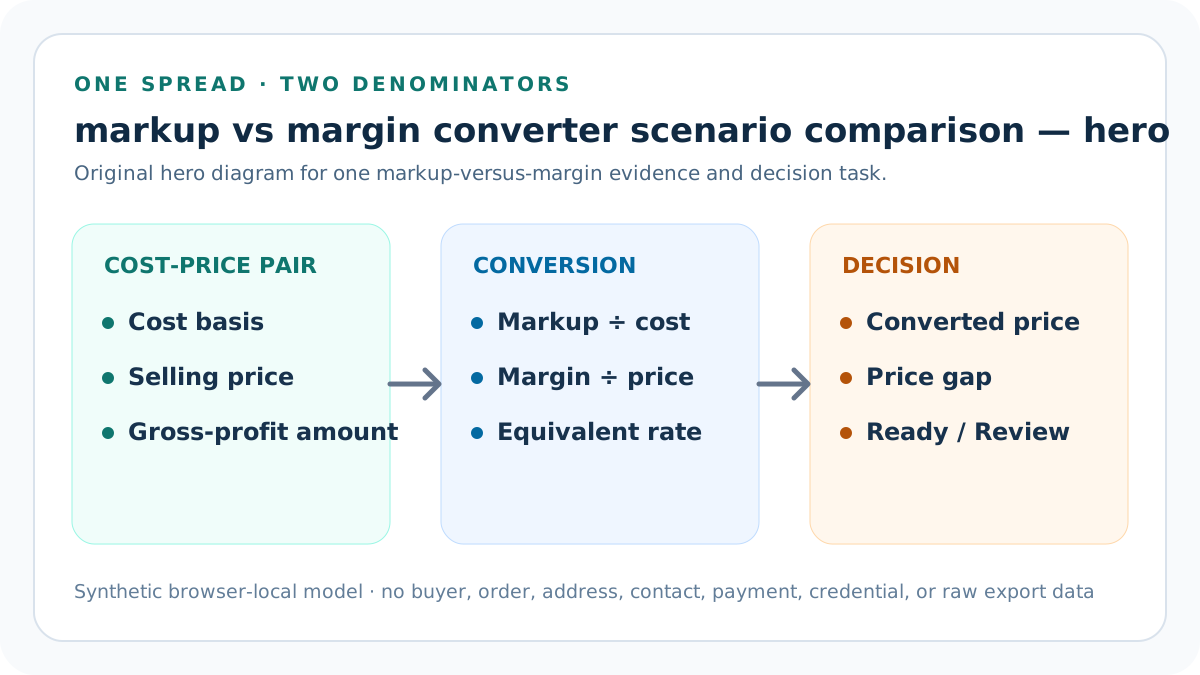
Freeze the cost basis
Use the identical USD 40 basis, unit scope, currency, and evidence month. This row belongs to the same-cost denominator comparison. Preserve the original value, unit, denominator label, calculation grain, currency, effective month, source class, owner, and confidence rather than keeping only a rounded percentage.
For controlled scenario attribution, checkpoint 1 must pass before it supports an explainable USD 6.67 price difference. Recalculate from the source pair, compare full-precision and displayed results, and correct the accountable field instead of offsetting it with an unrelated favorable assumption.
Freeze the current price
Keep USD 60 so the price-gap difference remains attributable. This row belongs to the same-cost denominator comparison. Preserve the original value, unit, denominator label, calculation grain, currency, effective month, source class, owner, and confidence rather than keeping only a rounded percentage.
For controlled scenario attribution, checkpoint 2 must pass before it supports an explainable USD 6.67 price difference. Recalculate from the source pair, compare full-precision and displayed results, and correct the accountable field instead of offsetting it with an unrelated favorable assumption.
Run 50% markup
Multiply USD 40 by 1.50 to obtain USD 60. This row belongs to the same-cost denominator comparison. Preserve the original value, unit, denominator label, calculation grain, currency, effective month, source class, owner, and confidence rather than keeping only a rounded percentage.
For controlled scenario attribution, checkpoint 3 must pass before it supports an explainable USD 6.67 price difference. Recalculate from the source pair, compare full-precision and displayed results, and correct the accountable field instead of offsetting it with an unrelated favorable assumption.
Read equivalent margin
Convert 0.50 over 1.50 to 33.33%. This row belongs to the same-cost denominator comparison. Preserve the original value, unit, denominator label, calculation grain, currency, effective month, source class, owner, and confidence rather than keeping only a rounded percentage.
For controlled scenario attribution, checkpoint 4 must pass before it supports an explainable USD 6.67 price difference. Recalculate from the source pair, compare full-precision and displayed results, and correct the accountable field instead of offsetting it with an unrelated favorable assumption.
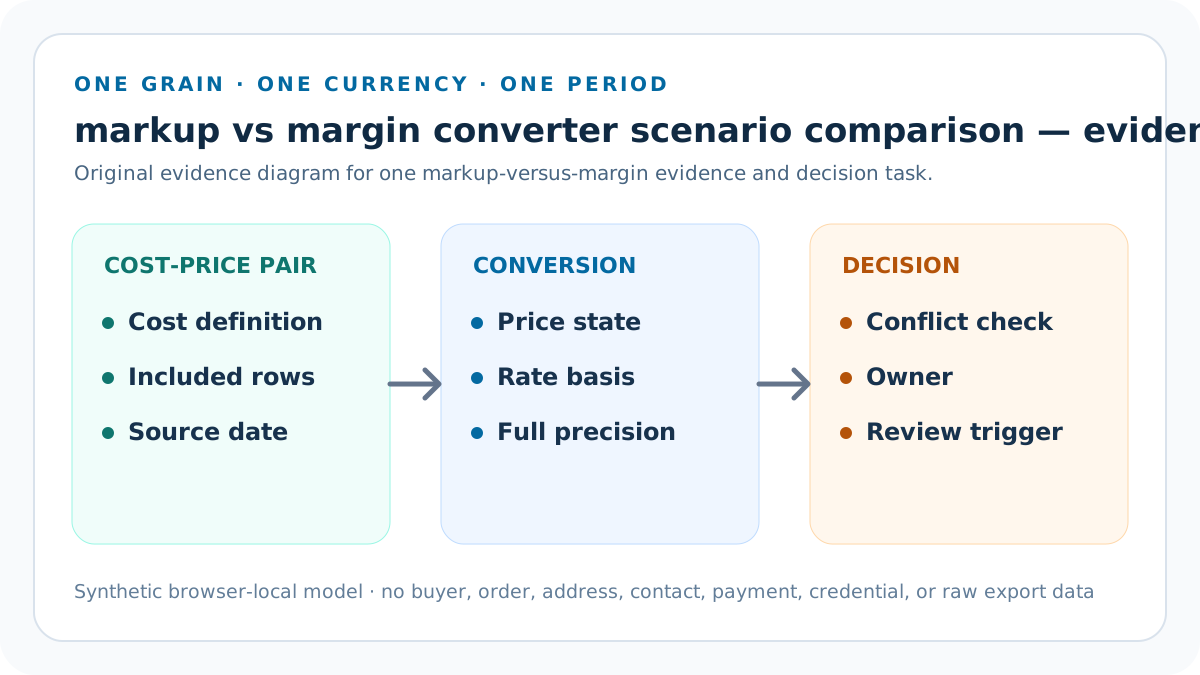
Run 40% margin
Divide USD 40 by 0.60 to obtain USD 66.67. This row belongs to the same-cost denominator comparison. Preserve the original value, unit, denominator label, calculation grain, currency, effective month, source class, owner, and confidence rather than keeping only a rounded percentage.
For controlled scenario attribution, checkpoint 5 must pass before it supports an explainable USD 6.67 price difference. Recalculate from the source pair, compare full-precision and displayed results, and correct the accountable field instead of offsetting it with an unrelated favorable assumption.
Read equivalent markup
Convert 0.40 over 0.60 to 66.67%. This row belongs to the same-cost denominator comparison. Preserve the original value, unit, denominator label, calculation grain, currency, effective month, source class, owner, and confidence rather than keeping only a rounded percentage.
For controlled scenario attribution, checkpoint 6 must pass before it supports an explainable USD 6.67 price difference. Recalculate from the source pair, compare full-precision and displayed results, and correct the accountable field instead of offsetting it with an unrelated favorable assumption.
Compare decisions
The first packet is Ready and the second is Review at the fixed current price. This row belongs to the same-cost denominator comparison. Preserve the original value, unit, denominator label, calculation grain, currency, effective month, source class, owner, and confidence rather than keeping only a rounded percentage.
For controlled scenario attribution, checkpoint 7 must pass before it supports an explainable USD 6.67 price difference. Recalculate from the source pair, compare full-precision and displayed results, and correct the accountable field instead of offsetting it with an unrelated favorable assumption.
Name the driver
The denominator and entered rate changed; cost, price, currency, period, and scope did not. This row belongs to the same-cost denominator comparison. Preserve the original value, unit, denominator label, calculation grain, currency, effective month, source class, owner, and confidence rather than keeping only a rounded percentage.
For controlled scenario attribution, checkpoint 8 must pass before it supports an explainable USD 6.67 price difference. Recalculate from the source pair, compare full-precision and displayed results, and correct the accountable field instead of offsetting it with an unrelated favorable assumption.
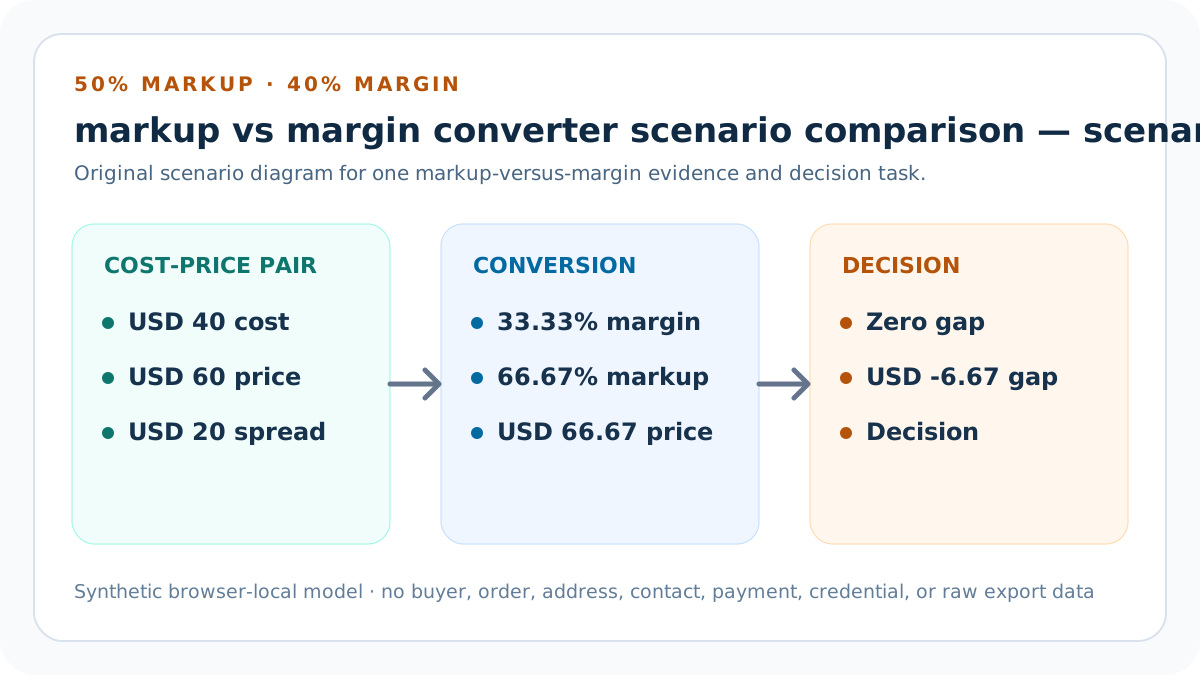
Worked control for controlled scenario attribution
Run markup, margin, current-price-clear, invalid-margin, invalid-basis, and declared-conflict fixtures while changing only the field discussed in this guide.
The control verifies controlled scenario attribution. It does not classify costs automatically, reproduce a private order, recommend a market price, or promise an explainable USD 6.67 price difference.
Reconciliation and sensitivity
Recalculate observed markup and margin directly from the same cost-price pair, then reconstruct price from the entered branch. The equivalent rate and reconstructed price must agree within full-precision tolerance before display rounding.
Vary one cost-basis row, price state, entered rate, or basis at a time. If a plausible alternative changes Review to Ready, resolve the disputed source or preserve separately named scenarios rather than averaging incompatible evidence.
Block conditions and safe correction
Block nonpositive cost, nonpositive price, unsupported basis, negative target rate, margin at or above 100%, invalid currency, invalid month, missing scope, or any declared conflict. Structural errors cannot be compensated by a high price.
Correct one named field, preserve the rejected value and reason, rerun supported and broken fixtures, and compare exact before and after outputs. A repair that requires hidden offsets elsewhere is not isolated enough to approve.
Bounded decision and action
Use Block before Review before Ready. Review means valid arithmetic but a current price below the entered rate's converted price. Ready means only that the current price clears this declared cost and denominator contract.
Choose one source correction, basis clarification, price experiment, cost action, or explicit no-action conclusion. Define owner, observation window, feedback measure, stop condition, and restoration trigger before changing a public price.
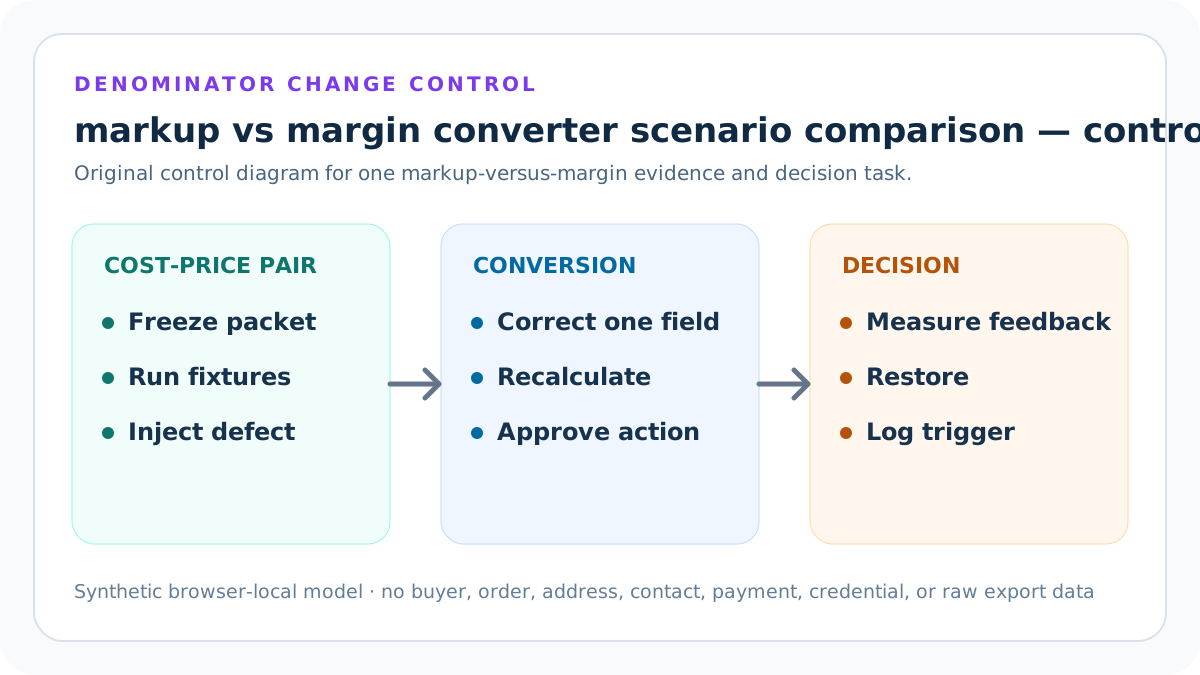
Verification and release controls
Preserve the same-cost denominator comparison, source pointers, deterministic fixtures, tests, build, SEO and content audits, similarity evidence, screenshots, release manifest, backup, and rollback identifier.
Verify canonical, Article and Breadcrumb schema, sources, four explanatory visuals, internal links, privacy, indexability, mobile layout, public response, and live calculation behavior. A green build cannot validate unsupported source evidence.
Limits and privacy boundary
This arithmetic model does not determine accounting profit, taxable income, cash flow, fixed-overhead recovery, customer value, competitor response, demand, conversion, ranking, traffic, advertising approval, revenue, or income.
Keep buyer names, emails, addresses, order IDs, payment rows, bank details, tax identifiers, contacts, tokens, OAuth material, credentials, and raw exports outside the same-cost denominator comparison. Public examples remain synthetic.
Evidence log and review trigger
Store packet ID, nonprivate product alias, cost-basis definition, included and excluded rows, cost, price state, entered rate, basis, currency, period, scope, source dates, outputs, decision, conflicts, reviewer, and rollback reference.
Recalculate when supplier cost, freight, duty, packaging, labor, discount state, refund state, bundle quantity, currency conversion, or rate policy changes. Do not rewrite history; create a dated successor row.
Next related calculation
Use the contribution margin calculator when multiple order-variable costs must be subtracted from net revenue. Use the product price floor calculator when fees, discounts, buyer shipping, return loss, and a contribution target must be solved inversely.
Use the listing cost library to version SKU costs before comparing products. A denominator conversion is only as comparable as the cost definition and price state supplied to it.
Controlled scenario identity
Give both rows the same packet root and freeze USD 40 cost, USD 60 current price, currency, period, scope, and sources. Record only basis and entered rate as intentional differences. This makes the USD 6.67 converted-price movement attributable.
Add a difference table for gross-profit amount, observed rates, equivalent rate, converted price, price gap, and decision. Unchanged observed values confirm that the comparison did not silently alter the underlying cost-price pair.
same-cost denominator comparison completion test
A complete packet lets an independent reviewer reproduce an explainable USD 6.67 price difference from the declared cost, price, entered rate, and explicit basis without private data or hidden spreadsheet state.
Closure requires exact arithmetic, source alignment, privacy-safe examples, a non-compensating decision, bounded language, one approved next step or no-action conclusion, feedback ownership, and a recoverable prior state.
Scenario column contract
Create columns for scenario ID, cost basis, current price, entered rate, entered basis, equivalent rate, converted price, current-price gap, observed markup, observed margin, and decision. Freeze source hashes and units beside both scenario IDs.
The comparison fails when a column changes without being declared an intentional variable. A hidden cost update, currency conversion, price state, bundle quantity, or evidence month makes the apparent denominator effect uninterpretable.
Price reconstruction paths
For the markup row, reconstruct USD 60 by multiplying USD 40 by 1.50. For the margin row, reconstruct USD 66.666667 by dividing USD 40 by 0.60. Keep these inverse paths side by side rather than translating both into one shortcut.
Substitute each reconstructed price into observed markup and margin equations. The first must reproduce 50% markup and 33.33% margin; the second must reproduce 66.67% markup and 40% margin.
Current-price holdout
Keep the observed USD 60 current price outside the conversion equations until both target prices are solved. Then compare it independently with each result. This prevents the observed price from leaking into the target branch.
The zero gap in the markup row and negative USD 6.67 gap in the margin row explain the different decisions. The cost-price observation itself remains identical.
Denominator-only attribution
The scenarios intentionally use different entered percentages because they represent two seller policies, not two mathematical restatements of one policy. Name that distinction before interpreting the USD 6.67 movement.
For a pure restatement test, compare 50% markup with 33.333333% margin. Both must reconstruct USD 60. That separate identity test proves the converter before the policy comparison is used.
Comparison decision memo
Write a one-paragraph memo stating which fields were frozen, which fields changed, the exact converted-price difference, the two price gaps, and why the decisions differ. Avoid saying one rate is universally better.
Assign a next step only if the seller has evidence for the intended policy basis. If the target label is ambiguous, the correct outcome is source clarification rather than choosing the lower converted price.
Scenario restoration check
Restore the original USD 40 cost, USD 60 price, 50% markup packet after testing the alternative. Confirm equivalent margin, converted price, gap, and Ready decision return exactly.
A restoration mismatch indicates state leakage, rounding reuse, or an unrecorded field change. Keep the comparison open until the baseline fixture is reproducible.
Sources and further reading
- Seller Profit Guard methodology: Calculation contracts, evidence precedence, deterministic fixtures, validation, correction, release, and rollback.
- Seller Profit Guard data privacy: Local-first boundaries for seller, buyer, order, payment, contact, credential, and raw export data.
- IRS Publication 334 (2025): Primary U.S. context for net receipts, cost of goods sold, gross profit, and the selling-price denominator; this converter does not make a tax determination.
- OpenStax markup guidance: Primary educational source for markup on cost and retail price equal to cost times one plus markup.
- SBA break-even point guidance: Primary U.S. small-business source for the contribution-margin denominator and separation of fixed and variable costs.
Related Seller Profit Guard tools
- Open the Markup vs Margin Converter: Convert one rate with an explicit cost or selling-price denominator.
- Solve a product price floor: Include discount, buyer shipping, fees, order-variable costs, expected loss, and a contribution target.
- Calculate contribution margin: Run a forward order-level contribution equation from observed revenue and variable costs.
- Version SKU costs: Maintain dated product, packaging, labor, fulfillment, and expected-loss evidence.
- Check bundle margin: Compare a bundle selling price with combined item and order costs.
- Read the methodology: Review evidence, calculation, privacy, testing, release, correction, and rollback.
- Review data privacy: Keep private seller and buyer data outside public content.
- Markup vs Margin Formulas and Inputs: Continue with a distinct formula, example, source, threshold, comparison, operating, interpretation, or audit task.
- Markup vs Margin Worked Example: Continue with a distinct formula, example, source, threshold, comparison, operating, interpretation, or audit task.
- Price-Based Margin Conversion Example: Continue with a distinct formula, example, source, threshold, comparison, operating, interpretation, or audit task.
- Markup vs Margin Conversion Mistakes: Continue with a distinct formula, example, source, threshold, comparison, operating, interpretation, or audit task.
- Reliable Markup and Margin Data Sources: Continue with a distinct formula, example, source, threshold, comparison, operating, interpretation, or audit task.
Next step: Open the Markup vs Margin Converter.
This is operational planning help, not tax, accounting, legal, financial, or platform-policy advice. Review the Terms and disclaimer, and verify current platform rules and fee assumptions before changing prices.