Etsy payment reconciliation mistakes that hide unresolved money
Last updated: 2026-07-28
Written and reviewed by Seller Profit Guard Editorial Team.
The most damaging reconciliation mistakes are amount-only matching, repeated order totals, reversed signs, mixed currencies, widened date windows, refunds that erase sales, and deposits counted as revenue. Correct the source map first, preserve every movement, and keep ambiguous rows unresolved until a stable reference or documented grouped match explains them.

Why does amount-only matching create false confidence?
Equal amounts are common. Two orders, a refund, a fee credit, and a deposit can share the same value without representing the same event. An amount-only rule can consume the wrong row and make the remaining exception appear somewhere else. Require compatible category and currency, use a narrow date condition, and prefer a stable transaction or order reference.
Measure ambiguity before accepting a fallback. If more than one candidate satisfies the rule, keep all candidates unresolved and show the collision. Do not choose the nearest date automatically unless the rule is documented, tested against counterexamples, and appropriate to the source.
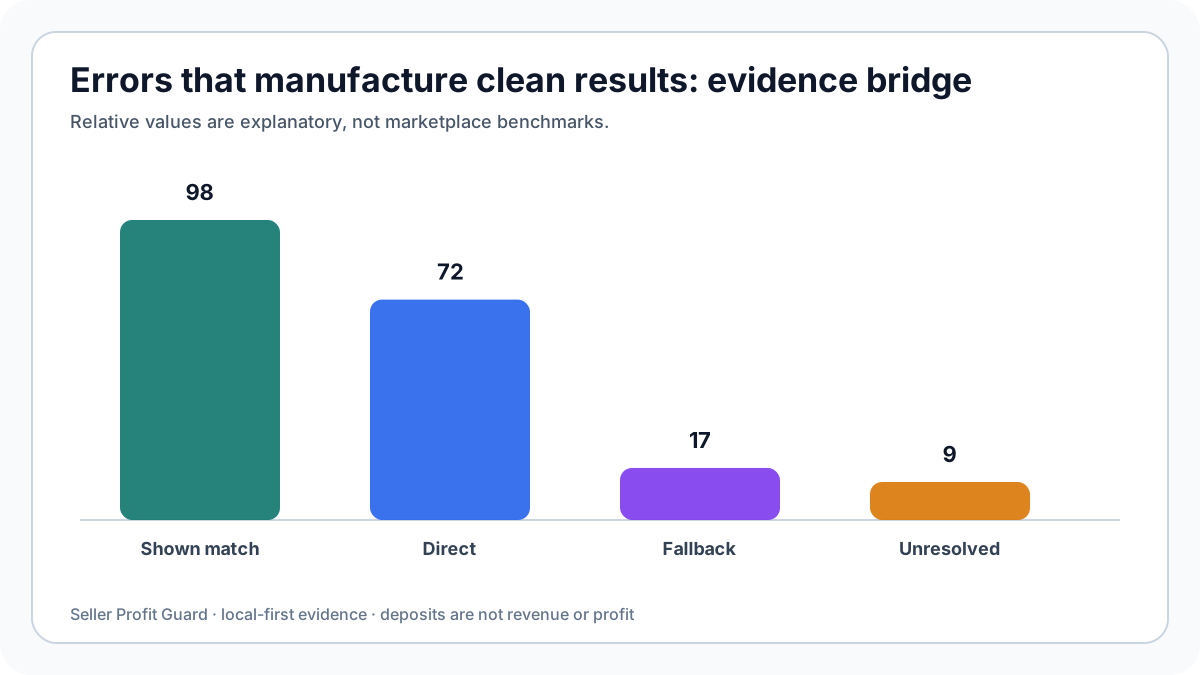
| Mistake | Symptom | Correction |
|---|---|---|
| Amount only | Duplicate candidates | Require reference, type, currency, bounded date |
| Repeated order total | Revenue doubled across items | Group once at order grain |
| Sign reversal | Fees increase balance | Preserve source direction |
| Mixed currency | Equal numbers falsely match | Partition by currency |
| Deposit as sale | Revenue counted twice | Separate cash bridge |
| Refund deletes sale | History disappears | Retain both movements |
How do source-grain mistakes distort totals?
An order-items export can repeat order-level shipping, discount, tax, or total fields on every line. Summing those columns without grouping can multiply activity. Conversely, collapsing all lines too early can hide partial refunds, variation identifiers, or item-specific amounts. Document whether each field is item, order, transaction, statement-row, or deposit grain.
Test normalization with an order containing multiple items, quantity greater than one, partial refund, and shared shipping. The normalized rows must sum back to the trusted order total exactly once. If they do not, stop before matching.

Which process mistakes keep exceptions invisible?
Filtering exports before preserving them, hiding zero-net rows, netting credits into charges, expanding tolerances to reach a target match rate, and deleting manually resolved rows all weaken the evidence trail. Preserve the source, generate a normalized working copy, and record every override.
A clean dashboard can still be wrong if unresolved rows are excluded from the denominator. Report direct, grouped, fallback, ambiguous, timing, and unresolved counts and amounts separately. The seller should be able to reproduce the headline from the row-level classifications.
- Never optimize for match rate alone.
- Never overwrite raw signs or descriptions.
- Never delete exceptions after manual review.
- Never use a deposit to plug an unexplained balance.
- Never claim profit from a statement match.
Reconciliation mistake questions
Is rounding tolerance acceptable? Only when currency precision and source behavior justify it; document and test the boundary.
Can I ignore zero-net rows? No. They can contain offsetting movements that explain the account.
Should small differences be dropped? Retain them mathematically; materiality can determine review priority, not existence.
Can a high match rate prove correctness? No. Inspect rule quality, ambiguity, source coverage, and unresolved amount.
What should be fixed first? Source grain, currency, sign, date, category, and reference mapping before any business interpretation.
How can a seller detect a cascade of false matches?
Sort accepted fallback matches by rule, candidate count, amount frequency, and time distance. A cascade often appears when one popular amount repeatedly matches the nearest row, leaving a chain of displaced references. Re-run the set with direct matches locked, then remove the weak rule. The newly unresolved rows reveal whether the prior success rate depended on order rather than identity.
Create adversarial fixtures: two equal sales on the same day, a sale and refund with equal absolute values, repeated fixed fees, split deposits, a partial refund, and two currencies using the same numeric amount. A safe matcher rejects or groups these according to explicit evidence. A matcher that always returns one answer is not robust.
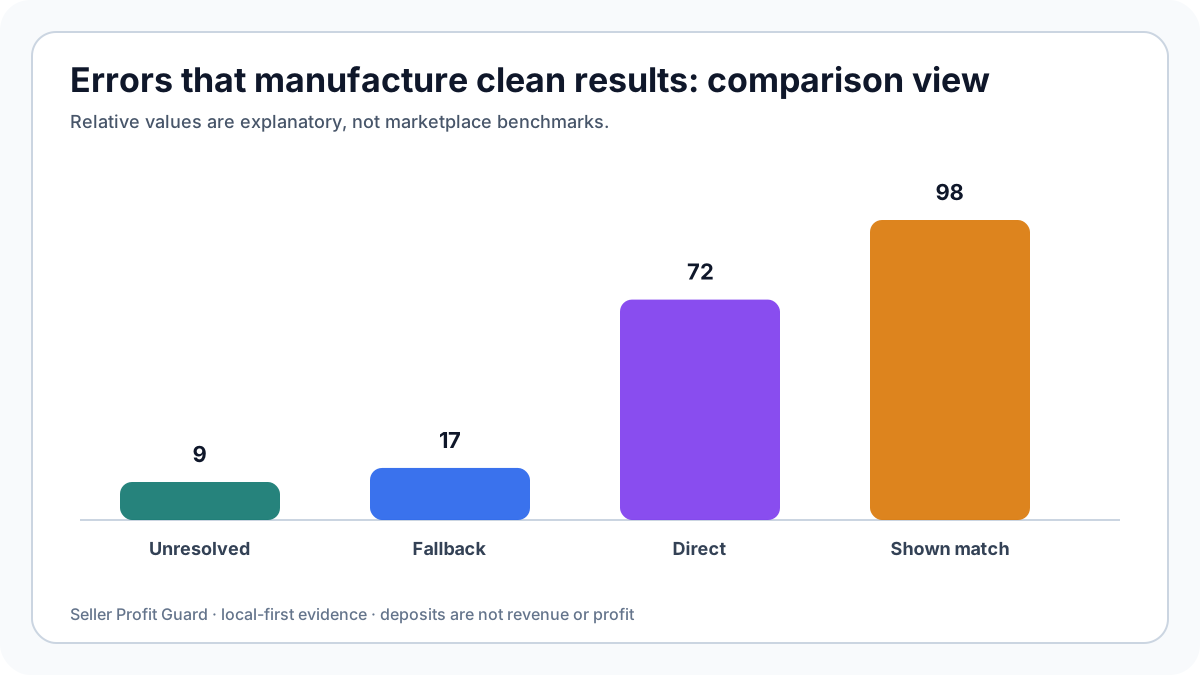
Track changes in direct, grouped, fallback, ambiguous, and unresolved amounts after every rule update. A lower headline match rate can be an improvement when false fallback matches become visible. The release decision should favor reproducibility and explainability over cosmetic completeness.
Which records make this reconciliation error review defensible?
Use three evidence layers without merging their jobs. Order exports explain what sold and at what line-item grain. Payment Account or monthly-statement activity explains sales, fees, refunds, shipping labels, advertising, reserves, adjustments, and deposit movements. The bank confirms cash received. Private SKU, labor, packaging, fulfillment, and replacement costs belong in a separate contribution review; they do not repair a statement mismatch.
Record shop, currency, export type, requested period, actual earliest and latest row dates, download time, column map, and any filter applied before matching. Preserve signs and row categories. A net amount can help verify arithmetic, but it should not erase the components that explain the balance. If Etsy changes an export or account label, retain the raw heading and document the normalized category beside it.
A row is evidence only within its scope. An order ID can support a direct match, but a deposit is normally a transfer of available balance rather than an order-level sale. A refund can occur outside the original sale period. A shipping-label adjustment can arrive later. Keep these timing differences visible instead of forcing every row into the same day or payout.
- Preserve source files and work from a local copy.
- Normalize currency, signs, dates, and row types before matching.
- Prefer stable transaction or order references over amount-only matches.
- Retain unmatched and timing-difference rows with an owner and next review date.
- Keep profit, tax, accounting, and policy conclusions outside the tool's operating scope.
Privacy boundary for reconciliation error review
Payment reconciliation does not require publishing buyer names, delivery addresses, private messages, payment credentials, marketplace passwords, bank account numbers, or raw order histories. Use a redacted transaction key, date, category, currency, gross amount, fee, net amount, deposit reference, and match status. Keep the untouched export and bank evidence in controlled seller storage.
Seller Profit Guard is designed to process supported files locally in the browser. A reconciliation export can still reveal shop volume, fee exposure, refund patterns, reserves, and cash timing, so treat it as a confidential business record. For support, share column names and a made-up example that reproduces the mapping issue. Never paste real buyer or order rows into a public community, email draft, or AI prompt.
- Use public dummy data for demonstrations and tests.
- Remove buyer, address, message, credential, and bank-identifier fields.
- Do not copy private CSV files into the active public-content directory.
- Store source fingerprints and aggregate counts instead of raw rows in operator reports.
- Escalate tax, legal, accounting, reserve, suspension, or account-policy questions to the appropriate official or professional source.
How to apply this reconciliation error review in the reconciliation tool
Open Payment Reconciliation and load a supported order export plus the relevant Payment Account or monthly-statement export. Confirm the date, amount, currency, category, order reference, fee, refund, and deposit mappings before reading the summary. Start with source-quality warnings. A high match rate built on the wrong amount column or duplicated order-level totals is not a reliable result.
Review direct matches, unresolved sales, unresolved statement rows, refunds, deposits, fee categories, and formula checks separately. Export the private exception list and record the source period, matching rule, unresolved amount, owner, evidence requested, decision, and next review date. Re-run after late rows arrive or an adjustment is explained. The useful output is a controlled exception queue, not a promise that the account is profitable or the bank balance is correct.
- Preserve and fingerprint the source exports.
- Confirm date, currency, sign, category, and reference mappings.
- Run direct-reference matching before bounded fallback rules.
- Separate timing differences from unexplained exceptions.
- Bridge statement activity to deposits without treating deposits as sales.
- Assign every material unresolved row and retain the closing evidence.
Related resources
- Open Etsy Payment Reconciliation: Compare order exports with Payment Account or monthly-statement activity in the browser.
- Read the Etsy Payment Account reconciliation guide: Review the source hierarchy, balance bridge, row categories, and investigation sequence.
- Estimate SKU-level Etsy contribution: Keep product economics separate from the cash-movement reconciliation.
- Review local-first CSV privacy: Understand which fields are needed and which buyer or address fields should remain private.
- Read the editorial policy: See how sources, corrections, review dates, and AI assistance are handled.
Sources and further reading
- Etsy Help: Download Sold Transaction Spreadsheets: Official export workflow for order items, orders, Etsy Payments sales, and Etsy Payments deposits.
- Etsy Help: Manage Your Payment Account: Official reference for sales, fees, refunds, shipping, seller services, monthly statements, balances, and deposits.
- Etsy Help: Fees and Taxes for Selling: Official overview of fee categories and account treatment; exact charges vary by country, currency, service, and shop activity.
- Etsy Help: Issue a Full or Partial Refund: Official refund workflow and Payment Account impact reference.
- Seller Profit Guard reconciliation methodology: Evidence hierarchy, local-first data handling, contribution scope, editable assumptions, and result limitations.
Related Seller Profit Guard tools
- Open Etsy Payment Reconciliation: Compare order exports with Payment Account or monthly-statement activity in the browser.
- Read the Etsy Payment Account reconciliation guide: Review the source hierarchy, balance bridge, row categories, and investigation sequence.
- Estimate SKU-level Etsy contribution: Keep product economics separate from the cash-movement reconciliation.
- Review local-first CSV privacy: Understand which fields are needed and which buyer or address fields should remain private.
- Read the editorial policy: See how sources, corrections, review dates, and AI assistance are handled.
- Etsy Payment Reconciliation: Inputs and Match Rules: Continue the Etsy payment evidence, exception, and control workflow.
- Etsy Deposit Reconciliation: A Weekly Worked Example: Continue the Etsy payment evidence, exception, and control workflow.
- Etsy Month-End Reconciliation: Close Without Guessing: Continue the Etsy payment evidence, exception, and control workflow.
- Etsy Reconciliation Data: Which Export Proves What?: Continue the Etsy payment evidence, exception, and control workflow.
- Etsy Reconciliation Thresholds: When to Investigate: Continue the Etsy payment evidence, exception, and control workflow.
Next step: Open Etsy Payment Reconciliation.
This is operational planning help, not tax, accounting, legal, financial, or platform-policy advice. Review the Terms and disclaimer, and verify current platform rules and fee assumptions before changing prices.