Where to get reliable data for Seller Profit Guard
Last updated: 2026-07-27
Written and reviewed by Seller Profit Guard Editorial Team.
Reliable Etsy profit data comes from four layers: order exports for what sold, Payment Account or statement evidence for platform activity, private seller records for SKU and fulfillment costs, and dated assumptions for future risk. Record each source, grain, currency, owner, and review date instead of blending evidence with guesses.

Which source answers each Etsy profit question?
No single Etsy screen or CSV contains complete product economics. The order export explains item, price, quantity, SKU, payment method, and transaction structure. Payment Account and monthly statement evidence explain sales, fees, refunds, shipping labels, seller services, credits, deposits, and balance movement. Seller invoices and operating records explain material, provider, labor, packaging, and other private costs.
A decision-ready model connects those layers without pretending they are interchangeable. The bank statement confirms cash arrival but does not replace the order. The order export does not prove every charge. The Payment Account does not know private labor or material cost. A planning assumption can cover future uncertainty, but it must be named and dated so it cannot be confused with measured evidence.

| Question | Preferred source | Secondary check |
|---|---|---|
| What sold and for how much? | Order items or orders CSV | Order receipt and Payment Account sale |
| Which platform charges occurred? | Payment Account or monthly statement | Official Etsy fee definitions |
| What did the SKU consume? | Invoice, bill of materials or provider record | Inventory and production record |
| How much labor did the order need? | Timed workflow and loaded rate | Production or fulfillment log |
| What did shipping cost? | Final label, insurance and carrier adjustment | Packaging and handling record |
| What future loss should be reserved? | Observed SKU/category outcomes | Dated conservative scenario |
How should order CSV fields be documented?
Etsy's official download guidance currently identifies order items, orders, Etsy Payments sales, and Etsy Payments deposits as available CSV types. The order-item file can include payment method, item price, title, and seller-assigned SKU. Export headers and layouts can change, so inspect the actual file and preserve its original column names before mapping.
Create a data dictionary for the fields used by the profit model. For every column, record whether it is line-item or order-level, gross or net, seller-attributable or marketplace-remitted, source or allocated, and which currency and sign it uses. If order-level shipping or discounts repeat on each item row, choose an allocation rule and prove the allocated rows sum to the order.

| Field property | Example value | Why record it |
|---|---|---|
| Grain | Order item | Prevents order shipping from repeating on each line |
| Currency | USD | Prevents direct addition of converted and source-currency values |
| Sign | Refund stored as negative | Prevents reversing a cost twice |
| Tax scope | Marketplace-remitted | Prevents tax from becoming seller revenue |
| Allocation | Revenue share | Explains how a shared order amount reaches a SKU |
| Mapping version | 2026-07 Etsy order items | Makes export-format changes detectable |
What does the Payment Account contribute?
Etsy's current Payment Account guidance separates sales, refunds, fees, seller services, shipping, credits, deposits, balances, and monthly statements. Use it to replace broad fee assumptions with matched retrospective evidence and to explain why a deposit differs from order sales. Preserve charge and credit rows separately so the result can be reconciled.
Do not force every statement row onto an order. Listing renewals, subscriptions, advertising, reserves, adjustments, and deposit activity can have different grains or periods. Classify the row, identify whether allocation is useful for the decision, and retain an exception category. When planning future prices, use current official definitions and country-scoped assumptions, then reconcile the forecast with actual rows later.
- Match sale rows to orders when a reliable reference and grain exist.
- Keep fee type, amount, Fees & Taxes, Net, balance, and date meanings explicit.
- Treat deposits as transfers and match them to bank receipts separately.
- Preserve unknown or unmatched activity in an exception queue.
- Do not use Etsy's platform-facing net label as complete accounting profit.
Where should private SKU and labor data come from?
Build SKU cost from evidence the marketplace cannot see: supplier invoice, provider price, bill of materials, component quantity, waste or defect allowance, production batch, and effective date. Use a separate record for every variation whose material, size, finish, personalization, weight, bundle, provider, or fulfillment changes economics.
Measure labor by timing the defined task under representative conditions. Record preparation, production, personalization, quality check, packing, and support separately when they change for different products. Multiply minutes by a stated loaded hourly rate. Do not invent first-hand precision: if the workflow has not been timed, use a conservative range and assign an owner to measure it.
| Seller record | Minimum fields | Freshness trigger |
|---|---|---|
| Supplier invoice | Item, unit, quantity, currency, date | Supplier or quantity change |
| Bill of materials | SKU, component, quantity, waste | Design or material change |
| Time study | Task, sample, minutes, rate, date | Workflow or rate change |
| Packaging record | Components, unit cost, order type | Package or protection change |
| Provider quote | SKU/variant, production, shipping, tax | Provider or destination change |
How should shipping, advertising, and refunds be evidenced?
Shipping evidence begins with the final label charge, then adds packaging, handling, insurance, pickup, and carrier adjustments relevant to the order. Buyer-paid shipping is a revenue field; it does not prove the seller's shipping cost. If a future threshold uses an average, segment by weight, zone, carrier, package type, and variation before treating the average as representative.
Advertising evidence should state the program, attribution source, order or SKU, window, currency, and whether the amount is actual or scenario. Refund evidence should connect the original order, customer-facing refund, platform fee or credit evidence, outbound and reverse shipping, inventory recovery, replacement production, and support work. Expected loss then uses observed unrecovered components rather than gross refund value.
How do you score data quality before using the result?
Score coverage by economic weight, not only row count. Ten missing low-value rows can matter less than one bestseller representing half of reviewed revenue. Track the percentage of revenue and units with mapped revenue, matched fees, current SKU cost, labor, fulfillment, advertising status, and return evidence. Flag any layer whose absence can reverse the target decision.
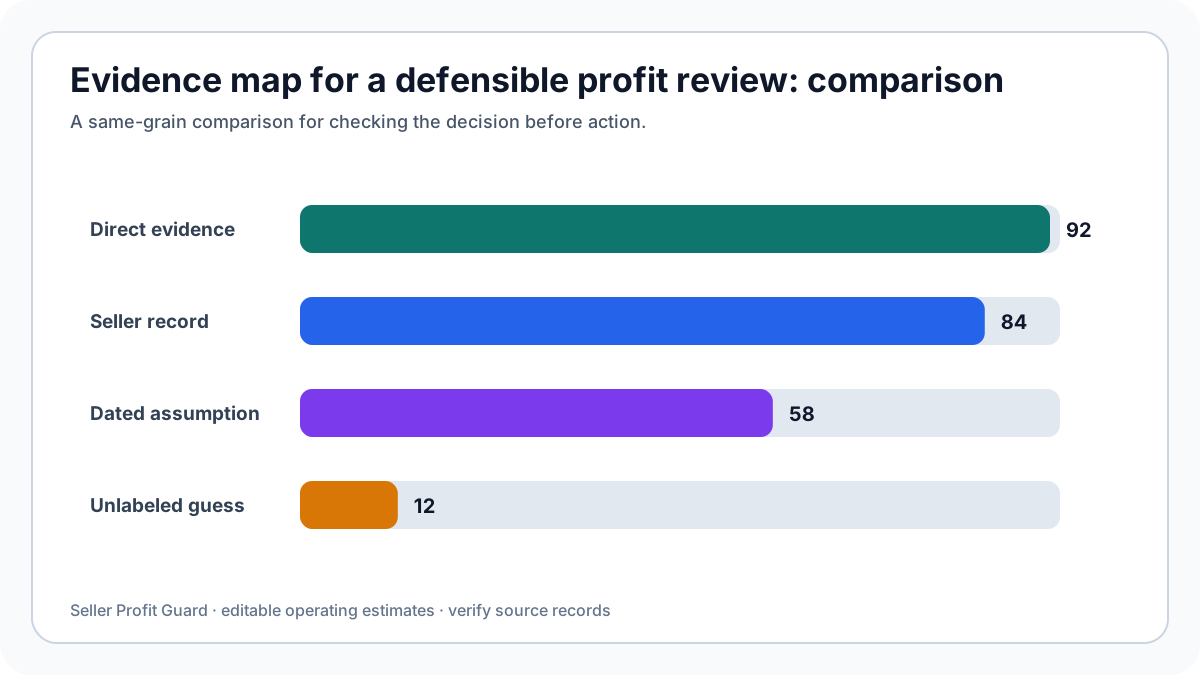
Use a simple evidence grade. Direct matched evidence is strongest for the reviewed period. Current private seller records support SKU and workflow costs. Dated measured averages support planning when the segment matches. Conservative scenarios support uncertainty decisions. Unlabeled guesses and stale values do not support approval. Show the grade beside the result so a high contribution with weak evidence does not outrank a smaller but defensible result.
| Grade | Evidence quality | Allowed use |
|---|---|---|
| A | Matched current source plus traceable private cost | Retrospective review and bounded decision |
| B | Current measured segment average with documented allocation | Planning and monitored test |
| C | Dated conservative scenario with important gaps | Provisional hold or research action |
| D | Stale, wrong-grain or weakly matched value | Do not approve price or scale |
| Unknown | Missing or unlabeled input | Assign owner and block decision |
How should source changes be logged?
Store the source name, location, shop or account scope, export type, period, currency, retrieved date, effective date, reviewer, and mapping version. For private cost records, store supplier or method and an owner-visible note without exposing the data publicly. For official platform rules, store the exact URL and review date; do not copy a short-lived rate into evergreen text without its scope.
When a source changes, preserve the previous mapping or assumption. Record old value, new value, reason, effective date, affected tools and pages, test evidence, and rollback criteria. Recalculate a small representative fixture before bulk processing. If the export schema changes, update the mapping audit and public dummy fixture rather than adapting from private seller rows.
- Inventory every source used by the formula.
- Record grain, currency, date, owner, and system of record.
- Measure coverage across revenue and units.
- Replace unlabeled guesses with evidence, ranges, or explicit unknowns.
- Recalculate a public fixture after a source or mapping change.
- Archive the prior version and its affected decisions.
Etsy profit data-source questions
Can I use only the order CSV? No. It can explain products and revenue structure, but complete contribution also needs platform-charge evidence or assumptions plus private product, labor, packaging, fulfillment, advertising, and loss inputs.
Can the Payment Account replace bookkeeping? No. It explains Etsy account activity and deposits, not every private cost, accounting classification, tax treatment, or other channel.
What if the export has no SKU? Create a controlled mapping from listing and variation evidence, then add a stable SKU. Do not assign an average cost silently.
Are screenshots acceptable evidence? A screenshot can help review, but a structured export or statement is easier to reconcile and audit. Redact private information before sharing.
How often should official links be checked? Check before a material release and on a recurring source-freshness schedule, especially after a fee, country, currency, program, export, or Payment Account change.
Privacy and evidence limits for profit evidence and data-source map
A contribution review does not need buyer names, delivery addresses, private messages, payment credentials, marketplace passwords, or a public copy of the seller's order history. It normally needs a redacted transaction key, date, SKU, quantity, seller-attributable revenue, relevant fee evidence, and private cost assumptions. Keep the untouched export in controlled storage and work from a local copy.
Seller Profit Guard is designed to read supported CSV files in the browser. A report can still contain commercially sensitive prices, SKU economics, labor rates, and supplier costs, so treat exports as private operating records. For support, share column names and a made-up example row. If an account-specific reserve, fee, refund, or suspension determines the answer, use the authenticated Etsy record rather than a generic assumption.
- Do not upload buyer identity or address fields for a margin calculation.
- Do not paste raw order rows into public communities, support email, or AI prompts.
- Use public dummy data to reproduce mapping and formula issues.
- Store cost libraries, reports, and change logs as confidential business records.
- Escalate tax, accounting, legal, and account-policy questions to the appropriate official or professional source.
How to apply this profit evidence and data-source map in Seller Profit Guard
Open the Etsy CSV profit calculator with a recent, representative order-item export or the public dummy sample. Confirm the revenue, quantity, SKU, shipping, discount, fee, and transaction mappings before importing private cost assumptions. Review missing-cost and mapping warnings first; a precise result built on an empty or misidentified field is not decision-ready.
Run the relevant base and stress scenarios, export the private review list, and record the source period, assumptions, result, decision, owner, and next review date. The useful output is not a perfect score. It is a short, evidence-backed queue of listings or SKUs that need a price, cost, shipping, promotion, or data-quality action.
- Preserve the source export and record its shop, currency, period, and file type.
- Confirm every mapped field and keep missing values unknown rather than zero.
- Attach the correct SKU-level material, labor, packaging, fulfillment, and target assumptions.
- Run a base case plus the page-specific stress or comparison case.
- Inspect the rows that fail the target or evidence-quality gate.
- Record one reversible action and a dated follow-up instead of changing the whole shop.
Related resources
- Open the Etsy CSV profit calculator: Run a browser-local order and SKU contribution review with editable assumptions.
- Build an Etsy SKU cost library: Store material, labor, packaging, shipping, and target assumptions for repeat reviews.
- Reconcile Etsy Payment Account activity: Match order and statement evidence before interpreting cash movement as product economics.
- Review CSV data privacy: Keep raw buyer and order data out of public support and community posts.
- Read the editorial policy: See how sources, corrections, AI assistance, and update dates are handled.
Sources and further reading
- Seller Profit Guard calculation methodology: Calculation scope, editable assumptions, contribution terminology, privacy boundaries, and result limits.
- Etsy Help: Fees and Taxes for Selling: Official fee categories, fee bases, country-dependent processing charges, advertising fees, and Payment Account treatment.
- Etsy Help: Download Sold Transaction Spreadsheets: Official order items, orders, Etsy Payments sales, and Etsy Payments deposits CSV workflow.
- Etsy Help: Manage Your Payment Account: Official sales, fees, refunds, seller services, shipping, monthly statements, balance, and deposit context.
- Etsy Help: How Offsite Ads Work: Official attribution, participation, fee-rate, and order-cap context; verify current shop-specific status.
- Etsy Help: Issue a Full or Partial Refund: Official refund workflow and Payment Account impact reference.
Related Seller Profit Guard tools
- Open the Etsy CSV profit calculator: Run a browser-local order and SKU contribution review with editable assumptions.
- Build an Etsy SKU cost library: Store material, labor, packaging, shipping, and target assumptions for repeat reviews.
- Reconcile Etsy Payment Account activity: Match order and statement evidence before interpreting cash movement as product economics.
- Review CSV data privacy: Keep raw buyer and order data out of public support and community posts.
- Read the editorial policy: See how sources, corrections, AI assistance, and update dates are handled.
- Etsy Profit Formula: Inputs Small Sellers Must Track: Continue the Seller Profit Guard evidence and decision workflow.
- Etsy Profit Example: Trace a $74 Order Step by Step: Continue the Seller Profit Guard evidence and decision workflow.
- Etsy Discount Profit: Test Coupons and Free Shipping: Continue the Seller Profit Guard evidence and decision workflow.
- Etsy Profit Calculator Mistakes: 12 Cost Traps: Continue the Seller Profit Guard evidence and decision workflow.
- Etsy Profit Thresholds: Break-Even Is Not Enough: Continue the Seller Profit Guard evidence and decision workflow.
Next step: Open the Etsy CSV profit calculator.
This is operational planning help, not tax, accounting, legal, financial, or platform-policy advice. Review the Terms and disclaimer, and verify current platform rules and fee assumptions before changing prices.