Where to get reliable free-shipping threshold data
Last updated: 2026-07-29
Written and reviewed by Seller Profit Guard Editorial Team.
Build the threshold from seven evidence groups: SKU or bundle cost records, actual labels and carrier adjustments, packaging bills of materials, current Etsy fee policies and Payment Account charges, a documented target margin, recent qualifying-cart mix, and the exact shipping profile or guarantee. Keep buyer data out of the worksheet.

Which source should populate each calculator input?
Product cost should come from a versioned SKU or bundle cost record with material, purchased component, production, and fulfillment boundaries stated. Shipping subsidy should come from actual labels, carrier invoices, and adjustments for the chosen destination and package cohort, reduced only by buyer-paid shipping or documented platform coverage that the seller actually receives.
Packaging belongs in a package bill of materials: box or mailer, padding, tape, label stock, insert, seal, and other consumed supplies. The fixed fee and combined percentage assumption should be reconciled to current official fee rules and actual Payment Account lines. The target margin is an internal operating policy with owner, purpose, included costs, and review date.
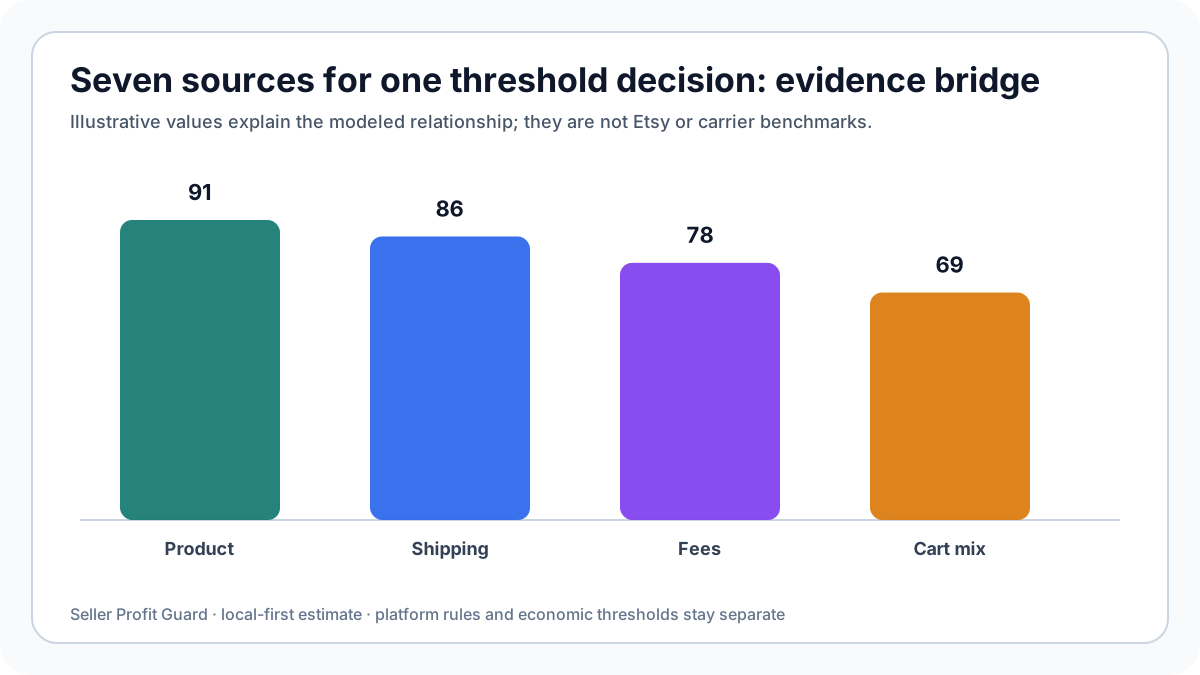
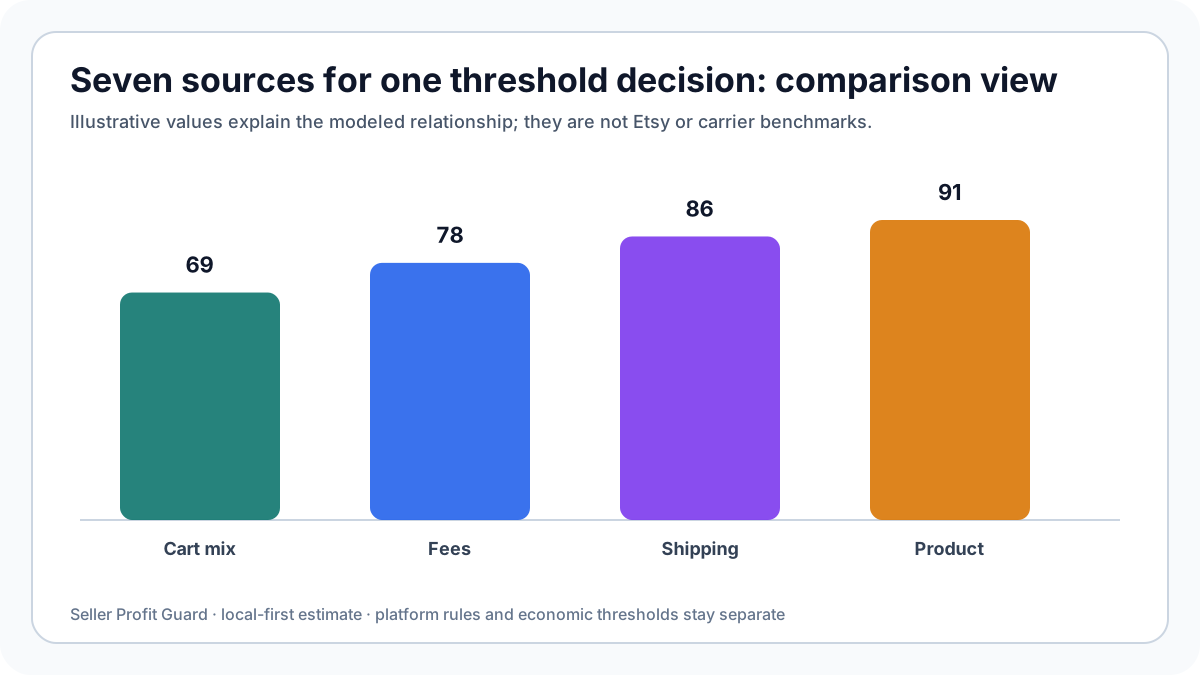
Cart mix is a validation source rather than a direct field. It tells the operator which product-cost and package scenarios are likely to cross the threshold. The shipping profile or guarantee defines buyer-facing eligibility. Keep these sources separate so the model does not mistake a setting for a cost or an average outcome for an input.
| Decision field | Preferred evidence | Freshness trigger |
|---|---|---|
| Product cost | Versioned SKU/bundle record | Supplier or process change |
| Shipping | Labels, invoices, adjustments | Carrier or package change |
| Packaging | Package bill of materials | Design or supplier change |
| Fees | Official policy + Payment Account | Policy or location change |
| Target margin | Approved operating policy | Business-model review |
| Offer scope | Current profile/guarantee | Listing or destination change |
How should postage evidence be sampled?
Define origin, destination group, carrier, service, package type, dimensions, weight, insurance, signature, and adjustment treatment. Pull a bounded recent sample that includes ordinary and adverse orders. Reconcile purchased label amount with later carrier adjustments. A rate preview can plan a new package, but actual receipts are stronger evidence for a live offer.
Use a distribution rather than one favorable label. Report median, upper percentile, maximum explained case, sample count, and excluded structural exceptions. If a remote or international destination follows a different profile, calculate it separately. Do not publish an exact nationwide threshold from a local-zone sample.
When orders use calculated shipping, Etsy's official help explains that origin, buyer location, item size and weight, package preferences, and eligible service affect the checkout calculation. That buyer-facing amount still needs comparison with the seller's final cost and any free-shipping subsidy.

How are Etsy fee sources reconciled without overgeneralizing?
Read the current Fees & Payments Policy and country-specific payment guidance, then match the modeled order to actual Payment Account lines. Etsy's policy states a 6.5% transaction fee on displayed listing price plus charged shipping and gift wrap, while payment-processing fees vary by bank location and use a broader total. Other charges may apply by advertising attribution, seller location, currency, service, and tax treatment.
Do not place every possible rate into one percentage merely because it exists. Build representative and adverse fee scenarios. For example, one scenario can exclude Offsite Ads and another can include the applicable attributed-order assumption. Record which revenue base each rate uses and whether a fixed component is already entered separately.
If observed fee lines do not reconcile, hold the threshold decision. A combined percentage that accidentally double-counts the fixed fee or excludes shipping from a fee base can move the rule materially. Preserve official links and access dates because policies change.
What quality controls belong in the source package?
Store source name, owner, location, access date, effective period, units, currency, population, exclusions, transformation, and fingerprint. Record the calculator inputs separately from raw evidence. Use a public dummy fixture for tests and keep private invoices, labels, and cost libraries in controlled storage.
Run completeness, nonnegative, unit, currency, date, and grain checks. Challenge suspicious patterns: every package has the same cost, every SKU has one update date, adjustments are absent despite known carrier corrections, or the fee rate never changes across countries and ad states. Clean columns can still represent weak evidence.
Approve an input only for a bounded use. A domestic lightweight sample can support that cohort; it cannot certify international or oversized cases. Reopen the source when the trigger occurs, not only on a calendar date.
- Trace every input.
- Preserve units and effective dates.
- Test completeness and grain.
- Challenge suspicious uniformity.
- Approve only bounded scope.
Threshold-data questions
Can a public carrier rate replace actual labels? It can seed a scenario, not validate a mature offer.
Should the worksheet store addresses? No; aggregate destination cohorts are enough.
What if product costs are private? Keep them local and publish only rounded dummy examples.
How often should sources refresh? On material cost, fee, package, carrier, profile, or mix changes.
Which source decides the threshold? No single source—the decision requires a reproducible join at one scope.
Which evidence supports this free-shipping threshold data map?
Use current carrier or Etsy label receipts for postage, adjustments, insurance, and services; packaging purchase records for mailers, boxes, inserts, tape, and protective material; product or SKU records for the cost of goods; and the Etsy Payment Account for fees tied to actual orders. Use shipping profiles and the current listing only to describe what the buyer is offered. A profile does not prove the seller's final label cost.
Record the analysis period, currency, destination cohort, package class, included costs, excluded costs, fee assumption, fixed fee, target margin, calculator version, and source dates. Reconcile a small public dummy example by hand before applying the result to a catalog. A file fingerprint proves that an input did not change; it does not prove that the input represents the next order mix.
Keep official platform rules separate from business assumptions. Etsy's US free-shipping guarantee can apply to qualifying US-bound orders of $35 or more after it is enabled, while the calculator derives a shop-specific economic threshold from entered costs and rates. Neither value proves conversion lift, tax treatment, carrier eligibility, or profit on every destination.
- Prefer actual labels and adjustments over advertised rate estimates.
- Segment heavy, remote, international, upgraded, fragile, and mixed-cart orders when costs differ.
- Treat fee percentages and target margin as explicit editable assumptions.
- Recalculate after carrier, package, fee, product-cost, or offer changes.
- Verify tax, accounting, legal, and platform-policy questions separately.
Privacy and commercial sensitivity for free-shipping threshold data map
The threshold calculation needs costs, rates, a package or cart scenario, and a target margin. Buyer names, email addresses, phone numbers, delivery addresses, order IDs, messages, personalization, and payment credentials are unnecessary. Use aggregate destination zones or public dummy locations rather than exposing a buyer's exact address. Seller Profit Guard runs this quick calculation in the browser and does not need an Etsy login.
Supplier prices, package dimensions, negotiated carrier rates, product mix, margin targets, and exception rules can reveal commercial strategy even without buyer data. Keep detailed worksheets in controlled storage. Public reports should use rounded dummy numbers, aggregate ranges, redacted product names, and non-reversible fingerprints. Never paste a private order row or label into an article, analytics event, ticket, email draft, or community post.
How to apply this free-shipping threshold data map in the calculator
Open the Free Shipping Threshold Calculator and enter product cost, seller-funded shipping, packaging, the combined percentage fee assumption, fixed fee, and target margin. The tool adds the four fixed-dollar costs, subtracts the fee and target-margin shares from one, and divides the cost total by the remaining revenue share. It reports no safe threshold when the denominator is zero or negative.
Round the result upward to a practical cart rule, then rerun at least a representative, adverse, and mixed-cart case. Confirm that the products likely to reach the threshold can actually produce the modeled cost mix. The output is a planning estimate, not an Etsy setting, carrier quote, conversion forecast, accounting profit statement, or promise that every qualifying order is profitable.
- Define one destination, package, product-mix, and offer cohort.
- Enter evidence-backed dollar costs and editable percentage assumptions.
- Hand-check the formula and round upward rather than down.
- Stress-test heavy, distant, upgraded, discounted, and mixed-cart cases.
- Publish only a bounded rule with owner, review date, exception, and rollback.
Sources and further reading
- Etsy Help: How to Offer Free Shipping: Official Etsy guidance for the US $35 free-shipping guarantee, shipping profiles, smart pricing, upgrades, and domestic versus international offers.
- Etsy Fees & Payments Policy: Official policy for transaction, payment-processing, Offsite Ads, regulatory, currency-conversion, shipping-label, and other seller charges.
- Etsy Help: How to Set Up Calculated Shipping: Official explanation of how origin, destination, package weight, dimensions, mail class, and package preferences affect calculated shipping.
- Etsy Help: How to Ship Your Items: Official shipping-profile, label, policy, and competitive-shipping overview for Etsy sellers.
- Seller Profit Guard calculation methodology: Definitions for contribution, editable assumptions, evidence hierarchy, local-first processing, uncertainty, and decision limits.
Related Seller Profit Guard tools
- Open the Free Shipping Threshold Calculator: Calculate the minimum order value that can absorb seller-funded shipping while preserving an editable target margin.
- Review Etsy shipping margin mistakes: Separate platform guarantees from economic thresholds and inspect funding, package, variation, replacement, and international cases.
- Calculate break-even ROAS and return loss: Add acquisition and expected incident loss after the shipping threshold is understood.
- Use the Etsy profit calculator: Validate the threshold against actual order revenue, fees, SKU cost, shipping, and margin evidence.
- Read the local-first methodology: Understand formulas, assumptions, privacy, evidence quality, and non-advice limits.
- Free Shipping Threshold Formula: 6 Inputs: Continue the free-shipping threshold evidence and decision workflow.
- Free Shipping Threshold: $26.32 Example: Continue the free-shipping threshold evidence and decision workflow.
- Mixed-Cart Free Shipping Threshold: $37.75: Continue the free-shipping threshold evidence and decision workflow.
- Free Shipping Threshold: 12 Costly Mistakes: Continue the free-shipping threshold evidence and decision workflow.
- Free Shipping Rules: Break-Even vs Target: Continue the free-shipping threshold evidence and decision workflow.
Next step: Open the Free Shipping Threshold Calculator.
This is operational planning help, not tax, accounting, legal, financial, or platform-policy advice. Review the Terms and disclaimer, and verify current platform rules and fee assumptions before changing prices.