How to interpret duplicate order checker results
Last updated: 2026-07-31
Written and reviewed by Seller Profit Guard Editorial Team.
Exact groups show repeated invented fingerprints; probable groups show a bounded order-level similarity rule; repeated keys show multiplicity; split groups show preserved lower-grain exceptions. Block stops the fixture, Review requires named investigation, and Ready clears only the synthetic packet. None of these outputs proves a production row should be deleted or merged.
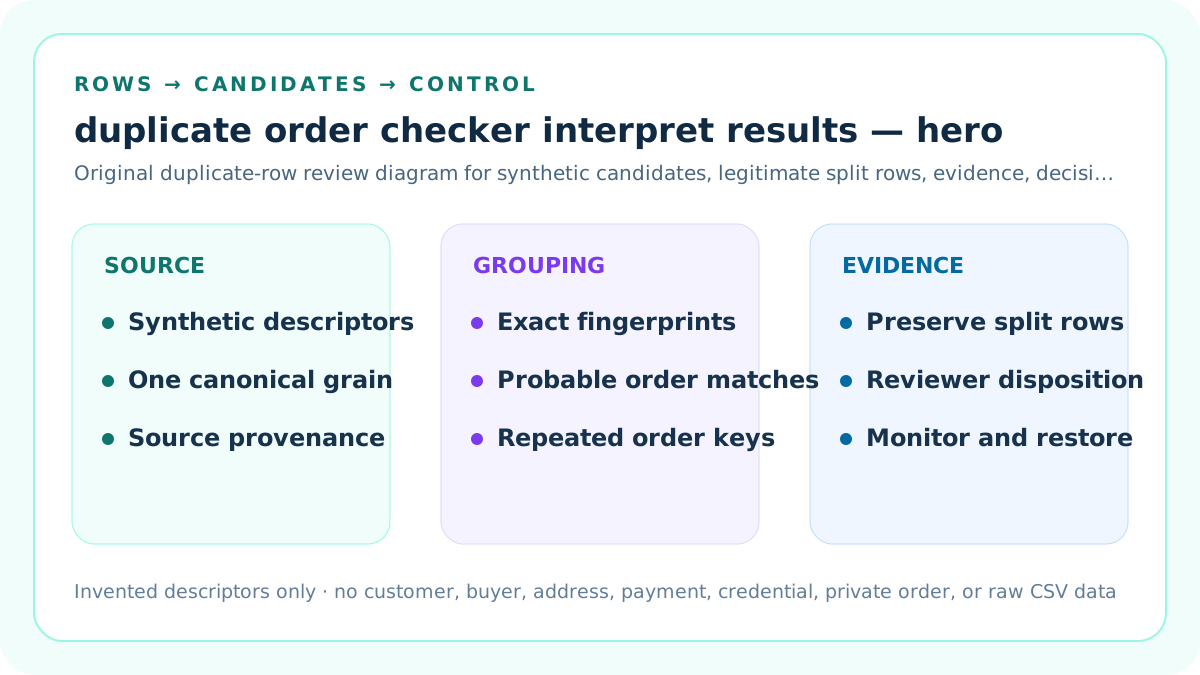
Synthetic rows
Count entered descriptors only. The duplicate-result interpretation note records source version, canonical grain, invented row position, synthetic key, event timestamp, amount unit, item count, source label, fingerprint version, row role, expected group, threshold version, owner, reviewer, exception, and prior accepted value needed for bounded candidate meaning.
Not production volume. At checkpoint 1, reperform the duplicate-import and split-shipment fixtures plus one counterexample, report only counts and categories, and state which identity, reconciliation, privacy, accounting, fraud, platform, or deletion conclusion remains outside this checker.
Exact groups
Count connected repeated fingerprints. The duplicate-result interpretation note records source version, canonical grain, invented row position, synthetic key, event timestamp, amount unit, item count, source label, fingerprint version, row role, expected group, threshold version, owner, reviewer, exception, and prior accepted value needed for bounded candidate meaning.
Not proven identity. At checkpoint 2, reperform the duplicate-import and split-shipment fixtures plus one counterexample, report only counts and categories, and state which identity, reconciliation, privacy, accounting, fraud, platform, or deletion conclusion remains outside this checker.
Probable groups
Count bounded different-fingerprint matches. The duplicate-result interpretation note records source version, canonical grain, invented row position, synthetic key, event timestamp, amount unit, item count, source label, fingerprint version, row role, expected group, threshold version, owner, reviewer, exception, and prior accepted value needed for bounded candidate meaning.
Always Review. At checkpoint 3, reperform the duplicate-import and split-shipment fixtures plus one counterexample, report only counts and categories, and state which identity, reconciliation, privacy, accounting, fraud, platform, or deletion conclusion remains outside this checker.
Candidate groups
Sum exact and probable groups. The duplicate-result interpretation note records source version, canonical grain, invented row position, synthetic key, event timestamp, amount unit, item count, source label, fingerprint version, row role, expected group, threshold version, owner, reviewer, exception, and prior accepted value needed for bounded candidate meaning.
Not rows to delete. At checkpoint 4, reperform the duplicate-import and split-shipment fixtures plus one counterexample, report only counts and categories, and state which identity, reconciliation, privacy, accounting, fraud, platform, or deletion conclusion remains outside this checker.
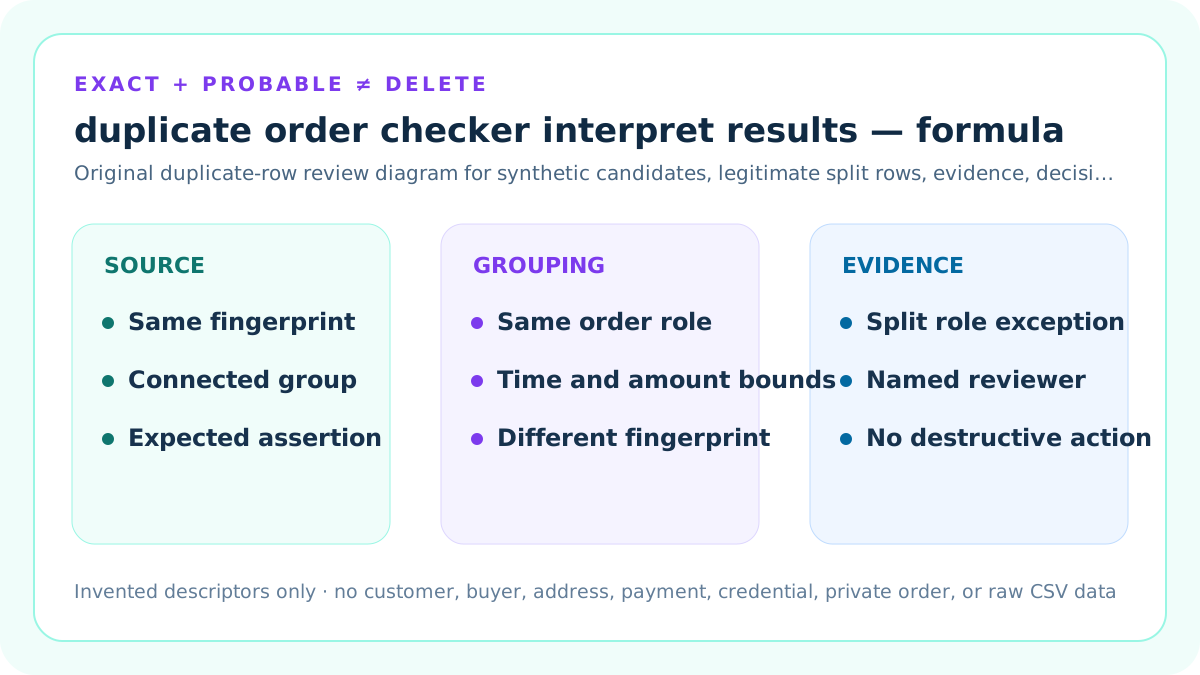
Expected groups
Read fixture assertions. The duplicate-result interpretation note records source version, canonical grain, invented row position, synthetic key, event timestamp, amount unit, item count, source label, fingerprint version, row role, expected group, threshold version, owner, reviewer, exception, and prior accepted value needed for bounded candidate meaning.
Not forecasts. At checkpoint 5, reperform the duplicate-import and split-shipment fixtures plus one counterexample, report only counts and categories, and state which identity, reconciliation, privacy, accounting, fraud, platform, or deletion conclusion remains outside this checker.
Unexpected groups
Compare observed and declared counts. The duplicate-result interpretation note records source version, canonical grain, invented row position, synthetic key, event timestamp, amount unit, item count, source label, fingerprint version, row role, expected group, threshold version, owner, reviewer, exception, and prior accepted value needed for bounded candidate meaning.
Investigate changes. At checkpoint 6, reperform the duplicate-import and split-shipment fixtures plus one counterexample, report only counts and categories, and state which identity, reconciliation, privacy, accounting, fraud, platform, or deletion conclusion remains outside this checker.
Repeated keys
Measure multiplicity at entered grain. The duplicate-result interpretation note records source version, canonical grain, invented row position, synthetic key, event timestamp, amount unit, item count, source label, fingerprint version, row role, expected group, threshold version, owner, reviewer, exception, and prior accepted value needed for bounded candidate meaning.
May be legitimate. At checkpoint 7, reperform the duplicate-import and split-shipment fixtures plus one counterexample, report only counts and categories, and state which identity, reconciliation, privacy, accounting, fraud, platform, or deletion conclusion remains outside this checker.
Split groups
Count preserved distinct shipment roles. The duplicate-result interpretation note records source version, canonical grain, invented row position, synthetic key, event timestamp, amount unit, item count, source label, fingerprint version, row role, expected group, threshold version, owner, reviewer, exception, and prior accepted value needed for bounded candidate meaning.
Needs exception evidence. At checkpoint 8, reperform the duplicate-import and split-shipment fixtures plus one counterexample, report only counts and categories, and state which identity, reconciliation, privacy, accounting, fraud, platform, or deletion conclusion remains outside this checker.
Unsafe rows
Block private or credential-like content. The duplicate-result interpretation note records source version, canonical grain, invented row position, synthetic key, event timestamp, amount unit, item count, source label, fingerprint version, row role, expected group, threshold version, owner, reviewer, exception, and prior accepted value needed for bounded candidate meaning.
Do not echo. At checkpoint 9, reperform the duplicate-import and split-shipment fixtures plus one counterexample, report only counts and categories, and state which identity, reconciliation, privacy, accounting, fraud, platform, or deletion conclusion remains outside this checker.
Decision
Block stops, Review investigates, Ready clears fixture. The duplicate-result interpretation note records source version, canonical grain, invented row position, synthetic key, event timestamp, amount unit, item count, source label, fingerprint version, row role, expected group, threshold version, owner, reviewer, exception, and prior accepted value needed for bounded candidate meaning.
Human authority remains. At checkpoint 10, reperform the duplicate-import and split-shipment fixtures plus one counterexample, report only counts and categories, and state which identity, reconciliation, privacy, accounting, fraud, platform, or deletion conclusion remains outside this checker.
Next action
Reconcile provenance, disposition, totals, backup, and restoration. The duplicate-result interpretation note records source version, canonical grain, invented row position, synthetic key, event timestamp, amount unit, item count, source label, fingerprint version, row role, expected group, threshold version, owner, reviewer, exception, and prior accepted value needed for bounded candidate meaning.
No automatic merge. At checkpoint 11, reperform the duplicate-import and split-shipment fixtures plus one counterexample, report only counts and categories, and state which identity, reconciliation, privacy, accounting, fraud, platform, or deletion conclusion remains outside this checker.
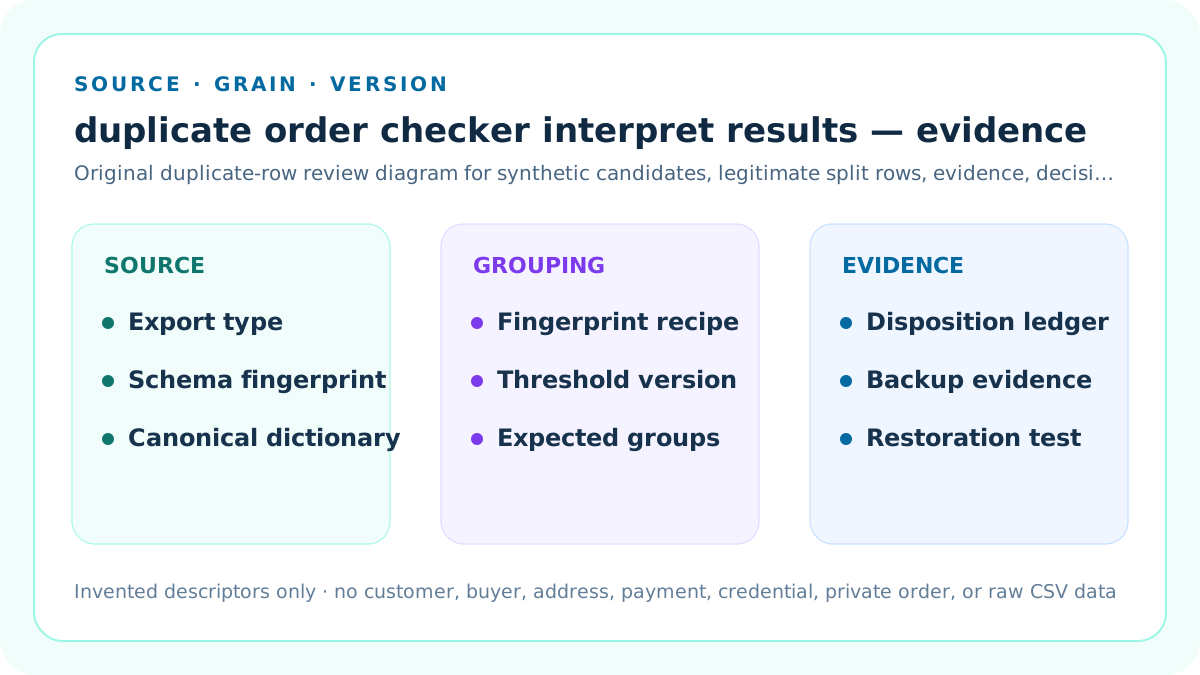
Interpret Duplicate Check Results: grain and provenance integrity control
Partition every packet by source type, canonical event grain, currency, period, and version before grouping. Control 1 defines a pass condition, evidence owner, independent reviewer, correction deadline, counterexample, monitoring signal, stop condition, and restoration trigger for bounded candidate meaning.
Mixed populations block. Apply it while keeping structural validation, canonical mapping, candidate grouping, protected disposition, downstream reconciliation, and destructive authority separate.
Interpret Duplicate Check Results: fingerprint and candidate evidence control
Version the fingerprint recipe and distinguish exact tokens, probable business keys, repeated identifiers, and legitimate exceptions. Control 2 defines a pass condition, evidence owner, independent reviewer, correction deadline, counterexample, monitoring signal, stop condition, and restoration trigger for bounded candidate meaning.
A candidate is not identity proof. Apply it while keeping structural validation, canonical mapping, candidate grouping, protected disposition, downstream reconciliation, and destructive authority separate.
Interpret Duplicate Check Results: threshold and expectation control control
Declare timestamp, amount, expected-group, and unexpected-group rules before running fixtures. Control 3 defines a pass condition, evidence owner, independent reviewer, correction deadline, counterexample, monitoring signal, stop condition, and restoration trigger for bounded candidate meaning.
Changes require retesting. Apply it while keeping structural validation, canonical mapping, candidate grouping, protected disposition, downstream reconciliation, and destructive authority separate.
Interpret Duplicate Check Results: dated confirmation contract control
Require real source-review and policy-effective dates, keep policy no later than source review, affirm all nine controls, and reject copied duplicate-import and split-shipment packets. Control 4 defines a pass condition, evidence owner, independent reviewer, correction deadline, counterexample, monitoring signal, stop condition, and restoration trigger for bounded candidate meaning.
Missing or duplicated evidence blocks. Apply it while keeping structural validation, canonical mapping, candidate grouping, protected disposition, downstream reconciliation, and destructive authority separate.
Interpret Duplicate Check Results: bounded public packet control
Limit each scenario to 2–100 synthetic rows and 50,000 evidence characters, strictly parse thresholds, and mask every derived group under Block. Control 5 defines a pass condition, evidence owner, independent reviewer, correction deadline, counterexample, monitoring signal, stop condition, and restoration trigger for bounded candidate meaning.
A public worksheet is not a production deduplication engine. Apply it while keeping structural validation, canonical mapping, candidate grouping, protected disposition, downstream reconciliation, and destructive authority separate.
Interpret Duplicate Check Results: privacy and output minimization control
Use invented public descriptors, report counts only, and keep protected rows in authorized storage. Control 6 defines a pass condition, evidence owner, independent reviewer, correction deadline, counterexample, monitoring signal, stop condition, and restoration trigger for bounded candidate meaning.
Never echo private values. Apply it while keeping structural validation, canonical mapping, candidate grouping, protected disposition, downstream reconciliation, and destructive authority separate.
Interpret Duplicate Check Results: human disposition authority control
Require a named reviewer, retained reference, reason, reconciliation, and approval before excluding anything. Control 7 defines a pass condition, evidence owner, independent reviewer, correction deadline, counterexample, monitoring signal, stop condition, and restoration trigger for bounded candidate meaning.
Ready cannot delete. Apply it while keeping structural validation, canonical mapping, candidate grouping, protected disposition, downstream reconciliation, and destructive authority separate.
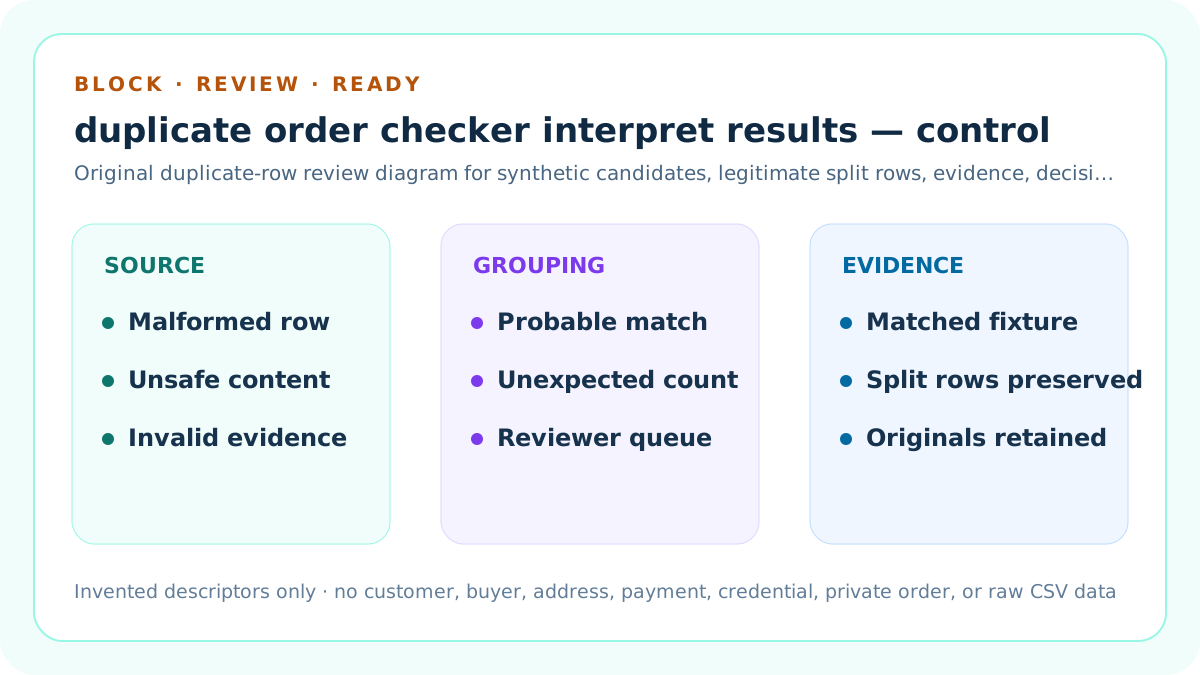
Interpret Duplicate Check Results: monitoring and restoration control
Preserve source, prior rules, dispositions, derived totals, stop triggers, and a tested restore path. Control 8 defines a pass condition, evidence owner, independent reviewer, correction deadline, counterexample, monitoring signal, stop condition, and restoration trigger for bounded candidate meaning.
Rollback evidence is mandatory. Apply it while keeping structural validation, canonical mapping, candidate grouping, protected disposition, downstream reconciliation, and destructive authority separate.
Synthetic rows: synthetic duplicate lab 1
Reperform both packets. Count entered descriptors only. Change one row label, synthetic key, timestamp, amount, item count, source label, fingerprint, role, expected group, threshold, evidence term, or scope statement only; preserve the rest and record exact, probable, repeated-key, split, unexpected, and decision outputs.
Not production volume. Test clean, boundary, and failed values without exposing production rows. Explain the dominant change, protected evidence still required, disposition authority, and exact stop or restoration action before any operational use.
Exact groups: synthetic duplicate lab 2
Reperform both packets. Count connected repeated fingerprints. Change one row label, synthetic key, timestamp, amount, item count, source label, fingerprint, role, expected group, threshold, evidence term, or scope statement only; preserve the rest and record exact, probable, repeated-key, split, unexpected, and decision outputs.
Not proven identity. Test clean, boundary, and failed values without exposing production rows. Explain the dominant change, protected evidence still required, disposition authority, and exact stop or restoration action before any operational use.
Probable groups: synthetic duplicate lab 3
Reperform both packets. Count bounded different-fingerprint matches. Change one row label, synthetic key, timestamp, amount, item count, source label, fingerprint, role, expected group, threshold, evidence term, or scope statement only; preserve the rest and record exact, probable, repeated-key, split, unexpected, and decision outputs.
Always Review. Test clean, boundary, and failed values without exposing production rows. Explain the dominant change, protected evidence still required, disposition authority, and exact stop or restoration action before any operational use.
Candidate groups: synthetic duplicate lab 4
Reperform both packets. Sum exact and probable groups. Change one row label, synthetic key, timestamp, amount, item count, source label, fingerprint, role, expected group, threshold, evidence term, or scope statement only; preserve the rest and record exact, probable, repeated-key, split, unexpected, and decision outputs.
Not rows to delete. Test clean, boundary, and failed values without exposing production rows. Explain the dominant change, protected evidence still required, disposition authority, and exact stop or restoration action before any operational use.
Expected groups: synthetic duplicate lab 5
Reperform both packets. Read fixture assertions. Change one row label, synthetic key, timestamp, amount, item count, source label, fingerprint, role, expected group, threshold, evidence term, or scope statement only; preserve the rest and record exact, probable, repeated-key, split, unexpected, and decision outputs.
Not forecasts. Test clean, boundary, and failed values without exposing production rows. Explain the dominant change, protected evidence still required, disposition authority, and exact stop or restoration action before any operational use.
Unexpected groups: synthetic duplicate lab 6
Reperform both packets. Compare observed and declared counts. Change one row label, synthetic key, timestamp, amount, item count, source label, fingerprint, role, expected group, threshold, evidence term, or scope statement only; preserve the rest and record exact, probable, repeated-key, split, unexpected, and decision outputs.
Investigate changes. Test clean, boundary, and failed values without exposing production rows. Explain the dominant change, protected evidence still required, disposition authority, and exact stop or restoration action before any operational use.
Repeated keys: synthetic duplicate lab 7
Reperform both packets. Measure multiplicity at entered grain. Change one row label, synthetic key, timestamp, amount, item count, source label, fingerprint, role, expected group, threshold, evidence term, or scope statement only; preserve the rest and record exact, probable, repeated-key, split, unexpected, and decision outputs.
May be legitimate. Test clean, boundary, and failed values without exposing production rows. Explain the dominant change, protected evidence still required, disposition authority, and exact stop or restoration action before any operational use.
Split groups: synthetic duplicate lab 8
Reperform both packets. Count preserved distinct shipment roles. Change one row label, synthetic key, timestamp, amount, item count, source label, fingerprint, role, expected group, threshold, evidence term, or scope statement only; preserve the rest and record exact, probable, repeated-key, split, unexpected, and decision outputs.
Needs exception evidence. Test clean, boundary, and failed values without exposing production rows. Explain the dominant change, protected evidence still required, disposition authority, and exact stop or restoration action before any operational use.
Unsafe rows: synthetic duplicate lab 9
Reperform both packets. Block private or credential-like content. Change one row label, synthetic key, timestamp, amount, item count, source label, fingerprint, role, expected group, threshold, evidence term, or scope statement only; preserve the rest and record exact, probable, repeated-key, split, unexpected, and decision outputs.
Do not echo. Test clean, boundary, and failed values without exposing production rows. Explain the dominant change, protected evidence still required, disposition authority, and exact stop or restoration action before any operational use.
Decision: synthetic duplicate lab 10
Reperform both packets. Block stops, Review investigates, Ready clears fixture. Change one row label, synthetic key, timestamp, amount, item count, source label, fingerprint, role, expected group, threshold, evidence term, or scope statement only; preserve the rest and record exact, probable, repeated-key, split, unexpected, and decision outputs.
Human authority remains. Test clean, boundary, and failed values without exposing production rows. Explain the dominant change, protected evidence still required, disposition authority, and exact stop or restoration action before any operational use.
Next action: synthetic duplicate lab 11
Reperform both packets. Reconcile provenance, disposition, totals, backup, and restoration. Change one row label, synthetic key, timestamp, amount, item count, source label, fingerprint, role, expected group, threshold, evidence term, or scope statement only; preserve the rest and record exact, probable, repeated-key, split, unexpected, and decision outputs.
No automatic merge. Test clean, boundary, and failed values without exposing production rows. Explain the dominant change, protected evidence still required, disposition authority, and exact stop or restoration action before any operational use.
Interpret Duplicate Check Results: intent-specific implementation walkthrough
duplicate-result interpretation note checkpoint 1 addresses synthetic rows for bounded candidate meaning. Count entered descriptors only. Record the classification decision, failed alternative, reviewer question, retained evidence, correction owner, downstream check, monitoring signal, and restoration value. Not production volume.
duplicate-result interpretation note checkpoint 2 addresses exact groups for bounded candidate meaning. Count connected repeated fingerprints. Record the classification decision, failed alternative, reviewer question, retained evidence, correction owner, downstream check, monitoring signal, and restoration value. Not proven identity.
duplicate-result interpretation note checkpoint 3 addresses probable groups for bounded candidate meaning. Count bounded different-fingerprint matches. Record the classification decision, failed alternative, reviewer question, retained evidence, correction owner, downstream check, monitoring signal, and restoration value. Always Review.
duplicate-result interpretation note checkpoint 4 addresses candidate groups for bounded candidate meaning. Sum exact and probable groups. Record the classification decision, failed alternative, reviewer question, retained evidence, correction owner, downstream check, monitoring signal, and restoration value. Not rows to delete.
duplicate-result interpretation note checkpoint 5 addresses expected groups for bounded candidate meaning. Read fixture assertions. Record the classification decision, failed alternative, reviewer question, retained evidence, correction owner, downstream check, monitoring signal, and restoration value. Not forecasts.
duplicate-result interpretation note checkpoint 6 addresses unexpected groups for bounded candidate meaning. Compare observed and declared counts. Record the classification decision, failed alternative, reviewer question, retained evidence, correction owner, downstream check, monitoring signal, and restoration value. Investigate changes.
duplicate-result interpretation note checkpoint 7 addresses repeated keys for bounded candidate meaning. Measure multiplicity at entered grain. Record the classification decision, failed alternative, reviewer question, retained evidence, correction owner, downstream check, monitoring signal, and restoration value. May be legitimate.
duplicate-result interpretation note checkpoint 8 addresses split groups for bounded candidate meaning. Count preserved distinct shipment roles. Record the classification decision, failed alternative, reviewer question, retained evidence, correction owner, downstream check, monitoring signal, and restoration value. Needs exception evidence.
duplicate-result interpretation note checkpoint 9 addresses unsafe rows for bounded candidate meaning. Block private or credential-like content. Record the classification decision, failed alternative, reviewer question, retained evidence, correction owner, downstream check, monitoring signal, and restoration value. Do not echo.
duplicate-result interpretation note checkpoint 10 addresses decision for bounded candidate meaning. Block stops, Review investigates, Ready clears fixture. Record the classification decision, failed alternative, reviewer question, retained evidence, correction owner, downstream check, monitoring signal, and restoration value. Human authority remains.
duplicate-result interpretation note checkpoint 11 addresses next action for bounded candidate meaning. Reconcile provenance, disposition, totals, backup, and restoration. Record the classification decision, failed alternative, reviewer question, retained evidence, correction owner, downstream check, monitoring signal, and restoration value. No automatic merge.
Evidence boundary for bounded candidate meaning
The duplicate-import packet contains two invented order rows sharing one fingerprint plus one unrelated row. The split-shipment packet repeats an ORD-SYN key across distinct shipment roles, values, timestamps, and fingerprints.
The packet demonstrates entered candidate-group logic only. It cannot prove production identity, deletion safety, source completeness, platform error, fraud, accounting accuracy, privacy compliance, payout reconciliation, tax treatment, or the correct retained record.
Release, monitor, and restore the duplicate-result interpretation note
Block shape, pattern, timestamp, numeric, source, fingerprint, role, context, threshold, privacy, evidence, scope, or conflict failures. Review probable or unexpected groups. Ready clears only fixtures that match declared expectations.
Before indexing or operational use, preserve evidence and rollback artifacts; run typecheck, unit, integration, build, content, similarity, SEO, image, link, privacy, mobile, strict-route, deployment, and live checks; then monitor drift without claiming causality.
Sources and further reading
- W3C: Model for Tabular Data and Metadata on the Web: Official row, primary-key, source-order, provenance, and repeated-primary-key validation model.
- W3C: CSV on the Web Primer: Official schema, identifier, validation, and documented-processing examples.
- IETF RFC 4180: Informational CSV record, header, field-count, quoting, interoperability, and privacy context.
- Etsy Help: Download sold transactions: Official distinction among order items, orders, payment sales, and deposits.
- Shopify Help: Exporting orders: Official order-export and transaction-history structure and delivery guidance.
- Seller Profit Guard methodology: Evidence, privacy, correction, release, monitoring, and rollback controls.
- Seller Profit Guard data privacy: Local-first boundaries for synthetic rows, identifiers, fingerprints, orders, buyers, and raw files.
Related Seller Profit Guard tools
- Duplicate Order Checker: Group invented candidate rows without deleting or merging anything.
- Seller CSV Import Validator: Validate synthetic structure before duplicate review.
- Seller CSV Column Mapper: Map sources to one canonical grain before grouping rows.
- Payment Reconciliation: Reconcile retained order and payment populations after disposition.
- Ad Attribution Reconciliation Checker: Classify aggregate attribution rows separately.
- SKU Naming Generator: Design stable product identifiers without buyer data.
- Guides: Browse related seller evidence workflows.
- How It Works: Understand browser-local processing boundaries.
- Methodology: Review source, formula, correction, release, and restoration rules.
- Data Privacy: Protect customer, payment, address, credential, and raw export data.
- Changelog: Track dated public changes.
- Duplicate Order Checker Formula and Inputs: Define the exact fingerprint, probable-match, repeated-key, and split-shipment logic for synthetic seller rows, including thresholds and privacy boundaries.
- Duplicate Import Worked Example: Work through one invented repeated-file import and one unrelated order row without using customer or production data, then document review controls.
- Split Shipment Duplicate Check: Preserve legitimate shipment rows that share an order reference while exposing why order-level uniqueness would be unsafe.
- Duplicate Order Checker Mistakes: Diagnose grain, fingerprint, threshold, provenance, privacy, exception, and destructive-action mistakes that create false duplicate claims.
- Duplicate Order Check Data Sources: Map duplicate-review inputs to first-party export documentation, protected source pointers, canonical dictionaries, and versioned synthetic fixtures.
- Duplicate Candidate Thresholds: Set bounded timestamp, amount, expected-group, and exception thresholds without converting uncertain candidates into automatic deletions.
- Duplicate Imports vs Split Shipments: Compare repeated file imports and legitimate split shipments at a consistent evidence level without collapsing their different grains.
- Weekly Duplicate Review Routine: Turn duplicate candidate review into a repeatable weekly control with versioned fixtures, protected dispositions, reconciliation, monitoring, and restoration.
- Duplicate Review Audit Template: Use a checklist and change log for source, grain, fingerprint, thresholds, exceptions, dispositions, reconciliation, authority, monitoring, and restoration.
Next step: Open Seller Profit Guard.
This is operational planning help, not tax, accounting, legal, financial, or platform-policy advice. Review the Terms and disclaimer, and verify current platform rules and fee assumptions before changing prices.