How to set safe Etsy deposit fee decision thresholds
Last updated: 2026-07-30
Written and reviewed by Seller Profit Guard Editorial Team.
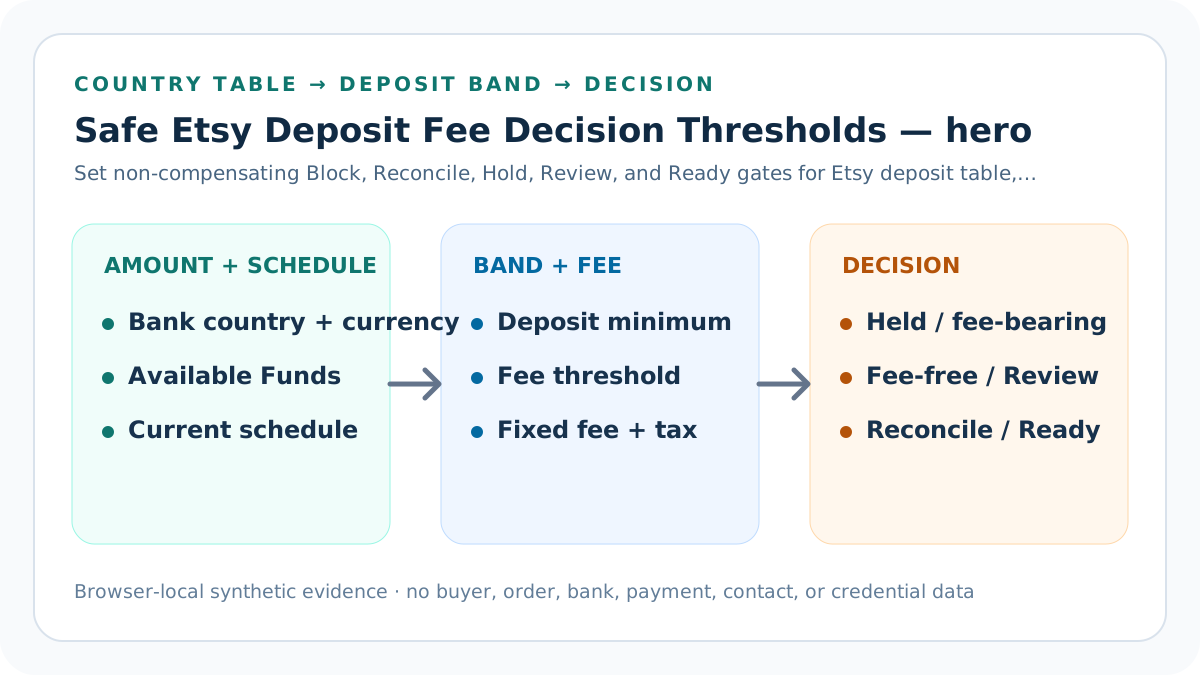
Block invalid country-table values, schedules, currencies, event counts, periods, or declared conflicts. Reconcile actual fee or tax-row differences. Hold funds that do not exceed the deposit minimum. Review reconciled projected monthly fees above a seller-owned ceiling. Use Ready only when the country table, deposit band, actual rows, and threshold pass.
non-compensating gates: scope and direct answer
This guide addresses a decision that preserves evidence before schedule preference for one Etsy Payments evidence period. It begins with bank country, currency, current public table, Available Funds, schedule, actual fee rows, and declared conflicts rather than a preferred cash-flow outcome.
The calculator is browser-local and uses synthetic examples. It does not retrieve Etsy or bank data, authenticate a seller, guarantee a payment date, value cash timing, or change a deposit schedule.
Build the Block-Reconcile-Hold-Review-Ready deposit card
The contract stores country, currency, period, Available Funds per event, deposit minimum, fee threshold, fixed fee, fee-tax rate, actual fee and tax, tolerance, current and comparison schedules, event counts, monthly ceiling, and known evidence issues.
Decision precedence is Block, Reconcile, Hold, Review, then Ready. A favorable comparison cannot compensate for a wrong country table, unknown account condition, actual-row difference, or declared reserve, hold, delay, refund, currency, or statement conflict.
Gate 1: current country row
Match bank country, currency, minimum, threshold, and fee to Etsy's current additional deposit table.
Apply deposit gates without compensation; a cheaper schedule cannot validate an unsupported country row. Gate-card row 1 is evaluated independently and in precedence order. Record the exact predicate, observed value, allowed range, resulting state, remediation owner, and retest condition; do not average failures or let a fee saving override an invalid table, unreconciled row, held amount, or declared conflict.
The gate test evaluates invalid country data, a fee-row variance, an amount exactly at the minimum, a reconciled high monthly exposure, and a clean fee-free packet. Expected states are Block, Reconcile, Hold, Review, and Ready respectively, with no compensating score or schedule preference.
Gate 2: schedule identity
Require recognized current and comparison schedules that are different and tied to one evidence month.
Apply deposit gates without compensation; a cheaper schedule cannot validate an unsupported country row. Gate-card row 2 is evaluated independently and in precedence order. Record the exact predicate, observed value, allowed range, resulting state, remediation owner, and retest condition; do not average failures or let a fee saving override an invalid table, unreconciled row, held amount, or declared conflict.
The gate test evaluates invalid country data, a fee-row variance, an amount exactly at the minimum, a reconciled high monthly exposure, and a clean fee-free packet. Expected states are Block, Reconcile, Hold, Review, and Ready respectively, with no compensating score or schedule preference.
Gate 3: valid event counts
Require positive whole modeled deposits per month for each scenario.
Apply deposit gates without compensation; a cheaper schedule cannot validate an unsupported country row. Gate-card row 3 is evaluated independently and in precedence order. Record the exact predicate, observed value, allowed range, resulting state, remediation owner, and retest condition; do not average failures or let a fee saving override an invalid table, unreconciled row, held amount, or declared conflict.
The gate test evaluates invalid country data, a fee-row variance, an amount exactly at the minimum, a reconciled high monthly exposure, and a clean fee-free packet. Expected states are Block, Reconcile, Hold, Review, and Ready respectively, with no compensating score or schedule preference.
Gate 4: deposit-band inputs
Require nonnegative Available Funds, minimum, fee, tax, and a fee threshold above the minimum.
Apply deposit gates without compensation; a cheaper schedule cannot validate an unsupported country row. Gate-card row 4 is evaluated independently and in precedence order. Record the exact predicate, observed value, allowed range, resulting state, remediation owner, and retest condition; do not average failures or let a fee saving override an invalid table, unreconciled row, held amount, or declared conflict.
The gate test evaluates invalid country data, a fee-row variance, an amount exactly at the minimum, a reconciled high monthly exposure, and a clean fee-free packet. Expected states are Block, Reconcile, Hold, Review, and Ready respectively, with no compensating score or schedule preference.
Gate 5: fee reconciliation
Compare expected and actual fixed deposit fees independently within tolerance.
Apply deposit gates without compensation; a cheaper schedule cannot validate an unsupported country row. Gate-card row 5 is evaluated independently and in precedence order. Record the exact predicate, observed value, allowed range, resulting state, remediation owner, and retest condition; do not average failures or let a fee saving override an invalid table, unreconciled row, held amount, or declared conflict.
The gate test evaluates invalid country data, a fee-row variance, an amount exactly at the minimum, a reconciled high monthly exposure, and a clean fee-free packet. Expected states are Block, Reconcile, Hold, Review, and Ready respectively, with no compensating score or schedule preference.
Gate 6: fee-tax reconciliation
Compare expected and actual VAT or similar tax as a separate row.
Apply deposit gates without compensation; a cheaper schedule cannot validate an unsupported country row. Gate-card row 6 is evaluated independently and in precedence order. Record the exact predicate, observed value, allowed range, resulting state, remediation owner, and retest condition; do not average failures or let a fee saving override an invalid table, unreconciled row, held amount, or declared conflict.
The gate test evaluates invalid country data, a fee-row variance, an amount exactly at the minimum, a reconciled high monthly exposure, and a clean fee-free packet. Expected states are Block, Reconcile, Hold, Review, and Ready respectively, with no compensating score or schedule preference.
Gate 7: Hold and Review
Hold at or below the minimum; after reconciliation, Review monthly fee exposure above the seller ceiling.
Apply deposit gates without compensation; a cheaper schedule cannot validate an unsupported country row. Gate-card row 7 is evaluated independently and in precedence order. Record the exact predicate, observed value, allowed range, resulting state, remediation owner, and retest condition; do not average failures or let a fee saving override an invalid table, unreconciled row, held amount, or declared conflict.
The gate test evaluates invalid country data, a fee-row variance, an amount exactly at the minimum, a reconciled high monthly exposure, and a clean fee-free packet. Expected states are Block, Reconcile, Hold, Review, and Ready respectively, with no compensating score or schedule preference.
Gate 8: dated evidence confirmations
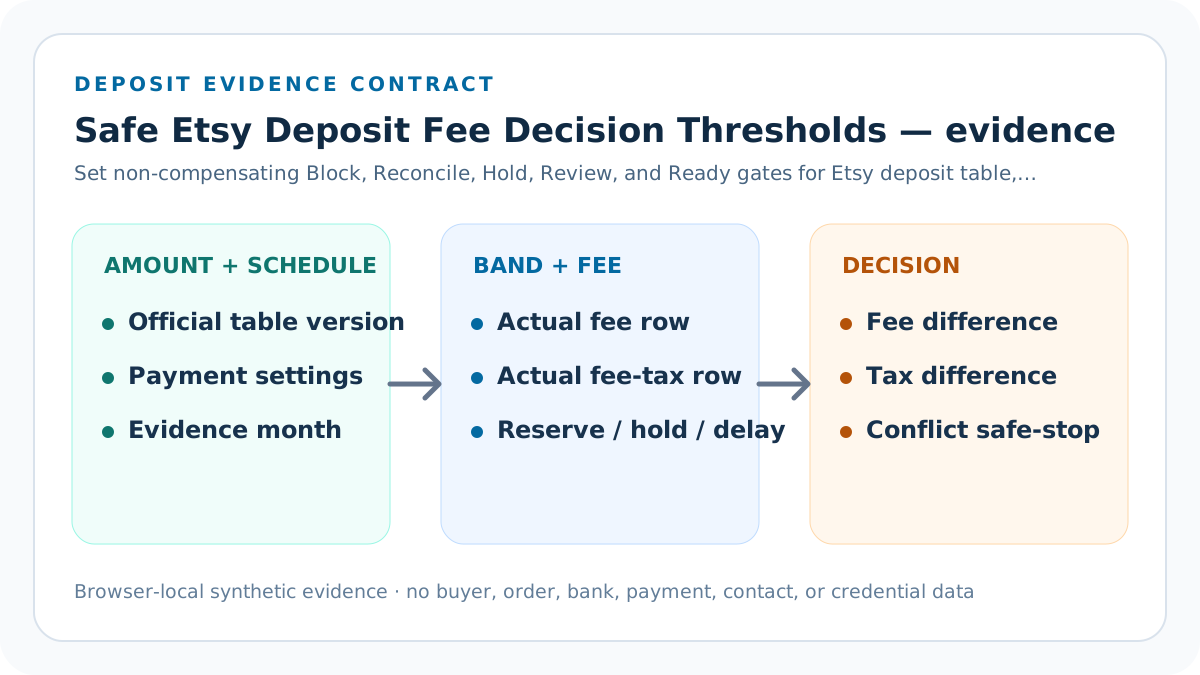
Require valid official-table and Available Funds dates plus explicit confirmations for bank country, country row, Available Funds, schedules, account constraints, and same-event actual rows. Missing evidence blocks rather than lowering a weighted score.
Apply deposit gates without compensation; a cheaper schedule cannot validate an unsupported country row. Gate-card row 8 is evaluated independently and in precedence order. Record the exact predicate, observed value, allowed range, resulting state, remediation owner, and retest condition; do not average failures or let a fee saving override an invalid table, unreconciled row, held amount, or declared conflict.
The gate test evaluates invalid country data, a fee-row variance, an amount exactly at the minimum, a reconciled high monthly exposure, and a clean fee-free packet. Expected states are Block, Reconcile, Hold, Review, and Ready respectively, with no compensating score or schedule preference.
Gate 9: exact decision precedence
Evaluate Block before Reconcile, Reconcile before Hold, Hold before Review, and Review before Ready. A packet with two simultaneous conditions takes the earliest failing state so a fee saving, clean total, or high score cannot compensate for missing proof.
Apply deposit gates without compensation; a cheaper schedule cannot validate an unsupported country row. Gate-card row 9 is evaluated independently and in precedence order. Record the exact predicate, observed value, allowed range, resulting state, remediation owner, and retest condition; do not average failures or let a fee saving override an invalid table, unreconciled row, held amount, or declared conflict.
The gate test evaluates invalid country data, a fee-row variance, an amount exactly at the minimum, a reconciled high monthly exposure, and a clean fee-free packet. Expected states are Block, Reconcile, Hold, Review, and Ready respectively, with no compensating score or schedule preference.
Gate 10: declared conflicts
Give reserve, hold, delay, refund, country, schedule, amount, fee, tax, currency, and statement issues Block precedence.
Apply deposit gates without compensation; a cheaper schedule cannot validate an unsupported country row. Gate-card row 10 is evaluated independently and in precedence order. Record the exact predicate, observed value, allowed range, resulting state, remediation owner, and retest condition; do not average failures or let a fee saving override an invalid table, unreconciled row, held amount, or declared conflict.
The gate test evaluates invalid country data, a fee-row variance, an amount exactly at the minimum, a reconciled high monthly exposure, and a clean fee-free packet. Expected states are Block, Reconcile, Hold, Review, and Ready respectively, with no compensating score or schedule preference.
Verification, release, and deposit feedback
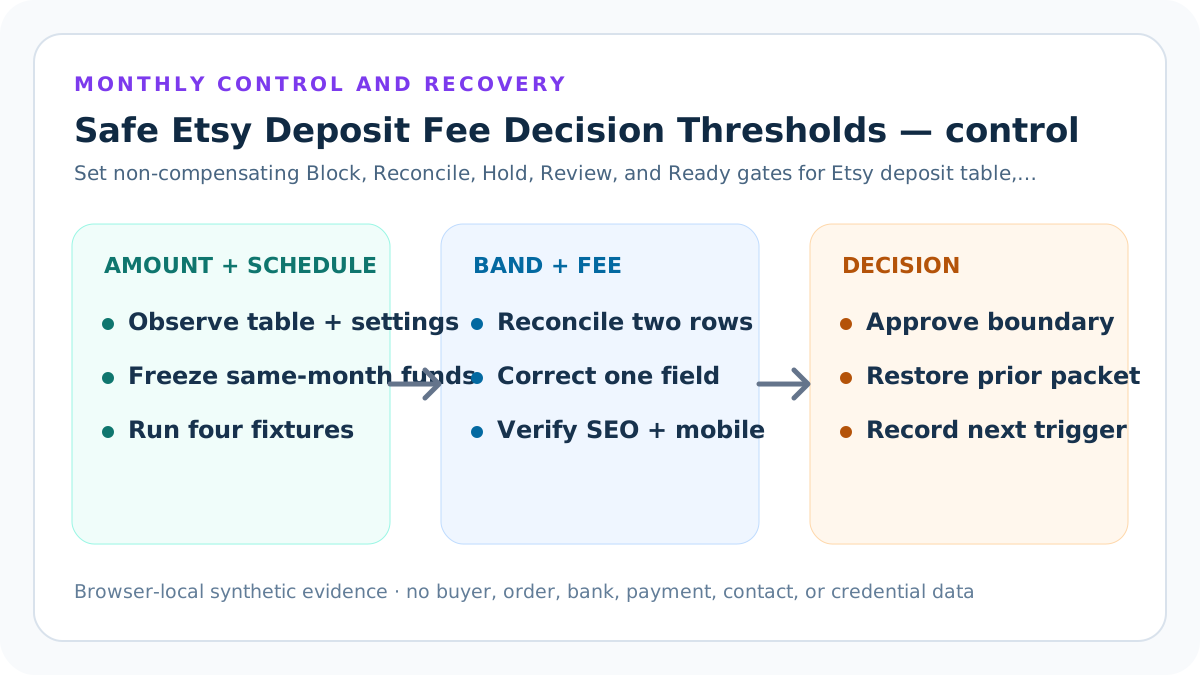
Before changing schedule guidance, fee-stack values, public routes, or calculator defaults, preserve the Block-Reconcile-Hold-Review-Ready deposit card, current official sources, private evidence pointers, inputs, expected fixtures, tests, build output, route inventory, release manifest, and rollback identifier. Safe-stop on an unexpected account, warning, authentication challenge, or target context.
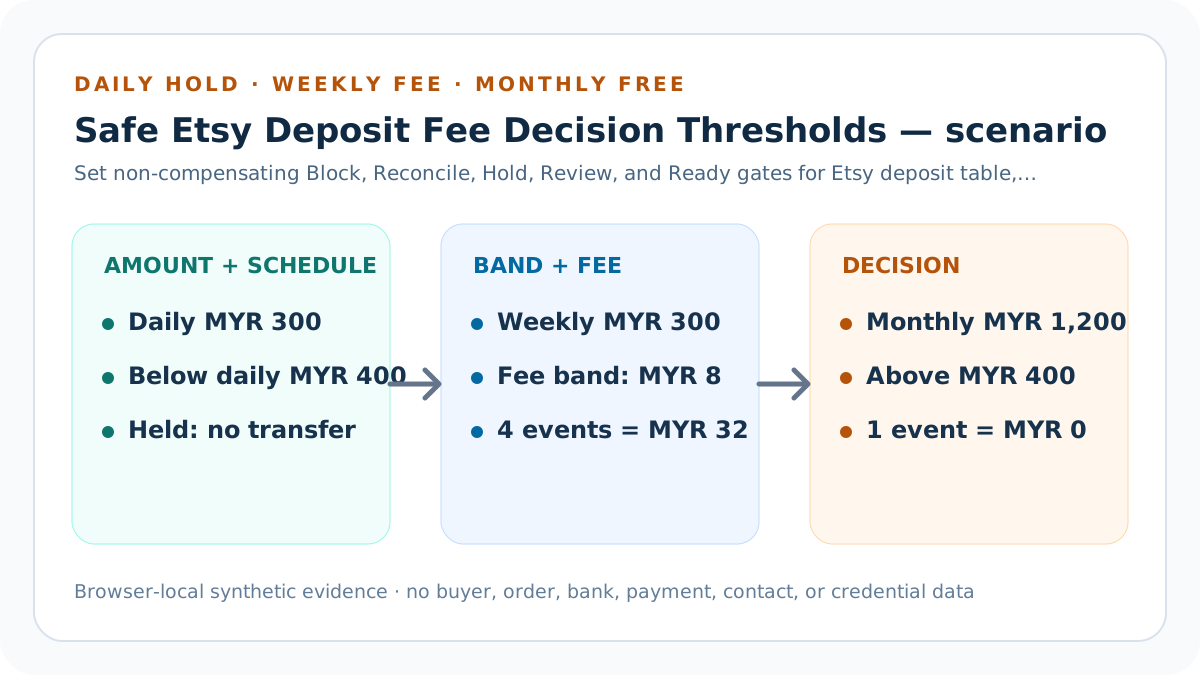
Require valid YYYY-MM-DD source and Available Funds dates, with the source review on or after the funds evidence; explicit yes confirmations for bank country, table row, Available Funds, schedules, account constraints, and actual rows; the exact scope “One scheduled Etsy Payments deposit”; and finite nonnegative amounts and tolerance. After a bounded correction, rerun MYR 300 Available Funds, MYR 9 minimum, MYR 400 fee and daily threshold, MYR 8 fee, and four modeled weekly deposits, the same MYR 1,200 monthly Available Funds in one MYR 1,200 monthly deposit, a daily MYR 300 amount held below Malaysia's MYR 400 daily threshold, MYR 9 Available Funds at the entered MYR 9 minimum, ZAR 1,000 Available Funds, ZAR 35 minimum, ZAR 1,500 threshold, ZAR 30 fee, and separately entered fee tax, and invalid dates, incomplete confirmations, a wrong evidence scope, negative rows, malformed currency, or a mismatched country table. Inspect exact amounts, band, fee, tax, net bank deposit, separate differences, monthly exposure, comparison, mobile layout, canonical, schema, sources, original visuals, internal links, and indexability.
Limits, privacy boundary, and next action
This guide and calculator do not reproduce every daily minimum, reserve, hold, delay, bank change, refund, holiday, instant transfer, Payoneer rule, tax, or future policy. They do not prove payout, bank receipt, liquidity, tax liability, accounting profit, ranking, traffic, qualified intent, AdSense approval, revenue, or income.
Keep buyer names, emails, addresses, messages, order and listing IDs, bank details, payment rows, tax identifiers, account notices, contacts, tokens, OAuth material, credentials, and raw exports outside the Block-Reconcile-Hold-Review-Ready deposit card. Verify current Etsy settings and actual statements, then obtain qualified accounting, tax, legal, or cash-management advice when material.
Sources and further reading
- Etsy Help: Receive Your Etsy Payments Deposit: Reviewed 2026-07-30: current schedules plus the nine-country daily threshold, additional minimum, fee-threshold, and fixed deposit-fee table.
- Etsy Payments Policy: Reviewed 2026-07-30: Available Funds, scheduled deposits, fee deduction, VAT boundary, returned-deposit refund, reserves, holds, and delays.
- Etsy Help: Fees and Taxes for Selling: Reviewed 2026-07-30: deposit-fee applicability in certain countries and the above-minimum, below-threshold band.
- Etsy Help: Calculate Your Etsy Payments Deposit: Available deposit amount, monthly statement evidence, fees, taxes, refunds, and activity since the prior deposit.
- Etsy Help: What Is Etsy Payments?: Etsy Payments eligibility plus additional minimum, threshold, and fee concepts in supported markets.
- Seller Profit Guard methodology: Evidence precedence, browser-local synthetic fixtures, privacy boundaries, deterministic decisions, validation, release, correction, and rollback.
Related Seller Profit Guard tools
- Open the Etsy Deposit Fee Calculator: Classify one scheduled deposit and compare monthly fee exposure with a less frequent schedule.
- Reconcile the Payment account: Compare expected deposit-fee and tax rows with actual statement activity.
- Calculate an Etsy Payments deposit: Trace sales, refunds, fees, taxes, reserves, holds, and available funds.
- Build the complete Etsy fee stack: Carry reconciled deposit fees into the wider seller-cost model without double counting.
- Run Seller Profit Guard: Combine the reconciled fee stack with direct costs, returns, and target contribution.
- Read the local-first methodology: Keep buyer, order, bank, tax, contact, credential, and raw export data outside public pages.
- Etsy Deposit Fee Formula and Inputs: Continue the formula, example, source, threshold, comparison, routine, interpretation, or audit workflow.
- Malaysia Etsy Deposit Fee Worked Example: Continue the formula, example, source, threshold, comparison, routine, interpretation, or audit workflow.
- Monthly Etsy Deposit Fee Scenario: Continue the formula, example, source, threshold, comparison, routine, interpretation, or audit workflow.
- 12 Etsy Deposit Fee Errors and Fixes: Continue the formula, example, source, threshold, comparison, routine, interpretation, or audit workflow.
- Etsy Deposit Fee Evidence Sources: Continue the formula, example, source, threshold, comparison, routine, interpretation, or audit workflow.
Next step: Open the Etsy Deposit Fee Calculator.
This is operational planning help, not tax, accounting, legal, financial, or platform-policy advice. Review the Terms and disclaimer, and verify current platform rules and fee assumptions before changing prices.