How to interpret creator sample payback without false precision
Last updated: 2026-07-31
Written and reviewed by Seller Profit Guard Editorial Team.
Treat payback as a conditional recovery statement for the included campaign costs and mature retained attributed orders. Eight required orders means seven are insufficient and eight meet the arithmetic threshold. It does not prove incremental demand, creator quality, correct attribution, contract compliance, cash availability, or accounting profit.
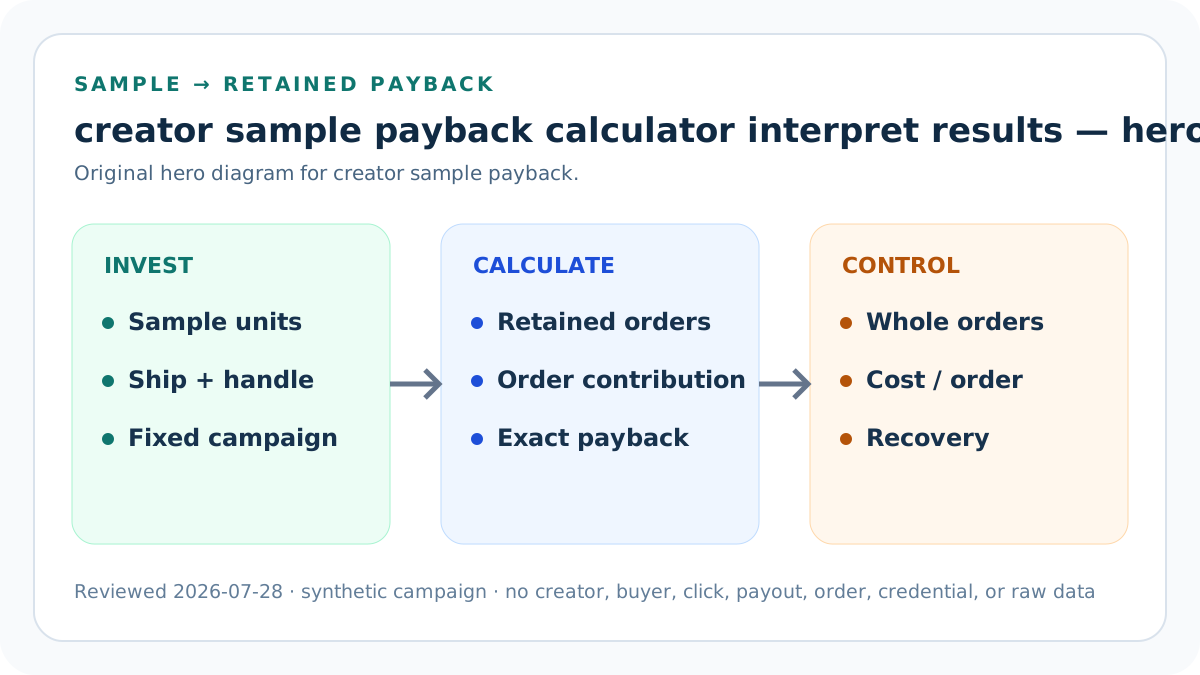
Read exact payback
Use it for sensitivity and comparison. In the sample payback interpretation note, record the exact field, unit, source version, evidence date, maturity state, reviewer, and declared uncertainty. Recalculate at full precision before formatting a currency amount, rate, ratio, or whole-order threshold.
Do not call 7.875 an achievable fraction of an order. Topic 1 documents a supported case, broken case, correction path, and why the conclusion belongs to a bounded creator campaign action rather than a platform-wide, creator-wide, or causal performance claim.
Read whole-order payback
Use the upward-rounded number for operational thresholds. In the sample payback interpretation note, record the exact field, unit, source version, evidence date, maturity state, reviewer, and declared uncertainty. Recalculate at full precision before formatting a currency amount, rate, ratio, or whole-order threshold.
Preserve the exact value beside it. Topic 2 documents a supported case, broken case, correction path, and why the conclusion belongs to a bounded creator campaign action rather than a platform-wide, creator-wide, or causal performance claim.
Read cost per retained order
Divide included campaign investment by mature retained orders. In the sample payback interpretation note, record the exact field, unit, source version, evidence date, maturity state, reviewer, and declared uncertainty. Recalculate at full precision before formatting a currency amount, rate, ratio, or whole-order threshold.
Do not use views, clicks, or gross orders. Topic 3 documents a supported case, broken case, correction path, and why the conclusion belongs to a bounded creator campaign action rather than a platform-wide, creator-wide, or causal performance claim.
Read progress
Compare closed retained orders with exact payback. In the sample payback interpretation note, record the exact field, unit, source version, evidence date, maturity state, reviewer, and declared uncertainty. Recalculate at full precision before formatting a currency amount, rate, ratio, or whole-order threshold.
More than 100% indicates modeled recovery, not causal ROI. Topic 4 documents a supported case, broken case, correction path, and why the conclusion belongs to a bounded creator campaign action rather than a platform-wide, creator-wide, or causal performance claim.
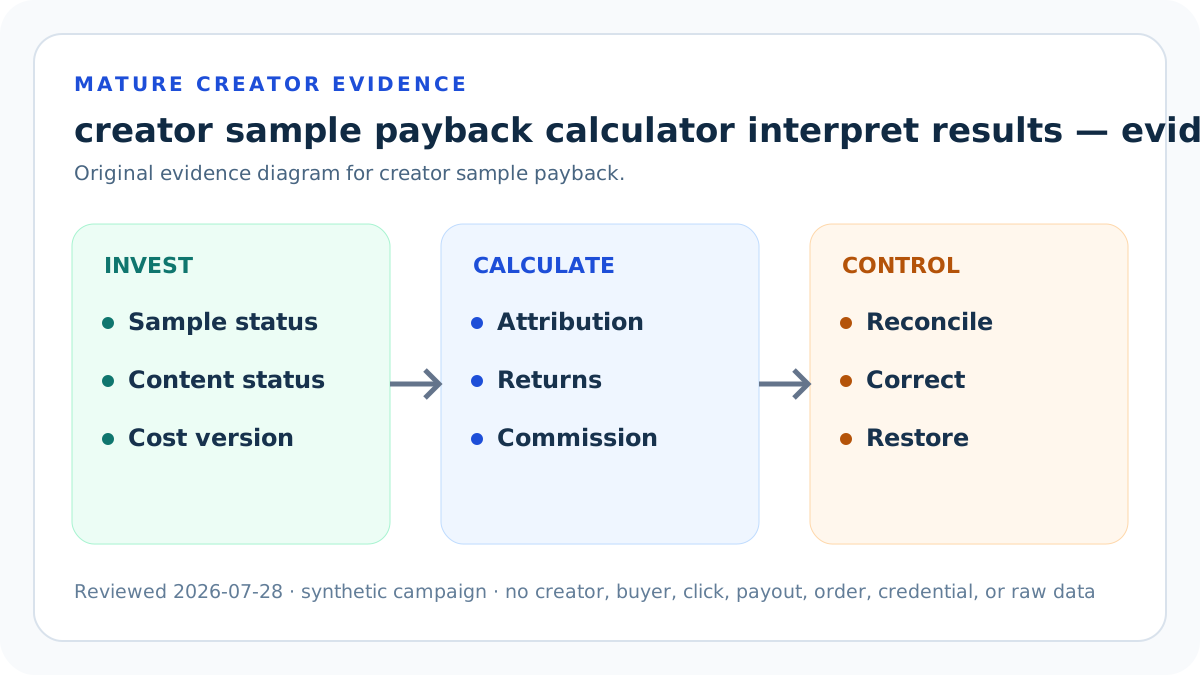
Read remaining orders
Subtract observed mature retained orders from the whole-order threshold. In the sample payback interpretation note, record the exact field, unit, source version, evidence date, maturity state, reviewer, and declared uncertainty. Recalculate at full precision before formatting a currency amount, rate, ratio, or whole-order threshold.
Open orders remain excluded. Topic 5 documents a supported case, broken case, correction path, and why the conclusion belongs to a bounded creator campaign action rather than a platform-wide, creator-wide, or causal performance claim.
Read contribution after campaign
Subtract investment from total retained-order contribution. In the sample payback interpretation note, record the exact field, unit, source version, evidence date, maturity state, reviewer, and declared uncertainty. Recalculate at full precision before formatting a currency amount, rate, ratio, or whole-order threshold.
It is not accounting net income or cash flow. Topic 6 documents a supported case, broken case, correction path, and why the conclusion belongs to a bounded creator campaign action rather than a platform-wide, creator-wide, or causal performance claim.
Read uncertainty
List attribution, maturity, cost, commission, return, rights, and scope sensitivity. In the sample payback interpretation note, record the exact field, unit, source version, evidence date, maturity state, reviewer, and declared uncertainty. Recalculate at full precision before formatting a currency amount, rate, ratio, or whole-order threshold.
Collect or review evidence when uncertainty can reverse the state. Topic 7 documents a supported case, broken case, correction path, and why the conclusion belongs to a bounded creator campaign action rather than a platform-wide, creator-wide, or causal performance claim.
Maturity and reconciliation: interpret creator sample payback results
Close sample, content, attribution, cancellation, refund, return, dispute, commission, payout, and reporting windows. Control 1 names the owner, review frequency, exception code, correction threshold, expiry trigger, and previous restorable packet.
Preserve open states and late adjustments. Apply the control specifically to a bounded creator campaign action; separate TikTok documentation, seller evidence, contract terms, and editable assumptions by authority.
Sensitivity and counterexample: interpret creator sample payback results
Change one supported input and show the exact payback effect. Control 2 names the owner, review frequency, exception code, correction threshold, expiry trigger, and previous restorable packet.
Retain unfavorable and unrecovered fixtures. Apply the control specifically to a bounded creator campaign action; separate TikTok documentation, seller evidence, contract terms, and editable assumptions by authority.
Mature retained-attributed rate floor: interpret creator sample payback results
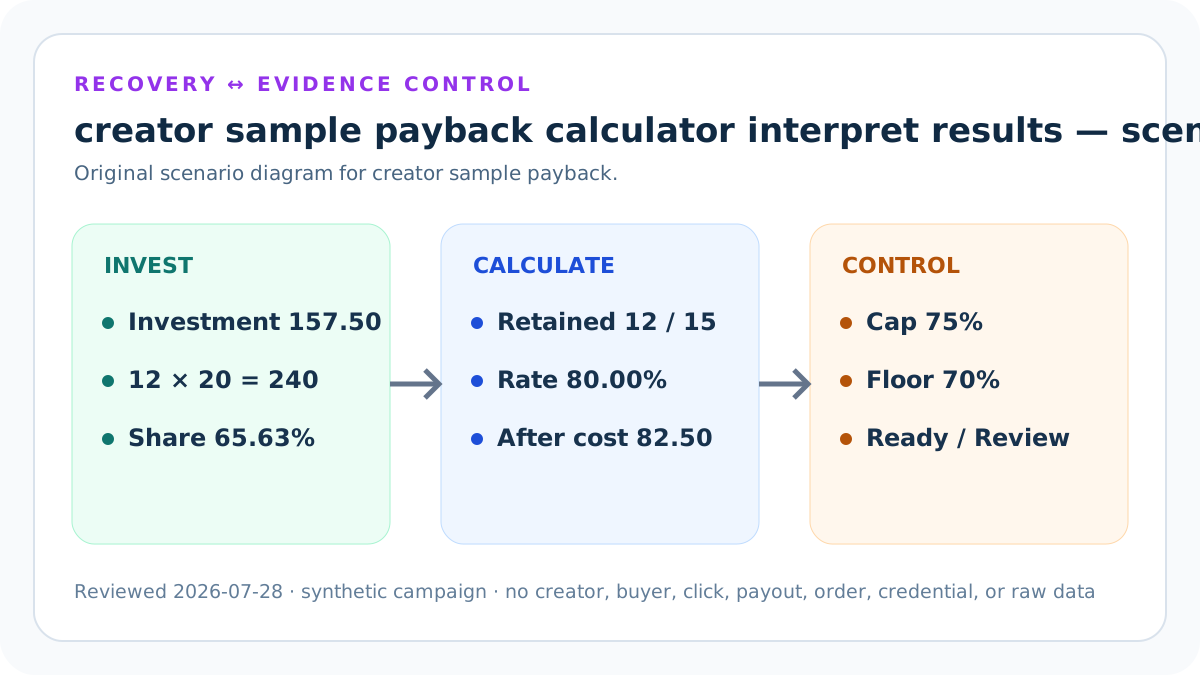
Divide mature retained attributed orders by all mature attributed orders. The default is 80%; 10 of 15 is 66.67% and Review against the seller's 70% minimum. Control 3 names the owner, review frequency, exception code, correction threshold, expiry trigger, and previous restorable packet.
The floor is a seller-owned evidence control, not a TikTok benchmark or creator score. Apply the control specifically to a bounded creator campaign action; separate TikTok documentation, seller evidence, contract terms, and editable assumptions by authority.
Privacy and access: interpret creator sample payback results
Use aggregate counts, synthetic fixtures, redacted pointers, role-based access, and retention rules. Control 4 names the owner, review frequency, exception code, correction threshold, expiry trigger, and previous restorable packet.
Exclude identities, raw exports, credentials, tokens, and OAuth. Apply the control specifically to a bounded creator campaign action; separate TikTok documentation, seller evidence, contract terms, and editable assumptions by authority.
Campaign investment-share cap: interpret creator sample payback results
Divide campaign investment by observed mature retained-order contribution. The default is 65.63%; USD 80 amplification raises it to 78.13% and Review against the seller's 75% cap. Control 5 names the owner, review frequency, exception code, correction threshold, expiry trigger, and previous restorable packet.
Positive recovery does not override excessive concentration of observed contribution in fixed campaign investment. Apply the control specifically to a bounded creator campaign action; separate TikTok documentation, seller evidence, contract terms, and editable assumptions by authority.
Read exact payback: verification drill
Recreate “Read exact payback” from a clean synthetic creator campaign instead of copying the default. Use it for sensitivity and comparison. Change one driver, preserve the original packet, show intermediate arithmetic, and attach the expected Block, Review, or Ready state to the sample payback interpretation note.
Do not call 7.875 an achievable fraction of an order. Drill 1 includes a micro-campaign case, larger-campaign case, immature-evidence case, and corrected case. Explain which variable moved, which denominator remained fixed, how payback changed, and what evidence permits the next action.
Read whole-order payback: verification drill
Recreate “Read whole-order payback” from a clean synthetic creator campaign instead of copying the default. Use the upward-rounded number for operational thresholds. Change one driver, preserve the original packet, show intermediate arithmetic, and attach the expected Block, Review, or Ready state to the sample payback interpretation note.
Preserve the exact value beside it. Drill 2 includes a micro-campaign case, larger-campaign case, immature-evidence case, and corrected case. Explain which variable moved, which denominator remained fixed, how payback changed, and what evidence permits the next action.
Read cost per retained order: verification drill
Recreate “Read cost per retained order” from a clean synthetic creator campaign instead of copying the default. Divide included campaign investment by mature retained orders. Change one driver, preserve the original packet, show intermediate arithmetic, and attach the expected Block, Review, or Ready state to the sample payback interpretation note.
Do not use views, clicks, or gross orders. Drill 3 includes a micro-campaign case, larger-campaign case, immature-evidence case, and corrected case. Explain which variable moved, which denominator remained fixed, how payback changed, and what evidence permits the next action.
Read progress: verification drill
Recreate “Read progress” from a clean synthetic creator campaign instead of copying the default. Compare closed retained orders with exact payback. Change one driver, preserve the original packet, show intermediate arithmetic, and attach the expected Block, Review, or Ready state to the sample payback interpretation note.
More than 100% indicates modeled recovery, not causal ROI. Drill 4 includes a micro-campaign case, larger-campaign case, immature-evidence case, and corrected case. Explain which variable moved, which denominator remained fixed, how payback changed, and what evidence permits the next action.
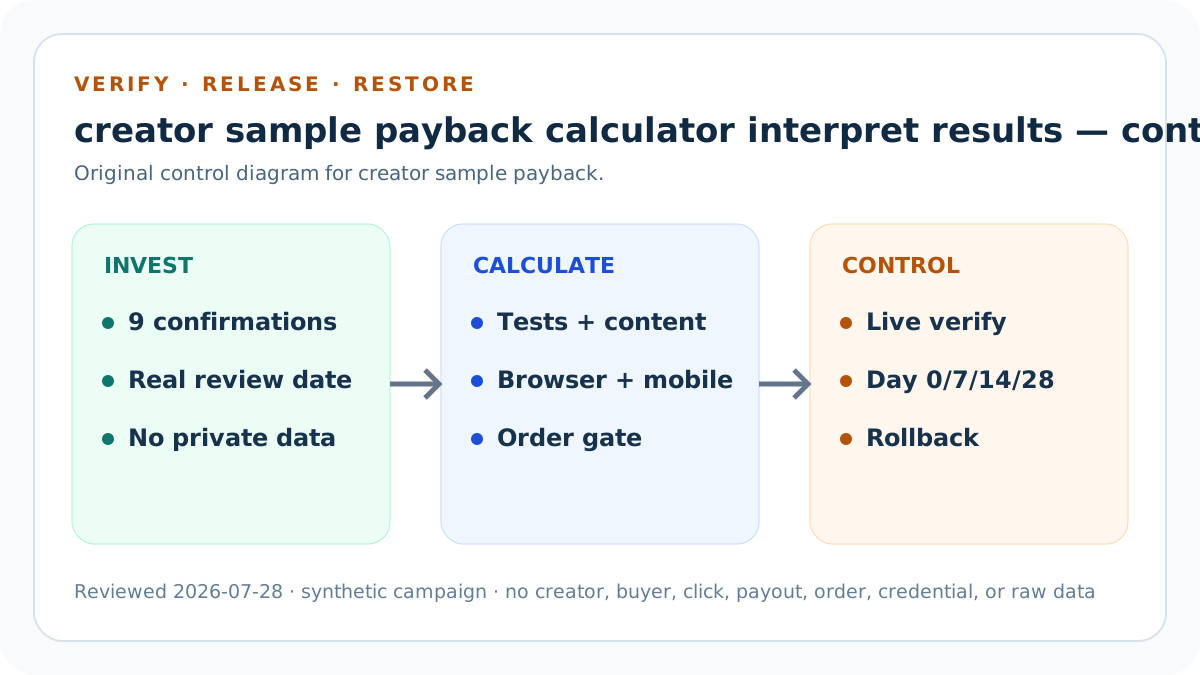
Read remaining orders: verification drill
Recreate “Read remaining orders” from a clean synthetic creator campaign instead of copying the default. Subtract observed mature retained orders from the whole-order threshold. Change one driver, preserve the original packet, show intermediate arithmetic, and attach the expected Block, Review, or Ready state to the sample payback interpretation note.
Open orders remain excluded. Drill 5 includes a micro-campaign case, larger-campaign case, immature-evidence case, and corrected case. Explain which variable moved, which denominator remained fixed, how payback changed, and what evidence permits the next action.
Read contribution after campaign: verification drill
Recreate “Read contribution after campaign” from a clean synthetic creator campaign instead of copying the default. Subtract investment from total retained-order contribution. Change one driver, preserve the original packet, show intermediate arithmetic, and attach the expected Block, Review, or Ready state to the sample payback interpretation note.
It is not accounting net income or cash flow. Drill 6 includes a micro-campaign case, larger-campaign case, immature-evidence case, and corrected case. Explain which variable moved, which denominator remained fixed, how payback changed, and what evidence permits the next action.
Read uncertainty: verification drill
Recreate “Read uncertainty” from a clean synthetic creator campaign instead of copying the default. List attribution, maturity, cost, commission, return, rights, and scope sensitivity. Change one driver, preserve the original packet, show intermediate arithmetic, and attach the expected Block, Review, or Ready state to the sample payback interpretation note.
Collect or review evidence when uncertainty can reverse the state. Drill 7 includes a micro-campaign case, larger-campaign case, immature-evidence case, and corrected case. Explain which variable moved, which denominator remained fixed, how payback changed, and what evidence permits the next action.
What a bounded creator campaign action can and cannot prove
It can prove that the displayed arithmetic follows the declared sample states, campaign investment, per-retained-order contribution, attribution convention, maturity window, currency, and evidence version.
It cannot prove incremental sales, creator quality, correct attribution, compliance, contract enforceability, payout authority, tax treatment, accounting profit, liquidity, customer lifetime value, or future performance.
Block, review, release, and restore sample payback interpretation note
Block invalid, private, conflicted, or materially immature evidence. Review valid arithmetic below whole-order payback or sensitive to supported stresses. Ready means observed mature retained contribution recovers included investment and quality gates pass.
Release only a reversible public model with synthetic defaults, explicit sources, original diagrams, accessible labels, canonical and schema checks, internal links, strict 404 behavior, correction policy, and rollback evidence.
Sources and further reading
- Seller Profit Guard methodology: Contribution equations, evidence versions, privacy, correction, release, and rollback.
- Seller Profit Guard data privacy: Local-first boundaries for creator, buyer, order, advertising, payout, refund, and raw-record data.
- TikTok Shop Academy: How Creators Can Request Samples: Official April 10, 2026 context for free and refundable samples, creator content obligations, eligibility, request states, and sample management.
- TikTok Shop Academy: Refundable Samples Terms for Sellers: Official May 14, 2026 seller terms for eligibility, seller-set sales criteria, criteria versioning, return-window maturity, refunds, commissions, availability, and settlement.
- TikTok Business Help: Affiliate creatives for TikTok Shop Ads: Official March 2026 context for authorized affiliate creative, commissions, Shop Ads, and Seller Center attribution reporting.
Related Seller Profit Guard tools
- Creator Sample Payback Calculator: Calculate fixed campaign recovery from mature retained attributed order contribution.
- Affiliate Commission Calculator: Model order commission separately from fixed sample investment.
- Paid CPA Limit Calculator: Keep customer-acquisition cost capacity separate from creator sample recovery.
- TikTok Ads CPA Limit: Use the TikTok-specific paid acquisition model.
- Contribution Margin Calculator: Reconstruct retained-order contribution.
- Methodology: Review evidence, privacy, calculation, correction, release, and rollback.
- Data Privacy: Protect creator, buyer, order, advertising, payout, and credential data.
- Creator Sample Payback Formula and Inputs: Calculate creator-sample investment, retained-order contribution, payback orders, allocation, and campaign recovery from mature evidence.
- Creator Sample Payback Micro-Creator Example: Follow five synthetic samples and paid amplification through campaign investment, retained-order contribution, and payback.
- Creator Sample Payback for Larger Campaigns: Model a larger creator campaign with more samples, fixed fees, usage rights, paid amplification, and a longer recovery path.
- Creator Sample Payback Calculation Mistakes: Correct sample-state, retail-value, gross-order, commission, return, attribution, paid-spend, and double-counting errors.
- Creator Sample Payback Evidence Sources: Map sample, shipping, handling, creator, rights, ad, commission, order, return, and contribution inputs to first-party records.
- Safe Creator Sample Payback Thresholds: Set whole-order payback, progress, stress, warning, stop, scale, release, and rollback thresholds for creator sample campaigns.
- Micro-Creator vs Larger Creator Sample Payback: Compare small and large creator sample campaigns at one retained-order contribution grain without hiding fixed-cost differences.
- Weekly Creator Sample Payback Review: Run a repeatable cycle from sample and creative status through order maturity, contribution, payback, correction, and rollback.
- Creator Sample Payback Audit Template: Use a standalone checklist and dated change log for sample status, campaign investment, mature orders, contribution, release, and rollback.
Next step: Open Seller Profit Guard.
This is operational planning help, not tax, accounting, legal, financial, or platform-policy advice. Review the Terms and disclaimer, and verify current platform rules and fee assumptions before changing prices.