Dead stock markdown formula, inputs, and boundaries
Last updated: 2026-07-31
Written and reviewed by Seller Profit Guard Editorial Team.
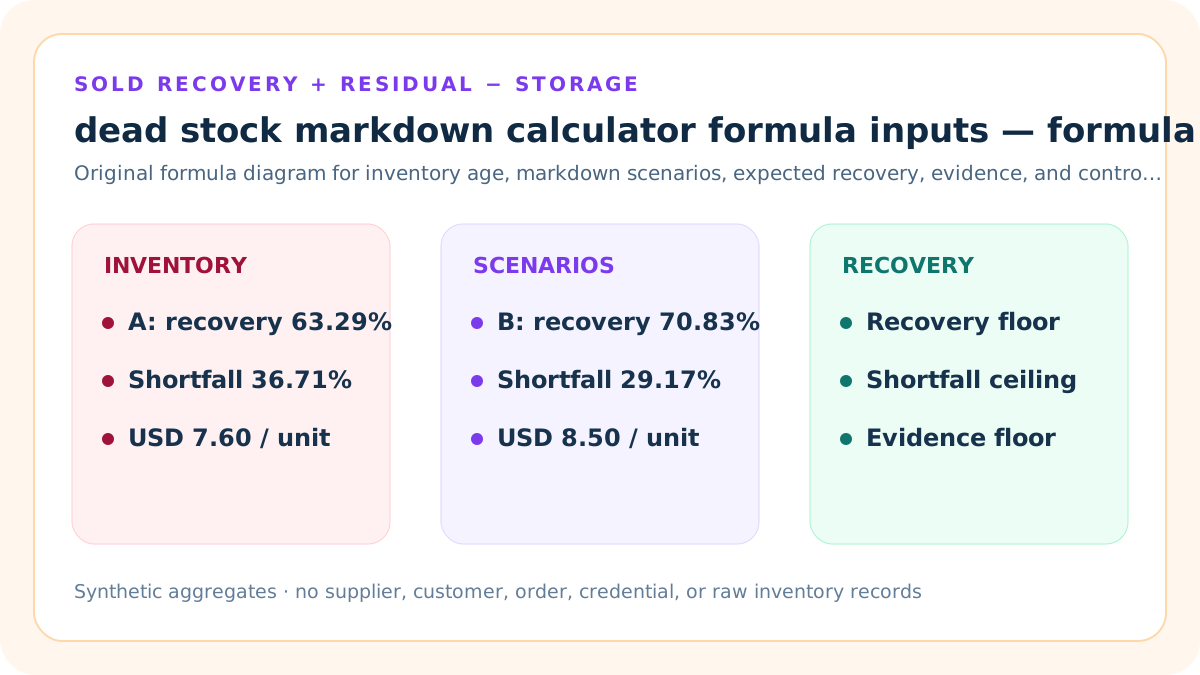
Expected net recovery equals expected sold units multiplied by net recovery per sold unit, plus expected disposal recovery, minus decision-window storage. Divide that amount by inventory cost basis for the recovery rate. Use one SKU-location, currency, price state, evidence window, and cost definition; the result is a scenario, not a forecast.
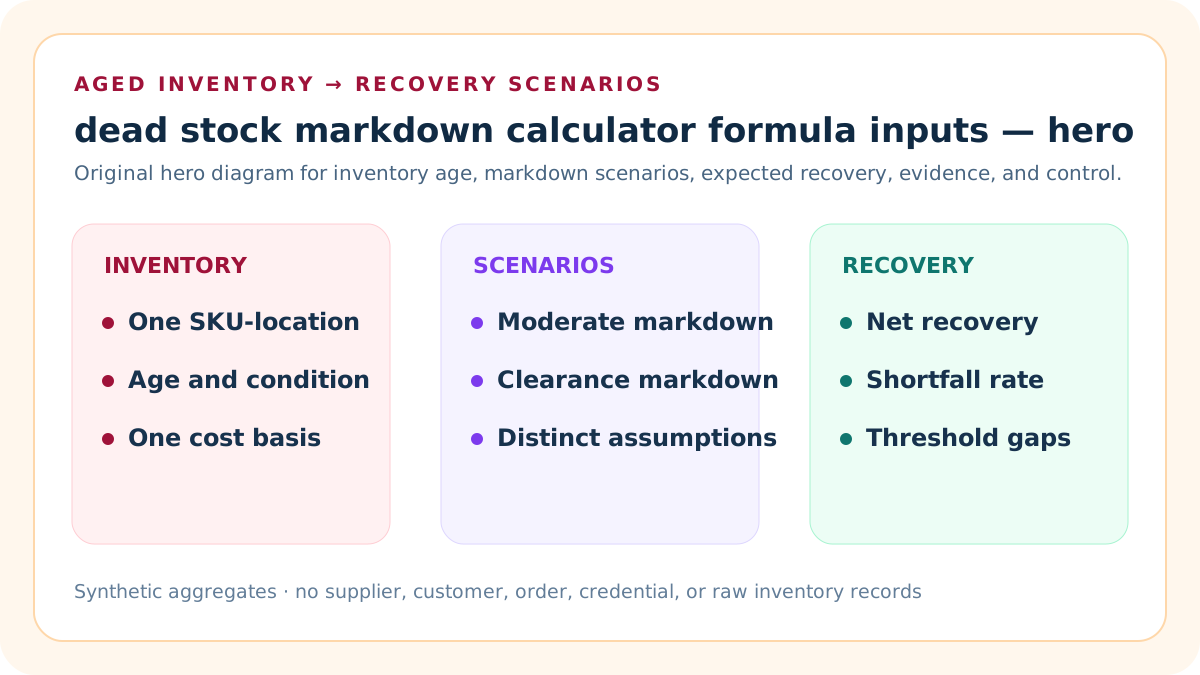
Define the inventory population
Reconcile sellable on-hand units at one SKU-location and exclude reserved, damaged, expired, or committed stock unless explicitly modeled. The markdown formula specification records the exact source, definition, period, unit, currency, transformation, timestamp, owner, reviewer, exception, and prior accepted value needed for a reproducible expected-recovery comparison.
A mixed unit population blocks the calculation. At checkpoint 1, reperform the affected Scenario A and Scenario B terms, identify the input that changes expected recovery, and state the operational, accounting, tax, policy, or privacy conclusion that remains outside the calculator.
Define current and markdown price
Record the current price state, markdown percentage, effective date, and whether the change is permanent, clearance, or temporary. The markdown formula specification records the exact source, definition, period, unit, currency, transformation, timestamp, owner, reviewer, exception, and prior accepted value needed for a reproducible expected-recovery comparison.
A scenario price is not execution authority. At checkpoint 2, reperform the affected Scenario A and Scenario B terms, identify the input that changes expected recovery, and state the operational, accounting, tax, policy, or privacy conclusion that remains outside the calculator.
Define sell-through probability
Name the denominator, window, price state, availability state, season, placement, and channel used to estimate probability. The markdown formula specification records the exact source, definition, period, unit, currency, transformation, timestamp, owner, reviewer, exception, and prior accepted value needed for a reproducible expected-recovery comparison.
Historical sell-through is not a guaranteed forecast. At checkpoint 3, reperform the affected Scenario A and Scenario B terms, identify the input that changes expected recovery, and state the operational, accounting, tax, policy, or privacy conclusion that remains outside the calculator.
Define sold-unit costs
Map percentage selling fees and per-sold-unit fulfillment once to the markdown price. The markdown formula specification records the exact source, definition, period, unit, currency, transformation, timestamp, owner, reviewer, exception, and prior accepted value needed for a reproducible expected-recovery comparison.
Do not duplicate packaging or shipping. At checkpoint 4, reperform the affected Scenario A and Scenario B terms, identify the input that changes expected recovery, and state the operational, accounting, tax, policy, or privacy conclusion that remains outside the calculator.
Define storage and disposal
Assign decision-window storage to all modeled on-hand units and conservative recovery to expected unsold units. The markdown formula specification records the exact source, definition, period, unit, currency, transformation, timestamp, owner, reviewer, exception, and prior accepted value needed for a reproducible expected-recovery comparison.
Annual carrying cost is a separate model. At checkpoint 5, reperform the affected Scenario A and Scenario B terms, identify the input that changes expected recovery, and state the operational, accounting, tax, policy, or privacy conclusion that remains outside the calculator.
Define cost basis and recovery rate
Multiply on-hand units by one consistent unit cost and divide expected net recovery by that basis. The markdown formula specification records the exact source, definition, period, unit, currency, transformation, timestamp, owner, reviewer, exception, and prior accepted value needed for a reproducible expected-recovery comparison.
This is not an accounting or tax valuation. At checkpoint 6, reperform the affected Scenario A and Scenario B terms, identify the input that changes expected recovery, and state the operational, accounting, tax, policy, or privacy conclusion that remains outside the calculator.
Preserve formula order
Calculate price, expected units, sold recovery, unsold recovery, storage, net recovery, and rate in a visible sequence. The markdown formula specification records the exact source, definition, period, unit, currency, transformation, timestamp, owner, reviewer, exception, and prior accepted value needed for a reproducible expected-recovery comparison.
Preserve unrounded intermediate values. At checkpoint 7, reperform the affected Scenario A and Scenario B terms, identify the input that changes expected recovery, and state the operational, accounting, tax, policy, or privacy conclusion that remains outside the calculator.
Set validation controls
Constrain units, nonnegative costs, percentages, evidence days, currency, scope, and open conflicts. The markdown formula specification records the exact source, definition, period, unit, currency, transformation, timestamp, owner, reviewer, exception, and prior accepted value needed for a reproducible expected-recovery comparison.
Invalid structure returns Block. At checkpoint 8, reperform the affected Scenario A and Scenario B terms, identify the input that changes expected recovery, and state the operational, accounting, tax, policy, or privacy conclusion that remains outside the calculator.
Document exclusions
Keep advertising, overhead, tax, financing, opportunity cost, returns, and cash timing outside unless separately modeled. The markdown formula specification records the exact source, definition, period, unit, currency, transformation, timestamp, owner, reviewer, exception, and prior accepted value needed for a reproducible expected-recovery comparison.
Do not call the output profit. At checkpoint 9, reperform the affected Scenario A and Scenario B terms, identify the input that changes expected recovery, and state the operational, accounting, tax, policy, or privacy conclusion that remains outside the calculator.
Record restoration values
Retain prior price, inputs, output, reviewer, approval, stop condition, and rollback path. The markdown formula specification records the exact source, definition, period, unit, currency, transformation, timestamp, owner, reviewer, exception, and prior accepted value needed for a reproducible expected-recovery comparison.
A reversible packet is required. At checkpoint 10, reperform the affected Scenario A and Scenario B terms, identify the input that changes expected recovery, and state the operational, accounting, tax, policy, or privacy conclusion that remains outside the calculator.
Dead Stock Markdown Formula and Inputs: population integrity control
Keep one SKU-location, condition state, availability rule, unit count, and cost basis. Control 1 defines a pass condition, evidence owner, independent reviewer, correction deadline, sensitivity range, monitoring signal, stop condition, and restoration trigger before the markdown formula specification can support a reproducible expected-recovery comparison.
Mixed inventory blocks. Apply the control to both synthetic fixtures while keeping inventory age, markdown price, expected units, selling costs, storage, disposal recovery, cost basis, recovery rate, and decision authority as separate concepts.
Dead Stock Markdown Formula and Inputs: probability lineage control
Record sell-through definition, window, price, season, placement, availability, and source delay. Control 2 defines a pass condition, evidence owner, independent reviewer, correction deadline, sensitivity range, monitoring signal, stop condition, and restoration trigger before the markdown formula specification can support a reproducible expected-recovery comparison.
Unsupported probability requires Review. Apply the control to both synthetic fixtures while keeping inventory age, markdown price, expected units, selling costs, storage, disposal recovery, cost basis, recovery rate, and decision authority as separate concepts.
Dead Stock Markdown Formula and Inputs: cost separation control
Map fees, fulfillment, storage, disposal, and cost basis once. Control 3 defines a pass condition, evidence owner, independent reviewer, correction deadline, sensitivity range, monitoring signal, stop condition, and restoration trigger before the markdown formula specification can support a reproducible expected-recovery comparison.
Duplicate or missing cost blocks. Apply the control to both synthetic fixtures while keeping inventory age, markdown price, expected units, selling costs, storage, disposal recovery, cost basis, recovery rate, and decision authority as separate concepts.
Dead Stock Markdown Formula and Inputs: three seller thresholds control
Compare expected recovery rate, cost-basis shortfall rate, and evidence days with three separately entered seller controls. Control 4 defines a pass condition, evidence owner, independent reviewer, correction deadline, sensitivity range, monitoring signal, stop condition, and restoration trigger before the markdown formula specification can support a reproducible expected-recovery comparison.
One passing threshold cannot override another. Apply the control to both synthetic fixtures while keeping inventory age, markdown price, expected units, selling costs, storage, disposal recovery, cost basis, recovery rate, and decision authority as separate concepts.
Dead Stock Markdown Formula and Inputs: dated evidence governance control
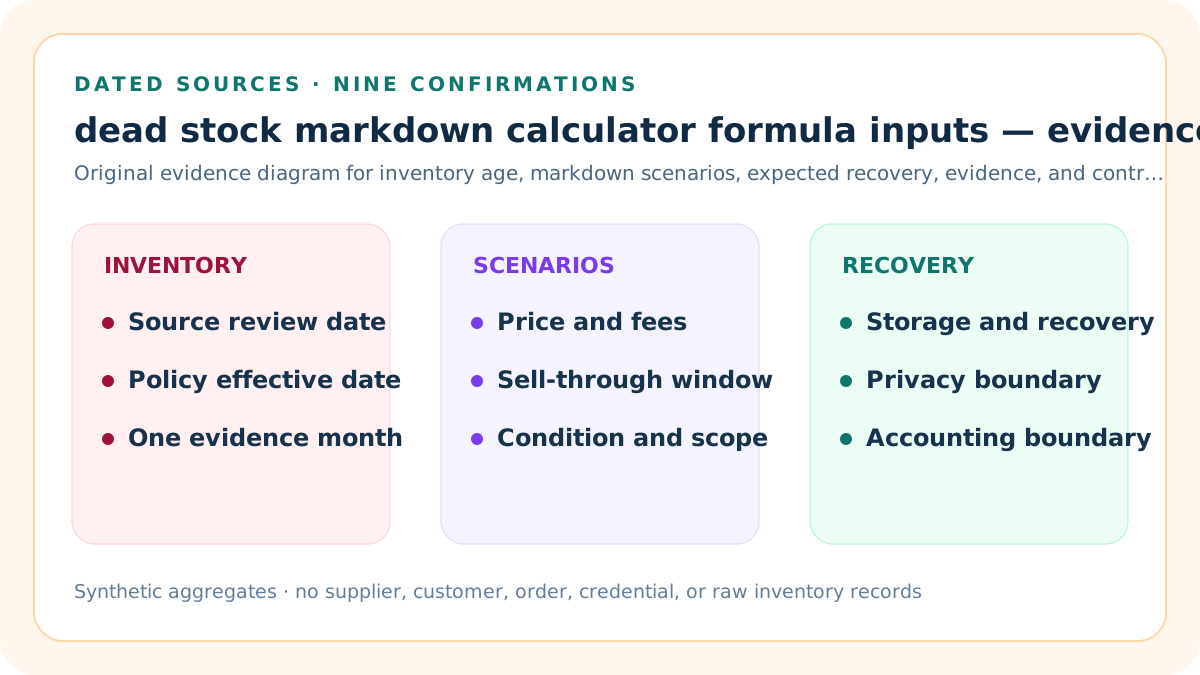
Record a real source-review date and seller-policy effective date, with policy no later than the reviewed evidence. Control 5 defines a pass condition, evidence owner, independent reviewer, correction deadline, sensitivity range, monitoring signal, stop condition, and restoration trigger before the markdown formula specification can support a reproducible expected-recovery comparison.
Impossible or reversed dates block. Apply the control to both synthetic fixtures while keeping inventory age, markdown price, expected units, selling costs, storage, disposal recovery, cost basis, recovery rate, and decision authority as separate concepts.
Dead Stock Markdown Formula and Inputs: nine confirmations control
Confirm SKU-location grain, on-hand and cost basis, price and fees, sell-through, storage and fulfillment, residual recovery, condition, privacy, and accounting boundaries. Control 6 defines a pass condition, evidence owner, independent reviewer, correction deadline, sensitivity range, monitoring signal, stop condition, and restoration trigger before the markdown formula specification can support a reproducible expected-recovery comparison.
Any missing confirmation blocks. Apply the control to both synthetic fixtures while keeping inventory age, markdown price, expected units, selling costs, storage, disposal recovery, cost basis, recovery rate, and decision authority as separate concepts.
Dead Stock Markdown Formula and Inputs: distinct scenarios control
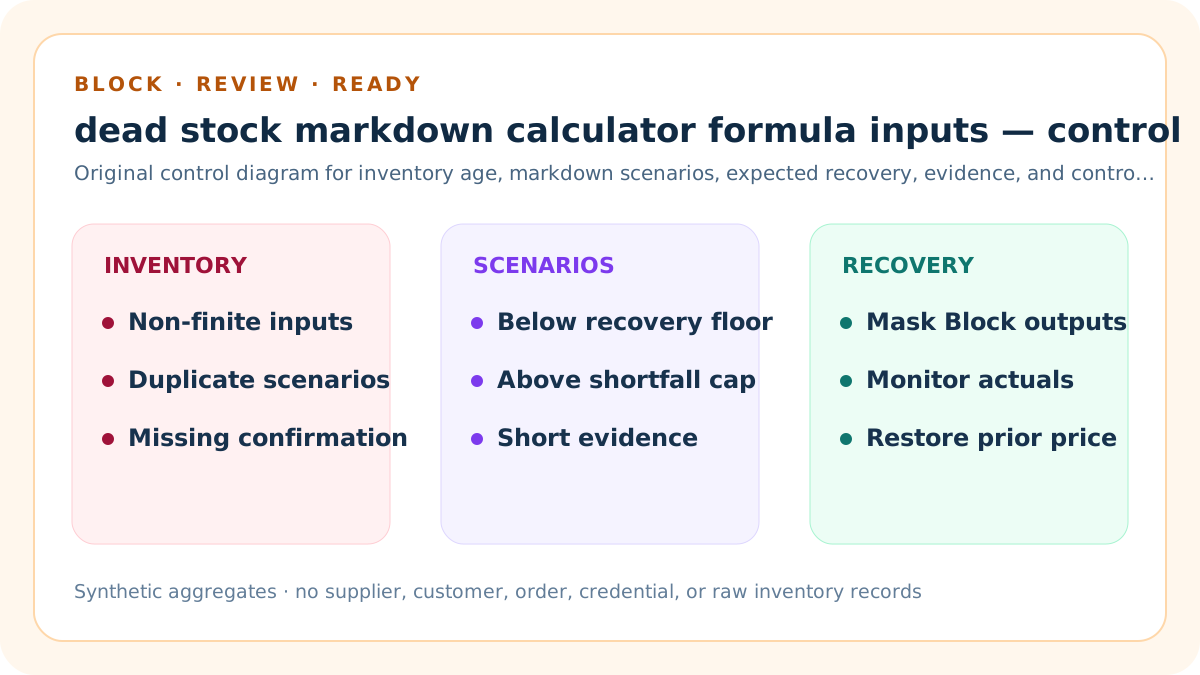
Change at least one markdown, probability, selling cost, residual recovery, age, or evidence-window assumption between the two cases. Control 7 defines a pass condition, evidence owner, independent reviewer, correction deadline, sensitivity range, monitoring signal, stop condition, and restoration trigger before the markdown formula specification can support a reproducible expected-recovery comparison.
A copied scenario is not a comparison. Apply the control to both synthetic fixtures while keeping inventory age, markdown price, expected units, selling costs, storage, disposal recovery, cost basis, recovery rate, and decision authority as separate concepts.
Dead Stock Markdown Formula and Inputs: output masking control
Mask derived money, rates, units, preference, and threshold gaps whenever structural validation returns Block. Control 8 defines a pass condition, evidence owner, independent reviewer, correction deadline, sensitivity range, monitoring signal, stop condition, and restoration trigger before the markdown formula specification can support a reproducible expected-recovery comparison.
Never act on partial invalid arithmetic. Apply the control to both synthetic fixtures while keeping inventory age, markdown price, expected units, selling costs, storage, disposal recovery, cost basis, recovery rate, and decision authority as separate concepts.
Dead Stock Markdown Formula and Inputs: decision boundary control
Separate scenario recovery from forecasting, accounting, tax, pricing authority, promotion setup, and disposal approval. Control 9 defines a pass condition, evidence owner, independent reviewer, correction deadline, sensitivity range, monitoring signal, stop condition, and restoration trigger before the markdown formula specification can support a reproducible expected-recovery comparison.
Arithmetic cannot authorize action. Apply the control to both synthetic fixtures while keeping inventory age, markdown price, expected units, selling costs, storage, disposal recovery, cost basis, recovery rate, and decision authority as separate concepts.
Dead Stock Markdown Formula and Inputs: privacy and recovery control
Use aggregates, protect source rows, retain prior values, monitor variance, and preserve restoration. Control 10 defines a pass condition, evidence owner, independent reviewer, correction deadline, sensitivity range, monitoring signal, stop condition, and restoration trigger before the markdown formula specification can support a reproducible expected-recovery comparison.
Public buyer or order data is prohibited. Apply the control to both synthetic fixtures while keeping inventory age, markdown price, expected units, selling costs, storage, disposal recovery, cost basis, recovery rate, and decision authority as separate concepts.
Define the inventory population: recovery lab 1
Recalculate the relevant output from both fixtures. Reconcile sellable on-hand units at one SKU-location and exclude reserved, damaged, expired, or committed stock unless explicitly modeled. Change one input only, retain every other population and cost assumption, and record the new expected sold units, unsold units, net recovery, recovery rate, threshold headroom, and preferred scenario.
A mixed unit population blocks the calculation. Test a low and high case for sell-through, price, fee, fulfillment, storage, and disposal recovery. Explain when the preference crosses over and which protected evidence or approval would still be required before an inventory action.
Define current and markdown price: recovery lab 2
Recalculate the relevant output from both fixtures. Record the current price state, markdown percentage, effective date, and whether the change is permanent, clearance, or temporary. Change one input only, retain every other population and cost assumption, and record the new expected sold units, unsold units, net recovery, recovery rate, threshold headroom, and preferred scenario.
A scenario price is not execution authority. Test a low and high case for sell-through, price, fee, fulfillment, storage, and disposal recovery. Explain when the preference crosses over and which protected evidence or approval would still be required before an inventory action.
Define sell-through probability: recovery lab 3
Recalculate the relevant output from both fixtures. Name the denominator, window, price state, availability state, season, placement, and channel used to estimate probability. Change one input only, retain every other population and cost assumption, and record the new expected sold units, unsold units, net recovery, recovery rate, threshold headroom, and preferred scenario.
Historical sell-through is not a guaranteed forecast. Test a low and high case for sell-through, price, fee, fulfillment, storage, and disposal recovery. Explain when the preference crosses over and which protected evidence or approval would still be required before an inventory action.
Define sold-unit costs: recovery lab 4
Recalculate the relevant output from both fixtures. Map percentage selling fees and per-sold-unit fulfillment once to the markdown price. Change one input only, retain every other population and cost assumption, and record the new expected sold units, unsold units, net recovery, recovery rate, threshold headroom, and preferred scenario.
Do not duplicate packaging or shipping. Test a low and high case for sell-through, price, fee, fulfillment, storage, and disposal recovery. Explain when the preference crosses over and which protected evidence or approval would still be required before an inventory action.
Define storage and disposal: recovery lab 5
Recalculate the relevant output from both fixtures. Assign decision-window storage to all modeled on-hand units and conservative recovery to expected unsold units. Change one input only, retain every other population and cost assumption, and record the new expected sold units, unsold units, net recovery, recovery rate, threshold headroom, and preferred scenario.
Annual carrying cost is a separate model. Test a low and high case for sell-through, price, fee, fulfillment, storage, and disposal recovery. Explain when the preference crosses over and which protected evidence or approval would still be required before an inventory action.
Define cost basis and recovery rate: recovery lab 6
Recalculate the relevant output from both fixtures. Multiply on-hand units by one consistent unit cost and divide expected net recovery by that basis. Change one input only, retain every other population and cost assumption, and record the new expected sold units, unsold units, net recovery, recovery rate, threshold headroom, and preferred scenario.
This is not an accounting or tax valuation. Test a low and high case for sell-through, price, fee, fulfillment, storage, and disposal recovery. Explain when the preference crosses over and which protected evidence or approval would still be required before an inventory action.
Preserve formula order: recovery lab 7
Recalculate the relevant output from both fixtures. Calculate price, expected units, sold recovery, unsold recovery, storage, net recovery, and rate in a visible sequence. Change one input only, retain every other population and cost assumption, and record the new expected sold units, unsold units, net recovery, recovery rate, threshold headroom, and preferred scenario.
Preserve unrounded intermediate values. Test a low and high case for sell-through, price, fee, fulfillment, storage, and disposal recovery. Explain when the preference crosses over and which protected evidence or approval would still be required before an inventory action.
Set validation controls: recovery lab 8
Recalculate the relevant output from both fixtures. Constrain units, nonnegative costs, percentages, evidence days, currency, scope, and open conflicts. Change one input only, retain every other population and cost assumption, and record the new expected sold units, unsold units, net recovery, recovery rate, threshold headroom, and preferred scenario.
Invalid structure returns Block. Test a low and high case for sell-through, price, fee, fulfillment, storage, and disposal recovery. Explain when the preference crosses over and which protected evidence or approval would still be required before an inventory action.
Document exclusions: recovery lab 9
Recalculate the relevant output from both fixtures. Keep advertising, overhead, tax, financing, opportunity cost, returns, and cash timing outside unless separately modeled. Change one input only, retain every other population and cost assumption, and record the new expected sold units, unsold units, net recovery, recovery rate, threshold headroom, and preferred scenario.
Do not call the output profit. Test a low and high case for sell-through, price, fee, fulfillment, storage, and disposal recovery. Explain when the preference crosses over and which protected evidence or approval would still be required before an inventory action.
Record restoration values: recovery lab 10
Recalculate the relevant output from both fixtures. Retain prior price, inputs, output, reviewer, approval, stop condition, and rollback path. Change one input only, retain every other population and cost assumption, and record the new expected sold units, unsold units, net recovery, recovery rate, threshold headroom, and preferred scenario.
A reversible packet is required. Test a low and high case for sell-through, price, fee, fulfillment, storage, and disposal recovery. Explain when the preference crosses over and which protected evidence or approval would still be required before an inventory action.
Dead Stock Markdown Formula and Inputs: intent-specific implementation walkthrough
markdown formula specification checkpoint 1 addresses define the inventory population as a distinct requirement for a reproducible expected-recovery comparison. Reconcile sellable on-hand units at one SKU-location and exclude reserved, damaged, expired, or committed stock unless explicitly modeled. Record the source decision, formula effect, failed alternative, reviewer question, correction owner, monitoring signal, and restoration value. A mixed unit population blocks the calculation.
markdown formula specification checkpoint 2 addresses define current and markdown price as a distinct requirement for a reproducible expected-recovery comparison. Record the current price state, markdown percentage, effective date, and whether the change is permanent, clearance, or temporary. Record the source decision, formula effect, failed alternative, reviewer question, correction owner, monitoring signal, and restoration value. A scenario price is not execution authority.
markdown formula specification checkpoint 3 addresses define sell-through probability as a distinct requirement for a reproducible expected-recovery comparison. Name the denominator, window, price state, availability state, season, placement, and channel used to estimate probability. Record the source decision, formula effect, failed alternative, reviewer question, correction owner, monitoring signal, and restoration value. Historical sell-through is not a guaranteed forecast.
markdown formula specification checkpoint 4 addresses define sold-unit costs as a distinct requirement for a reproducible expected-recovery comparison. Map percentage selling fees and per-sold-unit fulfillment once to the markdown price. Record the source decision, formula effect, failed alternative, reviewer question, correction owner, monitoring signal, and restoration value. Do not duplicate packaging or shipping.
markdown formula specification checkpoint 5 addresses define storage and disposal as a distinct requirement for a reproducible expected-recovery comparison. Assign decision-window storage to all modeled on-hand units and conservative recovery to expected unsold units. Record the source decision, formula effect, failed alternative, reviewer question, correction owner, monitoring signal, and restoration value. Annual carrying cost is a separate model.
markdown formula specification checkpoint 6 addresses define cost basis and recovery rate as a distinct requirement for a reproducible expected-recovery comparison. Multiply on-hand units by one consistent unit cost and divide expected net recovery by that basis. Record the source decision, formula effect, failed alternative, reviewer question, correction owner, monitoring signal, and restoration value. This is not an accounting or tax valuation.
markdown formula specification checkpoint 7 addresses preserve formula order as a distinct requirement for a reproducible expected-recovery comparison. Calculate price, expected units, sold recovery, unsold recovery, storage, net recovery, and rate in a visible sequence. Record the source decision, formula effect, failed alternative, reviewer question, correction owner, monitoring signal, and restoration value. Preserve unrounded intermediate values.
markdown formula specification checkpoint 8 addresses set validation controls as a distinct requirement for a reproducible expected-recovery comparison. Constrain units, nonnegative costs, percentages, evidence days, currency, scope, and open conflicts. Record the source decision, formula effect, failed alternative, reviewer question, correction owner, monitoring signal, and restoration value. Invalid structure returns Block.
markdown formula specification checkpoint 9 addresses document exclusions as a distinct requirement for a reproducible expected-recovery comparison. Keep advertising, overhead, tax, financing, opportunity cost, returns, and cash timing outside unless separately modeled. Record the source decision, formula effect, failed alternative, reviewer question, correction owner, monitoring signal, and restoration value. Do not call the output profit.
markdown formula specification checkpoint 10 addresses record restoration values as a distinct requirement for a reproducible expected-recovery comparison. Retain prior price, inputs, output, reviewer, approval, stop condition, and rollback path. Record the source decision, formula effect, failed alternative, reviewer question, correction owner, monitoring signal, and restoration value. A reversible packet is required.
Evidence boundary for a reproducible expected-recovery comparison
The moderate fixture uses 100 units, USD 12 unit cost, USD 30 current price, a 30 percent markdown, 55 percent expected sell-through, 10 percent selling fees, USD 4 fulfillment per sold unit, USD 1.50 storage per on-hand unit, and USD 2 disposal recovery per unsold unit. Expected net recovery is USD 759.50, or 63.29 percent of cost basis. The clearance fixture uses the same inventory and cost basis, a 50 percent markdown, 90 percent expected sell-through, 10 percent selling fees, USD 4 fulfillment per sold unit, USD 0.25 storage per on-hand unit, and USD 2 disposal recovery per unsold unit. Expected net recovery is USD 850, or 70.83 percent of cost basis.
The enhanced packet also displays cost-basis shortfall rates of 36.71 and 29.17 percent, expected net recovery per opening unit of USD 7.60 and USD 8.50, and recovery-floor gaps of negative 6.71 and positive 0.83 percentage points. It can demonstrate entered arithmetic and sensitivity, but it cannot prove future demand, optimal price, incrementality, accounting value, tax treatment, cash timing, policy compliance, buyer response, disposal eligibility, or the correct business action.
Release, monitor, and restore the markdown formula specification
Block invalid or non-finite units, costs, prices, rates, dates, evidence, scope, currency, confirmations, duplicated scenarios, privacy, or conflicts, and mask every derived output. Review short evidence, very old inventory, negative sold-unit recovery, recovery below the seller floor, or shortfall above the seller ceiling. Ready clears only the three entered thresholds, nine confirmations, and the rest of the entered worksheet.
Before indexing or operational use, preserve evidence and rollback artifacts; run typecheck, unit, integration, build, content, similarity, SEO, image, link, mobile, strict-route, deployment, and live checks; then compare later evidence without claiming same-period causality.
Dead Stock Markdown Formula and Inputs: concrete working record
Record SKU-location scope, sellable units, excluded unit classes, unit cost definition, current price, proposed markdown, price event type, evidence window, sell-through definition, comparable periods, fee base, fulfillment map, storage allocation, disposal path, recovery evidence, currency, formula version, owner, reviewer, exceptions, accepted output, monitoring date, stop rule, and restoration value.
Sources and further reading
- Seller Profit Guard methodology: Evidence, formula, privacy, correction, release, monitoring, and rollback rules.
- Seller Profit Guard data privacy: Local-first boundaries for inventory, supplier, customer, order, and raw export data.
- Shopify Help: Product analytics overview: Official definitions for product sell-through, days of inventory remaining, and inventory value context.
- Shopify Help: Inventory reports: Official reporting periods, month-end inventory snapshots, sell-through, ending quantity, and days-remaining boundaries.
- Square Support: Run an aging inventory report: Official weighted age, last-received date, age bands, on-hand quantity, value, and location filters.
- Microsoft Learn: Item Age Composition by Quantity and Value: Current official receipt-date aging report for on-hand quantity and value with item and location filters.
- Oracle Retail: Markdown data requirements: Official treatment of permanent, clearance, and promotional markdown data.
- Oracle Retail Markdown Optimization User Guide: Official lifecycle context for markdown timing, depth, profitability, and inventory targets.
Related Seller Profit Guard tools
- Dead Stock Markdown Calculator: Compare moderate and clearance scenarios using expected net recovery and cost-basis recovery rate.
- Inventory Carrying Cost Calculator: Estimate the annual holding burden separately from a markdown decision window.
- Maximum Discount Calculator: Calculate a contribution-based discount ceiling for ordinary retained orders.
- Contribution Margin Calculator: Measure retained order contribution separately from inventory disposition.
- Methodology: Review evidence, formula, privacy, correction, release, and rollback.
- Data Privacy: Protect inventory, supplier, customer, order, and raw export data.
- Dead Stock Markdown Worked Example: Reperform a moderate markdown example from aged inventory through expected units, selling costs, storage, disposal, and recovery rate.
- Clearance Markdown Recovery Scenario: Reperform a clearance markdown example with higher expected sell-through, lower storage, deeper price reduction, and unsold-unit recovery.
- Dead Stock Markdown Modeling Mistakes: Find population, probability, fee, storage, disposal, cost-basis, accounting, privacy, and decision errors in markdown recovery models.
- Dead Stock Markdown Data Sources: Map inventory age, on-hand units, cost, price, sell-through, fees, fulfillment, storage, and disposal recovery to controlled evidence.
- Dead Stock Markdown Decision Threshold: Set a seller-owned recovery threshold, evidence floor, sensitivity range, approval boundary, stop rule, and restoration trigger.
- Moderate vs Clearance Markdown: Compare moderate and clearance markdowns across price, expected units, costs, storage, disposal, recovery, uncertainty, and reversibility.
- Weekly Dead Stock Markdown Routine: Run a weekly age review, source reconciliation, scenario comparison, approval, monitoring, exception, and restoration routine.
- Interpret Markdown Recovery Results: Interpret expected units, recovery, rate, threshold, uncertainty, operating boundaries, and actual-versus-expected results without false precision.
- Dead Stock Markdown Audit Template: Audit inventory scope, price, sell-through, costs, storage, disposal, formula, approvals, execution, monitoring, privacy, and rollback.
Next step: Open Seller Profit Guard.
This is operational planning help, not tax, accounting, legal, financial, or platform-policy advice. Review the Terms and disclaimer, and verify current platform rules and fee assumptions before changing prices.