Break-even ROAS calculator: include 9 real costs
Last updated: 2026-07-14
Written and reviewed by Seller Profit Guard Editorial Team.
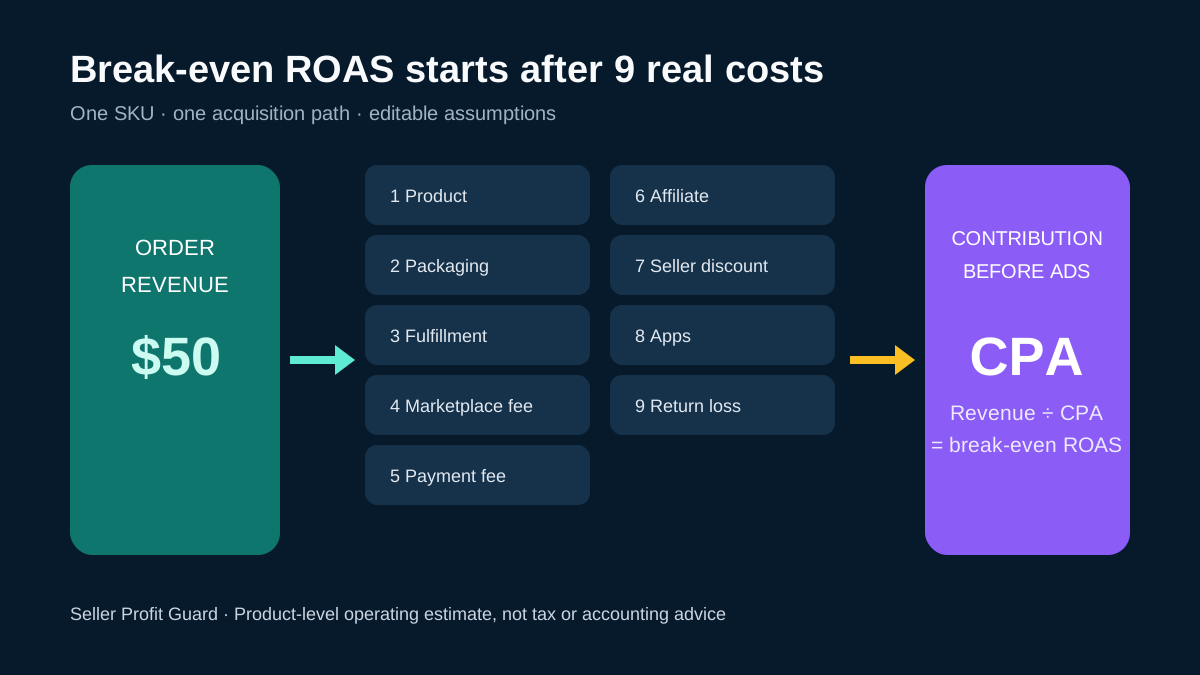
Break-even ROAS equals order revenue divided by contribution before ads. Calculate that contribution only after subtracting product, packaging, fulfillment, marketplace, payment, affiliate, seller-funded discount, app, and expected return-loss costs. A target-safe ROAS is higher because it also reserves the contribution you want to keep.
What is break-even ROAS?
Return on ad spend, or ROAS, compares conversion value with advertising cost. Google Ads defines ROAS as total conversion value divided by total cost. TikTok describes the same basic revenue-to-ad-spend relationship. That ratio is useful for reporting, but neither a campaign ROAS nor a platform dashboard knows every private cost inside your product unless you supply those values correctly.
Break-even ROAS is the point at which the order has used all contribution available for advertising. It is not the point at which revenue equals product cost, and it is not automatically a profitable target. If an order produces 20 dollars of contribution before ads, a 20-dollar acquisition cost consumes that entire amount. There is nothing left in this product-level estimate for target contribution, owner compensation, tax, general overhead, or unexpected loss.
Use one consistent revenue definition in the numerator and cost worksheet. If the conversion value includes buyer-paid shipping, include it in order revenue and subtract the actual seller shipping subsidy separately. If tax is collected and remitted rather than earned by the seller, do not inflate revenue with it. Platform reporting settings differ, so reconcile the value used in the ad platform with the order or settlement record before treating the result as a decision threshold.
| Metric | Formula | What it answers |
|---|---|---|
| Reported ROAS | Attributed conversion value / ad spend | How much reported value the campaign generated per ad dollar. |
| Break-even CPA | Revenue - all non-ad costs | The maximum acquisition cost before product-level contribution reaches zero. |
| Break-even ROAS | Revenue / break-even CPA | The minimum ROAS that avoids consuming more than all contribution before ads. |
| Target-safe CPA | Break-even CPA - target contribution | The acquisition ceiling after reserving the amount you want to keep. |
| Target ROAS | Revenue / target-safe CPA | The higher ROAS required to preserve the target contribution. |
The nine costs a real break-even ROAS calculator should include
A useful calculator starts with one sellable SKU and one acquisition path. Do not begin with store-wide gross margin because different variations, fulfillment routes, creator commissions, and discount funding can produce different allowable CPAs. Enter each cost separately so the model can show which assumption changes the answer.
The first three layers are landed product cost, packaging, and fulfillment. Landed product cost can include the unit, inbound freight, and other directly attributable acquisition or production costs. Packaging includes the mailer, box, insert, tape, label, and protective material consumed by the order. Fulfillment can be a 3PL pick-and-pack charge or a documented labor assumption. Keep these layers variant-specific when size, weight, fragility, or personalization changes the work.
The next three layers are marketplace or transaction fee, payment processing, and affiliate or creator commission. A marketplace percentage and a payment fee may use different bases and may include a fixed amount. Affiliate commission belongs only on the selling path that incurs it. Verify current rates and bases in the relevant platform, provider, market, category, plan, and order record rather than copying an old universal percentage.
The final three layers are seller-funded discount, plan or app allocation, and expected return loss. Separate a platform-funded promotion from the amount the seller actually absorbs. Allocate recurring software across realistic completed orders, not an optimistic traffic forecast. Model expected return loss from unrecovered costs and recovery value rather than simply subtracting a return-rate percentage from revenue.
| Cost layer | Input to use | Common error |
|---|---|---|
| 1. Product | Actual landed unit or production cost | Using one average for materially different variants. |
| 2. Packaging | Materials consumed by one shipment | Treating packaging as invisible overhead. |
| 3. Fulfillment | 3PL charge or documented labor | Ignoring seller handling time. |
| 4. Marketplace | Current applicable order fee | Applying one rate to every channel or category. |
| 5. Payment | Current percentage, fixed fee and base | Combining it with marketplace fees without checking the base. |
| 6. Affiliate | Commission attributable to this selling path | Applying it to every order or omitting it from creator sales. |
| 7. Discount | Seller-funded portion only | Charging the model for platform-funded value. |
| 8. Apps | Monthly applicable software / realistic orders | Dividing by sessions or a best-case sales goal. |
| 9. Return loss | Affected-order rate x unrecovered loss | Using refund value as if it were the final loss. |
The formula from revenue to allowable CPA
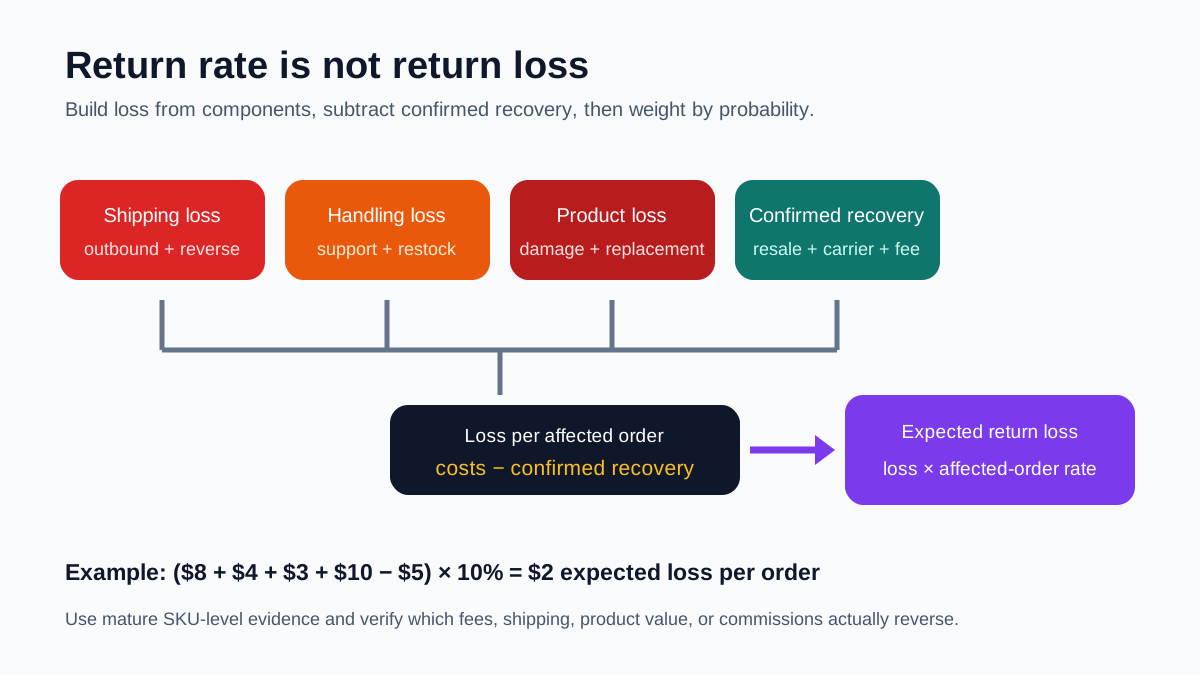
Start with seller-attributable order revenue. Then add the nine non-ad costs. Expected return loss is calculated separately because it is a probability-weighted operating assumption: affected-order rate multiplied by the unrecovered loss per affected order. The unrecovered loss can include outbound or reverse shipping, handling, damaged product, replacement, support time, and fees that do not reverse, minus confirmed inventory, carrier, platform, insurance, or resale recovery.
Contribution before ads equals revenue minus product cost, packaging, fulfillment, marketplace fee, payment fee, affiliate commission, seller-funded discount, app allocation, and expected return loss. In this model, contribution before ads is the break-even CPA. Break-even ROAS equals revenue divided by that CPA. If contribution before ads is zero or negative, there is no positive paid-acquisition ceiling to calculate; price, cost, offer, or product economics must change first.
A safer planning threshold reserves target contribution. Choose a target amount rather than assuming every order only needs to stay above zero. Target-safe CPA equals contribution before ads minus the target contribution. Target ROAS equals revenue divided by target-safe CPA. When the target-safe CPA is zero or negative, paid acquisition cannot preserve that target under the entered assumptions.
These equations are a planning model, not an official Google, TikTok, Meta, Shopify, Etsy, or accounting formula. Attribution windows, view-through conversions, refunds, currency conversion, tax handling, and modeled conversion values can make an ad dashboard differ from settled order economics. Keep the source, date, market, currency, attribution setting, and revenue definition beside the worksheet.
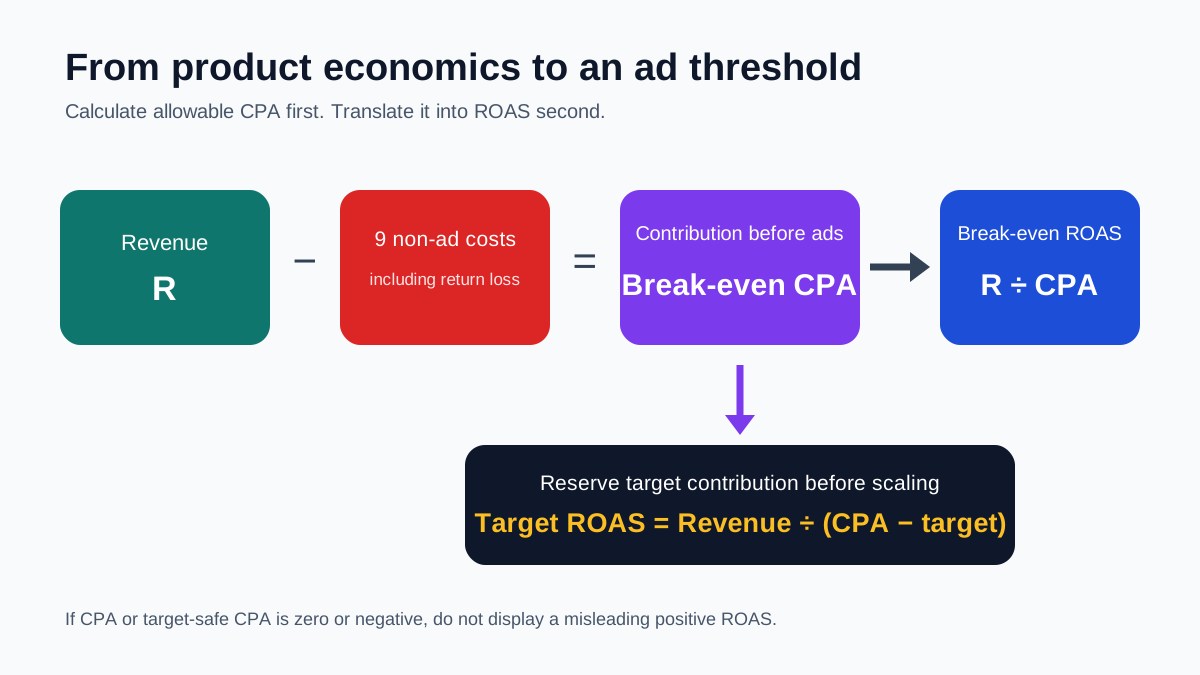
- Revenue = item revenue + seller-earned shipping or other included order value.
- Expected return loss = affected-order rate x unrecovered loss per affected order.
- Break-even CPA = revenue - nine non-ad cost layers.
- Break-even ROAS = revenue / break-even CPA.
- Target-safe CPA = break-even CPA - target contribution.
- Target ROAS = revenue / target-safe CPA.
Worked example: a $50 order can require 3.13 ROAS
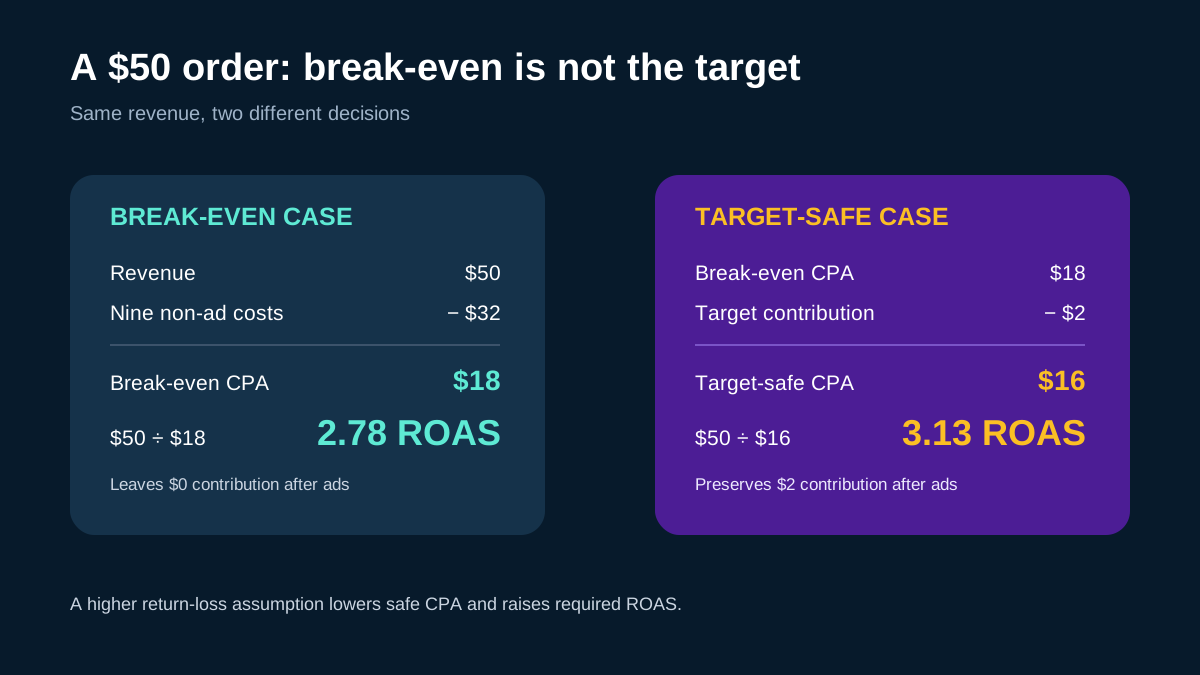
Consider a product with 50.00 in seller-attributable revenue. Landed product cost is 14.00, packaging is 1.50, fulfillment is 3.00, marketplace fee is 4.00, payment processing is 1.75, affiliate commission is 3.00, the seller-funded discount is 2.00, and plan plus app allocation is 0.75. The seller also estimates 2.00 of expected return loss per order. Total non-ad cost is 32.00, leaving 18.00 contribution before ads.
The break-even CPA is therefore 18.00. Dividing 50.00 revenue by 18.00 produces a break-even ROAS of 2.78. A campaign at 2.78 ROAS would use the entire 18.00 contribution as acquisition cost in this simplified product model. It should not be described as comfortably profitable.
Suppose the seller wants to preserve 2.00 per order as target contribution. Target-safe CPA becomes 16.00, and target ROAS becomes 50.00 divided by 16.00, or 3.13. If expected return loss rises from 2.00 to 4.00, contribution before ads falls to 16.00; after reserving the same 2.00 target, safe CPA falls to 14.00 and target ROAS rises to 3.57.
The example shows why a familiar campaign target cannot be copied across products. A lightweight item with low return loss may support a lower ROAS. A fragile, commissioned, discounted, or high-support product may need a much higher ROAS even when the sale price is identical. Run the calculation by SKU and acquisition path, then compare base, downside, and target cases.
| Line | Base case | Higher return-loss case |
|---|---|---|
| Revenue | $50.00 | $50.00 |
| Non-ad costs | $32.00 | $34.00 |
| Break-even CPA | $18.00 | $16.00 |
| Break-even ROAS | 2.78 | 3.13 |
| Target contribution | $2.00 | $2.00 |
| Target-safe CPA | $16.00 | $14.00 |
| Target ROAS | 3.13 | 3.57 |
How returns change break-even ROAS
A 10% return rate is not automatically a 10% revenue loss. One returned unopened item may be restocked with a small handling cost; a personalized product may have no resale value; a damaged international order may lose the item, outbound shipping, replacement, support time, and part of the fee stack. Model loss per affected order from its components, then multiply by a realistic rate for that SKU and reason group.
For example, assume an affected order creates 8.00 in unrecovered outbound shipping, 4.00 in reverse or replacement shipping, 3.00 in handling and support, and 10.00 in unrecovered product value. If confirmed resale, carrier, fee, or other recovery is 5.00, net loss per affected order is 20.00. At a 10% affected-order rate, expected return loss is 2.00 per order. That 2.00 belongs in every forward-looking ROAS scenario for the product until newer evidence supports another assumption.
Keep refunds and returns tied to the cohort that generated them. A short ad-platform window can show revenue before later returns are known. Reconcile settled orders after the relevant return window, and do not mix a current campaign's gross conversion value with an unrelated annual return assumption without noting the mismatch. Use multiple scenarios when the sample is small: observed base, conservative downside, and an improvement case tied to a concrete packaging or listing change.
Do not assume platform fees, affiliate commission, payment fees, shipping, or tax reverse in full. Check the actual policy and settled record. Confirmed recoveries reduce loss; hoped-for recoveries do not. This keeps the ROAS threshold cautious without treating every refund as a total loss.
A five-step workflow before increasing ad spend
Use contribution as the decision metric and ROAS as the translation into the ad platform. ROAS is convenient because media buyers see it, but allowable CPA is often easier to audit: it states the maximum acquisition dollars one order can support. When average order value changes because of bundles or upsells, recalculate rather than assuming the old ROAS threshold still applies.
Blended ROAS can hide product-level loss. A strong product may subsidize a weak one, branded search may subsidize prospecting, or repeat buyers may subsidize new-customer acquisition. Segment only as far as the data remains trustworthy, but keep at least product or product-family, market, and acquisition-path visibility before scaling.
- Select one SKU, market, currency, and acquisition path. Record the ad platform's attribution window and the exact conversion value used in reported ROAS.
- Reconcile seller-attributable order revenue, then enter the nine non-ad cost layers from current order, settlement, supplier, fulfillment, commission, discount, software, and return records.
- Calculate break-even CPA and ROAS, then reserve a specific target contribution to calculate target-safe CPA and target ROAS.
- Run base, higher-fee, higher-return, higher-CPA, and lower-conversion-value scenarios. Stop if any denominator becomes zero or negative instead of displaying a misleading ratio.
- Compare the mature cohort's settled economics with the planning threshold. Change one lever—price, discount, commission, packaging, fulfillment, offer, or campaign—then measure the next comparable cohort.
Break-even ROAS mistakes and FAQ
What is a good ROAS? There is no universal profitable number. A good ROAS is one that clears the product's target ROAS under a consistent revenue definition and mature cost window. One store may retain contribution at 2.5 while another loses money at 4.0 because their product, fee, commission, discount, fulfillment, and return layers differ.
Is break-even ROAS the same as target ROAS? No. Break-even allows advertising to consume all contribution before ads. Target ROAS reserves a chosen contribution amount first, so its allowable CPA is lower and its required ROAS is higher.
Should customer lifetime value lower the ROAS target? Only when repeat-purchase evidence is reliable, contribution-based, and matched to the acquisition cohort. Do not use projected lifetime revenue as if it were collected profit. Keep first-order economics visible and run a separate, documented payback case.
Should discounts be included in revenue or cost? Use the settled seller-attributable revenue consistently. If a seller-funded discount already reduces recorded revenue, do not subtract it again. If the calculator begins with list price, subtract the seller-funded amount. Platform-funded value should not be treated as seller cost without evidence.
Should tax, duties, currency fees, and overhead be included? Include seller-borne amounts relevant to the decision, but label their scope. This guide models product-level operating contribution and does not replace accounting, tax, legal, inventory, or professional advice. General overhead and owner compensation can be reserved through a target contribution or modeled separately.
Why does the ad dashboard disagree? Conversion value settings, attribution, reporting delay, refunds, cancellations, currency, tax, shipping value, modeled conversions, and cross-device behavior can differ from settled orders. Google recommends setting conversion values that reflect their relative business value; that still requires the seller to validate the values and reconcile them with actual economics.
When should the threshold be updated? Update it after a material price, fee, provider, commission, discount, fulfillment, software, packaging, or return change. Also review it when the product mix or order volume changes enough to alter cost allocation. Store the source and review date rather than silently overwriting an old assumption.
- Do not call revenue minus ad spend profit.
- Do not omit fixed fees, software allocation, commissions, or seller-funded discounts.
- Do not use gross refund value as expected return loss.
- Do not mix attribution windows or currencies without adjustment.
- Do not let a blended campaign average hide a weak SKU.
- Do not scale at break-even when the business needs retained contribution.
Sources and further reading
- Google Ads Help: Metrics and terms glossary: Official definition of ROAS as total conversion value divided by total cost.
- Google Ads Help: About conversion values: Official guidance on assigning and reporting business values for conversions.
- TikTok for Business: What is ROAS?: Official overview of ROAS, calculation, interpretation, and limitations.
- Seller Profit Guard calculation methodology: Scope, editable assumptions, contribution terminology, privacy, and result limits.
Related Seller Profit Guard tools
- Cross-border seller calculators: Enter editable revenue, fee, commission, software, return, target, CPA, and ROAS assumptions.
- Return window loss estimator: Estimate unrecovered return, refund, replacement, shipping, handling, and recovery cost.
- Tool subscription audit: Allocate recurring software cost before calculating contribution and allowable CPA.
- Shopify fee and app cost calculator: Allocate nine Shopify order-cost layers before setting allowable CPA.
- TikTok Shop profit calculator: Separate referral fees, creator commission, seller discounts, ads, and expected return loss.
- Etsy Ads Break-Even Formula: 12 Inputs: Calculate Etsy Ads break-even and target-safe spend, ACOS, and ROAS from twelve scoped revenue, cost, fee, return, and ad inputs.
- Etsy Ads Break-Even Example: Low-Cost Item: Follow a $36 low-cost Etsy listing from non-ad costs to $8.28 target-safe ad spend, 23.0% ACOS, and 4.35 target ROAS with reproducible math.
- Etsy Ads Break-Even for a High-Return Item: Model a $48 high-return Etsy listing where $4.20 expected return loss leaves no target-safe spend at a 25% target and 4.83x break-even ROAS.
- Break-Even ROAS Formula and Inputs: Derive break-even and target ROAS from retained revenue, conversion value, variable order costs, expected loss, contribution target, and ad spend.
- Break-Even ROAS Prospecting Example: Follow a USD 100 prospecting cohort through retained revenue, cost layers, contribution before ads, spend ceilings, ROAS thresholds, and headroom.
- Break-Even ROAS for Retargeting: Model a retargeting cohort without reusing prospecting attribution, audience, conversion value, product mix, or spend assumptions.
- Paid CPA Limit Formula and Inputs: Calculate a target-safe paid CPA from retained first-order contribution, measured repeat contribution, recognition policy, and acquisition evidence.
- Paid CPA Limit First-Order Example: Follow an USD 80 first order through variable costs, contribution reserve, first-order CPA limit, recognized repeat value, and paid CPA headroom.
- Paid CPA Limit with Measured Repeat Value: Use mature repeat-purchase contribution without turning revenue forecasts, returning-customer share, or generic lifetime value into acquisition capacity.
- Ad Attribution Reconciliation Formula and Inputs: Classify platform-attributed order rows into retained, excluded, ambiguous, and gap outcomes with aggregate seller evidence.
- Ad Attribution Click Reconciliation Example: Follow 100 synthetic platform rows through click matches, view matches, exclusions, ambiguity, tolerance, and decision state.
- Ad Attribution View Reconciliation: Reconcile view-through attributed orders with shorter windows, precedence, source conflicts, and stronger interpretation limits.
- Seasonal Promotion Margin Formula and Inputs: Build plan and stress contribution formulas from retained orders, discount, mix, shipping, ads, returns, commission, and capacity.
- Holiday Weekend Promotion Margin Example: Follow a 200-order synthetic holiday weekend through retained revenue, campaign costs, capacity, contribution, and target headroom.
- Month-Long Seasonal Promotion Stress Test: Stress a month-long campaign with more orders, weaker retention and mix, deeper discount, shipping pressure, and higher ad spend.
- BOGO Margin Formula, Inputs, and Assumptions: Build a Buy X Get Y contribution formula from paid and reward units, reward discount, retained outcomes, costs, fees, and target headroom.
- BOGO Margin Example: Buy One Get One Free: Follow a 100-order synthetic buy-one-get-one-free offer through retained revenue, two-unit cost, fees, setup, contribution, and target headroom.
- BOGO Margin for Buy Two Get One 50% Off: Model a materially different buy-two-get-one-half-off offer with three fulfilled units, higher collected merchandise, cost, fees, and target headroom.
- Influencer Campaign Payback Formula and Inputs: Build fixed-fee influencer payback from complete investment, approved assets, retained contribution, reuse recognition, and target headroom.
- Influencer Campaign Payback Example: One Sponsored Post: Follow one sponsored post through creator fee, rights, sample, media, retained contribution, recognized reuse, and target payback.
- Influencer Campaign Payback for a Multi-Asset Campaign: Model a four-asset campaign with larger creator fee, rights, samples, paid amplification, approved assets, reuse, and target recovery.
Next step: Calculate break-even ROAS.
This is operational planning help, not tax, accounting, legal, financial, or platform-policy advice. Review the Terms and disclaimer, and verify current platform rules and fee assumptions before changing prices.