Where to get reliable quantity-tier inputs
Last updated: 2026-07-30
Written and reviewed by Seller Profit Guard Editorial Team.
Use current checkout configuration for unit price and proposed discounts, SKU cost versions for product cost, bills of material and time studies for repeating fulfillment, package standards for per-order handling, statements or current rules for fees, comparable tier cohorts for expected loss, and a dated seller target policy. Preserve source dates and replacement triggers.
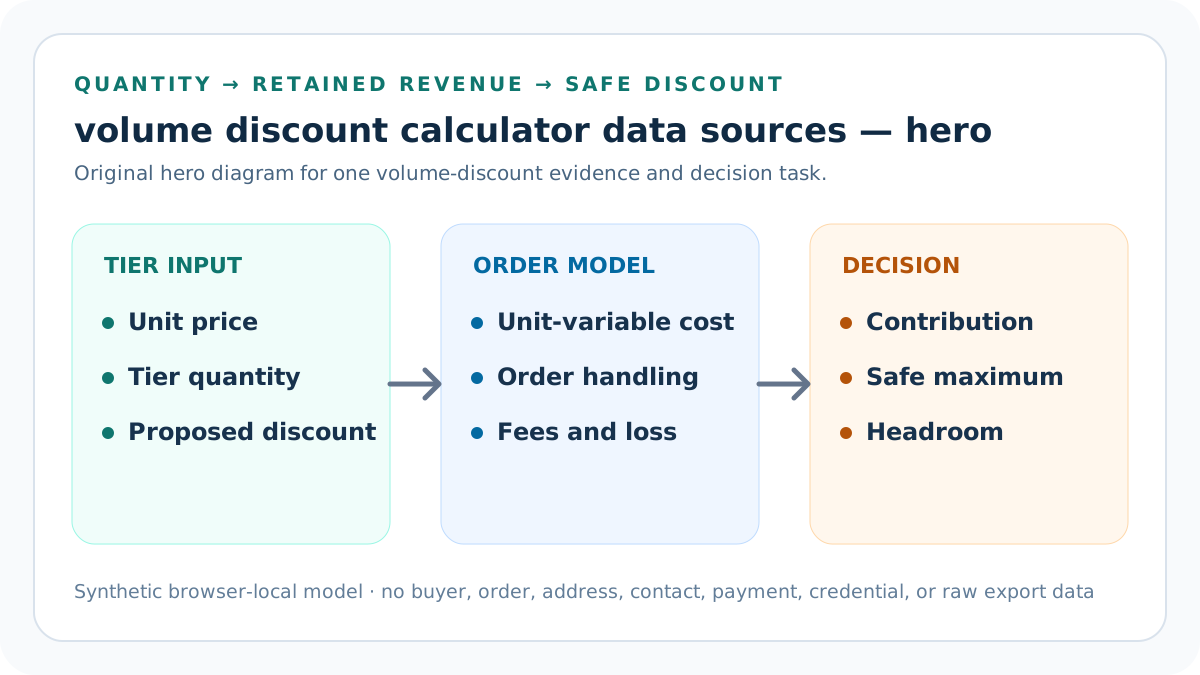
Source unit list price
Use the active price list, listing, catalog, or checkout state with currency and effective date. Preserve value, unit, quantity or order role, currency, period, source class, owner, confidence, and replacement trigger in the quantity-tier provenance map. A rounded rate without its tier identity cannot support a public pricing decision.
For tier source authority and freshness, checkpoint 1 must pass before it supports traceable tier evidence at one product and order grain. Recalculate from the aligned tier row and correct the accountable field instead of offsetting it with an unrelated favorable price, quantity, cost, discount, or target.
Source tier quantities
Use an actual minimum, case pack, offer configuration, or approved proposed tier. Confirm whether the rule applies per variant, product, customer class, or order. Preserve value, unit, quantity or order role, currency, period, source class, owner, confidence, and replacement trigger in the quantity-tier provenance map. A rounded rate without its tier identity cannot support a public pricing decision.
For tier source authority and freshness, checkpoint 2 must pass before it supports traceable tier evidence at one product and order grain. Recalculate from the aligned tier row and correct the accountable field instead of offsetting it with an unrelated favorable price, quantity, cost, discount, or target.
Source proposed discounts
Record rate, funding, eligibility, customer class, channel, and effective period. Preserve value, unit, quantity or order role, currency, period, source class, owner, confidence, and replacement trigger in the quantity-tier provenance map. A rounded rate without its tier identity cannot support a public pricing decision.
For tier source authority and freshness, checkpoint 3 must pass before it supports traceable tier evidence at one product and order grain. Recalculate from the aligned tier row and correct the accountable field instead of offsetting it with an unrelated favorable price, quantity, cost, discount, or target.
Source unit product cost
Use a current SKU-specific supplier, landed-cost, or seller-owned standard-cost version. Preserve value, unit, quantity or order role, currency, period, source class, owner, confidence, and replacement trigger in the quantity-tier provenance map. A rounded rate without its tier identity cannot support a public pricing decision.
For tier source authority and freshness, checkpoint 4 must pass before it supports traceable tier evidence at one product and order grain. Recalculate from the aligned tier row and correct the accountable field instead of offsetting it with an unrelated favorable price, quantity, cost, discount, or target.
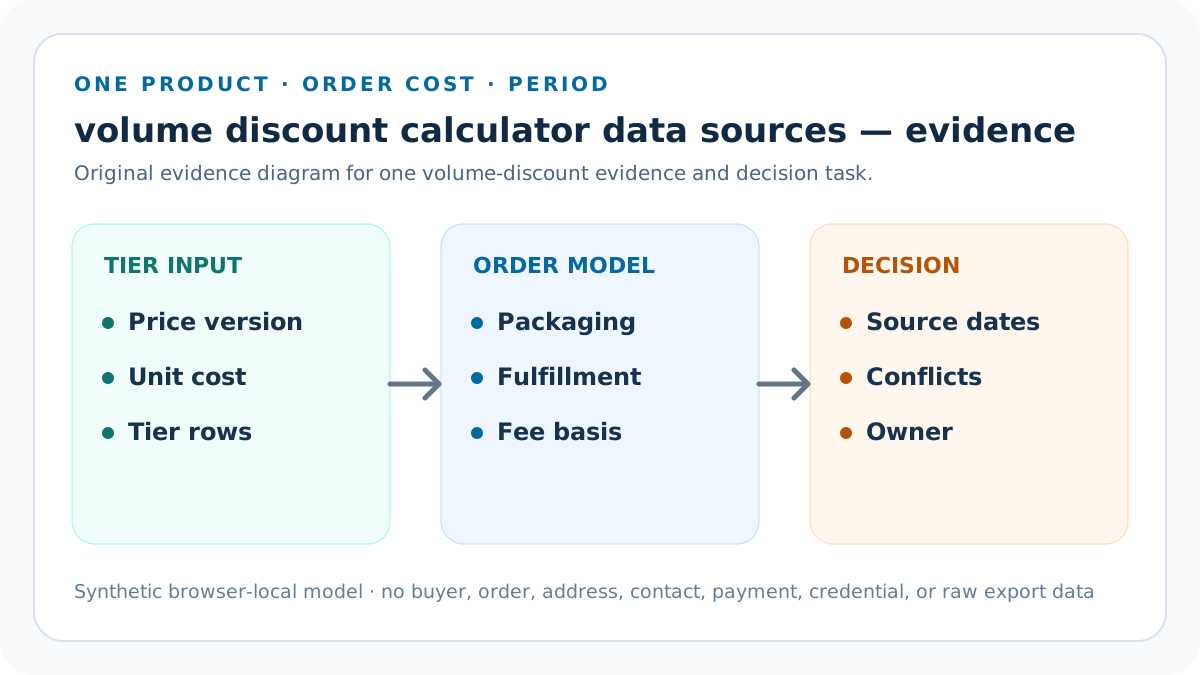
Source unit fulfillment
Use a bill of material, direct time study, and repeating handling evidence. Preserve value, unit, quantity or order role, currency, period, source class, owner, confidence, and replacement trigger in the quantity-tier provenance map. A rounded rate without its tier identity cannot support a public pricing decision.
For tier source authority and freshness, checkpoint 5 must pass before it supports traceable tier evidence at one product and order grain. Recalculate from the aligned tier row and correct the accountable field instead of offsetting it with an unrelated favorable price, quantity, cost, discount, or target.
Source per-order handling
Use package standards, purchase records, labor study, and carrier workflow for the tier. Preserve value, unit, quantity or order role, currency, period, source class, owner, confidence, and replacement trigger in the quantity-tier provenance map. A rounded rate without its tier identity cannot support a public pricing decision.
For tier source authority and freshness, checkpoint 6 must pass before it supports traceable tier evidence at one product and order grain. Recalculate from the aligned tier row and correct the accountable field instead of offsetting it with an unrelated favorable price, quantity, cost, discount, or target.
Source fees
Use current first-party rules and statement evidence for the applicable charged-revenue basis. Preserve value, unit, quantity or order role, currency, period, source class, owner, confidence, and replacement trigger in the quantity-tier provenance map. A rounded rate without its tier identity cannot support a public pricing decision.
For tier source authority and freshness, checkpoint 7 must pass before it supports traceable tier evidence at one product and order grain. Recalculate from the aligned tier row and correct the accountable field instead of offsetting it with an unrelated favorable price, quantity, cost, discount, or target.
Source expected loss and target
Use mature comparable cohorts and a dated target policy with owners and review triggers. Preserve value, unit, quantity or order role, currency, period, source class, owner, confidence, and replacement trigger in the quantity-tier provenance map. A rounded rate without its tier identity cannot support a public pricing decision.
For tier source authority and freshness, checkpoint 8 must pass before it supports traceable tier evidence at one product and order grain. Recalculate from the aligned tier row and correct the accountable field instead of offsetting it with an unrelated favorable price, quantity, cost, discount, or target.
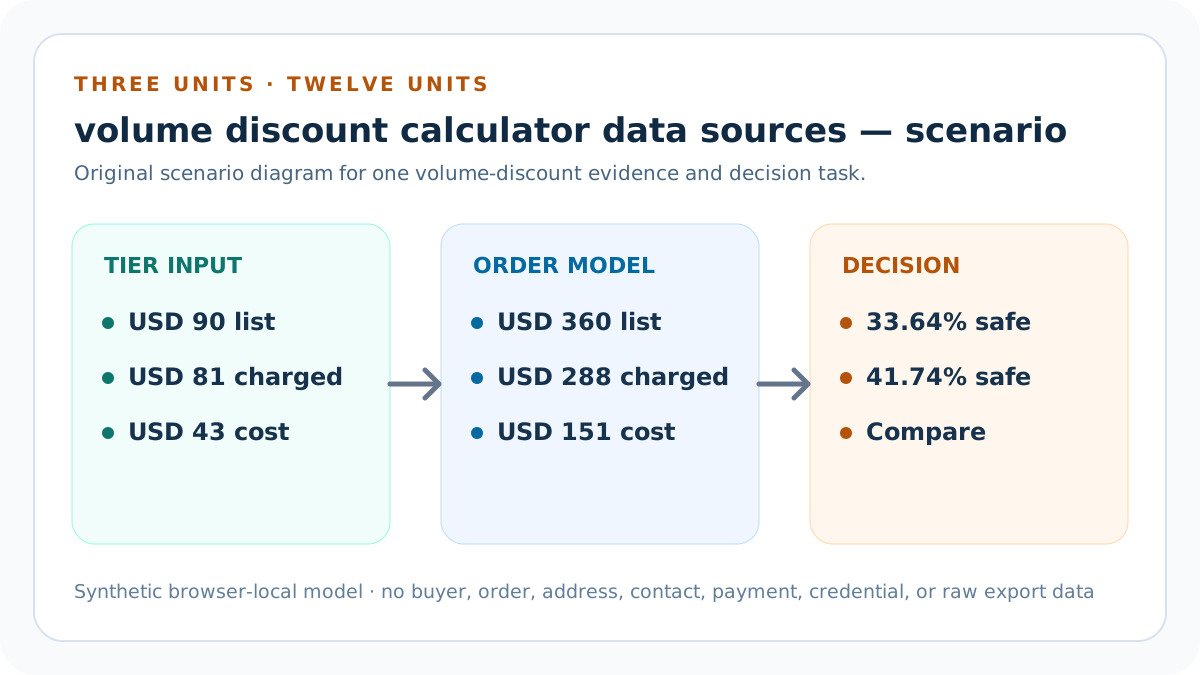
Grade source confidence
Label observed, contracted, quoted, estimated, or unsupported rows before comparing tiers. Preserve value, unit, quantity or order role, currency, period, source class, owner, confidence, and replacement trigger in the quantity-tier provenance map. A rounded rate without its tier identity cannot support a public pricing decision.
For tier source authority and freshness, checkpoint 9 must pass before it supports traceable tier evidence at one product and order grain. Recalculate from the aligned tier row and correct the accountable field instead of offsetting it with an unrelated favorable price, quantity, cost, discount, or target.
Set replacement triggers
Refresh evidence after price, supplier, product, package, labor, carrier, fee, return, or target changes. Preserve value, unit, quantity or order role, currency, period, source class, owner, confidence, and replacement trigger in the quantity-tier provenance map. A rounded rate without its tier identity cannot support a public pricing decision.
For tier source authority and freshness, checkpoint 10 must pass before it supports traceable tier evidence at one product and order grain. Recalculate from the aligned tier row and correct the accountable field instead of offsetting it with an unrelated favorable price, quantity, cost, discount, or target.
Worked control for tier source authority and freshness
Run three-unit Ready, twelve-unit Ready, 45%-discount Review, mismatched-row Block, unordered-tier Block, invalid-rate Block, and declared-conflict Block fixtures.
This control verifies tier source authority and freshness; it does not reproduce a private order, prove incremental demand, approve wholesale terms, guarantee capacity, or promise traceable tier evidence at one product and order grain.
Forward and inverse tier reconciliation
Recalculate full-list revenue, retained product revenue, charged revenue, percentage fees, variable-cost pool, contribution, and margin for every tier. Then solve its target-safe discount and insert that rate into the forward equation.
The substituted rate should reproduce the seller target at full precision. A mismatch indicates a changed quantity row, discount pairing, unit or order-cost role, shipping treatment, fee base, denominator, or rounding path.
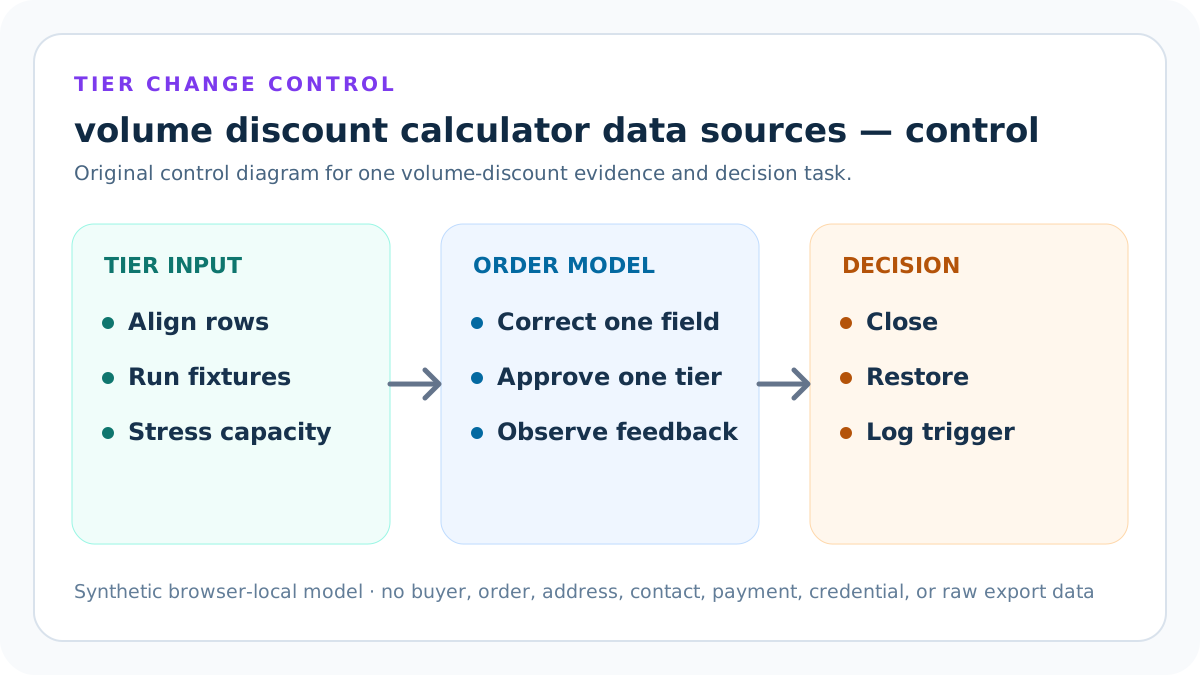
Tier sensitivity and exception handling
Vary one unit cost, fulfillment role, handling amount, discount, fee, buyer shipping, expected loss, target, or quantity at a time. Preserve the exact output and status movement.
When plausible retail, case-pack, or wholesale-size contracts change the decision, show named scenarios or ranges instead of averaging incompatible packaging, service, payment, or loss paths.
Block conditions and correction
Block mismatched, duplicate, descending, fractional, nonpositive, nonfinite, or missing tier rows; blank, nonfinite, or negative costs; impossible source dates; incomplete confirmations; invalid prices, discounts, rates, denominator, currency, month, scope, or declared conflicts.
Correct one named field, preserve the rejected value and reason, rerun supported and broken fixtures, and reject a repair that requires compensating changes elsewhere.
Bounded tier decision and next action
Use Block before Review before Ready. Review any structurally valid tier below target or above its target-safe discount. Ready confirms only the entered contribution contract.
Choose one source correction, tier removal, quantity or discount experiment, packaging or fulfillment change, target review, or explicit no-action conclusion with an owner and restoration reference.
Verification and release controls
Preserve the quantity-tier provenance map, sources, deterministic fixtures, tests, build, SEO and content audits, similarity evidence, screenshots, release manifest, backup, and rollback identifier.
Verify canonical, Article and Breadcrumb schema, four visuals, internal links, privacy, indexability, mobile layout, public response, and live calculator behavior before release.
Limits and privacy boundary
This model does not determine accounting profit, taxable income, cash flow, fixed-overhead recovery, wholesale status, payment risk, inventory capacity, customer demand, conversion, ranking, traffic, revenue, or income.
Keep buyer names, emails, addresses, order IDs, payment rows, bank details, contacts, tokens, credentials, and raw exports outside the quantity-tier provenance map. Public examples remain synthetic.
Evidence confidence grades
Label observed, contracted, quoted, estimated, or unsupported inputs. Store the exact before state, isolated change, full-precision result, displayed result, tier status, responsible owner, and expected restoration path.
Deep check 1 is complete only when an independent reviewer can reproduce it from privacy-safe evidence and explain why it supports traceable tier evidence at one product and order grain without importing demand, capacity, accounting, tax, or platform claims.
Unit-cost version register
Preserve included rows, unit, currency, effective date, owner, and replacement trigger. Store the exact before state, isolated change, full-precision result, displayed result, tier status, responsible owner, and expected restoration path.
Deep check 2 is complete only when an independent reviewer can reproduce it from privacy-safe evidence and explain why it supports traceable tier evidence at one product and order grain without importing demand, capacity, accounting, tax, or platform claims.
Fulfillment packet
Preserve package, weight, dimensions, service, destination, time, and quote or label date. Store the exact before state, isolated change, full-precision result, displayed result, tier status, responsible owner, and expected restoration path.
Deep check 3 is complete only when an independent reviewer can reproduce it from privacy-safe evidence and explain why it supports traceable tier evidence at one product and order grain without importing demand, capacity, accounting, tax, or platform claims.
Loss cohort packet
Separate damage, shortage, partial return, replacement, shipping, and recovery. Store the exact before state, isolated change, full-precision result, displayed result, tier status, responsible owner, and expected restoration path.
Deep check 4 is complete only when an independent reviewer can reproduce it from privacy-safe evidence and explain why it supports traceable tier evidence at one product and order grain without importing demand, capacity, accounting, tax, or platform claims.
Price-break configuration capture
Record the active variant, minimum, increment, maximum, price break, customer eligibility, funding source, and platform plan without copying private customer data. Store the exact before state, isolated change, full-precision result, displayed result, tier status, responsible owner, and expected restoration path.
Deep check 5 is complete only when an independent reviewer can reproduce it from privacy-safe evidence and explain why it supports traceable tier evidence at one product and order grain without importing demand, capacity, accounting, tax, or platform claims.
Fee-base trace
Map each percentage or fixed charge to product revenue, shipping, tax, order, transaction, settlement, or another explicit base. Store the exact before state, isolated change, full-precision result, displayed result, tier status, responsible owner, and expected restoration path.
Deep check 6 is complete only when an independent reviewer can reproduce it from privacy-safe evidence and explain why it supports traceable tier evidence at one product and order grain without importing demand, capacity, accounting, tax, or platform claims.
Source-date reconciliation
Compare the calculator review date with every underlying effective date and Block when a material source expired before the review. Store the exact before state, isolated change, full-precision result, displayed result, tier status, responsible owner, and expected restoration path.
Deep check 7 is complete only when an independent reviewer can reproduce it from privacy-safe evidence and explain why it supports traceable tier evidence at one product and order grain without importing demand, capacity, accounting, tax, or platform claims.
Authority hierarchy
Prefer current first-party configuration and contractual evidence over screenshots, memory, generic articles, or an averaged historical rate. Store the exact before state, isolated change, full-precision result, displayed result, tier status, responsible owner, and expected restoration path.
Deep check 8 is complete only when an independent reviewer can reproduce it from privacy-safe evidence and explain why it supports traceable tier evidence at one product and order grain without importing demand, capacity, accounting, tax, or platform claims.
Conflict handling
Keep mutually exclusive sources as named scenarios rather than averaging them. Store the exact before state, isolated change, full-precision result, displayed result, tier status, responsible owner, and expected restoration path.
Deep check 9 is complete only when an independent reviewer can reproduce it from privacy-safe evidence and explain why it supports traceable tier evidence at one product and order grain without importing demand, capacity, accounting, tax, or platform claims.
Sources and further reading
- Seller Profit Guard methodology: Calculation contracts, evidence precedence, deterministic fixtures, validation, correction, release, and rollback.
- Seller Profit Guard data privacy: Local-first boundaries for seller, buyer, order, payment, contact, credential, and raw export data.
- Shopify quantity rules and volume pricing: Current first-party example of variant-level increments, minimums, maximums, up to ten price breaks, and fixed volume prices; actual platform, plan, catalog, variant, and discount interactions must be confirmed separately.
- U.S. Small Business Administration break-even guidance: Primary explanation of contribution margin as sale price minus variable cost divided by sale price.
- IRS Publication 334 (2025): Primary U.S. context for cost of goods sold and gross profit; this tier model does not make a tax determination.
- IRS Schedule C instructions (2025): Primary U.S. context for inventory and cost-of-goods-sold reporting boundaries.
Related Seller Profit Guard tools
- Open the Volume Discount Calculator: Calculate contribution and target-safe discount for multiple quantity tiers.
- Calculate contribution margin: Run a forward contribution equation for one observed order.
- Solve a product price floor: Solve the list price required after discount, fees, variable costs, and target contribution.
- Model a product bundle: Extend mixed component quantities and bundle-level costs.
- Version unit costs: Maintain dated product, fulfillment, packaging, labor, and expected-loss evidence.
- Read the methodology: Review evidence, calculation, privacy, testing, release, correction, and rollback.
- Review data privacy: Keep private seller and buyer data outside public content.
- Volume Discount Formula and Inputs: Continue with a distinct tier formula, example, source, threshold, comparison, operating, interpretation, or audit task.
- Three-Unit Volume Discount Example: Continue with a distinct tier formula, example, source, threshold, comparison, operating, interpretation, or audit task.
- Wholesale-Size Volume Discount Tier: Continue with a distinct tier formula, example, source, threshold, comparison, operating, interpretation, or audit task.
- Volume Discount Calculation Mistakes: Continue with a distinct tier formula, example, source, threshold, comparison, operating, interpretation, or audit task.
- Safe Volume Discount Decision Thresholds: Continue with a distinct tier formula, example, source, threshold, comparison, operating, interpretation, or audit task.
Next step: Open the Volume Discount Calculator.
This is operational planning help, not tax, accounting, legal, financial, or platform-policy advice. Review the Terms and disclaimer, and verify current platform rules and fee assumptions before changing prices.