Free gift margin worked example for a lightweight sample
Last updated: 2026-07-31
Written and reviewed by Seller Profit Guard Editorial Team.
A synthetic lightweight sample reaches 1,000 eligible visits, 6.5% assumed conversion versus a 5% baseline, and 90% retained outcomes. The USD 3.75 per-order gift packet plus USD 50 setup costs USD 269.38. Contribution after gift is USD 1,017.63, and incremental contribution after gift is USD 27.63.
Freeze the sample offer
Use one threshold, one sample SKU, one quantity, one warehouse, one period, and one channel. In the lightweight sample worksheet, record the value, unit, denominator, source version, evidence date, maturity state, owner, reviewer, and uncertainty. Recalculate from a clean aggregate or synthetic packet before formatting any rate, amount, lift, boundary, or decision.
Do not mix concurrent offers. Topic 1 retains a supported case, a defective case, the correction step, and the reason the conclusion belongs to a traceable low-weight gift decision rather than a platform promise, demand forecast, or causal promotion claim.
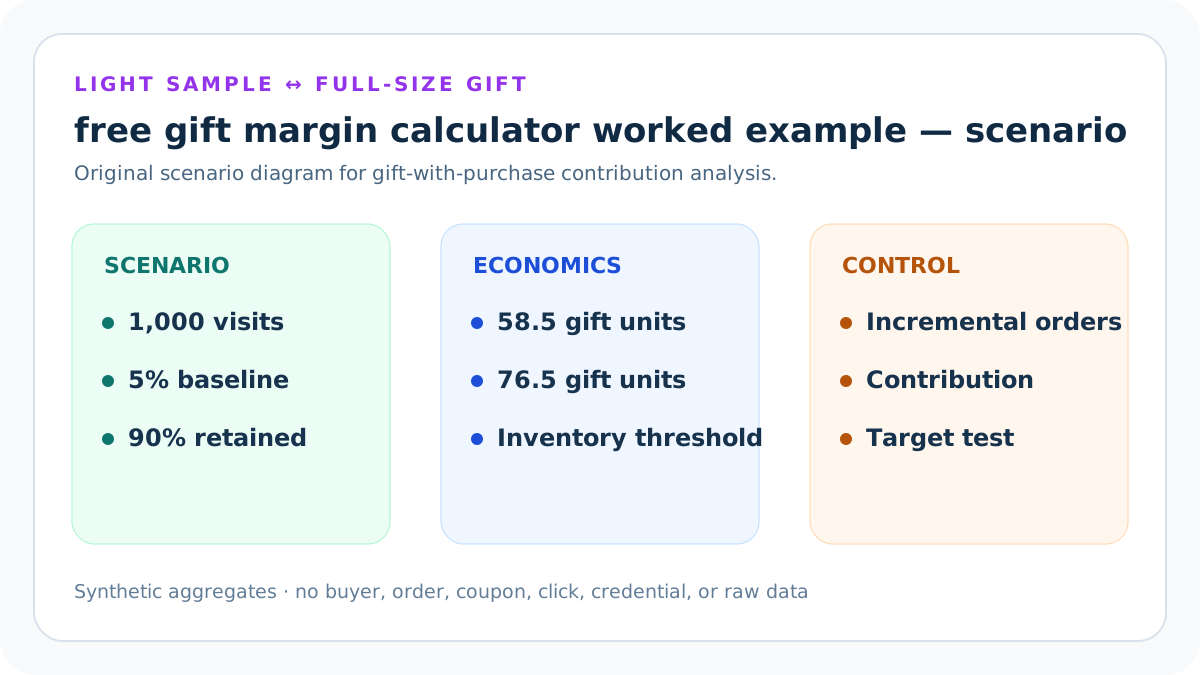
Calculate 58.5 promoted retained orders
Multiply 1,000 visits by 6.5% conversion and 90% retention. In the lightweight sample worksheet, record the value, unit, denominator, source version, evidence date, maturity state, owner, reviewer, and uncertainty. Recalculate from a clean aggregate or synthetic packet before formatting any rate, amount, lift, boundary, or decision.
Expected values do not predict individual orders. Topic 2 retains a supported case, a defective case, the correction step, and the reason the conclusion belongs to a traceable low-weight gift decision rather than a platform promise, demand forecast, or causal promotion claim.
Reserve 65 gift units
Cover all 65 placed qualifying orders before the retained-outcome adjustment; 65 of 80 available units is 81.25% utilization. In the lightweight sample worksheet, record the value, unit, denominator, source version, evidence date, maturity state, owner, reviewer, and uncertainty. Recalculate from a clean aggregate or synthetic packet before formatting any rate, amount, lift, boundary, or decision.
This conservative inventory check is separate from retained-order contribution math. Topic 3 retains a supported case, a defective case, the correction step, and the reason the conclusion belongs to a traceable low-weight gift decision rather than a platform promise, demand forecast, or causal promotion claim.
Calculate 45 baseline retained orders
Multiply the same visits by 5% baseline conversion and 90% retention. In the lightweight sample worksheet, record the value, unit, denominator, source version, evidence date, maturity state, owner, reviewer, and uncertainty. Recalculate from a clean aggregate or synthetic packet before formatting any rate, amount, lift, boundary, or decision.
Keep the denominator equal. Topic 4 retains a supported case, a defective case, the correction step, and the reason the conclusion belongs to a traceable low-weight gift decision rather than a platform promise, demand forecast, or causal promotion claim.
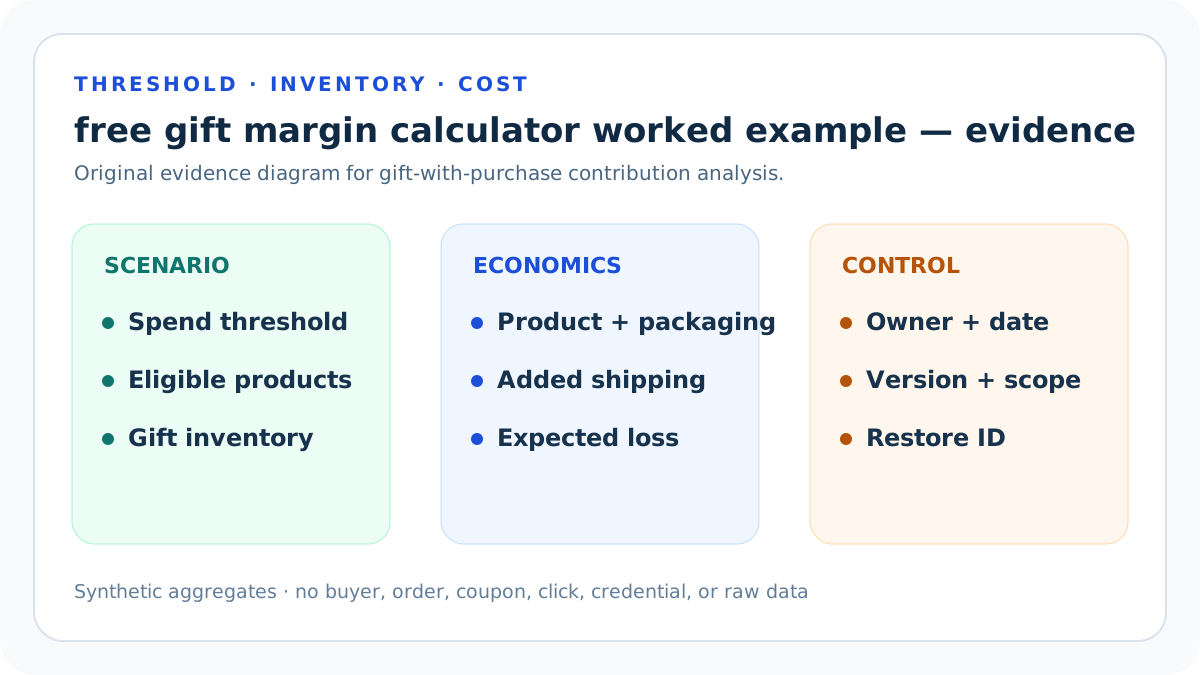
Build USD 3.75 gift cost
Add USD 2 product, USD 0.25 packaging, USD 0.50 pick-pack, USD 0.75 shipping, and USD 0.25 loss. In the lightweight sample worksheet, record the value, unit, denominator, source version, evidence date, maturity state, owner, reviewer, and uncertainty. Recalculate from a clean aggregate or synthetic packet before formatting any rate, amount, lift, boundary, or decision.
Weight remains separately documented. Topic 5 retains a supported case, a defective case, the correction step, and the reason the conclusion belongs to a traceable low-weight gift decision rather than a platform promise, demand forecast, or causal promotion claim.
Calculate USD 269.38 total gift cost
Charge USD 3.75 to 58.5 promoted retained orders and add USD 50 setup. In the lightweight sample worksheet, record the value, unit, denominator, source version, evidence date, maturity state, owner, reviewer, and uncertainty. Recalculate from a clean aggregate or synthetic packet before formatting any rate, amount, lift, boundary, or decision.
Do not charge only the 13.5 incremental orders. Topic 6 retains a supported case, a defective case, the correction step, and the reason the conclusion belongs to a traceable low-weight gift decision rather than a platform promise, demand forecast, or causal promotion claim.
Calculate USD 1,017.63 contribution
Multiply 58.5 by USD 22 pre-gift contribution and subtract total gift cost. In the lightweight sample worksheet, record the value, unit, denominator, source version, evidence date, maturity state, owner, reviewer, and uncertainty. Recalculate from a clean aggregate or synthetic packet before formatting any rate, amount, lift, boundary, or decision.
This is conditional scenario math. Topic 7 retains a supported case, a defective case, the correction step, and the reason the conclusion belongs to a traceable low-weight gift decision rather than a platform promise, demand forecast, or causal promotion claim.
Read USD 27.63 incremental payback
Multiply 13.5 incremental retained orders by USD 22 and subtract all gift-program cost. In the lightweight sample worksheet, record the value, unit, denominator, source version, evidence date, maturity state, owner, reviewer, and uncertainty. Recalculate from a clean aggregate or synthetic packet before formatting any rate, amount, lift, boundary, or decision.
The narrow result requires a conservative stress case. Topic 8 retains a supported case, a defective case, the correction step, and the reason the conclusion belongs to a traceable low-weight gift decision rather than a platform promise, demand forecast, or causal promotion claim.
Baseline and attribution control: free gift margin example: lightweight sample
Keep audience, event definition, baseline source, scenario rate, filters, and period explicit. Control 1 names the authority, owner, review frequency, exception code, threshold, expiry, correction trigger, and prior restorable gift packet.
Do not turn an assumption into a causal claim. Apply the control specifically to a traceable low-weight gift decision; distinguish platform behavior, seller settings, aggregate records, calculator formulas, estimates, and conversion assumptions.
Release and restoration control: free gift margin example: lightweight sample
Require calculation, content, similarity, SEO, image, browser, mobile, privacy, live, and rollback evidence. Control 2 names the authority, owner, review frequency, exception code, threshold, expiry, correction trigger, and prior restorable gift packet.
Restore on formula, source, route, stock, privacy, accessibility, policy, or health regression. Apply the control specifically to a traceable low-weight gift decision; distinguish platform behavior, seller settings, aggregate records, calculator formulas, estimates, and conversion assumptions.
Gift-cost and parcel control: free gift margin example: lightweight sample
Version product, weight, packaging, labor, fulfillment, warehouse, carrier, zone, service, and separate-shipment evidence. Control 3 names the authority, owner, review frequency, exception code, threshold, expiry, correction trigger, and prior restorable gift packet.
Charge gifts to all promoted retained orders. Apply the control specifically to a traceable low-weight gift decision; distinguish platform behavior, seller settings, aggregate records, calculator formulas, estimates, and conversion assumptions.
Platform-mechanics control: free gift margin example: lightweight sample
Separate official gift rules, seller configuration, and calculator assumptions. Control 4 names the authority, owner, review frequency, exception code, threshold, expiry, correction trigger, and prior restorable gift packet.
A tool result cannot establish promotion eligibility. Apply the control specifically to a traceable low-weight gift decision; distinguish platform behavior, seller settings, aggregate records, calculator formulas, estimates, and conversion assumptions.
Privacy and maturity control: free gift margin example: lightweight sample
Use aggregate inputs, closed outcomes, synthetic fixtures, redacted pointers, access limits, retention, and deletion. Control 5 names the authority, owner, review frequency, exception code, threshold, expiry, correction trigger, and prior restorable gift packet.
Exclude buyer, order, payment, address, credential, token, and OAuth data. Apply the control specifically to a traceable low-weight gift decision; distinguish platform behavior, seller settings, aggregate records, calculator formulas, estimates, and conversion assumptions.
Freeze the sample offer: gift scenario drill
Recreate “Freeze the sample offer” from the synthetic lightweight-sample and full-size-gift fixtures. Use one threshold, one sample SKU, one quantity, one warehouse, one period, and one channel. Change one supported input, preserve the original packet, show the baseline-to-promoted bridge and all-order gift-cost allocation, and attach the expected Block, Review, or Ready state to the lightweight sample worksheet.
Do not mix concurrent offers. Drill 1 includes a supported case, below-target case, below-incremental-payback case, invalid case, corrected case, parcel-cost change, and conversion-assumption change. Explain what moved, what stayed fixed, and what evidence permits the next step.
Calculate 58.5 promoted retained orders: gift scenario drill
Recreate “Calculate 58.5 promoted retained orders” from the synthetic lightweight-sample and full-size-gift fixtures. Multiply 1,000 visits by 6.5% conversion and 90% retention. Change one supported input, preserve the original packet, show the baseline-to-promoted bridge and all-order gift-cost allocation, and attach the expected Block, Review, or Ready state to the lightweight sample worksheet.
Expected values do not predict individual orders. Drill 2 includes a supported case, below-target case, below-incremental-payback case, invalid case, corrected case, parcel-cost change, and conversion-assumption change. Explain what moved, what stayed fixed, and what evidence permits the next step.
Reserve 65 gift units: gift scenario drill
Recreate “Reserve 65 gift units” from the synthetic lightweight-sample and full-size-gift fixtures. Cover all 65 placed qualifying orders before the retained-outcome adjustment; 65 of 80 available units is 81.25% utilization. Change one supported input, preserve the original packet, show the baseline-to-promoted bridge and all-order gift-cost allocation, and attach the expected Block, Review, or Ready state to the lightweight sample worksheet.
This conservative inventory check is separate from retained-order contribution math. Drill 3 includes a supported case, below-target case, below-incremental-payback case, invalid case, corrected case, parcel-cost change, and conversion-assumption change. Explain what moved, what stayed fixed, and what evidence permits the next step.
Calculate 45 baseline retained orders: gift scenario drill
Recreate “Calculate 45 baseline retained orders” from the synthetic lightweight-sample and full-size-gift fixtures. Multiply the same visits by 5% baseline conversion and 90% retention. Change one supported input, preserve the original packet, show the baseline-to-promoted bridge and all-order gift-cost allocation, and attach the expected Block, Review, or Ready state to the lightweight sample worksheet.
Keep the denominator equal. Drill 4 includes a supported case, below-target case, below-incremental-payback case, invalid case, corrected case, parcel-cost change, and conversion-assumption change. Explain what moved, what stayed fixed, and what evidence permits the next step.
Build USD 3.75 gift cost: gift scenario drill
Recreate “Build USD 3.75 gift cost” from the synthetic lightweight-sample and full-size-gift fixtures. Add USD 2 product, USD 0.25 packaging, USD 0.50 pick-pack, USD 0.75 shipping, and USD 0.25 loss. Change one supported input, preserve the original packet, show the baseline-to-promoted bridge and all-order gift-cost allocation, and attach the expected Block, Review, or Ready state to the lightweight sample worksheet.
Weight remains separately documented. Drill 5 includes a supported case, below-target case, below-incremental-payback case, invalid case, corrected case, parcel-cost change, and conversion-assumption change. Explain what moved, what stayed fixed, and what evidence permits the next step.
Calculate USD 269.38 total gift cost: gift scenario drill
Recreate “Calculate USD 269.38 total gift cost” from the synthetic lightweight-sample and full-size-gift fixtures. Charge USD 3.75 to 58.5 promoted retained orders and add USD 50 setup. Change one supported input, preserve the original packet, show the baseline-to-promoted bridge and all-order gift-cost allocation, and attach the expected Block, Review, or Ready state to the lightweight sample worksheet.
Do not charge only the 13.5 incremental orders. Drill 6 includes a supported case, below-target case, below-incremental-payback case, invalid case, corrected case, parcel-cost change, and conversion-assumption change. Explain what moved, what stayed fixed, and what evidence permits the next step.
Calculate USD 1,017.63 contribution: gift scenario drill
Recreate “Calculate USD 1,017.63 contribution” from the synthetic lightweight-sample and full-size-gift fixtures. Multiply 58.5 by USD 22 pre-gift contribution and subtract total gift cost. Change one supported input, preserve the original packet, show the baseline-to-promoted bridge and all-order gift-cost allocation, and attach the expected Block, Review, or Ready state to the lightweight sample worksheet.
This is conditional scenario math. Drill 7 includes a supported case, below-target case, below-incremental-payback case, invalid case, corrected case, parcel-cost change, and conversion-assumption change. Explain what moved, what stayed fixed, and what evidence permits the next step.
Read USD 27.63 incremental payback: gift scenario drill
Recreate “Read USD 27.63 incremental payback” from the synthetic lightweight-sample and full-size-gift fixtures. Multiply 13.5 incremental retained orders by USD 22 and subtract all gift-program cost. Change one supported input, preserve the original packet, show the baseline-to-promoted bridge and all-order gift-cost allocation, and attach the expected Block, Review, or Ready state to the lightweight sample worksheet.
The narrow result requires a conservative stress case. Drill 8 includes a supported case, below-target case, below-incremental-payback case, invalid case, corrected case, parcel-cost change, and conversion-assumption change. Explain what moved, what stayed fixed, and what evidence permits the next step.
What a traceable low-weight gift decision can and cannot prove
It can prove that entered aggregate assumptions follow the declared threshold, audience, baseline, conversion scenario, retained-order maturity, revenue and contribution convention, gift packet, all-order cost allocation, seller target, formula version, and evidence scope.
It cannot prove platform eligibility, lawful disclosures, inventory availability, demand, conversion, attribution, incrementality, buyer behavior, return rights, fulfillment performance, accounting profit, liquidity, tax treatment, or future campaign results.
Block, review, release, and restore the lightweight sample worksheet
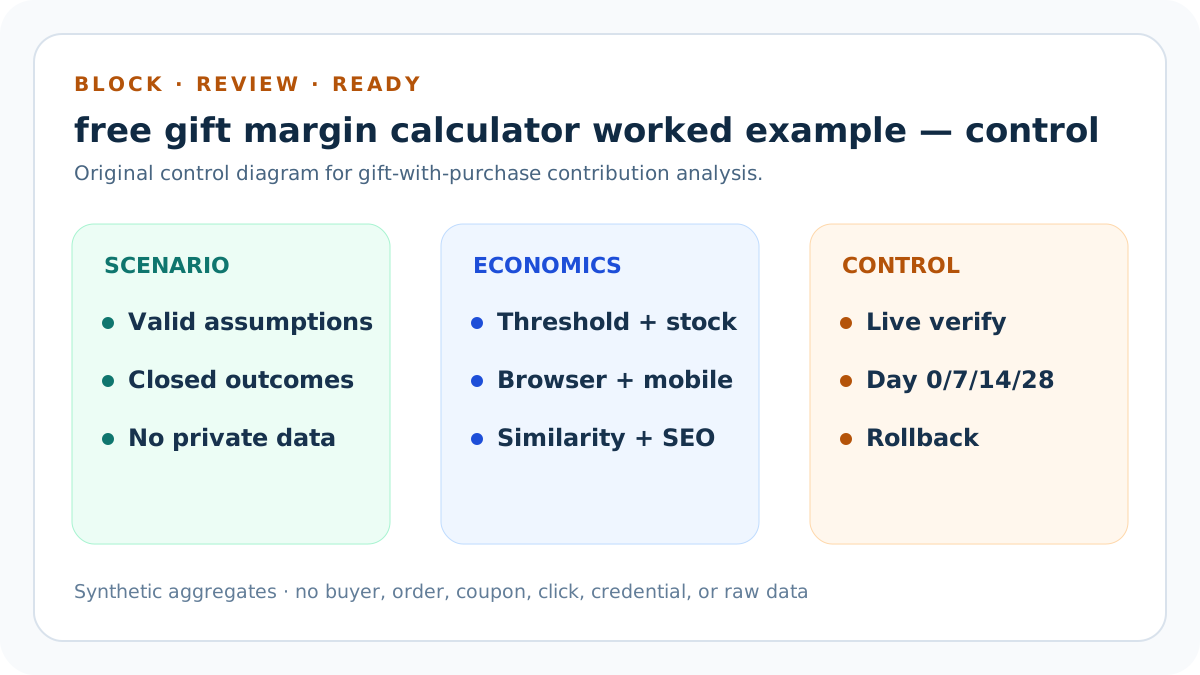
Block invalid rates, audience, threshold, revenue, contribution, gift cost, private exposure, missing mechanics, incompatible periods, stale scope, or declared conflicts. Review a valid scenario below contribution target or incremental payback. Ready means both gift sizes clear both declared tests.
Release only a reversible public model with synthetic defaults, first-party sources, original diagrams, accessible labels, self-canonical, Article and Breadcrumb schema, contextual links, strict 404 behavior, correction policy, and rollback evidence.
Sources and further reading
- Seller Profit Guard methodology: Evidence versions, formulas, privacy, correction, release, and rollback.
- Seller Profit Guard data privacy: Local-first boundaries for buyer, order, gift, promotion, payment, credential, and raw-record data.
- TikTok Shop Academy: Gift with Purchase: Reviewed July 31, 2026. Official U.S. guidance covers eligibility, thresholds, gift inventory and claim limits, separate fulfillment, seller-paid shipping, returns, compatibility, and management history.
- TikTok Shop Academy: Giveaway and Promotions Policy: Reviewed July 31, 2026. Official U.S. policy covers purchase-based incentives, clear listing and content disclosures, Seller Center registration, stock-limit disclosure, and enforcement.
- Shopify Help: Buy X get Y discounts: Reviewed July 31, 2026. Official guidance covers purchase-amount qualification, customer cart addition, online/POS scope, dates, and store time zone; it remains distinct from TikTok Shop Gift with Purchase.
Related Seller Profit Guard tools
- Free Gift Margin Calculator: Compare light and full-size gift economics.
- BOGO Margin Calculator: Model paid and reward quantities separately.
- Creator Sample Payback Calculator: Model creator-sample investment and retained-order payback.
- Seasonal Promotion Margin Calculator: Stress a dated promotion across volume, mix, ads, and capacity.
- Shipping Subsidy Calculator: Verify seller-funded parcel cost separately.
- Methodology: Review evidence, formulas, privacy, correction, release, and rollback.
- Data Privacy: Protect buyer, order, gift, promotion, payment, credential, and raw-record data.
- Free Gift Margin Formula and Inputs: Build gift-with-purchase economics from audience, baseline and scenario conversion, retained orders, gift cost, contribution, and payback.
- Free Gift Margin for a Full-Size Gift: Model a materially different full-size gift with more assumed conversion, product cost, weight, packaging, pick-pack, shipping, and loss.
- Free Gift Margin Mistakes That Hide Cost: Correct baseline, denominator, all-order gift cost, weight, separate-shipment, returns, inventory, threshold, fee, and causality errors.
- Reliable Data for Free Gift Margin: Map eligibility, threshold, audience, conversion, retention, revenue, pre-gift contribution, gift, parcel, return, and setup inputs to evidence.
- Free Gift Contribution and Payback Thresholds: Separate contribution target, incremental payback, required conversion lift, gift-cost ceiling, evidence maturity, inventory, and rollback thresholds.
- Free Gift Comparison: Sample vs Full-Size Gift: Compare a lightweight sample and full-size gift at equal audience and baseline while exposing gift cost, lift assumption, contribution, and payback.
- A Weekly Free Gift Margin Routine: Operate a repeatable gift review across configuration, audience, baseline, retained outcomes, gift cost, parcel cost, stock, thresholds, and rollback.
- How to Interpret Free Gift Margin: Interpret promoted and incremental retained orders, gift cost, contribution, target headroom, payback, required lift, and uncertainty responsibly.
- Free Gift Margin Audit Checklist: Use a standalone checklist and dated change log for gift mechanics, baseline, formulas, sources, fixtures, thresholds, release, and rollback.
Next step: Open Seller Profit Guard.
This is operational planning help, not tax, accounting, legal, financial, or platform-policy advice. Review the Terms and disclaimer, and verify current platform rules and fee assumptions before changing prices.