Seller Profit Guard: full-price order vs discounted order
Last updated: 2026-07-27
Written and reviewed by Seller Profit Guard Editorial Team.
Compare a full-price and discounted Etsy order at the same SKU, quantity, currency, cost version, fulfillment route, and attribution state. Change only the offer-related variables, reconcile both cases to seller proceeds, and explain the contribution delta. Otherwise product mix, shipping, ads, or stale costs can be mistaken for discount impact.

What makes a scenario comparison valid?
A valid comparison holds the economic grain constant. Use the same sellable SKU or variation, quantity, currency, material cost, labor method, packaging, fulfillment route, and evidence date. Define whether each case is organic or attributed. Then change the variables caused by the offer: seller-attributable revenue, seller-funded discount, shipping funding, fee base, bundle quantity, or offer-sensitive return risk.
Do not compare the shop's full-price average with a discounted holiday weekend. Product mix, seasonality, traffic source, order size, carrier zones, stockouts, and buyer behavior can all differ. The comparison first explains modeled economics; a later controlled test can examine observed commercial outcomes. Keep the modeled and measured questions separate.

| Comparison field | Hold constant | Allowed to change |
|---|---|---|
| Product | SKU, variation, quantity and cost version | Bundle quantity only if the offer changes it |
| Time and currency | Defined period and currency | Exchange rate only in an explicit scenario |
| Fulfillment | Package, weight, zone method and handling | Shipping funding or bundle package |
| Acquisition | Same organic/ad attribution state | Only in a separately labeled acquisition case |
| Offer | None | Coupon, markdown, threshold, free shipping or bundle |
| Target | Same retained contribution rule | Change only with a dated policy decision |
A same-SKU full-price and discount example
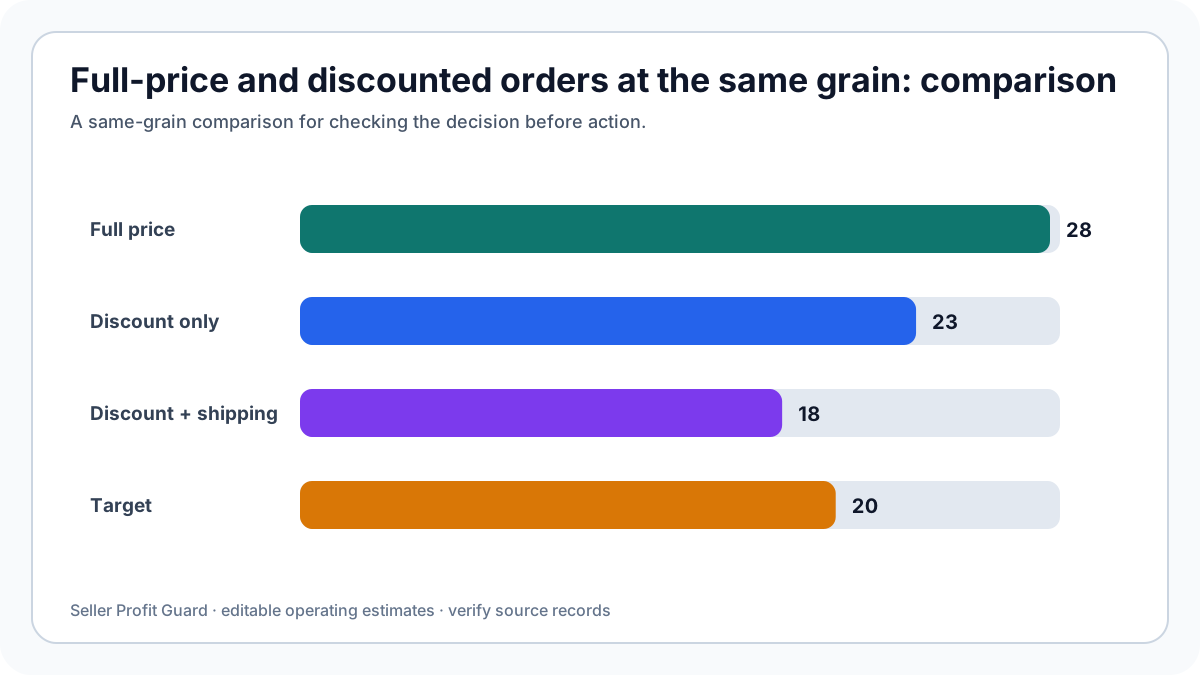
Use one SKU whose full-price order produces $58 of seller-attributable revenue. The matched or illustrative platform charges are $7, product plus labor and packaging cost $23, and shipping plus expected loss costs $11. Estimated contribution is $17. The seller's target is $15, so the full-price case passes with $2 of headroom.
Now apply a $6 seller-funded coupon that reduces seller proceeds. Assume platform charges fall by $1 under the current illustrative fee-base model while every private cost remains the same. Discounted contribution becomes $12: $52 revenue minus $6 charges, $23 product/labor/packaging, and $11 shipping/loss. It fails the same $15 target by $3.
| Layer | Full price | Discounted | Delta |
|---|---|---|---|
| Seller-attributable revenue | $58 | $52 | −$6 |
| Platform-charge example | $7 | $6 | +$1 contribution |
| Product, labor and packaging | $23 | $23 | $0 |
| Shipping and expected loss | $11 | $11 | $0 |
| Estimated contribution | $17 | $12 | −$5 |
| Target headroom | +$2 | −$3 | Decision reverses |
Why is the contribution delta not always equal to the coupon?
A seller-funded coupon changes revenue, but it can also change a percentage-based fee base, order composition, threshold eligibility, shipping funding, or return behavior. A fixed fee does not necessarily change. A platform-funded credit may offset part of the buyer discount. A bundle can increase unit quantity and packaging efficiency. The contribution delta therefore needs a bridge rather than a single subtraction.
In the example, revenue falls $6 while illustrative platform charges fall $1, producing a $5 contribution loss. If free shipping is added, the delta also includes lost shipping revenue or added subsidy. If the offer attracts a different variation or bundle, create a second product-mix comparison rather than hiding it inside the coupon analysis.

How do you compare free shipping or bundles?
For free shipping, hold the product and delivery method constant first. Compare buyer-paid shipping revenue with the seller's actual label, packaging, handling, insurance, and adjustment evidence. Then test the offer at the relevant cart or item threshold. A shop-wide average label can hide heavy variations and distant zones that cross the decision boundary.
For a bundle, compare at both order and unit level. The bundle may reduce per-unit packaging or pick work while increasing material, weight, label, discount, and return exposure. Record component quantities and ensure shared costs allocate back to the order. A higher order contribution can coexist with a lower contribution rate; decide which measure matches the operating constraint.
- Separate buyer shipping revenue from seller fulfillment cost.
- Test heavy and distant credible shipping cases.
- Model bundle components and shared costs explicitly.
- Review both contribution dollars and rate.
- Use the same retained target rule in each scenario.
How do ads and returns affect the comparison?
Do not compare a full-price organic order with a discounted attributed order unless the purpose is explicitly to test the combined offer-and-acquisition path. First compare both offers under the same organic assumption. Then compare both under the same verified or source-dated ad scenario. This shows whether the discount or acquisition cost drives the failure.
Returns can also differ when a promotion attracts gift, impulse, bundle, or clearance behavior. Use the same return allowance for the first controlled economics comparison, then add an offer-sensitive stress case if evidence supports it. Keep refund value, unrecovered loss, inventory recovery, and fee credits separate. The goal is to identify a decision driver, not load every risk into the discounted column.
What does the comparison tell the seller to change?
If the discounted case fails only because the coupon is too large, test a smaller bounded coupon. If free shipping creates the failure, use a threshold, restrict costly variations, or revise the package. If both cases fail, the underlying price, product cost, labor, fulfillment, or evidence is the priority. If both pass but the discount consumes most headroom, cap the promotion before an adverse ad or return case arrives.
Translate the result into one action with a limit. For example: test a $3 coupon for 30 orders, preserve paid shipping below a $45 cart, exclude the oversized variation, or pause the listing until the supplier record is updated. Record baseline, changed variable, expected contribution, target, start, end, owner, confounders, and rollback condition.
| Observed pattern | Likely driver | Bounded next action |
|---|---|---|
| Full price passes, discount fails | Offer size or funding | Reduce or segment the offer |
| Coupon passes, free shipping fails | Shipping subsidy | Set threshold or exclude costly cases |
| Both fail | Underlying economics or data | Repair price, cost, workflow or evidence |
| Both pass, weak headroom | Downside exposure | Limit test and improve evidence |
| Discount has higher dollars | Bundle/order mix | Check rate, labor and capacity too |
How should an observed promotion test be measured?
Save a pre-test snapshot: listings, SKUs, old offer, new offer, dates, traffic source, inventory, price, shipping, ads, images, and other relevant changes. Define the order or time limit and the contribution threshold. Compare settled, evidence-complete orders rather than gross sales alone. Flag seasonality, marketplace campaigns, stockouts, and product-mix shifts.
Do not claim that the offer caused a change from a small or confounded sample. Review revenue, contribution dollars, rate, order value, units, labor, shipping, advertising, returns, cancellations, and missing-cost coverage together. A promotion can raise orders while reducing contribution or overwhelming capacity. Keep, revise, or roll back with a dated reason.
- Create a same-grain modeled comparison before the offer begins.
- Define one primary commercial and one primary contribution outcome.
- Cap orders, spend, inventory, or time.
- Freeze unrelated listing variables where practical.
- Reconcile actual fee, shipping and return evidence.
- Record confounders and choose keep, revise or rollback.
Full-price versus discount questions
Should list price appear in the discounted model? It can appear as reference, but settled seller-attributable revenue drives the contribution arithmetic.
What if the fee base changes with the discount? Use the current official rule or matched statement evidence, and show the fee delta separately.
Can a discount improve contribution? A bundle or threshold can improve order economics through mix or efficiency, but prove component costs, fulfillment, and funding. A simple seller-funded markdown normally reduces revenue.
What if the discounted offer has more orders? Compare total and per-order contribution plus capacity. More orders do not automatically repair weak unit economics.
How many scenarios are enough? Begin with base full-price, base discounted, and one credible adverse case. Add scenarios only when they answer a different decision.
Privacy and evidence limits for same-grain scenario comparison
A contribution review does not need buyer names, delivery addresses, private messages, payment credentials, marketplace passwords, or a public copy of the seller's order history. It normally needs a redacted transaction key, date, SKU, quantity, seller-attributable revenue, relevant fee evidence, and private cost assumptions. Keep the untouched export in controlled storage and work from a local copy.
Seller Profit Guard is designed to read supported CSV files in the browser. A report can still contain commercially sensitive prices, SKU economics, labor rates, and supplier costs, so treat exports as private operating records. For support, share column names and a made-up example row. If an account-specific reserve, fee, refund, or suspension determines the answer, use the authenticated Etsy record rather than a generic assumption.
- Do not upload buyer identity or address fields for a margin calculation.
- Do not paste raw order rows into public communities, support email, or AI prompts.
- Use public dummy data to reproduce mapping and formula issues.
- Store cost libraries, reports, and change logs as confidential business records.
- Escalate tax, accounting, legal, and account-policy questions to the appropriate official or professional source.
How to apply this same-grain scenario comparison in Seller Profit Guard
Open the Etsy CSV profit calculator with a recent, representative order-item export or the public dummy sample. Confirm the revenue, quantity, SKU, shipping, discount, fee, and transaction mappings before importing private cost assumptions. Review missing-cost and mapping warnings first; a precise result built on an empty or misidentified field is not decision-ready.
Run the relevant base and stress scenarios, export the private review list, and record the source period, assumptions, result, decision, owner, and next review date. The useful output is not a perfect score. It is a short, evidence-backed queue of listings or SKUs that need a price, cost, shipping, promotion, or data-quality action.
- Preserve the source export and record its shop, currency, period, and file type.
- Confirm every mapped field and keep missing values unknown rather than zero.
- Attach the correct SKU-level material, labor, packaging, fulfillment, and target assumptions.
- Run a base case plus the page-specific stress or comparison case.
- Inspect the rows that fail the target or evidence-quality gate.
- Record one reversible action and a dated follow-up instead of changing the whole shop.
Related resources
- Open the Etsy CSV profit calculator: Run a browser-local order and SKU contribution review with editable assumptions.
- Build an Etsy SKU cost library: Store material, labor, packaging, shipping, and target assumptions for repeat reviews.
- Reconcile Etsy Payment Account activity: Match order and statement evidence before interpreting cash movement as product economics.
- Review CSV data privacy: Keep raw buyer and order data out of public support and community posts.
- Read the editorial policy: See how sources, corrections, AI assistance, and update dates are handled.
Sources and further reading
- Seller Profit Guard calculation methodology: Calculation scope, editable assumptions, contribution terminology, privacy boundaries, and result limits.
- Etsy Help: Fees and Taxes for Selling: Official fee categories, fee bases, country-dependent processing charges, advertising fees, and Payment Account treatment.
- Etsy Help: Download Sold Transaction Spreadsheets: Official order items, orders, Etsy Payments sales, and Etsy Payments deposits CSV workflow.
- Etsy Help: Manage Your Payment Account: Official sales, fees, refunds, seller services, shipping, monthly statements, balance, and deposit context.
- Etsy Help: How Offsite Ads Work: Official attribution, participation, fee-rate, and order-cap context; verify current shop-specific status.
- Etsy Help: Issue a Full or Partial Refund: Official refund workflow and Payment Account impact reference.
Related Seller Profit Guard tools
- Open the Etsy CSV profit calculator: Run a browser-local order and SKU contribution review with editable assumptions.
- Build an Etsy SKU cost library: Store material, labor, packaging, shipping, and target assumptions for repeat reviews.
- Reconcile Etsy Payment Account activity: Match order and statement evidence before interpreting cash movement as product economics.
- Review CSV data privacy: Keep raw buyer and order data out of public support and community posts.
- Read the editorial policy: See how sources, corrections, AI assistance, and update dates are handled.
- Etsy Profit Formula: Inputs Small Sellers Must Track: Continue the Seller Profit Guard evidence and decision workflow.
- Etsy Profit Example: Trace a $74 Order Step by Step: Continue the Seller Profit Guard evidence and decision workflow.
- Etsy Discount Profit: Test Coupons and Free Shipping: Continue the Seller Profit Guard evidence and decision workflow.
- Etsy Profit Calculator Mistakes: 12 Cost Traps: Continue the Seller Profit Guard evidence and decision workflow.
- Etsy Profit Data Sources: Build a Defensible Record: Continue the Seller Profit Guard evidence and decision workflow.
Next step: Open the Etsy CSV profit calculator.
This is operational planning help, not tax, accounting, legal, financial, or platform-policy advice. Review the Terms and disclaimer, and verify current platform rules and fee assumptions before changing prices.