How variation naming changes for material and personalization
Last updated: 2026-07-30
Written and reviewed by Seller Profit Guard Editorial Team.
Use a Material variation when buyers choose from a fixed set such as Sterling silver, Gold filled, or Brass and those choices affect photos, price, inventory, SKU, or processing. Collect the exact engraving separately through focused personalization instructions. Do not disguise an open-ended custom request as a vague Custom variation value.

material-versus-personalization scenario: scope and decision
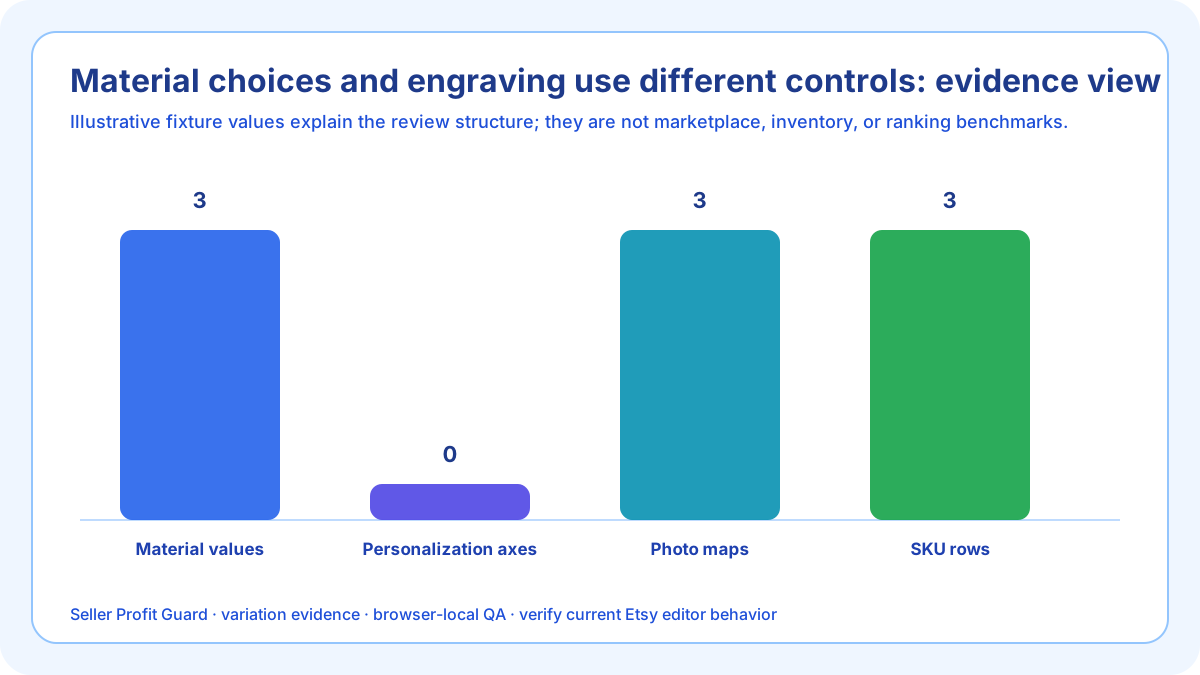
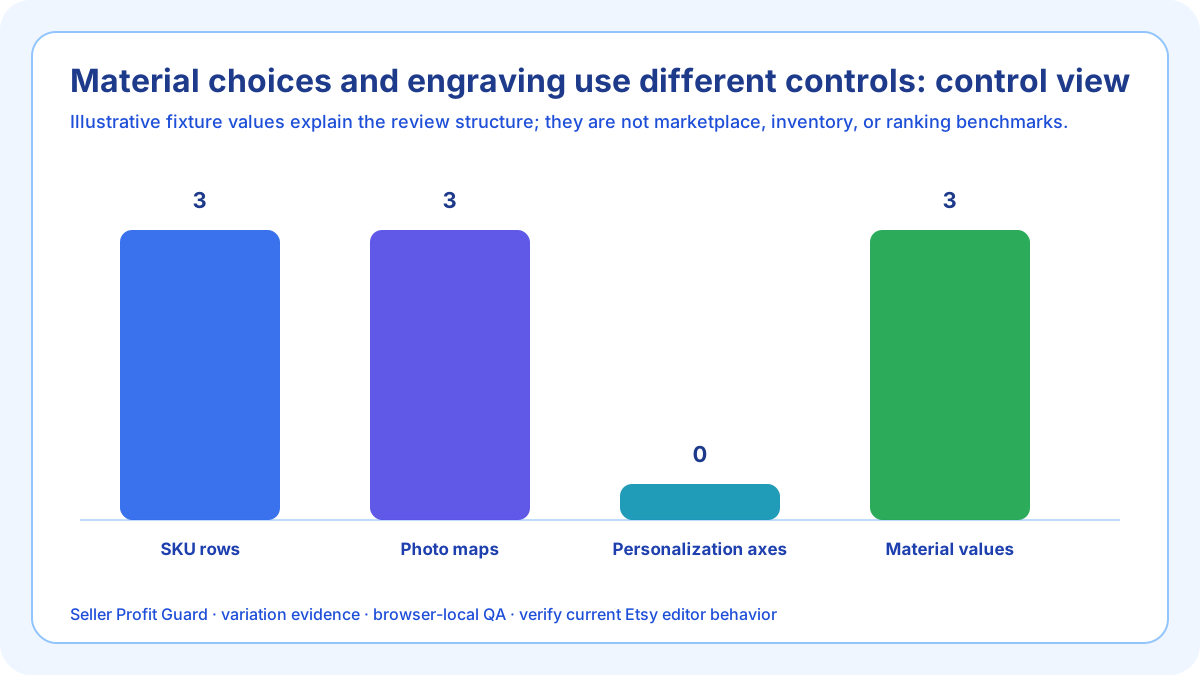
This scenario uses a personalized necklace with three fixed material choices and buyer-entered engraving. The material options change appearance, cost, price, SKU, and sometimes processing; engraving text changes the made-to-order instruction but does not create a reusable inventory value.
Etsy's current personalization guidance distinguishes variations, Custom options, and one-off custom listings by operating effect. Variations suit finite base-item choices that affect inventory, price, or SKU. Custom options can collect focused text, a bounded list choice, or a file without turning every buyer input into inventory. A private custom listing handles a unique request created for one buyer.
Build the jewelry choice boundary map before analysis
The checker audits the Material axis and its values, selected photos, total prices, and combination SKUs. The personalization prompt, character boundary, examples, proof process, and missing-information rule belong to the next dedicated checker rather than being hidden inside an option called Custom.
The evidence packet uses synthetic engraving examples and product aliases. Never copy a buyer name, photograph, message, address, private proof, order ID, or receipt into the public tool or guide.
Define the base product first
Record necklace design, pendant dimensions, chain specification, material composition evidence, finish samples, packaging, processing, care, price totals, and inventory method. The choice model cannot rescue an undefined or unsupported base item.
The jewelry choice boundary map treats “Define the base product first” as an independent claim with its own evidence and failure consequence. Compare three fixed necklace materials with open-ended Custom value at the same grain. Document the responsible owner, uncertainty, next check, and rollback trigger so a clean separation of selectable inventory and buyer-entered text does not depend on memory, a buyer order, or a copied private message.
Use Material as the buyer axis
Material accurately names Sterling silver, Gold filled, and Brass. Finish would be misleading if composition changes; Style would be too generic. Use the term that matches the approved product authority and the question the buyer actually answers.
The jewelry choice boundary map treats “Use Material as the buyer axis” as an independent claim with its own evidence and failure consequence. Compare three fixed necklace materials with open-ended Custom value at the same grain. Document the responsible owner, uncertainty, next check, and rollback trigger so a clean separation of selectable inventory and buyer-entered text does not depend on memory, a buyer order, or a copied private message.
Keep material values factual
Each value names one selectable construction. Do not mix Gold filled, 18-inch chain, Gift box, and Custom under Material. Internal abbreviations such as GF can remain in SKU codes while the buyer sees the clear full term.
The jewelry choice boundary map treats “Keep material values factual” as an independent claim with its own evidence and failure consequence. Compare three fixed necklace materials with open-ended Custom value at the same grain. Document the responsible owner, uncertainty, next check, and rollback trigger so a clean separation of selectable inventory and buyer-entered text does not depend on memory, a buyer order, or a copied private message.
Map every visible material
Link each material value to a finished example under comparable lighting. A color swatch or rendering may be supplemental, but it cannot silently replace required actual-product evidence. Check the selected image in the public view.
The jewelry choice boundary map treats “Map every visible material” as an independent claim with its own evidence and failure consequence. Compare three fixed necklace materials with open-ended Custom value at the same grain. Document the responsible owner, uncertainty, next check, and rollback trigger so a clean separation of selectable inventory and buyer-entered text does not depend on memory, a buyer order, or a copied private message.
Map total price and processing
Record the complete price for every material and separately verify whether the processing profile varies. A material with longer sourcing or fabrication time should not inherit an inaccurate shipping expectation merely because the variation label is correct.
The jewelry choice boundary map treats “Map total price and processing” as an independent claim with its own evidence and failure consequence. Compare three fixed necklace materials with open-ended Custom value at the same grain. Document the responsible owner, uncertainty, next check, and rollback trigger so a clean separation of selectable inventory and buyer-entered text does not depend on memory, a buyer order, or a copied private message.

Build material-level SKUs
If chain length is fixed, one SKU per material may be sufficient; if another axis varies, enumerate all combinations. Keep the buyer-readable material name linked to the internal code so picking, cost, and returns do not depend on memory.
The jewelry choice boundary map treats “Build material-level SKUs” as an independent claim with its own evidence and failure consequence. Compare three fixed necklace materials with open-ended Custom value at the same grain. Document the responsible owner, uncertainty, next check, and rollback trigger so a clean separation of selectable inventory and buyer-entered text does not depend on memory, a buyer order, or a copied private message.
Collect engraving through Custom options
Use a focused text box for exact engraving text, or a bounded Custom options list for a non-inventory choice such as an approved font when that accurately fits the workflow. Record capitalization, allowed characters, examples, price treatment if the eligible test is present, and what happens when information is incomplete. Do not turn every buyer string into a variation value or expose private personalization content in an audit fixture.
The jewelry choice boundary map treats “Collect engraving through Custom options” as an independent claim with its own evidence and failure consequence. Compare three fixed necklace materials with open-ended Custom value at the same grain. Document the responsible owner, uncertainty, next check, and rollback trigger so a clean separation of selectable inventory and buyer-entered text does not depend on memory, a buyer order, or a copied private message.
Escalate one-off custom work
A request for a different shape, composition, layout, or unlisted design may require a custom-order workflow rather than a Custom dropdown. Define eligibility, evidence, price, processing, proof, private context, and listing path before accepting it.
The jewelry choice boundary map treats “Escalate one-off custom work” as an independent claim with its own evidence and failure consequence. Compare three fixed necklace materials with open-ended Custom value at the same grain. Document the responsible owner, uncertainty, next check, and rollback trigger so a clean separation of selectable inventory and buyer-entered text does not depend on memory, a buyer order, or a copied private message.
Verification, release, and rollback controls
Before changing a public listing, preserve the complete jewelry choice boundary map, editor values, linked assets, selected-path observations, test fixtures, approval, and rollback identifier. Confirm the correct account and listing. Safe-stop on login or CAPTCHA ambiguity, a platform warning, wrong profile, missing target context, private data, or an unexpected editor state.
After one bounded release, verify three fixed necklace materials on mobile and desktop and deliberately revisit the risk represented by open-ended Custom value. Check axis names, values, selected photo, full price, availability, processing, cart or receipt choice, and SKU for every valid combination. Restore the prior configuration when a critical path does not support a clean separation of selectable inventory and buyer-entered text.
Limits, privacy boundary, and next action
This guide and checker use seller-entered text and synthetic examples. They do not retrieve Etsy data, alter a listing, inspect images, validate product composition, confirm inventory or receipts, certify marketplace policy, or predict ranking, clicks, conversion, sales, returns, income, or AdSense approval. Seller Profit Guard is independent and unaffiliated with Etsy and provides operational QA rather than legal, tax, accounting, inventory, search, accessibility, or platform advice.
Keep buyer names, addresses, messages, order IDs, receipts, private personalization, credentials, OAuth data, and raw CSV files outside the jewelry choice boundary map. The next action is to repair the named evidence layer, rerun complete and crossed fixtures, release only the approved set, inspect the public choice path, and record whether a clean separation of selectable inventory and buyer-entered text was verified or rolled back.
Sources and further reading
- Etsy Help: How to Add Variations for Your Listings: Current official variation attributes, values, total prices, quantities, processing profiles, SKUs, linked photos, custom variations, visibility, preview, and buyer-selection behavior.
- Etsy Help: How to Create a Listing: Current official category, price, quantity, SKU, physical-listing, and variation context.
- Etsy Help: Processing Times and Processing Profiles: Current official listing- and variation-level processing-profile behavior.
- Etsy Help: How to Offer Personalized Listings: Current official Custom options fields, five-field limit, field types, test-limited add-on pricing, and the inventory-versus-personalization boundary.
- Etsy Help: How to Offer Custom Items: Current official boundary between public listing variations and one-buyer private custom listings.
- Etsy Seller Policy effective July 9, 2026: Current official accuracy, content, privacy, representation, and seller-responsibility requirements.
- Seller Profit Guard methodology: Evidence hierarchy, privacy boundary, uncertainty labels, corrections, release verification, and rollback controls.
Related Seller Profit Guard tools
- Open the Etsy Variation Naming Checker: Review axes, values, buyer selectors, linked photos, total prices, and unique SKU combinations.
- Audit Etsy variation and SKU risk: Check cost and fulfillment risk after the naming contract is coherent.
- Review Etsy attribute coverage: Keep category attributes separate from buyer-selectable options.
- Check Etsy photo coverage: Verify appearance-changing values have truthful buyer evidence.
- Read the variation SKU checklist: Connect buyer choices with stable cost and inventory controls.
- Read the local-first methodology: Preserve evidence, privacy, bounded release, feedback, and recovery.
- Etsy Variation Naming Formula and Inputs: Continue the variation evidence, mapping, decision, release, interpretation, or audit workflow.
- Etsy Variation Names: Size and Color Example: Continue the variation evidence, mapping, decision, release, interpretation, or audit workflow.
- 12 Etsy Variation Naming Mistakes: Continue the variation evidence, mapping, decision, release, interpretation, or audit workflow.
- Evidence Sources for Etsy Variations: Continue the variation evidence, mapping, decision, release, interpretation, or audit workflow.
- Etsy Variation Naming: Ready to Block: Continue the variation evidence, mapping, decision, release, interpretation, or audit workflow.
Next step: Open the Etsy Variation Naming Checker.
This is operational planning help, not tax, accounting, legal, financial, or platform-policy advice. Review the Terms and disclaimer, and verify current platform rules and fee assumptions before changing prices.