Single coupon versus a complete promotion stack
Last updated: 2026-07-29
Written and reviewed by Seller Profit Guard Editorial Team.
Compare a single coupon and a complete promotion stack with the same gross revenue, product, packaging, fulfillment, advertising, return, fee-rate, and target assumptions. Add only the item discount, seller-funded shipping, and affiliate commission to the second row. The contribution difference then isolates the entered stack cost rather than a product or period change.

What does this matched scenario comparison answer?
compare a single coupon and a complete offer stack with the same gross like-for-like revenue, product, packaging, fulfillment, advertising, return, fee-rate, and target assumptions. Add only the item discount, comparison owner-funded shipping, and affiliate commission to the second row. The delta difference then isolates the entered stack held expense rather than a product or period change. This page treats the comparison grid as a bounded operating aid for the comparison owner, not as a substitute for a marketplace statement or checkout engine.
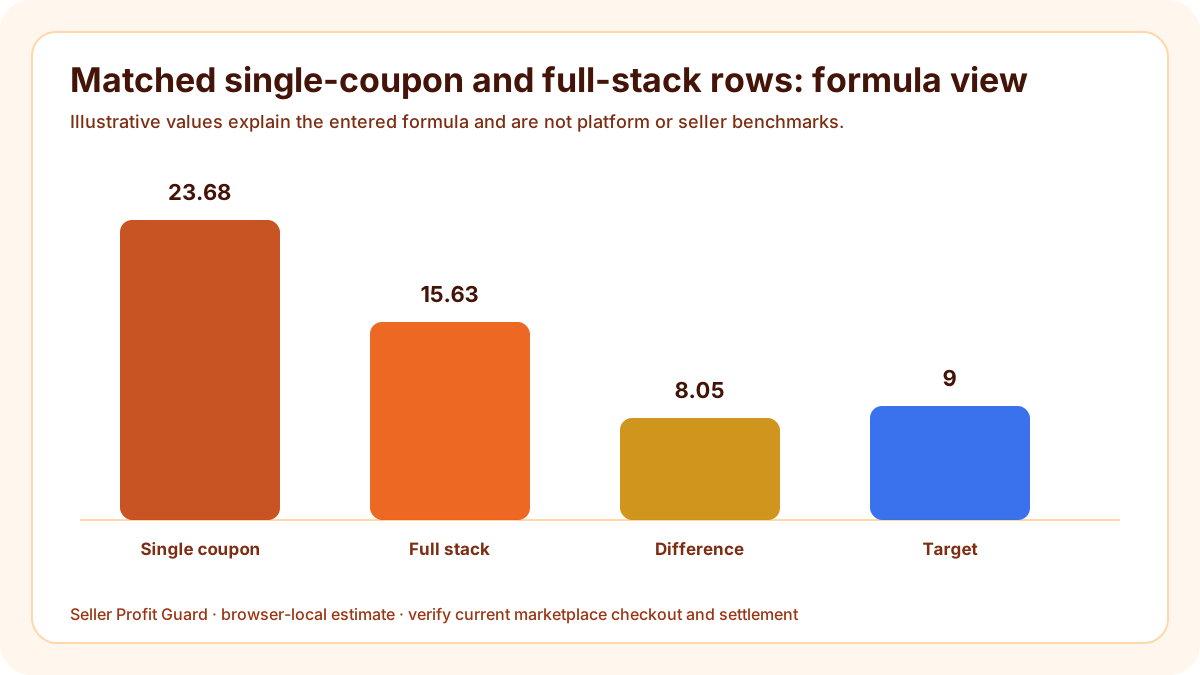
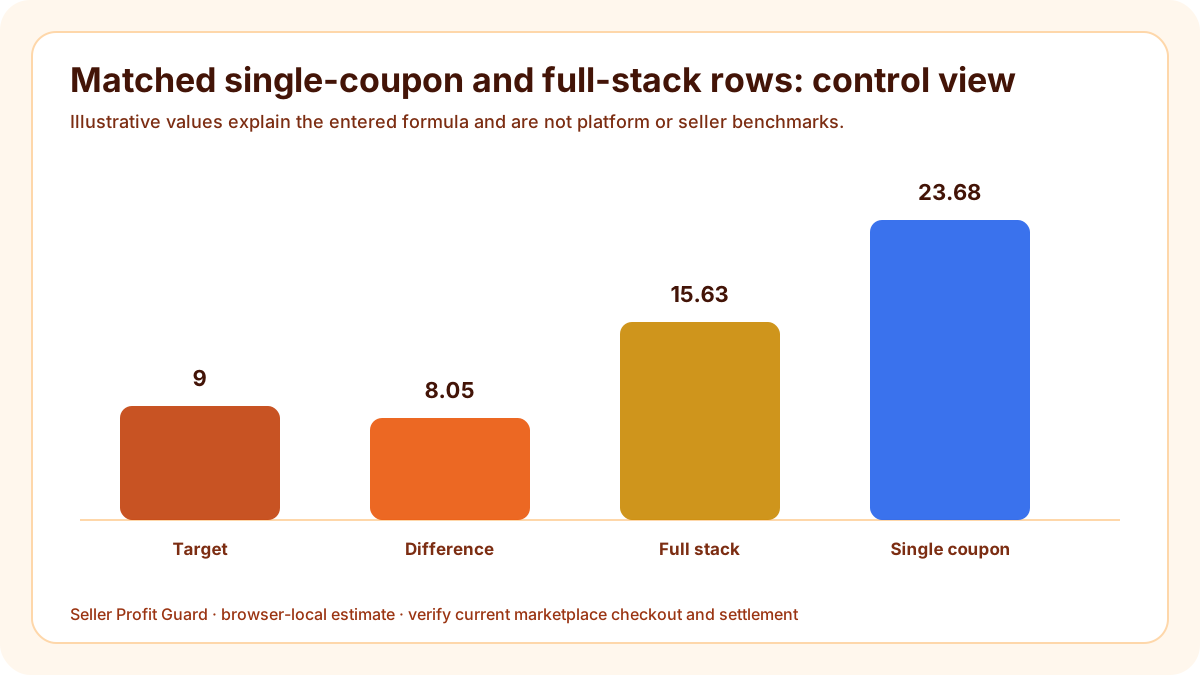
In the matched $60 fixture, the one-coupon row leaves $23.68 and the full-stack row leaves $15.63. The $8.05 difference combines the extra item discount, shipping, affiliate charge, and changed fee and coupon bases. The matched purchase stays at one declared grain so the paired offer paths, like-for-like like-for-like revenue, and held expense can be compared without mixing products, countries, currencies, or matched purchase states.
The arithmetic difference is not causal lift. It does not show whether the affiliate, free shipping, or deeper shopper price created incremental retained demand. It only shows the entered per-matched purchase economics if that matched purchase occurs. Record the convention beside the calculation; a hidden convention is a authority of comparison drift, not a harmless simplification.
How should the incremental deduction sequence be calculated?
Start with gross merchandise like-for-like revenue for the selected matched purchase. Apply an item-level percentage to the eligible merchandise amount, then apply the matched purchase coupon to the revised subtotal when that is the verified sequence. Subtract fixed comparison owner-funded shipping separately. This fixs each shopper benefit rather than adding percentages into one unsupported rate.
Calculate marketplace and payment fees and affiliate commission on the basis documented for the current market and account. The checker uses post-discount merchandise like-for-like revenue as its transparent planning basis. If the settlement report uses gross like-for-like revenue, shipping, tax, or another definition, replace the assumption and explain the variance in the matched-case proof.
Round only display values. Keep unrounded numbers in the private comparison grid when cents affect the route selection. The comparison is delta, not tax or accounting profit, and excludes any overhead the comparison owner has not entered.
Which marketplace combination rules must stay separate?
Etsy, Shopify, and TikTok Shop do not share one universal stacking rule. Etsy distinguishes shop and Etsy-funded coupons and can apply a best offer. Shopify uses product, matched purchase, and shipping classes with eligibility and application-matched purchase rules. TikTok directs comparison owners to current stacking guidance and its offer Simulator. Treat each as a separate comparison row.
Never transfer a rule from one marketplace, sales channel, plan, country, or offer class to another. A combination allowed in one Shopify checkout path does not prove eligibility on an external checkout. A TikTok-funded incentive does not prove comparison owner funding. An Etsy shopper offer does not define another marketplace’s commission basis.
Before the route selection, capture the exact account, market, product, channel, offer classes, dates, and checkout outcome. If the interface shows an unexpected warning, wrong profile, missing target, ambiguous funding, or login challenge, safe-stop instead of inferring the rule.

How should product, shipping, ads, and returns enter the comparison grid?
Use the landed product amount for the exact SKU or weighted mix, then add packaging and fulfillment at the same matched purchase grain. Put comparison owner-funded shipping in its own cell because carrier zone, service, dimensional weight, and buyer charge can change independently from the merchandise incremental deduction.
Advertising remains a separate acquisition held expense; an affiliate commission does not replace media spend. Use aggregate spend divided by the retained matched purchases assigned to the same campaign and window. Do not divide by impressions, clicks, all shop matched purchases, or refunded matched purchases when the question is retained delta per promoted matched purchase.
Expected return loss is probability-weighted exposure after refund, reverse shipping, unrecovered outbound fulfillment, handling, inventory damage, replacement, and realistic recovery. Refresh it after the return window matures. An unresolved matched purchase is not final matched-case proof.
What base and stress comparison rows belong in the analysis?
The base comparison row uses the most supportable present values. Stress higher shipping, advertising, return loss, and affiliate commission; a lower retained-matched purchase denominator; and a different redemption mix. Change one variable first, then combine an ordinary downside case whose values come from observed variation or contract boundaries.
In the matched $60 fixture, the one-coupon row leaves $23.68 and the full-stack row leaves $15.63. The $8.05 difference combines the extra item discount, shipping, affiliate charge, and changed fee and coupon bases. Recalculate with a plausible carrier increase, a less favorable ad-held expense allocation, and a mature return estimate. The point is to identify which layer consumes the matched target, not to manufacture dozens of arbitrary combinations.
Keep the single-coupon row as a matched control. Hold product, base like-for-like revenue, fee convention, direct held expenses, advertising, return exposure, and target constant. Add only the full-stack layers so the delta difference remains interpretable.
What matched-case proof is required before selection?
fix market, currency, time zone, product and variation scope, offer class, item and matched purchase discount settings, combination controls, funding owner, fee and commission convention, shipping rule, direct-held expense version, advertising filter, return cohort, authority access dates, and calculator version.
Use aggregate cells and privacy-safe references in the working comparison grid. Buyer identities, addresses, messages, payment details, raw matched purchase exports, private CSV files, affiliate contact details, and account credentials are unnecessary for this public checker and must remain in the approved private environment.
Separate official marketplace guidance, comparison owner-observed records, model assumptions, and the route selection. A authority can define eligibility without proving settlement; a payout can show funding without proving causal demand. Unknown cells remain labeled unknown or assumed.
How should the matched target and maximum coupon be read?
Break-even is zero delta under the entered assumptions. The target reserves the comparison owner’s declared margin requirement. The checker’s maximum matched purchase coupon at target solves for the coupon rate that would consume the remaining cushion after the other full-stack layers. It is a sensitivity boundary, not marketplace permission.
If fee plus affiliate rates leave no delta-bearing like-for-like revenue, or item discounts eliminate the subtotal, no safe coupon rate exists. A displayed zero can also mean the target is already missed before the matched purchase coupon. Diagnose the held expense stack rather than interpreting zero as a recommended launch value.
Changing product mix, average matched purchase value, carrier zone, advertising channel, return maturity, and coupon redemption together defeats the comparison. Aggregate like-for-like revenue can rise while the matched matched purchase loses more money. Express the matched target as a range when shipping, ads, returns, or settlement bases are uncertain. The precision of the delta cannot exceed the precision of its inputs.
Which route selection and rollback controls apply?
Hold all shared inputs constant, reconcile each path separately, then choose keep, cap, adjust, retest, stop, or rollback. Evaluate volume and delta as separate outcomes. The selection log names owner, market, product, exact paired offer paths, start and end, volume or spend cap, expected comparison window, unchanged context, exception list, stop trigger, and restoration instruction.
After saving, match the intended product, dates, eligibility, combination settings, budget, and customer-facing outcome. Use a checkout simulator or controlled test appropriate to the marketplace. Do not assume a saved configuration is active merely because the editor accepted it.
Rollback restores the fixd offer state or pauses the offer when delta misses the matched target, funding differs from the approval, shipping or returns drift beyond bounds, the wrong context appears, or a marketplace or policy warning is unresolved. Match the restored state and keep the failure record.
How should the delta be reviewed after the offer?
Wait for the declared matched-case proof window, then reconcile retained matched purchases, comparison owner-funded discounts, fee and commission settlement, shipping, advertising, returns, and held expense changes at the same grain. Use observed-after language; do not claim the offer caused volume without a credible experimental design.
compare the modeled base, stress range, and reconciled distribution. Diagnose variance by layer. A miss caused by carrier mix requires a different response from one caused by affiliate rate, redemption mix, fee basis, ad allocation, or refund maturity.
Close the side-by-side check with keep, cap, adjust, retest, hold, stop, or rollback and a reason. Schedule the next check and fix the accepted comparison, authoritys, delta, exceptions, and restoration state.
What should the comparison owner do next?
Open the Coupon Stack Risk Checker and enter one representative matched purchase without private data. Save the single-coupon and full-stack outputs, then replace every default with an account-specific value supported by the matched-case proof map.
Run the checkout and authority checks described above. If the full-stack delta clears the matched target, test within the declared cap. If it fails, change one controllable lever—discount, shipping, commission, ad spend, price, or direct held expense—then rerun the matched cases.
The calculator is unaffiliated with Etsy, Shopify, TikTok, or other marketplaces and does not provide tax, legal, accounting, or marketplace-compliance advice. Verify official guidance and current account behavior before publishing or spending.
Sources and further reading
- Etsy Help: Set up sales and discounts: Official seller guidance for sales, promo codes, discounted bundles, targeted offers, and promotion review.
- Etsy Help: Redeem coupons and offers: Official checkout-facing explanation of Etsy-funded and shop-funded coupons, offer limits, eligibility, and best-offer behavior.
- Shopify Help: Combining discounts: Official combination classes, eligibility, application order, limits, best-discount behavior, and checkout-channel boundaries.
- TikTok Shop Academy: Promotion stacking rules: Official explanation of stackability, promotion priority, and the Seller Center Promotion Simulator.
- TikTok Shop Academy: Seller coupons: Official seller-coupon funding, eligibility, application, and current combination guidance.
- Seller Profit Guard methodology: Evidence hierarchy, editable assumptions, privacy boundaries, uncertainty labels, and change-control rules.
Related Seller Profit Guard tools
- Open the Coupon Stack Risk Checker: Compare a single coupon with a full seller-funded promotion stack.
- Calculate a free-shipping threshold: Test the order value required before absorbing shipping.
- Estimate creator commission: Keep affiliate commission, ads, samples, and returns visible.
- Calculate TikTok Shop margin: Map seller revenue and cost layers at one order grain.
- Read the editorial policy: Review sourcing, correction, and publication controls.
- Read the local-first methodology: Keep raw orders, buyer data, and credentials outside public tools.
- Coupon Stack Formula: 12 Inputs That Matter: Continue the coupon-stack formula, evidence, decision, or control workflow.
- Coupon Stack Example: From $60 to Contribution: Continue the coupon-stack formula, evidence, decision, or control workflow.
- Coupon Plus Free Shipping and Affiliate Fees: Continue the coupon-stack formula, evidence, decision, or control workflow.
- 10 Coupon Stack Mistakes That Hide Losses: Continue the coupon-stack formula, evidence, decision, or control workflow.
- Coupon Stack Data Sources: Field by Field: Continue the coupon-stack formula, evidence, decision, or control workflow.
Next step: Open the Coupon Stack Risk Checker.
This is operational planning help, not tax, accounting, legal, financial, or platform-policy advice. Review the Terms and disclaimer, and verify current platform rules and fee assumptions before changing prices.