Influencer campaign payback audit checklist and change log
Last updated: 2026-07-31
Written and reviewed by Seller Profit Guard Editorial Team.
An influencer campaign payback audit records the signed scope, fixed fee, rights, contracted and approved assets, sample and media costs, attribution and maturity rules, contribution, reusable-asset basis, recognition rate, formulas, scenarios, decision, owner, reviewer, exceptions, and restoration packet without exposing creator contracts or customer records.
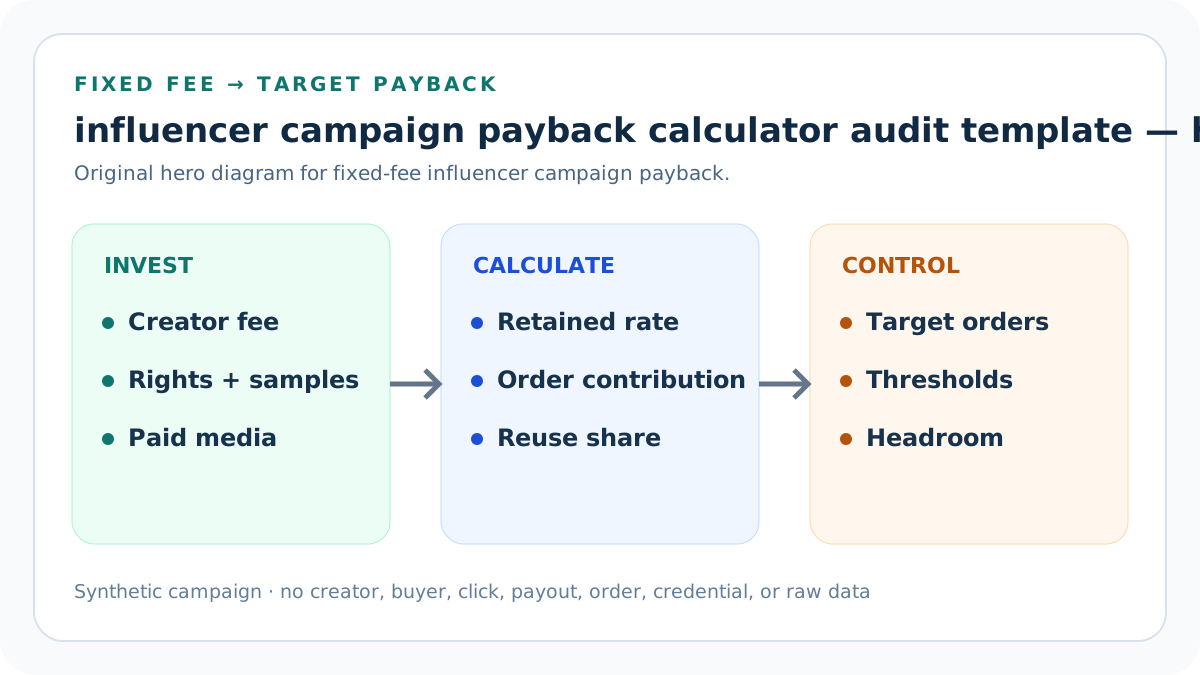
Open a cover sheet with an immutable packet ID
Create one redacted audit packet identifier that binds the campaign, platform, market, currency, evidence period, formula version, preparer, independent reviewer, opening date, and final disposition. The cover sheet points to private evidence without copying contracts, invoices, creator identities, buyer records, order rows, or credentials into a public artifact. This entry belongs to the campaign audit and change log and supports a reviewable influencer campaign payback audit.
Record every later correction as a new packet version. Preserve the prior identifier, reason for change, approving role, effective timestamp, and restoration reference so a reviewer can reconstruct what the calculator knew at each decision point.
Build an evidence index before recalculating
List the signed scope, amendments, invoice, rights schedule, asset register, fulfillment summary, billed-media report, aggregate attribution export, contribution specification, and reuse memo as separate evidence classes. For each pointer, capture owner, evidence date, covered period, redaction state, access class, checksum or version label, and expiry. This entry belongs to the campaign audit and change log and supports a reviewable influencer campaign payback audit.
Mark an item missing, open, superseded, or accepted instead of filling gaps with memory. The index is complete only when every calculator input has one authoritative pointer and conflicting records have a documented precedence rule.
Chronicle contract and amendment events
Create a dated chronology for initial agreement, revised deliverables, fee changes, rights extensions, cancellation terms, performance payouts, approval milestones, and payment status. Tie each event to the exact clause or redacted evidence pointer that changed the economic model. This entry belongs to the campaign audit and change log and supports a reviewable influencer campaign payback audit.
Do not collapse amendments into the latest total. A reviewer must be able to bridge the original commitment to final recognized investment and identify costs that were proposed, contracted, invoiced, disputed, waived, or paid.
Reconcile every deliverable in an acceptance matrix
Give each promised asset a stable row with required format, length, aspect ratio, submission date, revision count, claims review, disclosure review, approval state, publication URL, paid-use readiness, and rejection reason. Count only assets accepted under the declared rule. This entry belongs to the campaign audit and change log and supports a reviewable influencer campaign payback audit.
Reconcile the matrix total to both the contract and calculator denominator. A filename, draft upload, or creator submission is not automatically an approved reusable asset; unresolved rows keep the closed-campaign packet blocked.
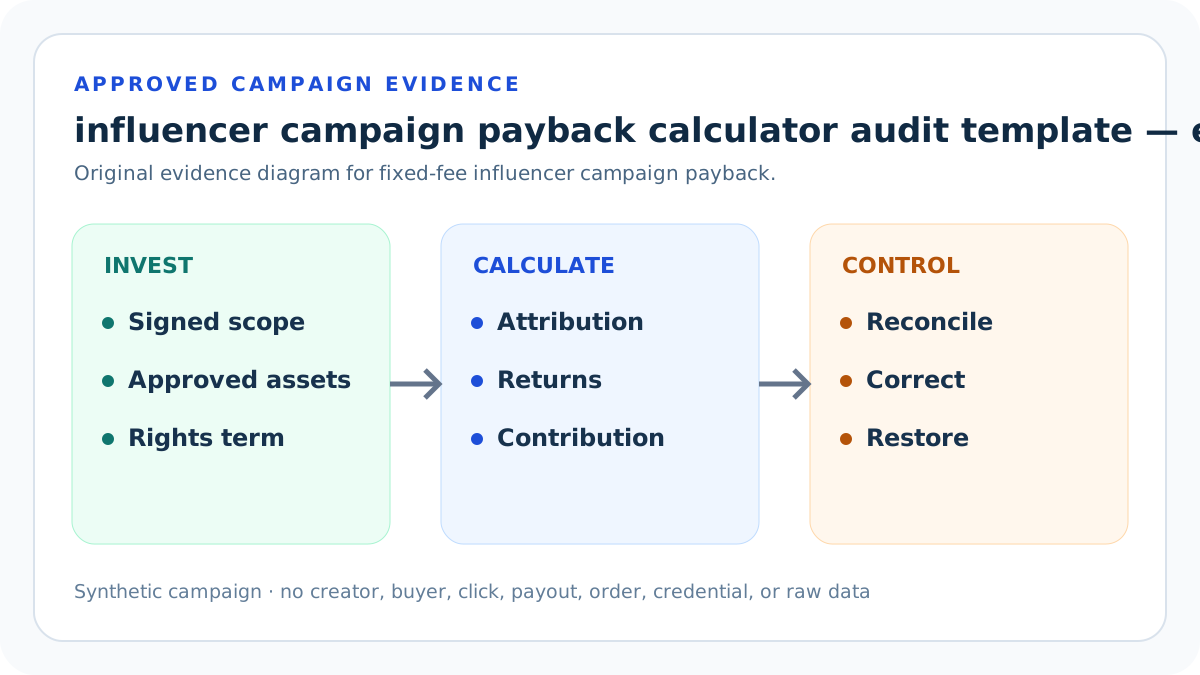
Create a rights register by asset and use
Record organic publication, paid amplification, editing, cropping, localization, territory, channel, term, likeness, exclusivity, sublicensing, renewal, and deletion duties for every asset. Attach the governing clause pointer and expiration date to each permitted use. This entry belongs to the campaign audit and change log and supports a reviewable influencer campaign payback audit.
Treat the YouTube Open Call 180-day usage example only as program-specific evidence, not a universal term. Recognized reuse must fit the actual signed scope and must expire when the underlying permission expires.
Document disclosure and claims review
Record where the material-connection disclosure appears, whether the platform paid-promotion control was used, which claims were reviewed, the responsible reviewer, target audience, jurisdiction, product restrictions, and correction path. Keep screenshots or review records behind redacted pointers. This entry belongs to the campaign audit and change log and supports a reviewable influencer campaign payback audit.
Passing this worksheet does not certify legal compliance. Missing, ambiguous, or contradictory disclosure evidence creates a separate stop condition even when modeled contribution covers campaign investment.
Reconcile the cost ledger to invoices and fulfillment
Bridge creator fee, rights, fulfilled sample product, packaging, shipping, agency, production, review, billed amplification, and other campaign cost from source records to the calculator. Show currency conversion, tax treatment convention, allocation method, and any credit or refund separately. This entry belongs to the campaign audit and change log and supports a reviewable influencer campaign payback audit.
Classify every amount once. Distinguish budget, commitment, invoice, payment, and final economic cost; explain rather than silently net disputed or waived amounts.
Test the sample-fulfillment population
Reconcile samples promised, shipped, delivered, returned, refused, lost, or replaced using aggregate fulfillment evidence. Use fulfilled landed sample cost under the declared rule and keep private addresses, tracking numbers, creator names, and order records outside the audit packet. This entry belongs to the campaign audit and change log and supports a reviewable influencer campaign payback audit.
A delivered sample can remain a campaign cost even if no content is approved. A proposed shipment or cancelled label is not fulfilled cost unless the written convention explicitly supports it.
Bridge paid amplification to the campaign scope
Match billed creator-partnership ads, boosting, whitelisting, editing, and placement charges to the approved asset, account, market, date range, and rights window. Reconcile platform billing totals with seller records and isolate unrelated ad groups. This entry belongs to the campaign audit and change log and supports a reviewable influencer campaign payback audit.
Google Ads creator-partnership metrics and experiments can support measurement, but they do not replace sufficient usage rights or prove creator causality. Record experiment design separately from the payback calculation.
Reconcile the attributed-order population
Start with the aggregate platform-reported population, apply the declared event, attribution model, lookback window, precedence rule, deduplication, and campaign scope, then bridge to the seller-side eligible count. Preserve counts at each step rather than only the final number. This entry belongs to the campaign audit and change log and supports a reviewable influencer campaign payback audit.
Do not store buyer identities or raw order rows in this public workpaper. Differences between platform reporting and seller records remain visible exceptions with an owner and resolution date.
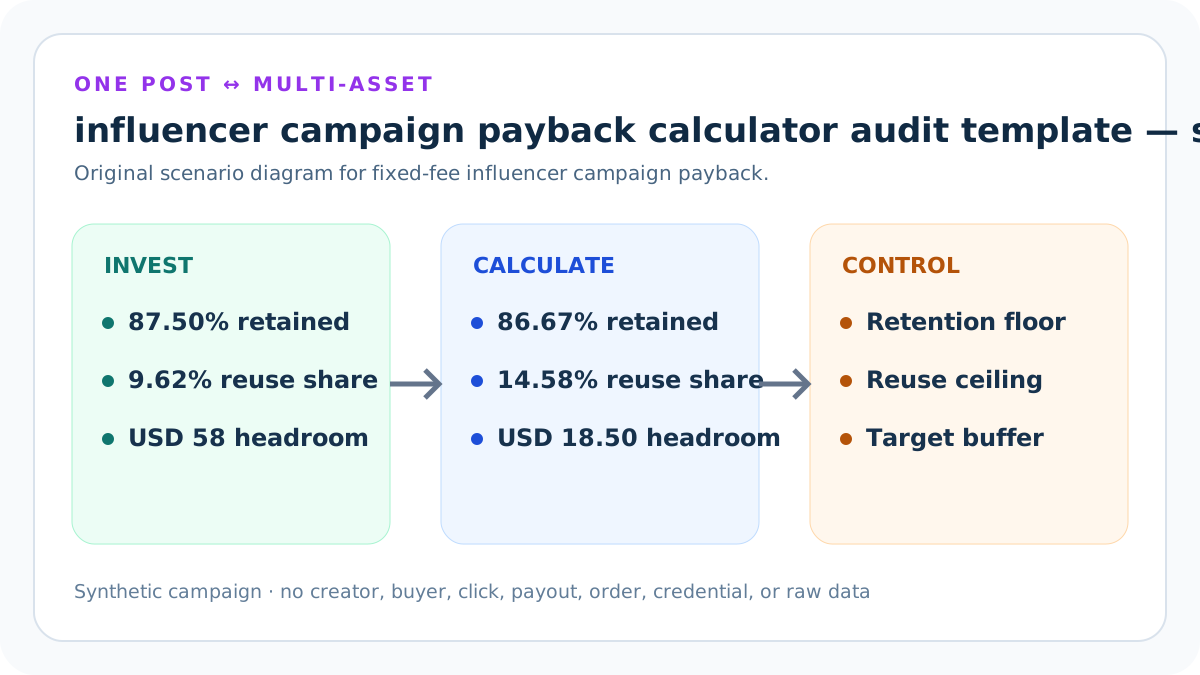
Roll outcomes forward to maturity
Track aggregate attributed orders through cancellations, refunds, returns, disputes, duplicate removal, and reporting delay until the declared evidence window closes. Present opening, excluded, still-open, and mature retained counts in one roll-forward. This entry belongs to the campaign audit and change log and supports a reviewable influencer campaign payback audit.
A recent campaign may be operationally interesting but is not a closed payback packet. If the source-review date predates the evidence period or material outcomes remain open, classification stays Block.
Bridge retained contribution versions
Document the per-order contribution formula, ordinary marketplace and payment fees, fulfillment, product cost, performance commission convention, currency, source version, and effective date. Recalculate the campaign under the contribution rule that covers its evidence period. This entry belongs to the campaign audit and change log and supports a reviewable influencer campaign payback audit.
Show any change from the prior contribution version as a separate bridge. Never count creator commission both inside per-order contribution and again in fixed campaign investment.
Recognize reusable value on a dated schedule
List each actual or contractually supported reuse, comparable avoided-production basis, gross documented value, recognition rate, recognized amount, rights support, reviewer, and expiry. Sum only rows that remain valid at the audit date. This entry belongs to the campaign audit and change log and supports a reviewable influencer campaign payback audit.
Keep a mandatory zero-reuse scenario beside the base case. Reach, impressions, engagement, or hypothetical future edits do not create recoverable value without a documented basis and usable rights.
Reperform every formula independently
Recalculate complete investment, recognized reuse, mature retained contribution, break-even orders, buffered target orders, cost per retained attributed order, cost per approved asset, retained-order rate, recognized-reuse share, and target headroom from the indexed inputs. This entry belongs to the campaign audit and change log and supports a reviewable influencer campaign payback audit.
Record exact quotients before upward rounding and compare independent results with the application output. Any difference beyond the declared precision becomes an exception rather than a manual overwrite.
Maintain a threshold exception register
List every deliverable mismatch, rights gap, stale source, below-floor retained rate, above-ceiling reuse share, missing confirmation, narrow headroom result, and open outcome. Give each exception a severity, owner, due date, compensating control, decision effect, and evidence needed for closure. This entry belongs to the campaign audit and change log and supports a reviewable influencer campaign payback audit.
An exception can be accepted only under a named seller-owned policy. Acceptance does not convert unsupported evidence into Ready; applicable Block conditions remain blocking.
Archive deterministic scenario evidence
Run the supported base case, below-target case, zero-reuse case, lower-order case, lower-contribution case, higher-cost case, deliverable mismatch, stale-source case, and invalid-input case. Save inputs, expected outputs, observed outputs, formula version, and execution timestamp. This entry belongs to the campaign audit and change log and supports a reviewable influencer campaign payback audit.
A scenario archive proves repeatability of the model, not future performance. Unexpected state, rounding, or validation behavior stops release until corrected and independently rerun.
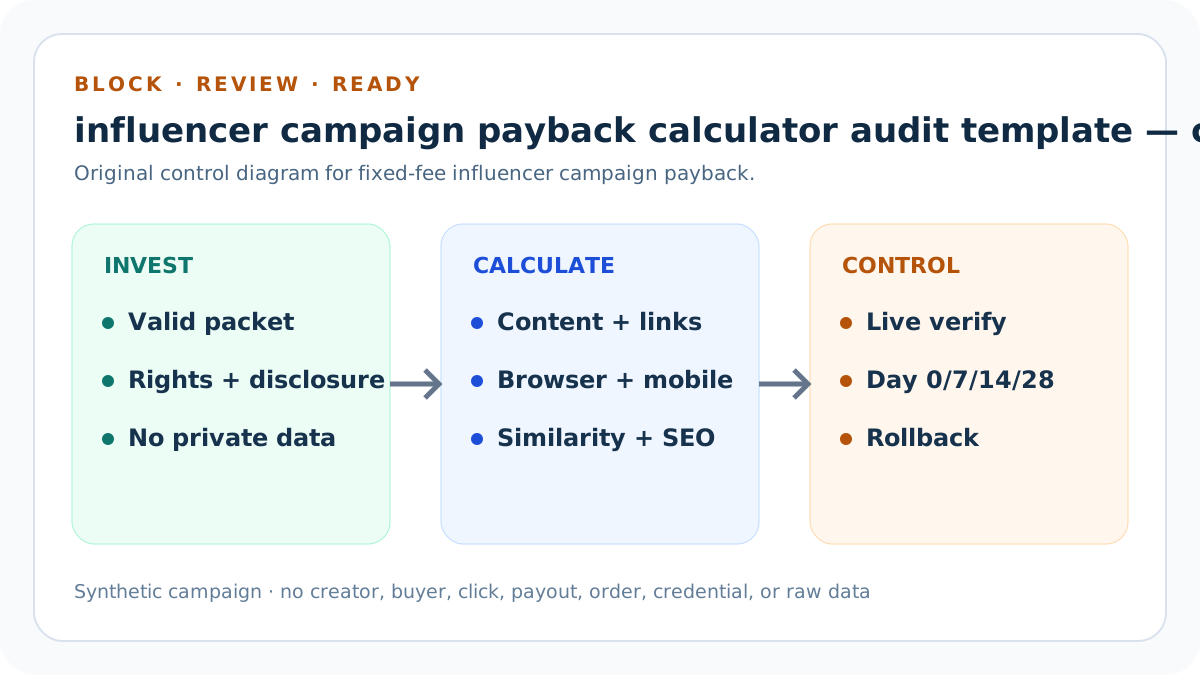
Separate preparation, review, and approval roles
Name the preparer who indexed evidence, the reviewer who reperformed calculations, the rights or disclosure reviewer where applicable, and the decision owner. Record conflicts, delegated authority, review date, and sign-off state. This entry belongs to the campaign audit and change log and supports a reviewable influencer campaign payback audit.
One person may hold several roles in a small business, but the packet must make that limitation visible and require a deliberate second pass rather than implying independent assurance.
Write a field-level change log
For each correction, record old value, new value, unit, source pointer, reason, affected formulas, affected classification, editor, reviewer, timestamp, and prior packet ID. Distinguish evidence corrections from assumption changes and software releases. This entry belongs to the campaign audit and change log and supports a reviewable influencer campaign payback audit.
Never silently replace an unfavorable result. The current public calculation and the last restorable packet must be identifiable without revealing private evidence.
Rehearse correction and rollback
Define triggers for disclosure failure, rights withdrawal, asset rejection, invoice change, attribution correction, return maturation, contribution change, privacy exposure, software defect, or source expiry. Map each trigger to pause, correction, approval, purge, and restoration steps. This entry belongs to the campaign audit and change log and supports a reviewable influencer campaign payback audit.
The rehearsal ends only when the prior release can be restored from a named backup and the corrected packet can be reverified through tests, content audits, browser checks, and live checks.
Attest to privacy and redaction boundaries
Confirm that public pages use synthetic examples or aggregates and contain no creator identity, private contract, buyer detail, order row, payment credential, token, password, private CSV, or raw export. Record the redaction reviewer and scan result. This entry belongs to the campaign audit and change log and supports a reviewable influencer campaign payback audit.
A redacted pointer may identify an internal evidence class without exposing its contents. Any accidental private-data inclusion blocks publication and requires removal, cache purge, credential review where relevant, and incident documentation.
Issue the final disposition memorandum
Summarize complete investment, approved assets, mature retained contribution, recognized reuse, adverse cases, threshold exceptions, disclosure and rights status, Block or Review or Ready result, owner, reviewer, expiration, and next review date. Link each statement to the workpaper index. This entry belongs to the campaign audit and change log and supports a reviewable influencer campaign payback audit.
The memorandum states that attribution is not causality and that Ready is only a conditional calculator result. It does not authorize a contract, payment, publication, amplification, accounting valuation, or legal conclusion.
Set the retention and expiration schedule
Assign retention periods to the public model, private evidence pointers, calculation packets, screenshots, contract records, aggregate exports, scenario evidence, and backups according to seller policy and applicable obligations. Record deletion owner and legal-hold exceptions separately. This entry belongs to the campaign audit and change log and supports a reviewable influencer campaign payback audit.
Expire the decision when rights, evidence, contribution rules, attribution settings, or policy sources no longer cover the campaign. A scheduled refresh must reopen the relevant workpapers rather than merely changing the displayed date.
Sources and further reading
- Seller Profit Guard methodology: Evidence versions, formulas, privacy, correction, release, and rollback.
- Seller Profit Guard data privacy: Local-first boundaries for creator, buyer, order, advertising, contract, payment, and raw-record data.
- FTC: Disclosures 101 for Social Media Influencers: Reviewed July 31, 2026: official material-connection, clear-disclosure, placement, truthfulness, and audience-context guidance.
- FTC: Endorsement Guides — What People Are Asking: Reviewed July 31, 2026: official advertiser review, monitoring, material-connection, platform-tool, and endorsement-compliance context.
- YouTube Help: Add paid product placements, sponsorships & endorsements: Reviewed July 31, 2026: official paid-promotion declaration, platform-policy, and local-law responsibility boundaries.
- Google Ads Help: Creator partnerships boost: Reviewed July 31, 2026: official creator-video linking, organic metrics, experiment guidance, and advertiser responsibility for sufficient usage rights.
- YouTube Creator Partnerships Open Call program policies: Reviewed July 31, 2026: one program-specific example of asset selection, rights, likeness, a 180-day usage period, and advertiser review; it is not a universal campaign contract.
Related Seller Profit Guard tools
- Influencer Campaign Payback Calculator: Compare one sponsored post with a multi-asset fixed-fee campaign.
- Creator Sample Payback Calculator: Model sample-led creator investment and commission separately.
- Affiliate Commission Calculator: Model performance payouts rather than fixed content production.
- Ad Attribution Reconciliation Checker: Reconcile reported attributed rows before payback modeling.
- Paid CPA Limit Calculator: Keep acquisition capacity separate from asset recovery.
- Methodology: Review evidence, formulas, privacy, correction, release, and rollback.
- Data Privacy: Protect creator, buyer, order, contract, payout, credential, and raw-record data.
- Influencer Campaign Payback Formula and Inputs: Build fixed-fee influencer payback from complete investment, approved assets, retained contribution, reuse recognition, and target headroom.
- Influencer Campaign Payback Example: One Sponsored Post: Follow one sponsored post through creator fee, rights, sample, media, retained contribution, recognized reuse, and target payback.
- Influencer Campaign Payback for a Multi-Asset Campaign: Model a four-asset campaign with larger creator fee, rights, samples, paid amplification, approved assets, reuse, and target recovery.
- Influencer Campaign Payback Mistakes and Corrections: Correct fixed-fee campaign errors involving incomplete costs, gross orders, disputed assets, speculative reuse, attribution, and target math.
- Influencer Campaign Payback Data Sources: Map creator fees, rights, assets, samples, media, retained contribution, attribution, reuse, and maturity to reviewable evidence.
- Influencer Campaign Payback Decision Thresholds: Separate cash break-even, buffered target payback, order-only recovery, reusable-asset credit, and evidence failure thresholds.
- Influencer Payback: One Post vs Multi-Asset Campaign: Compare one sponsored post with a four-asset campaign at the same contribution, attribution, maturity, rights, and target grain.
- Weekly Influencer Campaign Payback Routine: Run a repeatable fixed-fee campaign review across assets, rights, costs, attribution, returns, contribution, reuse, exceptions, and rollback.
- How to Interpret Influencer Campaign Payback: Read payback orders, target headroom, cost per retained order, cost per asset, and reuse value without causal or accounting overclaim.
Next step: Open Seller Profit Guard.
This is operational planning help, not tax, accounting, legal, financial, or platform-policy advice. Review the Terms and disclaimer, and verify current platform rules and fee assumptions before changing prices.