A weekly operating routine for the Listing Cost Library
Last updated: 2026-07-28
Written and reviewed by Seller Profit Guard Editorial Team.
A weekly SKU cost routine backs up the library, validates imports, reviews missing and duplicate SKUs, refreshes changed sources, samples labor and fulfillment, tests downstream joins, and records new versions. Time-box routine records, not material unknowns. Every unresolved cost receives an owner, evidence request, and next review date.

What happens in the first fifteen minutes?
Export and back up the current library, record its fingerprint, and compare row count, unique SKU count, currencies, required fields, and version distribution with the prior run. Stop bulk changes when schema, delimiter, decimal locale, or column meaning changed.
Review blank SKUs, normalized-key collisions, duplicate active records, negative or nonnumeric values, missing required layers, invalid effective dates, and unit outliers. Resolve systematic import defects before editing individual records.
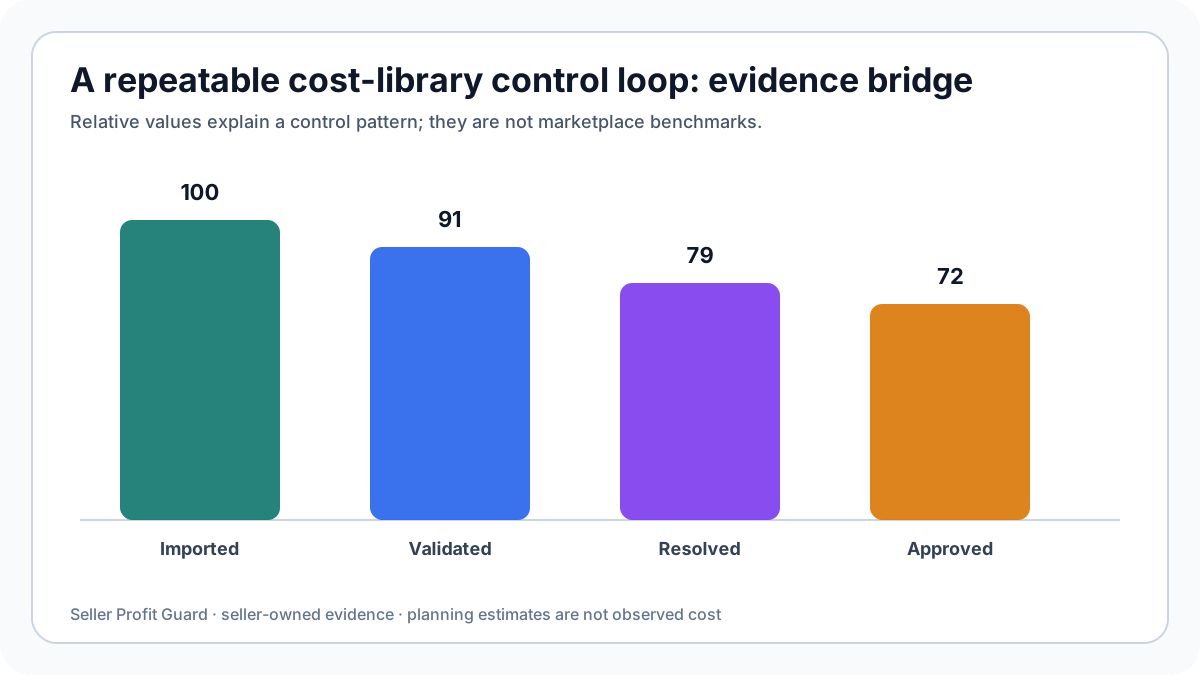
| Time | Work | Exit control |
|---|---|---|
| 0–10 | Backup and schema check | Fingerprint preserved |
| 10–20 | Identity and unit exceptions | No ambiguous active SKU |
| 20–30 | Refresh changed sources | New versions documented |
| 30–38 | Downstream join sample | Representative rows match |
| 38–45 | Assign and archive | Owner and next date |
How should source changes become new versions?
Identify affected SKUs, old source, new source, effective date, unit conversion, old value, new value, reason, operator, and test result. Create a new active version and preserve the prior one. Do not overwrite history or set an effective date earlier than the supporting evidence without a documented correction.
Recalculate only affected records, then run conservation and downstream join checks. A supplier pack-size change can alter unit cost even when invoice total looks similar. A labor workflow change needs new timing evidence rather than a blanket percentage.

What should the weekly summary contain?
Record current records, active SKUs, stale sources, missing layers, duplicate or blank identifiers, changed versions, downstream join failures, high-impact unknowns, assigned owners, and evidence-based closures. Use aggregates and fingerprints, not private source rows.
Compare trends only when schema and scope remain stable. A falling warning count can be false improvement if required fields were removed or a validator became permissive. Explain control changes beside the trend.
- Back up before editing.
- Fix schema before values.
- Version rather than overwrite.
- Sample sold-SKU joins.
- Carry unresolved evidence actions forward.
Weekly routine questions
Must every SKU be reviewed weekly? No. Review exceptions and material changes while using scheduled source-specific refresh.
What if time expires? Preserve a controlled unresolved queue; never convert unknown to zero.
Should old inactive SKUs be deleted? Archive them with history if no longer active; keep records needed for historical orders.
Can imports update everything automatically? Only validated, unambiguous rows with rollback and version controls.
What triggers immediate review? Supplier, labor, package, provider, currency, unit, SKU mapping, or repeated margin-warning change.
How should closed exceptions be verified?
A closure includes the new source or measurement, corrected formula, effective version, affected SKU set, before-and-after validation, downstream join sample, operator, and date. Status alone is insufficient.
Reopen a bounded sample during the next routine. If the same unit, source, or join defect recurs, change the import or validation rule rather than repeatedly patching individual records.
Use a calendar by evidence type rather than opening every record weekly. Supplier invoices enter when received; volatile inputs receive shorter review intervals; labor is retimed after process or equipment changes; packaging is sampled after vendor or specification changes; fulfillment is reviewed by route cohort and adjustment history. The weekly session triages triggers and exceptions while scheduled measurement supplies the evidence.
Measure routine health with time-to-triage, time-to-evidence, recurring defect class, stale high-impact records, unresolved join exposure, and rollback success—not with raw closure count. A fast closure that changes unknown to zero is deterioration. If one defect repeatedly consumes the session, improve the import schema, unit dictionary, SKU policy, or fixture suite and verify the systemic control next week.
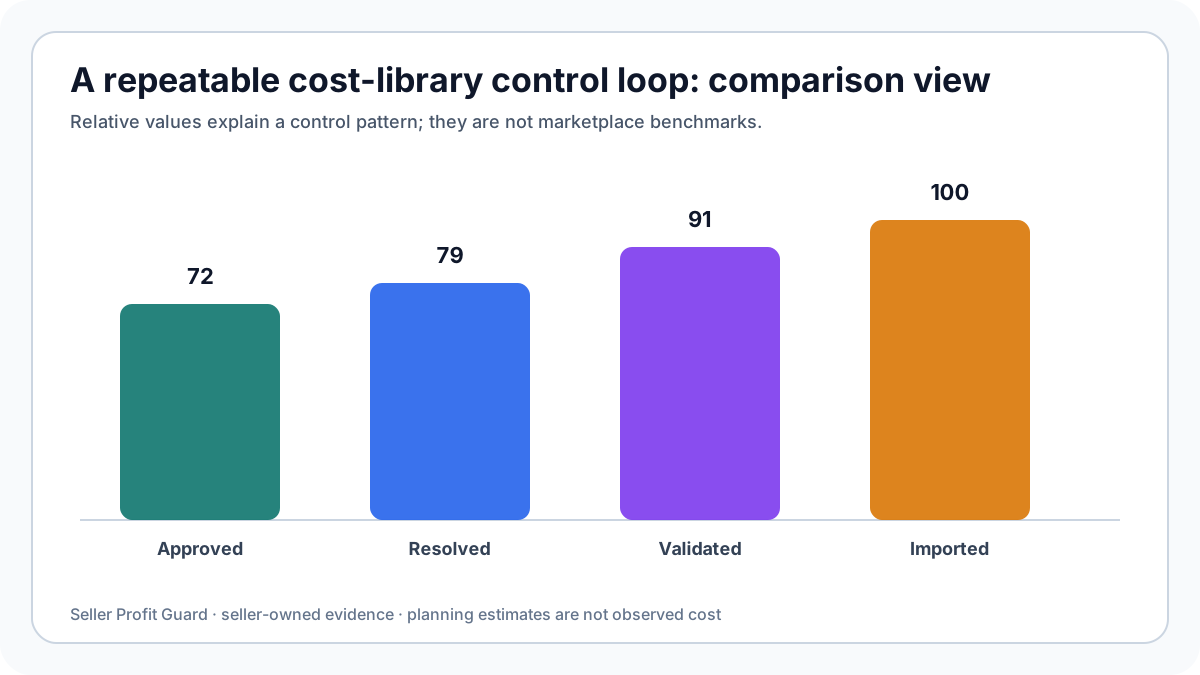
Which evidence supports this weekly SKU cost maintenance?
A reusable cost record needs seller-owned evidence. Material and purchased-component costs come from invoices, bills of materials, measured usage, scrap, and yield. Labor comes from timed tasks and an explicit loaded hourly rate. Packaging comes from component quantities and purchase cost. Fulfillment comes from label receipts, carrier adjustments, outsourced fulfillment bills, handling, insurance, and documented subsidies. Etsy exports can carry seller-added SKUs and transaction context, but they do not supply the seller's private production economics.
Record source type, supplier or internal process, currency, quantity basis, unit conversion, effective date, operator, and evidence location without copying private invoices into public reports. A checksum or file identifier can protect lineage, but it does not prove the unit basis is correct. Recalculate pack, sheet, roll, batch, hour, minute, weight, and quantity conversions with a public dummy example before importing a large cost library.
Keep observed, allocated, and estimated values distinguishable. A current invoice is observed evidence; a monthly subscription divided by forecast orders is an allocation; expected scrap, return loss, or future shipping is an estimate. Store the formula and review trigger with every non-observed amount. Unknown remains unknown until measured; zero requires evidence that the cost is genuinely absent.
- Use one stable SKU for every cost-distinct sellable variation.
- Store currency, unit, quantity basis, source, and effective date.
- Separate materials, labor, packaging, fulfillment, overhead allocation, and risk.
- Retain prior versions so historical sales can use the cost effective at the time.
- Escalate tax, accounting, legal, employment, and platform-policy questions to the appropriate professional or official source.
Privacy and commercial sensitivity for weekly SKU cost maintenance
A cost library does not need buyer names, delivery addresses, private messages, payment credentials, marketplace passwords, or raw order history. It may contain supplier pricing, labor rates, production time, margins, sourcing notes, and fulfillment terms that are commercially sensitive. Keep the working library in controlled seller storage and use redacted identifiers or public dummy values for documentation and support.
Seller Profit Guard stores the free browser workflow locally by design. A downloaded cost library or profit report is still a private business record. Do not paste real supplier invoices, buyer data, order rows, or SKU economics into public communities, email drafts, or AI prompts. Share the column map, formula, units, and a made-up reproduction case when troubleshooting.
- Do not publish raw supplier, buyer, address, or order data.
- Use controlled identifiers rather than invoice images in reports.
- Separate public calculation examples from private operating records.
- Back up the cost library before bulk edits or imports.
- Treat exported cost and margin files as confidential.
How to apply this weekly SKU cost maintenance in the SKU Cost Library
Open the SKU Cost Library and add one representative SKU manually before importing a file. Confirm material, packaging, labor minutes, labor rate, shipping, transaction extra, other cost, target margin, notes, currency, source date, and unit basis. Save locally, reload, and export the record. Then import the public template or a controlled working copy and review missing, duplicate, invalid, and suspicious values before accepting the batch.
Use the saved library in Profit Guard with a representative order export or the public dummy sample. Inspect missing-cost warnings and variation joins before interpreting contribution. Run a base case and a page-specific stress case, then record the cost version, result, seller decision, owner, and next review date. A reusable record is valuable only when its units, source, effective date, and SKU join remain traceable.
- Preserve the source evidence and current library backup.
- Validate the SKU, currency, units, quantity basis, and effective date.
- Calculate each cost layer independently before summing.
- Import and resolve duplicate, missing, or invalid rows.
- Test one handmade and one variation-sensitive scenario.
- Record the version, decision, rollback, and next review.
Related resources
- Open the SKU Cost Library: Create, import, validate, and reuse browser-local SKU cost assumptions.
- Calculate SKU-level Etsy profit: Apply material, labor, packaging, shipping, and fee records to sold SKUs.
- Review Etsy variation SKU risk: Find blank, duplicated, inconsistent, or cost-distinct variation SKUs.
- Read the Etsy SKU naming guide: Design stable identifiers for listings, variations, inventory, and historical joins.
- Review local-first CSV privacy: Keep buyer, address, order, supplier, and private margin data out of public artifacts.
Sources and further reading
- Etsy Help: How to Use SKU for Your Inventory: Official Etsy guidance on adding SKUs and using seller-defined identifiers to track inventory.
- Etsy Help: How to Add Variations for Your Listings: Official variation workflow, including variation-level price, quantity, processing profile, and SKU controls.
- Etsy Help: Download Sold Transaction Spreadsheets: Official sold-transaction export workflow; order data can include seller-added SKU numbers.
- Etsy Help: How to Calculate Shipping Costs: Official shipping-cost estimator context; final label cost can differ from a planning estimate.
- Seller Profit Guard calculation methodology: Cost-layer definitions, editable assumptions, evidence hierarchy, contribution scope, and local-first privacy boundary.
Related Seller Profit Guard tools
- Open the SKU Cost Library: Create, import, validate, and reuse browser-local SKU cost assumptions.
- Calculate SKU-level Etsy profit: Apply material, labor, packaging, shipping, and fee records to sold SKUs.
- Review Etsy variation SKU risk: Find blank, duplicated, inconsistent, or cost-distinct variation SKUs.
- Read the Etsy SKU naming guide: Design stable identifiers for listings, variations, inventory, and historical joins.
- Review local-first CSV privacy: Keep buyer, address, order, supplier, and private margin data out of public artifacts.
- SKU Cost Formula: 8 Inputs Etsy Sellers Need: Continue the SKU evidence, version, and decision workflow.
- Etsy SKU Cost Example: A $18.35 Handmade Item: Continue the SKU evidence, version, and decision workflow.
- Etsy Variation Costs: Stop Averaging Every Option: Continue the SKU evidence, version, and decision workflow.
- SKU Costing Mistakes: 12 Errors That Hide Margin: Continue the SKU evidence, version, and decision workflow.
- SKU Cost Data Sources: Invoice to Time Study: Continue the SKU evidence, version, and decision workflow.
Next step: Open the SKU Cost Library.
This is operational planning help, not tax, accounting, legal, financial, or platform-policy advice. Review the Terms and disclaimer, and verify current platform rules and fee assumptions before changing prices.