Seller Profit Guard · How it works · CSV privacy
Etsy title checker
Check an Etsy listing title against five seller-supplied facts: the exact title, one verified item noun, up to three objective traits, a primary buyer phrase, and an optional privacy-safe evidence note. The checker reports length, words, repetition, fact coverage, mobile lead, and deterministic 2026 guidance flags without predicting ranking or sales.
Maintained by Seller Profit Guard Editorial Team. Last reviewed: 2026-07-29.
What does the Etsy title checker review?
The checker reviews whether a proposed title is mechanically readable and supported by the product facts the seller enters. It counts characters and words, detects repeated important words, checks whether the verified item noun and objective traits appear, tests an optional primary buyer phrase, displays the first 60 characters as a mobile lead, and flags a bounded list of subjective, gifting, sale, or delivery wording.
Etsy's current listing guidance allows titles up to 140 characters and suggests considering fewer than 15 words when the essential item traits still fit. Etsy also advises sellers to clearly state the item, put important objective traits early, avoid unnecessary repetition, and move nonessential gifting, subjective, price, sale, or delivery language elsewhere. The checker translates part of that public guidance into transparent text rules.
The tool cannot see the product, photos, category, attributes, tags, description, variations, intellectual-property rights, live search results, buyer intent, or Etsy's private ranking systems. A clean result does not prove relevance, accuracy, search visibility, conversion, compliance, or sales. The seller remains responsible for every claim and publication decision.
- Enter one real title, not a keyword list or multiple variants.
- Use verified facts from the actual product and listing.
- Read every issue and next step instead of relying on the score.
- Inspect the complete listing on mobile before publication.
- Preserve the prior title and a tested restoration path.
The five inputs and deterministic outputs
The first input is the complete current or proposed title. The second is one verified item noun, such as necklace, mug, dress, candle, printable planner, or another accurate product identity. The third is a comma-separated set of up to three critical objective traits such as material, color, size, construction, personalization method, or vintage status.
The fourth input is one natural primary buyer phrase. It is not a volume claim or instruction to repeat keywords. It lets the checker report whether the exact phrase appears and whether it falls beyond the first 60 characters. The fifth input is an optional privacy-safe baseline note, which can record the prior title, edit date, aggregate Etsy Search visits or terms, and planned review date without buyer or order data.
Outputs include a 0–100 convenience score, character count against 140, word count, noun status, trait coverage, repeated important words, primary-phrase status, a 60-character mobile preview, deterministic guidance flags, and evidence-note status. Score deductions are visible in the rule contract; the score is not a probability.
| Input | Question answered | Output | Boundary |
|---|---|---|---|
| Title | What will buyers scan? | Characters, words, repetition, preview | Maximum 140 characters |
| Verified item noun | What is being sold? | Present, missing, or not set | One accurate noun |
| Objective traits | Which facts distinguish it? | Covered traits out of entered traits | Use a small critical set |
| Primary buyer phrase | Is one natural phrase present? | Present, missing, or not set | No ranking or demand claim |
| Evidence note | Was a baseline preserved? | Recorded or not recorded | No buyer or order data |
How the score is calculated
The score starts at 100. Characters above 90 reduce the score one point each. Each repeated important word reduces it by eight points. Each issue reduces it by twelve points. Each detected guidance flag reduces it by four additional points. Missing objective-trait coverage can reduce the score by up to twelve points; entering no traits creates a four-point deduction. The final result is bounded from 0 to 100.
Issues include an empty title, more than 140 characters, repeated important words, a missing verified noun, a missing primary phrase, dense separators, subjective descriptors, and sale or delivery claims. Next steps can include reducing a title above 110 characters, considering fewer than 15 words, moving excess synonyms, moving the primary phrase earlier when appropriate, recording a baseline, and reviewing missing traits.
These weights are Seller Profit Guard review heuristics, not Etsy ranking weights. Etsy does not publish or endorse this score. Two titles with the same score can differ materially in accuracy, buyer clarity, category fit, image promise, competition, listing quality, or performance. A hard accuracy or policy concern overrides a high score.
| Rule | Score treatment | Interpretation |
|---|---|---|
| Characters over 90 | −1 per extra character | Readability pressure before the 140 hard limit |
| Repeated important word | −8 each | Mechanical repetition risk |
| Issue | −12 each | A condition requiring review |
| Guidance flag | −4 each in addition to issue logic | A bounded 2026 wording signal |
| Missing trait coverage | Up to −12 | Entered facts are not represented |
| Final clamp | 0 through 100 | Prevents impossible score values |
Default fixture: a useful warning inside a good score
The public default title is “Personalized Birth Flower Necklace, Sterling Silver, Custom Name.” The seller enters necklace as the verified noun; personalized, sterling silver, and birth flower as critical traits; personalized necklace as the primary phrase; and a baseline note. The title is 64 characters and eight words.
The noun is present, all three traits are present, no important word repeats, the mobile preview begins “Personalized Birth Flower Necklace, Sterling Silver, Custom,” and no bounded 2026 wording flag appears. The evidence note is recorded. However, the exact phrase “personalized necklace” is not contiguous because “Birth Flower” sits between the two words.
The checker therefore returns 88/100 with one issue: the primary buyer phrase is missing. This is intentional. A good overall score does not suppress a specific mismatch. The seller can keep the title when it reads accurately, change the phrase input when it was poorly chosen, or test a natural rewrite after preserving the baseline.
| Default check | Result |
|---|---|
| Length | 64/140 characters |
| Words | 8 |
| Noun | Present |
| Objective traits | 3/3 |
| Primary phrase | Missing |
| Guidance flags | None found |
| Score | 88/100 |
Worked fixture: a 100-point mechanical pass
Use the fictional title “Personalized Necklace, Sterling Silver Birth Flower.” Keep necklace as the verified item noun; personalized, sterling silver, and birth flower as the objective traits; personalized necklace as the primary phrase; and record a privacy-safe baseline. The title is 51 characters and six words.
Every entered fact appears, the exact primary phrase is present, no important word repeats, and none of the checker's bounded subjective, gifting, sale, or delivery patterns appears. The first 60 characters contain the entire title. Under the published formula, the result is 100/100 with no issues.
This result means only that the entered text passes the deterministic checks. It does not prove the item is really sterling silver, that “birth flower” matches the design, that the phrase has search demand, that the category is correct, or that Etsy will rank or convert the listing. Verify the product, listing fields, and rights before publication.
Adverse fixture: repetition and over-length
A deliberately bad fixture repeats “personalized necklace” three times, adds gifting and generic craft terms, then duplicates the entire string. It reaches 264 characters and 33 words. The checker finds repeated important words including personalized, necklace, gift, mom, birthday, handmade, custom, jewelry, and flower.
The result is clamped to 0/100. It reports the 140-character violation and repeated-word issue, shows that only one of three entered objective traits appears, and flags a nonessential gifting phrase. Its next steps recommend trimming, considering fewer than 15 words, moving extra synonyms to other listing fields, preserving a baseline, and reviewing missing facts.
The adverse fixture protects the tool from becoming a superficial green badge. It also shows why shortening alone is not enough: a shorter title can still be inaccurate, subjective, or unsupported. Fix product identity and factual coverage first, then improve scanability.
Mobile lead, phrase position, and punctuation
The tool exposes the first 60 characters because buyers often scan truncated listing cards and mobile interfaces. This preview is an editorial aid, not an Etsy display guarantee; interfaces, screen widths, localization, experiments, and badges can change what a buyer sees. Put the item noun and the most useful objective distinction early when the wording remains natural.
The checker suggests moving the primary phrase closer to the start only when the phrase begins after character 60. Etsy's current Keywords 101 guidance says the position of a phrase in the title does not affect ranking, while still advising sellers to lead with the words that best explain the item for buyers scanning search results. The position check is therefore about clarity, not a ranking boost.
Normal punctuation can separate readable clauses. The deterministic rule flags repeated double slashes or pipes and three or more consecutive commas as dense separator patterns. It does not ban punctuation, parse grammar, or understand every language. Read the title aloud and inspect it beside the first photo.
Move excess phrases to the right listing fields
Etsy currently describes search as a holistic system that can use title, tags, attributes, descriptions, first photo, reviews, and other listing information. A title does not need to carry every synonym, recipient, occasion, material detail, shipping statement, and sale message. Keep the title focused on accurate product identity and critical traits.
Use the most specific valid category and all relevant attributes. Use varied, relevant tag phrases for additional ways a shopper may describe the item. Explain dimensions, materials, process, compatibility, personalization, care, and limitations in the description. Let the first image confirm the product promise rather than contradict it.
Do not move an inaccurate or infringing claim to another field. “Sterling silver,” “vintage,” “handmade,” brand names, character names, certifications, origin, compatibility, and recipient claims require evidence and policy review wherever they appear. Mechanical redistribution is not compliance.
- Title: item identity and critical objective traits.
- Category and attributes: structured product facts.
- Tags: varied relevant phrases within current limits.
- Description: complete buyer-facing explanation and limitations.
- Images: visible confirmation of the title promise.
Accuracy, intellectual property, and policy stop rules
Stop the review when the seller cannot verify the product noun, material, size, construction, age, origin, personalization method, compatibility, certification, recipient, occasion, or brand reference. A title can score 100 while making a false claim because the checker compares text with seller-entered facts; it does not independently authenticate those facts.
Do not use trademarks, character names, celebrity names, protected designs, or another seller's copy merely because a term appears in search suggestions. The tool does not perform trademark, copyright, counterfeiting, creativity-standards, prohibited-items, or truthful-advertising review. Consult current Etsy policies and qualified advice when rights or regulatory claims are material.
Hard stop rules override scoring: wrong product identity, unverified material or certification, variation mismatch, misleading first-photo promise, policy warning, account ambiguity, or missing publication context. Resolve the source evidence before rewriting.
A controlled title-editing workflow
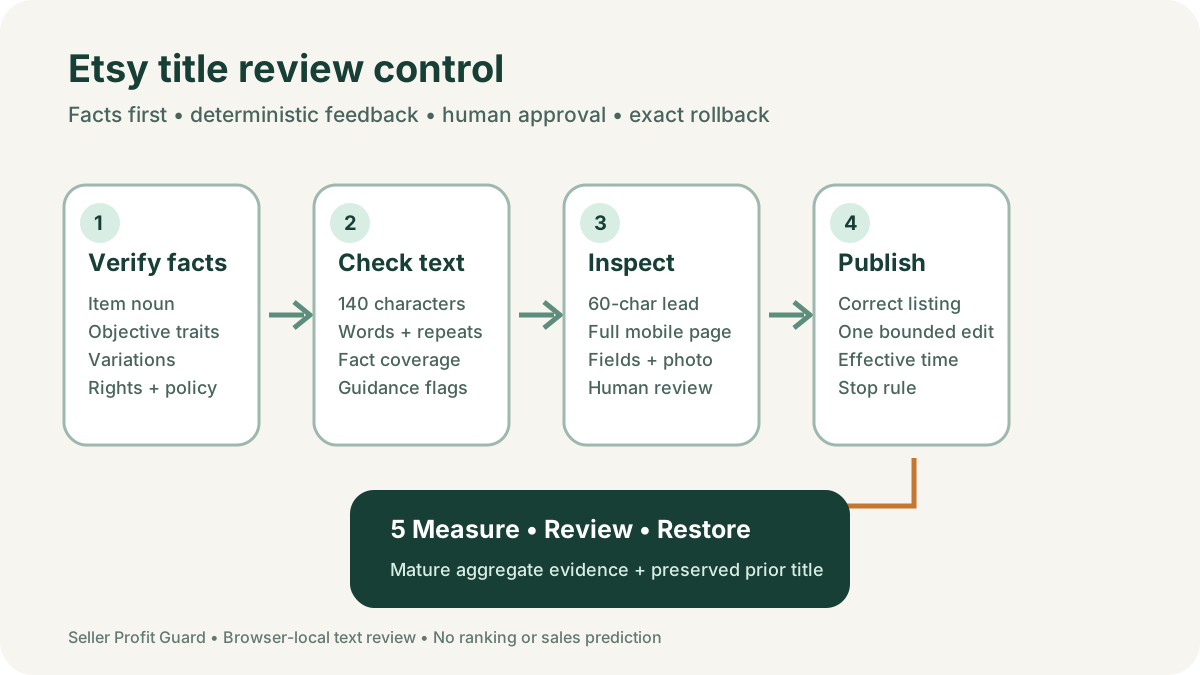
Preserve the current title and download or store an approved private listing backup before editing. Record the listing identifier privately, current title, first-photo promise, category, attributes, tags, description lead, variations, shop language, aggregate search evidence, last material change, owner, reviewer, and rollback condition.
Draft one candidate from verified product facts. Run the checker, inspect issues and next steps, compare the first 60 characters, read the title aloud, and review the entire listing on mobile. Check that title claims match every offered variation. Use the Etsy suggestion tool only as an optional draft source; Etsy explicitly describes suggestions as starting points, not prescriptions.
Publish one listing or a small controlled group. Verify the exact intended listing and profile, then record the effective time. Keep other major variables stable where possible. Wait for the declared evidence window before interpreting aggregate Shop Stats. Restore the exact prior title if accuracy, policy, buyer clarity, or the approved performance stop rule fails.
- Freeze the prior title, listing context, evidence, and restoration copy.
- Verify item identity, objective traits, variations, and rights.
- Draft one buyer-readable candidate and run deterministic checks.
- Inspect mobile rendering and all related listing fields.
- Publish one bounded change and verify the correct listing.
- Measure the mature window and restore on the stop rule.
Boundary fixtures and browser validation
Test an empty title, one- and two-word titles, exactly 140 characters, 141 characters, more than 110 characters, 15 and 16 words, repeated non-stop words, missing noun, missing traits, missing primary phrase, a phrase after character 60, dense separators, subjective descriptors, gifting phrases, and sale or delivery language.
Verify the default 88-point fixture, the 100-point clean fixture, and the 0-point adverse fixture. Confirm the mobile preview, issue text, next steps, score clamp, reset behavior, keyboard labels, and 390-pixel layout. Regression tests should assert meaningful outputs rather than only checking that a page loads.
Treat a changed rule, source, tokenizer, stop-word set, score weight, or UI label as a versioned behavior change. Re-run the fixtures and update the reviewed date. Do not silently change a score contract after sellers have preserved prior results.
Privacy-safe evidence and responsible interpretation
A title review needs public listing copy and aggregate observations, not buyer identity. Do not enter buyer names, email addresses, postal addresses, order IDs, personalization requests, private messages, payment data, tracking numbers, account credentials, or raw exports. Keep private backups in the seller's approved environment.
Record the source version, access date, exact five inputs, result, issues, candidate title, reviewer, effective time, unchanged-context list, comparison window, minimum evidence, decision, and rollback proof. A fingerprint can show that a review package stayed unchanged; it cannot prove accuracy or performance.
Interpret the result as Ready, Review, or Block only after human evidence review. Ready means the deterministic checks and factual review pass. Review means the text is mechanically usable but evidence, mobile clarity, or field alignment remains uncertain. Block means a hard factual, policy, rights, profile, or publication-context problem exists.
Use the ten support guides by task
The dedicated support cluster separates ten jobs: inputs and assumptions, a complete worked example, a materially different scenario, common mistakes, first-party data sources, decision thresholds, scenario comparison, a recurring routine, responsible interpretation, and an audit template. The parent page remains the only interactive checker.
Start with the input guide when defining noun and traits, the worked example when validating outputs, and the data-source guide when the listing evidence is fragmented. Use the decision and interpretation guides before publication. Use the audit template when another person must reproduce the edit and rollback.
The checker and guides are independent educational tools. They are not affiliated with or endorsed by Etsy and do not replace current Etsy documentation, seller policy review, intellectual-property review, legal advice, or observed shop evidence.
Sources and further reading
- Etsy Help: How to Create a Listing: Current 140-character title limit and buyer-friendly title guidance; reviewed July 29, 2026.
- Etsy Seller Handbook: New Guidance for Listing Titles: April 2026 guidance on item nouns, objective traits, fewer than 15 words, gifting, subjective, sale and delivery wording, optional suggestions, backups, experiments, and rollback.
- Etsy Seller Handbook: Keywords 101: Current holistic search, title clarity, mobile scanning, punctuation, accuracy, category, attribute, description, tag, and Shop Stats context.
- Etsy Seller Policy: Current seller accuracy, representation, intellectual-property, manipulation, and responsibility boundaries.
- Seller Profit Guard methodology: Evidence hierarchy, local-first privacy, deterministic fixtures, uncertainty, change control, and non-advice limits.
Related Seller Profit Guard tools
- Etsy CSV profit calculator: Run a local order profit check with editable fee and SKU cost assumptions.
- Payment reconciliation tool: Compare order rows with statement activity and flag unmatched rows.
- SKU cost library: Save or import material, labor, packaging, shipping, and target margin assumptions.
- Variant risk checker: Find missing SKUs and variation cost risks before a listing scales.
- Etsy title checker: Review listing-title clarity, repetition, keyword chains, and mobile scanning.
- Etsy tag checker: Review all 13 tag slots for duplicates, repeated meaning, and truthful coverage.
- Free shipping threshold calculator: Estimate when a shipping subsidy can still meet a target margin.
- Return window loss estimator: Model expected reverse shipping, restock work, recovery, and replacement loss.
- Etsy Ads break-even calculator: Estimate target-safe Etsy Ads spend, ACOS, and ROAS after fees, fulfillment, and expected return loss.
- CSV data privacy: Understand what the local-first workflow needs and what it does not need.
- Etsy Title Checker: Five Inputs That Matter: Use five evidence-backed Etsy title inputs to review item clarity, objective traits, mobile scanning, repetition, and change context.
- Etsy Title Checker Example: Personalized Item: Rewrite a 21-word personalized necklace title into a clear 10-word version while preserving facts, tags, baseline evidence, and rollback.
- Etsy Title Checker for Material-Led Products: Review a material-led moonstone ring title where verified stone, metal, color, and construction matter more than generic gifting language.
- 12 Etsy Title Checker Mistakes to Correct: Correct twelve Etsy title review mistakes involving limits, nouns, traits, gifting, evidence, Shop Stats, mobile scans, and causal claims.
- Etsy Title Checker Data Sources Map: Map Etsy title inputs to listings, product records, attributes, Shop Stats, search visibility, first photos, policies, and change logs.
- Safe Etsy Title Change Decision Thresholds: Use accuracy, readability, evidence, stability, headroom, and rollback thresholds to decide whether an Etsy title change is ready.
- Etsy Title Checker: Personalization vs Material: Compare personalized and material-led Etsy titles at the same evidence grain to see how noun, traits, variations, and rollback differ.
- Weekly Etsy Title Review Routine: Run a 40-minute weekly Etsy title review that preserves baselines, selects candidates, verifies facts, controls changes, and closes feedback.
- Interpret Etsy Title Checker Results Safely: Interpret title score, character count, noun and trait coverage, mobile preview, flags, and evidence notes without false ranking precision.
- Etsy Title Audit Checklist and Change Log: Audit Etsy title facts, fields, checker rules, mobile rendering, privacy, approval, publication, evidence feedback, and rollback.
Use the interactive tool
Enable JavaScript to open the calculator and process browser-local inputs. The explanatory content and source links remain available without JavaScript.
Related guide: Review Etsy variation and SKU evidence.
This tool provides operating estimates, not tax, accounting, legal, financial, or marketplace-policy advice. Verify current official sources and your own records before changing prices or operations.