A repeatable operating routine for Etsy variation names
Last updated: 2026-07-30
Written and reviewed by Seller Profit Guard Editorial Team.
Each week, sample listings changed by product, size, color, material, price, quantity, photo, SKU, processing, or personalization updates; refresh the option contract; run complete and failure fixtures; resolve discrepancies by consequence; release one bounded set; select every public combination; preserve rollback; and measure later corrections and qualified intent without forcing stable listings to change.

operating cadence: scope and decision
A useful routine follows change risk instead of rewriting every listing on a calendar. Product, option, supplier, price, stock, photo, SKU, processing, category, description, or personalization changes create triggers; stable mappings can remain under observation.
Assign one accountable owner for the product contract and named owners for photos, prices, inventory, processing, and release verification. The audit records the decision and evidence rather than pretending one person can silently infer every source.
Build the variation maintenance loop before analysis
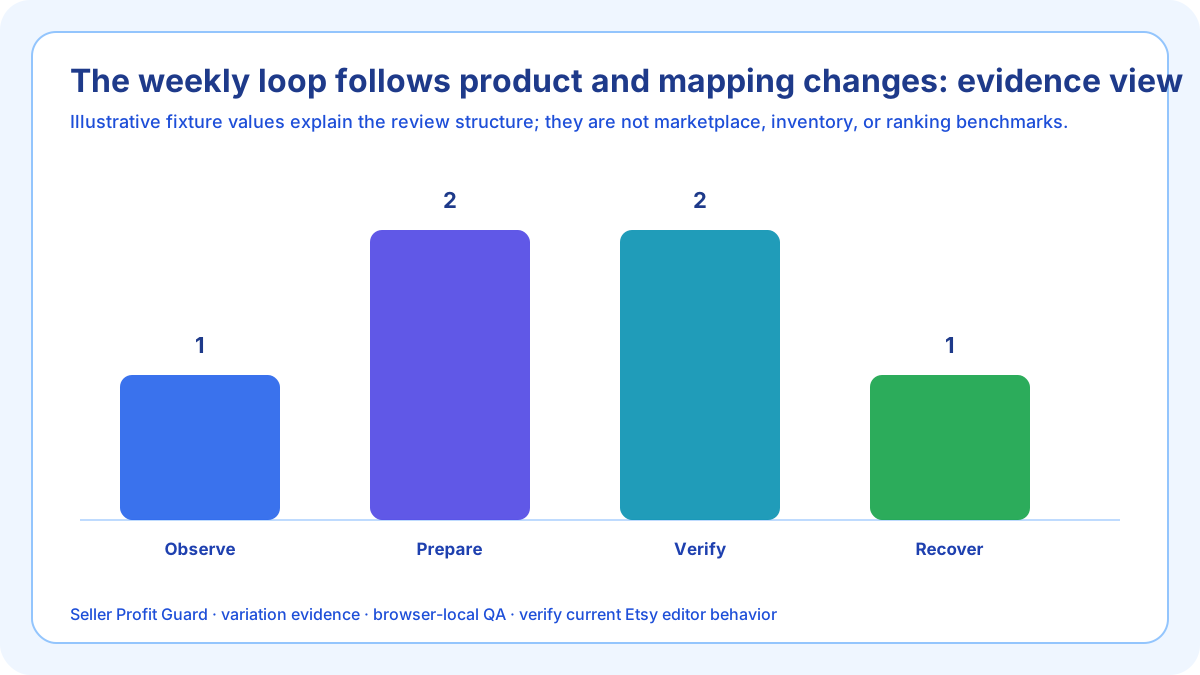
The weekly loop is Observe, Classify, Select, Prepare, Verify, Release, Live Verify, Measure. A failed critical gate stays local or restores the previous public state. Search signals are measurement inputs, not permission to bypass quality.
Use synthetic fixtures and public observations. Private orders, receipts, buyer messages, addresses, personalization proofs, credentials, and raw CSVs stay outside public content and general operating reports.
Observe meaningful triggers
Compare the product change log, editor modifications, price and inventory updates, new photos, SKU migrations, processing-profile changes, support themes, and correction reports. Record no change when no trigger exists.
Place “Observe meaningful triggers” in the weekly variation maintenance loop with a trigger, owner, evidence packet, fixture, release gate, feedback check, and recovery state. Sample triggered listing sample when relevant; retain stable listing with no change as a stop test. Close only after a durable evidence-to-feedback control cycle is observed on the intended buyer path and the next review date is assigned.
Classify consequence and scope
Separate buyer-label, visual, price, availability, processing, fulfillment, private-data, policy, and reporting risks. Choose one listing or coherent template family instead of applying a broad edit before the defect is understood.
Place “Classify consequence and scope” in the weekly variation maintenance loop with a trigger, owner, evidence packet, fixture, release gate, feedback check, and recovery state. Sample triggered listing sample when relevant; retain stable listing with no change as a stop test. Close only after a durable evidence-to-feedback control cycle is observed on the intended buyer path and the next review date is assigned.
Select a bounded candidate
Prioritize a reproducible critical contradiction, a stale high-use product, or a prepared quality-passed cluster. Preserve existing ranking URLs and slugs. Do not manufacture an edit merely to satisfy cadence.
Place “Select a bounded candidate” in the weekly variation maintenance loop with a trigger, owner, evidence packet, fixture, release gate, feedback check, and recovery state. Sample triggered listing sample when relevant; retain stable listing with no change as a stop test. Close only after a durable evidence-to-feedback control cycle is observed on the intended buyer path and the next review date is assigned.
Prepare the evidence packet
Freeze axes, values, public selector, images, total prices, quantities, processing, SKU combinations, personalization boundary, reviewer, date, and before state. Resolve source conflicts before editing.
Place “Prepare the evidence packet” in the weekly variation maintenance loop with a trigger, owner, evidence packet, fixture, release gate, feedback check, and recovery state. Sample triggered listing sample when relevant; retain stable listing with no change as a stop test. Close only after a durable evidence-to-feedback control cycle is observed on the intended buyer path and the next review date is assigned.
Verify complete and failure fixtures
The complete matrix must produce Ready. Duplicate axes, missing values, wrong photo map, incomplete price map, missing combination, duplicate SKU, declared discrepancy, and missing evidence should produce the expected non-ready states.
Place “Verify complete and failure fixtures” in the weekly variation maintenance loop with a trigger, owner, evidence packet, fixture, release gate, feedback check, and recovery state. Sample triggered listing sample when relevant; retain stable listing with no change as a stop test. Close only after a durable evidence-to-feedback control cycle is observed on the intended buyer path and the next review date is assigned.

Release one approved set
Create narrow backups and rollback identifiers, confirm the correct account and listing, apply only approved values and mappings, and safe-stop on authentication ambiguity, warnings, wrong profile, or missing context.
Place “Release one approved set” in the weekly variation maintenance loop with a trigger, owner, evidence packet, fixture, release gate, feedback check, and recovery state. Sample triggered listing sample when relevant; retain stable listing with no change as a stop test. Close only after a durable evidence-to-feedback control cycle is observed on the intended buyer path and the next review date is assigned.
Inspect every public combination
On mobile and desktop, select each available choice and verify labels, image, full price, quantity or availability, processing, cart, receipt-facing values, and internal SKU. Restore on critical mismatch.
Place “Inspect every public combination” in the weekly variation maintenance loop with a trigger, owner, evidence packet, fixture, release gate, feedback check, and recovery state. Sample triggered listing sample when relevant; retain stable listing with no change as a stop test. Close only after a durable evidence-to-feedback control cycle is observed on the intended buyer path and the next review date is assigned.
Measure and close responsibly
Record correction rate, option-related questions, aggregate engagement, tool completion, qualified consented intent, and later search discovery. Distinguish observation from causation and schedule source freshness by risk.
Place “Measure and close responsibly” in the weekly variation maintenance loop with a trigger, owner, evidence packet, fixture, release gate, feedback check, and recovery state. Sample triggered listing sample when relevant; retain stable listing with no change as a stop test. Close only after a durable evidence-to-feedback control cycle is observed on the intended buyer path and the next review date is assigned.
Verification, release, and rollback controls
Before changing a public listing, preserve the complete variation maintenance loop, editor values, linked assets, selected-path observations, test fixtures, approval, and rollback identifier. Confirm the correct account and listing. Safe-stop on login or CAPTCHA ambiguity, a platform warning, wrong profile, missing target context, private data, or an unexpected editor state.
After one bounded release, verify triggered listing sample on mobile and desktop and deliberately revisit the risk represented by stable listing with no change. Check axis names, values, selected photo, full price, availability, processing, cart or receipt choice, and SKU for every valid combination. Restore the prior configuration when a critical path does not support a durable evidence-to-feedback control cycle.
Limits, privacy boundary, and next action
This guide and checker use seller-entered text and synthetic examples. They do not retrieve Etsy data, alter a listing, inspect images, validate product composition, confirm inventory or receipts, certify marketplace policy, or predict ranking, clicks, conversion, sales, returns, income, or AdSense approval. Seller Profit Guard is independent and unaffiliated with Etsy and provides operational QA rather than legal, tax, accounting, inventory, search, accessibility, or platform advice.
Keep buyer names, addresses, messages, order IDs, receipts, private personalization, credentials, OAuth data, and raw CSV files outside the variation maintenance loop. The next action is to repair the named evidence layer, rerun complete and crossed fixtures, release only the approved set, inspect the public choice path, and record whether a durable evidence-to-feedback control cycle was verified or rolled back.
Sources and further reading
- Etsy Help: How to Add Variations for Your Listings: Current official variation attributes, values, total prices, quantities, processing profiles, SKUs, linked photos, custom variations, visibility, preview, and buyer-selection behavior.
- Etsy Help: How to Create a Listing: Current official category, price, quantity, SKU, physical-listing, and variation context.
- Etsy Help: Processing Times and Processing Profiles: Current official listing- and variation-level processing-profile behavior.
- Etsy Help: How to Offer Personalized Listings: Current official Custom options fields, five-field limit, field types, test-limited add-on pricing, and the inventory-versus-personalization boundary.
- Etsy Help: How to Offer Custom Items: Current official boundary between public listing variations and one-buyer private custom listings.
- Etsy Seller Policy effective July 9, 2026: Current official accuracy, content, privacy, representation, and seller-responsibility requirements.
- Seller Profit Guard methodology: Evidence hierarchy, privacy boundary, uncertainty labels, corrections, release verification, and rollback controls.
Related Seller Profit Guard tools
- Open the Etsy Variation Naming Checker: Review axes, values, buyer selectors, linked photos, total prices, and unique SKU combinations.
- Audit Etsy variation and SKU risk: Check cost and fulfillment risk after the naming contract is coherent.
- Review Etsy attribute coverage: Keep category attributes separate from buyer-selectable options.
- Check Etsy photo coverage: Verify appearance-changing values have truthful buyer evidence.
- Read the variation SKU checklist: Connect buyer choices with stable cost and inventory controls.
- Read the local-first methodology: Preserve evidence, privacy, bounded release, feedback, and recovery.
- Etsy Variation Naming Formula and Inputs: Continue the variation evidence, mapping, decision, release, interpretation, or audit workflow.
- Etsy Variation Names: Size and Color Example: Continue the variation evidence, mapping, decision, release, interpretation, or audit workflow.
- Etsy Material and Personalization Options: Continue the variation evidence, mapping, decision, release, interpretation, or audit workflow.
- 12 Etsy Variation Naming Mistakes: Continue the variation evidence, mapping, decision, release, interpretation, or audit workflow.
- Evidence Sources for Etsy Variations: Continue the variation evidence, mapping, decision, release, interpretation, or audit workflow.
Next step: Open the Etsy Variation Naming Checker.
This is operational planning help, not tax, accounting, legal, financial, or platform-policy advice. Review the Terms and disclaimer, and verify current platform rules and fee assumptions before changing prices.