How contribution margin changes on a multi-item order
Last updated: 2026-07-30
Written and reviewed by Seller Profit Guard Editorial Team.
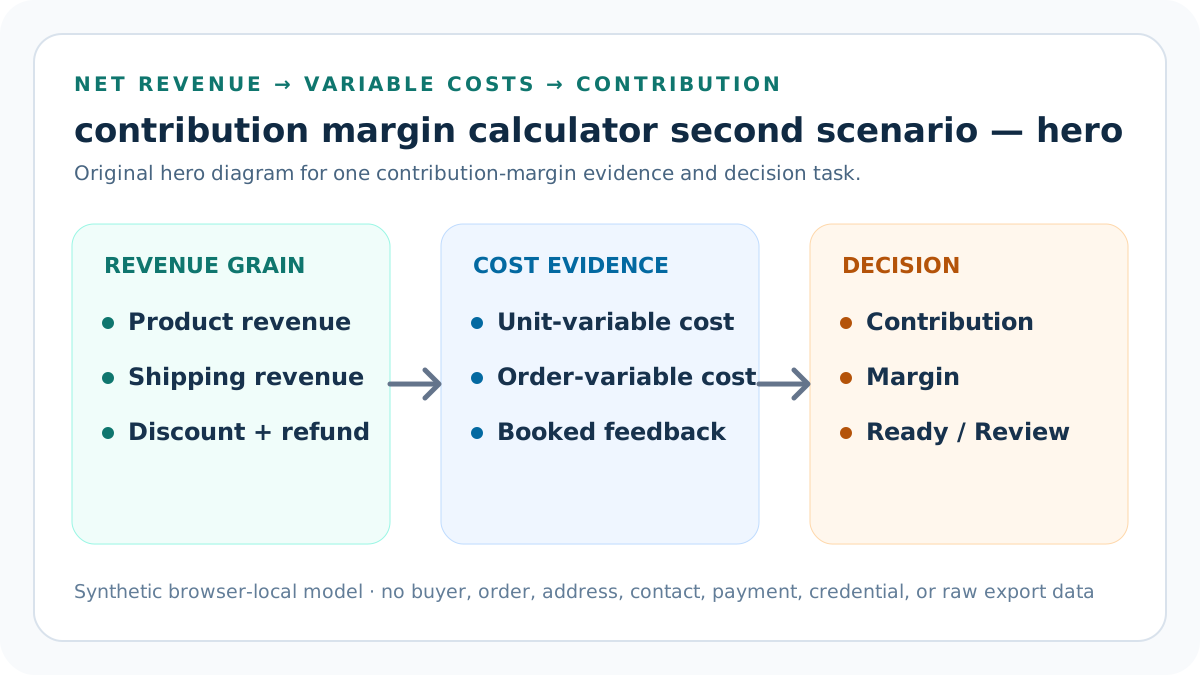
A synthetic three-unit order can produce USD 88 net revenue and USD 78.28 modeled variable costs, leaving USD 9.72 contribution and an 11% contribution margin. Quantity multiplies product, packaging, and direct labor, while shipping, fixed payment fees, acquisition cost, and expected loss remain order-level inputs unless evidence supports another allocation.
Define the three-unit basket
Use three units and USD 88 net revenue after the basket's discount and expected refund allowance. Do not multiply order revenue again after recording the complete basket total. This step belongs to the multi-item cost-allocation worksheet; it should remain attributable to a dated source, an explicit assumption, or a synthetic fixture rather than a hidden default.
For unit extension and shared order costs, checkpoint 1 tests “Define the three-unit basket” before it can support USD 9.72 contribution and an 11% margin. Record the relevant value, unit, source class, effective date, calculation grain, and reviewer conclusion. If that assertion fails, preserve the failure and correct its field; do not offset it with an unrelated favorable input or silently revise the seller threshold.
Extend product cost by quantity
Multiply the entered per-unit product amount by three. This prevents the common error of subtracting one unit of cost from a three-unit sale. This step belongs to the multi-item cost-allocation worksheet; it should remain attributable to a dated source, an explicit assumption, or a synthetic fixture rather than a hidden default.
For unit extension and shared order costs, checkpoint 2 tests “Extend product cost by quantity” before it can support USD 9.72 contribution and an 11% margin. Record the relevant value, unit, source class, effective date, calculation grain, and reviewer conclusion. If that assertion fails, preserve the failure and correct its field; do not offset it with an unrelated favorable input or silently revise the seller threshold.
Extend packaging deliberately
Use a per-unit packaging amount only for materials that genuinely repeat. Add shared mailer or carton cost to another order-variable field if it occurs once for the basket. This step belongs to the multi-item cost-allocation worksheet; it should remain attributable to a dated source, an explicit assumption, or a synthetic fixture rather than a hidden default.
For unit extension and shared order costs, checkpoint 3 tests “Extend packaging deliberately” before it can support USD 9.72 contribution and an 11% margin. Record the relevant value, unit, source class, effective date, calculation grain, and reviewer conclusion. If that assertion fails, preserve the failure and correct its field; do not offset it with an unrelated favorable input or silently revise the seller threshold.
Separate direct labor grain
Multiply pick, personalize, or assembly labor that repeats per unit. Keep a single packing or label task as an order-level amount when the evidence supports that treatment. This step belongs to the multi-item cost-allocation worksheet; it should remain attributable to a dated source, an explicit assumption, or a synthetic fixture rather than a hidden default.
For unit extension and shared order costs, checkpoint 4 tests “Separate direct labor grain” before it can support USD 9.72 contribution and an 11% margin. Record the relevant value, unit, source class, effective date, calculation grain, and reviewer conclusion. If that assertion fails, preserve the failure and correct its field; do not offset it with an unrelated favorable input or silently revise the seller threshold.
Record shared shipping once
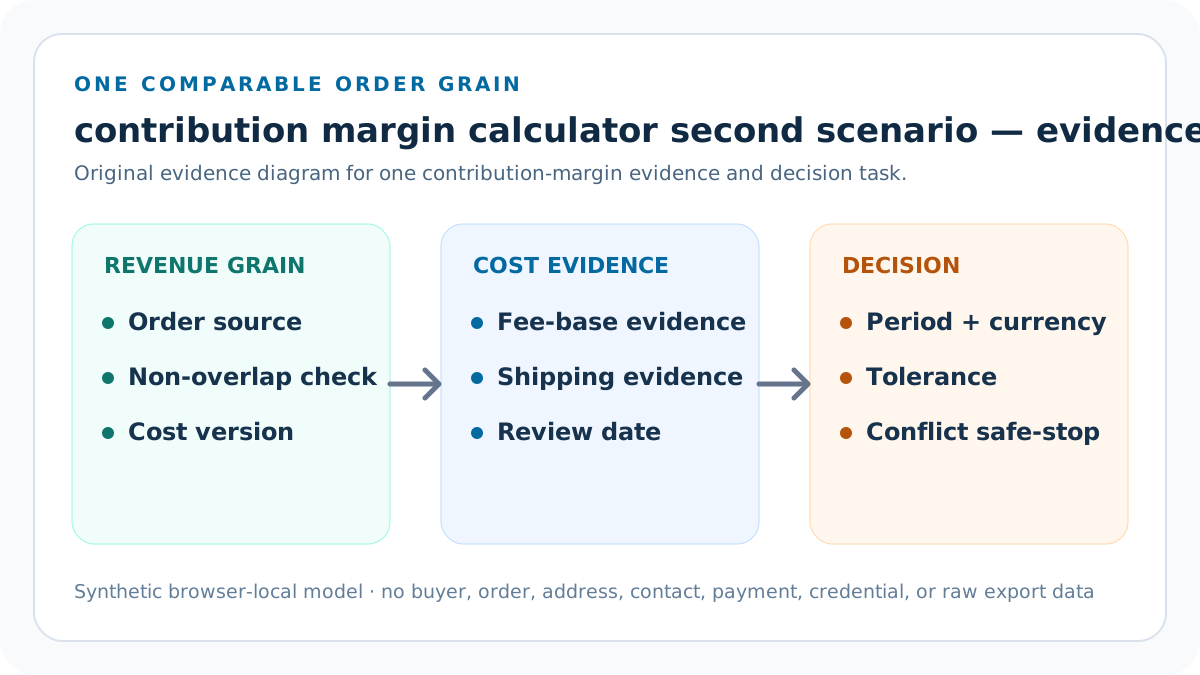
Outbound postage belongs to the full shipment, not automatically to each item. A multi-item basket may reduce shipping cost per unit while increasing total package weight. This step belongs to the multi-item cost-allocation worksheet; it should remain attributable to a dated source, an explicit assumption, or a synthetic fixture rather than a hidden default.
For unit extension and shared order costs, checkpoint 5 tests “Record shared shipping once” before it can support USD 9.72 contribution and an 11% margin. Record the relevant value, unit, source class, effective date, calculation grain, and reviewer conclusion. If that assertion fails, preserve the failure and correct its field; do not offset it with an unrelated favorable input or silently revise the seller threshold.
Apply fee rates to net revenue
Percentage payment or marketplace fees generally use the modeled revenue base, while fixed fees occur per order. The calculator keeps those mechanisms separate. This step belongs to the multi-item cost-allocation worksheet; it should remain attributable to a dated source, an explicit assumption, or a synthetic fixture rather than a hidden default.
For unit extension and shared order costs, checkpoint 6 tests “Apply fee rates to net revenue” before it can support USD 9.72 contribution and an 11% margin. Record the relevant value, unit, source class, effective date, calculation grain, and reviewer conclusion. If that assertion fails, preserve the failure and correct its field; do not offset it with an unrelated favorable input or silently revise the seller threshold.
Enter basket acquisition cost
Use the cost attributable to acquiring this order, not a shop-wide advertising total divided by an arbitrary denominator. Preserve the allocation method beside the value. This step belongs to the multi-item cost-allocation worksheet; it should remain attributable to a dated source, an explicit assumption, or a synthetic fixture rather than a hidden default.
For unit extension and shared order costs, checkpoint 7 tests “Enter basket acquisition cost” before it can support USD 9.72 contribution and an 11% margin. Record the relevant value, unit, source class, effective date, calculation grain, and reviewer conclusion. If that assertion fails, preserve the failure and correct its field; do not offset it with an unrelated favorable input or silently revise the seller threshold.
Model basket return exposure
Expected loss may change with quantity, category mix, damage risk, and recovery value. Treat it as a documented allowance rather than multiplying the single-item assumption blindly. This step belongs to the multi-item cost-allocation worksheet; it should remain attributable to a dated source, an explicit assumption, or a synthetic fixture rather than a hidden default.
For unit extension and shared order costs, checkpoint 8 tests “Model basket return exposure” before it can support USD 9.72 contribution and an 11% margin. Record the relevant value, unit, source class, effective date, calculation grain, and reviewer conclusion. If that assertion fails, preserve the failure and correct its field; do not offset it with an unrelated favorable input or silently revise the seller threshold.
Interpret the 11% result
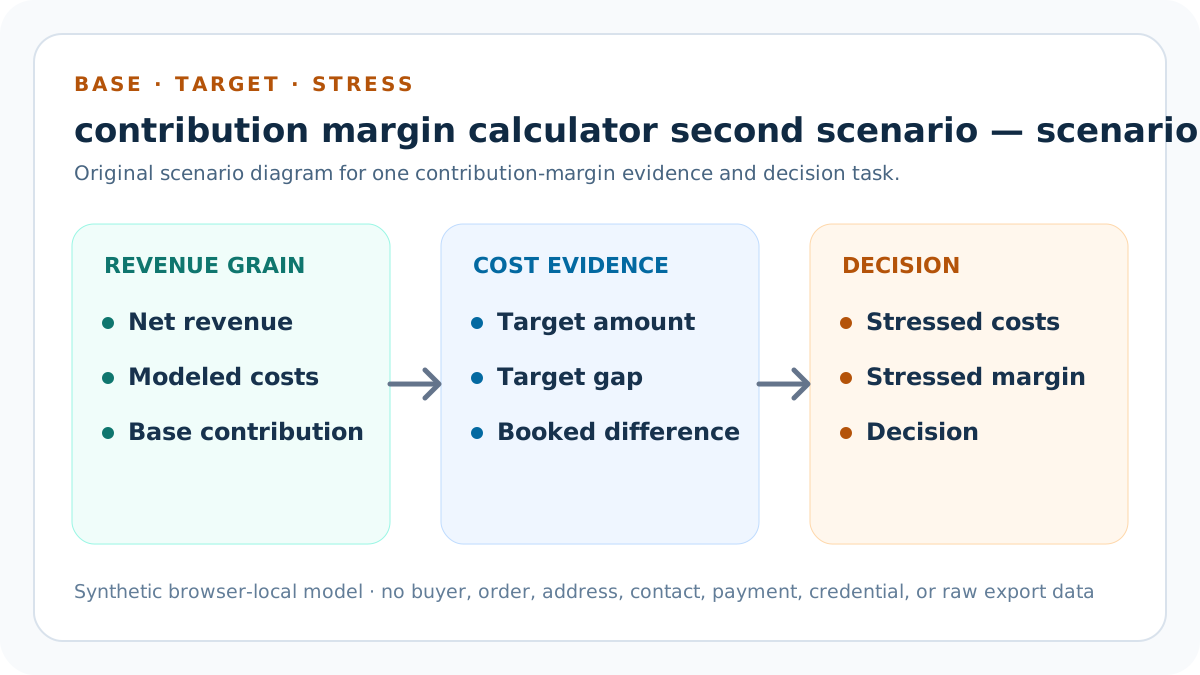
USD 9.72 remains positive but misses a higher seller target, so Review is appropriate even though the order is not mathematically below zero. This step belongs to the multi-item cost-allocation worksheet; it should remain attributable to a dated source, an explicit assumption, or a synthetic fixture rather than a hidden default.
For unit extension and shared order costs, checkpoint 9 tests “Interpret the 11% result” before it can support USD 9.72 contribution and an 11% margin. Record the relevant value, unit, source class, effective date, calculation grain, and reviewer conclusion. If that assertion fails, preserve the failure and correct its field; do not offset it with an unrelated favorable input or silently revise the seller threshold.
Compare allocation alternatives
Test whether shared packaging, shipping, and acquisition assumptions change the decision. If the classification flips under reasonable evidence, investigate the input before changing price or promotion. This step belongs to the multi-item cost-allocation worksheet; it should remain attributable to a dated source, an explicit assumption, or a synthetic fixture rather than a hidden default.
For unit extension and shared order costs, checkpoint 10 tests “Compare allocation alternatives” before it can support USD 9.72 contribution and an 11% margin. Record the relevant value, unit, source class, effective date, calculation grain, and reviewer conclusion. If that assertion fails, preserve the failure and correct its field; do not offset it with an unrelated favorable input or silently revise the seller threshold.
Worked control for unit extension and shared order costs
Recalculate the three-unit fixture from its unit extensions and shared order costs. Verify USD 88 net revenue, USD 78.28 modeled variable costs, USD 9.72 contribution, 11% margin, and Review when the seller target is higher. Do not borrow the single-item target conclusion.
The control must expose intermediate values, units, currency, period, fee base, allocation method, evidence date, and decision rule. Its purpose is to test unit extension and shared order costs, not to simulate a real customer's private order or promise that another seller will obtain the same result.
Exceptions and evidence conflicts
Block the multi-item cost-allocation worksheet when reductions exceed gross revenue, units are not positive, any modeled cost is negative without a documented credit mechanism, currency or period is missing, or source grain is incompatible. Record conflicts instead of inventing a compensating value.
Use Reconcile when an independently booked variable-cost total differs from the detailed model beyond the seller-owned tolerance. Use Review for negative contribution, a missed target, or negative stressed contribution only after the structure and reconciliation gates pass.
Verification, release, and feedback
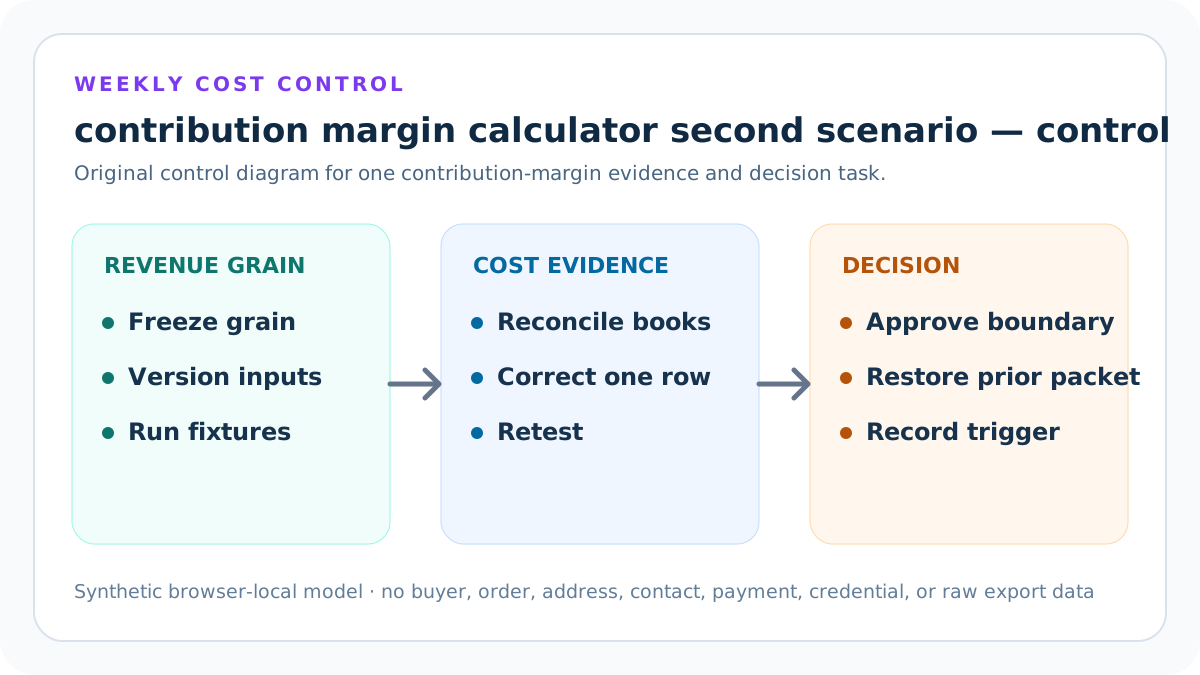
Before changing public guidance or defaults, preserve the multi-item cost-allocation worksheet, source pointers, fixtures, tests, build output, content audit, similarity report, release manifest, remote backup, and rollback identifier. Safe-stop on unexpected authentication, account, platform warning, or target context.
After a bounded change, inspect arithmetic, decisions, mobile layout, canonical, Article and Breadcrumb schema, source labels, four explanatory visuals, internal links, privacy text, indexability, public response, and feedback. A green build cannot validate an unsupported business input.
Limits, privacy boundary, and next action
This educational model excludes fixed overhead, owner compensation, financing, depreciation, income tax, and final accounting profit. It does not establish marketplace policy, legal duty, tax treatment, demand, conversion, ranking, traffic, advertising approval, revenue, or income.
Keep buyer names, emails, addresses, messages, order and listing IDs, payment rows, bank details, tax identifiers, contacts, tokens, OAuth material, credentials, and raw exports outside the multi-item cost-allocation worksheet. Verify current first-party evidence and obtain qualified accounting, tax, or legal advice when material.
Sources and further reading
- Seller Profit Guard methodology: Evidence precedence, browser-local fixtures, deterministic decisions, validation, correction, release, and rollback.
- Seller Profit Guard data privacy: Local-first handling boundaries for seller, customer, order, payment, contact, and credential data.
- OpenStax Managerial Accounting: Contribution Margin: Reviewed 2026-07-30: contribution amount is sales less variable costs, and the contribution margin ratio divides contribution by sales.
- U.S. Small Business Administration: Break-even point: Reviewed 2026-07-30: contribution-margin and break-even formulas plus the instruction to separate mixed costs into fixed and variable parts.
- IRS Publication 334: Tax Guide for Small Business: A primary U.S. tax reference showing why an operational contribution estimate must not be represented as taxable income.
Related Seller Profit Guard tools
- Open the Contribution Margin Calculator: Calculate browser-local contribution amount, percentage, target gap, booked-cost difference, and a variable-cost stress case.
- Run Seller Profit Guard: Carry contribution into a wider SKU-level operating view without treating it as accounting profit.
- Calculate break-even ROAS: Translate contribution before advertising into an allowable acquisition-cost decision.
- Model return-window loss: Estimate expected unrecovered return costs before adding them to the contribution model.
- Build an Etsy fee stack: Reconcile Etsy-specific fee inputs before using them as variable costs.
- Read the methodology: Review evidence, calculation, privacy, validation, correction, and rollback controls.
- Review data privacy: Keep raw buyer, order, payment, contact, credential, and export data outside public pages.
- Contribution Margin Formula and Inputs: Continue with a distinct formula, example, evidence, threshold, operating, interpretation, or audit task.
- Single-Item Contribution Margin Example: Continue with a distinct formula, example, evidence, threshold, operating, interpretation, or audit task.
- Contribution Margin Calculation Mistakes: Continue with a distinct formula, example, evidence, threshold, operating, interpretation, or audit task.
- Contribution Margin Data Sources: Continue with a distinct formula, example, evidence, threshold, operating, interpretation, or audit task.
- Safe Contribution Margin Thresholds: Continue with a distinct formula, example, evidence, threshold, operating, interpretation, or audit task.
Next step: Open the Contribution Margin Calculator.
This is operational planning help, not tax, accounting, legal, financial, or platform-policy advice. Review the Terms and disclaimer, and verify current platform rules and fee assumptions before changing prices.