How to set a safe contribution threshold after affiliate commission
Last updated: 2026-07-31
Written and reviewed by Seller Profit Guard Editorial Team.
Start with pre-affiliate contribution, reserve the seller's target contribution, and treat the remainder as maximum commission capacity after processing cost. Divide that capacity by commissionable revenue for the percentage ceiling; use it directly for the flat-bounty ceiling; then stress returns, order value, costs, and base definitions.
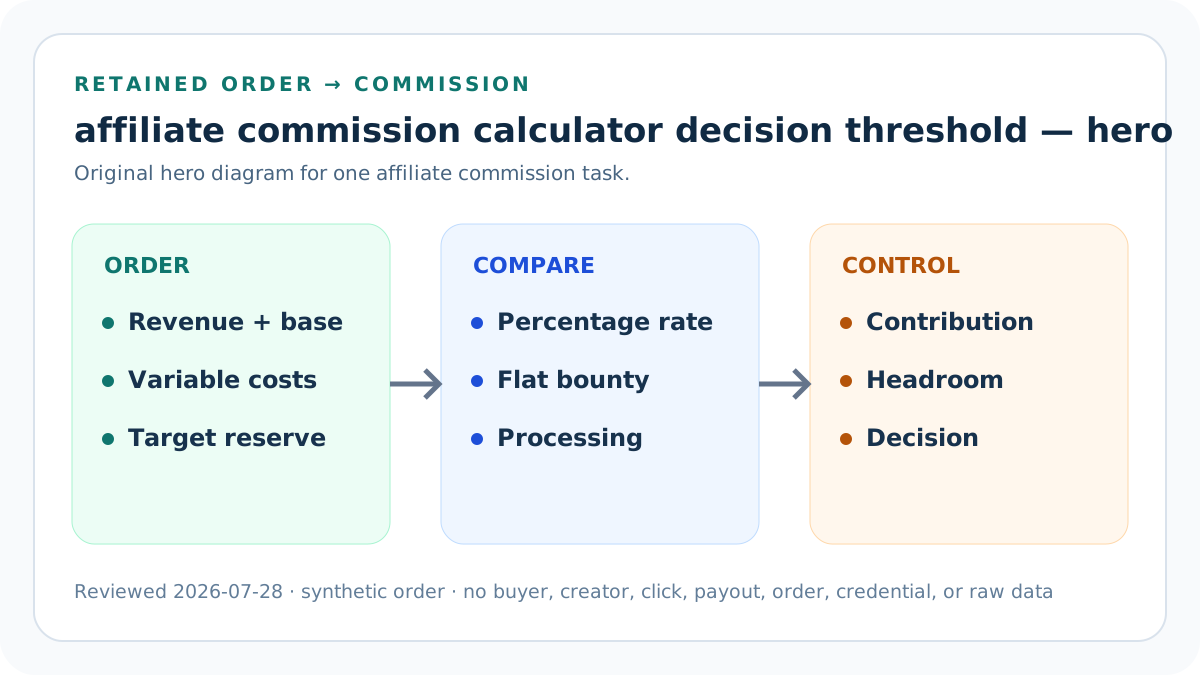
Name the break-even edge
Record commission capacity before the target reserve. For affiliate threshold policy, record the exact field, unit, source version, evidence date, maturity state, reviewer, and declared uncertainty. Recalculate at full precision before formatting a rate or currency amount.
Zero modeled contribution is an outer diagnostic boundary. Topic 1 must explain the supported case, a broken case, the correction path, and why the result belongs to a governed commission limit rather than a platform-wide or creator-wide conclusion.
Name the target edge
Subtract the retained-revenue contribution reserve and processing cost. For affiliate threshold policy, record the exact field, unit, source version, evidence date, maturity state, reviewer, and declared uncertainty. Recalculate at full precision before formatting a rate or currency amount.
This is the normal economic ceiling. Topic 2 must explain the supported case, a broken case, the correction path, and why the result belongs to a governed commission limit rather than a platform-wide or creator-wide conclusion.
Set percentage warning
Keep the offered rate below the full-precision ceiling by an evidence-quality buffer. For affiliate threshold policy, record the exact field, unit, source version, evidence date, maturity state, reviewer, and declared uncertainty. Recalculate at full precision before formatting a rate or currency amount.
Displayed equality can hide rounding and late outcomes. Topic 3 must explain the supported case, a broken case, the correction path, and why the result belongs to a governed commission limit rather than a platform-wide or creator-wide conclusion.
Set bounty warning
Compare the fixed reward with low, normal, and high commissionable-order bands. For affiliate threshold policy, record the exact field, unit, source version, evidence date, maturity state, reviewer, and declared uncertainty. Recalculate at full precision before formatting a rate or currency amount.
One bounty has different effective rates. Topic 4 must explain the supported case, a broken case, the correction path, and why the result belongs to a governed commission limit rather than a platform-wide or creator-wide conclusion.
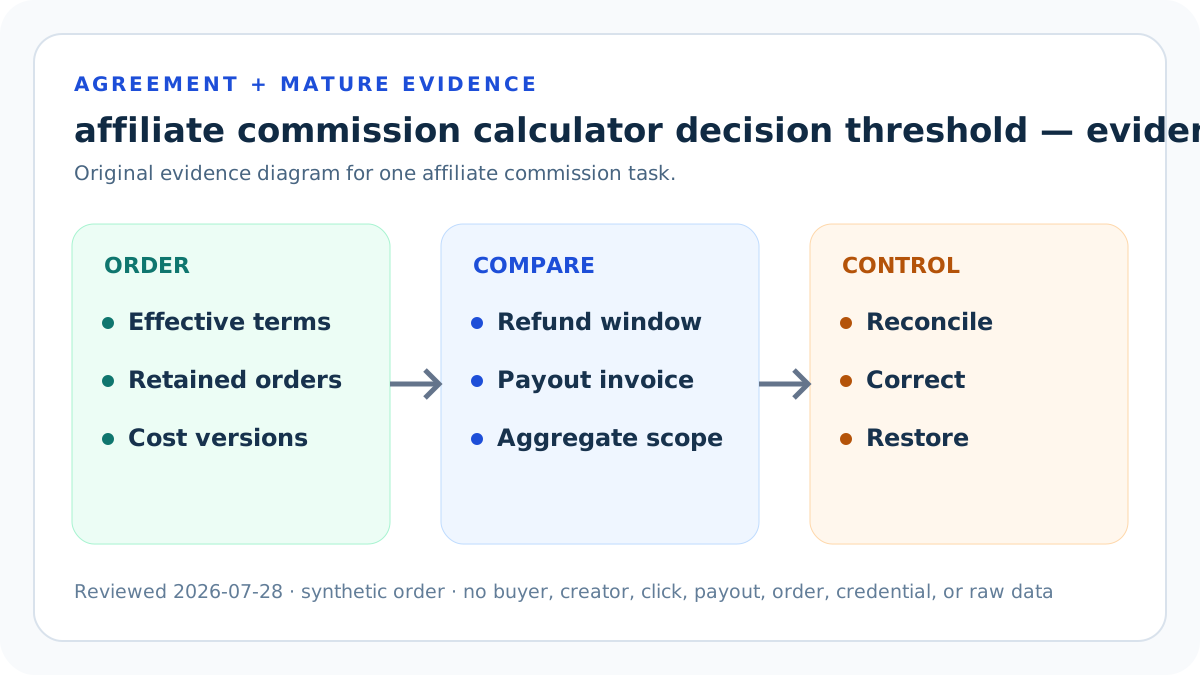
Stress adverse loss
Raise only the supported return-loss driver. For affiliate threshold policy, record the exact field, unit, source version, evidence date, maturity state, reviewer, and declared uncertainty. Recalculate at full precision before formatting a rate or currency amount.
Do not hide policy optimism in several simultaneous assumptions. Topic 5 must explain the supported case, a broken case, the correction path, and why the result belongs to a governed commission limit rather than a platform-wide or creator-wide conclusion.
Stress cost drift
Version product, delivery, fee, and processing changes. For affiliate threshold policy, record the exact field, unit, source version, evidence date, maturity state, reviewer, and declared uncertainty. Recalculate at full precision before formatting a rate or currency amount.
An expired packet cannot govern a current offer. Topic 6 must explain the supported case, a broken case, the correction path, and why the result belongs to a governed commission limit rather than a platform-wide or creator-wide conclusion.
Define stop conditions
Stop on invalid scope, negative contribution, missing agreement, immature outcomes, or privacy defects. For affiliate threshold policy, record the exact field, unit, source version, evidence date, maturity state, reviewer, and declared uncertainty. Recalculate at full precision before formatting a rate or currency amount.
Name owner, expiry, correction, and rollback. Topic 7 must explain the supported case, a broken case, the correction path, and why the result belongs to a governed commission limit rather than a platform-wide or creator-wide conclusion.
Nine confirmations and dated sources: safe affiliate commission thresholds
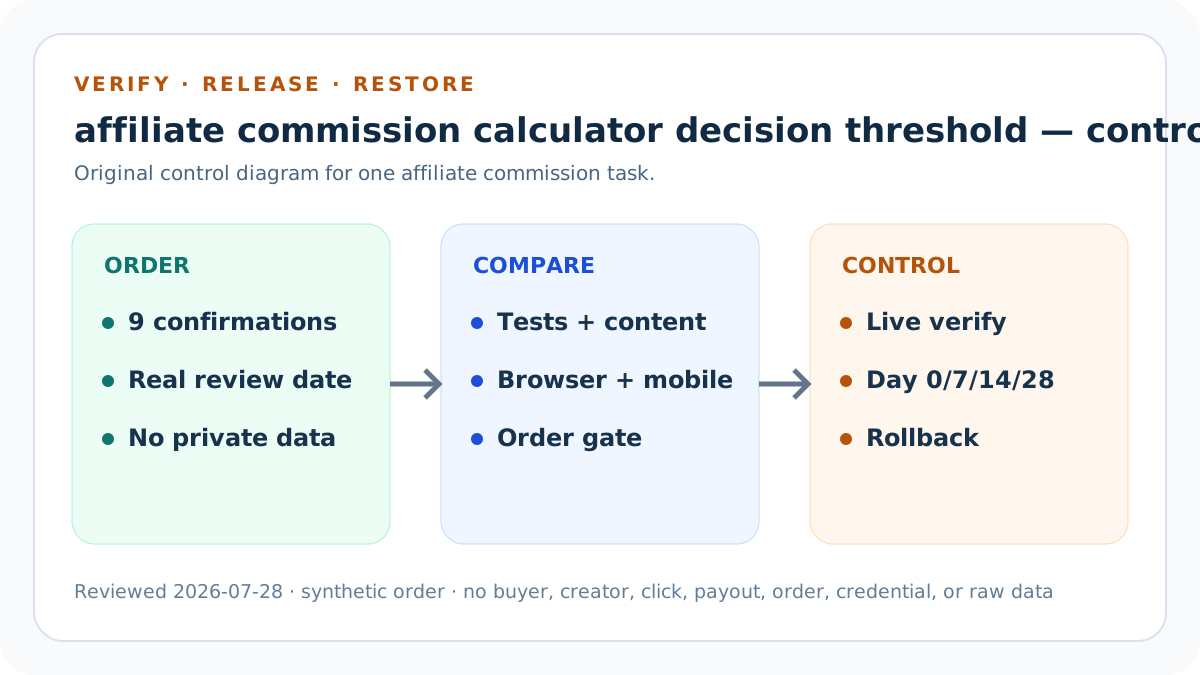
Confirm revenue, base, terms, variable costs, fees and mature loss, thresholds, attribution eligibility, payout maturity, and planning boundaries under a real source-review date. Control 1 names the accountable owner, review frequency, exception code, correction threshold, expiry trigger, and previous restorable packet.
Block display values when evidence authority is incomplete rather than filling gaps with a plausible rate. Apply the control specifically to a governed commission limit; distinguish seller evidence, platform documentation, contract terms, and editable assumptions without merging their authority.
Day 0/7/14/28 measurement: safe affiliate commission thresholds
Record indexability, impressions, clicks, engagement, tool entry, result state, and qualified intent at delayed windows. Control 2 names the accountable owner, review frequency, exception code, correction threshold, expiry trigger, and previous restorable packet.
Do not call temporal change causal proof. Apply the control specifically to a governed commission limit; distinguish seller evidence, platform documentation, contract terms, and editable assumptions without merging their authority.
Privacy and access control: safe affiliate commission thresholds
Use aggregate values, synthetic fixtures, redacted evidence pointers, access controls, and retention schedules. Control 3 names the accountable owner, review frequency, exception code, correction threshold, expiry trigger, and previous restorable packet.
Do not publish buyer, creator, click, payment, credential, or raw-export data. Apply the control specifically to a governed commission limit; distinguish seller evidence, platform documentation, contract terms, and editable assumptions without merging their authority.
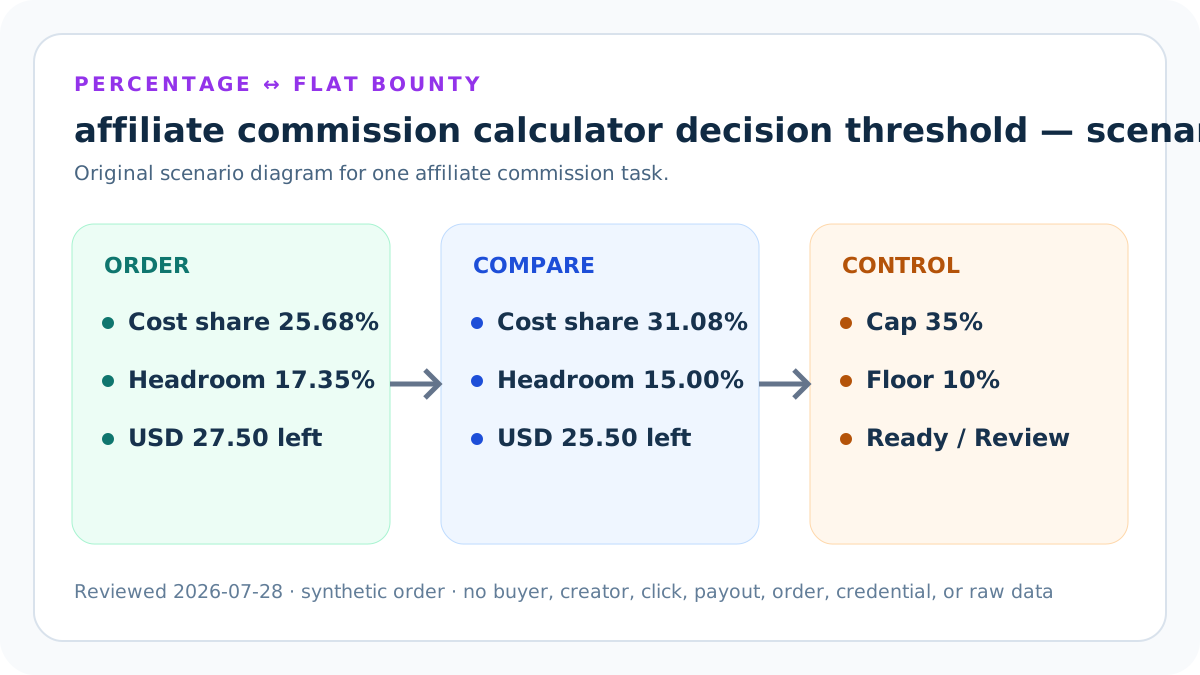
Release and rollback: safe affiliate commission thresholds
Require typecheck, unit, integration, build, content, similarity, SEO, image, link, browser, mobile, keyboard, privacy, and restoration evidence. Control 4 names the accountable owner, review frequency, exception code, correction threshold, expiry trigger, and previous restorable packet.
Restore on a formula, routing, privacy, accessibility, or health regression. Apply the control specifically to a governed commission limit; distinguish seller evidence, platform documentation, contract terms, and editable assumptions without merging their authority.
Evidence maturity and reconciliation: safe affiliate commission thresholds
Close cancellation, refund, return, chargeback, commission-reversal, payout, and settlement windows before treating the packet as final. Control 5 names the accountable owner, review frequency, exception code, correction threshold, expiry trigger, and previous restorable packet.
Mark open states explicitly and preserve late adjustments. Apply the control specifically to a governed commission limit; distinguish seller evidence, platform documentation, contract terms, and editable assumptions without merging their authority.
Name the break-even edge: calculation and verification drill
Recreate “Name the break-even edge” from a clean synthetic retained order rather than copying the default fixture. Record commission capacity before the target reserve. Change one driver, preserve the original row, show intermediate arithmetic, and attach the expected Block, Review, or Ready state to the affiliate threshold policy.
Zero modeled contribution is an outer diagnostic boundary. Drill 1 includes a percentage case, flat-bounty case, immature-evidence case, and corrected case. Explain which variable changed, which denominator remained fixed, how target headroom moved, and what evidence would permit the next action.
Name the target edge: calculation and verification drill
Recreate “Name the target edge” from a clean synthetic retained order rather than copying the default fixture. Subtract the retained-revenue contribution reserve and processing cost. Change one driver, preserve the original row, show intermediate arithmetic, and attach the expected Block, Review, or Ready state to the affiliate threshold policy.
This is the normal economic ceiling. Drill 2 includes a percentage case, flat-bounty case, immature-evidence case, and corrected case. Explain which variable changed, which denominator remained fixed, how target headroom moved, and what evidence would permit the next action.
Set percentage warning: calculation and verification drill
Recreate “Set percentage warning” from a clean synthetic retained order rather than copying the default fixture. Keep the offered rate below the full-precision ceiling by an evidence-quality buffer. Change one driver, preserve the original row, show intermediate arithmetic, and attach the expected Block, Review, or Ready state to the affiliate threshold policy.
Displayed equality can hide rounding and late outcomes. Drill 3 includes a percentage case, flat-bounty case, immature-evidence case, and corrected case. Explain which variable changed, which denominator remained fixed, how target headroom moved, and what evidence would permit the next action.
Set bounty warning: calculation and verification drill
Recreate “Set bounty warning” from a clean synthetic retained order rather than copying the default fixture. Compare the fixed reward with low, normal, and high commissionable-order bands. Change one driver, preserve the original row, show intermediate arithmetic, and attach the expected Block, Review, or Ready state to the affiliate threshold policy.
One bounty has different effective rates. Drill 4 includes a percentage case, flat-bounty case, immature-evidence case, and corrected case. Explain which variable changed, which denominator remained fixed, how target headroom moved, and what evidence would permit the next action.
Stress adverse loss: calculation and verification drill
Recreate “Stress adverse loss” from a clean synthetic retained order rather than copying the default fixture. Raise only the supported return-loss driver. Change one driver, preserve the original row, show intermediate arithmetic, and attach the expected Block, Review, or Ready state to the affiliate threshold policy.
Do not hide policy optimism in several simultaneous assumptions. Drill 5 includes a percentage case, flat-bounty case, immature-evidence case, and corrected case. Explain which variable changed, which denominator remained fixed, how target headroom moved, and what evidence would permit the next action.
Stress cost drift: calculation and verification drill
Recreate “Stress cost drift” from a clean synthetic retained order rather than copying the default fixture. Version product, delivery, fee, and processing changes. Change one driver, preserve the original row, show intermediate arithmetic, and attach the expected Block, Review, or Ready state to the affiliate threshold policy.
An expired packet cannot govern a current offer. Drill 6 includes a percentage case, flat-bounty case, immature-evidence case, and corrected case. Explain which variable changed, which denominator remained fixed, how target headroom moved, and what evidence would permit the next action.
Define stop conditions: calculation and verification drill
Recreate “Define stop conditions” from a clean synthetic retained order rather than copying the default fixture. Stop on invalid scope, negative contribution, missing agreement, immature outcomes, or privacy defects. Change one driver, preserve the original row, show intermediate arithmetic, and attach the expected Block, Review, or Ready state to the affiliate threshold policy.
Name owner, expiry, correction, and rollback. Drill 7 includes a percentage case, flat-bounty case, immature-evidence case, and corrected case. Explain which variable changed, which denominator remained fixed, how target headroom moved, and what evidence would permit the next action.
What a governed commission limit can prove
It can prove that the displayed arithmetic follows the declared retained revenue, commission base, commission structure, variable-cost packet, processing convention, return-loss estimate, and contribution target for one bounded evidence version.
It cannot prove incremental sales, correct attribution, creator quality, fraud absence, contract enforceability, payout authorization, tax treatment, accounting profit, liquidity, customer lifetime value, or future performance.
When to block, review, or release affiliate threshold policy
Block missing, negative, impossible, private, conflicted, or materially immature evidence. Review valid arithmetic that misses a target, relies on thin cohorts, or changes under a supported stress case. Ready means the entered scenario preserves its declared target and quality gates pass.
Release only a reversible public model with synthetic defaults, explicit source notes, answer-first copy, original diagrams, accessible labels, canonical and schema checks, internal links, strict 404 behavior, and a dated correction path.
Sources and further reading
- Seller Profit Guard methodology: Contribution equations, evidence versions, privacy, correction, release, and rollback.
- Seller Profit Guard data privacy: Local-first boundaries for buyer, order, affiliate, payment, refund, and raw-record data.
- Shopify Help: Pay creators on Collabs: Official merchant context for tracked affiliate commission, holding periods, canceled or fully refunded orders, processing fees, and payment disputes.
- Shopify Help: Set up and manage Collabs programs: Official context for merchant-created programs and commission offers.
- Shopify Help: Collabs for custom storefronts: Official context for tracked affiliate links, redirects, discount destinations, and conversion-summary verification on custom storefronts.
Related Seller Profit Guard tools
- Affiliate Commission Calculator: Compare percentage and flat-bounty contribution on one retained order.
- Paid CPA Limit Calculator: Keep paid acquisition capacity separate from affiliate compensation.
- Break-Even ROAS Calculator: Model advertising value-to-cost boundaries separately.
- Maximum Discount Calculator: Keep promotion discount capacity separate from commission capacity.
- Contribution Margin Calculator: Reconstruct retained contribution before affiliate cost.
- Methodology: Review evidence, privacy, calculation, correction, release, and rollback.
- Data Privacy: Protect buyer, creator, order, payout, refund, and credential data.
- Affiliate Commission Formula and Inputs: Calculate contribution after percentage commission or flat bounty from one retained-order evidence packet, target, and mature cost record.
- Affiliate Commission Percentage Example: Follow a synthetic USD 85 retained order through a 12% commission, processing cost, contribution, margin, and target headroom.
- Affiliate Commission Flat-Bounty Model: Test a fixed bounty per retained order without disguising order-value, return, processing, attribution, agreement, and eligibility risk.
- Affiliate Commission Calculation Mistakes: Correct commission-base, refund, processing-fee, order-grain, attribution, double-counting, maturity, and false-comparison errors.
- Affiliate Commission Evidence Sources: Map every input to agreements, retained-order reports, cost libraries, mature adverse outcomes, invoices, and seller policy.
- Percentage Commission vs Flat Bounty: Compare percentage and flat-bounty affiliate compensation at one retained-order grain without changing the economic denominator or target.
- Weekly Affiliate Commission Review: Run a repeatable evidence cycle from agreement and retained-order reconciliation through stress testing, action, correction, and rollback.
- Interpret Affiliate Contribution: Read contribution, margin, target headroom, scenario difference, and maximum rates without false precision or causal claims.
- Affiliate Commission Audit Template: Use a standalone checklist and dated change log for agreement terms, retained economics, scenarios, decision, release, and rollback.
Next step: Open Seller Profit Guard.
This is operational planning help, not tax, accounting, legal, financial, or platform-policy advice. Review the Terms and disclaimer, and verify current platform rules and fee assumptions before changing prices.