Etsy title checker audit checklist and change log template
Last updated: 2026-07-29
Written and reviewed by Seller Profit Guard Editorial Team.
A complete Etsy title audit records listing scope, prior and proposed titles, verified noun and traits, variation truth, primary buyer phrase, surrounding fields, mobile review, checker version and outputs, official-source versions, privacy review, approval, exact publication, unchanged context, feedback date, observed evidence, exceptions, and a tested rollback path.

What belongs in the title audit evidence register?
Record private listing reference, listing state, shop language, product family, variation scope, current title, proposed title, item noun, objective traits, buyer phrase, category, attributes, tags, description lead, first-photo promise, price, inventory, promotion, and active experiment context.
For every proposed phrase, record evidence source, effective date, variation coverage, owner, uncertainty, and keep, move, remove, or verify decision. Include material, origin, maker, personalization, size, compatibility, vintage, certification, brand, recipient, and occasion claims when applicable.
Preserve prior title and a privacy-safe fingerprint. Record aggregate baseline dates and metrics without buyer data. Confirm raw exports remain outside the public workspace.
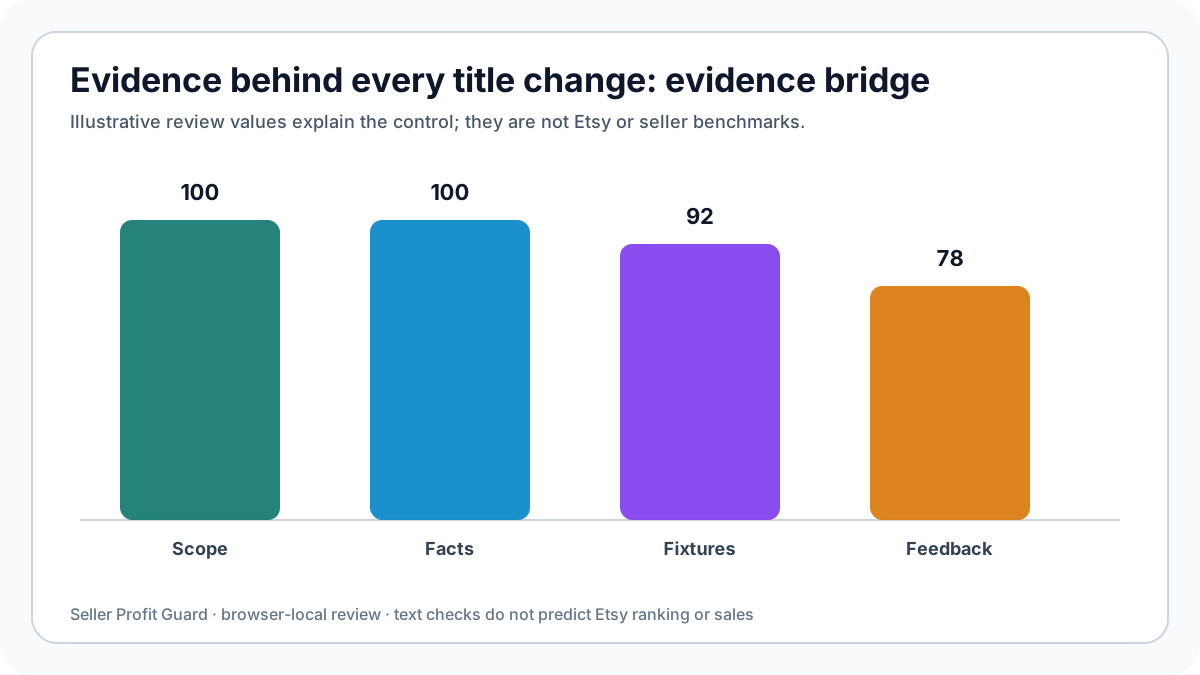
| Control | Artifact | Failure response |
|---|---|---|
| Scope | Listing + variations | Narrow |
| Facts | Phrase-source map | Remove |
| Fields | Consistency review | Repair |
| Baseline | Prior title + Stats | Preserve |
| Rollback | Trigger + copy | No release |
Which checker and interface controls must pass?
Store the five inputs, character count, word count, noun result, trait coverage, repeated words, buyer-phrase result, mobile lead, guidance flags, evidence-note status, score, issues, and next steps. Identify the tool and rule version.
Run the default personalized fixture, a material-led fixture, empty title, missing noun, missing primary phrase, more than 140 characters, more than 15 words, repeated nouns, dense separators, subjective language, gifting, sale, delivery, missing evidence note, and Unicode or punctuation cases.
Test keyboard input, textarea behavior, reset, labels, mobile layout, result descriptions, and horizontal overflow. Verify that no input is sent in analytics events or embedded in generated public reports.

How are sources and claims audited?
Version the April 2026 title guidance, Keywords 101, How Etsy Search Works, search checklist, and Seller Policy. Record access date and the precise statement each source supports.
Search public copy for unsupported certainty. Remove claims that fewer than 15 words is a hard limit, that word order guarantees ranking, that a suggestion proves underperformance, that a score predicts sales, or that a before-and-after change is causal.
Confirm policy language remains narrow. The audit does not certify intellectual-property rights, regulated claims, tax, legal compliance, or every regional requirement. Escalate uncertain high-risk claims.
What belongs in approval and publication feedback?
Record prior and proposed title, reason, hard-gate results, readability review, checker output, mobile inspection, reviewer, effective time, unchanged-context list, expected feedback, comparison window, minimum evidence, exception, and rollback.
After publication, verify the exact title on the intended listing and shop. Record platform warnings or bulk-edit differences. Do not proceed under wrong-profile, missing-context, login, or CAPTCHA ambiguity.
At the mature date, record aggregate observed metrics, context changes, result classification, and next action. Use 'observed after' rather than 'caused by' unless a credible design proves causality.
How are rollback and audit closure verified?
Rollback for inaccuracy, policy concern, variation mismatch, buyer confusion, publication error, or the predefined evidence threshold. Restore the exact preserved title and verify it on the live listing.
Preserve the failed candidate, evidence, reason, time, operator, and recovery proof. Do not erase the record or immediately publish a third version. Reopen product or field evidence when the failure exposes a deeper listing problem.
Close only when the accepted title or restored title is verified, exceptions have owners and dates, private artifacts remain controlled, and the next review is scheduled. A checked template without live feedback is incomplete.
Which evidence should support this audit and change-log control?
Preserve the current title before editing. Record the listing identifier privately, public product facts, shop language, title text, first-photo promise, relevant category and attributes, all tags, description lead, aggregate Etsy Search visits and search terms, price or variation changes, and the exact review window. Keep the evidence grain at one listing unless a defensible listing family truly shares the same product noun and objective traits.
Separate platform guidance from seller evidence. Etsy's current guidance supports clear, buyer-friendly titles, one accurate item noun, critical objective traits, and restrained occasion or subjective language. It does not prove that a particular rewrite will rank, receive more clicks, or convert. Shop Stats can show observed traffic and terms, but personalized search, listing quality, competition, seasonality, price, photos, reviews, and service signals can change the outcome.
Freeze the prior title, proposed title, tool version, source-access date, comparison dates, listing settings, and a privacy-safe fingerprint. Record whether a title suggestion came from Etsy, Seller Profit Guard, or the seller. An unchanged fingerprint proves only that the review package stayed stable; it does not prove performance or policy compliance.
- Use verified product facts rather than invented keywords.
- Keep title, tags, attributes, description, and photo promises consistent.
- Compare one stable listing before changing a whole shop.
- Wait for a declared evidence window before judging a rewrite.
- Restore the preserved title when a rollback rule is met.
Privacy and policy boundaries for this audit and change-log control
A title review needs public listing copy and aggregate observations, not buyer identity. Do not paste names, email addresses, postal addresses, order IDs, message text, personalization requests, payment data, tracking numbers, private search histories, or raw listing and order exports into the public tool, public articles, analytics events, feedback forms, email drafts, or community posts.
Store any downloaded listing CSV in the approved private environment. Extract only the title, public product facts, and aggregate comparison fields needed for the review, then apply access, retention, and deletion rules. Public examples in this cluster are fictional. Seller Profit Guard runs the quick checker in the browser and does not require Etsy credentials.
Accuracy and intellectual-property review remain seller responsibilities. A mechanically clean title can still be misleading, prohibited, infringing, or inconsistent with the product. Stop when a proposed noun, material, origin, personalization, brand, compatibility, certification, recipient, or occasion claim cannot be verified from the actual item and current policy.
How should the Etsy Title Checker be used for this audit and change-log control?
Enter the complete current or proposed title, the verified item noun, up to three critical objective traits, the primary buyer phrase, and an optional privacy-safe Shop Stats or change note. The checker measures characters and words, tests whether the noun and traits appear, highlights repetition, shows the first 60 characters as a mobile-lead preview, and flags subjective, gifting, sale, or delivery language covered by its deterministic rules.
Treat the score as a convenience summary, not a probability of ranking, traffic, conversion, policy approval, or sales. Read every issue and next step. A phrase can be absent from the title yet still belong in a tag, attribute, or description; a phrase can be present and still be inaccurate. The tool cannot inspect the product, photo, listing category, trademark rights, live search results, or Etsy's private ranking systems.
Use the tool before and after a proposed change, then review the listing as a buyer would on mobile. Preserve the baseline, change one listing or a small controlled group, record the effective time, and compare mature aggregate evidence. Roll back when the approved stop rule is met. Do not repeatedly rewrite the same title to chase day-to-day personalized search results.
- Preserve the current title and stable listing context.
- Verify the item noun and objective product traits.
- Run the deterministic buyer-readability review.
- Inspect the mobile lead and surrounding listing fields.
- Release one bounded change with evidence and rollback.
Sources and further reading
- Etsy Seller Handbook: New Guidance for Listing Titles: Etsy's April 2026 buyer-friendly title guidance, examples, optional suggestion tool, baseline-download advice, and rollback reminder.
- Etsy Seller Handbook: Keywords 101: Current guidance for clear titles, objective descriptors, punctuation, tags, attributes, descriptions, and accurate claims.
- Etsy Seller Handbook: How Etsy Search Works: Official explanation of holistic query matching, ranking, personalization, listing quality, engagement, and Shop Stats use.
- Etsy Seller Handbook: Search Optimization Checklist: Official mobile-scanning, title, attributes, shop language, experimentation, and Shop Stats guidance.
- Etsy Seller Policy: Current accuracy, representation, intellectual-property, manipulation, and seller-responsibility boundaries.
- Seller Profit Guard methodology: Evidence hierarchy, local-first privacy, editable assumptions, uncertainty, control logs, and non-advice limits.
Related Seller Profit Guard tools
- Open the Etsy Title Checker: Review a title against verified facts, mobile scanning, repetition, and an optional evidence note.
- Check Etsy tags and keywords: Move relevant phrases out of a crowded title and into a varied 13-tag set.
- Review the variation and SKU checklist: Keep title claims aligned with actual variations, materials, sizes, and SKU records.
- Use the listing QA checklist: Review cost, variation, SKU, and price evidence around the title.
- Read the editorial policy: Understand source, correction, review, and publication controls.
- Read the local-first methodology: Keep private listing exports and buyer data outside public tools and reports.
- Etsy Title Checker: Five Inputs That Matter: Continue the Etsy title evidence, buyer-readability, release, and rollback workflow.
- Etsy Title Checker Example: Personalized Item: Continue the Etsy title evidence, buyer-readability, release, and rollback workflow.
- Etsy Title Checker for Material-Led Products: Continue the Etsy title evidence, buyer-readability, release, and rollback workflow.
- 12 Etsy Title Checker Mistakes to Correct: Continue the Etsy title evidence, buyer-readability, release, and rollback workflow.
- Etsy Title Checker Data Sources Map: Continue the Etsy title evidence, buyer-readability, release, and rollback workflow.
Next step: Open the Etsy Title Checker.
This is operational planning help, not tax, accounting, legal, financial, or platform-policy advice. Review the Terms and disclaimer, and verify current platform rules and fee assumptions before changing prices.