The exact inputs for an Etsy listing claims check
Last updated: 2026-07-30
Written and reviewed by Seller Profit Guard Editorial Team.
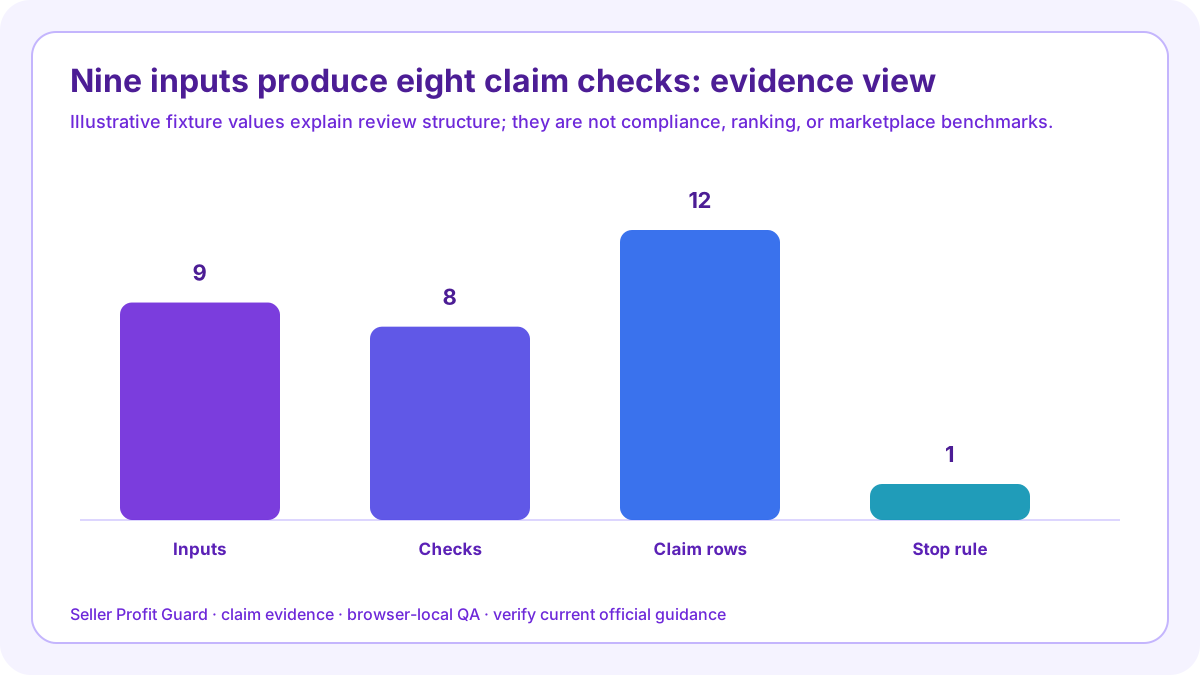
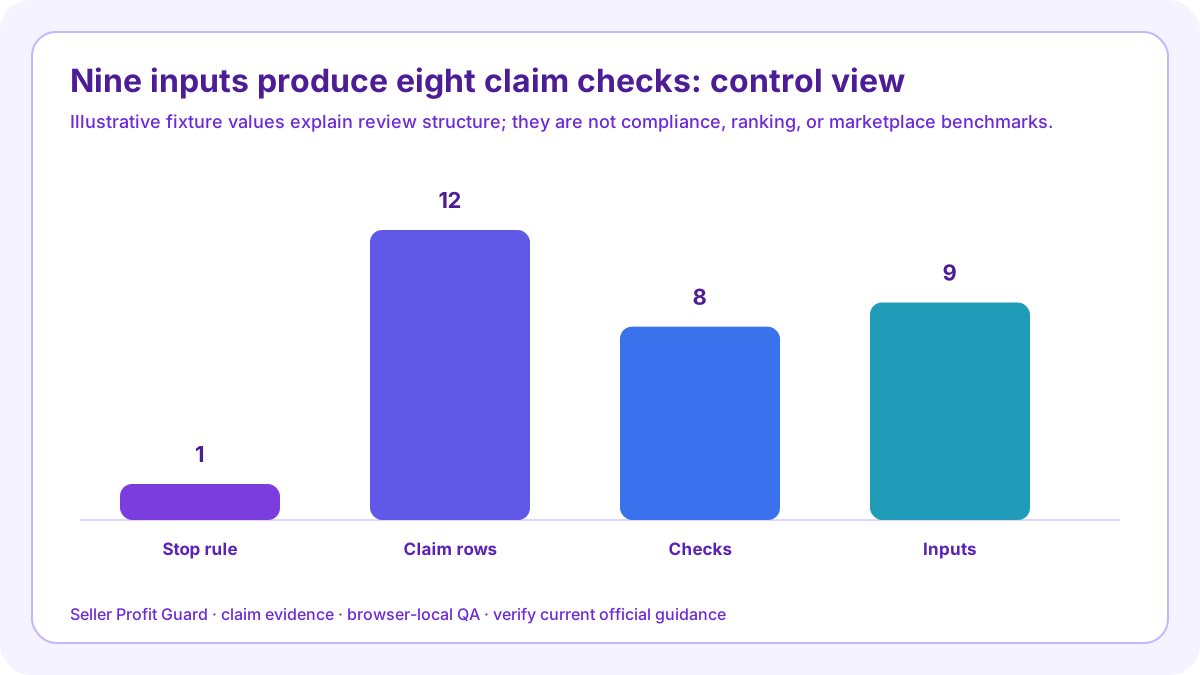
Record one listing version, then enter each claim as claim, type, public surface, evidence, and qualification. Add component and origin records, performance or compatibility methods, image reconciliation, disclosure placement, high-risk review rules, known issues, and a dated approval note. Eight non-compensating checks return Ready, Revise, Hold, or Block.

claim input contract: scope and decision
A claims review begins by freezing one candidate listing, not by scoring persuasive language. Save the alias, draft or version, exact review date, and pre-publication state so every row refers to the same title, description, attributes, images, captions, badges, highlights, and video.
The manifest separates the buyer takeaway from its proof. A row records the exact claim, claim family, public surface, accountable evidence, and qualification. This prevents a supplier specification for one component from being used as silent support for an entire product.
Build the claim-evidence register before editing
Use public wording and non-sensitive record references. The checker does not need private certificates, supplier credentials, customer records, unreleased designs, order exports, buyer messages, email addresses, payment data, tokens, or raw CSV rows.
Known unsupported or prohibited statements have Block precedence. A complete evidence packet for size and process cannot compensate for one untested waterproof badge or a disease-treatment statement embedded in a photograph.
Input 1: listing identity
Name the listing candidate, version, review purpose, and exact date. A generic product name is insufficient because the public surfaces and evidence can change independently between edits.
In the claim-evidence register, give “Input 1: listing identity” an exact public surface, accountable source, version, owner, reviewer, date, limitation, and expected result. Compare a component-specific sterling-silver pendant statement with an unsupported whole-item silver claim. The required outcome is a traceable eight-check publication decision, not a persuasive rewrite or a stronger claim assembled from incomplete records. Preserve the failed row so later templates, images, bulk edits, and supplier changes can be tested against the same boundary.
Input 2: claim manifest
Use one to twelve unique rows with exactly five columns formatted as claim | type | surface | evidence | qualification. Keep the buyer meaning literal and assign each row to a title, description, image, caption, attribute, badge, highlight, tag, or video surface. Malformed rows, duplicates, and unresolved evidence stop review rather than being silently accepted.
In the claim-evidence register, give “Input 2: claim manifest” an exact public surface, accountable source, version, owner, reviewer, date, limitation, and expected result. Compare a component-specific sterling-silver pendant statement with an unsupported whole-item silver claim. The required outcome is a traceable eight-check publication decision, not a persuasive rewrite or a stronger claim assembled from incomplete records. Preserve the failed row so later templates, images, bulk edits, and supplier changes can be tested against the same boundary.
Input 3: material and origin evidence
Separate product components, maker or supplier records, batch or receipt references, measurements, certificates where applicable, and limitations. Current records should match the exact SKU rather than a neighboring product or an expired supplier page.
In the claim-evidence register, give “Input 3: material and origin evidence” an exact public surface, accountable source, version, owner, reviewer, date, limitation, and expected result. Compare a component-specific sterling-silver pendant statement with an unsupported whole-item silver claim. The required outcome is a traceable eight-check publication decision, not a persuasive rewrite or a stronger claim assembled from incomplete records. Preserve the failed row so later templates, images, bulk edits, and supplier changes can be tested against the same boundary.
Input 4: performance and compatibility evidence
State the method, measured result, device or model, tolerance, test condition, limitation, reviewer, and date. If the listing makes no performance claim, record that boundary explicitly.
In the claim-evidence register, give “Input 4: performance and compatibility evidence” an exact public surface, accountable source, version, owner, reviewer, date, limitation, and expected result. Compare a component-specific sterling-silver pendant statement with an unsupported whole-item silver claim. The required outcome is a traceable eight-check publication decision, not a persuasive rewrite or a stronger claim assembled from incomplete records. Preserve the failed row so later templates, images, bulk edits, and supplier changes can be tested against the same boundary.
Input 5: visual claim match
Map actual-item photographs, captions, comparison cards, badges, props, and mockups to supported material, quantity, size, origin, performance, and included-item statements. Record what is illustrative or excluded.
In the claim-evidence register, give “Input 5: visual claim match” an exact public surface, accountable source, version, owner, reviewer, date, limitation, and expected result. Compare a component-specific sterling-silver pendant statement with an unsupported whole-item silver claim. The required outcome is a traceable eight-check publication decision, not a persuasive rewrite or a stronger claim assembled from incomplete records. Preserve the failed row so later templates, images, bulk edits, and supplier changes can be tested against the same boundary.

Input 6: disclosure map
Place qualifications beside the claim they limit. Component materials, production partner, AI use, origin, environmental scope, and measured compatibility need surface-specific wording rather than a generic footer.
In the claim-evidence register, give “Input 6: disclosure map” an exact public surface, accountable source, version, owner, reviewer, date, limitation, and expected result. Compare a component-specific sterling-silver pendant statement with an unsupported whole-item silver claim. The required outcome is a traceable eight-check publication decision, not a persuasive rewrite or a stronger claim assembled from incomplete records. Preserve the failed row so later templates, images, bulk edits, and supplier changes can be tested against the same boundary.
Input 7: high-risk boundary
Define when health, safety, environmental, certification, guarantee, comparative, origin, or test-proven language requires qualified human review. At the Etsy boundary, separately screen disease treatment, medication or treatment substitutes, skin bleaching or whitening, weight loss or body transformation, sexual dysfunction or impotence, and regulatory-approval claims for supplements or similar products. The tool cannot set a universal legal or scientific evidence standard.
In the claim-evidence register, give “Input 7: high-risk boundary” an exact public surface, accountable source, version, owner, reviewer, date, limitation, and expected result. Compare a component-specific sterling-silver pendant statement with an unsupported whole-item silver claim. The required outcome is a traceable eight-check publication decision, not a persuasive rewrite or a stronger claim assembled from incomplete records. Preserve the failed row so later templates, images, bulk edits, and supplier changes can be tested against the same boundary.
Inputs 8 and 9: issues and approval
List seller-known defects separately, then cite the reviewed public surfaces, product records, tests or measurements, policy sources, reviewer, approval result, date, and rollback reference.
In the claim-evidence register, give “Inputs 8 and 9: issues and approval” an exact public surface, accountable source, version, owner, reviewer, date, limitation, and expected result. Compare a component-specific sterling-silver pendant statement with an unsupported whole-item silver claim. The required outcome is a traceable eight-check publication decision, not a persuasive rewrite or a stronger claim assembled from incomplete records. Preserve the failed row so later templates, images, bulk edits, and supplier changes can be tested against the same boundary.
Verification, release, and rollback controls
Before changing public copy or media, preserve the claim-evidence register, title, description, attributes, images, captions, badges, video, component records, measurements or tests, qualifications, approvals, and rollback identifier. Confirm the correct account and listing. Safe-stop on login or CAPTCHA ambiguity, a platform warning, wrong profile, missing target context, private data, or unexpected editor behavior.
After one bounded change, verify a component-specific sterling-silver pendant statement on desktop and mobile and deliberately revisit an unsupported whole-item silver claim. Inspect every declared surface, qualification, image implication, and evidence-dependent statement. Restore the approved previous packet when a critical public observation does not support a traceable eight-check publication decision.
Limits, privacy boundary, and next action
This guide and checker use seller-entered summaries, aliases, manifests, and synthetic fixtures. They do not inspect products, authenticate records, assay materials, perform laboratory tests, analyze image pixels, determine origin, certify claims, decide applicable law, reproduce Etsy review, or predict ranking, clicks, conversion, sales, complaints, refunds, income, or AdSense approval.
Keep buyer identities, emails, addresses, messages, order IDs, receipts, payment data, supplier credentials, private certificates, unreleased designs, tokens, OAuth material, and raw CSV rows outside the claim-evidence register. Repair the accountable source, rerun complete and broken fixtures, obtain required human review, release only the approved packet, inspect public surfaces, and record verified closure or rollback.
Sources and further reading
- Etsy Seller Policy: Current accuracy, origin, provenance, materials, components, disclosures, legal obligations, and misleading-content responsibilities.
- Etsy Creativity Standards: Current made, designed, handpicked, sourced, AI-disclosure, and human-contribution boundaries.
- Etsy Listing Image Requirements: Current original finished-product image expectations and specified exceptions.
- Etsy Prohibited Items Policy: Current prohibited-item policy in force through August 11, 2026; recheck the effective version before release.
- Etsy Medical Claims Policy: Current disease, treatment-substitute, sensitive-health, supplement-approval, testimonial, image, and disclaimer boundaries.
- FTC Advertising Substantiation Policy Statement: Official reasonable-basis framework for objective express and implied claims before dissemination.
- FTC Advertising FAQs for Small Business: Official explanation of objective evidence, reasonable basis, and the stronger support often expected for health and safety claims.
- FTC Environmental Claims: Green Guides Summary: Official summary for specific environmental claims and clear, prominent qualifications.
- Seller Profit Guard methodology: Evidence hierarchy, privacy-safe fixtures, deterministic decisions, uncertainty, verification, correction, and rollback.
Related Seller Profit Guard tools
- Open the Etsy Listing Claims Checker: Map public claims to evidence, qualifications, visuals, risk review, and approval.
- Check Etsy description clarity: Review buyer-question completeness separately from claim substantiation.
- Check Etsy photo coverage: Audit the image set separately while reconciling visual implications.
- Check Etsy attribute coverage: Keep structured product facts aligned with public claim wording.
- Check production-partner disclosure: Review outside-production roles, public identity, location, and dispatch origin.
- Read the local-first methodology: Use aliases, synthetic fixtures, dated evidence, public verification, and rollback.
- Etsy Material Claim: A Component Example: Continue the claim, evidence, scenario, decision, operating, interpretation, or audit workflow.
- Etsy Compatibility Claim: A Sleeve Example: Continue the claim, evidence, scenario, decision, operating, interpretation, or audit workflow.
- 14 Etsy Listing Claim Mistakes to Block: Continue the claim, evidence, scenario, decision, operating, interpretation, or audit workflow.
- Etsy Claim Evidence: Source Hierarchy: Continue the claim, evidence, scenario, decision, operating, interpretation, or audit workflow.
- Etsy Claim Decisions: Ready to Block: Continue the claim, evidence, scenario, decision, operating, interpretation, or audit workflow.
Next step: Open the Etsy Listing Claims Checker.
This is operational planning help, not tax, accounting, legal, financial, or platform-policy advice. Review the Terms and disclaimer, and verify current platform rules and fee assumptions before changing prices.