Etsy profit formula: inputs, assumptions, and contribution
Last updated: 2026-07-27
Written and reviewed by Seller Profit Guard Editorial Team.
An Etsy profit estimate starts with settled seller-attributable revenue, then subtracts evidenced marketplace charges, SKU product cost, labor, packaging, fulfillment, seller-funded promotions, advertising, software allocation, and expected loss. Label every field as source evidence, private record, or editable assumption so the result remains traceable and updateable.

What is the Seller Profit Guard formula?
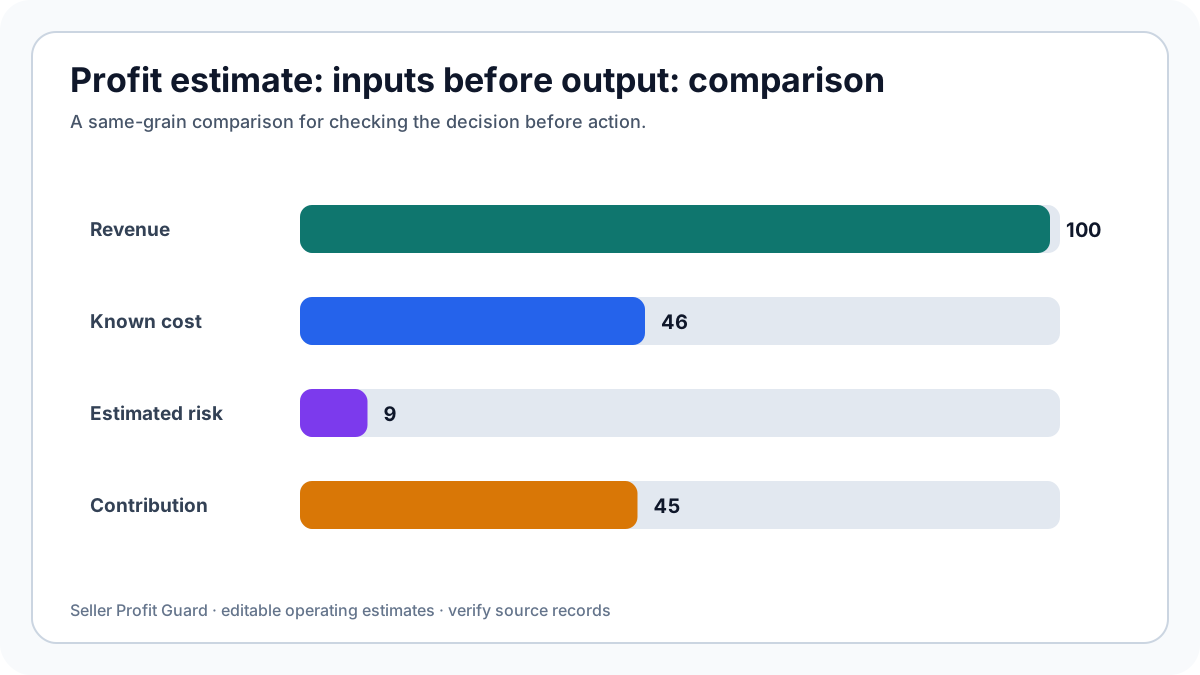
Use a contribution formula, not a single gross-margin percentage. At order or SKU level, estimated contribution equals settled seller-attributable revenue minus marketplace and payment charges, product cost, labor, packaging, fulfillment, seller-funded discounts, attributable advertising, allocated variable software, and expected return or replacement loss. If the decision requires a retained amount for overhead or owner pay, subtract that target separately so break-even is not mistaken for success.
The formula is deliberately modular. Etsy publishes fee categories and shows sales, fees, refunds, shipping, seller services, and other account activity, but private material, labor, packaging, and operating records remain the seller's responsibility. A country-dependent payment fee or a shop-specific Offsite Ads status should come from the seller's current evidence. An unknown cost stays unknown until it is measured; zero means the seller has evidence that the cost is truly zero.

| Formula layer | Preferred evidence | Failure to avoid |
|---|---|---|
| Settled revenue | Order export and Payment Account context | Using list price when a seller-funded discount reduced proceeds |
| Marketplace charges | Current statement rows and official fee definitions | One blended percent that hides fixed and country-specific fees |
| SKU cost | Supplier invoices, bill of materials, waste record | Assigning the cheapest variation cost to every SKU |
| Labor | Timed task and explicit loaded hourly rate | Treating owner time as automatically free |
| Fulfillment | Packaging, label, handling, insurance and adjustment evidence | Confusing buyer-paid shipping with seller shipping cost |
| Risk | Observed returns, replacements and recoveries by SKU | Subtracting the full refund value as expected loss |
Which revenue number belongs in the formula?
Choose one revenue definition and document it. For an order-level operating review, begin with the amount economically attributable to the seller for the product and seller-charged shipping, adjusted consistently for seller-funded discounts and cancellations. Do not add tax collected and remitted by the marketplace as if it were seller income. Do not count a bank deposit as revenue; a deposit combines eligible account activity and timing.
The safest method is a field map. Record the export column, its meaning, currency, sign, tax treatment, discount treatment, and whether the number is line-item or order-level. A multi-item order can repeat order-level shipping or discount values on several rows. Allocate shared amounts with a documented rule—such as revenue share or weight—then verify the allocated rows sum back to the order total.

How should Etsy fees enter the calculation?
Prefer actual Payment Account or statement evidence for completed orders. Etsy's current fee help separates listing, transaction, payment-processing, advertising, shipping-label, currency-conversion, regulatory, deposit, and other service charges. Those categories can use different bases, fixed amounts, country rules, eligibility, timing, or credits. The calculator therefore keeps editable fields rather than presenting one permanent universal Etsy fee rate.
When actual rows are not yet available, create a dated planning scenario. Name the source, country, currency, fee base, percent, fixed amount, and excluded items. Reconcile the plan with the statement later. If a charge is already included in a Net field, do not subtract it again. If a fee credit arrives later, preserve the original charge and the credit as separate evidence rather than silently rewriting history.
- Use actual statement charges for retrospective order review when they can be matched.
- Use source-dated editable assumptions for future pricing scenarios.
- Separate fixed, percentage, advertising, currency, and seller-service charges.
- Keep credits and adjustments visible instead of netting away the explanation.
- Recheck the official source whenever the platform, country, currency, or program changes.
How do product, labor, packaging, and shipping costs differ?
Product cost describes what the sellable SKU consumes: materials, purchased components, production charge, print provider charge, spoilage allowance, or wholesale unit cost. Labor describes measured seller or employee time. Packaging covers mailers, boxes, inserts, tape, labels, and protective material. Fulfillment includes carrier labels, insurance, pickup, handling, outsourced fulfillment, and carrier adjustments. Combining these layers makes cost reduction harder to diagnose.
Use variation-level records when size, material, finish, personalization, weight, bundle quantity, supplier, or fulfillment route changes cost. A listing-level average can be useful for a high-level forecast, but it should not approve a price for a heavy or labor-intensive variation. Store the effective date and source beside each cost so an old supplier price does not masquerade as current evidence.
| Private input | Measurement method | Review trigger |
|---|---|---|
| Material or provider cost | Invoice, bill of materials, provider quote | Supplier, design, material or quantity change |
| Labor | Timed task × loaded hourly rate | Workflow, personalization or wage change |
| Packaging | Per-order component count and purchase cost | Mailer, box, insert or protection change |
| Shipping and handling | Label receipt, adjustment and handling record | Carrier, zone, weight or free-shipping change |
| Other variable cost | Documented per-unit or per-order evidence | App, payment, licensing or service change |
How do discounts, advertising, and return risk enter?
A seller-funded discount reduces seller economics once. If the export already records revenue after the discount, do not subtract the coupon again. If the starting number is list price, subtract the seller-funded amount explicitly. Platform-funded value belongs in the model only when evidence shows how it affects seller proceeds. Offsite Ads, Etsy Ads, affiliate, or other acquisition costs should be assigned using the most defensible order or SKU evidence available.
Expected return loss is not refund value multiplied by return rate. Model the unrecovered components: outbound shipping, reverse shipping, damaged product, replacement production, handling, support time, and any confirmed fee or inventory recovery. Use observed SKU or category evidence when enough exists and retain a range when the sample is small. A single optimistic recovery assumption should not approve an aggressive price.
What assumptions must be dated and stress-tested?
Date every value that is not directly matched to the reviewed order: fee rate, fixed fee, labor rate, minutes, return rate, loss per return, ad attribution, shipping estimate, software allocation, and target contribution. Record the source and owner. A number without a date cannot be distinguished from a current measurement, a temporary test, or an obsolete guess.
Run at least three cases for important products. The base case uses the most representative evidence. The conservative case increases uncertain costs or reduces recovery without inventing an impossible disaster. The improvement case changes one controllable input, such as packaging, labor minutes, price, or shipping funding. The comparison should show which variable changes the decision rather than merely producing three totals.
- Base: representative recent evidence.
- Conservative: credible adverse fee, shipping, advertising, or return outcome.
- Improvement: one operational change the seller can actually test.
- Unknown: held outside approval until evidence exists.
- Target: retained contribution required after variable costs.
Etsy profit formula questions
Is contribution the same as accounting profit? No. Contribution is an operating estimate after the costs included in the model. It can exclude income tax, financing, owner compensation, inventory adjustments, depreciation, general overhead, and other accounting treatments. The page and exported report must state the scope.
Should buyer-paid shipping count as revenue? Include seller-attributable shipping consistently, then subtract the actual seller-borne fulfillment cost. Buyer-paid shipping is not automatically margin. If the marketplace report handles it differently, map the fields so the order total reconciles.
Can I use a standard Etsy fee percentage? Use a planning assumption only when it is dated, scoped to the right country and program, and replaced by actual evidence when available. Etsy currently documents several categories with different bases and country-dependent payment fees.
What if a SKU cost is missing? Keep the row incomplete and block an approval decision. Do not interpret missing as zero. Add a cost record or use a clearly labeled conservative range.
How often should inputs change? Update after a material price, supplier, labor, packaging, shipping, fee, discount, ad, software, or return change. Keep the prior value and effective date for auditability.
Privacy and evidence limits for formula and input map
A contribution review does not need buyer names, delivery addresses, private messages, payment credentials, marketplace passwords, or a public copy of the seller's order history. It normally needs a redacted transaction key, date, SKU, quantity, seller-attributable revenue, relevant fee evidence, and private cost assumptions. Keep the untouched export in controlled storage and work from a local copy.
Seller Profit Guard is designed to read supported CSV files in the browser. A report can still contain commercially sensitive prices, SKU economics, labor rates, and supplier costs, so treat exports as private operating records. For support, share column names and a made-up example row. If an account-specific reserve, fee, refund, or suspension determines the answer, use the authenticated Etsy record rather than a generic assumption.
- Do not upload buyer identity or address fields for a margin calculation.
- Do not paste raw order rows into public communities, support email, or AI prompts.
- Use public dummy data to reproduce mapping and formula issues.
- Store cost libraries, reports, and change logs as confidential business records.
- Escalate tax, accounting, legal, and account-policy questions to the appropriate official or professional source.
How to apply this formula and input map in Seller Profit Guard
Open the Etsy CSV profit calculator with a recent, representative order-item export or the public dummy sample. Confirm the revenue, quantity, SKU, shipping, discount, fee, and transaction mappings before importing private cost assumptions. Review missing-cost and mapping warnings first; a precise result built on an empty or misidentified field is not decision-ready.
Run the relevant base and stress scenarios, export the private review list, and record the source period, assumptions, result, decision, owner, and next review date. The useful output is not a perfect score. It is a short, evidence-backed queue of listings or SKUs that need a price, cost, shipping, promotion, or data-quality action.
- Preserve the source export and record its shop, currency, period, and file type.
- Confirm every mapped field and keep missing values unknown rather than zero.
- Attach the correct SKU-level material, labor, packaging, fulfillment, and target assumptions.
- Run a base case plus the page-specific stress or comparison case.
- Inspect the rows that fail the target or evidence-quality gate.
- Record one reversible action and a dated follow-up instead of changing the whole shop.
Related resources
- Open the Etsy CSV profit calculator: Run a browser-local order and SKU contribution review with editable assumptions.
- Build an Etsy SKU cost library: Store material, labor, packaging, shipping, and target assumptions for repeat reviews.
- Reconcile Etsy Payment Account activity: Match order and statement evidence before interpreting cash movement as product economics.
- Review CSV data privacy: Keep raw buyer and order data out of public support and community posts.
- Read the editorial policy: See how sources, corrections, AI assistance, and update dates are handled.
Sources and further reading
- Seller Profit Guard calculation methodology: Calculation scope, editable assumptions, contribution terminology, privacy boundaries, and result limits.
- Etsy Help: Fees and Taxes for Selling: Official fee categories, fee bases, country-dependent processing charges, advertising fees, and Payment Account treatment.
- Etsy Help: Download Sold Transaction Spreadsheets: Official order items, orders, Etsy Payments sales, and Etsy Payments deposits CSV workflow.
- Etsy Help: Manage Your Payment Account: Official sales, fees, refunds, seller services, shipping, monthly statements, balance, and deposit context.
- Etsy Help: How Offsite Ads Work: Official attribution, participation, fee-rate, and order-cap context; verify current shop-specific status.
- Etsy Help: Issue a Full or Partial Refund: Official refund workflow and Payment Account impact reference.
Related Seller Profit Guard tools
- Open the Etsy CSV profit calculator: Run a browser-local order and SKU contribution review with editable assumptions.
- Build an Etsy SKU cost library: Store material, labor, packaging, shipping, and target assumptions for repeat reviews.
- Reconcile Etsy Payment Account activity: Match order and statement evidence before interpreting cash movement as product economics.
- Review CSV data privacy: Keep raw buyer and order data out of public support and community posts.
- Read the editorial policy: See how sources, corrections, AI assistance, and update dates are handled.
- Etsy Profit Example: Trace a $74 Order Step by Step: Continue the Seller Profit Guard evidence and decision workflow.
- Etsy Discount Profit: Test Coupons and Free Shipping: Continue the Seller Profit Guard evidence and decision workflow.
- Etsy Profit Calculator Mistakes: 12 Cost Traps: Continue the Seller Profit Guard evidence and decision workflow.
- Etsy Profit Data Sources: Build a Defensible Record: Continue the Seller Profit Guard evidence and decision workflow.
- Etsy Profit Thresholds: Break-Even Is Not Enough: Continue the Seller Profit Guard evidence and decision workflow.
Next step: Open the Etsy CSV profit calculator.
This is operational planning help, not tax, accounting, legal, financial, or platform-policy advice. Review the Terms and disclaimer, and verify current platform rules and fee assumptions before changing prices.