Return window loss for an unsellable item
Last updated: 2026-07-29
Written and reviewed by Seller Profit Guard Editorial Team.
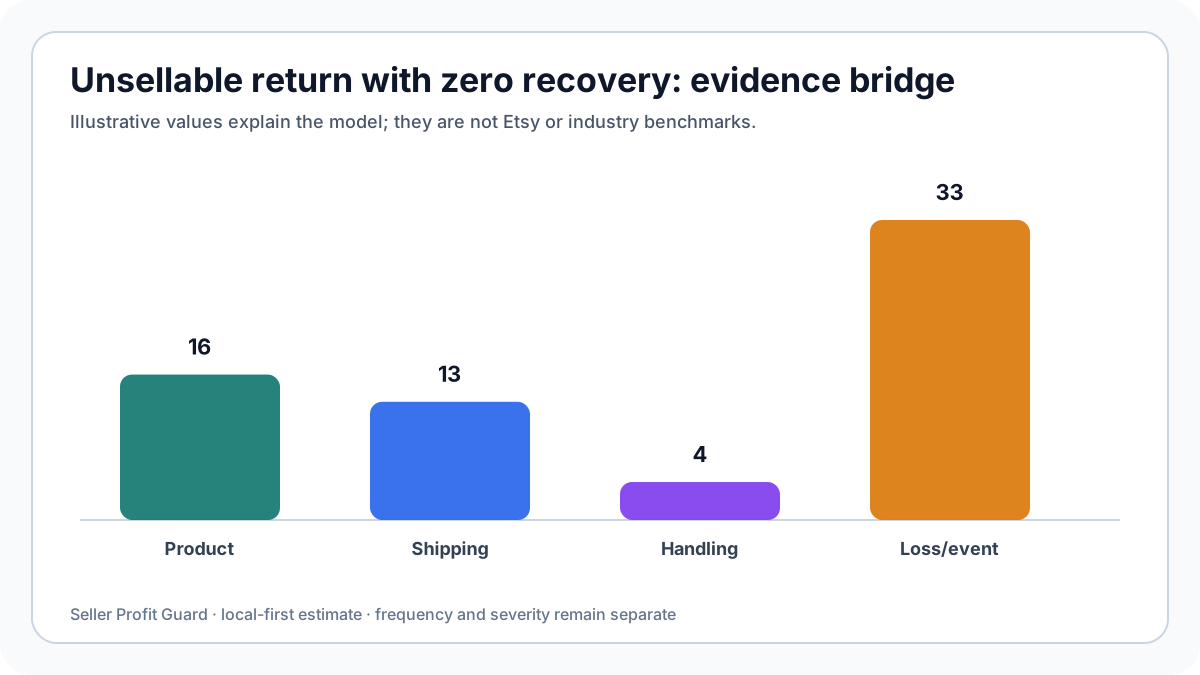
An unsellable return should normally use zero resale recovery and include disposal, damage review, support, lost outbound shipping, and return shipping that the seller actually bears. Because incident severity can approach product cost plus two-way logistics, model it separately from resellable returns and from eligible platform-covered cases.

When is a return economically unsellable?
Treat an item as unsellable when inspection shows damage, contamination, personalization, missing components, unsafe condition, expiration, legal restriction, or a recovery cost greater than defensible resale value. The label is an economic and compliance decision, not a shortcut for every opened package. Document condition categories and who can approve a write-off.
Do not mix true write-offs with items waiting for inspection, repair, parts, or markdown. Inventory aging can reduce recovery, but it does not prove zero value on receipt. Conversely, recording retail price as recovery exaggerates value when a returned item sells slowly, needs discounting, or consumes labor and storage.
Use a separate cohort for damage-in-transit, buyer-remorse, incorrect listing, customization, lost parcel, and case resolution when their responsibility or recovery differs. Etsy Purchase Protection and applicable law can change who funds a refund, but eligibility must be verified rather than assumed.
| Outcome | Recovery input | Extra cost |
|---|---|---|
| Like new | Observed resale recovery | Inspect + repack |
| Markdown | Net recovered cost share | Inspect + markdown |
| Repair | Recovery after repair | Parts + labor |
| Write-off | 0% | Dispose + document |
| Platform covered | Model separately | Eligibility evidence |
How does zero recovery change the calculation?
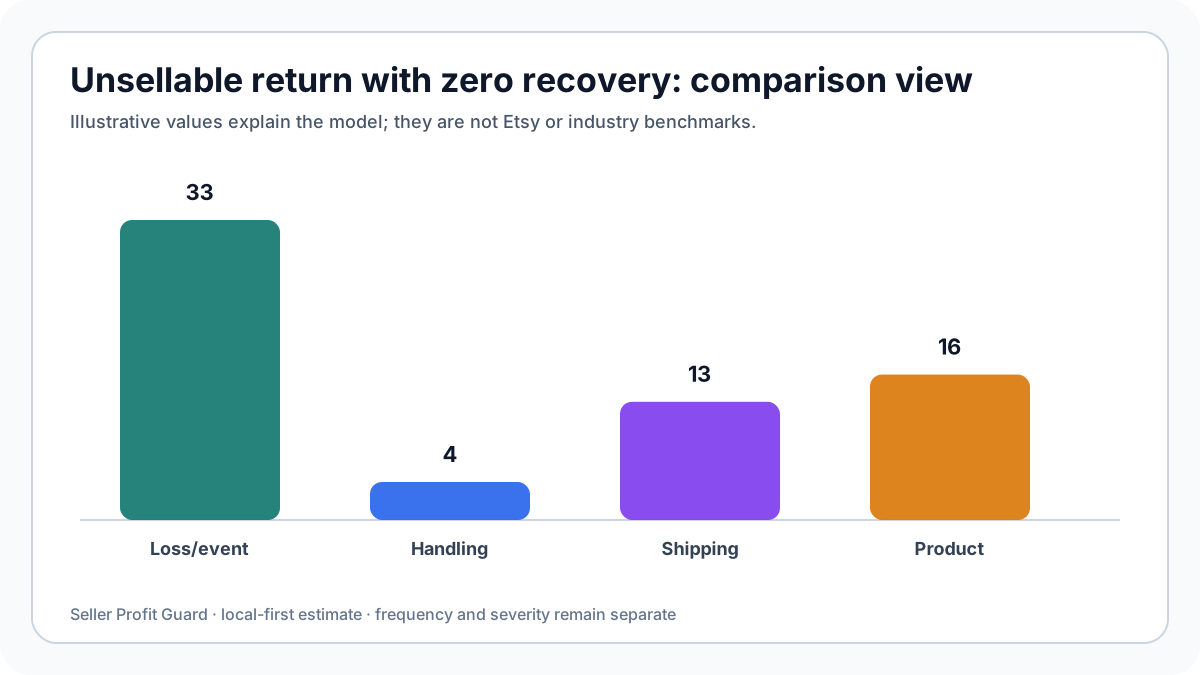
Use a $42 public dummy order with $16 product cost, $6 fulfillment, 9% fees, a 7% unsellable-return rate, $6 lost outbound shipping, $7 return shipping, $4 damage review and disposal, zero recovery, and a 25% target. Loss per return is $6 + $7 + $4 + $16 = $33.
Expected return loss is $33 × 7% = $2.31 per original order. Contribution before returns is $42 − $16 − $6 − $3.78 = $16.22. Adjusted contribution is $13.91, or 33.12%. The target requires $10.50, leaving $3.41 expected headroom.
The target-safe return rate is ($16.22 − $10.50) ÷ $33 = 17.33%. That ceiling looks comfortable, but it depends on a 7% rate representing the same product and condition class. If the 7% figure includes all returns while only some are unsellable, model a weighted severity matrix instead of multiplying two mismatched aggregates.

How should platform-covered and seller-funded outcomes be separated?
Create three explicit branches: seller-funded return or case, platform-covered eligible case, and uncertain eligibility. For seller-funded outcomes, include costs the seller actually retains. For confirmed platform coverage, record what Etsy covered and what operational costs remain. For uncertain cases, use a probability-weighted or adverse scenario without claiming protection.
Current Etsy guidance describes Purchase Protection as conditional and up to specified coverage. It does not guarantee every damaged, late, lost, or description dispute. The Seller Policy also describes situations outside protection where the seller may be responsible for refund and shipping amounts. Region, policy, evidence, timing, and case facts matter.
Never edit historic outcomes to make the model appear accurate. Reconcile credits, recoupments, labels, and retained costs after resolution. A protected refund can still leave production, fulfillment, support, and inventory consequences. A seller-funded refund can receive some fee credits without recovering other losses.
Which actions reduce unsellable-return severity?
Start with the cause: inaccurate dimensions, weak packaging, material misunderstanding, customization error, variation confusion, carrier damage, or unsafe return condition. Correct listing facts, images, sizing, variation labels, proofing, package design, or carrier process as appropriate. Do not simply narrow a policy if law or marketplace commitments require another outcome.
Compare prevention cost with avoided incident severity. An extra $0.70 package insert or protective material may be rational if it materially lowers a $33 loss event, but only observed evidence can establish the effect. Separate buyer-experience consequences and operational capacity from the financial estimate.
Set a rollback or escalation threshold: unsellable rate, incident loss, repeated cause, case volume, or evidence failure. Preserve before-and-after fixtures, monitor the same cohort, and stop a change that introduces confusion or violates policy. This tool supports the economic review; it does not make the policy decision.
Which records support this unsellable-return scenario?
Use a product-level return-rate cohort, not a shop-wide percentage copied from memory. Reconcile completed sales, returns, exchanges, cancellations, cases, refunds, fee credits, return labels, replacement shipments, inspection work, restocking outcomes, markdowns, and write-offs for the same analysis period. The calculator needs aggregate operating values; it does not need buyer identity or a raw order file.
Separate platform evidence from seller assumptions. Etsy's current guidance explains return-policy requirements, agreements, fee credits, cancellations, Purchase Protection, and regional legal boundaries. It does not supply a universal return rate, resale recovery percentage, product cost, labor rate, or shipping loss for a particular shop. Those values must come from controlled seller records or be labeled as provisional.
Freeze the source period, currency, product cohort, policy version, calculation version, inclusion rules, exclusions, and fingerprints. Reperform one public dummy fixture by hand. A matching fingerprint proves that a file did not change; it does not prove the cohort represents future orders. Recalculate after a product, package, carrier, policy, marketplace, or fee-scope change.
- Keep refund amount, fee credit, and retained operating cost on separate lines.
- Segment resellable, markdown, damaged, lost, exchanged, and abandoned returns.
- Use actual label and handling evidence where available.
- Treat Purchase Protection as conditional, never guaranteed recovery.
- Verify legal, tax, and accounting treatment separately.
Privacy boundaries for unsellable-return scenario
Return analysis can be completed with aggregate counts, rates, product costs, shipping costs, handling costs, and recovery outcomes. Buyer names, email addresses, phone numbers, postal addresses, order IDs, tracking numbers, messages, personalization, payment data, and case narratives are unnecessary. Replace individual examples with public dummy fixtures and aggregate outcome categories.
Return reasons and messages may reveal health details, family events, protected traits, disputes, or other sensitive context. Do not paste them into the calculator, article, analytics event, ticket, email draft, or community post. Keep controlled evidence under the existing retention policy, redact exports, and use non-reversible fingerprints when proving that an input package remained unchanged.
Seller costs, defect rates, carrier adjustments, recovery percentages, and policy exceptions are commercially sensitive even without buyer data. Public pages should use rounded fictional examples. Seller Profit Guard performs this quick calculation in the browser and does not require Etsy credentials, but the operator remains responsible for handling any source files privately.
How to use the calculator for this unsellable-return scenario
Enter sale price, product cost, fulfillment cost, combined percentage fee assumption, expected return rate, lost outbound shipping, return shipping, restock or support cost, resale recovery percentage, and target margin. The tool calculates unrecovered product value, adds the three incident costs, multiplies loss per returned order by return rate, and subtracts that expected drag from contribution before returns.
The primary output is expected return loss per original order, not loss per retained order and not the buyer's refund amount. The tool also reports loss per returned order, contribution before returns, adjusted contribution, and the maximum return rate that still meets the entered target. It does not model tax, legal eligibility, case outcomes, cash timing, inventory aging, or every fee-credit rule.
Run representative, adverse, and clearly out-of-scope scenarios. Reconcile the displayed values by hand, compare headroom with input uncertainty, and record a bounded use, hold, redesign, or rollback decision. A score is only a convenience signal; it is not an Etsy rating, probability of a return, accounting opinion, or promise of profit.
- Define one product, period, market, policy, and outcome cohort.
- Enter evidence-backed costs and clearly labeled assumptions.
- Reperform loss per return and expected loss per order by hand.
- Stress-test recovery, shipping, return rate, and target margin.
- Record owner, decision, exception, next review, and rollback.
Sources and further reading
- Etsy Help: Refunds, Returns, and Exchanges for Sellers: Current Etsy seller guidance on listing return policies, return agreements, replacements, and Purchase Protection boundaries.
- Etsy Help: How to Cancel a Sale: Official workflow distinguishing a refund from cancellation and explaining related Etsy fee credits.
- Etsy Fees & Payments Policy: Current policy for transaction, payment-processing, listing, advertising, regulatory, and other seller charges.
- Etsy Seller Policy: Seller obligations, July 2026 return and case boundaries, buyer-data privacy, and region-specific legal responsibilities.
- Seller Profit Guard calculation methodology: Definitions for contribution, evidence hierarchy, editable assumptions, privacy, uncertainty, and non-advice limits.
Related Seller Profit Guard tools
- Open the Return Window Loss Calculator: Estimate loss per return, expected loss per order, adjusted contribution, and a target-safe return rate.
- Review refund fee impact: Separate buyer refund, fee credits, retained costs, cancellation, and operating loss.
- Calculate break-even ROAS and return loss: Connect expected incident loss to contribution, CPA, and ROAS decisions.
- Use the Etsy profit calculator: Reconcile actual order revenue, SKU cost, shipping, fees, and contribution evidence.
- Read the local-first methodology: Understand formula scope, source quality, privacy, and interpretation limits.
- Return Loss Formula: 10 Inputs Explained: Continue the return-loss evidence, calculation, and decision workflow.
- Return Loss Example: Resellable Item: Continue the return-loss evidence, calculation, and decision workflow.
- 12 Return Loss Calculator Mistakes: Continue the return-loss evidence, calculation, and decision workflow.
- Return Loss Data: 8 Reliable Sources: Continue the return-loss evidence, calculation, and decision workflow.
- Set a Safe Return Loss Threshold: Continue the return-loss evidence, calculation, and decision workflow.
Next step: Open the Return Window Loss Calculator.
This is operational planning help, not tax, accounting, legal, financial, or platform-policy advice. Review the Terms and disclaimer, and verify current platform rules and fee assumptions before changing prices.