Etsy refund and fee impact on profit
Last updated: 2026-07-17
Written and reviewed by Seller Profit Guard Editorial Team.
An Etsy refund can cost more or less than the amount returned to the buyer. Estimate the seller's loss from unrecovered revenue, product, shipping, packaging, labor, support, and replacement costs, then subtract documented fee credits, carrier recoveries, protection payments, and resale value. Confirm each recovery in the actual Payment Account and order record.

Why can an Etsy refund cost more than the refunded amount?
A refund tells you how much money went back to the buyer. It does not, by itself, tell you what the incident cost the business. The original material may already be consumed, the outbound label used, the packaging discarded, and the production labor completed. A fragile or personalized item may return with little resale value. If the seller sends a replacement, a second product, another package, extra handling, and another shipment can be added even when no second refund appears.
The reverse can also happen. A returned standard item may be resold, a carrier claim may reimburse damage, or the Payment Account may show an eligible fee credit. Those recoveries lower seller-attributable loss, but only after they are documented. Do not assume every fee, tax, label, protection case, or return-shipping charge is treated the same. Match the order, refund, cancellation, account activity, carrier claim, and shop policy before assigning a recovery.
Use contribution language for this review. It estimates direct operating impact, not financial-statement profit, tax, legal responsibility, or a guaranteed Etsy outcome.
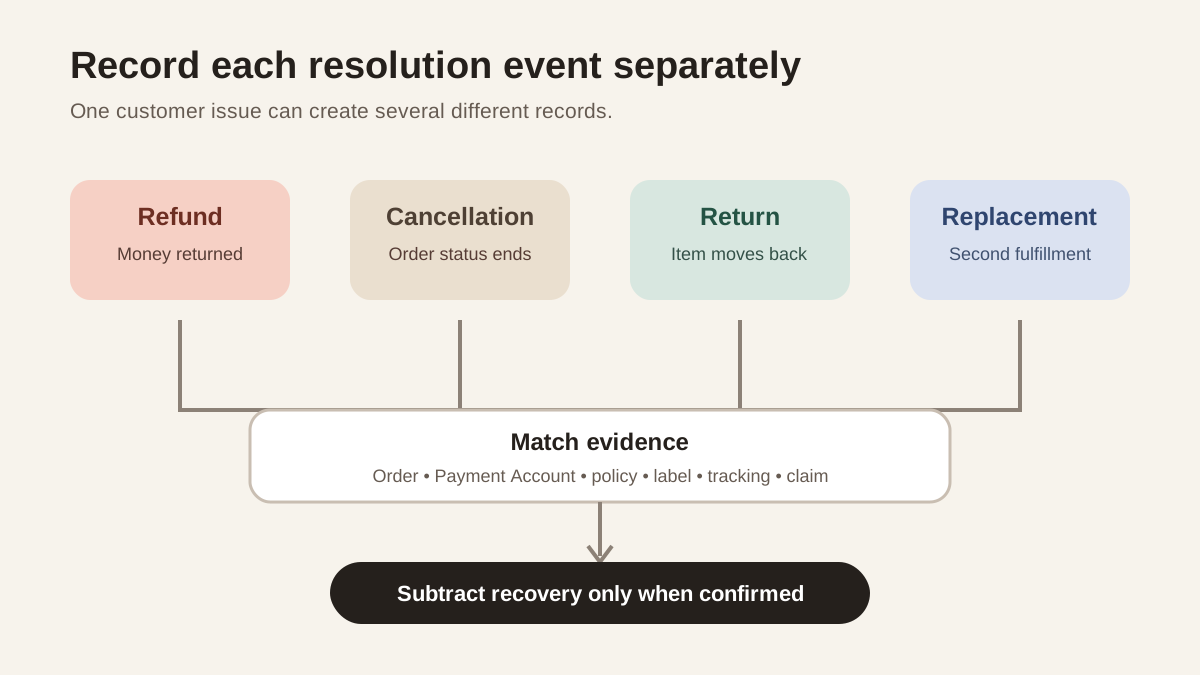
What is the difference between a refund, cancellation, return, and replacement?
A refund returns all or part of a payment. A cancellation ends the transaction in Etsy's system and is a separate action from issuing the refund. Etsy's current seller help says an eligible Shop Manager refund credits applicable transaction and payment-processing fees to the Payment Account; canceling can also credit the listing fee. The order record and Payment Account remain the authority for what happened in a specific case.
A return is the physical movement of the item back to the seller. It may occur before or after a refund, and the parties need to agree on the return method and shipping responsibility under the shop policy, the order context, and applicable law. A replacement sends another item. It may settle a problem without a full refund, accompany a partial refund, or follow a damaged shipment. Track the second unit and shipment even if the platform ledger contains only the original sale.
An exchange may combine a return with a replacement or new transaction. Cases, charge disputes, and Purchase Protection have separate evidence and eligibility rules. Record Etsy-funded recovery only when account or case evidence confirms it.
Which fields belong in an Etsy refund-loss calculation?
Create one incident row for each affected order, then preserve the SKU and variation so patterns can be grouped later. Keep the refunded amount separate from platform credits. Keep original fulfillment separate from resolution costs. Keep potential recovery separate from confirmed recovery. This structure prevents a promised carrier claim or expected resale from hiding a loss before the money or value is available.
For labor, use an explicit hourly assumption and consistent time bands for production, restocking, support, photo review, proofing, and coordination.
For returned inventory, record condition and realistic recovery value. The original retail price is rarely a safe recovery assumption. A sealed standard item may recover much of its product value; a personalized, damaged, seasonal, hygiene-sensitive, or incomplete item may recover little. Do not subtract resale value until the item is inspected or the recovery assumption is clearly marked as a scenario.
| Field | Typical source | Treatment |
|---|---|---|
| Refunded amount | Order and Payment Account | Revenue reversal; use the actual amount |
| Eligible fee credit | Payment Account activity | Subtract only the credit shown |
| Original product and packaging | Private SKU cost library | Include the portion not recovered |
| Original outbound shipping | Label or carrier record | Include seller-borne amount not recovered |
| Return shipping and restock | Agreement, label and labor record | Include the seller-borne resolution cost |
| Replacement unit and shipment | Private cost and label records | Add the complete second-fulfillment cost |
| Support and handling labor | Minutes multiplied by an hourly assumption | Add repeated, material resolution work |
| Carrier, insurance or protection payment | Closed claim or account evidence | Subtract only confirmed recovery |
| Resale or salvage value | Inspection and later disposition | Subtract realistic recovered value |
| Taxes and accounting treatment | Official record and professional advice | Keep outside a generic operating formula |
What formula estimates seller-attributable refund loss?
Use an editable operating formula: incident loss equals refunded revenue plus unrecovered original fulfillment plus seller-borne return and resolution cost plus replacement fulfillment plus support labor, minus documented platform credits, carrier or protection recoveries, and recovered inventory value. Keep each term visible. A single refund percentage cannot explain whether the item returned, whether it can be resold, or whether a second shipment was required.
Avoid double counting. If a private product-cost figure already includes production labor, do not add that labor again. If a replacement-cost figure includes packaging and label cost, do not repeat those rows. If Payment Account Net already reflects a fee credit, reconcile the account using its field definitions before adding a separate credit. The model should reproduce evidence, not force a preferred result.
This is not an official Etsy formula. Use one currency and a stated date boundary when a refund, cancellation, replacement, and recovery occur in different weeks.
- Incident loss = refunded revenue + unrecovered original cost + seller-borne resolution cost + replacement cost + support labor − confirmed credits − confirmed recoveries − recovered inventory value.
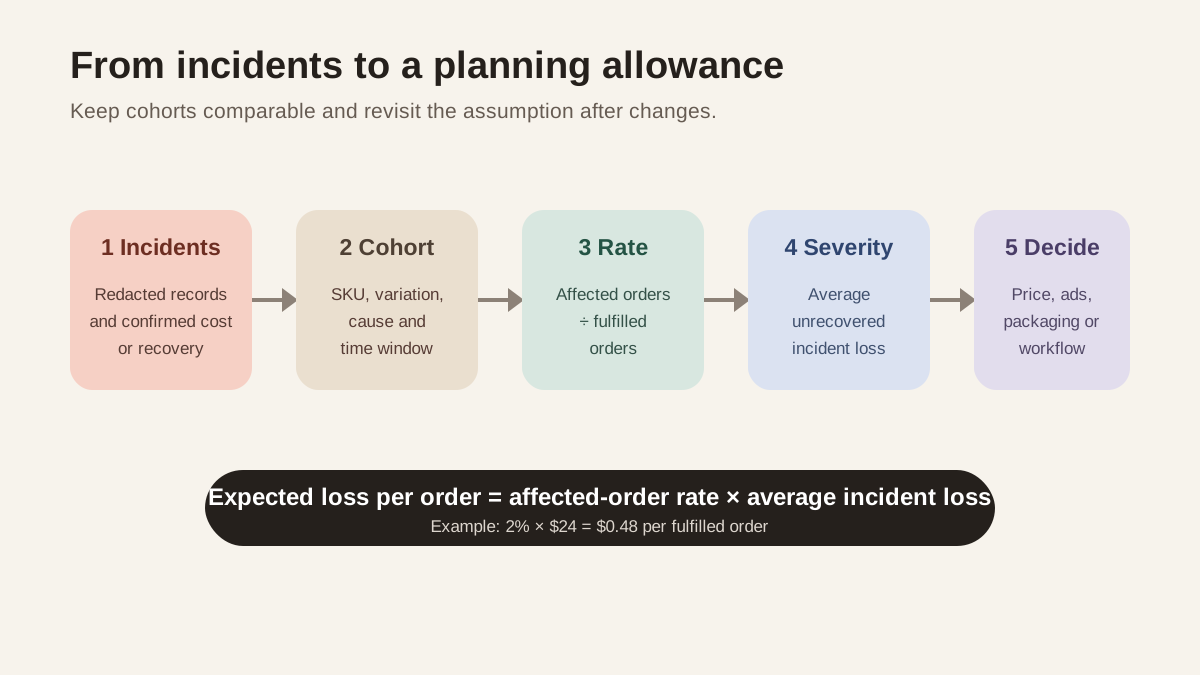
- Expected refund loss per order = affected-order rate × average incident loss for the relevant SKU or cohort.
- Contribution after expected loss = order revenue − normal order costs − expected refund loss − acquisition cost.
How do full, partial, and replacement outcomes compare?
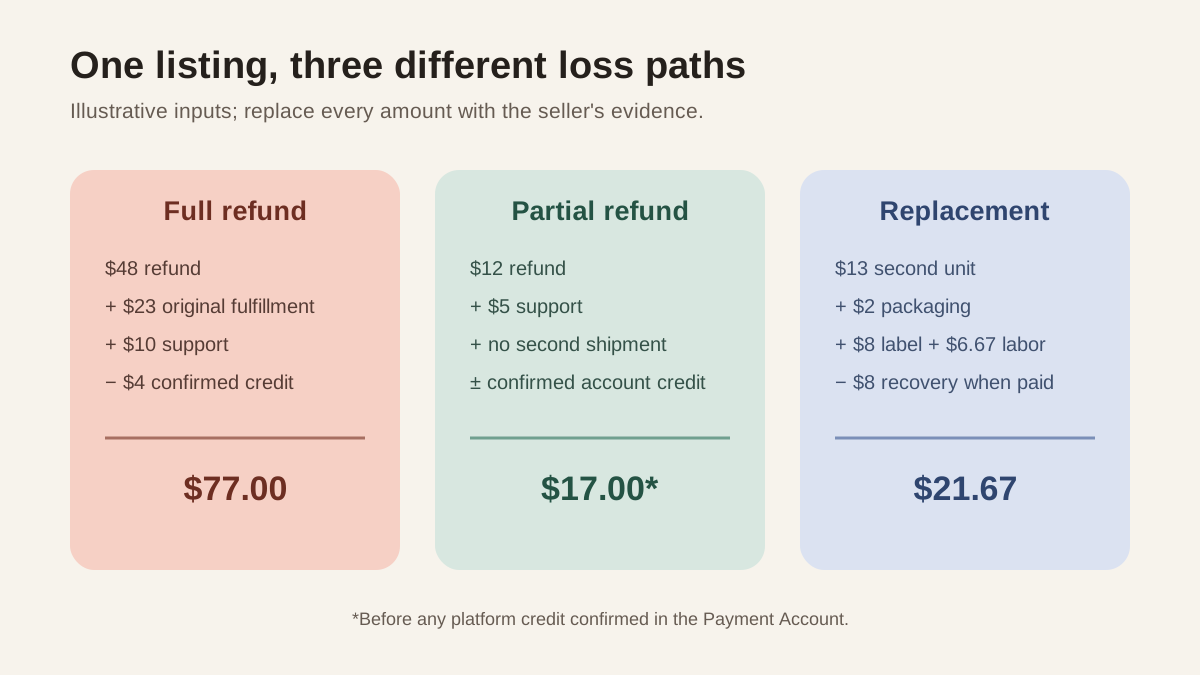
Consider a $48 item with $13 of product and production cost, $2 of packaging, and an $8 outbound label. In a full-refund scenario, the seller refunds $48 and the personalized item cannot be resold. If $4 of eligible platform credits is shown, the direct incident loss is $67 before support: $48 refunded, plus $23 of original fulfillment, minus the $4 confirmed credit. Add thirty minutes of support at a $20 hourly assumption and the operating estimate becomes $77.
For a partial refund, suppose the buyer keeps the same item and receives $12. The seller spends fifteen minutes resolving the issue and no additional shipping occurs. At the same hourly assumption, the estimate is $17: the $12 refund plus $5 of support labor, adjusted by any fee credit actually visible in the account. The original unit cost belongs to normal fulfillment and should not automatically be counted again when the buyer keeps the delivered item.
For a replacement, suppose no buyer refund occurs, but the seller produces another $13 unit, uses $2 of packaging, pays a second $8 label, and spends twenty minutes at $20 per hour. The resolution costs about $29.67 before a carrier recovery. If a closed carrier claim later pays $8, documented loss falls to $21.67. Until payment is confirmed, keep the $8 as pending rather than subtracting it.
Replace every illustrative amount with the seller's actual costs and account evidence.
How do you calculate expected refund loss per order?
Historical incidents can become a planning allowance. For a defined SKU and time window, divide affected orders by fulfilled orders, then multiply that affected-order rate by average incident loss. If 4 of 200 fulfilled orders created an average $24 of unrecovered loss, the observed rate is 2% and expected loss is $0.48 per fulfilled order. Add that allowance to margin planning before deciding a discount, ad bid, or free-shipping offer.
Do not pool unlike products too early. A fragile glass variation, an engraved product, and a standard printable may have different failure modes and recovery values. Use enough volume to avoid reacting to one unusual case, but preserve the SKU, variation, destination band, fulfillment method, and cause so concentrated risk remains visible.
Treat the result as a monitored assumption. Compare recent and longer windows, document interventions, and check whether the incident cause changes.
| Step | Example | Result |
|---|---|---|
| Fulfilled orders | 200 orders for one SKU cohort | Denominator = 200 |
| Affected orders | 4 refund or replacement incidents | Observed rate = 2% |
| Average unrecovered incident loss | $24 across the four incidents | Severity = $24 |
| Expected loss per fulfilled order | 2% × $24 | $0.48 planning allowance |
| Decision | Add $0.48 before ad and target contribution | Compare price, packaging and traffic options |
Which Etsy SKUs deserve a separate refund-risk cohort?
Prioritize products where incident severity or frequency can vary materially: fragile items, personalized or made-to-order goods, size-dependent products, international shipments, high-label-cost packages, seasonal items, and products with low resale value. Separate a variation when its weight, dimensions, material, production time, packaging, destination mix, or returnability changes the loss model.
Use consistent operational causes such as transit damage, fit expectation, personalization approval, wrong item, late arrival, listing representation, delivery issue, or production error. Do not copy private buyer messages into analytics or public support requests.
Use the pattern to choose a control. Transit damage may justify packaging tests or a carrier-claim workflow. Fit problems may justify clearer measurements and photos. Personalization mistakes may justify a proof log. A high-severity, low-frequency event may need a reserve; a high-frequency preventable event may justify pausing ads until the listing or fulfillment process changes.
Related resources
- Check variation and SKU risk: Find missing SKU and cost-record boundaries before grouping incidents.
- Use a local proof log: Track personalized-order approvals without publishing buyer records.
- Review shipping margin: Separate buyer-paid, seller-funded, and replacement shipping.
What weekly refund review keeps buyer data private?
Once a week, reconcile refund and credit activity to the original order, then add only the private cost fields needed for the operating estimate. Use a redacted local incident identifier, SKU, variation, dates, currency, resolution type, cost components, and recovery status. A buyer name, address, private message, payment credential, marketplace password, and raw public order export are not required for the calculation.
Keep source exports read-only and analyze them locally. For mapping help, share column names and a made-up example, not the buyer row. Supported Seller Profit Guard file analysis runs in the browser; voluntary forms and analytics remain separate from raw order files.
Close the review with three queues: unresolved account or case records, pending carrier or protection recovery, and SKU changes. Do not mark a claim as recovered until paid. Do not change a shop policy solely from one incident. Record why a packaging, price, photo, proofing, or traffic decision was made so the next review can test whether it worked.
- Match the refund to the order and Payment Account activity without exporting buyer details into the work log.
- Classify refund, cancellation, return, replacement, case, and recovery as separate events.
- Add original, resolution, replacement, and labor costs without double counting.
- Subtract only credits, payments, and inventory recovery supported by current evidence.
- Group incidents by SKU, variation and cause; calculate rate, severity and expected loss.
- Assign an owner and date for account follow-up, carrier recovery, or listing and fulfillment changes.
Related resources
- Review CSV data privacy: Keep buyer and order details out of support, screenshots, and AI prompts.
- Reconcile Payment Account activity: Separate platform rows from private operating costs.
- Read the calculation methodology: Understand the contribution boundary and evidence rules.
When should a seller escalate instead of estimating?
Use Etsy's authenticated support path when the order, refund, cancellation, case, protection decision, reserve, deposit, or account credit does not match the current official record. Use the carrier or insurer's process for shipment damage, loss, or a claim. Preserve redacted dates, identifiers, amounts, tracking, and evidence, but do not publish buyer information in a forum or prompt.
Use qualified local advice for consumer-law obligations, tax, bookkeeping, revenue recognition, charge disputes, and policy wording. Etsy's help pages describe platform processes; they do not replace jurisdiction-specific duties or professional advice. This guide is an educational operating model and cannot determine legal responsibility or accounting treatment.
Etsy refund profit FAQ
Does issuing a refund automatically cancel the Etsy order? No. Etsy treats refunding and canceling as separate actions. Follow the current official cancellation workflow and confirm the order status.
Are Etsy fees always refunded to the seller? Do not assume that. Etsy describes eligible credits for refunds issued through Shop Manager and additional cancellation treatment, but timing, method, and the actual Payment Account record matter.
Should product cost be counted after every partial refund? Not automatically. If the buyer keeps the fulfilled item, product cost remains part of normal order economics. Add it again only when the incident creates another unit loss or the model clearly compares total order contribution.
How should a replacement be recorded? Keep the original sale and its normal costs, then add the second unit, packaging, labor, label, support, and any confirmed recovery as a separate resolution layer.
Can expected refund loss be used for pricing? Yes, as an editable planning allowance based on a relevant SKU cohort. Recalculate it after material listing, packaging, carrier, or fulfillment changes.
Does this calculator replace Etsy records, bookkeeping, tax, or legal advice? No. Reconcile platform behavior to current Etsy records and use qualified advice for accounting, tax, policy, and legal decisions.
How do you use the refund-loss calculator?
Open Return Window Loss and enter the product cohort's observed return or refund rate, direct cost, shipping, handling, and recovery assumptions. Use the worked incidents above to avoid a shop-wide guess. Then compare expected loss per order with current contribution and the price or acquisition decision under review.
Use Payment Reconciliation when the question is what Etsy credited or deducted. Use Profit Guard when the question is whether the SKU covers private product, labor, packaging, shipping, advertising, and target contribution. The three tools answer related but distinct questions.
Related resources
- Estimate return-window loss: Model affected-order rate, severity, shipping, handling, and recovery assumptions.
- Reconcile platform activity: Confirm the refund and fee-credit side of the Payment Account.
- Check SKU-level contribution: Test the price after private cost and expected-loss assumptions.
Sources and further reading
- Etsy Help: Issue a Full or Partial Refund: Official refund flow, eligibility window, funding source, fee-credit and cancellation distinction.
- Etsy Help: Refunds, Returns, and Exchanges for Sellers: Official policy, return agreement, replacement, Purchase Protection and regional-law context.
- Etsy Help: How to Cancel a Sale: Official cancellation workflow, processing, credits and return-shipping coordination.
- Etsy Help: Manage Your Payment Account: Official refunds, credits, fees, shipping, account activity and statement context.
- Etsy Help: Fees and Taxes for Selling: Official fee categories and Payment Account deduction context.
Related Seller Profit Guard tools
- Return Window Loss calculator: Estimate expected loss from an affected-order rate and recovery assumptions.
- Payment reconciliation tool: Match refund, credit, fee, and deposit records locally.
- Etsy CSV profit calculator: Review SKU contribution after private costs and expected loss.
- Payment Account reconciliation guide: Separate orders, account activity, deposits, and private costs.
- Shipping margin guide: Identify who funded original, free, return, and replacement shipping.
- CSV data privacy: Keep buyer data out of public and support artifacts.
- Return Loss Formula: 10 Inputs Explained: Calculate expected return loss per order from ten scoped inputs, distinguish refund cash from retained cost, and derive a target-safe return rate.
- Return Loss Example: Resellable Item: Follow a complete resellable-return example from contribution and recovery through expected loss, adjusted margin, and a target-safe return rate.
- Return Loss for an Unsellable Item: Model an unsellable return with zero product recovery, higher handling, and seller-funded shipping without reusing a resellable-item average.
- Etsy Refund Fee Reconciliation Formula: Reconcile original revenue, buyer refund, cancellation, four fee-credit rows, retained costs, inventory recovery, and final contribution.
- Full Etsy Refund Fee Worked Example: Trace a synthetic USD 88 full refund through fee credits, cancellation, retained costs, inventory recovery, and contribution impact.
- Partial Etsy Refund Fee Scenario: Model a USD 40 item-only partial refund with proportional fee credits, no cancellation, retained revenue, and final contribution.
- Refund vs Replacement Formula and Inputs: Define original contribution, refund cash, return costs, fee credits, recoveries, replacement costs, targets, and decision precedence.
- Refund vs Replacement Worked Example: Reconstruct a low-cost order through original contribution, full refund loss, replacement loss, remaining contribution, and target headroom.
- Refund vs Replacement With High Shipping: Stress a high-shipping replacement, preserve the refund baseline, explain target Review, and separate cost from remedy authority.
- Damaged Order Loss Formula and Inputs: Define original contribution, one frozen damage remedy, shared recovery, insured claim recovery, uninsured recovery, and target headroom.
- Insured Damaged Order Worked Example: Work a complete insured damage case from original contribution through remedy cost, verified recovery, recognized claim proceeds, and target headroom.
- Uninsured and Denied Damage Scenario: Model an uninsured or denied-claim damage case without inventing carrier recovery, then compare response loss, remaining contribution, and target risk.
- Restocking Decision Formula and Inputs: Define condition grade, markdown, resale probability, fees, shipping subsidy, labor, supplies, storage, failure recovery, alternative, and target.
- Like-New Restocking Worked Example: Work a complete like-new return from a comparable price and markdown through resale probability, fees, process cost, alternative recovery, and target.
- Damaged Return Restocking Scenario: Model a damaged or lower-grade return with deeper markdown, lower resale probability, longer processing, and a verified alternative recovery.
- Exchange Order Loss Formula and Inputs: Define original contribution, exchange response cost, verified recovery, remaining contribution, evidence states, decision target, and authority boundaries.
- Size Exchange Loss Worked Example: Work a size-exchange example from original contribution through second fulfillment, inventory recovery, remaining contribution, and target headroom.
- Product Exchange Cost Scenario: Model a higher-cost product exchange with a different SKU, parcel, handling load, fee debit, verified customer payment, recovery, and target outcome.
Next step: Estimate return loss.
This is operational planning help, not tax, accounting, legal, financial, or platform-policy advice. Review the Terms and disclaimer, and verify current platform rules and fee assumptions before changing prices.