A weekly operating routine for the Variant Risk Checker
Last updated: 2026-07-30
Written and reviewed by Seller Profit Guard Editorial Team.
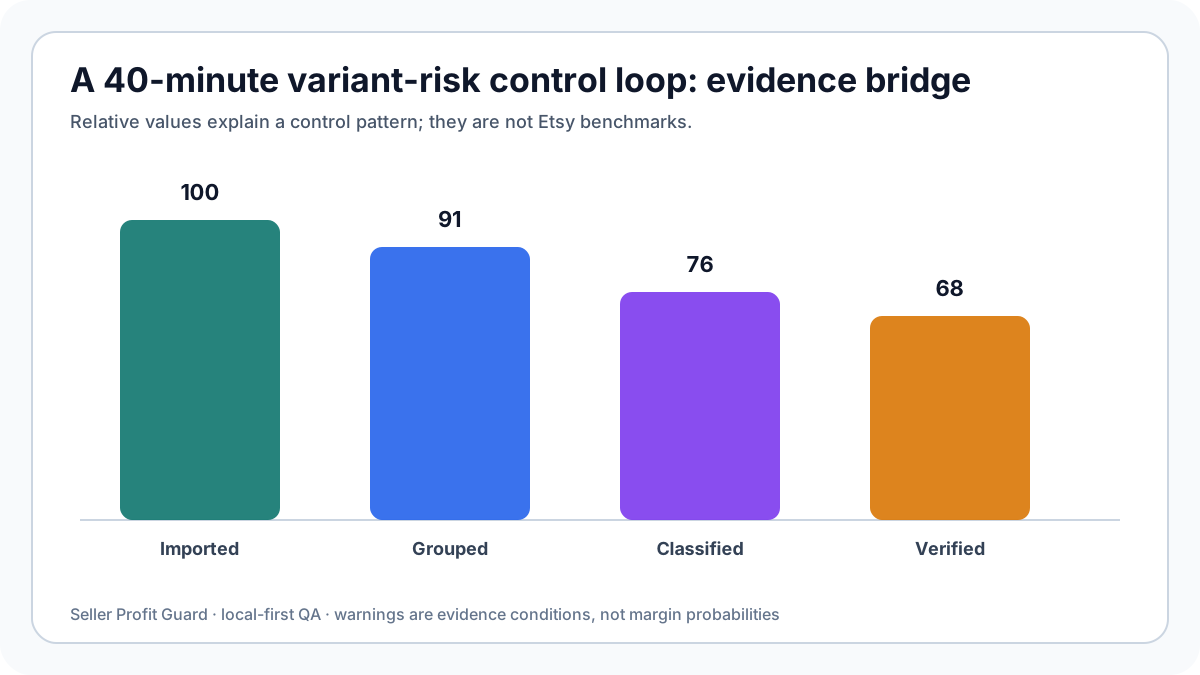
A 40-minute weekly variant-risk routine preserves the prior evidence, validates the latest order-item mapping, runs known-good and known-bad fixtures, reviews new and recurring identity or cost-coverage warnings, assigns upstream actions, and reruns corrected cases. Time-box triage, not unresolved evidence, and retain every open finding with an owner and date.

What happens during the first ten minutes?
Preserve the prior report, source fingerprint, mapping, threshold, cost-library fingerprint, and open-issue register. Export or select a bounded current order-item period, record its scope, and confirm that private columns are removed. Compare source rows, usable rows, required headers, unique SKUs, and grouped combinations with the prior run.
Run a clean fixture and five negative fixtures before reviewing real warnings. The expected failures are blank SKU, blank variation, one SKU under multiple variation strings, one item-and-variation under multiple SKUs, and an uncovered SKU exactly at the quantity threshold. Stop if a fixture fails to trigger or the clean control gains a warning.
Do not bulk-edit source data while the import or validator is uncertain. Preserve the failure and repair the control first.
| Minute | Work | Exit condition |
|---|---|---|
| 0–5 | Preserve scope and fingerprints | Rollback available |
| 5–10 | Validate mapping and fixtures | Controls behave |
| 10–22 | Triage new warnings | Root issues classified |
| 22–32 | Verify listing and costs | Actions assigned |
| 32–40 | Rerun and log | Evidence updated |
How should warnings become an owned work queue?
Group report rows into root issues. One reused SKU can affect several displayed groups. Record issue ID, warning direction, affected item and normalized identities, quantity and row scope, first and latest observation, evidence references, classification, owner, action, due date, reviewer, and status. Keep private rows outside the shared summary.
Classify each issue as mapping defect, source limitation, valid single-option blank, label rename, SKU replacement, active collision, missing cost, provisional cost, or tool defect. The classification must explain why the expected warning should remain, change, or clear after action.
Prioritize structural identity ambiguity before cost measurement and high-impact coverage before low-impact cleanup. Never close an issue because the current period had no sales; verify current listing and historical treatment.

What counts as a verified correction?
A correction changes the authoritative listing, SKU policy, export mapping, cost record, or code control. Preserve before-and-after evidence and a rollback path. Rerun the smallest fixture that proves the intended warning change, then a representative bounded export that checks adjacent groups for regression.
Expected changes must be specific. Adding a stable SKU clears the missing-SKU warning; it must not erase variation history. Adding a matching cost record clears the coverage warning; it must not change relationship warnings. Canonicalizing a label can change one-SKU-to-many-variants only after historical aliases remain explainable.
If the same defect recurs, update the upstream policy, import validation, unit dictionary, listing template, or training step. Repeated manual patches are feedback that the control loop is not closing.
Which routine metrics are useful?
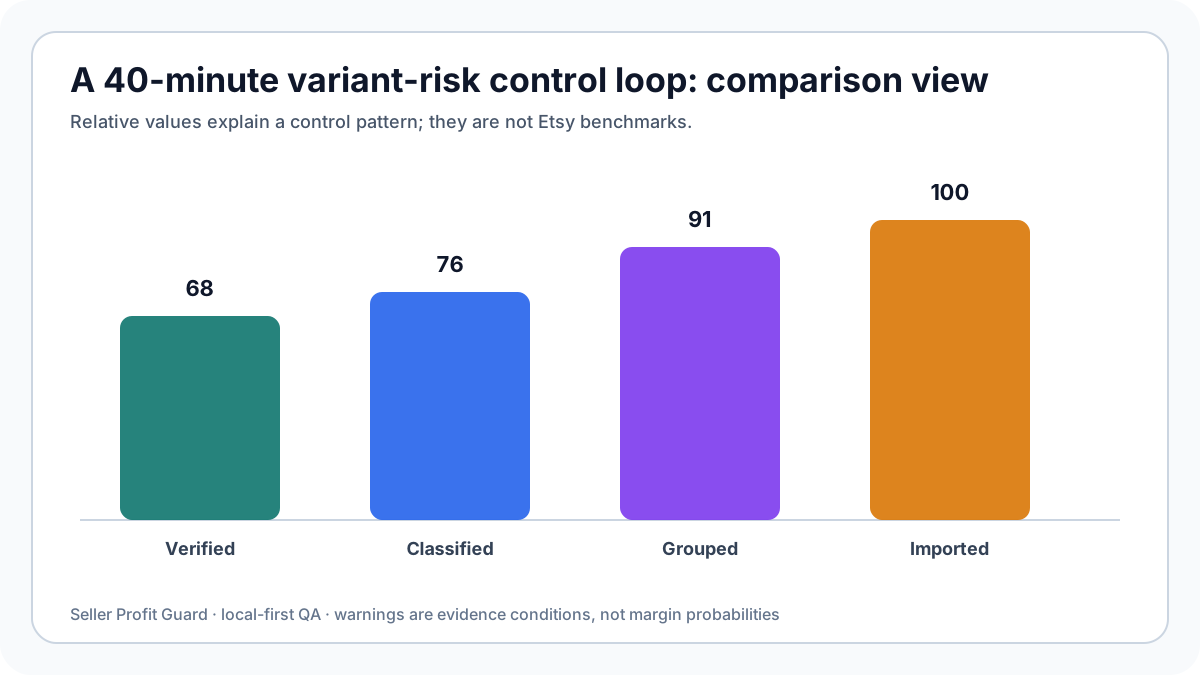
Track source rows, grouped combinations, warning rows, root issues, new issues, recurring issues, high-volume uncovered SKUs, time to classification, time to evidence, verified closures, reopened issues, and fixture failures. Interpret changes only when scope, mapping, threshold, and control version are comparable.
A falling warning count can reflect lower sales, a raised threshold, missing variation column, or weakened validator. A rising count can reflect broader coverage or a newly detected historical problem. Explain the driver beside the metric and avoid claiming margin improvement without separate financial evidence.
- Compare stable scope.
- Separate warning rows from root issues.
- Track recurrence and reopenings.
- Protect fixture sensitivity.
- Link every closure to rerun evidence.
Weekly routine questions
Must every listing be reviewed weekly? No. Review new, changed, recurring, and high-impact evidence with scheduled broader sampling.
What if forty minutes expires? Preserve open issues; never convert unknown to zero.
Should historical warnings be deleted? No. Classify them under the relevant period.
Can the fix list be imported into Etsy? No. Verify and change authoritative records deliberately.
What triggers immediate review? Mapping drift, reused identity, major listing change, bulk import, or cost-library coverage loss.
Which evidence supports this weekly variant-risk routine?
Use the Etsy order-item or sold-transaction export for observed item title, seller-added SKU, selected variation text, quantity, and transaction frequency. Use the active-listing export or Shop Manager for current listing, option, price, quantity, and SKU setup. Use the seller's private cost library for material, labor, packaging, fulfillment, and other cost coverage. These sources answer different questions and should not be silently merged into one truth table.
Preserve the export date, covered period, row count, detected headers, mapping version, normalization rule, cost-library fingerprint, and checker version. Verify at least one harmless dummy row from source fields through the exported fix list. A checksum can show that a file did not change; it cannot prove that the seller mapped the SKU, variation, quantity, or item columns correctly.
Classify findings by evidence: an empty SKU is observed in the selected export; one normalized SKU mapping to several normalized variation strings is a deterministic consistency warning; a high-volume SKU without a cost record is a coverage warning under the chosen quantity threshold. None of those findings alone proves accounting loss, listing-policy violation, inventory shortage, or buyer harm.
- Keep listing identity, sold-order observations, and private cost evidence separate.
- Record the period, mapping, normalization, threshold, and library fingerprint.
- Use seller-defined SKUs as identifiers, not universal marketplace product codes.
- Confirm findings in the current listing and relevant historical records before changing data.
- Treat tax, accounting, legal, and marketplace-policy questions as separate professional or official-source work.
Privacy and commercial sensitivity for weekly variant-risk routine
The checker needs item, SKU, variation, quantity, and mapping context. Buyer names, email addresses, phone numbers, delivery addresses, private messages, personalization text, and payment credentials are unnecessary. Seller Profit Guard removes recognized private columns during parsing and performs the analysis in the browser, but the operator must still inspect unknown headers and avoid sharing raw exports.
Cost-library values, supplier terms, sell-through, variation mix, and exception lists can reveal commercial strategy even when buyer data is absent. Keep raw CSVs and detailed fix lists in controlled storage. Public reports should use dummy examples, aggregate counts, redacted identifiers, and non-reversible fingerprints. Never paste a private transaction row into an article, issue, analytics event, or community post.
How to apply this weekly variant-risk routine in the Variant Risk Checker
Open Seller Profit Guard, load a recent Etsy order-item CSV or a public dummy fixture, confirm the detected item, SKU, variation, and quantity columns, and load the matching SKU cost library. The checker groups rows by item, SKU, and variation, normalizes case and spacing for comparison, then reports five bounded warning families: missing SKU, missing variation text, one SKU linked to multiple variation strings, one item-and-variation linked to multiple SKUs, and a high-volume SKU without a matching cost record.
Review the highest-impact warning with its source row and current listing. Correct the upstream listing, SKU policy, export mapping, or cost record; do not merely edit the downloaded fix list. Re-export a bounded period, rerun the same mapping and threshold, and compare the warning with the saved evidence. The tool is operational QA, not an Etsy connection, inventory system, accounting ledger, or guarantee of margin.
- Use a bounded export and confirm the detected mapping.
- Load or create the matching SKU cost assumptions locally.
- Review each warning code and its grouped quantity and order count.
- Verify the current listing and historical identity before making a correction.
- Rerun the same fixture and record the result, owner, date, and rollback.
Sources and further reading
- Etsy Help: How to Use SKU for Your Inventory: Official Etsy guidance on seller-defined SKUs, inventory identification, and practical SKU naming.
- Etsy Help: How to Add Variations for Your Listings: Official listing-variation workflow and controls for option-level price, quantity, processing profile, and SKU.
- Etsy Help: Processing Times, Profiles, and Ship-By Dates: Official definition of physical-item processing time and the current listing- or variation-level processing-profile workflow.
- Etsy Help: Download Sold Transaction Spreadsheets: Official order-item export workflow and confirmation that seller-added SKU numbers can appear in the downloaded data.
- Etsy Help: Download Your Listing Information: Official active-listing export fields, including price, currency, quantity, and seller-added SKU numbers.
- Seller Profit Guard calculation methodology: Definitions for editable assumptions, evidence hierarchy, local-first processing, contribution scope, and uncertainty.
Related Seller Profit Guard tools
- Open the Variant Risk Checker: Check order-item CSV rows for missing SKUs, inconsistent variation mapping, and high-volume SKUs without cost records.
- Use the SKU Cost Library: Create and reuse browser-local material, labor, packaging, fulfillment, and target-margin assumptions.
- Review the Etsy variation SKU checklist: Inspect listing setup before a variation or SKU mapping defect reaches sold-order data.
- Learn what an Etsy SKU is: Build stable seller-defined identifiers for products, variations, inventory, costs, and fulfillment.
- Read local-first CSV privacy: Understand which fields the checker needs and which buyer, address, and contact fields it removes.
- Etsy Variant Risk: 5 Checks Before Margin Review: Continue the variation identity, coverage, and evidence workflow.
- Etsy Size Variation Audit: One SKU, Two Labels: Continue the variation identity, coverage, and evidence workflow.
- Etsy Material Variations: One Label, Two SKUs: Continue the variation identity, coverage, and evidence workflow.
- Etsy Variant Audit: 12 Mistakes That Hide Risk: Continue the variation identity, coverage, and evidence workflow.
- Etsy Variant Audit Data: 6 Sources to Reconcile: Continue the variation identity, coverage, and evidence workflow.
Next step: Open the Variant Risk Checker.
This is operational planning help, not tax, accounting, legal, financial, or platform-policy advice. Review the Terms and disclaimer, and verify current platform rules and fee assumptions before changing prices.