Listing Cost Library mistakes that distort SKU cost
Last updated: 2026-07-28
Written and reviewed by Seller Profit Guard Editorial Team.
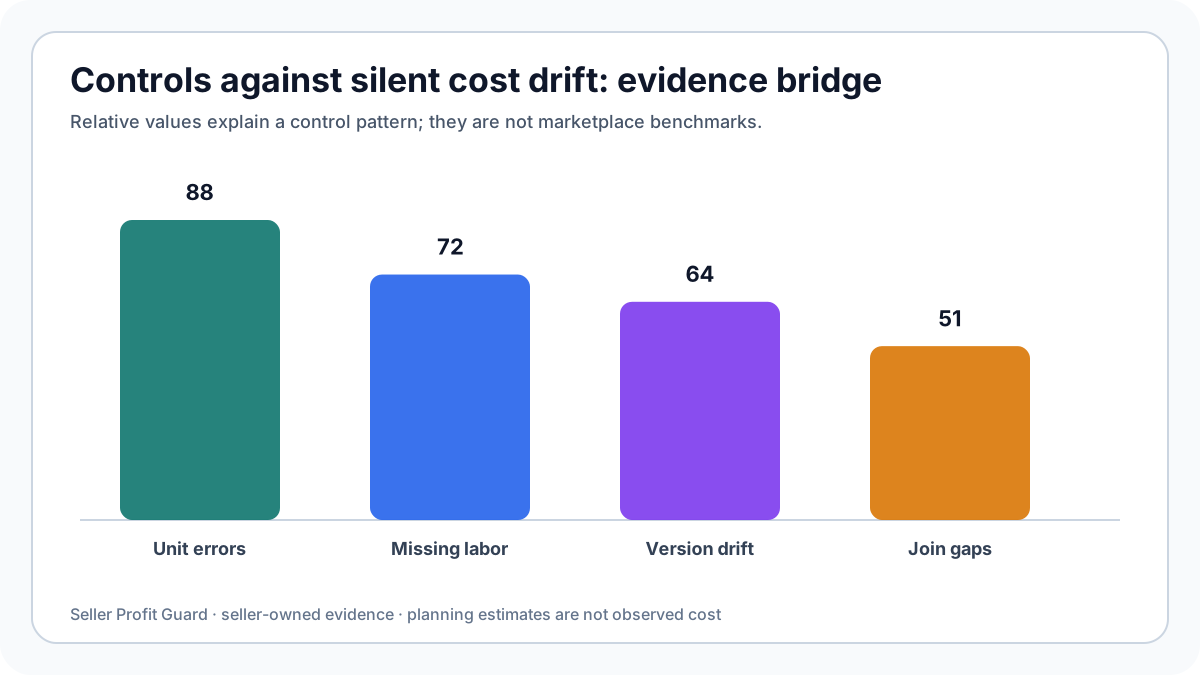
The worst SKU cost-library errors are pack prices stored as unit cost, labor minutes treated as hours, waste counted twice, shipping averaged across unlike orders, overhead hidden inside materials, duplicate SKUs, and old values overwritten. Correct units, evidence, effective dates, and joins before calculating margin.

Why do unit and denominator errors create large distortions?
A $24 pack of sixty components is $0.40 per component, not $24 per SKU. A 12-minute task is 0.2 hours, not 12 hours. A batch cost belongs across good output using a documented yield. Pack, roll, sheet, weight, volume, batch, hour, minute, item, order, and bundle units must be explicit.
Audit unusually high and low values against expected unit ranges without turning those ranges into invented benchmarks. Recalculate the source conversion and compare the library quantity basis with how the downstream order calculator multiplies quantity.
| Mistake | Symptom | Correction |
|---|---|---|
| Pack price as unit | Extreme cost | Divide by usable quantity |
| Minutes as hours | Labor multiplied 60× | Minutes ÷ 60 × rate |
| Waste twice | Inflated material | Choose consumption or yield method |
| Average shipping | Heavy options subsidized | Use route/weight cohorts |
| Duplicate SKU | Nondeterministic join | Resolve and version |
| Overwrite old cost | History changes | Create effective-dated version |
How do missing and duplicate SKUs corrupt joins?
A blank SKU cannot deterministically select a cost record. A duplicate SKU with conflicting values can attach different cost depending on import order. Block both conditions before saving or importing, and report affected rows separately from zero cost.
Use normalization carefully. Trimming whitespace or standardizing case can help, but it can also collapse intentionally distinct identifiers. Show the normalized key, original key, collision count, and proposed resolution before applying a bulk cleanup.

Which scope mistakes hide cost rather than miscalculate it?
Leaving owner labor, packaging, handling, label adjustments, rework, provider fees, or expected replacement loss outside the stated scope can make a mathematically correct total economically incomplete. Conversely, placing marketplace fees or tax into materials can double-count downstream costs.
Publish the scope beside the total. Show included layers, excluded layers, observed versus allocated values, and unknown items. A subtotal named direct production cost should not be labeled total cost.
- Validate units before values.
- Block blank and conflicting SKUs.
- Separate cost layers.
- Preserve effective dates.
- Keep missing values unknown.
- State included and excluded scope.
SKU costing mistake questions
Can negative cost be valid? Use explicit credit or recovery fields rather than a silent negative material cost.
Should refunds change the SKU record? Stable production cost remains; expected unrecovered loss can be a separate dated risk layer.
Can a cost library store sale price? It can for reference, but price is not cost and should not determine source conversion.
What if supplier currency changes? Preserve original currency and conversion evidence or maintain currency-specific versions.
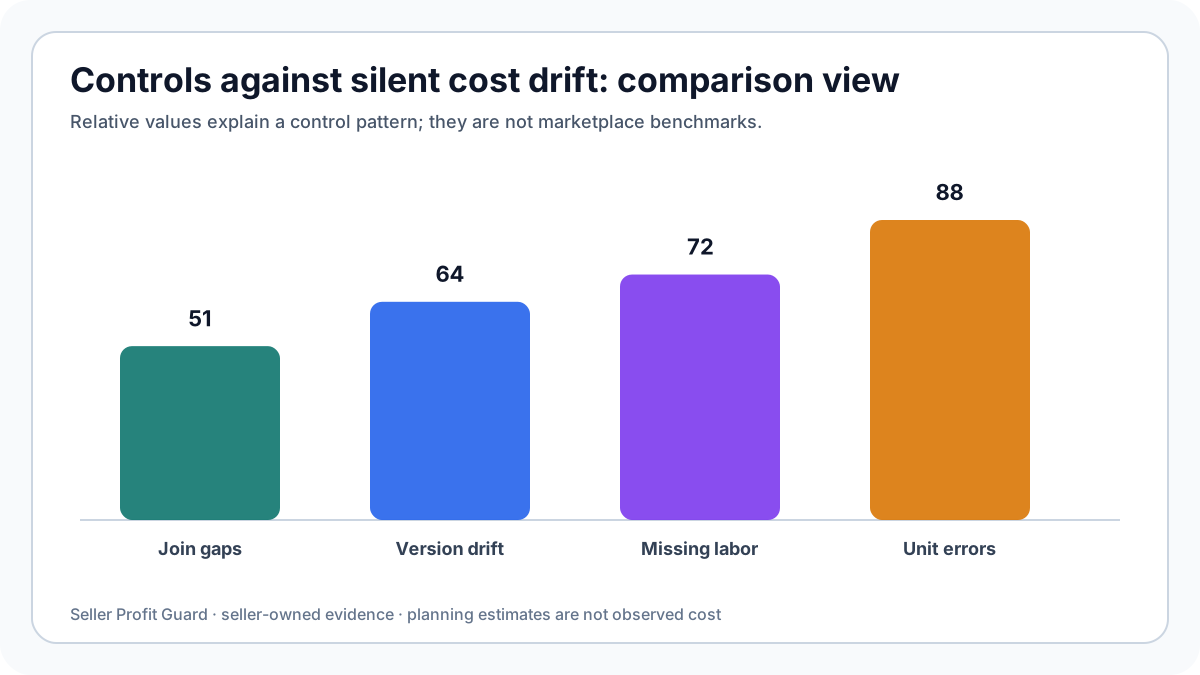
What metric catches errors fastest? Missing/duplicate joins, unit conversion checks, version age, and layer-level outliers together.
How can a library detect silent version drift?
Compare effective intervals, source dates, update timestamps, and downstream selection for a fixed historical dummy order. The selected cost must not change merely because a newer version was added.
Flag overlapping active intervals, gaps, future-dated records used early, and corrections that masquerade as source changes. Preserve the reason and approval for every interval edit.
Build a defect ledger by mechanism rather than by page symptom: identity collision, unit denominator, source staleness, layer omission, double count, version overlap, future version selected early, currency overwrite, and unmatched transaction. For each mechanism, retain one harmless fixture that must trigger the control. A validator that cannot fail a known-bad fixture is not protecting the library.
Estimate exposure without pretending the estimate is realized loss. Count affected active SKUs, transaction joins, cost amount, and decision dependency, then rank defects by reversibility and evidence gap. Repair ambiguous identity before repricing because a perfect formula attached to the wrong variation produces confident misinformation.
Which evidence supports this SKU cost error audit?
A reusable cost record needs seller-owned evidence. Material and purchased-component costs come from invoices, bills of materials, measured usage, scrap, and yield. Labor comes from timed tasks and an explicit loaded hourly rate. Packaging comes from component quantities and purchase cost. Fulfillment comes from label receipts, carrier adjustments, outsourced fulfillment bills, handling, insurance, and documented subsidies. Etsy exports can carry seller-added SKUs and transaction context, but they do not supply the seller's private production economics.
Record source type, supplier or internal process, currency, quantity basis, unit conversion, effective date, operator, and evidence location without copying private invoices into public reports. A checksum or file identifier can protect lineage, but it does not prove the unit basis is correct. Recalculate pack, sheet, roll, batch, hour, minute, weight, and quantity conversions with a public dummy example before importing a large cost library.
Keep observed, allocated, and estimated values distinguishable. A current invoice is observed evidence; a monthly subscription divided by forecast orders is an allocation; expected scrap, return loss, or future shipping is an estimate. Store the formula and review trigger with every non-observed amount. Unknown remains unknown until measured; zero requires evidence that the cost is genuinely absent.
- Use one stable SKU for every cost-distinct sellable variation.
- Store currency, unit, quantity basis, source, and effective date.
- Separate materials, labor, packaging, fulfillment, overhead allocation, and risk.
- Retain prior versions so historical sales can use the cost effective at the time.
- Escalate tax, accounting, legal, employment, and platform-policy questions to the appropriate professional or official source.
Privacy and commercial sensitivity for SKU cost error audit
A cost library does not need buyer names, delivery addresses, private messages, payment credentials, marketplace passwords, or raw order history. It may contain supplier pricing, labor rates, production time, margins, sourcing notes, and fulfillment terms that are commercially sensitive. Keep the working library in controlled seller storage and use redacted identifiers or public dummy values for documentation and support.
Seller Profit Guard stores the free browser workflow locally by design. A downloaded cost library or profit report is still a private business record. Do not paste real supplier invoices, buyer data, order rows, or SKU economics into public communities, email drafts, or AI prompts. Share the column map, formula, units, and a made-up reproduction case when troubleshooting.
- Do not publish raw supplier, buyer, address, or order data.
- Use controlled identifiers rather than invoice images in reports.
- Separate public calculation examples from private operating records.
- Back up the cost library before bulk edits or imports.
- Treat exported cost and margin files as confidential.
How to apply this SKU cost error audit in the SKU Cost Library
Open the SKU Cost Library and add one representative SKU manually before importing a file. Confirm material, packaging, labor minutes, labor rate, shipping, transaction extra, other cost, target margin, notes, currency, source date, and unit basis. Save locally, reload, and export the record. Then import the public template or a controlled working copy and review missing, duplicate, invalid, and suspicious values before accepting the batch.
Use the saved library in Profit Guard with a representative order export or the public dummy sample. Inspect missing-cost warnings and variation joins before interpreting contribution. Run a base case and a page-specific stress case, then record the cost version, result, seller decision, owner, and next review date. A reusable record is valuable only when its units, source, effective date, and SKU join remain traceable.
- Preserve the source evidence and current library backup.
- Validate the SKU, currency, units, quantity basis, and effective date.
- Calculate each cost layer independently before summing.
- Import and resolve duplicate, missing, or invalid rows.
- Test one handmade and one variation-sensitive scenario.
- Record the version, decision, rollback, and next review.
Related resources
- Open the SKU Cost Library: Create, import, validate, and reuse browser-local SKU cost assumptions.
- Calculate SKU-level Etsy profit: Apply material, labor, packaging, shipping, and fee records to sold SKUs.
- Review Etsy variation SKU risk: Find blank, duplicated, inconsistent, or cost-distinct variation SKUs.
- Read the Etsy SKU naming guide: Design stable identifiers for listings, variations, inventory, and historical joins.
- Review local-first CSV privacy: Keep buyer, address, order, supplier, and private margin data out of public artifacts.
Sources and further reading
- Etsy Help: How to Use SKU for Your Inventory: Official Etsy guidance on adding SKUs and using seller-defined identifiers to track inventory.
- Etsy Help: How to Add Variations for Your Listings: Official variation workflow, including variation-level price, quantity, processing profile, and SKU controls.
- Etsy Help: Download Sold Transaction Spreadsheets: Official sold-transaction export workflow; order data can include seller-added SKU numbers.
- Etsy Help: How to Calculate Shipping Costs: Official shipping-cost estimator context; final label cost can differ from a planning estimate.
- Seller Profit Guard calculation methodology: Cost-layer definitions, editable assumptions, evidence hierarchy, contribution scope, and local-first privacy boundary.
Related Seller Profit Guard tools
- Open the SKU Cost Library: Create, import, validate, and reuse browser-local SKU cost assumptions.
- Calculate SKU-level Etsy profit: Apply material, labor, packaging, shipping, and fee records to sold SKUs.
- Review Etsy variation SKU risk: Find blank, duplicated, inconsistent, or cost-distinct variation SKUs.
- Read the Etsy SKU naming guide: Design stable identifiers for listings, variations, inventory, and historical joins.
- Review local-first CSV privacy: Keep buyer, address, order, supplier, and private margin data out of public artifacts.
- SKU Cost Formula: 8 Inputs Etsy Sellers Need: Continue the SKU evidence, version, and decision workflow.
- Etsy SKU Cost Example: A $18.35 Handmade Item: Continue the SKU evidence, version, and decision workflow.
- Etsy Variation Costs: Stop Averaging Every Option: Continue the SKU evidence, version, and decision workflow.
- SKU Cost Data Sources: Invoice to Time Study: Continue the SKU evidence, version, and decision workflow.
- SKU Cost Confidence: When a Record Is Ready: Continue the SKU evidence, version, and decision workflow.
Next step: Open the SKU Cost Library.
This is operational planning help, not tax, accounting, legal, financial, or platform-policy advice. Review the Terms and disclaimer, and verify current platform rules and fee assumptions before changing prices.