Where Etsy personalization instructions get reliable evidence
Last updated: 2026-07-30
Written and reviewed by Seller Profit Guard Editorial Team.
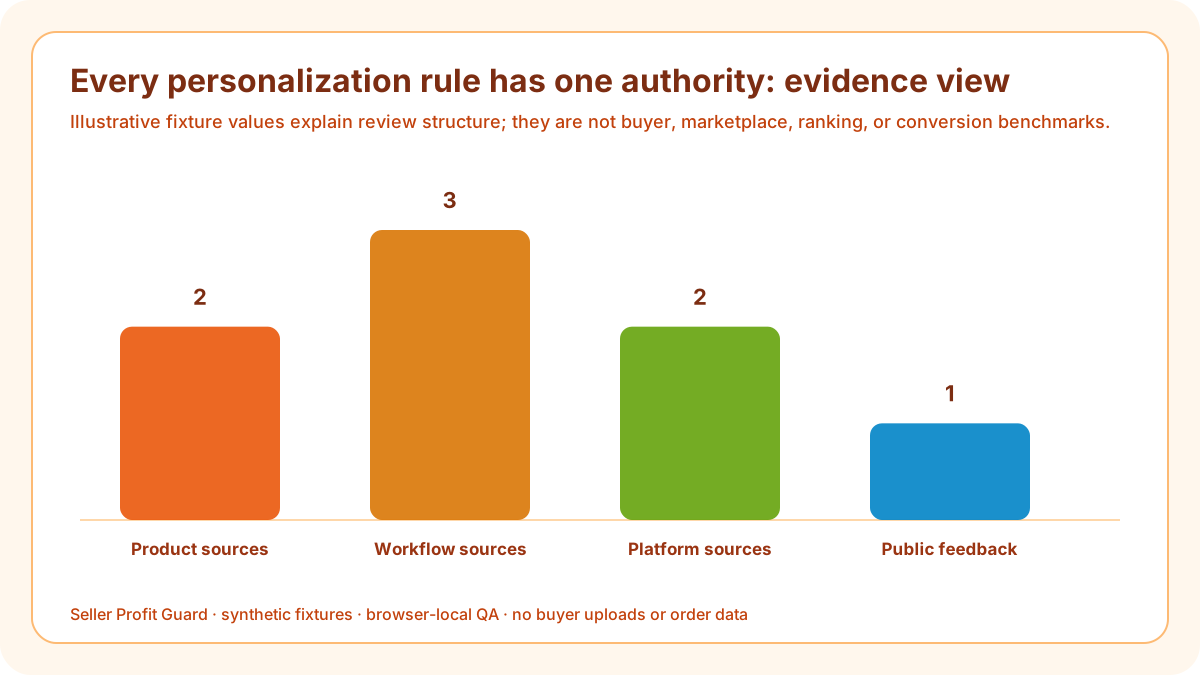
Use the product specification for customizable scope, production templates for formats and limits, approved samples for examples, current custom fields for buyer inputs, written proof and exception procedures, processing profiles for timing, Etsy Help and policy pages for platform boundaries, and the published buyer and seller order paths for release feedback.

evidence hierarchy: scope and decision
The public prompt is an interface, not the sole authority for a made-to-order product. Each customizable surface, accepted input, limit, example, price behavior, proof step, exception, and processing promise should point to the source that owns it.
Use current official pages for platform behavior, the seller product and production records for controlled truth, the editor for configuration, and the public buyer and seller order views for release feedback. Keep these evidence classes separately dated.
Build the personalization source map before analysis
When sources conflict, identify the owner and stop release. A production template supporting 16 characters does not become a 25-character capability because the listing field accepts more text; a saved field does not prove the public page shows it.
Record aliases, versions, dates, and decisions without importing buyer submissions. A synthetic value can test format handling; a real portrait, name, order, message, address, receipt, or private file should remain outside the content workspace.
Product specifications own scope
Define the base item, customizable surface, method, placement, included choices, exclusions, and material constraints. Product authority explains what the seller can reliably produce before the listing asks for any buyer detail.
For “Product specifications own scope,” cite the current owner of truth inside the personalization source map; do not infer it from the most recently edited screen. Reconcile current product and field packet and public prompt that contradicts production, retain source dates and versions, and require public feedback before closing a traceable requirement-to-authority map. Missing provenance remains uncertainty rather than permission to invent a rule.
Production templates own limits
Engraving area, embroidery frame, print crop, file workflow, font set, line count, subject count, and manufacturing tolerance determine accepted formats. Version them and connect each public boundary to its operational reason.
For “Production templates own limits,” cite the current owner of truth inside the personalization source map; do not infer it from the most recently edited screen. Reconcile current product and field packet and public prompt that contradicts production, retain source dates and versions, and require public feedback before closing a traceable requirement-to-authority map. Missing provenance remains uncertainty rather than permission to invent a rule.
Approved samples own examples
Use synthetic or authorized samples that demonstrate accepted text, layout, style, color, orientation, and finish. Label examples as examples and avoid implying that every open-ended submission is available.
For “Approved samples own examples,” cite the current owner of truth inside the personalization source map; do not infer it from the most recently edited screen. Reconcile current product and field packet and public prompt that contradicts production, retain source dates and versions, and require public feedback before closing a traceable requirement-to-authority map. Missing provenance remains uncertainty rather than permission to invent a rule.
Custom fields own configuration
Observe field label, type, required state, character or option boundary, display order, file behavior, and any account-specific pricing feature. Preserve a privacy-safe before state before editing.
For “Custom fields own configuration,” cite the current owner of truth inside the personalization source map; do not infer it from the most recently edited screen. Reconcile current product and field packet and public prompt that contradicts production, retain source dates and versions, and require public feedback before closing a traceable requirement-to-authority map. Missing provenance remains uncertainty rather than permission to invent a rule.
Procedures own proof and exceptions
A written procedure should define eligibility, proof content, approval action, response window, revision count, scope change, missing input, unusable file, no response, cancellation, and escalation owner.
For “Procedures own proof and exceptions,” cite the current owner of truth inside the personalization source map; do not infer it from the most recently edited screen. Reconcile current product and field packet and public prompt that contradicts production, retain source dates and versions, and require public feedback before closing a traceable requirement-to-authority map. Missing provenance remains uncertainty rather than permission to invent a rule.

Processing profiles own preparation time
The made-to-order profile covers getting the item ready to ship. Document which proof or response events affect work and keep production, dispatch, transit, and needed-by requests separately represented.
For “Processing profiles own preparation time,” cite the current owner of truth inside the personalization source map; do not infer it from the most recently edited screen. Reconcile current product and field packet and public prompt that contradicts production, retain source dates and versions, and require public feedback before closing a traceable requirement-to-authority map. Missing provenance remains uncertainty rather than permission to invent a rule.
Official pages own platform boundaries
Review the current Etsy personalization, listing, buyer custom-request, processing, image, and seller-policy sources. Interface and test features can change, so record the reviewed URL and date rather than treating old screenshots as permanent rules.
For “Official pages own platform boundaries,” cite the current owner of truth inside the personalization source map; do not infer it from the most recently edited screen. Reconcile current product and field packet and public prompt that contradicts production, retain source dates and versions, and require public feedback before closing a traceable requirement-to-authority map. Missing provenance remains uncertainty rather than permission to invent a rule.
Public paths own release feedback
Inspect mobile and desktop fields, required states, options, files, examples, prices, processing, cart summary, and seller order representation. A successful save is feedforward evidence; observed public behavior closes the loop.
For “Public paths own release feedback,” cite the current owner of truth inside the personalization source map; do not infer it from the most recently edited screen. Reconcile current product and field packet and public prompt that contradicts production, retain source dates and versions, and require public feedback before closing a traceable requirement-to-authority map. Missing provenance remains uncertainty rather than permission to invent a rule.
Verification, release, and rollback controls
Before changing public fields, preserve the personalization source map, product and production versions, field configuration, dependent copy and images, pricing and processing context, test fixtures, approval, and rollback identifier. Confirm the correct account and listing. Safe-stop on login or CAPTCHA ambiguity, a platform warning, wrong profile, missing target context, private data, or unexpected editor state.
After one bounded release, verify current product and field packet on mobile and desktop and deliberately revisit public prompt that contradicts production. Check labels, field types, required states, limits, options, uploads, examples, total price, processing, cart summary, and seller order representation. Restore the approved prior state when a critical path does not support a traceable requirement-to-authority map.
Limits, privacy boundary, and next action
This guide and checker use seller-entered text and synthetic fixtures. They do not retrieve Etsy data, edit a listing, open an upload, inspect a portrait, validate consent or intellectual-property rights, confirm product truth, certify policy compliance, or predict ranking, clicks, conversion, sales, refunds, income, or AdSense approval. Seller Profit Guard is independent and unaffiliated with Etsy and provides operational QA rather than legal, tax, accounting, privacy, accessibility, inventory, delivery, or platform advice.
Keep buyer names, emails, addresses, messages, order IDs, portraits, files, receipts, payment details, credentials, OAuth data, and raw CSV rows outside the personalization source map. The next action is to repair the named source, rerun complete and crossed fixtures, release only the approved set, inspect public and seller paths, and record whether a traceable requirement-to-authority map was verified or rolled back.
Sources and further reading
- Etsy Help: How to Offer Personalized Listings: Current five-field limit, text/list/file field contracts, focused-field guidance, file-upload limits, personalization-versus-variation boundary, and optional text-box add-on pricing.
- Etsy Help: How to Create a Listing: Current listing item-options workflow, personalization instructions, required state, character boundary, and physical or digital listing context.
- Etsy Help: How Buyers Request Personalized or Custom Items: Current buyer-facing personalization path, file or image instructions, custom request, price, timing, and transaction context.
- Etsy Help: Processing Times and Processing Profiles: Current made-to-order preparation, listing or variation processing profiles, and ship-by expectation context.
- Etsy Seller Policy: Current seller accuracy, representation, privacy, communication, service, and marketplace-responsibility boundaries.
- Seller Profit Guard methodology: Evidence hierarchy, privacy boundary, deterministic fixtures, uncertainty, bounded release, public feedback, and recovery.
Related Seller Profit Guard tools
- Open the Etsy Personalization Instruction Checker: Review field scope, instructions, limits, examples, proofing, exceptions, processing, and evidence.
- Check Etsy variation naming: Keep finite product choices separate from buyer-entered personalization.
- Check description clarity: Reconcile public listing copy with the structured personalization contract.
- Check photo coverage: Show truthful finished examples and clearly label options and illustrative mockups.
- Review processing-time evidence: Keep production, proof waiting, and carrier transit expectations separate.
- Read the local-first methodology: Use synthetic fixtures, preserve privacy, verify public state, and retain rollback values.
- Etsy Personalization Instructions: Inputs and Checks: Continue the field, example, proof, exception, decision, release, interpretation, or audit workflow.
- Etsy Engraving Instructions Worked Example: Continue the field, example, proof, exception, decision, release, interpretation, or audit workflow.
- Etsy Custom Portrait Input Instructions: Continue the field, example, proof, exception, decision, release, interpretation, or audit workflow.
- 12 Etsy Personalization Instruction Mistakes: Continue the field, example, proof, exception, decision, release, interpretation, or audit workflow.
- Etsy Personalization Instructions: Ready to Block: Continue the field, example, proof, exception, decision, release, interpretation, or audit workflow.
Next step: Open the Etsy Personalization Instruction Checker.
This is operational planning help, not tax, accounting, legal, financial, or platform-policy advice. Review the Terms and disclaimer, and verify current platform rules and fee assumptions before changing prices.