A reusable Etsy variation naming audit and change log
Last updated: 2026-07-30
Written and reviewed by Seller Profit Guard Editorial Team.
A complete audit records product and listing aliases, approved axes and values, public selector text, appearance and price axes, linked photos, full selected prices, quantity and processing differences, every complete SKU combination, known discrepancies, source versions, fixtures, backup, release owner, selected-path verification, rollback triggers, correction history, and later aggregate measurements without private buyer data.

audit and change-log template: scope and decision
The audit is an operating record, not a decorative checklist. It preserves what the product allows, what the editor stored, what buyers saw, what changed, which tests passed, who approved release, what would trigger rollback, and whether the final path matched.
Use stable listing and product aliases rather than buyer information. The template needs product versions, option mappings, public URLs, hashes or filenames, dates, owners, decisions, and screenshots; it does not need names, addresses, messages, orders, receipts, credentials, or raw CSV rows.
Build the reversible variation evidence record before analysis
Keep before and after values side by side. A change log that records only the new selector cannot restore a photo link, total price, quantity, processing profile, or SKU that was overwritten in the same editor action.
Closure requires evidence, not an intention to check later. If public verification is incomplete or a critical combination differs, record Hold, Block, or rollback and keep the cluster non-public until the responsible layer passes.
Section 1: identity and before state
Record listing alias, canonical path, product version, category, physical-item status, current axes, values, display order, visibility, photos, prices, quantities, processing profiles, SKUs, personalization boundary, editor date, and owner.
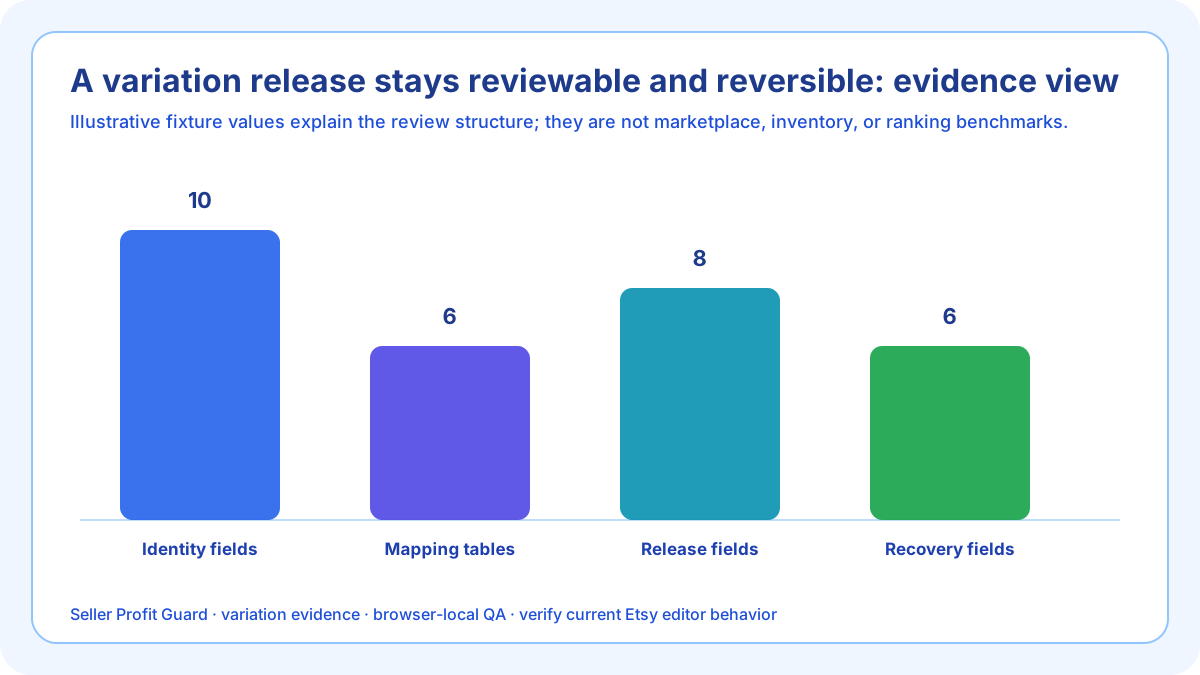
In the reversible variation evidence record, “Section 1: identity and before state” needs before state, evidence, expected fixture, approval, after state, public feedback, and rollback closure. Record approved bounded release and restored mismatch without personal or order data. A complete line proves how a reviewable and recoverable decision history was reached and recovered; an empty line remains open work rather than implied success.
Section 2: approved product contract
Record each allowed axis, unique values, units, exclusions, combination rules, unavailable states, source documents, sample approvals, measurement versions, price scope, inventory authority, and processing authority.
In the reversible variation evidence record, “Section 2: approved product contract” needs before state, evidence, expected fixture, approval, after state, public feedback, and rollback closure. Record approved bounded release and restored mismatch without personal or order data. A complete line proves how a reviewable and recoverable decision history was reached and recovered; an empty line remains open work rather than implied success.
Section 3: mapping tables
Create buyer-selector, appearance-photo, total-price, quantity, processing, and complete SKU matrices. Keep not-applicable decisions explicit and justified rather than leaving ambiguous blanks.
In the reversible variation evidence record, “Section 3: mapping tables” needs before state, evidence, expected fixture, approval, after state, public feedback, and rollback closure. Record approved bounded release and restored mismatch without personal or order data. A complete line proves how a reviewable and recoverable decision history was reached and recovered; an empty line remains open work rather than implied success.
Section 4: known issues and severity
List ambiguous names, synonyms, stale values, wrong images, price gaps, missing combinations, duplicate SKUs, processing conflicts, private-data risks, owners, deadlines, and non-compensating stop decisions.
In the reversible variation evidence record, “Section 4: known issues and severity” needs before state, evidence, expected fixture, approval, after state, public feedback, and rollback closure. Record approved bounded release and restored mismatch without personal or order data. A complete line proves how a reviewable and recoverable decision history was reached and recovered; an empty line remains open work rather than implied success.
Section 5: deterministic fixtures
Store complete and failure inputs, expected seven-check counts, Ready, Revise, Hold, and Block decisions, combination counts, issue text, reset behavior, test date, build identifier, and reviewer.
In the reversible variation evidence record, “Section 5: deterministic fixtures” needs before state, evidence, expected fixture, approval, after state, public feedback, and rollback closure. Record approved bounded release and restored mismatch without personal or order data. A complete line proves how a reviewable and recoverable decision history was reached and recovered; an empty line remains open work rather than implied success.

Section 6: backup and release
Record local and remote backups, rollback image or identifier, changed listing and fields, correct account confirmation, approval, deployment time, targeted cache action, and safe-stop observations.
In the reversible variation evidence record, “Section 6: backup and release” needs before state, evidence, expected fixture, approval, after state, public feedback, and rollback closure. Record approved bounded release and restored mismatch without personal or order data. A complete line proves how a reviewable and recoverable decision history was reached and recovered; an empty line remains open work rather than implied success.
Section 7: public selected-path QA
For every available combination, record mobile and desktop label, selected image, full price, availability, processing, cart choice, receipt-facing value, SKU, canonical, indexability, links, and unexpected behavior.
In the reversible variation evidence record, “Section 7: public selected-path QA” needs before state, evidence, expected fixture, approval, after state, public feedback, and rollback closure. Record approved bounded release and restored mismatch without personal or order data. A complete line proves how a reviewable and recoverable decision history was reached and recovered; an empty line remains open work rather than implied success.
Section 8: rollback and closure
Record trigger, restored values, verification, unresolved exception, correction notice, Day 0/7/14/28 aggregate metrics, source-refresh date, and next owner. Never reinterpret a rollback as a successful release.
In the reversible variation evidence record, “Section 8: rollback and closure” needs before state, evidence, expected fixture, approval, after state, public feedback, and rollback closure. Record approved bounded release and restored mismatch without personal or order data. A complete line proves how a reviewable and recoverable decision history was reached and recovered; an empty line remains open work rather than implied success.
Verification, release, and rollback controls
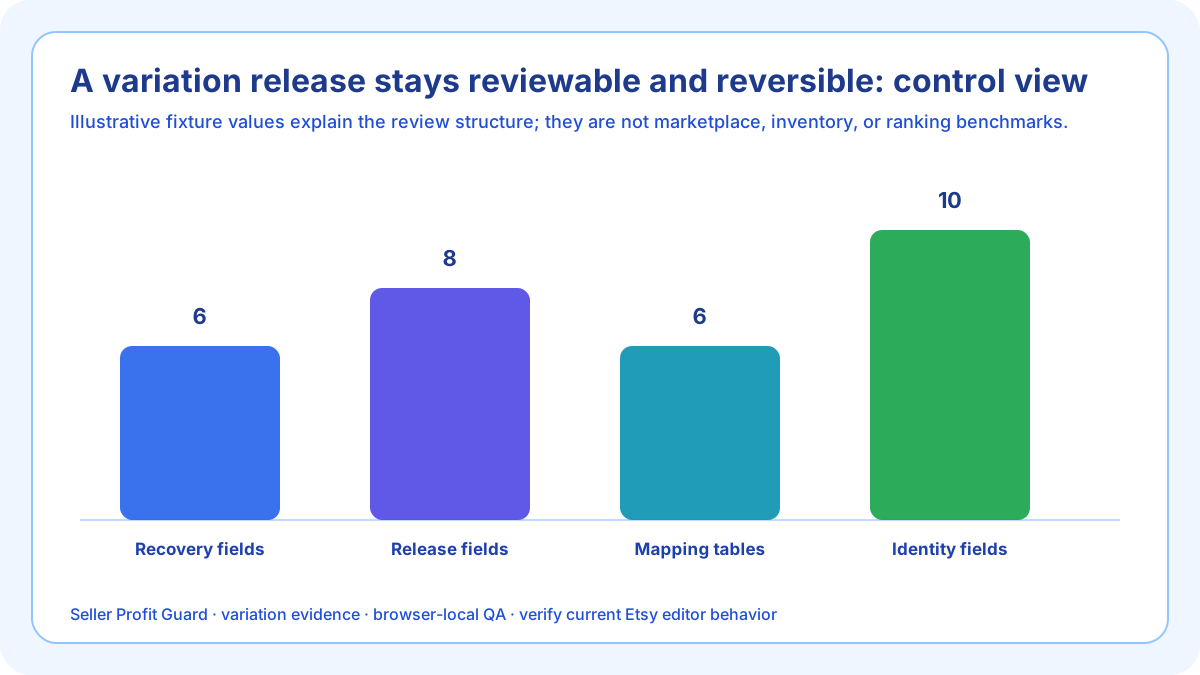
Before changing a public listing, preserve the complete reversible variation evidence record, editor values, linked assets, selected-path observations, test fixtures, approval, and rollback identifier. Confirm the correct account and listing. Safe-stop on login or CAPTCHA ambiguity, a platform warning, wrong profile, missing target context, private data, or an unexpected editor state.
After one bounded release, verify approved bounded release on mobile and desktop and deliberately revisit the risk represented by restored mismatch. Check axis names, values, selected photo, full price, availability, processing, cart or receipt choice, and SKU for every valid combination. Restore the prior configuration when a critical path does not support a reviewable and recoverable decision history.
Limits, privacy boundary, and next action
This guide and checker use seller-entered text and synthetic examples. They do not retrieve Etsy data, alter a listing, inspect images, validate product composition, confirm inventory or receipts, certify marketplace policy, or predict ranking, clicks, conversion, sales, returns, income, or AdSense approval. Seller Profit Guard is independent and unaffiliated with Etsy and provides operational QA rather than legal, tax, accounting, inventory, search, accessibility, or platform advice.
Keep buyer names, addresses, messages, order IDs, receipts, private personalization, credentials, OAuth data, and raw CSV files outside the reversible variation evidence record. The next action is to repair the named evidence layer, rerun complete and crossed fixtures, release only the approved set, inspect the public choice path, and record whether a reviewable and recoverable decision history was verified or rolled back.
Sources and further reading
- Etsy Help: How to Add Variations for Your Listings: Current official variation attributes, values, total prices, quantities, processing profiles, SKUs, linked photos, custom variations, visibility, preview, and buyer-selection behavior.
- Etsy Help: How to Create a Listing: Current official category, price, quantity, SKU, physical-listing, and variation context.
- Etsy Help: Processing Times and Processing Profiles: Current official listing- and variation-level processing-profile behavior.
- Etsy Help: How to Offer Personalized Listings: Current official Custom options fields, five-field limit, field types, test-limited add-on pricing, and the inventory-versus-personalization boundary.
- Etsy Help: How to Offer Custom Items: Current official boundary between public listing variations and one-buyer private custom listings.
- Etsy Seller Policy effective July 9, 2026: Current official accuracy, content, privacy, representation, and seller-responsibility requirements.
- Seller Profit Guard methodology: Evidence hierarchy, privacy boundary, uncertainty labels, corrections, release verification, and rollback controls.
Related Seller Profit Guard tools
- Open the Etsy Variation Naming Checker: Review axes, values, buyer selectors, linked photos, total prices, and unique SKU combinations.
- Audit Etsy variation and SKU risk: Check cost and fulfillment risk after the naming contract is coherent.
- Review Etsy attribute coverage: Keep category attributes separate from buyer-selectable options.
- Check Etsy photo coverage: Verify appearance-changing values have truthful buyer evidence.
- Read the variation SKU checklist: Connect buyer choices with stable cost and inventory controls.
- Read the local-first methodology: Preserve evidence, privacy, bounded release, feedback, and recovery.
- Etsy Variation Naming Formula and Inputs: Continue the variation evidence, mapping, decision, release, interpretation, or audit workflow.
- Etsy Variation Names: Size and Color Example: Continue the variation evidence, mapping, decision, release, interpretation, or audit workflow.
- Etsy Material and Personalization Options: Continue the variation evidence, mapping, decision, release, interpretation, or audit workflow.
- 12 Etsy Variation Naming Mistakes: Continue the variation evidence, mapping, decision, release, interpretation, or audit workflow.
- Evidence Sources for Etsy Variations: Continue the variation evidence, mapping, decision, release, interpretation, or audit workflow.
Next step: Open the Etsy Variation Naming Checker.
This is operational planning help, not tax, accounting, legal, financial, or platform-policy advice. Review the Terms and disclaimer, and verify current platform rules and fee assumptions before changing prices.