Return window loss formula, inputs, and assumptions
Last updated: 2026-07-29
Written and reviewed by Seller Profit Guard Editorial Team.
Expected return loss per order equals return rate multiplied by lost outbound shipping, return shipping, restock work, and unrecovered product cost. Subtract that result from contribution before returns. The model also solves the highest return rate that still preserves the entered target margin, provided incident loss is positive.

What is the exact return-window loss formula?
Let P be sale price, C product cost, F fulfillment cost, f the percentage fee rate, q the expected return rate, O lost outbound shipping, R return shipping, H restock or support cost, s resale recovery, and m target margin. Unrecovered product value is C × (1 − s). Loss per returned order is L = O + R + H + C × (1 − s). Expected return loss per original order is E = qL.
Contribution before returns is B = P − C − F − fP. Adjusted contribution is A = B − E, and adjusted contribution margin is A ÷ P when price is positive. The maximum return rate at the target is qmax = (B − mP) ÷ L when L is positive. A negative qmax means the product misses target even before expected returns; the displayed operating ceiling is therefore zero.
The formula intentionally does not equate the buyer refund with seller loss. Refunded revenue, credited fees, retained shipping, product recovery, replacement cost, and handling are different cash or cost lines. This quick tool models retained operating costs and expected drag under entered assumptions; use payment reconciliation for exact platform cash movement.
| Symbol | Input | Default | Role |
|---|---|---|---|
| P | Sale price | $38.00 | Revenue base |
| C | Product cost | $13.00 | Recovery base |
| F | Fulfillment | $5.50 | Non-return variable cost |
| f | Fee rate | 8.5% | Contribution before returns |
| q | Return rate | 8% | Incident frequency |
| O + R + H | Shipping + handling | $12.00 | Incident cost |
| s | Resale recovery | 60% | Recovered product value |
| m | Target margin | 20% | Decision threshold |
How do the default inputs produce a $1.38 expected loss?
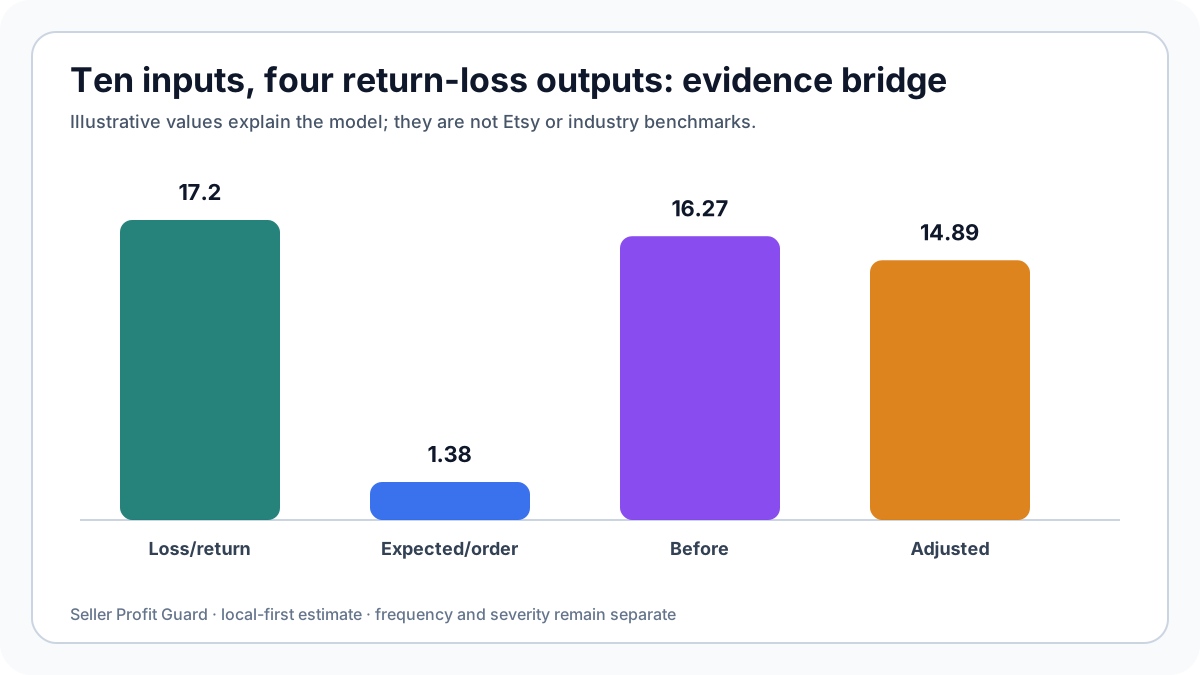
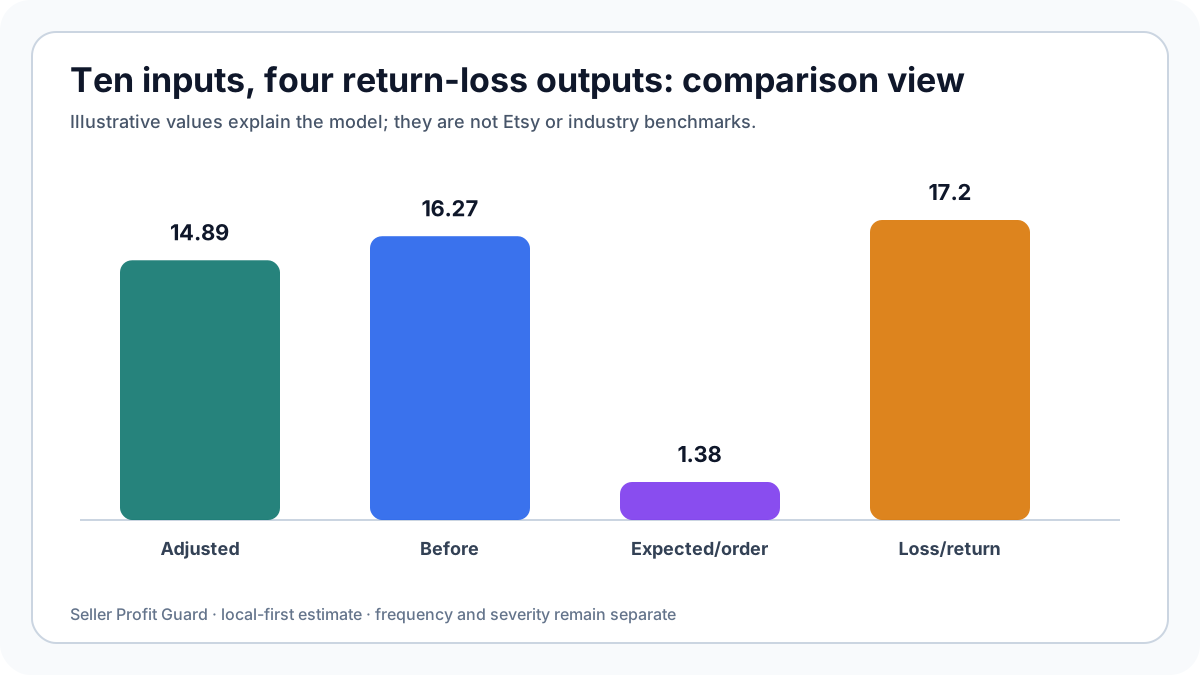
At 60% resale recovery, $13 product cost leaves $5.20 unrecovered. Add $4.50 lost outbound shipping, $5 return shipping, and $2.50 restock work: loss per returned order is $17.20. Multiply by the 8% return rate to obtain $1.376, displayed as $1.38 expected return loss per original order.
The 8.5% fee assumption produces $3.23 of fees on a $38 sale. Contribution before returns is $38 − $13 − $5.50 − $3.23 = $16.27. After $1.376 expected return drag, adjusted contribution is $14.894, displayed as $14.89, or about 39.19% of sale price.
A 20% target equals $7.60. The available pre-return headroom is $16.27 − $7.60 = $8.67. Divide by $17.20 incident loss to get a target-safe return-rate ceiling of about 50.41%. That high ceiling reflects the dummy fixture, not an industry benchmark or recommended policy.

Which units and denominator mistakes invalidate the model?
Enter percentages as percent values: 8 means 8%, not 0.08 and not eight dollars. Keep all dollar values in one currency and at the same order grain. Product cost is the cost assigned to the returned item or order; fulfillment cost belongs in contribution before returns, while lost outbound shipping belongs in incident severity only when it is truly unrecoverable.
Do not divide incident loss by retained orders and then label it per original order. This implementation multiplies return probability by loss per return. A retained-order metric would use a different denominator and should be labeled separately. Do not subtract full product cost when an item is resold, or claim full recovery when inspection, cleaning, markdown, and delayed inventory reduce its value.
The tool clamps percentage calculations to the 0–100% range and reports out-of-range inputs as issues. That prevents a 180% return rate from silently amplifying the calculation, but it does not validate missing or implausible data. Blank numeric fields can still behave like zero; treat incomplete evidence as a blocked scenario.
Formula questions sellers should answer before acting
Does a fee credit reduce return loss? Only the credited fee line; it does not recover shipping, handling, product damage, or every service fee. Does a refund automatically cancel an Etsy order? Etsy's current help says cancellation is separate. Does Purchase Protection erase expected loss? No; eligibility and coverage are conditional, so model protected and seller-funded outcomes separately.
Should the return rate be storewide? Use product or defensible cohort rates whenever severity or frequency differs. Should recovery be based on retail price? No. This model applies recovery to entered product cost, not hoped-for resale revenue. Can the result set a legal return policy? No; marketplace rules and applicable law require separate review.
Preserve the formula version, public dummy fixture, boundary tests, source dates, exclusions, and reviewer. Recalculate when fee treatment, policy, carrier, product, package, restock process, or market changes. A precise result from stale inputs is still a weak decision.
Which records support this return-loss formula?
Use a product-level return-rate cohort, not a shop-wide percentage copied from memory. Reconcile completed sales, returns, exchanges, cancellations, cases, refunds, fee credits, return labels, replacement shipments, inspection work, restocking outcomes, markdowns, and write-offs for the same analysis period. The calculator needs aggregate operating values; it does not need buyer identity or a raw order file.
Separate platform evidence from seller assumptions. Etsy's current guidance explains return-policy requirements, agreements, fee credits, cancellations, Purchase Protection, and regional legal boundaries. It does not supply a universal return rate, resale recovery percentage, product cost, labor rate, or shipping loss for a particular shop. Those values must come from controlled seller records or be labeled as provisional.
Freeze the source period, currency, product cohort, policy version, calculation version, inclusion rules, exclusions, and fingerprints. Reperform one public dummy fixture by hand. A matching fingerprint proves that a file did not change; it does not prove the cohort represents future orders. Recalculate after a product, package, carrier, policy, marketplace, or fee-scope change.
- Keep refund amount, fee credit, and retained operating cost on separate lines.
- Segment resellable, markdown, damaged, lost, exchanged, and abandoned returns.
- Use actual label and handling evidence where available.
- Treat Purchase Protection as conditional, never guaranteed recovery.
- Verify legal, tax, and accounting treatment separately.
Privacy boundaries for return-loss formula
Return analysis can be completed with aggregate counts, rates, product costs, shipping costs, handling costs, and recovery outcomes. Buyer names, email addresses, phone numbers, postal addresses, order IDs, tracking numbers, messages, personalization, payment data, and case narratives are unnecessary. Replace individual examples with public dummy fixtures and aggregate outcome categories.
Return reasons and messages may reveal health details, family events, protected traits, disputes, or other sensitive context. Do not paste them into the calculator, article, analytics event, ticket, email draft, or community post. Keep controlled evidence under the existing retention policy, redact exports, and use non-reversible fingerprints when proving that an input package remained unchanged.
Seller costs, defect rates, carrier adjustments, recovery percentages, and policy exceptions are commercially sensitive even without buyer data. Public pages should use rounded fictional examples. Seller Profit Guard performs this quick calculation in the browser and does not require Etsy credentials, but the operator remains responsible for handling any source files privately.
How to use the calculator for this return-loss formula
Enter sale price, product cost, fulfillment cost, combined percentage fee assumption, expected return rate, lost outbound shipping, return shipping, restock or support cost, resale recovery percentage, and target margin. The tool calculates unrecovered product value, adds the three incident costs, multiplies loss per returned order by return rate, and subtracts that expected drag from contribution before returns.
The primary output is expected return loss per original order, not loss per retained order and not the buyer's refund amount. The tool also reports loss per returned order, contribution before returns, adjusted contribution, and the maximum return rate that still meets the entered target. It does not model tax, legal eligibility, case outcomes, cash timing, inventory aging, or every fee-credit rule.
Run representative, adverse, and clearly out-of-scope scenarios. Reconcile the displayed values by hand, compare headroom with input uncertainty, and record a bounded use, hold, redesign, or rollback decision. A score is only a convenience signal; it is not an Etsy rating, probability of a return, accounting opinion, or promise of profit.
- Define one product, period, market, policy, and outcome cohort.
- Enter evidence-backed costs and clearly labeled assumptions.
- Reperform loss per return and expected loss per order by hand.
- Stress-test recovery, shipping, return rate, and target margin.
- Record owner, decision, exception, next review, and rollback.
Sources and further reading
- Etsy Help: Refunds, Returns, and Exchanges for Sellers: Current Etsy seller guidance on listing return policies, return agreements, replacements, and Purchase Protection boundaries.
- Etsy Help: How to Cancel a Sale: Official workflow distinguishing a refund from cancellation and explaining related Etsy fee credits.
- Etsy Fees & Payments Policy: Current policy for transaction, payment-processing, listing, advertising, regulatory, and other seller charges.
- Etsy Seller Policy: Seller obligations, July 2026 return and case boundaries, buyer-data privacy, and region-specific legal responsibilities.
- Seller Profit Guard calculation methodology: Definitions for contribution, evidence hierarchy, editable assumptions, privacy, uncertainty, and non-advice limits.
Related Seller Profit Guard tools
- Open the Return Window Loss Calculator: Estimate loss per return, expected loss per order, adjusted contribution, and a target-safe return rate.
- Review refund fee impact: Separate buyer refund, fee credits, retained costs, cancellation, and operating loss.
- Calculate break-even ROAS and return loss: Connect expected incident loss to contribution, CPA, and ROAS decisions.
- Use the Etsy profit calculator: Reconcile actual order revenue, SKU cost, shipping, fees, and contribution evidence.
- Read the local-first methodology: Understand formula scope, source quality, privacy, and interpretation limits.
- Return Loss Example: Resellable Item: Continue the return-loss evidence, calculation, and decision workflow.
- Return Loss for an Unsellable Item: Continue the return-loss evidence, calculation, and decision workflow.
- 12 Return Loss Calculator Mistakes: Continue the return-loss evidence, calculation, and decision workflow.
- Return Loss Data: 8 Reliable Sources: Continue the return-loss evidence, calculation, and decision workflow.
- Set a Safe Return Loss Threshold: Continue the return-loss evidence, calculation, and decision workflow.
Next step: Open the Return Window Loss Calculator.
This is operational planning help, not tax, accounting, legal, financial, or platform-policy advice. Review the Terms and disclaimer, and verify current platform rules and fee assumptions before changing prices.