A complete holiday gift listing readiness example
Last updated: 2026-07-30
Written and reviewed by Seller Profit Guard Editorial Team.
For a personalized ornament needed by December 24, reserve seven calendar days for carrier planning, five business days for the maximum processing profile, and two business days for contingency. In the 2026 fixture, that produces a seller planning cutoff of December 8. Verify Etsy’s current public delivery estimate before publishing or promoting it.

holiday gift worked example: scope and decision
The fixture uses a personalized family ornament for United States holiday gifting. Review occurs July 26, 2026. Demand monitoring begins October 1, the primary need-by date is December 24, and the packet is recalculated weekly plus immediately after a carrier, inventory, processing, or staffing change.
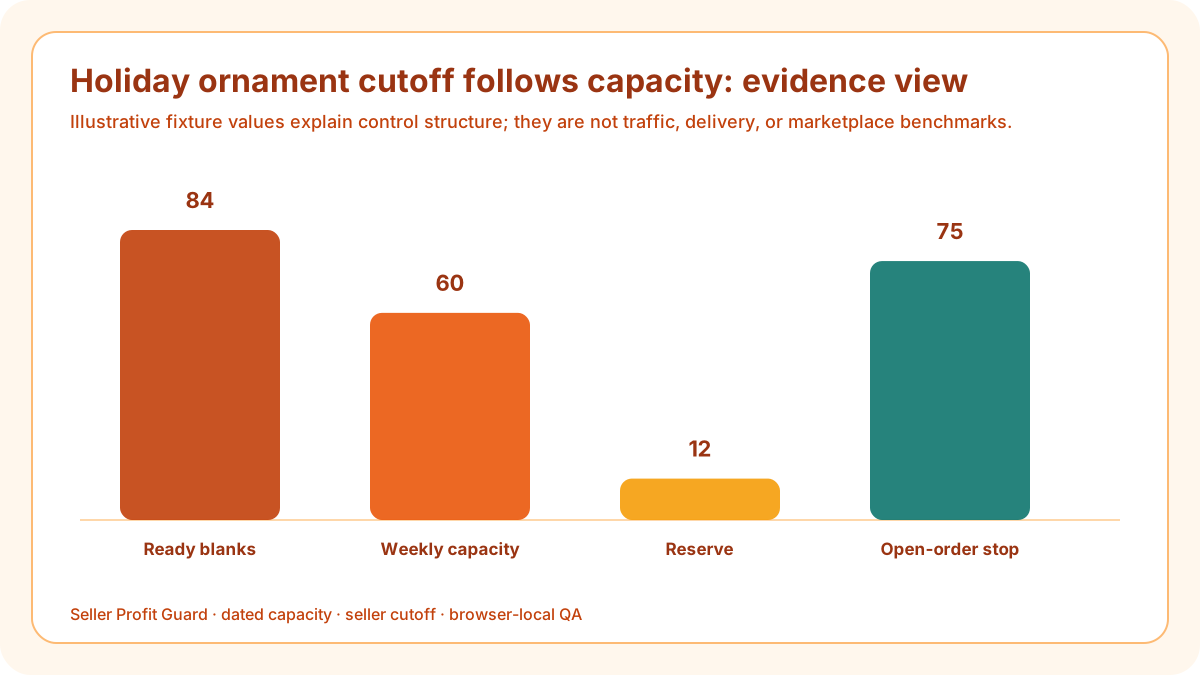
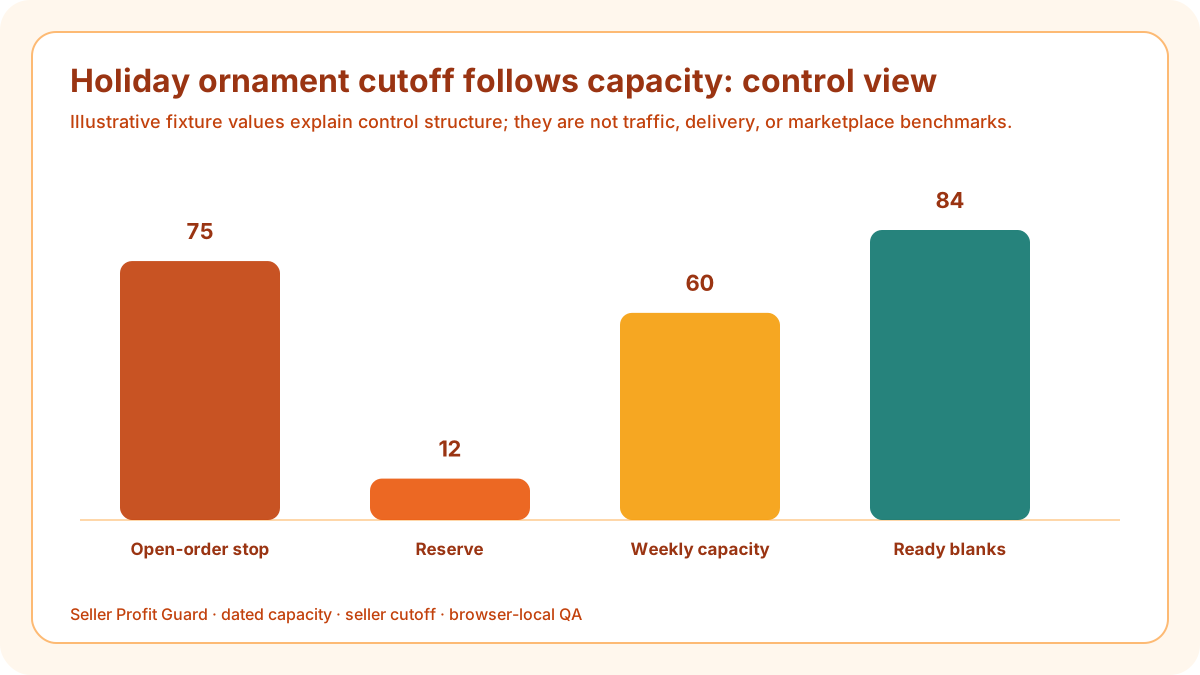
The shop has 84 ready blanks, 18 committed units, and a 12-unit reserve, leaving 54 usable units. Sustainable output is 12 completed orders per Monday–Friday processing day, capped at 60 per week. Promotion pauses at 48 open orders, exactly 80 percent of weekly capacity, or earlier at the inventory stop.
Build the ornament season control sheet before editing
The active profile is made to order at three to five business days. The seller declares Monday through Friday as processing days and records that no dated exclusion falls inside this cutoff interval. The planning calculation subtracts seven calendar days for transit, five declared processing days, and two more declared processing days for contingency from December 24, yielding a December 8 seller cutoff. A Monday-through-Saturday shop or a dated closure can produce a different result, so the schedule is an input rather than a hidden universal calendar.
The cutoff is not inserted as a universal Etsy rule. The seller checks the buyer-visible estimated-delivery range for the relevant destination and variation. If Etsy displays a later arrival or the production queue crosses the stop line, the promotion pauses and public copy moves to the approved after-cutoff state.
Step 1: freeze the ornament candidate
Record listing draft v6, the personalized family ornament SKU family, buyer market, finish variations, public photos, current title and tags, processing profile, need-by target, and the exact before-state that can be restored.
At step 1, connect “Step 1: freeze the ornament candidate” to the exact inventory row, production observation, processing profile, calendar calculation, listing surface, option, image, campaign, or rollback it controls. Re-run 84 ornament blanks and 60 weekly units after a bounded change and retain promotion with no capacity stop as a regression fixture until a dated, capacity-backed gift-listing release is observable.
The worked log for “Step 1: freeze the ornament candidate” should show the before value, subtraction or capacity step, after value, and decision. Reconcile the 84-unit blank pool, 18 commitments, 12-unit reserve, 60-unit weekly ceiling, three-to-five-day profile, and December 8 planning cutoff only where they apply to 84 ornament blanks and 60 weekly units. Replace them for a real shop. Retain promotion with no capacity stop to prove that missing reserve, stale dates, or excess promotion still stops a dated, capacity-backed gift-listing release.
Step 2: reconcile usable inventory
Subtract 18 committed units and the 12-unit reserve from 84 ready blanks. The immediately allocable balance is 54 units, but that number remains subordinate to sustainable engraving, proof, packing, and dispatch capacity.
At step 2, connect “Step 2: reconcile usable inventory” to the exact inventory row, production observation, processing profile, calendar calculation, listing surface, option, image, campaign, or rollback it controls. Re-run 84 ornament blanks and 60 weekly units after a bounded change and retain promotion with no capacity stop as a regression fixture until a dated, capacity-backed gift-listing release is observable.
The worked log for “Step 2: reconcile usable inventory” should show the before value, subtraction or capacity step, after value, and decision. Reconcile the 84-unit blank pool, 18 commitments, 12-unit reserve, 60-unit weekly ceiling, three-to-five-day profile, and December 8 planning cutoff only where they apply to 84 ornament blanks and 60 weekly units. Replace them for a real shop. Retain promotion with no capacity stop to prove that missing reserve, stale dates, or excess promotion still stops a dated, capacity-backed gift-listing release.
Step 3: calculate production capacity
At 12 completed orders per processing day, the shop can finish 60 in a normal five-day week. Use observed completed output, not theoretical machine speed, and lower the ceiling when personalization, quality checks, proofing, or staffing changes.
At step 3, connect “Step 3: calculate production capacity” to the exact inventory row, production observation, processing profile, calendar calculation, listing surface, option, image, campaign, or rollback it controls. Re-run 84 ornament blanks and 60 weekly units after a bounded change and retain promotion with no capacity stop as a regression fixture until a dated, capacity-backed gift-listing release is observable.
The worked log for “Step 3: calculate production capacity” should show the before value, subtraction or capacity step, after value, and decision. Reconcile the 84-unit blank pool, 18 commitments, 12-unit reserve, 60-unit weekly ceiling, three-to-five-day profile, and December 8 planning cutoff only where they apply to 84 ornament blanks and 60 weekly units. Replace them for a real shop. Retain promotion with no capacity stop to prove that missing reserve, stale dates, or excess promotion still stops a dated, capacity-backed gift-listing release.
Step 4: calculate the seller cutoff
Apply the dated need-by target, carrier-planning buffer, maximum processing profile, and contingency in one calendar that distinguishes business from calendar days. Store the arithmetic and resulting December 8 date as a planning assumption.
At step 4, connect “Step 4: calculate the seller cutoff” to the exact inventory row, production observation, processing profile, calendar calculation, listing surface, option, image, campaign, or rollback it controls. Re-run 84 ornament blanks and 60 weekly units after a bounded change and retain promotion with no capacity stop as a regression fixture until a dated, capacity-backed gift-listing release is observable.
The worked log for “Step 4: calculate the seller cutoff” should show the before value, subtraction or capacity step, after value, and decision. Reconcile the 84-unit blank pool, 18 commitments, 12-unit reserve, 60-unit weekly ceiling, three-to-five-day profile, and December 8 planning cutoff only where they apply to 84 ornament blanks and 60 weekly units. Replace them for a real shop. Retain promotion with no capacity stop to prove that missing reserve, stale dates, or excess promotion still stops a dated, capacity-backed gift-listing release.
Step 5: align buyer-facing copy
State the item and objective traits once, use holiday gifting only where it reflects actual buyer use, explain the personalization deadline and active processing profile, and avoid promising arrival by December 24.
At step 5, connect “Step 5: align buyer-facing copy” to the exact inventory row, production observation, processing profile, calendar calculation, listing surface, option, image, campaign, or rollback it controls. Re-run 84 ornament blanks and 60 weekly units after a bounded change and retain promotion with no capacity stop as a regression fixture until a dated, capacity-backed gift-listing release is observable.
The worked log for “Step 5: align buyer-facing copy” should show the before value, subtraction or capacity step, after value, and decision. Reconcile the 84-unit blank pool, 18 commitments, 12-unit reserve, 60-unit weekly ceiling, three-to-five-day profile, and December 8 planning cutoff only where they apply to 84 ornament blanks and 60 weekly units. Replace them for a real shop. Retain promotion with no capacity stop to prove that missing reserve, stale dates, or excess promotion still stops a dated, capacity-backed gift-listing release.

Step 6: align variations and photos
Each finish and quantity bundle needs current blank inventory, price, SKU, processing profile, actual-item photo, personalization example, package-contents image, and an after-cutoff treatment. Remove or pause an option whose evidence falls behind.
At step 6, connect “Step 6: align variations and photos” to the exact inventory row, production observation, processing profile, calendar calculation, listing surface, option, image, campaign, or rollback it controls. Re-run 84 ornament blanks and 60 weekly units after a bounded change and retain promotion with no capacity stop as a regression fixture until a dated, capacity-backed gift-listing release is observable.
The worked log for “Step 6: align variations and photos” should show the before value, subtraction or capacity step, after value, and decision. Reconcile the 84-unit blank pool, 18 commitments, 12-unit reserve, 60-unit weekly ceiling, three-to-five-day profile, and December 8 planning cutoff only where they apply to 84 ornament blanks and 60 weekly units. Replace them for a real shop. Retain promotion with no capacity stop to prove that missing reserve, stale dates, or excess promotion still stops a dated, capacity-backed gift-listing release.
Step 7: bind promotion to stop rules
Begin promotion only while open orders remain below 65 percent of sustainable weekly capacity. Pause at 48 open orders, exactly 80 percent of the 60-order weekly ceiling, or earlier at the inventory stop; then re-run the packet after cancellations, added shifts, or material shortages.
At step 7, connect “Step 7: bind promotion to stop rules” to the exact inventory row, production observation, processing profile, calendar calculation, listing surface, option, image, campaign, or rollback it controls. Re-run 84 ornament blanks and 60 weekly units after a bounded change and retain promotion with no capacity stop as a regression fixture until a dated, capacity-backed gift-listing release is observable.
The worked log for “Step 7: bind promotion to stop rules” should show the before value, subtraction or capacity step, after value, and decision. Reconcile the 84-unit blank pool, 18 commitments, 12-unit reserve, 60-unit weekly ceiling, three-to-five-day profile, and December 8 planning cutoff only where they apply to 84 ornament blanks and 60 weekly units. Replace them for a real shop. Retain promotion with no capacity stop to prove that missing reserve, stale dates, or excess promotion still stops a dated, capacity-backed gift-listing release.
Step 8: public-verify and monitor
Check the mobile listing, buyer-visible delivery range, title, tags, description, variations, images, price, and processing after publication. Record the observation, preserve the rollback value, and never treat same-day clicks as proof that the cutoff is safe.
At step 8, connect “Step 8: public-verify and monitor” to the exact inventory row, production observation, processing profile, calendar calculation, listing surface, option, image, campaign, or rollback it controls. Re-run 84 ornament blanks and 60 weekly units after a bounded change and retain promotion with no capacity stop as a regression fixture until a dated, capacity-backed gift-listing release is observable.
The worked log for “Step 8: public-verify and monitor” should show the before value, subtraction or capacity step, after value, and decision. Reconcile the 84-unit blank pool, 18 commitments, 12-unit reserve, 60-unit weekly ceiling, three-to-five-day profile, and December 8 planning cutoff only where they apply to 84 ornament blanks and 60 weekly units. Replace them for a real shop. Retain promotion with no capacity stop to prove that missing reserve, stale dates, or excess promotion still stops a dated, capacity-backed gift-listing release.
Verification, release, and rollback controls
Before changing a listing or promotion, preserve the ornament season control sheet, title, tags, attributes, description, personalization, quantities, prices, variations, SKUs, images, processing profiles, shipping settings, public date observations, campaign scope, approval, and rollback identifier. Confirm the correct account and target. Safe-stop on login or CAPTCHA ambiguity, warning, wrong profile, missing context, or unexpected editor behavior.
After one bounded change, verify 84 ornament blanks and 60 weekly units on desktop and mobile and deliberately revisit promotion with no capacity stop. Inspect the public buyer delivery range, every promoted option, image, deadline, processing statement, promotion term, and capacity stop. Restore the previous approved packet when a critical observation does not support a dated, capacity-backed gift-listing release.
Limits, privacy boundary, and next action
This guide and checker use seller-entered dates, counts, summaries, and synthetic fixtures. They do not retrieve Etsy account data, authenticate inventory, measure production, query carriers, predict demand, guarantee delivery, pause advertising, certify policy or legal compliance, determine ranking, or prove clicks, conversion, sales, income, qualified intent, or AdSense approval.
Keep buyer identities, emails, addresses, messages, order IDs, labels, payment data, supplier credentials, private designs, tokens, OAuth material, and raw CSV rows outside the ornament season control sheet. Repair the accountable source, rerun complete and broken fixtures, obtain required review, release only the approved packet, inspect public state, and record verified closure or rollback.
Sources and further reading
- Etsy Help: Processing Profiles and Ship-by Dates: Current definitions for processing time, ready-to-ship and made-to-order profiles, operating schedules, variation-level profiles, holidays, and ship-by dates.
- Etsy Help: Estimated Delivery Dates: Current explanation of processing, carrier, historical, origin, shipping-profile, and buyer-visible estimated-delivery inputs.
- Etsy Help: Create a Listing: Current listing controls for title, description, quantity, variations, personalization, attributes, tags, images, shipping, and processing.
- Etsy Help: Use Tags to Get Found: Current tag limit and relevance guidance; a seasonal term should remain accurate for the item and buyer intent.
- Etsy Seller Handbook: New Listing Title Guidance: Current title guidance: identify the item once, use objective descriptors, avoid repetition, and include an occasion only when essential.
- Etsy Seller Service Level Standards: Current expectations for accurate descriptions and images, manageable order volume, processing performance, communication, and buyer experience.
- Etsy Seller Policy: Current seller responsibility for accurate shop content, commitments, processing, dispatch, pricing, promotions, and applicable law.
- Etsy Advertising and Marketing Policy: Current Etsy Ads, Offsite Ads, sales, coupons, seller-set promotion terms, and seller responsibility boundaries.
- Seller Profit Guard methodology: Evidence hierarchy, local-first inputs, deterministic fixtures, uncertainty, bounded release, public verification, correction, and rollback.
Related Seller Profit Guard tools
- Open the Etsy Seasonal Listing Readiness Checker: Turn one dated seasonal packet into eight visible readiness checks.
- Check Etsy title clarity: Keep the item noun and objective traits clear while using occasion terms only where essential.
- Check Etsy tags: Review up to thirteen accurate tags without treating seasonal phrases as guaranteed demand.
- Check variation names and mappings: Align every promoted option with stock, price, photo, processing, and SKU evidence.
- Check photo coverage: Confirm seasonal styling does not replace actual-item, scale, variation, or package evidence.
- Read the local-first methodology: Use synthetic examples, bounded changes, public QA, and rollback without private buyer or order data.
- Etsy Seasonal Readiness: 9 Inputs and Formula: Continue the seasonal formula, example, evidence, threshold, routine, interpretation, or audit workflow.
- Etsy Wedding-Season Listing Readiness: Continue the seasonal formula, example, evidence, threshold, routine, interpretation, or audit workflow.
- 12 Etsy Seasonal Listing Mistakes to Block: Continue the seasonal formula, example, evidence, threshold, routine, interpretation, or audit workflow.
- Reliable Data for Etsy Seasonal Readiness: Continue the seasonal formula, example, evidence, threshold, routine, interpretation, or audit workflow.
- Etsy Seasonal Readiness Thresholds: Continue the seasonal formula, example, evidence, threshold, routine, interpretation, or audit workflow.
Next step: Open the Etsy Seasonal Listing Readiness Checker.
This is operational planning help, not tax, accounting, legal, financial, or platform-policy advice. Review the Terms and disclaimer, and verify current platform rules and fee assumptions before changing prices.