A markup and margin audit checklist
Last updated: 2026-07-30
Written and reviewed by Seller Profit Guard Editorial Team.
A conversion audit should record packet ID, product or order alias, cost-basis definition, included and excluded rows, cost, current price state, entered rate, markup-or-margin basis, currency, period, scope, source dates, gross-profit amount, observed rates, equivalent rate, converted price, price gap, decision, conflicts, reviewer, approved action, feedback, and rollback reference.
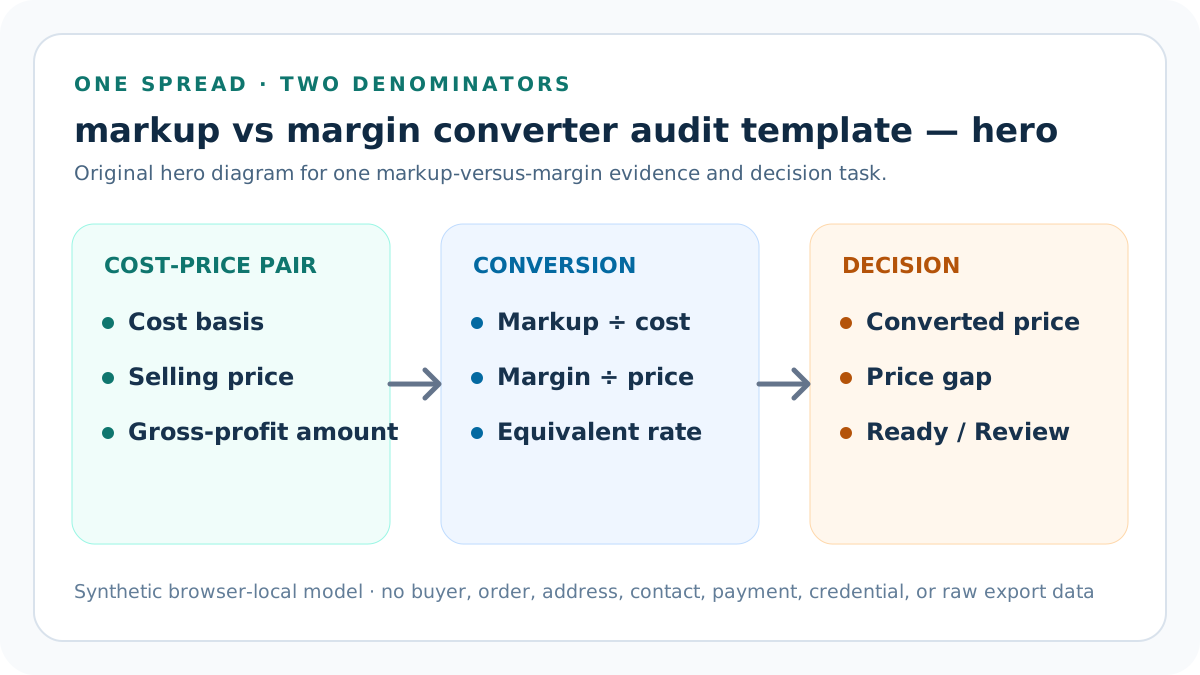
Record identity
Capture packet ID, nonprivate product alias, scope, owner, reviewer, and privacy class. This row belongs to the denominator assertion and change log. Preserve the original value, unit, denominator label, calculation grain, currency, effective month, source class, owner, and confidence rather than keeping only a rounded percentage.
For field-level auditability, checkpoint 1 must pass before it supports a standalone and reversible conversion packet. Recalculate from the source pair, compare full-precision and displayed results, and correct the accountable field instead of offsetting it with an unrelated favorable assumption.
Record cost basis
List included and excluded cost rows, amount, unit, currency, source, and effective date. This row belongs to the denominator assertion and change log. Preserve the original value, unit, denominator label, calculation grain, currency, effective month, source class, owner, and confidence rather than keeping only a rounded percentage.
For field-level auditability, checkpoint 2 must pass before it supports a standalone and reversible conversion packet. Recalculate from the source pair, compare full-precision and displayed results, and correct the accountable field instead of offsetting it with an unrelated favorable assumption.
Record price state
Name list, checkout, invoice, or retained revenue and preserve discount or refund context. This row belongs to the denominator assertion and change log. Preserve the original value, unit, denominator label, calculation grain, currency, effective month, source class, owner, and confidence rather than keeping only a rounded percentage.
For field-level auditability, checkpoint 3 must pass before it supports a standalone and reversible conversion packet. Recalculate from the source pair, compare full-precision and displayed results, and correct the accountable field instead of offsetting it with an unrelated favorable assumption.
Assert the denominator
Record exactly markup on cost or margin on selling price. This row belongs to the denominator assertion and change log. Preserve the original value, unit, denominator label, calculation grain, currency, effective month, source class, owner, and confidence rather than keeping only a rounded percentage.
For field-level auditability, checkpoint 4 must pass before it supports a standalone and reversible conversion packet. Recalculate from the source pair, compare full-precision and displayed results, and correct the accountable field instead of offsetting it with an unrelated favorable assumption.
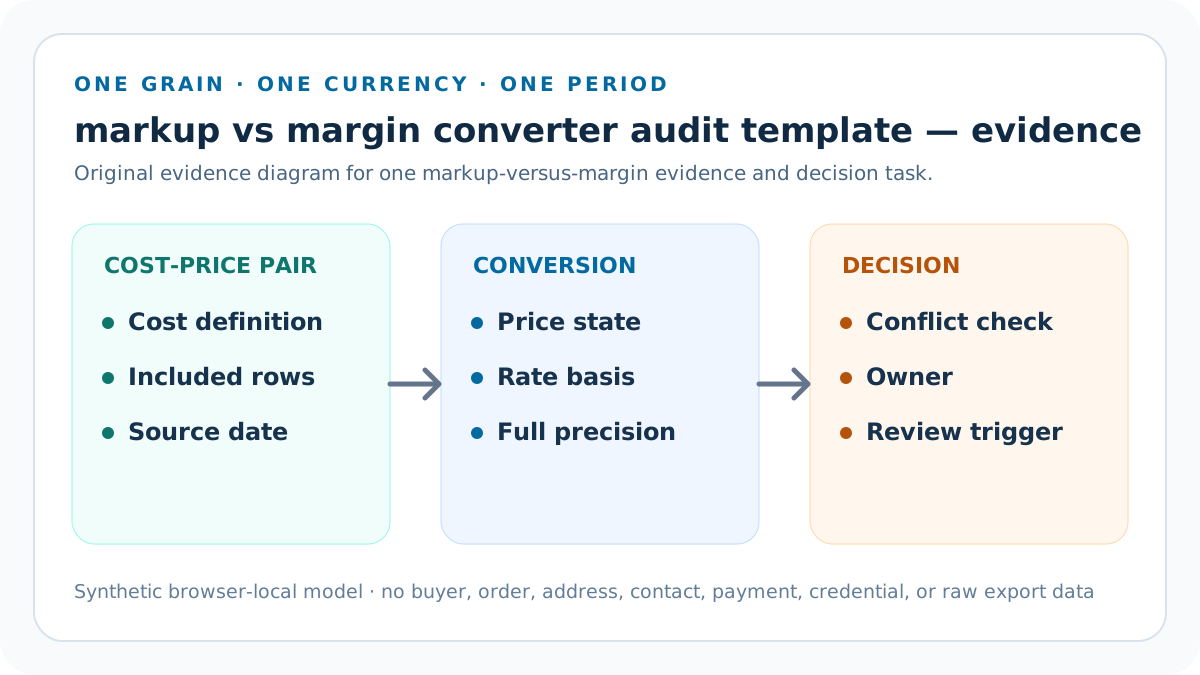
Assert equations
Recalculate gross profit, observed rates, equivalent rate, converted price, and gap. This row belongs to the denominator assertion and change log. Preserve the original value, unit, denominator label, calculation grain, currency, effective month, source class, owner, and confidence rather than keeping only a rounded percentage.
For field-level auditability, checkpoint 5 must pass before it supports a standalone and reversible conversion packet. Recalculate from the source pair, compare full-precision and displayed results, and correct the accountable field instead of offsetting it with an unrelated favorable assumption.
Record validation
Capture currency, period, scope, conflicts, Block reasons, and boundary fixtures. This row belongs to the denominator assertion and change log. Preserve the original value, unit, denominator label, calculation grain, currency, effective month, source class, owner, and confidence rather than keeping only a rounded percentage.
For field-level auditability, checkpoint 6 must pass before it supports a standalone and reversible conversion packet. Recalculate from the source pair, compare full-precision and displayed results, and correct the accountable field instead of offsetting it with an unrelated favorable assumption.
Record the change
Preserve before and after values, requester, approver, expected effect, and rollback ID. This row belongs to the denominator assertion and change log. Preserve the original value, unit, denominator label, calculation grain, currency, effective month, source class, owner, and confidence rather than keeping only a rounded percentage.
For field-level auditability, checkpoint 7 must pass before it supports a standalone and reversible conversion packet. Recalculate from the source pair, compare full-precision and displayed results, and correct the accountable field instead of offsetting it with an unrelated favorable assumption.
Record verification
Attach tests, build, content, similarity, browser, release, live, feedback, and restoration evidence. This row belongs to the denominator assertion and change log. Preserve the original value, unit, denominator label, calculation grain, currency, effective month, source class, owner, and confidence rather than keeping only a rounded percentage.
For field-level auditability, checkpoint 8 must pass before it supports a standalone and reversible conversion packet. Recalculate from the source pair, compare full-precision and displayed results, and correct the accountable field instead of offsetting it with an unrelated favorable assumption.
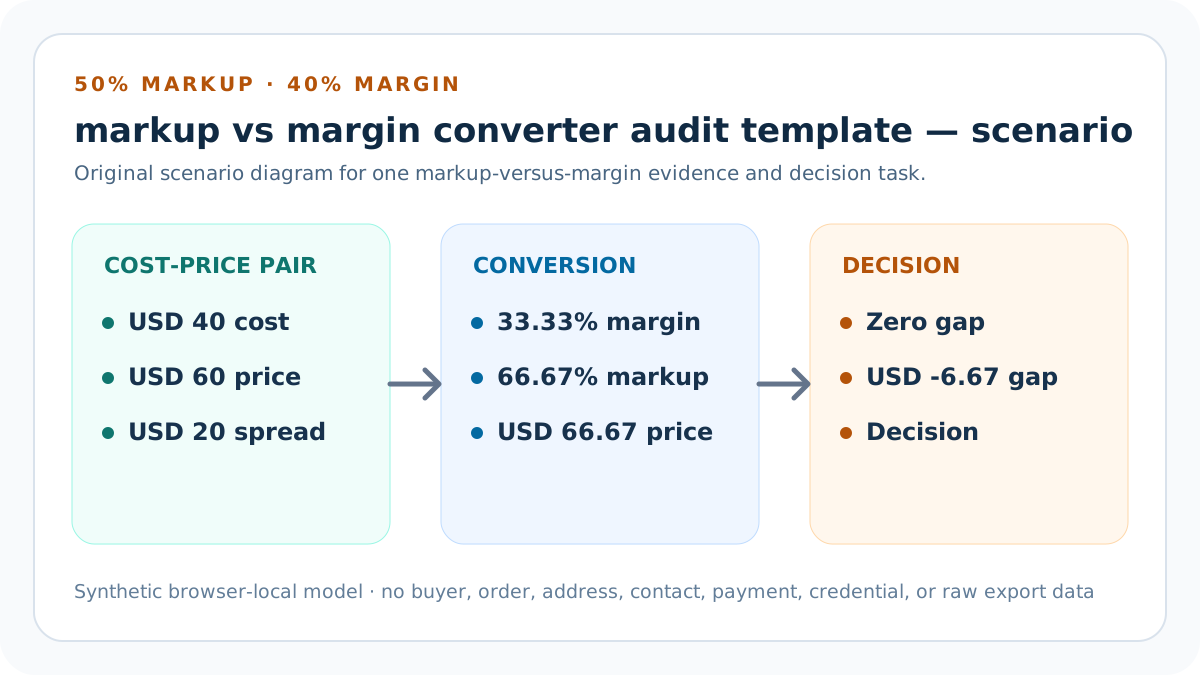
Packet identity and privacy assertions
Record audit ID, nonprivate product or order alias, calculation purpose, cost-price grain, currency, evidence month, owner, reviewer, privacy class, and linked release identifier. Exclude buyer, payment, credential, and raw export fields.
Assert that the public example is synthetic and that any private validation remained inside the local analysis boundary. A redacted screenshot can still expose sensitive context, so use aggregate evidence rather than cosmetic masking.
Cost-basis inclusion schedule
List merchandise, inbound freight, duty, packaging, direct labor, fulfillment, variable fee, acquisition, expected loss, and other candidate rows with included, excluded, or not-applicable status. Give each included row a unit, amount, source pointer, effective date, and owner.
State why excluded fixed overhead, owner compensation, financing, income tax, depreciation, or accounting allocations remain outside the chosen question. The schedule must reproduce the entered cost exactly.
Price-state assertion schedule
Name list price, checkout price, invoice price, or retained revenue explicitly. Capture discount, coupon, refund, allowance, buyer shipping, tax inclusion, bundle quantity, and effective timing even when those items are outside the narrow conversion.
Assert that cost and price describe the same unit or order. A price-state row fails when it mixes pre-discount and post-refund evidence or uses a bundle amount against a one-unit cost.
Formula assertion schedule
Record GP-01 as price minus cost, MARKUP-01 as GP divided by cost, MARGIN-01 as GP divided by price, EQUIV-01 as the branch conversion, PRICE-01 as reconstructed price, and GAP-01 as current price minus reconstructed price.
Store full-precision and display values separately. Reperform every equation independently and require exact fixture agreement before assigning a decision.
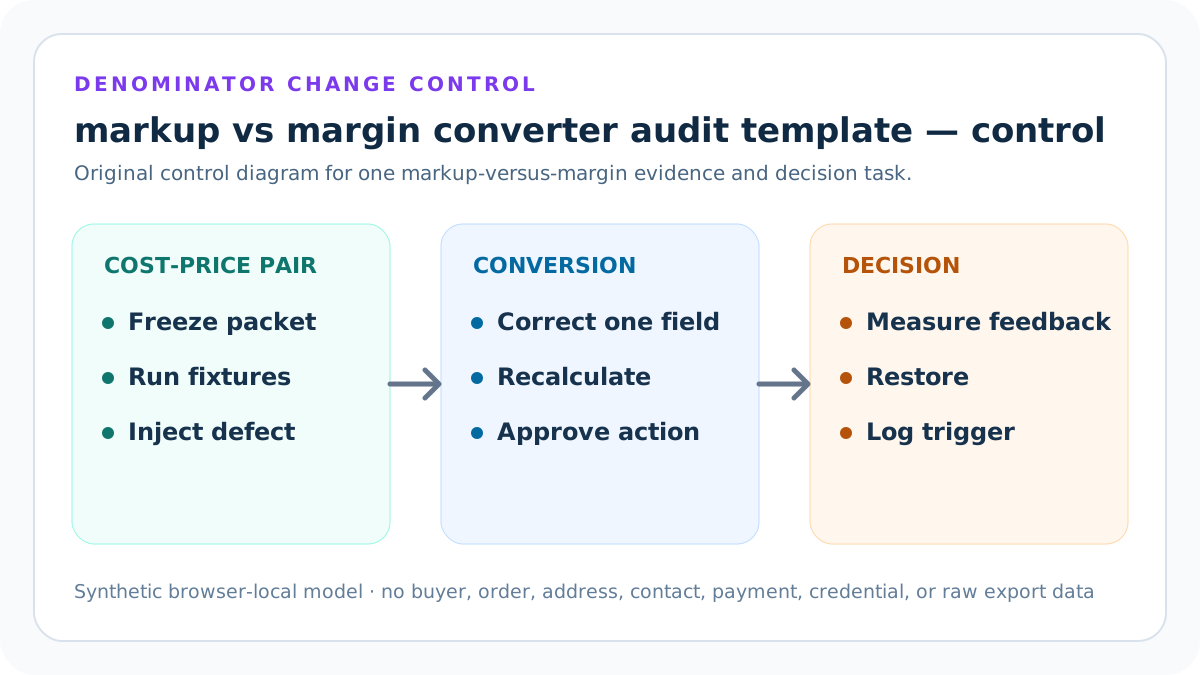
Boundary and defect assertions
Test cost and price at zero, unsupported basis, negative rate, 99.99% and 100% margin, invalid currency, invalid month, missing scope, declared conflicts, and current price one cent below and above the converted value.
Attach expected state and actual state to each fixture. A missing broken-case test is a control gap even when supported examples pass.
Change-log row contract
Each change row needs timestamp, assertion key, prior value, proposed value, unit, source, reason, requester, reviewer, affected aliases, expected output movement, release ID, and rollback pointer.
Preserve rejected proposals and review rationale. Overwriting the prior value erases the evidence needed to diagnose later disagreement or restore a public price.
Verification evidence index
Index typecheck, unit and integration tests, production build, static SEO, content word and answer gates, within- and cross-cluster similarity, schema, internal links, four visuals, mobile overflow, console, backup, release, purge, and live response evidence.
A checklist item must point to an inspectable artifact or fresh command result. The word passed without a path, timestamp, or observable output is not audit evidence.
Closure and restoration proof
Closure reproduces supported fixtures, identifies the corrected assertion, compares exact before and after outputs, names the approved bounded action, and attaches observed feedback or an explicit no-action conclusion.
Restoration proof recovers the prior packet, price state, route behavior, indexability, calculation result, accessibility state, and analytics boundary after a critical regression.
Assertion keys and restoration proof
Assign keys such as SCOPE-01, COST-01, PRICE-01, BASIS-01, RATE-01, GP-01, MARKUP-01, MARGIN-01, CONVERT-01, GAP-01, and DECISION-01. Store source pointer, unit, currency, effective date, owner, and status beside each.
Closure evidence must reproduce supported fixtures, show the corrected assertion, compare before and after results, name the approved action, and attach feedback or a no-action conclusion. Restoration proof must recover the prior packet and public route state.
denominator assertion and change log completion test
A complete packet lets an independent reviewer reproduce a standalone and reversible conversion packet from the declared cost, price, entered rate, and explicit basis without private data or hidden spreadsheet state.
Closure requires exact arithmetic, source alignment, privacy-safe examples, a non-compensating decision, bounded language, one approved next step or no-action conclusion, feedback ownership, and a recoverable prior state.
Sources and further reading
- Seller Profit Guard methodology: Calculation contracts, evidence precedence, deterministic fixtures, validation, correction, release, and rollback.
- Seller Profit Guard data privacy: Local-first boundaries for seller, buyer, order, payment, contact, credential, and raw export data.
- IRS Publication 334 (2025): Primary U.S. context for net receipts, cost of goods sold, gross profit, and the selling-price denominator; this converter does not make a tax determination.
- OpenStax markup guidance: Primary educational source for markup on cost and retail price equal to cost times one plus markup.
- SBA break-even point guidance: Primary U.S. small-business source for the contribution-margin denominator and separation of fixed and variable costs.
Related Seller Profit Guard tools
- Open the Markup vs Margin Converter: Convert one rate with an explicit cost or selling-price denominator.
- Solve a product price floor: Include discount, buyer shipping, fees, order-variable costs, expected loss, and a contribution target.
- Calculate contribution margin: Run a forward order-level contribution equation from observed revenue and variable costs.
- Version SKU costs: Maintain dated product, packaging, labor, fulfillment, and expected-loss evidence.
- Check bundle margin: Compare a bundle selling price with combined item and order costs.
- Read the methodology: Review evidence, calculation, privacy, testing, release, correction, and rollback.
- Review data privacy: Keep private seller and buyer data outside public content.
- Markup vs Margin Formulas and Inputs: Continue with a distinct formula, example, source, threshold, comparison, operating, interpretation, or audit task.
- Markup vs Margin Worked Example: Continue with a distinct formula, example, source, threshold, comparison, operating, interpretation, or audit task.
- Price-Based Margin Conversion Example: Continue with a distinct formula, example, source, threshold, comparison, operating, interpretation, or audit task.
- Markup vs Margin Conversion Mistakes: Continue with a distinct formula, example, source, threshold, comparison, operating, interpretation, or audit task.
- Reliable Markup and Margin Data Sources: Continue with a distinct formula, example, source, threshold, comparison, operating, interpretation, or audit task.
Next step: Open the Markup vs Margin Converter.
This is operational planning help, not tax, accounting, legal, financial, or platform-policy advice. Review the Terms and disclaimer, and verify current platform rules and fee assumptions before changing prices.