TikTok Shop profit calculator: 8 costs to include
Last updated: 2026-07-13
Written and reviewed by Seller Profit Guard Editorial Team.
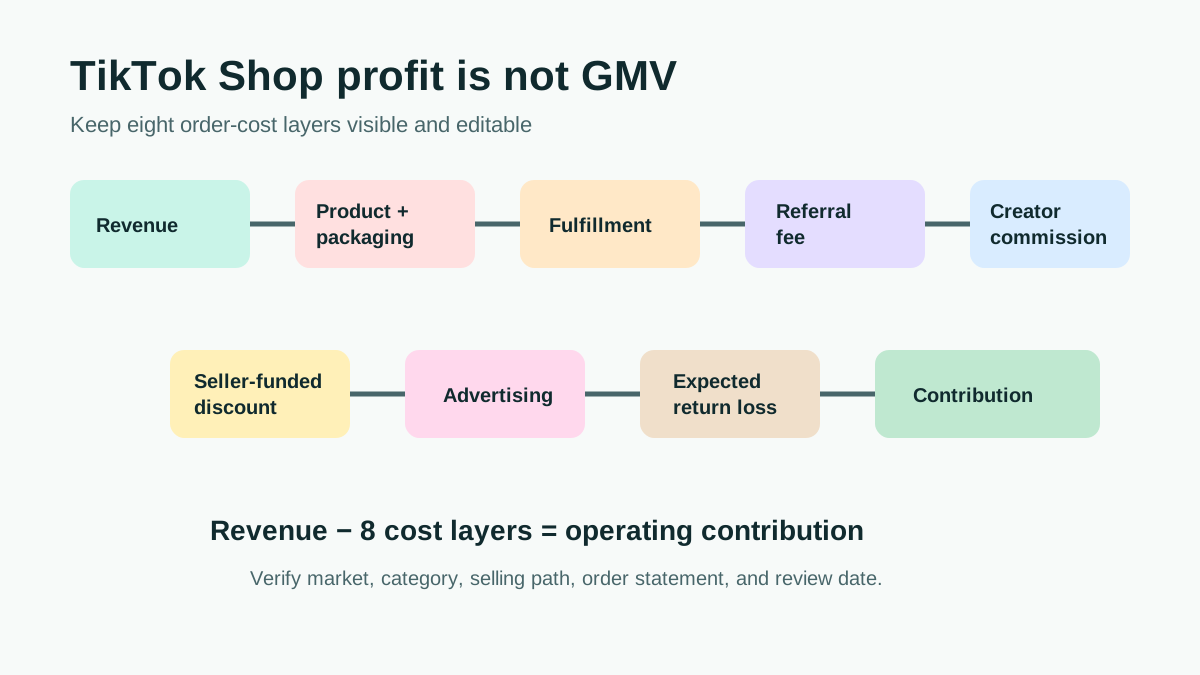
A TikTok Shop profit calculation starts with seller-attributable revenue, then subtracts product cost, referral fees, creator commission, seller-funded discounts, fulfillment, advertising, and expected return loss. Keep every rate editable and verify the applicable market, category, program, and order statement before using the result.
The TikTok Shop profit formula most dashboards do not show
Gross merchandise value can make a product look healthy while the order contribution is already thin. A useful TikTok Shop profit calculator does not start with a universal fee percentage. It starts with the revenue the seller can actually attribute to the order, then keeps eight cost layers separate: product cost, packaging, fulfillment, referral fee, creator or affiliate commission, seller-funded discounts, advertising, and expected return loss.
For a practical operating estimate, use: order contribution = seller-attributable revenue minus product cost minus packaging and fulfillment minus marketplace referral fee minus creator commission minus seller-funded discount minus advertising minus expected return loss. Divide contribution by seller-attributable revenue for contribution margin. The result is narrower than accounting profit because it does not automatically include tax, inventory accounting, financing, salaries, or every overhead item.
TikTok Shop fees and programs vary by market, category, seller status, fulfillment path, promotion, and time. This guide uses the US Seller Center documentation reviewed on July 13, 2026. It deliberately treats every platform or commission rate as an input, not a permanent fact. Confirm the order-level charges and current policy shown in your own Seller Center before changing price or campaign settings.
| Layer | Evidence to use | Common mistake |
|---|---|---|
| Revenue | Order statement and seller-funded discount detail | Treating GMV or customer payment as fully retained revenue |
| Referral fee | Current market and category fee record | Applying one headline rate to every category and country |
| Creator commission | Product collaboration and attributed-order data | Ignoring a commission because the ad dashboard shows only media spend |
| Fulfillment | Packaging, pick/pack, carrier, storage and adjustment records | Entering the label but omitting packaging and handling |
| Returns | Refund reason, shipping responsibility and recovery value | Subtracting only the refunded revenue |
| Advertising | Attributed spend divided by valid orders | Using campaign ROAS as product profit |
Eight cost layers to enter before trusting TikTok Shop margin
First, enter the landed product cost for the exact SKU. Include the purchase or manufacturing cost and any inbound freight, duty, inspection, or prep amount that belongs to each sellable unit. A bundle, heavier variation, or promotional pack needs its own assumption when its cost differs. Missing cost is unknown, not zero.
Second, separate packaging from outbound fulfillment. Packaging can include the mailer, box, protective material, insert, label stock, and handling supplies. Fulfillment can include pick and pack, storage, outbound shipping, residential or remote-area charges, and later carrier adjustments. If Fulfilled by TikTok or another service handles a layer, use the charge shown in the applicable record instead of guessing from a generic rate card.
Third, enter the category referral fee verified for the order's market and category. TikTok's current US category table lists many categories at 6%, specified jewelry subcategories at 5%, and additional category-specific treatment. That does not make 6% a safe global default. The calculator should ask for the observed rate and keep a source-review date.
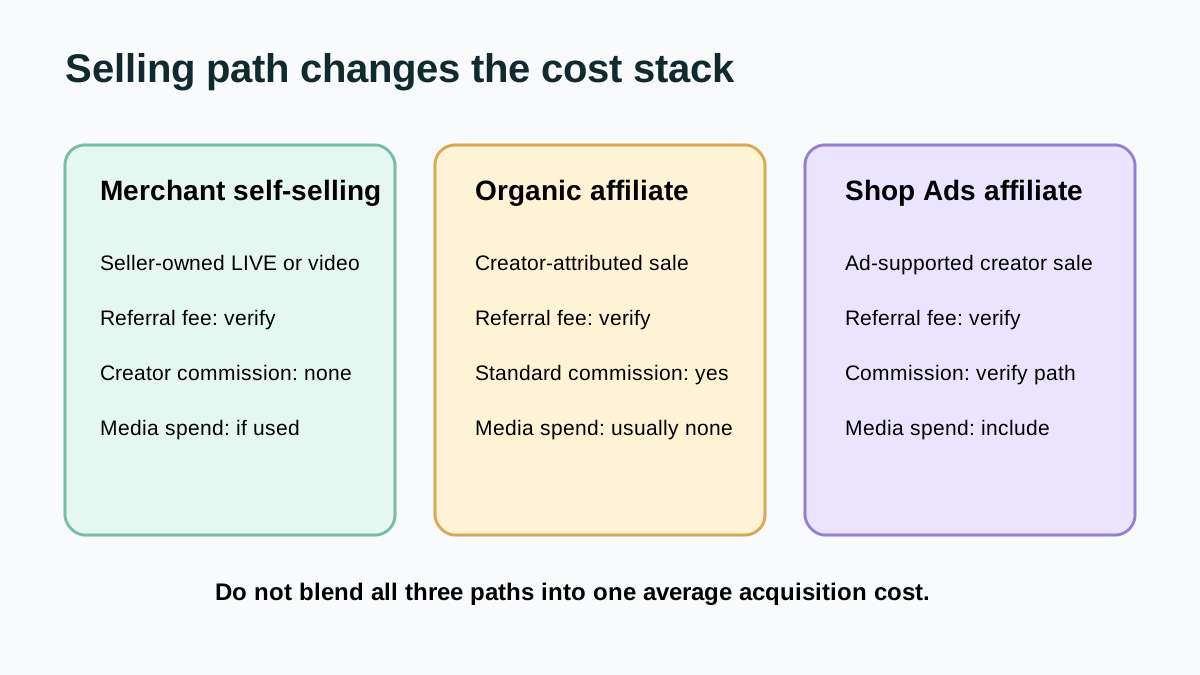
Fourth, enter creator commission only when the sale is attributed to an affiliate arrangement. TikTok distinguishes standard commission for organic affiliate sales from a Shop Ads commission rate that invited sellers may configure for ad-supported affiliate orders. Merchant self-selling through the seller's own content does not automatically create an affiliate commission. The order path determines which input belongs in the calculation.
Fifth, allocate only the discount the seller actually funds. A customer-facing coupon can be platform-funded, seller-funded, or shared. Subtracting the entire visible discount when TikTok funded part understates contribution; ignoring the seller-funded portion overstates it. Use settlement or promotion detail rather than the storefront badge.
Sixth, add attributed advertising cost per valid order. Divide spend by orders only after checking attribution, cancellations, refunds, and the reporting window. Seventh, add expected return loss. Eighth, include other variable costs such as samples, creator seeding, quality checks, payment adjustments, or per-order software when they are genuinely incremental. Keep fixed business overhead in a separate operating-profit view so the order worksheet remains explainable.
- Use SKU-level product and fulfillment costs, not the cheapest listing variation.
- Verify referral fees by market and category in Seller Center.
- Keep standard affiliate and Shop Ads commission inputs separate.
- Split platform-funded and seller-funded discount value.
- Use fulfilled, non-canceled orders when allocating ad spend.
- Model refunds, shipping, handling, recovery, and commission adjustments together.
Worked example: a $30 order can lose half its apparent margin
Consider a US order with a $30 product price and no buyer-paid shipping. The seller enters $8.50 landed product cost, $1.20 packaging, $4.80 outbound fulfillment, a 6% referral-fee assumption, an 8% creator commission, a $2 seller-funded coupon, and $3.50 attributed ad spend. Before return risk, contribution is $6.30: $30 minus $8.50 minus $1.20 minus $4.80 minus $1.80 minus $2.40 minus $2 minus $3.50. That is a 21% contribution margin, not the 72% gross margin suggested by price minus product cost.
Now compare merchant self-selling with no affiliate commission. Holding every other input constant raises contribution from $6.30 to $8.70. The difference is not evidence that creators are unprofitable; it shows exactly how much additional conversion volume or price room the affiliate path must produce to justify its commission. A seller can compare the two paths without mixing commission and ad spend into one unexplained acquisition number.
Finally, reserve $1.20 per order for expected return loss. The estimated contribution falls to $5.10, or 17%. If the business requires a 20% target contribution before fixed overhead, this scenario misses the threshold even though the order remains positive. The decision may be to adjust price, creator rate, coupon funding, ad cost, packaging, or fulfillment—not to assume that more revenue will repair the unit economics.
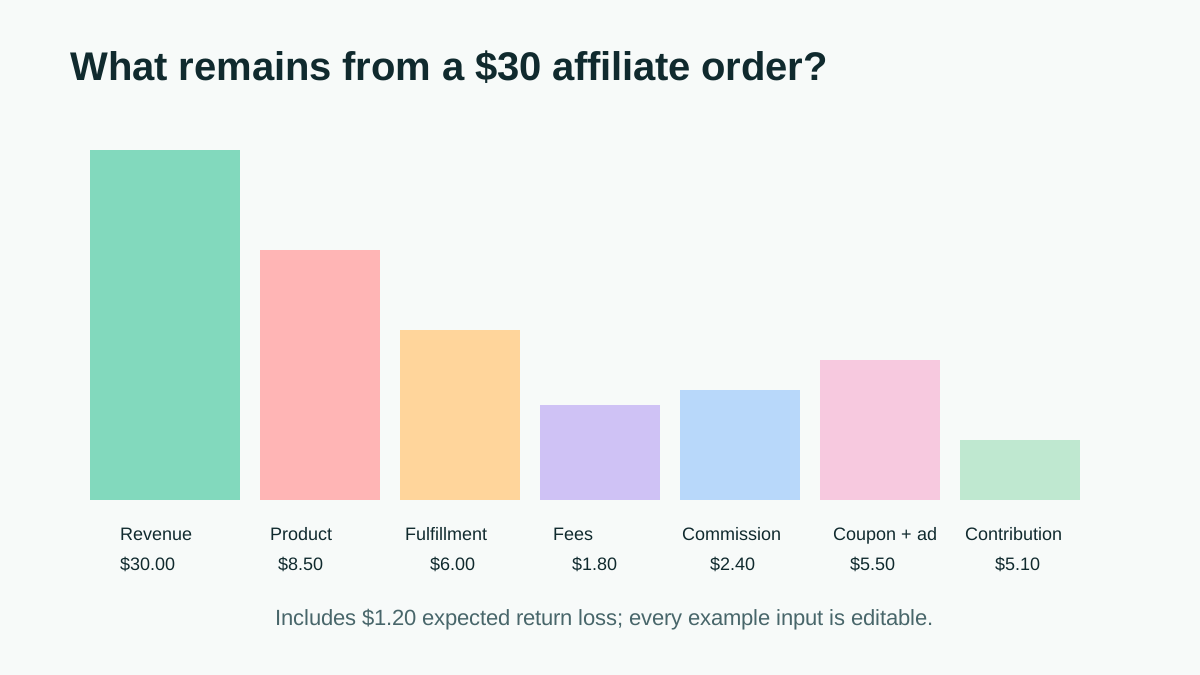
| Order layer | Affiliate example | Self-sold example |
|---|---|---|
| Seller-attributable revenue | $30.00 | $30.00 |
| Product + packaging + fulfillment | -$14.50 | -$14.50 |
| Referral fee assumption | -$1.80 | -$1.80 |
| Creator commission | -$2.40 | $0.00 |
| Seller coupon + ad spend | -$5.50 | -$5.50 |
| Expected return loss | -$1.20 | -$1.20 |
| Estimated contribution | $5.10 | $7.50 |
How refunds and returns change the real order result
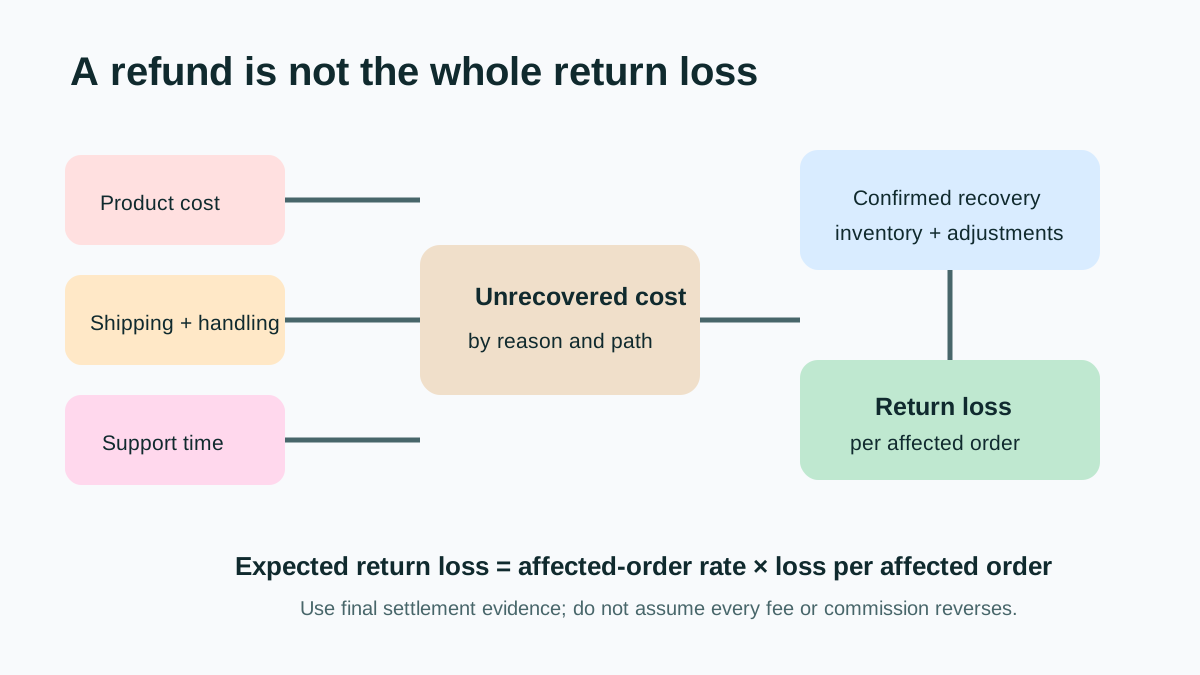
A refunded order is not simply a negative sale. The seller may retain product cost, packaging, outbound shipping, handling work, return shipping responsibility, damaged inventory, and support time. The product may return in resellable condition, return with a recovery discount, or never return under an allowed refund-without-return path. Build the loss from those components instead of entering the refund amount twice.
TikTok's US documentation describes different responsibility paths based on return reason and fulfillment method. It also explains that final creator commission changes with refunds: a partial refund reduces the commission basis and a full refund can reduce actual commission to zero. Treat those adjustments as evidence from the final settlement, not as an automatic recovery assumption in every scenario.
For planning, calculate loss per affected order as unrecovered product cost plus outbound and return fulfillment plus support or handling cost minus inventory recovery and confirmed fee or commission adjustments. Multiply that loss by a realistic affected-order rate to create expected return loss per order. Keep seller-fault and non-seller-fault cases separate because responsibility and recovery can differ materially.
- Do not count a commission reversal until the final order record confirms it.
- Separate refundable customer amounts from costs the seller cannot recover.
- Give damaged, personalized, consumable, and low-value products different recovery assumptions.
- Recheck the model when the return policy, fulfillment program, or subsidy changes.
A five-step calculator workflow before scaling ads or affiliates
Run the worksheet at the SKU and selling-path level. Blending a low-cost product with a heavy or fragile variation hides the exact unit that needs action. Blending merchant content and affiliate content hides the acquisition model. A small, explainable worksheet is more useful than a precise-looking blended dashboard.
Seller Profit Guard's cross-border calculators are planning tools. They do not connect to TikTok, do not verify eligibility, and do not replace the seller's statements, marketplace policies, bookkeeping, tax records, or professional advice. Save the rate, source, market, category, and review date beside each scenario.
- Choose one SKU and one selling path: merchant self-selling, organic affiliate, Shop Ads affiliate, or another clearly attributed route.
- Copy seller-attributable revenue and actual order charges from the final order or settlement view; identify which discounts are seller-funded.
- Enter landed product, packaging, fulfillment, referral fee, creator commission, advertising, and expected return-loss assumptions as separate fields.
- Compare base, higher-ad-cost, higher-return, and no-affiliate scenarios while preserving a target contribution amount.
- Investigate the largest cost layer, verify the applicable official source, and change one commercial assumption at a time before measuring the next cohort.
Seven TikTok Shop profit mistakes to avoid
The most common failure is using revenue minus product cost as profit. The second is using one platform fee for every market and category. The third is counting creator commission but forgetting ad spend on the same attributed order—or counting the same acquisition cost twice. The fourth is subtracting the full coupon value without checking who funded it.
The fifth mistake is using average fulfillment cost for every variation. The sixth is assuming all refunded fees, commission, shipping, and inventory value return automatically. The seventh is scaling on campaign ROAS while the product has insufficient contribution before ads. Each mistake can be prevented by keeping the eight layers visible and reconciling at least one order manually.
| Mistake | Why it distorts margin | Better control |
|---|---|---|
| Universal fee rate | Market and category rules differ | Store the observed rate, scope and review date |
| Blended acquisition cost | Affiliate and media costs become impossible to compare | Keep commission and ad spend separate |
| Full coupon deduction | Platform funding may be treated as seller cost | Use settlement-level funding detail |
| Return equals refund | Shipping, handling and recovery disappear | Model loss and confirmed recoveries by reason |
| ROAS equals profit | Product and fulfillment costs are ignored | Calculate contribution before allowable ad spend |
TikTok Shop profit calculator FAQ
What fee percentage should I use for TikTok Shop? Use the current rate shown for your market, category, program, and order. TikTok's US category documentation lists several rates, so this guide does not provide one universal global percentage.
Do I pay both affiliate commission and ad spend? Some selling paths can include creator commission and advertising cost. TikTok also documents separate standard and Shop Ads commission settings for eligible sellers. Use the attributed order and campaign records to determine which costs apply.
Should platform-funded discounts reduce my revenue? Do not treat a platform-funded amount as seller cost without evidence. Separate customer discount, platform contribution, seller contribution, and the revenue amount used in the final settlement.
How do I include returns in product margin? Estimate the unrecovered product, shipping, handling, support, and inventory loss per affected order, subtract confirmed recoveries, then multiply by a realistic affected-order rate. Reconcile actual outcomes later.
Is TikTok Shop ROAS the same as profit? No. ROAS compares attributed revenue with ad spend. Profit or operating contribution also accounts for product, packaging, fulfillment, referral fee, commission, discounts, returns, and other applicable costs.
Sources and further reading
- TikTok Shop US: Category Referral Rates: Official US category referral-fee table and category-specific exceptions.
- TikTok Shop: How Affiliate Commission Works: Official commission basis, refund adjustment, settlement timing, and merchant self-selling distinction.
- TikTok Business Help: Shop Ads Commission Rates: Official distinction between standard and Shop Ads commission rates for eligible sellers.
- TikTok Shop US: Cancellation, Return, and Refund Policy: Official US return, refund, shipping-responsibility, and fulfillment-path reference.
Related Seller Profit Guard tools
- Cross-border marketplace calculators: Model TikTok Shop margin, Shopify costs, break-even ROAS, and return loss with editable inputs.
- Break-even ROAS guide: Calculate allowable acquisition cost from contribution before ads.
- Return window loss estimator: Separate refunds, fulfillment, recovery, replacement, and support-time assumptions.
- Calculation methodology: Understand contribution scope, editable assumptions, and result limits.
- Creator Commission Formula: 14 Inputs: Build a TikTok Shop creator commission estimate from 14 labeled inputs, two commission paths, retained orders, and a target contribution threshold.
- Creator Commission Example: Standard Rate: Follow a complete TikTok Shop Standard commission example from eligible base and sample allocation to retained contribution and target-margin decision.
- Shop Ads Commission: Margin Scenario: Model TikTok Shop Ads commission separately from Standard commission, ad spend, authorization, attribution, and regional account rules.
- Coupon Stack Formula: 12 Inputs That Matter: Build a coupon-stack contribution formula from 12 explicit seller inputs while separating platform rules, funding, bases, and assumptions.
- Coupon Stack Example: From $60 to Contribution: Follow a complete $60 coupon-stack example through sequential discounts, fees, shipping, affiliate commission, costs, and target comparison.
- Coupon Plus Free Shipping and Affiliate Fees: Model a coupon with free shipping and affiliate commission without hiding application order, funding, fee bases, or acquisition cost.
- Affiliate Commission Formula and Inputs: Calculate contribution after percentage commission or flat bounty from one retained-order evidence packet, target, and mature cost record.
- Affiliate Commission Percentage Example: Follow a synthetic USD 85 retained order through a 12% commission, processing cost, contribution, margin, and target headroom.
- Affiliate Commission Flat-Bounty Model: Test a fixed bounty per retained order without disguising order-value, return, processing, attribution, agreement, and eligibility risk.
- Creator Sample Payback Formula and Inputs: Calculate creator-sample investment, retained-order contribution, payback orders, allocation, and campaign recovery from mature evidence.
- Creator Sample Payback Micro-Creator Example: Follow five synthetic samples and paid amplification through campaign investment, retained-order contribution, and payback.
- Creator Sample Payback for Larger Campaigns: Model a larger creator campaign with more samples, fixed fees, usage rights, paid amplification, and a longer recovery path.
- Free Gift Margin Formula and Inputs: Build gift-with-purchase economics from audience, baseline and scenario conversion, retained orders, gift cost, contribution, and payback.
- Free Gift Margin Example: Lightweight Sample: Follow a synthetic lightweight sample through promoted retained orders, added product and parcel cost, contribution, target, and payback.
- Free Gift Margin for a Full-Size Gift: Model a materially different full-size gift with more assumed conversion, product cost, weight, packaging, pick-pack, shipping, and loss.
Next step: Open the TikTok Shop profit calculator.
This is operational planning help, not tax, accounting, legal, financial, or platform-policy advice. Review the Terms and disclaimer, and verify current platform rules and fee assumptions before changing prices.