A product bundle margin audit checklist
Last updated: 2026-07-30
Written and reviewed by Seller Profit Guard Editorial Team.
A bundle audit should record packet ID, fixed or selected composition, component aliases, unit costs and quantities, bundle price and discount, buyer shipping, packaging, pick-pack, fulfillment, fees, acquisition, expected-loss inputs, target, currency, period, scope, equations, contribution, margin, target gap, safe discounts, decision, conflicts, reviewer, approved action, feedback, and rollback.
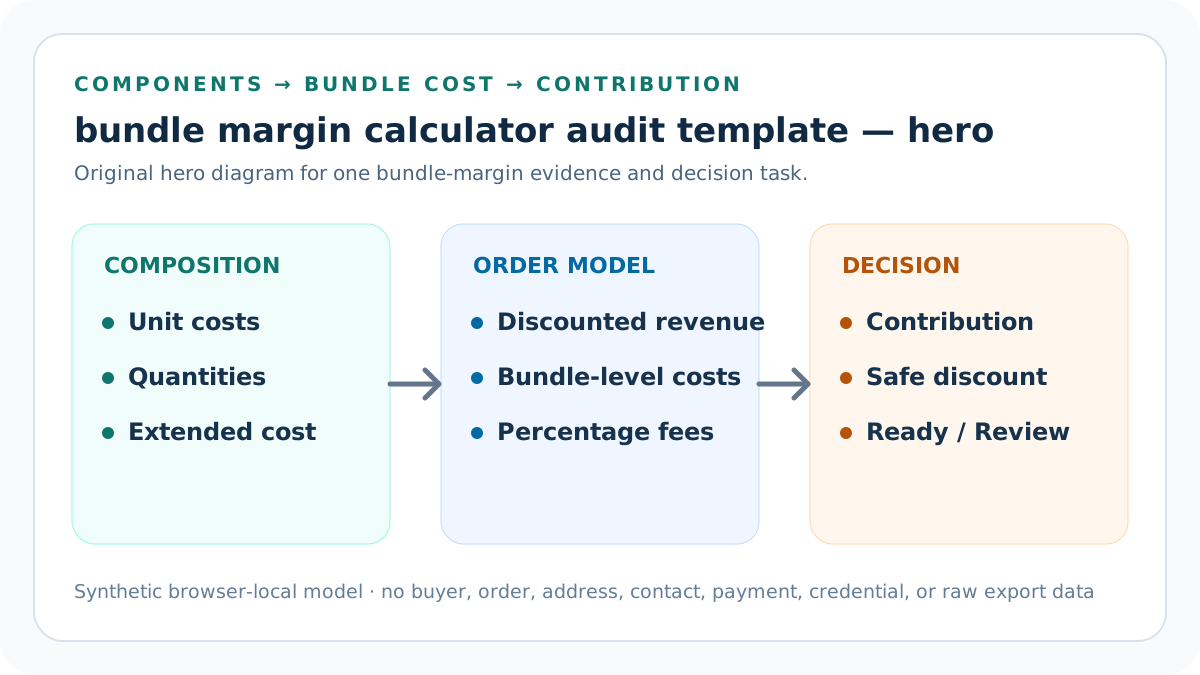
Record packet identity
Capture audit ID, nonprivate bundle alias, type, currency, period, scope, source-review date, owner, reviewer, and privacy class. Assign this record a stable field ID, declared data type, unit, evidence reference, effective date, privacy class, assertion owner, and review status. The packet must preserve the submitted value and the normalized value separately so silent coercion is visible.
Audit assertion A-01 passes only when a second reviewer can trace the field to one dated source, reproduce its transformation, and match the expected full-precision output. Record observed value, tolerance, pass or fail, reviewer, timestamp, and remediation reference in the assertion ledger.
Record component schedule
Capture alias, unit cost, quantity, extension, source, effective date, unit, and confidence. Assign this record a stable field ID, declared data type, unit, evidence reference, effective date, privacy class, assertion owner, and review status. The packet must preserve the submitted value and the normalized value separately so silent coercion is visible.
Audit assertion A-02 passes only when a second reviewer can trace the field to one dated source, reproduce its transformation, and match the expected full-precision output. Record observed value, tolerance, pass or fail, reviewer, timestamp, and remediation reference in the assertion ledger.
Record bundle-level costs
Capture packaging, labor, fulfillment, fixed fee, acquisition, expected loss, and other cost. Assign this record a stable field ID, declared data type, unit, evidence reference, effective date, privacy class, assertion owner, and review status. The packet must preserve the submitted value and the normalized value separately so silent coercion is visible.
Audit assertion A-03 passes only when a second reviewer can trace the field to one dated source, reproduce its transformation, and match the expected full-precision output. Record observed value, tolerance, pass or fail, reviewer, timestamp, and remediation reference in the assertion ledger.
Record commercial terms
Capture list price, discount, funding, buyer shipping, eligibility, and effective dates. Assign this record a stable field ID, declared data type, unit, evidence reference, effective date, privacy class, assertion owner, and review status. The packet must preserve the submitted value and the normalized value separately so silent coercion is visible.
Audit assertion A-04 passes only when a second reviewer can trace the field to one dated source, reproduce its transformation, and match the expected full-precision output. Record observed value, tolerance, pass or fail, reviewer, timestamp, and remediation reference in the assertion ledger.
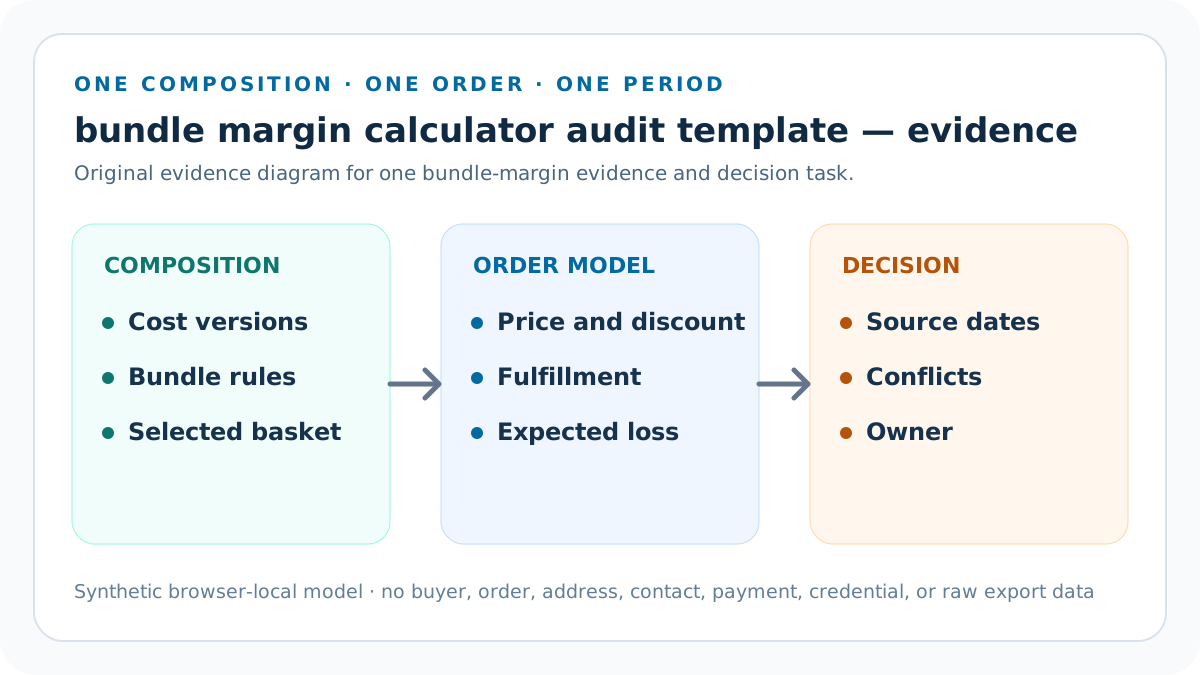
Assert equations
Recalculate component total, fixed pool, charged revenue, fees, contribution, margin, target gap, and safe discounts. Assign this record a stable field ID, declared data type, unit, evidence reference, effective date, privacy class, assertion owner, and review status. The packet must preserve the submitted value and the normalized value separately so silent coercion is visible.
Audit assertion A-05 passes only when a second reviewer can trace the field to one dated source, reproduce its transformation, and match the expected full-precision output. Record observed value, tolerance, pass or fail, reviewer, timestamp, and remediation reference in the assertion ledger.
Assert boundaries
Test row match, quantities, finite values, rates, denominator, source-review date, seven confirmations, context, conflicts, and discount threshold. Assign this record a stable field ID, declared data type, unit, evidence reference, effective date, privacy class, assertion owner, and review status. The packet must preserve the submitted value and the normalized value separately so silent coercion is visible.
Audit assertion A-06 passes only when a second reviewer can trace the field to one dated source, reproduce its transformation, and match the expected full-precision output. Record observed value, tolerance, pass or fail, reviewer, timestamp, and remediation reference in the assertion ledger.
Record change approval
Preserve prior and proposed values, source, reason, requester, reviewer, expected effect, and rollback ID. Assign this record a stable field ID, declared data type, unit, evidence reference, effective date, privacy class, assertion owner, and review status. The packet must preserve the submitted value and the normalized value separately so silent coercion is visible.
Audit assertion A-07 passes only when a second reviewer can trace the field to one dated source, reproduce its transformation, and match the expected full-precision output. Record observed value, tolerance, pass or fail, reviewer, timestamp, and remediation reference in the assertion ledger.
Record verification and feedback
Attach tests, build, content, similarity, browser, release, live, observed outcome, and restoration evidence. Assign this record a stable field ID, declared data type, unit, evidence reference, effective date, privacy class, assertion owner, and review status. The packet must preserve the submitted value and the normalized value separately so silent coercion is visible.
Audit assertion A-08 passes only when a second reviewer can trace the field to one dated source, reproduce its transformation, and match the expected full-precision output. Record observed value, tolerance, pass or fail, reviewer, timestamp, and remediation reference in the assertion ledger.
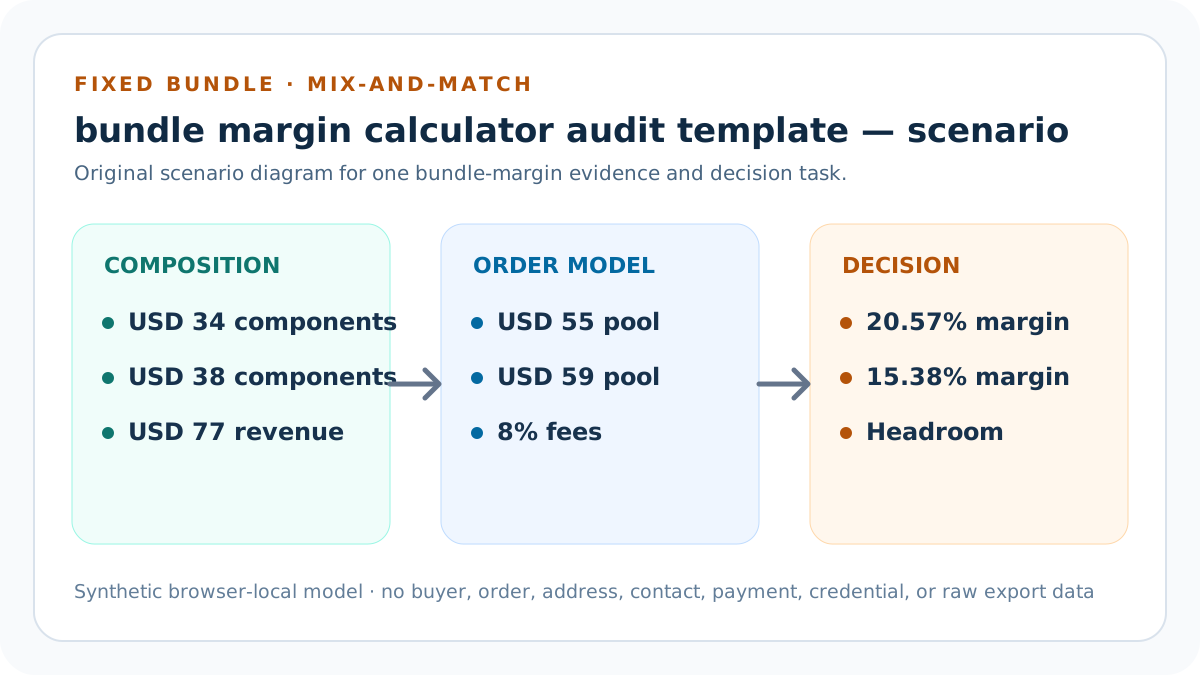
Hash the composition snapshot
Create a reproducible fingerprint from ordered component aliases, quantities, cost versions, and eligibility rules before any comparison. Assign this record a stable field ID, declared data type, unit, evidence reference, effective date, privacy class, assertion owner, and review status. The packet must preserve the submitted value and the normalized value separately so silent coercion is visible.
Audit assertion A-09 passes only when a second reviewer can trace the field to one dated source, reproduce its transformation, and match the expected full-precision output. Record observed value, tolerance, pass or fail, reviewer, timestamp, and remediation reference in the assertion ledger.
Reconcile displayed rounding
Preserve full-precision calculations beside displayed currency and percentage values so a reviewer can explain every rounding difference. Assign this record a stable field ID, declared data type, unit, evidence reference, effective date, privacy class, assertion owner, and review status. The packet must preserve the submitted value and the normalized value separately so silent coercion is visible.
Audit assertion A-10 passes only when a second reviewer can trace the field to one dated source, reproduce its transformation, and match the expected full-precision output. Record observed value, tolerance, pass or fail, reviewer, timestamp, and remediation reference in the assertion ledger.
Index conflicting evidence
List competing supplier costs, fulfillment quotes, fee interpretations, or return cohorts separately with an owner and resolution status. Assign this record a stable field ID, declared data type, unit, evidence reference, effective date, privacy class, assertion owner, and review status. The packet must preserve the submitted value and the normalized value separately so silent coercion is visible.
Audit assertion A-11 passes only when a second reviewer can trace the field to one dated source, reproduce its transformation, and match the expected full-precision output. Record observed value, tolerance, pass or fail, reviewer, timestamp, and remediation reference in the assertion ledger.
Link every assertion
Connect each input, equation, boundary, output, decision, and approved change to one privacy-safe evidence reference. Assign this record a stable field ID, declared data type, unit, evidence reference, effective date, privacy class, assertion owner, and review status. The packet must preserve the submitted value and the normalized value separately so silent coercion is visible.
Audit assertion A-12 passes only when a second reviewer can trace the field to one dated source, reproduce its transformation, and match the expected full-precision output. Record observed value, tolerance, pass or fail, reviewer, timestamp, and remediation reference in the assertion ledger.
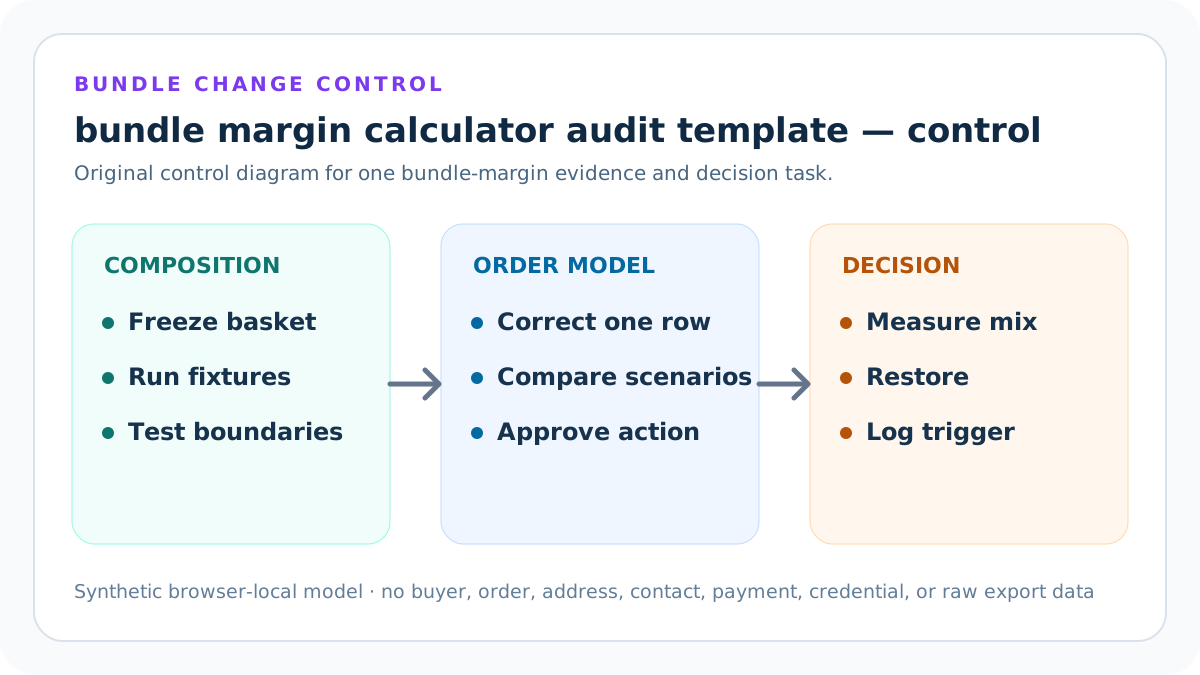
Seal the closure packet
Record the final reviewer, closure timestamp, observed outcome, unresolved limitation, restoration status, and next scheduled audit. Assign this record a stable field ID, declared data type, unit, evidence reference, effective date, privacy class, assertion owner, and review status. The packet must preserve the submitted value and the normalized value separately so silent coercion is visible.
Audit assertion A-13 passes only when a second reviewer can trace the field to one dated source, reproduce its transformation, and match the expected full-precision output. Record observed value, tolerance, pass or fail, reviewer, timestamp, and remediation reference in the assertion ledger.
Field dictionary and evidence manifest
Create one dictionary row for every component alias, quantity, unit cost, bundle-level cost, commercial term, context field, confirmation, conflict, formula output, decision, and change-control field. Require field ID, type, unit, nullable rule, accepted range, source owner, effective date, and privacy class.
Create a separate attachment manifest with evidence ID, source class, retrieved date, covered period, checksum, access boundary, and linked field IDs. Store only privacy-safe references in the public packet; private order rows and buyer data never become audit attachments.
Formula assertion table
List the component extension, component total, fixed pool, discounted product revenue, charged revenue, percentage fee, contribution, contribution margin, target contribution, target gap, safe discount, and discount headroom as separate assertions.
For each assertion record the exact equation, ordered inputs, expected full-precision value, observed full-precision value, display rule, accepted tolerance, status, and reviewer. A displayed rounding match cannot excuse a full-precision mismatch.
Boundary assertion table
Create explicit rows for component-count match, whole positive quantities, finite nonnegative costs, positive price, discount below 100%, valid rates, fee-plus-target below 100%, source date covering the evidence month, seven confirmations, currency, period, scope, and conflict status.
Each rejected fixture keeps its submitted value, rejection code, expected masked outputs, corrective owner, and retest result. A bundle remains Block when any required boundary lacks a passing assertion.
Immutable composition change log
Represent each added, removed, substituted, or quantity-changed component as its own append-only row. Include prior fingerprint, proposed fingerprint, changed field, old value, new value, evidence ID, reason, requester, approver, effective window, and restoration ID.
Recompute the ordered composition fingerprint after approval and compare it with the proposed fingerprint. Never overwrite the prior basket string, because an overwritten row cannot prove which cost or quantity changed the modeled contribution.
Before-and-after decision bridge
Start with the approved prior contribution, then bridge component cost, bundle-level cost, price, discount, shipping, fee, expected loss, and target movements one at a time until the proposed contribution and margin are reproduced.
The bridge total must equal the direct recalculation at full precision. Attribute status movement only to named bridge rows, and list demand, conversion, inventory compatibility, accounting profit, and tax effects as unsupported conclusions.
Verification evidence index
Index the supported fixtures, rejected fixtures, unit tests, integration tests, build, content audit, cross-cluster similarity audit, SEO audit, accessibility review, browser screenshots, release manifest, candidate response, live response, backup, and rollback artifact.
A verification entry includes command or check ID, environment, timestamp, expected result, observed result, status, artifact hash or path, and reviewer. Missing evidence is recorded as missing; it is never inferred from an earlier unrelated release.
Closure and restoration certificate
At closure, record the observation window, actual eligible mix, modeled versus observed contribution boundary, fulfillment or return exceptions, unresolved limitations, final decision, and next audit date. No-action is a valid decision when its evidence is preserved.
Prove restoration with the prior composition fingerprint, price, discount, route, calculation fixture, accessibility check, analytics boundary, and public response. The certificate passes only when the restored state is independently reproducible.
Assertion key schedule
Use keys for scope, component rows, quantities, bundle costs, revenue, fees, loss, target, contribution, safe discount, and decision. Give this control a unique evidence ID and record the input fingerprint, expected assertion set, observed assertion set, exception codes, reviewer, and closure status. Preserve the prior packet beside the amended packet instead of editing history in place.
Audit control C-01 closes only after an independent reviewer reproduces the referenced artifact, verifies its checksum, and signs the assertion or restoration result. Any missing attachment, unexplained tolerance, or unresolved conflict remains an open exception.
Composition change rows
Record added, removed, substituted, or quantity-changed components independently rather than overwriting one basket string. Give this control a unique evidence ID and record the input fingerprint, expected assertion set, observed assertion set, exception codes, reviewer, and closure status. Preserve the prior packet beside the amended packet instead of editing history in place.
Audit control C-02 closes only after an independent reviewer reproduces the referenced artifact, verifies its checksum, and signs the assertion or restoration result. Any missing attachment, unexplained tolerance, or unresolved conflict remains an open exception.
Verification index
Point every passed gate to a fresh command result, report, screenshot, backup, release identifier, or live response. Give this control a unique evidence ID and record the input fingerprint, expected assertion set, observed assertion set, exception codes, reviewer, and closure status. Preserve the prior packet beside the amended packet instead of editing history in place.
Audit control C-03 closes only after an independent reviewer reproduces the referenced artifact, verifies its checksum, and signs the assertion or restoration result. Any missing attachment, unexplained tolerance, or unresolved conflict remains an open exception.
Closure evidence
Reproduce supported fixtures, identify corrected assertions, compare exact before and after results, and attach feedback or no action. Give this control a unique evidence ID and record the input fingerprint, expected assertion set, observed assertion set, exception codes, reviewer, and closure status. Preserve the prior packet beside the amended packet instead of editing history in place.
Audit control C-04 closes only after an independent reviewer reproduces the referenced artifact, verifies its checksum, and signs the assertion or restoration result. Any missing attachment, unexplained tolerance, or unresolved conflict remains an open exception.
Restoration proof
Recover the prior composition, price, discount, route state, calculation behavior, accessibility, and analytics boundary. Give this control a unique evidence ID and record the input fingerprint, expected assertion set, observed assertion set, exception codes, reviewer, and closure status. Preserve the prior packet beside the amended packet instead of editing history in place.
Audit control C-05 closes only after an independent reviewer reproduces the referenced artifact, verifies its checksum, and signs the assertion or restoration result. Any missing attachment, unexplained tolerance, or unresolved conflict remains an open exception.
Sources and further reading
- Seller Profit Guard methodology: Calculation contracts, evidence precedence, deterministic fixtures, validation, correction, release, and rollback.
- Seller Profit Guard data privacy: Local-first boundaries for seller, buyer, order, payment, contact, credential, and raw export data.
- Shopify product bundles: First-party definitions for fixed, multipack, and mix-and-match component structures; platform eligibility remains outside this general model.
- Shopify bundle eligibility and considerations: First-party boundaries for bundle eligibility, compatibility, inventory, returns, and component line items; these remain outside this arithmetic model.
- SBA break-even point guidance: Primary U.S. small-business source for the selling-price contribution-margin denominator and variable-cost boundary.
- IRS Publication 334 (2025): Primary U.S. context for net receipts, cost of goods sold, gross profit, and later business expenses; this bundle model does not make a tax determination.
Related Seller Profit Guard tools
- Open the Product Bundle Margin Calculator: Extend component quantities and calculate bundle contribution and target-safe discount.
- Version component costs: Maintain dated component, packaging, labor, fulfillment, and expected-loss evidence.
- Calculate contribution margin: Run a forward order-level contribution equation from observed revenue and variable costs.
- Solve a product price floor: Calculate the list price required after discount, fees, shipping, variable costs, and target contribution.
- Estimate return-window loss: Build expected loss from affected-order frequency and unrecovered severity.
- Read the methodology: Review evidence, calculation, privacy, testing, release, correction, and rollback.
- Review data privacy: Keep private seller and buyer data outside public content.
- Bundle Margin Formula and Inputs: Continue with a distinct formula, example, source, threshold, comparison, operating, interpretation, or audit task.
- Fixed Bundle Margin Worked Example: Continue with a distinct formula, example, source, threshold, comparison, operating, interpretation, or audit task.
- Mix-and-Match Bundle Margin Example: Continue with a distinct formula, example, source, threshold, comparison, operating, interpretation, or audit task.
- Product Bundle Margin Mistakes: Continue with a distinct formula, example, source, threshold, comparison, operating, interpretation, or audit task.
- Reliable Product Bundle Margin Data: Continue with a distinct formula, example, source, threshold, comparison, operating, interpretation, or audit task.
Next step: Open the Product Bundle Margin Calculator.
This is operational planning help, not tax, accounting, legal, financial, or platform-policy advice. Review the Terms and disclaimer, and verify current platform rules and fee assumptions before changing prices.