What causes a false marketplace fee anomaly?
Last updated: 2026-07-31
Written and reviewed by Seller Profit Guard Editorial Team.
False fee anomalies usually come from mixing fee families, applying a current rate to an older event, using the wrong base, omitting fixed components, multiplying by an unsupported line count, comparing different currencies, or treating renewals, credits, reversals, and quantity triggers as duplicates.
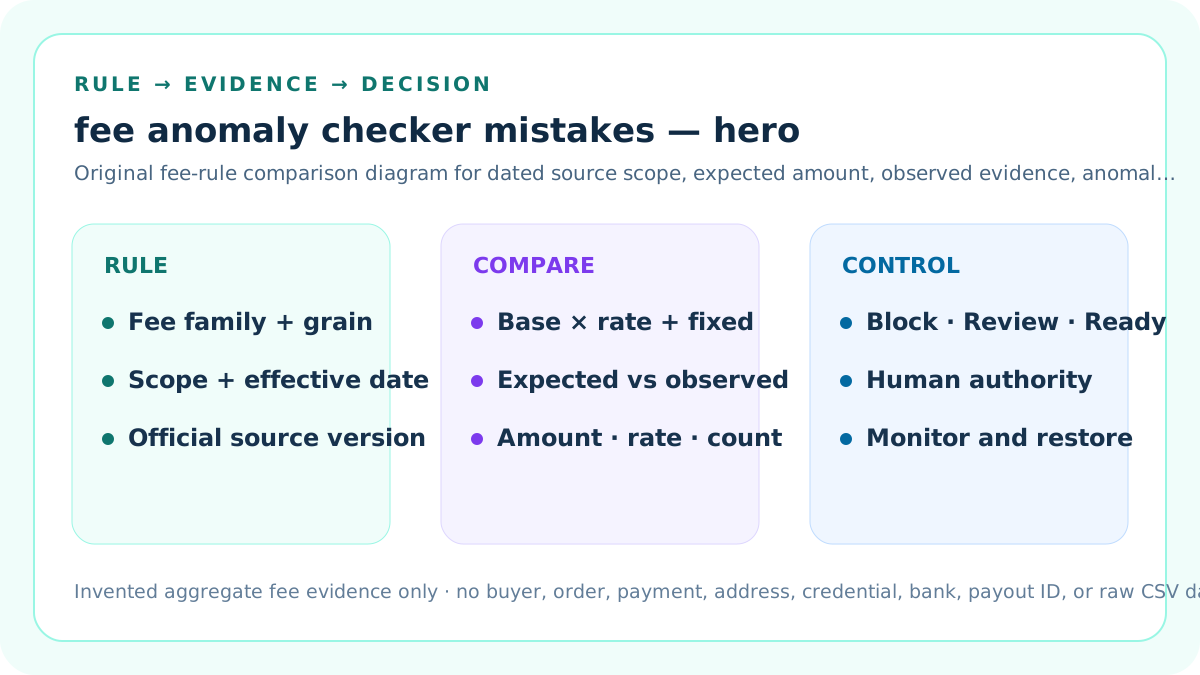
Mixed fee families
Do not compare processing with transaction fees. The correction register records the fee family, event grain, platform and market scope, base definition, percentage rate, fixed amount, currency, effective date, official source version, expected and observed amount, expected and observed line count, tolerance, owner, reviewer, exception, and prior accepted value needed for a defensible corrected packet.
At checkpoint 1, reperform the percentage-rate fixture and the fixed-fee line-count fixture plus one failing counterexample. Explain whether the evidence supports Ready, Review, or Block and name the exact rule, source, scope, privacy, correction, monitoring, or restoration conclusion still outside the public worksheet.
Stale rule
Do not apply a new rate retroactively. The correction register records the fee family, event grain, platform and market scope, base definition, percentage rate, fixed amount, currency, effective date, official source version, expected and observed amount, expected and observed line count, tolerance, owner, reviewer, exception, and prior accepted value needed for a defensible corrected packet.
At checkpoint 2, reperform the percentage-rate fixture and the fixed-fee line-count fixture plus one failing counterexample. Explain whether the evidence supports Ready, Review, or Block and name the exact rule, source, scope, privacy, correction, monitoring, or restoration conclusion still outside the public worksheet.
Wrong base
Reperform discounts, shipping, tax, and credit inclusion. The correction register records the fee family, event grain, platform and market scope, base definition, percentage rate, fixed amount, currency, effective date, official source version, expected and observed amount, expected and observed line count, tolerance, owner, reviewer, exception, and prior accepted value needed for a defensible corrected packet.
At checkpoint 3, reperform the percentage-rate fixture and the fixed-fee line-count fixture plus one failing counterexample. Explain whether the evidence supports Ready, Review, or Block and name the exact rule, source, scope, privacy, correction, monitoring, or restoration conclusion still outside the public worksheet.
Missing fixed fee
Do not model percentage alone when a fixed amount applies. The correction register records the fee family, event grain, platform and market scope, base definition, percentage rate, fixed amount, currency, effective date, official source version, expected and observed amount, expected and observed line count, tolerance, owner, reviewer, exception, and prior accepted value needed for a defensible corrected packet.
At checkpoint 4, reperform the percentage-rate fixture and the fixed-fee line-count fixture plus one failing counterexample. Explain whether the evidence supports Ready, Review, or Block and name the exact rule, source, scope, privacy, correction, monitoring, or restoration conclusion still outside the public worksheet.
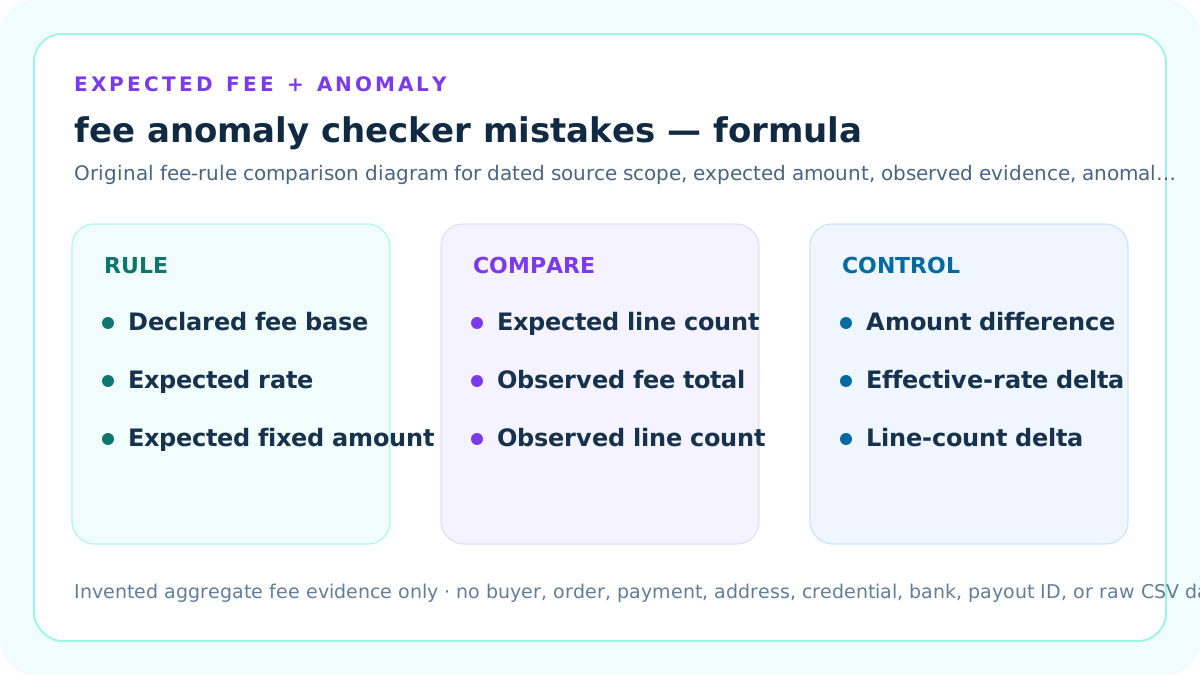
Wrong event count
Derive count from supported triggers. The correction register records the fee family, event grain, platform and market scope, base definition, percentage rate, fixed amount, currency, effective date, official source version, expected and observed amount, expected and observed line count, tolerance, owner, reviewer, exception, and prior accepted value needed for a defensible corrected packet.
At checkpoint 5, reperform the percentage-rate fixture and the fixed-fee line-count fixture plus one failing counterexample. Explain whether the evidence supports Ready, Review, or Block and name the exact rule, source, scope, privacy, correction, monitoring, or restoration conclusion still outside the public worksheet.
Mixed currency
Keep fee and base currencies explicit. The correction register records the fee family, event grain, platform and market scope, base definition, percentage rate, fixed amount, currency, effective date, official source version, expected and observed amount, expected and observed line count, tolerance, owner, reviewer, exception, and prior accepted value needed for a defensible corrected packet.
At checkpoint 6, reperform the percentage-rate fixture and the fixed-fee line-count fixture plus one failing counterexample. Explain whether the evidence supports Ready, Review, or Block and name the exact rule, source, scope, privacy, correction, monitoring, or restoration conclusion still outside the public worksheet.
Conversion timing
Use the documented conversion event. The correction register records the fee family, event grain, platform and market scope, base definition, percentage rate, fixed amount, currency, effective date, official source version, expected and observed amount, expected and observed line count, tolerance, owner, reviewer, exception, and prior accepted value needed for a defensible corrected packet.
At checkpoint 7, reperform the percentage-rate fixture and the fixed-fee line-count fixture plus one failing counterexample. Explain whether the evidence supports Ready, Review, or Block and name the exact rule, source, scope, privacy, correction, monitoring, or restoration conclusion still outside the public worksheet.
Refund assumption
Check whether the fee is credited. The correction register records the fee family, event grain, platform and market scope, base definition, percentage rate, fixed amount, currency, effective date, official source version, expected and observed amount, expected and observed line count, tolerance, owner, reviewer, exception, and prior accepted value needed for a defensible corrected packet.
At checkpoint 8, reperform the percentage-rate fixture and the fixed-fee line-count fixture plus one failing counterexample. Explain whether the evidence supports Ready, Review, or Block and name the exact rule, source, scope, privacy, correction, monitoring, or restoration conclusion still outside the public worksheet.
Credit or reversal
Preserve sign and role. The correction register records the fee family, event grain, platform and market scope, base definition, percentage rate, fixed amount, currency, effective date, official source version, expected and observed amount, expected and observed line count, tolerance, owner, reviewer, exception, and prior accepted value needed for a defensible corrected packet.
At checkpoint 9, reperform the percentage-rate fixture and the fixed-fee line-count fixture plus one failing counterexample. Explain whether the evidence supports Ready, Review, or Block and name the exact rule, source, scope, privacy, correction, monitoring, or restoration conclusion still outside the public worksheet.
Rounding drift
Measure platform minor-unit behavior. The correction register records the fee family, event grain, platform and market scope, base definition, percentage rate, fixed amount, currency, effective date, official source version, expected and observed amount, expected and observed line count, tolerance, owner, reviewer, exception, and prior accepted value needed for a defensible corrected packet.
At checkpoint 10, reperform the percentage-rate fixture and the fixed-fee line-count fixture plus one failing counterexample. Explain whether the evidence supports Ready, Review, or Block and name the exact rule, source, scope, privacy, correction, monitoring, or restoration conclusion still outside the public worksheet.
Duplicate assumption
Repeated context is not proof. The correction register records the fee family, event grain, platform and market scope, base definition, percentage rate, fixed amount, currency, effective date, official source version, expected and observed amount, expected and observed line count, tolerance, owner, reviewer, exception, and prior accepted value needed for a defensible corrected packet.
At checkpoint 11, reperform the percentage-rate fixture and the fixed-fee line-count fixture plus one failing counterexample. Explain whether the evidence supports Ready, Review, or Block and name the exact rule, source, scope, privacy, correction, monitoring, or restoration conclusion still outside the public worksheet.
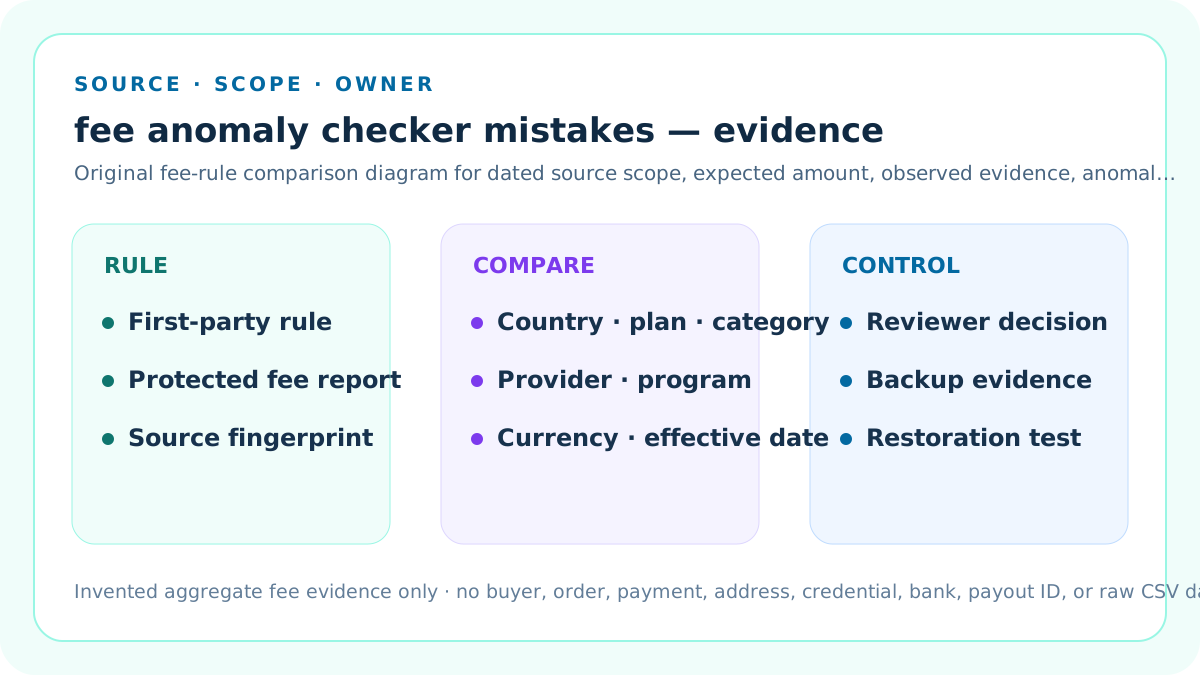
Wide tolerance
Do not hide recurring source gaps. The correction register records the fee family, event grain, platform and market scope, base definition, percentage rate, fixed amount, currency, effective date, official source version, expected and observed amount, expected and observed line count, tolerance, owner, reviewer, exception, and prior accepted value needed for a defensible corrected packet.
At checkpoint 12, reperform the percentage-rate fixture and the fixed-fee line-count fixture plus one failing counterexample. Explain whether the evidence supports Ready, Review, or Block and name the exact rule, source, scope, privacy, correction, monitoring, or restoration conclusion still outside the public worksheet.
Fee Anomaly Mistakes and Corrections: rule integrity control
Keep fee family, platform, country, plan, provider, category, program, base, rate, fixed amount, currency, event grain, effective date, and source version aligned. Control 1 defines a pass condition, evidence pointer, reviewer question, correction deadline, rejected shortcut, monitoring signal, stop condition, and restoration trigger for a defensible corrected packet.
Mixed rule scope Blocks interpretation. Keep fee checking separate from payout reconciliation, contribution, accounting, tax, legal analysis, platform compliance, and dispute authority.
Fee Anomaly Mistakes and Corrections: evidence integrity control
Preserve protected report fingerprints, fee roles, counts, reversals, credits, rounding, and source dates before aggregation. Control 2 defines a pass condition, evidence pointer, reviewer question, correction deadline, rejected shortcut, monitoring signal, stop condition, and restoration trigger for a defensible corrected packet.
Public fixtures remain invented. Keep fee checking separate from payout reconciliation, contribution, accounting, tax, legal analysis, platform compliance, and dispute authority.
Fee Anomaly Mistakes and Corrections: privacy and minimization control
Use synthetic amounts and labels publicly while operational orders, buyers, payments, addresses, bank data, credentials, and raw exports stay protected. Control 3 defines a pass condition, evidence pointer, reviewer question, correction deadline, rejected shortcut, monitoring signal, stop condition, and restoration trigger for a defensible corrected packet.
Never echo private records. Keep fee checking separate from payout reconciliation, contribution, accounting, tax, legal analysis, platform compliance, and dispute authority.
Fee Anomaly Mistakes and Corrections: human authority control
Require evidence owners, independent reviewer, correction approver, monitoring owner, stop authority, and restoration owner. Control 4 defines a pass condition, evidence pointer, reviewer question, correction deadline, rejected shortcut, monitoring signal, stop condition, and restoration trigger for a defensible corrected packet.
Ready cannot authorize a dispute. Keep fee checking separate from payout reconciliation, contribution, accounting, tax, legal analysis, platform compliance, and dispute authority.
Fee Anomaly Mistakes and Corrections: monitoring and escalation control
Track changed rules, recurring residuals, line-count patterns, aging, reversals, and prior decisions. Control 5 defines a pass condition, evidence pointer, reviewer question, correction deadline, rejected shortcut, monitoring signal, stop condition, and restoration trigger for a defensible corrected packet.
Stop on unexplained discontinuity. Keep fee checking separate from payout reconciliation, contribution, accounting, tax, legal analysis, platform compliance, and dispute authority.
Fee Anomaly Mistakes and Corrections: backup and restoration control
Preserve prior rules, mappings, packets, exception logs, downstream state, and tested recovery. Control 6 defines a pass condition, evidence pointer, reviewer question, correction deadline, rejected shortcut, monitoring signal, stop condition, and restoration trigger for a defensible corrected packet.
Rollback evidence is mandatory. Keep fee checking separate from payout reconciliation, contribution, accounting, tax, legal analysis, platform compliance, and dispute authority.
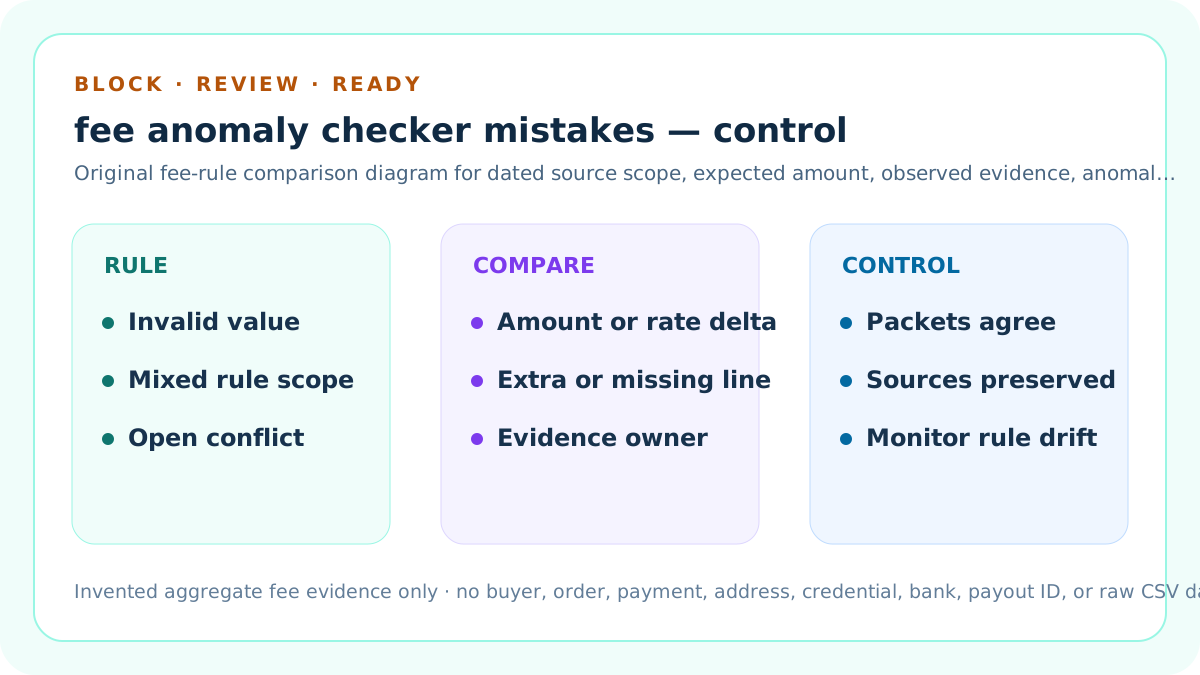
Fee Anomaly Mistakes and Corrections: versioned governance control
Record a nonfuture source-review date covering the evidence month, policy-effective date, per-packet rule-effective and event dates in chronological order, minimum evidence duration, bounded monetary inputs, maximum line bound, nine required confirmations, and distinct percentage versus fixed-fee packets. Control 7 defines a pass condition, evidence pointer, reviewer question, correction deadline, rejected shortcut, monitoring signal, stop condition, and restoration trigger for a defensible corrected packet.
Invalid controls mask derived outputs. Keep fee checking separate from payout reconciliation, contribution, accounting, tax, legal analysis, platform compliance, and dispute authority.
Mixed fee families: fee evidence lab 1
Reperform both synthetic packets. Do not compare processing with transaction fees. Change one fee family, base, rate, fixed amount, observed amount, count, currency, effective date, scope, source version, tolerance, context, or conflict only; preserve all other values and record the resulting amount, effective-rate, line-count, and decision outputs.
Use invented values only. Test clean, boundary, positive, negative, missing-line, duplicate-line, stale-rule, wrong-base, malformed, and open-conflict states, then state the protected evidence, named authority, downstream check, monitoring signal, and restoration action required before acting.
Stale rule: fee evidence lab 2
Reperform both synthetic packets. Do not apply a new rate retroactively. Change one fee family, base, rate, fixed amount, observed amount, count, currency, effective date, scope, source version, tolerance, context, or conflict only; preserve all other values and record the resulting amount, effective-rate, line-count, and decision outputs.
Use invented values only. Test clean, boundary, positive, negative, missing-line, duplicate-line, stale-rule, wrong-base, malformed, and open-conflict states, then state the protected evidence, named authority, downstream check, monitoring signal, and restoration action required before acting.
Wrong base: fee evidence lab 3
Reperform both synthetic packets. Reperform discounts, shipping, tax, and credit inclusion. Change one fee family, base, rate, fixed amount, observed amount, count, currency, effective date, scope, source version, tolerance, context, or conflict only; preserve all other values and record the resulting amount, effective-rate, line-count, and decision outputs.
Use invented values only. Test clean, boundary, positive, negative, missing-line, duplicate-line, stale-rule, wrong-base, malformed, and open-conflict states, then state the protected evidence, named authority, downstream check, monitoring signal, and restoration action required before acting.
Missing fixed fee: fee evidence lab 4
Reperform both synthetic packets. Do not model percentage alone when a fixed amount applies. Change one fee family, base, rate, fixed amount, observed amount, count, currency, effective date, scope, source version, tolerance, context, or conflict only; preserve all other values and record the resulting amount, effective-rate, line-count, and decision outputs.
Use invented values only. Test clean, boundary, positive, negative, missing-line, duplicate-line, stale-rule, wrong-base, malformed, and open-conflict states, then state the protected evidence, named authority, downstream check, monitoring signal, and restoration action required before acting.
Wrong event count: fee evidence lab 5
Reperform both synthetic packets. Derive count from supported triggers. Change one fee family, base, rate, fixed amount, observed amount, count, currency, effective date, scope, source version, tolerance, context, or conflict only; preserve all other values and record the resulting amount, effective-rate, line-count, and decision outputs.
Use invented values only. Test clean, boundary, positive, negative, missing-line, duplicate-line, stale-rule, wrong-base, malformed, and open-conflict states, then state the protected evidence, named authority, downstream check, monitoring signal, and restoration action required before acting.
Mixed currency: fee evidence lab 6
Reperform both synthetic packets. Keep fee and base currencies explicit. Change one fee family, base, rate, fixed amount, observed amount, count, currency, effective date, scope, source version, tolerance, context, or conflict only; preserve all other values and record the resulting amount, effective-rate, line-count, and decision outputs.
Use invented values only. Test clean, boundary, positive, negative, missing-line, duplicate-line, stale-rule, wrong-base, malformed, and open-conflict states, then state the protected evidence, named authority, downstream check, monitoring signal, and restoration action required before acting.
Conversion timing: fee evidence lab 7
Reperform both synthetic packets. Use the documented conversion event. Change one fee family, base, rate, fixed amount, observed amount, count, currency, effective date, scope, source version, tolerance, context, or conflict only; preserve all other values and record the resulting amount, effective-rate, line-count, and decision outputs.
Use invented values only. Test clean, boundary, positive, negative, missing-line, duplicate-line, stale-rule, wrong-base, malformed, and open-conflict states, then state the protected evidence, named authority, downstream check, monitoring signal, and restoration action required before acting.
Refund assumption: fee evidence lab 8
Reperform both synthetic packets. Check whether the fee is credited. Change one fee family, base, rate, fixed amount, observed amount, count, currency, effective date, scope, source version, tolerance, context, or conflict only; preserve all other values and record the resulting amount, effective-rate, line-count, and decision outputs.
Use invented values only. Test clean, boundary, positive, negative, missing-line, duplicate-line, stale-rule, wrong-base, malformed, and open-conflict states, then state the protected evidence, named authority, downstream check, monitoring signal, and restoration action required before acting.
Credit or reversal: fee evidence lab 9
Reperform both synthetic packets. Preserve sign and role. Change one fee family, base, rate, fixed amount, observed amount, count, currency, effective date, scope, source version, tolerance, context, or conflict only; preserve all other values and record the resulting amount, effective-rate, line-count, and decision outputs.
Use invented values only. Test clean, boundary, positive, negative, missing-line, duplicate-line, stale-rule, wrong-base, malformed, and open-conflict states, then state the protected evidence, named authority, downstream check, monitoring signal, and restoration action required before acting.
Rounding drift: fee evidence lab 10
Reperform both synthetic packets. Measure platform minor-unit behavior. Change one fee family, base, rate, fixed amount, observed amount, count, currency, effective date, scope, source version, tolerance, context, or conflict only; preserve all other values and record the resulting amount, effective-rate, line-count, and decision outputs.
Use invented values only. Test clean, boundary, positive, negative, missing-line, duplicate-line, stale-rule, wrong-base, malformed, and open-conflict states, then state the protected evidence, named authority, downstream check, monitoring signal, and restoration action required before acting.
Duplicate assumption: fee evidence lab 11
Reperform both synthetic packets. Repeated context is not proof. Change one fee family, base, rate, fixed amount, observed amount, count, currency, effective date, scope, source version, tolerance, context, or conflict only; preserve all other values and record the resulting amount, effective-rate, line-count, and decision outputs.
Use invented values only. Test clean, boundary, positive, negative, missing-line, duplicate-line, stale-rule, wrong-base, malformed, and open-conflict states, then state the protected evidence, named authority, downstream check, monitoring signal, and restoration action required before acting.
Wide tolerance: fee evidence lab 12
Reperform both synthetic packets. Do not hide recurring source gaps. Change one fee family, base, rate, fixed amount, observed amount, count, currency, effective date, scope, source version, tolerance, context, or conflict only; preserve all other values and record the resulting amount, effective-rate, line-count, and decision outputs.
Use invented values only. Test clean, boundary, positive, negative, missing-line, duplicate-line, stale-rule, wrong-base, malformed, and open-conflict states, then state the protected evidence, named authority, downstream check, monitoring signal, and restoration action required before acting.
Fee Anomaly Mistakes and Corrections: intent-specific implementation walkthrough
correction register checkpoint 1 addresses mixed fee families for a defensible corrected packet. Do not compare processing with transaction fees. Record the accepted classification, rejected shortcut, evidence owner, reviewer challenge, correction boundary, follow-up date, monitoring trigger, and rollback reference.
correction register checkpoint 2 addresses stale rule for a defensible corrected packet. Do not apply a new rate retroactively. Record the accepted classification, rejected shortcut, evidence owner, reviewer challenge, correction boundary, follow-up date, monitoring trigger, and rollback reference.
correction register checkpoint 3 addresses wrong base for a defensible corrected packet. Reperform discounts, shipping, tax, and credit inclusion. Record the accepted classification, rejected shortcut, evidence owner, reviewer challenge, correction boundary, follow-up date, monitoring trigger, and rollback reference.
correction register checkpoint 4 addresses missing fixed fee for a defensible corrected packet. Do not model percentage alone when a fixed amount applies. Record the accepted classification, rejected shortcut, evidence owner, reviewer challenge, correction boundary, follow-up date, monitoring trigger, and rollback reference.
correction register checkpoint 5 addresses wrong event count for a defensible corrected packet. Derive count from supported triggers. Record the accepted classification, rejected shortcut, evidence owner, reviewer challenge, correction boundary, follow-up date, monitoring trigger, and rollback reference.
correction register checkpoint 6 addresses mixed currency for a defensible corrected packet. Keep fee and base currencies explicit. Record the accepted classification, rejected shortcut, evidence owner, reviewer challenge, correction boundary, follow-up date, monitoring trigger, and rollback reference.
correction register checkpoint 7 addresses conversion timing for a defensible corrected packet. Use the documented conversion event. Record the accepted classification, rejected shortcut, evidence owner, reviewer challenge, correction boundary, follow-up date, monitoring trigger, and rollback reference.
correction register checkpoint 8 addresses refund assumption for a defensible corrected packet. Check whether the fee is credited. Record the accepted classification, rejected shortcut, evidence owner, reviewer challenge, correction boundary, follow-up date, monitoring trigger, and rollback reference.
correction register checkpoint 9 addresses credit or reversal for a defensible corrected packet. Preserve sign and role. Record the accepted classification, rejected shortcut, evidence owner, reviewer challenge, correction boundary, follow-up date, monitoring trigger, and rollback reference.
correction register checkpoint 10 addresses rounding drift for a defensible corrected packet. Measure platform minor-unit behavior. Record the accepted classification, rejected shortcut, evidence owner, reviewer challenge, correction boundary, follow-up date, monitoring trigger, and rollback reference.
correction register checkpoint 11 addresses duplicate assumption for a defensible corrected packet. Repeated context is not proof. Record the accepted classification, rejected shortcut, evidence owner, reviewer challenge, correction boundary, follow-up date, monitoring trigger, and rollback reference.
correction register checkpoint 12 addresses wide tolerance for a defensible corrected packet. Do not hide recurring source gaps. Record the accepted classification, rejected shortcut, evidence owner, reviewer challenge, correction boundary, follow-up date, monitoring trigger, and rollback reference.
Evidence boundary for a defensible corrected packet
The default percentage packet uses an invented USD 100 base, 6.5% expected rate, zero fixed amount, one expected and observed line, and USD 6.50 observed total. The fixed-fee packet uses zero base, zero percentage, USD 0.20 expected fixed amount, one expected and observed line, and USD 0.20 observed total.
These invented values demonstrate arithmetic only. They cannot prove overcharging, source completeness, loss, platform fault, duplicate production rows, correct accounting, tax treatment, regulatory treatment, contract rights, or dispute authority.
Release, monitor, and restore the correction register
Block invalid numeric inputs, noninteger counts, short fee labels or context, invalid tolerances, currency, period, evidence scope, privacy, or open conflicts. Review amount, rate, or count differences. Ready clears only the entered synthetic packets.
Before indexing or operational use, preserve backups and run type, unit, integration, build, content, similarity, SEO, image, link, privacy, mobile, deployment, and live checks; then monitor drift without claiming search or financial causality.
Sources and further reading
- Etsy Help: Fees and taxes for selling: Official fee families, bases, currencies, country differences, and current boundaries.
- Etsy Help: Fee basics: Official listing-event, multi-quantity, transaction, and processing-fee distinctions.
- Shopify Help: Third-party transaction fees: Official formula, plan dependency, exemptions, refund treatment, and billing report.
- Shopify Help: Third-party payment providers: Official provider, location, payment-method, and waiver boundaries.
- TikTok Shop: Check Tax Invoices: Official invoice detail and fee-family coverage.
- TikTok Shop: Referral fees by category: Official category and effective-date rate examples.
- Seller Profit Guard methodology: Evidence, correction, release, monitoring, and rollback controls.
- Seller Profit Guard data privacy: Synthetic public examples and protected operational-data boundaries.
Related Seller Profit Guard tools
- Marketplace Fee Anomaly Checker: Run the browser-local synthetic fee-rule comparison.
- Marketplace Payout Anomaly Checker: Bridge platform balances after fee evidence is classified.
- Seller CSV Column Mapper: Map fee evidence into stable protected fields.
- Duplicate Order Checker: Separate repeated keys from legitimate multi-event rows.
- Etsy Fee Reference Helper: Model editable planning assumptions separately.
- Methodology: Apply evidence and rollback controls.
- Data Privacy: Protect orders, buyers, payments, and raw exports.
- Fee Anomaly Formula and Input Contract: Define fee family, event grain, base, percentage rate, fixed amount, expected line count, observed evidence, tolerances, and rule scope.
- Fee Anomaly Worked Example: Changed Rate: Reperform a percentage-fee example, change only the observed amount, and trace the resulting effective-rate difference and review decision.
- Fee Anomaly Review for a Duplicate Line: Use a fixed-fee event to distinguish a true duplicate candidate from a legitimate second trigger, credit, renewal, or quantity event.
- Marketplace Fee Evidence Source Map: Map rule snapshots and protected statement evidence to every checker input without exposing private orders or payment data.
- Safe Fee Anomaly Decision Thresholds: Set minor-unit, rounding, rate-point, count, recurrence, age, materiality, and source-confidence controls without hiding a wrong rule.
- Changed Rate vs Duplicate Fee Line: Compare a percentage-rate difference and an extra fixed-fee line at the same evidence grain, then show why their investigation paths diverge.
- Weekly Marketplace Fee Review Routine: Turn rule preservation, fee classification, synthetic regression, exception ownership, approval, monitoring, and restoration into a repeatable control.
- Interpret Fee Anomalies Without False Precision: Explain what zero, positive, negative, rate-only, count-only, recurring, and aged fee differences prove, cannot prove, and require next.
- Fee Anomaly Audit and Change Log: Provide a standalone rule, input, source, exception, correction, monitoring, and restoration record for repeatable marketplace fee review.
Next step: Open Seller Profit Guard.
This is operational planning help, not tax, accounting, legal, financial, or platform-policy advice. Review the Terms and disclaimer, and verify current platform rules and fee assumptions before changing prices.