Where to get reliable Etsy Offsite Ads margin inputs
Last updated: 2026-07-30
Written and reviewed by Seller Profit Guard Editorial Team.
Use Etsy’s current Help and policy pages for attribution, rates, fee base, threshold, and cap; the Offsite Ads dashboard for attributed-order context; the Payment account and monthly statement for actual fees, refunds, and credits; and current SKU, labor, packaging, carrier, and return records for direct costs and expected loss.

Offsite Ads source hierarchy: scope and decision
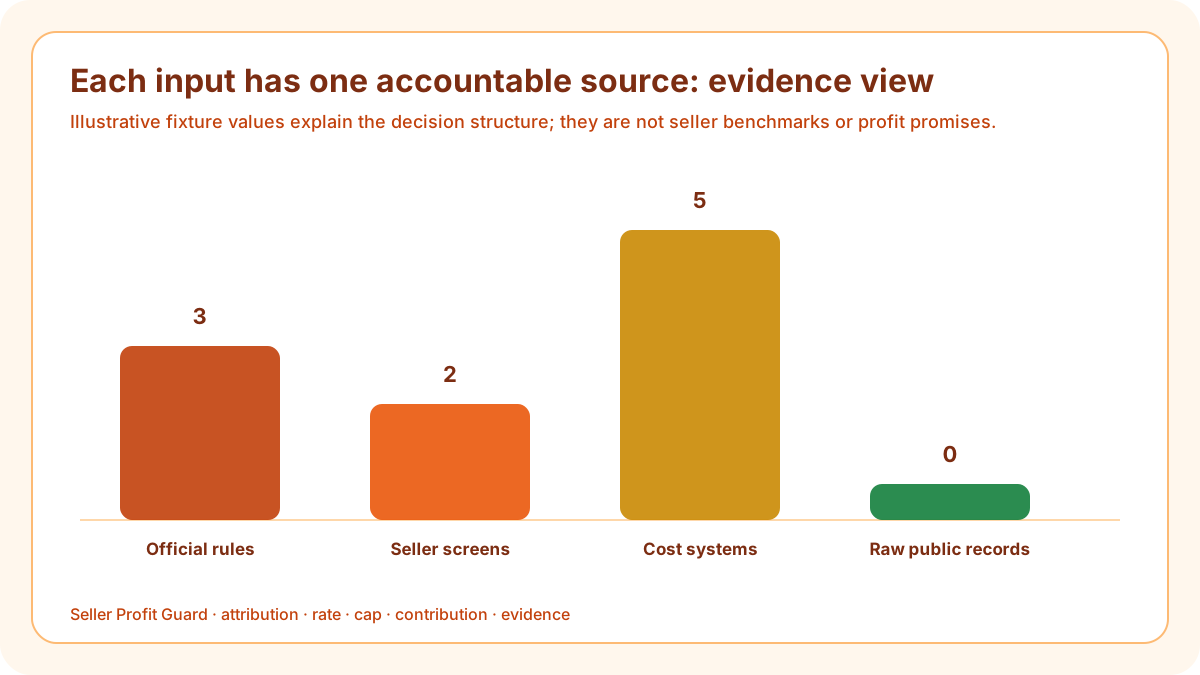
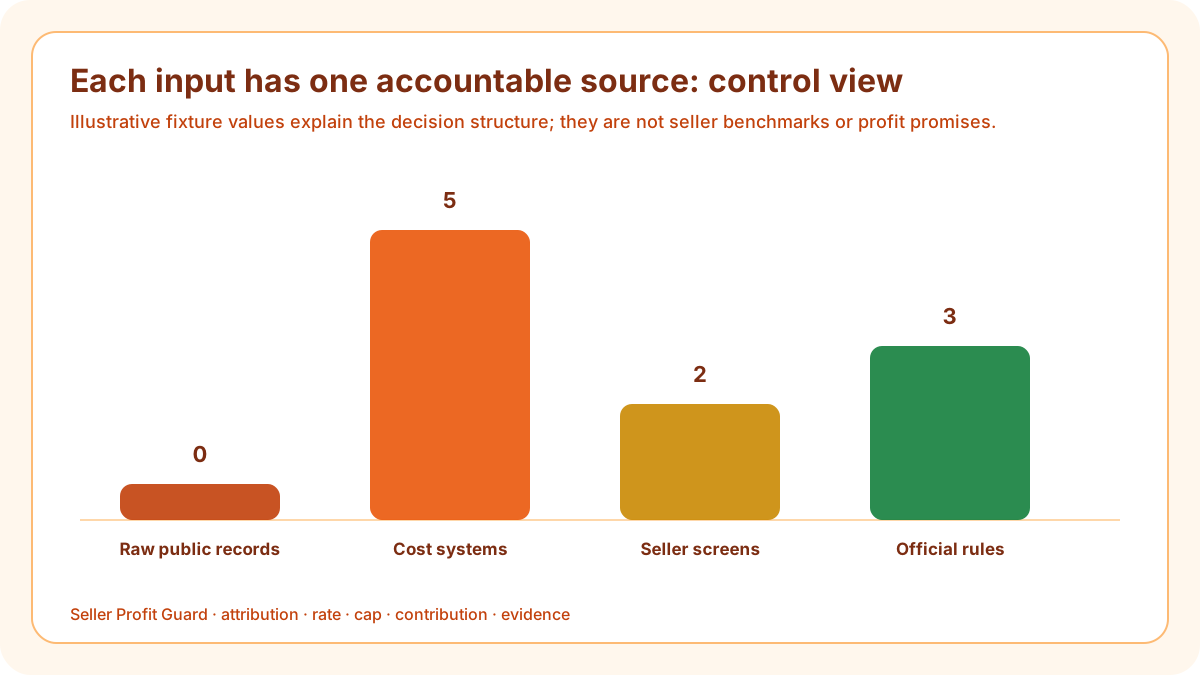
No single screen owns every input. Etsy policy owns current program rules, the dashboard owns attributed-order context, the Payment account owns actual financial rows, and the seller's cost systems own product and fulfillment evidence.
Record source owner, URL or private-system label, access date, effective period, currency, order scope, reviewer, expected value, observed value, and conflict rule. A screenshot without date or context is not durable provenance.
Build the source-to-input provenance map before acting
Official documentation can change after an order. Preserve the policy version or access date used for the model, then reconcile the actual statement rather than silently rewriting historical assumptions to match a newer page.
Keep private identifiers outside public content and analytics. Use synthetic fixtures for tests and privacy-safe aliases or aggregate amounts for internal evidence packets.
Source the attribution rule
Use Etsy Help and the Advertising and Marketing Policy for the current click, order, and last-click boundary. Use the seller dashboard to verify the actual order's attributed status.
Assign “Source the attribution rule” an authority, access date, effective period, currency, privacy class, reviewer, conflict rule, and refresh trigger in the source-to-input provenance map. If one dated privacy-safe attributed-order packet and a third-party fee article with no account evidence disagree, preserve both records and resolve the source owner before claiming a reproducible contribution model with owned evidence.
Give “Source the attribution rule” both rule evidence and actual evidence. Use official Etsy pages for definitions and account-owned sources for order-level state. Record private-system pointers rather than raw records. A current public rule cannot authenticate one seller's order, while a statement screenshot cannot establish the general policy for future orders.
Source the applicable rate
Use the current Fees and Payments Policy plus the shop's effective account notice or statement. Do not infer 12 percent from a single order or dashboard total.
Assign “Source the applicable rate” an authority, access date, effective period, currency, privacy class, reviewer, conflict rule, and refresh trigger in the source-to-input provenance map. If one dated privacy-safe attributed-order packet and a third-party fee article with no account evidence disagree, preserve both records and resolve the source owner before claiming a reproducible contribution model with owned evidence.
Give “Source the applicable rate” both rule evidence and actual evidence. Use official Etsy pages for definitions and account-owned sources for order-level state. Record private-system pointers rather than raw records. A current public rule cannot authenticate one seller's order, while a statement screenshot cannot establish the general policy for future orders.
Source the fee base
Use current policy language and the order's item, shipping, gift-wrap, personalization, tax, and jurisdiction details. Preserve each component separately.
Assign “Source the fee base” an authority, access date, effective period, currency, privacy class, reviewer, conflict rule, and refresh trigger in the source-to-input provenance map. If one dated privacy-safe attributed-order packet and a third-party fee article with no account evidence disagree, preserve both records and resolve the source owner before claiming a reproducible contribution model with owned evidence.
Give “Source the fee base” both rule evidence and actual evidence. Use official Etsy pages for definitions and account-owned sources for order-level state. Record private-system pointers rather than raw records. A current public rule cannot authenticate one seller's order, while a statement screenshot cannot establish the general policy for future orders.
Source the cap and currency
Use the official $100 USD rule, model currency, statement exchange evidence, and actual fee row. Record whether the cap changed the order result.
Assign “Source the cap and currency” an authority, access date, effective period, currency, privacy class, reviewer, conflict rule, and refresh trigger in the source-to-input provenance map. If one dated privacy-safe attributed-order packet and a third-party fee article with no account evidence disagree, preserve both records and resolve the source owner before claiming a reproducible contribution model with owned evidence.
Give “Source the cap and currency” both rule evidence and actual evidence. Use official Etsy pages for definitions and account-owned sources for order-level state. Record private-system pointers rather than raw records. A current public rule cannot authenticate one seller's order, while a statement screenshot cannot establish the general policy for future orders.
Source actual Offsite Ads fees
Use the Payment account and monthly statement at the same order and reporting period. Classify refunds, credits, taxes, and exchange effects before comparing.
Assign “Source actual Offsite Ads fees” an authority, access date, effective period, currency, privacy class, reviewer, conflict rule, and refresh trigger in the source-to-input provenance map. If one dated privacy-safe attributed-order packet and a third-party fee article with no account evidence disagree, preserve both records and resolve the source owner before claiming a reproducible contribution model with owned evidence.
Give “Source actual Offsite Ads fees” both rule evidence and actual evidence. Use official Etsy pages for definitions and account-owned sources for order-level state. Record private-system pointers rather than raw records. A current public rule cannot authenticate one seller's order, while a statement screenshot cannot establish the general policy for future orders.

Source other Etsy fees
Use the itemized Etsy fee stack or statement rows for listing, transaction, processing, conversion, regulatory, and seller-service tax charges.
Assign “Source other Etsy fees” an authority, access date, effective period, currency, privacy class, reviewer, conflict rule, and refresh trigger in the source-to-input provenance map. If one dated privacy-safe attributed-order packet and a third-party fee article with no account evidence disagree, preserve both records and resolve the source owner before claiming a reproducible contribution model with owned evidence.
Give “Source other Etsy fees” both rule evidence and actual evidence. Use official Etsy pages for definitions and account-owned sources for order-level state. Record private-system pointers rather than raw records. A current public rule cannot authenticate one seller's order, while a statement screenshot cannot establish the general policy for future orders.
Source direct costs and return loss
Use current SKU bills, labor logs, packaging purchases, carrier labels, insurance, fulfillment, and privacy-safe return summaries rather than seller memory.
Assign “Source direct costs and return loss” an authority, access date, effective period, currency, privacy class, reviewer, conflict rule, and refresh trigger in the source-to-input provenance map. If one dated privacy-safe attributed-order packet and a third-party fee article with no account evidence disagree, preserve both records and resolve the source owner before claiming a reproducible contribution model with owned evidence.
Give “Source direct costs and return loss” both rule evidence and actual evidence. Use official Etsy pages for definitions and account-owned sources for order-level state. Record private-system pointers rather than raw records. A current public rule cannot authenticate one seller's order, while a statement screenshot cannot establish the general policy for future orders.
Source the contribution target
Use an approved operating policy that names overhead boundary, owner, date, review trigger, currency, and reason. A competitor margin or generic percentage is not owned evidence.
Assign “Source the contribution target” an authority, access date, effective period, currency, privacy class, reviewer, conflict rule, and refresh trigger in the source-to-input provenance map. If one dated privacy-safe attributed-order packet and a third-party fee article with no account evidence disagree, preserve both records and resolve the source owner before claiming a reproducible contribution model with owned evidence.
Give “Source the contribution target” both rule evidence and actual evidence. Use official Etsy pages for definitions and account-owned sources for order-level state. Record private-system pointers rather than raw records. A current public rule cannot authenticate one seller's order, while a statement screenshot cannot establish the general policy for future orders.
Verification, release, and statement feedback
Before changing price, shipping, promotion, participation assumptions, or calculator defaults, preserve the source-to-input provenance map, official-source versions, account evidence pointer, current inputs, expected fixtures, tests, build, route state, and rollback identifier. Confirm the exact target environment and safe-stop on an unexpected account or production context.
After one bounded action, rerun one dated privacy-safe attributed-order packet, a third-party fee article with no account evidence, the cap fixture, and a declared-conflict fixture. Inspect full-precision and displayed amounts, mobile results, canonical, sources, original visuals, internal links, and the approved private statement observation. Restore the prior packet if a critical result cannot support a reproducible contribution model with owned evidence.
Limits, privacy boundary, and next action
This guide and calculator use seller-entered summaries and synthetic fixtures. They do not retrieve Etsy data, authenticate attribution, choose a rate, convert the cap automatically, settle tax, reproduce every refund or payout, estimate incrementality, change advertising, or prove ranking, traffic, qualified intent, AdSense approval, income, or final profit.
Keep buyer names, emails, addresses, messages, order IDs, payment rows, bank details, tax identifiers, labels, tokens, OAuth material, credentials, and raw CSV outside the source-to-input provenance map. Verify current Etsy sources and the seller's actual account, reconcile an approved privacy-safe sample, record closure or rollback, and obtain qualified accounting, tax, or legal advice when material.
Sources and further reading
- Etsy Help: How Offsite Ads Work: Current 30-day attribution, 15% and 12% fee rates, $100 USD per-order cap, enrollment, threshold, dashboard, and last-click boundary.
- Etsy Fees and Payments Policy: Controlling fee-base, attributed-order, 365-day sales test, tax, currency, cap, opt-out, and lifetime-participation policy language.
- Etsy Advertising and Marketing Policy: Current responsibilities and program terms for Etsy Ads and Offsite Ads.
- Etsy Help: Fees and Taxes for Selling: Current advertising-fee summary and the surrounding listing, transaction, processing, conversion, regulatory, and seller-fee tax boundaries.
- Etsy Help: How to Use Etsy Stats: Current traffic-source and Offsite Ads attribution observations available to a seller.
- Etsy Help: Manage Your Payment Account: Payment account, monthly statement, refund, credit, balance, reserve, shipping, and payout reconciliation context.
- Seller Profit Guard methodology: Local-first calculations, evidence hierarchy, privacy-safe fixtures, deterministic tests, bounded release, correction, and rollback.
Related Seller Profit Guard tools
- Open the Etsy Offsite Ads Margin Calculator: Model one attributed order under the current 15% or 12% rate and cap.
- Build the complete Etsy fee stack: Itemize every other marketplace fee before isolating the advertising consequence.
- Run the main Seller Profit Guard: Carry the reconciled ad fee into SKU-level cost, shipping, return, and target-profit analysis.
- Reconcile the Etsy Payment account: Compare modeled attribution and fees with actual statement rows, refunds, credits, and payouts.
- Read the Offsite Ads profit guide: Review the existing operating workflow for attributed orders and retained contribution.
- Read the local-first methodology: Keep buyer, order, payment, bank, contact, and credential data outside public pages and analytics.
- Etsy Offsite Ads Margin Formula and Inputs: Continue the formula, example, source, threshold, comparison, routine, interpretation, or audit workflow.
- Etsy Offsite Ads 15% Fee: Worked Example: Continue the formula, example, source, threshold, comparison, routine, interpretation, or audit workflow.
- Etsy Offsite Ads 12% Margin Scenario: Continue the formula, example, source, threshold, comparison, routine, interpretation, or audit workflow.
- 12 Etsy Offsite Ads Margin Mistakes: Continue the formula, example, source, threshold, comparison, routine, interpretation, or audit workflow.
- Etsy Offsite Ads Margin Decision Thresholds: Continue the formula, example, source, threshold, comparison, routine, interpretation, or audit workflow.
Next step: Open the Etsy Offsite Ads Margin Calculator.
This is operational planning help, not tax, accounting, legal, financial, or platform-policy advice. Review the Terms and disclaimer, and verify current platform rules and fee assumptions before changing prices.