Inventory carrying cost mistakes that distort the rate
Last updated: 2026-07-31
Written and reviewed by Seller Profit Guard Editorial Team.
Common errors are using ending inventory instead of a representative average, mixing retail and cost values, annualizing a short unusual period, double counting storage or damage, omitting capital and obsolescence, netting recoveries inconsistently, using an unsupported benchmark, and treating operating carrying cost as tax or COGS treatment.
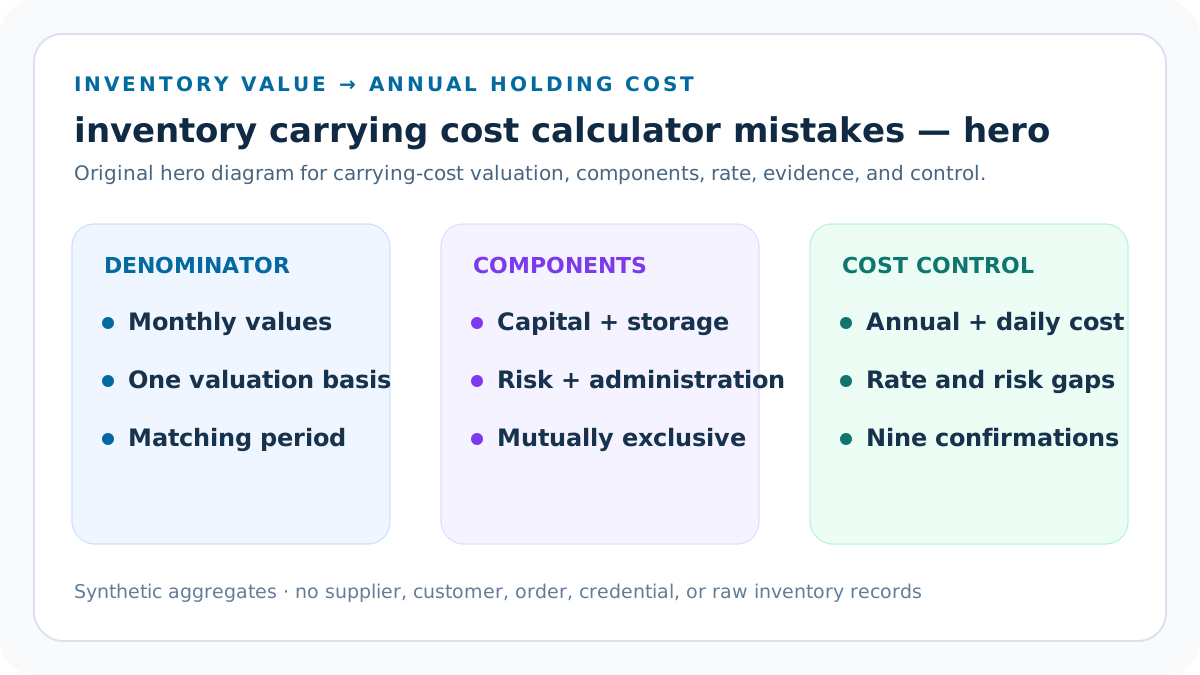
Using the wrong denominator
Replace a point-in-time or retail value with a representative average on the declared basis. The carrying-cost defect register records source, valuation, population, period, currency, component, allocation, calculation, timestamp, owner, exception, approval, and prior accepted value needed for a corrected annual rate.
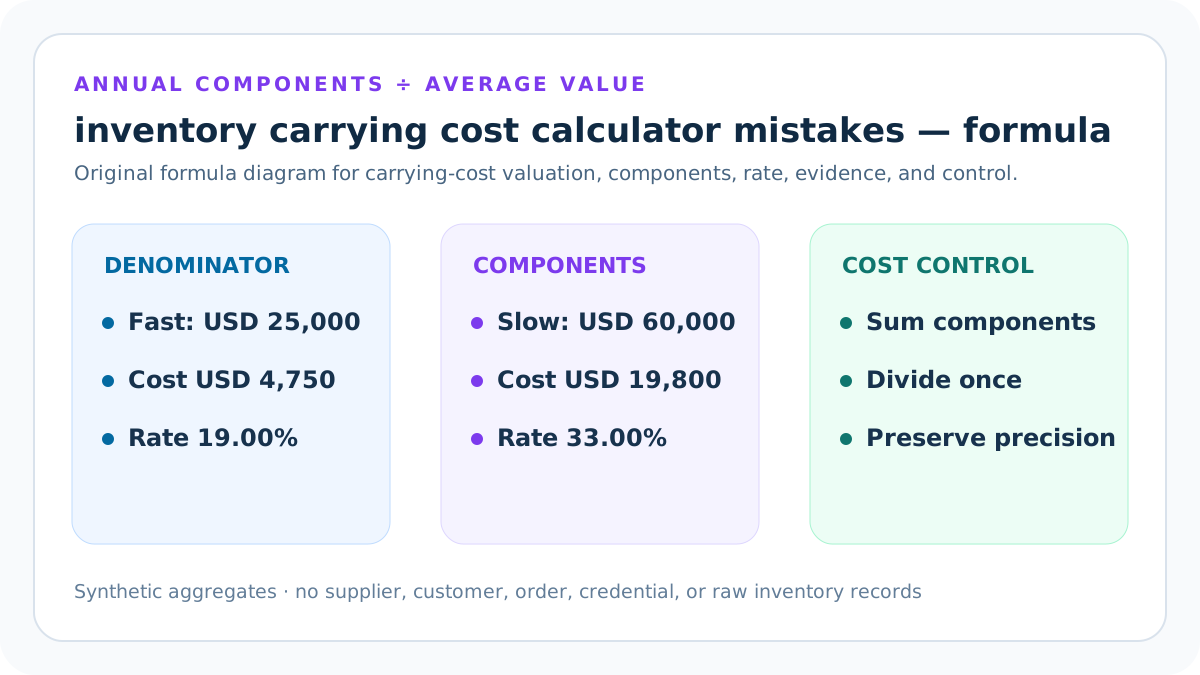
Denominator bias can dominate the rate. At review point 1, compare the USD 4,750 and 19 percent fast-moving fixture with the USD 19,800 and 33 percent slow-moving fixture. Identify which difference is arithmetic, which is allocation, and which conclusion still requires operating or accounting evidence.
Mixing periods
Match annual components with average value for the same months. The carrying-cost defect register records source, valuation, population, period, currency, component, allocation, calculation, timestamp, owner, exception, approval, and prior accepted value needed for a corrected annual rate.
A fiscal-calendar mismatch needs a bridge. At review point 2, compare the USD 4,750 and 19 percent fast-moving fixture with the USD 19,800 and 33 percent slow-moving fixture. Identify which difference is arithmetic, which is allocation, and which conclusion still requires operating or accounting evidence.
Double counting storage
Map rent, fulfillment, overhead, and per-order handling once. The carrying-cost defect register records source, valuation, population, period, currency, component, allocation, calculation, timestamp, owner, exception, approval, and prior accepted value needed for a corrected annual rate.
Shared invoices need allocation. At review point 3, compare the USD 4,750 and 19 percent fast-moving fixture with the USD 19,800 and 33 percent slow-moving fixture. Identify which difference is arithmetic, which is allocation, and which conclusion still requires operating or accounting evidence.
Double counting losses
Assign damage, shrink, returns, and obsolescence to one primary component. The carrying-cost defect register records source, valuation, population, period, currency, component, allocation, calculation, timestamp, owner, exception, approval, and prior accepted value needed for a corrected annual rate.
Cross-reference instead of duplicate. At review point 4, compare the USD 4,750 and 19 percent fast-moving fixture with the USD 19,800 and 33 percent slow-moving fixture. Identify which difference is arithmetic, which is allocation, and which conclusion still requires operating or accounting evidence.
Omitting capital or aging
Add supportable capital and obsolescence evidence. The carrying-cost defect register records source, valuation, population, period, currency, component, allocation, calculation, timestamp, owner, exception, approval, and prior accepted value needed for a corrected annual rate.
Cash and write-off exposure are material. At review point 5, compare the USD 4,750 and 19 percent fast-moving fixture with the USD 19,800 and 33 percent slow-moving fixture. Identify which difference is arithmetic, which is allocation, and which conclusion still requires operating or accounting evidence.
Using an inherited percentage
Build the rate from seller evidence and use benchmarks only as context. The carrying-cost defect register records source, valuation, population, period, currency, component, allocation, calculation, timestamp, owner, exception, approval, and prior accepted value needed for a corrected annual rate.
Historical rates are not defaults. At review point 6, compare the USD 4,750 and 19 percent fast-moving fixture with the USD 19,800 and 33 percent slow-moving fixture. Identify which difference is arithmetic, which is allocation, and which conclusion still requires operating or accounting evidence.
Confusing accounting treatment
Keep operating analysis separate from books and tax classification. The carrying-cost defect register records source, valuation, population, period, currency, component, allocation, calculation, timestamp, owner, exception, approval, and prior accepted value needed for a corrected annual rate.
Professional review remains required. At review point 7, compare the USD 4,750 and 19 percent fast-moving fixture with the USD 19,800 and 33 percent slow-moving fixture. Identify which difference is arithmetic, which is allocation, and which conclusion still requires operating or accounting evidence.
Inventory Carrying Cost Mistakes: valuation integrity control
Record one population, consistent inventory cost basis, currency, monthly values, averaging method, and effective mappings. Control 1 defines a pass condition, source owner, independent reviewer, failure owner, correction deadline, sensitivity test, monitoring signal, and restoration trigger before an inventory action can use the result.
Mixed or stale valuation blocks. Apply the control to the concrete carrying-cost defect register; keep average inventory, annual carrying cost, rate, cost shares, inventory valuation, COGS, tax treatment, purchasing, and private source records as separate concepts.
Inventory Carrying Cost Mistakes: component lineage control
Trace capital, storage, insurance, tax, shrink, obsolescence, and administration to distinct evidence and allocation keys. Control 2 defines a pass condition, source owner, independent reviewer, failure owner, correction deadline, sensitivity test, monitoring signal, and restoration trigger before an inventory action can use the result.
Missing or duplicate components block. Apply the control to the concrete carrying-cost defect register; keep average inventory, annual carrying cost, rate, cost shares, inventory valuation, COGS, tax treatment, purchasing, and private source records as separate concepts.
Inventory Carrying Cost Mistakes: period and annualization control
Align cost recognition and average inventory months, disclose scaling, and prefer a complete seasonal cycle. Control 3 defines a pass condition, source owner, independent reviewer, failure owner, correction deadline, sensitivity test, monitoring signal, and restoration trigger before an inventory action can use the result.
Short or mismatched periods require review. Apply the control to the concrete carrying-cost defect register; keep average inventory, annual carrying cost, rate, cost shares, inventory valuation, COGS, tax treatment, purchasing, and private source records as separate concepts.
Inventory Carrying Cost Mistakes: seller-threshold control
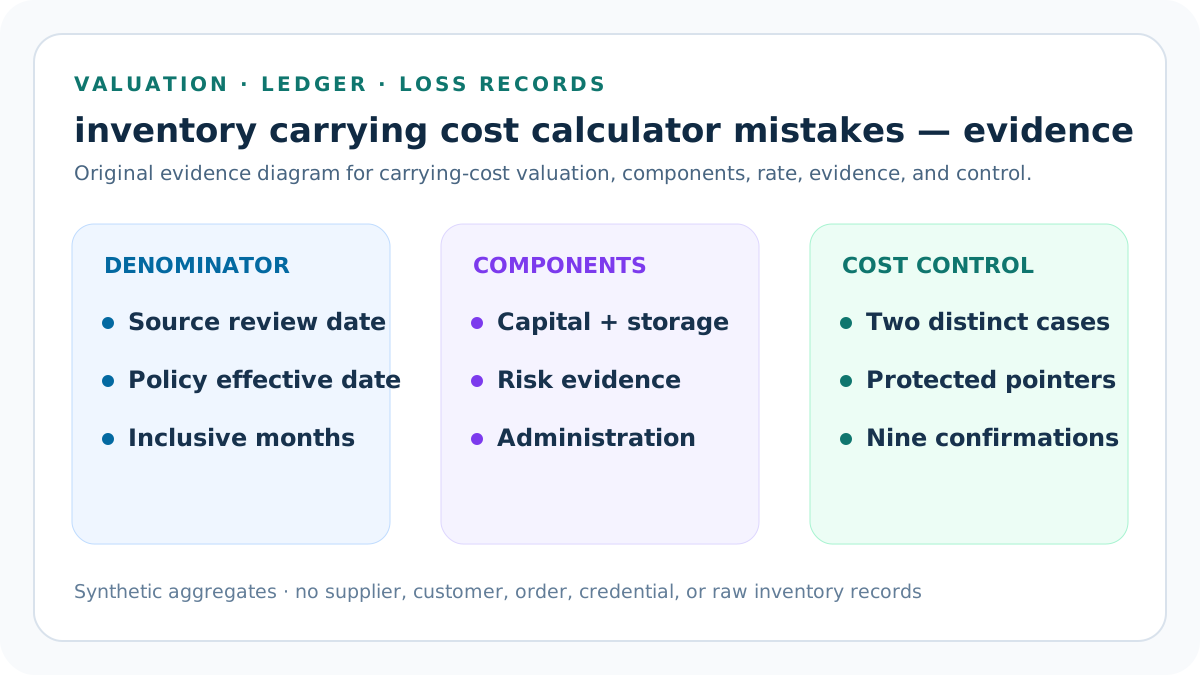
Record maximum carrying rate, maximum risk-component share, and minimum evidence months under one dated policy. Control 4 defines a pass condition, source owner, independent reviewer, failure owner, correction deadline, sensitivity test, monitoring signal, and restoration trigger before an inventory action can use the result.
A threshold exception returns Review without changing the arithmetic. Apply the control to the concrete carrying-cost defect register; keep average inventory, annual carrying cost, rate, cost shares, inventory valuation, COGS, tax treatment, purchasing, and private source records as separate concepts.
Inventory Carrying Cost Mistakes: confirmation and masking control
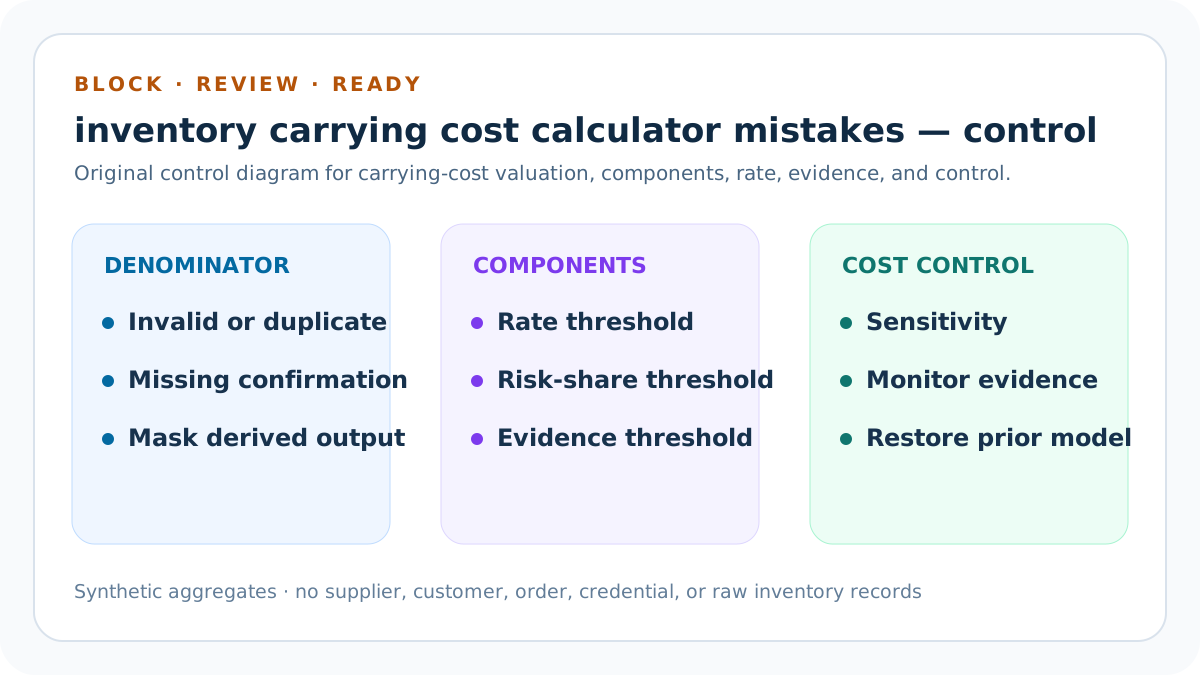
Confirm nine valuation, annualization, exclusivity, component-evidence, privacy, and accounting-boundary statements. Control 5 defines a pass condition, source owner, independent reviewer, failure owner, correction deadline, sensitivity test, monitoring signal, and restoration trigger before an inventory action can use the result.
A failed confirmation blocks and masks every derived output. Apply the control to the concrete carrying-cost defect register; keep average inventory, annual carrying cost, rate, cost shares, inventory valuation, COGS, tax treatment, purchasing, and private source records as separate concepts.
Inventory Carrying Cost Mistakes: decision-boundary control
Keep the operating rate separate from COGS, tax capitalization, accounting profit, EOQ, purchasing authority, and optimal-stock claims. Control 6 defines a pass condition, source owner, independent reviewer, failure owner, correction deadline, sensitivity test, monitoring signal, and restoration trigger before an inventory action can use the result.
Arithmetic cannot approve policy. Apply the control to the concrete carrying-cost defect register; keep average inventory, annual carrying cost, rate, cost shares, inventory valuation, COGS, tax treatment, purchasing, and private source records as separate concepts.
Inventory Carrying Cost Mistakes: recovery and privacy control
Keep row-level inventory and expenses private; retain prior values, monitoring, stop rules, and restoration authority. Control 7 defines a pass condition, source owner, independent reviewer, failure owner, correction deadline, sensitivity test, monitoring signal, and restoration trigger before an inventory action can use the result.
Public examples remain synthetic. Apply the control to the concrete carrying-cost defect register; keep average inventory, annual carrying cost, rate, cost shares, inventory valuation, COGS, tax treatment, purchasing, and private source records as separate concepts.
Using the wrong denominator: carrying-cost lab 1
Reperform the relevant output from both synthetic fixtures. Replace a point-in-time or retail value with a representative average on the declared basis. Change one component only, preserve the remaining population and valuation assumptions, recalculate annual amount, monthly equivalent, rate, component shares, and expected Block, Review, or Ready status.
Denominator bias can dominate the rate. Test a duplicated warehouse allocation, omitted capital charge, short evidence window, stale write-off, inconsistent recovery, point-in-time denominator, and restored prior model. State the protected evidence and decision approval still required.
Mixing periods: carrying-cost lab 2
Reperform the relevant output from both synthetic fixtures. Match annual components with average value for the same months. Change one component only, preserve the remaining population and valuation assumptions, recalculate annual amount, monthly equivalent, rate, component shares, and expected Block, Review, or Ready status.
A fiscal-calendar mismatch needs a bridge. Test a duplicated warehouse allocation, omitted capital charge, short evidence window, stale write-off, inconsistent recovery, point-in-time denominator, and restored prior model. State the protected evidence and decision approval still required.
Double counting storage: carrying-cost lab 3
Reperform the relevant output from both synthetic fixtures. Map rent, fulfillment, overhead, and per-order handling once. Change one component only, preserve the remaining population and valuation assumptions, recalculate annual amount, monthly equivalent, rate, component shares, and expected Block, Review, or Ready status.
Shared invoices need allocation. Test a duplicated warehouse allocation, omitted capital charge, short evidence window, stale write-off, inconsistent recovery, point-in-time denominator, and restored prior model. State the protected evidence and decision approval still required.
Double counting losses: carrying-cost lab 4
Reperform the relevant output from both synthetic fixtures. Assign damage, shrink, returns, and obsolescence to one primary component. Change one component only, preserve the remaining population and valuation assumptions, recalculate annual amount, monthly equivalent, rate, component shares, and expected Block, Review, or Ready status.
Cross-reference instead of duplicate. Test a duplicated warehouse allocation, omitted capital charge, short evidence window, stale write-off, inconsistent recovery, point-in-time denominator, and restored prior model. State the protected evidence and decision approval still required.
Omitting capital or aging: carrying-cost lab 5
Reperform the relevant output from both synthetic fixtures. Add supportable capital and obsolescence evidence. Change one component only, preserve the remaining population and valuation assumptions, recalculate annual amount, monthly equivalent, rate, component shares, and expected Block, Review, or Ready status.
Cash and write-off exposure are material. Test a duplicated warehouse allocation, omitted capital charge, short evidence window, stale write-off, inconsistent recovery, point-in-time denominator, and restored prior model. State the protected evidence and decision approval still required.
Using an inherited percentage: carrying-cost lab 6
Reperform the relevant output from both synthetic fixtures. Build the rate from seller evidence and use benchmarks only as context. Change one component only, preserve the remaining population and valuation assumptions, recalculate annual amount, monthly equivalent, rate, component shares, and expected Block, Review, or Ready status.
Historical rates are not defaults. Test a duplicated warehouse allocation, omitted capital charge, short evidence window, stale write-off, inconsistent recovery, point-in-time denominator, and restored prior model. State the protected evidence and decision approval still required.
Confusing accounting treatment: carrying-cost lab 7
Reperform the relevant output from both synthetic fixtures. Keep operating analysis separate from books and tax classification. Change one component only, preserve the remaining population and valuation assumptions, recalculate annual amount, monthly equivalent, rate, component shares, and expected Block, Review, or Ready status.
Professional review remains required. Test a duplicated warehouse allocation, omitted capital charge, short evidence window, stale write-off, inconsistent recovery, point-in-time denominator, and restored prior model. State the protected evidence and decision approval still required.
Inventory Carrying Cost Mistakes: intent-specific implementation walkthrough
carrying-cost defect register checkpoint 1 addresses using the wrong denominator as a distinct requirement for a corrected annual rate. Replace a point-in-time or retail value with a representative average on the declared basis. Record the resulting source decision, formula effect, reviewer question, failed alternative, correction owner, and restoration value in language specific to this checkpoint. Denominator bias can dominate the rate.
carrying-cost defect register checkpoint 2 addresses mixing periods as a distinct requirement for a corrected annual rate. Match annual components with average value for the same months. Record the resulting source decision, formula effect, reviewer question, failed alternative, correction owner, and restoration value in language specific to this checkpoint. A fiscal-calendar mismatch needs a bridge.
carrying-cost defect register checkpoint 3 addresses double counting storage as a distinct requirement for a corrected annual rate. Map rent, fulfillment, overhead, and per-order handling once. Record the resulting source decision, formula effect, reviewer question, failed alternative, correction owner, and restoration value in language specific to this checkpoint. Shared invoices need allocation.
carrying-cost defect register checkpoint 4 addresses double counting losses as a distinct requirement for a corrected annual rate. Assign damage, shrink, returns, and obsolescence to one primary component. Record the resulting source decision, formula effect, reviewer question, failed alternative, correction owner, and restoration value in language specific to this checkpoint. Cross-reference instead of duplicate.
carrying-cost defect register checkpoint 5 addresses omitting capital or aging as a distinct requirement for a corrected annual rate. Add supportable capital and obsolescence evidence. Record the resulting source decision, formula effect, reviewer question, failed alternative, correction owner, and restoration value in language specific to this checkpoint. Cash and write-off exposure are material.
carrying-cost defect register checkpoint 6 addresses using an inherited percentage as a distinct requirement for a corrected annual rate. Build the rate from seller evidence and use benchmarks only as context. Record the resulting source decision, formula effect, reviewer question, failed alternative, correction owner, and restoration value in language specific to this checkpoint. Historical rates are not defaults.
carrying-cost defect register checkpoint 7 addresses confusing accounting treatment as a distinct requirement for a corrected annual rate. Keep operating analysis separate from books and tax classification. Record the resulting source decision, formula effect, reviewer question, failed alternative, correction owner, and restoration value in language specific to this checkpoint. Professional review remains required.
Evidence boundary for a corrected annual rate
The packet can demonstrate entered average inventory value, capital, storage, insurance and inventory tax, shrink, obsolescence, administration, annual sum, monthly and daily equivalents, carrying rate, percentage-point gap, component shares, three seller thresholds, nine confirmations, and sensitivity. Annual carrying cost equals capital plus storage plus insurance and inventory tax plus shrink and inventory loss plus obsolescence plus carrying-related administration. Annual carrying rate equals that total divided by average inventory value on the same valuation, population, currency, and period basis.
It cannot prove financial-statement inventory value, tax capitalization, COGS, accounting profit, cash timing, optimal inventory, demand, supplier performance, service level, stockout prevention, economic order quantity, or the correct business action.
Release, monitor, and restore the carrying-cost defect register
Block invalid dates, population, valuation, non-finite amounts, currency, period reconciliation, duplicate scenarios, thresholds, confirmations, privacy, or open conflicts and mask all derived outputs. Review evidence below the seller minimum, rates or risk shares above their thresholds, and annual costs above average inventory value. Ready clears only the entered operating worksheet.
Before indexing or operational use, preserve evidence and rollback artifacts, run typecheck, unit, integration, build, content, similarity, SEO, image, link, mobile, strict-route, deployment, and live checks, then compare later evidence without claiming same-period causality.
Inventory Carrying Cost Mistakes: concrete working record
Log defect identifier, population, component, source, observed value, corrected value, denominator effect, rate effect, period, currency, valuation basis, duplicate or omission class, containment, owner, evidence, independent recalculation, approval, effective date, monitoring, prior value, and restoration. Separate ending-balance bias, retail-value denominator, mixed currencies, partial-year annualization, duplicated rent, duplicate damage, missing capital, stale write-off, unsupported rate, and tax-classification defects.
Sources and further reading
- Seller Profit Guard methodology: Evidence, formula, privacy, correction, release, monitoring, and rollback rules.
- Seller Profit Guard data privacy: Local-first boundaries for inventory, expense, supplier, customer, order, and raw export data.
- NetSuite Help: Inventory Turnover Report: Official month-end average inventory value, turnover, and days-on-hand calculations.
- Oracle Inventory Optimization User's Guide: Official statement that average inventory level is often used to calculate inventory carrying cost.
- NetSuite Help: Setting Inventory Costing Preferences: Official inventory-costing preference and negative-inventory treatment boundary.
- NetSuite Help: Inventory Items: Official separation of inventory quantity and value, COGS, income, and location records.
- IRS Publication 538: Accounting Periods and Methods: Official tax inventory valuation and accounting-method boundary.
- IRS Publication 583: Starting a Business and Keeping Records: Official inventory-cost and business-expense recordkeeping guidance.
- GAO: Defense Inventory—Applying Commercial Purchasing Practices: Primary source defining investment, storage, obsolescence, and inventory-loss components and the average on-hand inventory denominator.
- GAO: Greater Use of Commercial Distribution Systems: Primary source describing annual inventory holding costs and obsolescence exposure.
- Oracle E-Business Suite: Materials Management: Official source on tied-up cash, carrying cost, write-offs, degradation, and obsolescence.
- Microsoft Learn: Managing inventory costs: Official boundary for inventory valuation, cost methods, ledger posting, and COGS.
- IRS Publication 551: Basis of Assets: Official boundary for tax capitalization and inventory-cost treatment.
- IRS Publication 334: Tax Guide for Small Business: Official distinction among ending inventory, COGS, manufacturing overhead, and other expenses.
Related Seller Profit Guard tools
- Inventory Carrying Cost Calculator: Calculate annual carrying amount, monthly equivalent, cost mix, rate, and review status.
- Safety Stock Calculator: Estimate a statistical buffer before reviewing its holding consequences.
- Reorder Point Calculator: Review replenishment timing separately from annual holding cost.
- Overhead Allocation Calculator: Allocate recurring business overhead without automatically classifying every line as carrying cost.
- Contribution Margin Calculator: Measure order contribution separately from inventory investment.
- Methodology: Review evidence, formula, privacy, correction, release, and rollback.
- Data Privacy: Protect inventory, expense, supplier, customer, and raw export data.
- Inventory Carrying Cost Formula and Inputs: Define average inventory value, annual capital, storage, insurance, shrink, obsolescence, administration, carrying rate, and evidence rules.
- Inventory Carrying Cost Worked Example: Calculate USD 4,750 annual carrying cost and a 19% rate for fast-moving inventory with explicit capital, storage, loss, and aging inputs.
- Inventory Carrying Cost for Slow-Moving Stock: Calculate USD 19,800 annual carrying cost and a 33% rate for slow-moving inventory with higher storage, loss, and obsolescence exposure.
- Inventory Carrying Cost Data Sources: Map average inventory values, capital assumptions, warehouse costs, insurance, losses, write-offs, and administration to authoritative evidence.
- Inventory Carrying Cost Decision Gates: Separate arithmetic readiness from valuation, allocation, threshold, service, cash, accounting, approval, monitoring, and rollback gates.
- Fast vs Slow Inventory Carrying Cost: Compare 19% and 33% carrying rates at normalized scope and isolate capital, storage, loss, obsolescence, and denominator drivers.
- Inventory Carrying Cost Operating Routine: Run a monthly evidence close and quarterly rate review across valuation, cost components, aging, turns, exceptions, approvals, and rollback.
- How to Interpret Inventory Carrying Cost: Read annual amount, monthly equivalent, carrying rate, cost shares, threshold, and status without claiming optimal stock or accounting treatment.
- Inventory Carrying Cost Audit Template: Audit valuation, component lineage, allocations, annualization, arithmetic, accounting boundaries, approvals, monitoring, and restoration.
Next step: Open Seller Profit Guard.
This is operational planning help, not tax, accounting, legal, financial, or platform-policy advice. Review the Terms and disclaimer, and verify current platform rules and fee assumptions before changing prices.