Where an Etsy variation naming review gets reliable evidence
Last updated: 2026-07-30
Written and reviewed by Seller Profit Guard Editorial Team.
Use the product specification for available choices, measurement records for size values, approved samples for colors and materials, current price and inventory tables for each option, SKU records for complete combinations, processing profiles for timing differences, the Etsy editor for configuration, and the published buyer path for final verification. Resolve conflicts; never average them.

evidence hierarchy: scope and decision
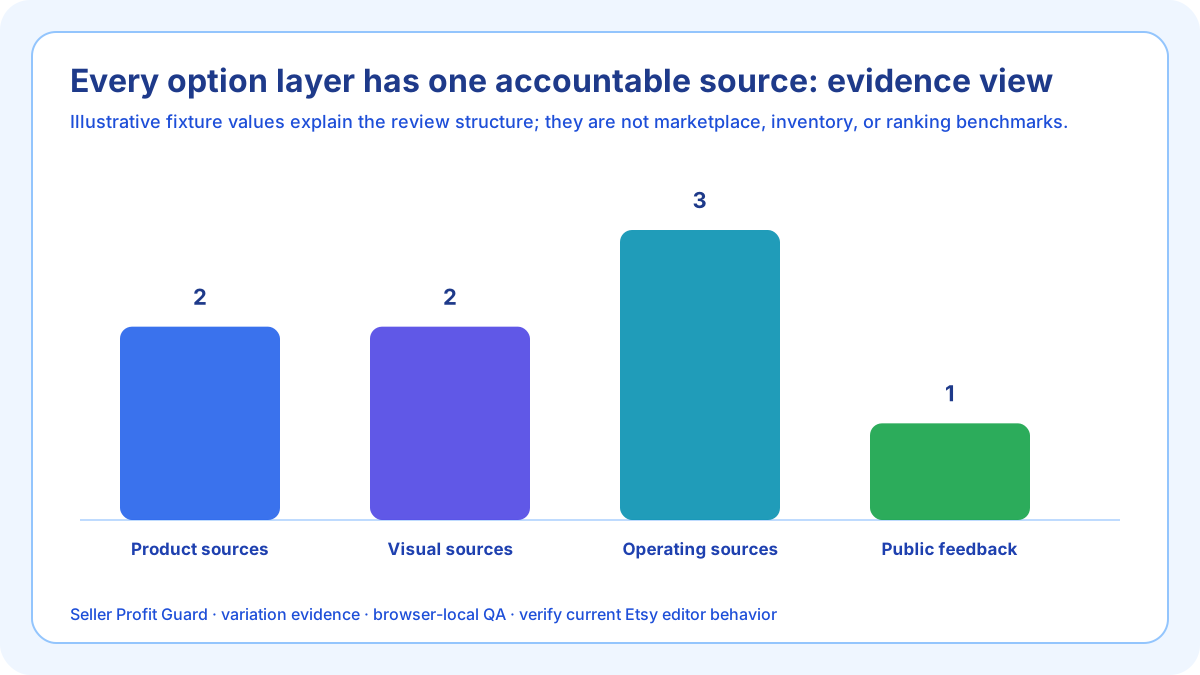
A selector is presentation, not product authority. Each axis, value, photo, price, availability state, processing profile, and SKU should point to the record that owns it. The published page then supplies feedback about whether the approved configuration reached buyers.
Use current Etsy Help and policy pages for platform behavior; product, measurement, sample, price, inventory, and processing records for seller-controlled truth; the listing editor for configuration; and the public selected path for release verification.
Build the variation source map before analysis
When sources disagree, identify the responsible owner and stop release. An editor value that lacks a product record, a price table that omits one size, or a SKU inventory using retired names is not solved by majority vote.
Record aliases, versions, dates, and decisions. Do not move buyer orders, receipts, private personalization, messages, addresses, credentials, or raw CSV files into the active content workspace.
Product specifications own the denominator
Define the base item, allowed axes, values, exclusions, components, and combination rules. Product authority should precede the listing configuration and explain why an option exists, not inherit unreviewed values from a live dropdown.
For “Product specifications own the denominator,” cite the current owner of truth inside the variation source map; do not infer it from whichever screen was edited last. Reconcile current product packet and editor and inventory conflict, retain source dates and versions, and require public feedback before closing a traceable choice-to-authority map. Missing provenance remains uncertainty, not permission to invent a variation rule.
Measurement records own size values
Attach width, height, length, unit, tolerance, method, sample, and review date to every size label. Small and Large are buyer shorthand; the measurement table makes the choice testable and prevents unit drift.
For “Measurement records own size values,” cite the current owner of truth inside the variation source map; do not infer it from whichever screen was edited last. Reconcile current product packet and editor and inventory conflict, retain source dates and versions, and require public feedback before closing a traceable choice-to-authority map. Missing provenance remains uncertainty, not permission to invent a variation rule.
Approved samples own visual values
Use finished color, finish, material, pattern, or configuration samples under controlled review. Photo labels illustrate approved evidence but do not prove composition, ownership, accessibility, or exact screen color.
For “Approved samples own visual values,” cite the current owner of truth inside the variation source map; do not infer it from whichever screen was edited last. Reconcile current product packet and editor and inventory conflict, retain source dates and versions, and require public feedback before closing a traceable choice-to-authority map. Missing provenance remains uncertainty, not permission to invent a variation rule.
Price records own selected totals
Maintain the full price for every price-changing value and applicable region or currency scope. Etsy configuration should reflect that table. Promotion, tax, fee, and profit layers remain separately documented.
For “Price records own selected totals,” cite the current owner of truth inside the variation source map; do not infer it from whichever screen was edited last. Reconcile current product packet and editor and inventory conflict, retain source dates and versions, and require public feedback before closing a traceable choice-to-authority map. Missing provenance remains uncertainty, not permission to invent a variation rule.
Inventory records own SKU combinations
Store one stable SKU for each complete choice and preserve old-to-new mappings when codes change. The public value should remain connected to picking, cost, quantity, fulfillment, return, and profit records.
For “Inventory records own SKU combinations,” cite the current owner of truth inside the variation source map; do not infer it from whichever screen was edited last. Reconcile current product packet and editor and inventory conflict, retain source dates and versions, and require public feedback before closing a traceable choice-to-authority map. Missing provenance remains uncertainty, not permission to invent a variation rule.

Processing profiles own timing differences
If a material, size, or configuration needs different preparation, link the appropriate current profile. A shared label or price does not justify inheriting an inaccurate made-to-order or ready-to-ship expectation.
For “Processing profiles own timing differences,” cite the current owner of truth inside the variation source map; do not infer it from whichever screen was edited last. Reconcile current product packet and editor and inventory conflict, retain source dates and versions, and require public feedback before closing a traceable choice-to-authority map. Missing provenance remains uncertainty, not permission to invent a variation rule.
The editor owns current configuration
Observe axis order, built-in or custom variation, values, visibility, linked photo, price, quantity, processing, and SKU settings. Save a privacy-safe before state before changing the correct listing.
For “The editor owns current configuration,” cite the current owner of truth inside the variation source map; do not infer it from whichever screen was edited last. Reconcile current product packet and editor and inventory conflict, retain source dates and versions, and require public feedback before closing a traceable choice-to-authority map. Missing provenance remains uncertainty, not permission to invent a variation rule.
The buyer path owns release feedback
Select every available combination after publication and check labels, photo, full price, availability, timing, cart, receipt-facing choice, and navigation. A successful save or preview does not replace this feedback.
For “The buyer path owns release feedback,” cite the current owner of truth inside the variation source map; do not infer it from whichever screen was edited last. Reconcile current product packet and editor and inventory conflict, retain source dates and versions, and require public feedback before closing a traceable choice-to-authority map. Missing provenance remains uncertainty, not permission to invent a variation rule.
Verification, release, and rollback controls
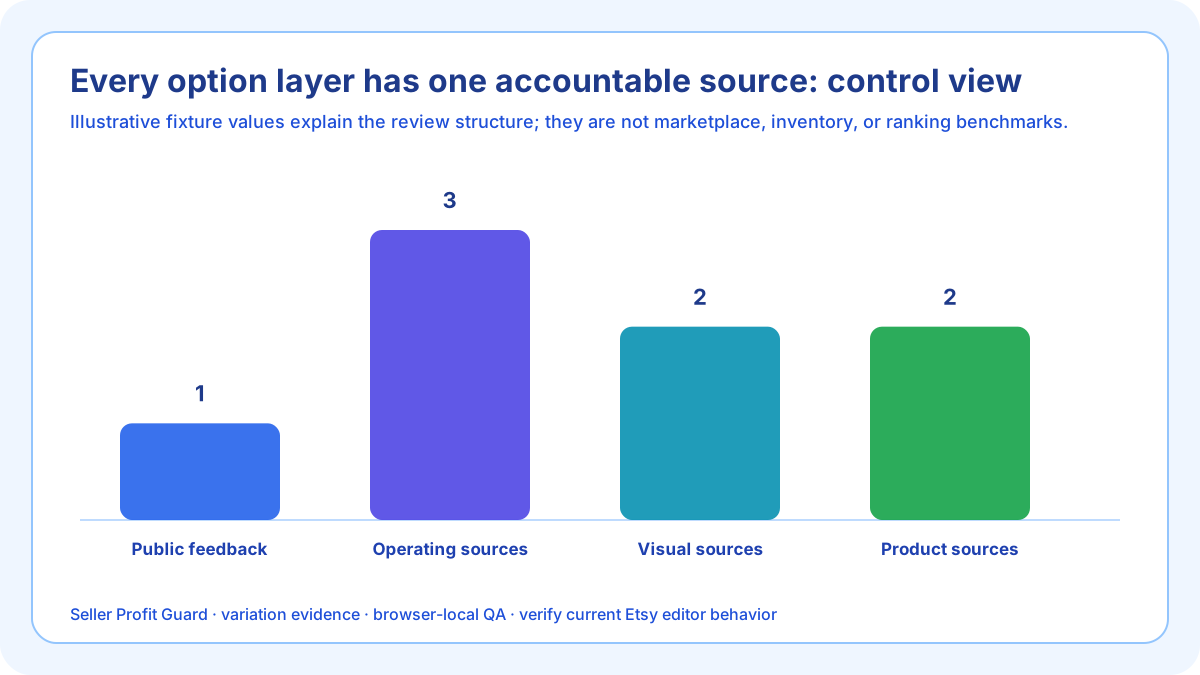
Before changing a public listing, preserve the complete variation source map, editor values, linked assets, selected-path observations, test fixtures, approval, and rollback identifier. Confirm the correct account and listing. Safe-stop on login or CAPTCHA ambiguity, a platform warning, wrong profile, missing target context, private data, or an unexpected editor state.
After one bounded release, verify current product packet on mobile and desktop and deliberately revisit the risk represented by editor and inventory conflict. Check axis names, values, selected photo, full price, availability, processing, cart or receipt choice, and SKU for every valid combination. Restore the prior configuration when a critical path does not support a traceable choice-to-authority map.
Limits, privacy boundary, and next action
This guide and checker use seller-entered text and synthetic examples. They do not retrieve Etsy data, alter a listing, inspect images, validate product composition, confirm inventory or receipts, certify marketplace policy, or predict ranking, clicks, conversion, sales, returns, income, or AdSense approval. Seller Profit Guard is independent and unaffiliated with Etsy and provides operational QA rather than legal, tax, accounting, inventory, search, accessibility, or platform advice.
Keep buyer names, addresses, messages, order IDs, receipts, private personalization, credentials, OAuth data, and raw CSV files outside the variation source map. The next action is to repair the named evidence layer, rerun complete and crossed fixtures, release only the approved set, inspect the public choice path, and record whether a traceable choice-to-authority map was verified or rolled back.
Sources and further reading
- Etsy Help: How to Add Variations for Your Listings: Current official variation attributes, values, total prices, quantities, processing profiles, SKUs, linked photos, custom variations, visibility, preview, and buyer-selection behavior.
- Etsy Help: How to Create a Listing: Current official category, price, quantity, SKU, physical-listing, and variation context.
- Etsy Help: Processing Times and Processing Profiles: Current official listing- and variation-level processing-profile behavior.
- Etsy Help: How to Offer Personalized Listings: Current official Custom options fields, five-field limit, field types, test-limited add-on pricing, and the inventory-versus-personalization boundary.
- Etsy Help: How to Offer Custom Items: Current official boundary between public listing variations and one-buyer private custom listings.
- Etsy Seller Policy effective July 9, 2026: Current official accuracy, content, privacy, representation, and seller-responsibility requirements.
- Seller Profit Guard methodology: Evidence hierarchy, privacy boundary, uncertainty labels, corrections, release verification, and rollback controls.
Related Seller Profit Guard tools
- Open the Etsy Variation Naming Checker: Review axes, values, buyer selectors, linked photos, total prices, and unique SKU combinations.
- Audit Etsy variation and SKU risk: Check cost and fulfillment risk after the naming contract is coherent.
- Review Etsy attribute coverage: Keep category attributes separate from buyer-selectable options.
- Check Etsy photo coverage: Verify appearance-changing values have truthful buyer evidence.
- Read the variation SKU checklist: Connect buyer choices with stable cost and inventory controls.
- Read the local-first methodology: Preserve evidence, privacy, bounded release, feedback, and recovery.
- Etsy Variation Naming Formula and Inputs: Continue the variation evidence, mapping, decision, release, interpretation, or audit workflow.
- Etsy Variation Names: Size and Color Example: Continue the variation evidence, mapping, decision, release, interpretation, or audit workflow.
- Etsy Material and Personalization Options: Continue the variation evidence, mapping, decision, release, interpretation, or audit workflow.
- 12 Etsy Variation Naming Mistakes: Continue the variation evidence, mapping, decision, release, interpretation, or audit workflow.
- Etsy Variation Naming: Ready to Block: Continue the variation evidence, mapping, decision, release, interpretation, or audit workflow.
Next step: Open the Etsy Variation Naming Checker.
This is operational planning help, not tax, accounting, legal, financial, or platform-policy advice. Review the Terms and disclaimer, and verify current platform rules and fee assumptions before changing prices.