How to set safe decision thresholds for variant-risk warnings
Last updated: 2026-07-30
Written and reviewed by Seller Profit Guard Editorial Team.
A safe variant-risk threshold separates identity blockers from prioritization settings. Blank SKUs, ambiguous active mappings, invalid quantity fields, and broken cost joins block SKU-level margin decisions. The high-volume quantity threshold only ranks missing-cost work. Use, hold, or escalate based on evidence quality, impact, recurrence, and reversibility—not a decorative score.

Which findings are blockers and which are priorities?
A missing SKU blocks a reliable SKU-cost join for that grouped item. An unexplained one-SKU-to-many-variations or one-variation-to-many-SKUs relationship blocks any decision that assumes one stable identity. A missing variation field may be acceptable for a genuinely single-option item but requires source and listing verification. A high-volume missing-cost warning prioritizes coverage; the underlying missing cost remains unknown even below the cut.
Define the decision before applying the gate. A listing-cleanup decision may proceed with price and cost excluded, while a SKU-level contribution calculation cannot proceed without identity and cost coverage. A broad content-planning or inventory-location task may use different evidence. Record permitted and prohibited uses beside each disposition.
Do not convert blockers into percentage penalties. A 95% complete library can still attach the wrong cost to the highest-volume option. Identity and unit errors are structural, not averageable.
| Finding | Default disposition | Release condition |
|---|---|---|
| Blank SKU | Hold SKU-level decision | Recover stable identity |
| Ambiguous active mapping | Escalate | Classify and repair relationship |
| Missing variation | Verify | Confirm source and listing scope |
| Cost gap above cut | Prioritize | Add evidence-backed cost |
| Cost gap below cut | Schedule | Retain unresolved queue |
How should impact and confidence be combined?
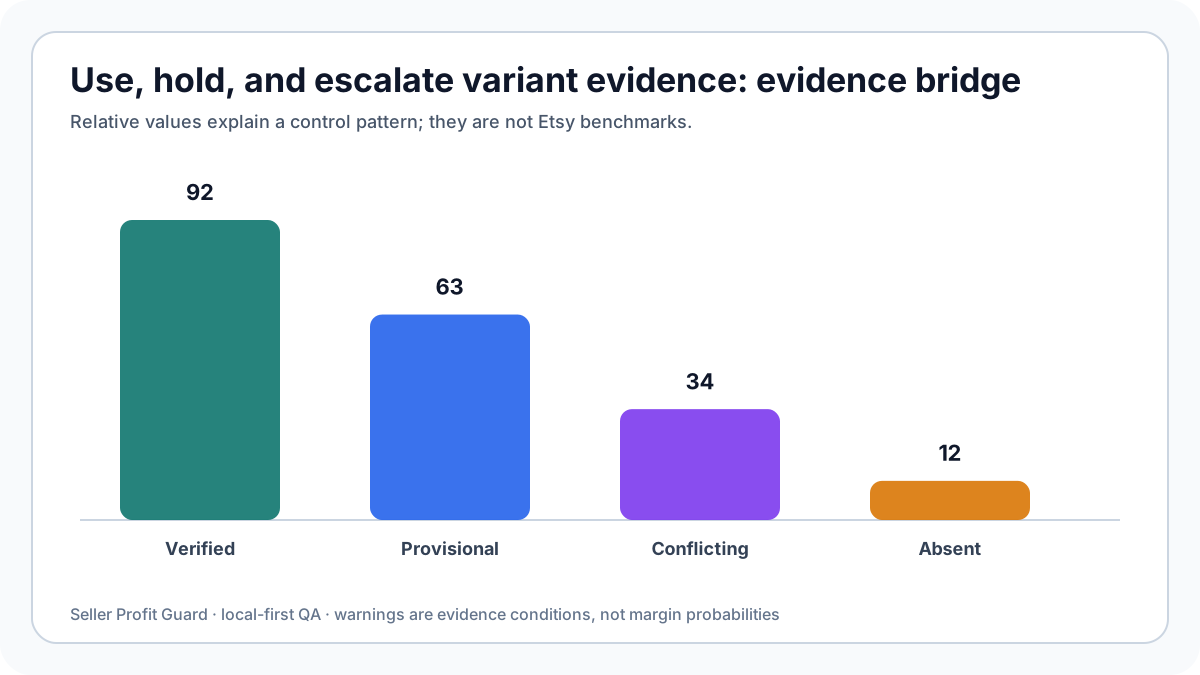
Use a small decision matrix rather than one score. Evidence confidence can be verified, provisional, conflicting, stale, or absent. Impact can consider grouped quantity, affected order rows, selling price exposure, operational complexity, reversibility, and whether the defect changes identity or only coverage. The current checker supplies quantity and order count; any financial exposure must be calculated separately with validated data.
Escalate conflicting identity even when quantity is low because one bad mapping can corrupt every downstream record. Prioritize a verified high-volume cost gap because its scope is clear and measurement work has high value. Hold a large estimated exposure when the input mapping itself is uncertain.
Keep recurrence visible. A defect that returns after correction indicates an upstream listing, import, normalization, or operating-policy weakness and deserves system-level action.

How do you calibrate the quantity threshold responsibly?
Begin with the review purpose and capacity. For a small weekly queue, inspect the quantity distribution and choose a cut that surfaces a manageable number of uncovered SKUs while retaining every lower-volume gap in a scheduled backlog. Record the inclusive cut, period, population, and reason. Do not call it a statistical confidence threshold.
Compare at least three cuts and show which SKUs enter or leave the priority queue. If one heavy or high-cost option sits below the quantity cut, add a separate risk override rather than manipulating the threshold. Reuse the same cut for a stable comparison period unless a documented capacity or business change justifies revision.
Validate the boundary with a cost-covered and uncovered SKU at exactly the cut. Coverage should clear the missing-cost warning; quantity alone should never clear it.
What are the use, hold, and escalate criteria?
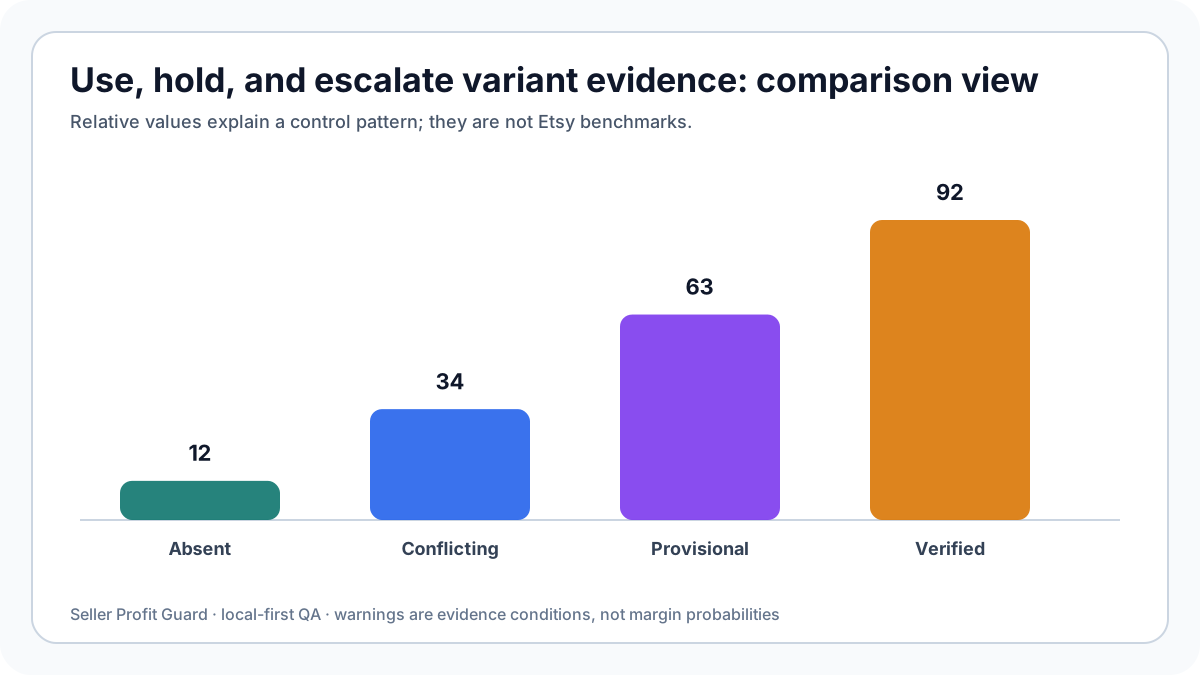
Use the data for bounded QA when mapping is verified, identity relationships are explainable, required cost records are appropriate, and negative fixtures pass. Hold when required fields are absent, source type is mixed, quantity is invalid, cost coverage is placeholder, or historical and current identity cannot be separated. Escalate when active collisions affect important options, corrections recur, or rollback and evidence ownership are missing.
Every override records the finding, decision scope, owner, justification, evidence, expiration, reviewer, and next test. Expired overrides return to hold. An operator cannot approve their own material historical rewrite without an independent check.
- Use only within stated scope.
- Hold on structural ambiguity.
- Escalate repeated or material identity defects.
- Expire provisional overrides.
- Rerun controlled fixtures after correction.
Variant-risk threshold questions
Is quantity two a universal risk threshold? No. It is the current default priority cut.
Can a low-volume blank SKU be ignored? Not for SKU-level cost or margin work.
Does a high warning count mean high financial loss? Not without a separate validated exposure calculation.
Can the seller override a hold? Only with documented scope, evidence, reviewer, expiration, and follow-up.
What closes escalation? Upstream repair, passing rerun, explained history, and retained rollback.
Which evidence supports this variant-risk decision threshold?
Use the Etsy order-item or sold-transaction export for observed item title, seller-added SKU, selected variation text, quantity, and transaction frequency. Use the active-listing export or Shop Manager for current listing, option, price, quantity, and SKU setup. Use the seller's private cost library for material, labor, packaging, fulfillment, and other cost coverage. These sources answer different questions and should not be silently merged into one truth table.
Preserve the export date, covered period, row count, detected headers, mapping version, normalization rule, cost-library fingerprint, and checker version. Verify at least one harmless dummy row from source fields through the exported fix list. A checksum can show that a file did not change; it cannot prove that the seller mapped the SKU, variation, quantity, or item columns correctly.
Classify findings by evidence: an empty SKU is observed in the selected export; one normalized SKU mapping to several normalized variation strings is a deterministic consistency warning; a high-volume SKU without a cost record is a coverage warning under the chosen quantity threshold. None of those findings alone proves accounting loss, listing-policy violation, inventory shortage, or buyer harm.
- Keep listing identity, sold-order observations, and private cost evidence separate.
- Record the period, mapping, normalization, threshold, and library fingerprint.
- Use seller-defined SKUs as identifiers, not universal marketplace product codes.
- Confirm findings in the current listing and relevant historical records before changing data.
- Treat tax, accounting, legal, and marketplace-policy questions as separate professional or official-source work.
Privacy and commercial sensitivity for variant-risk decision threshold
The checker needs item, SKU, variation, quantity, and mapping context. Buyer names, email addresses, phone numbers, delivery addresses, private messages, personalization text, and payment credentials are unnecessary. Seller Profit Guard removes recognized private columns during parsing and performs the analysis in the browser, but the operator must still inspect unknown headers and avoid sharing raw exports.
Cost-library values, supplier terms, sell-through, variation mix, and exception lists can reveal commercial strategy even when buyer data is absent. Keep raw CSVs and detailed fix lists in controlled storage. Public reports should use dummy examples, aggregate counts, redacted identifiers, and non-reversible fingerprints. Never paste a private transaction row into an article, issue, analytics event, or community post.
How to apply this variant-risk decision threshold in the Variant Risk Checker
Open Seller Profit Guard, load a recent Etsy order-item CSV or a public dummy fixture, confirm the detected item, SKU, variation, and quantity columns, and load the matching SKU cost library. The checker groups rows by item, SKU, and variation, normalizes case and spacing for comparison, then reports five bounded warning families: missing SKU, missing variation text, one SKU linked to multiple variation strings, one item-and-variation linked to multiple SKUs, and a high-volume SKU without a matching cost record.
Review the highest-impact warning with its source row and current listing. Correct the upstream listing, SKU policy, export mapping, or cost record; do not merely edit the downloaded fix list. Re-export a bounded period, rerun the same mapping and threshold, and compare the warning with the saved evidence. The tool is operational QA, not an Etsy connection, inventory system, accounting ledger, or guarantee of margin.
- Use a bounded export and confirm the detected mapping.
- Load or create the matching SKU cost assumptions locally.
- Review each warning code and its grouped quantity and order count.
- Verify the current listing and historical identity before making a correction.
- Rerun the same fixture and record the result, owner, date, and rollback.
Sources and further reading
- Etsy Help: How to Use SKU for Your Inventory: Official Etsy guidance on seller-defined SKUs, inventory identification, and practical SKU naming.
- Etsy Help: How to Add Variations for Your Listings: Official listing-variation workflow and controls for option-level price, quantity, processing profile, and SKU.
- Etsy Help: Processing Times, Profiles, and Ship-By Dates: Official definition of physical-item processing time and the current listing- or variation-level processing-profile workflow.
- Etsy Help: Download Sold Transaction Spreadsheets: Official order-item export workflow and confirmation that seller-added SKU numbers can appear in the downloaded data.
- Etsy Help: Download Your Listing Information: Official active-listing export fields, including price, currency, quantity, and seller-added SKU numbers.
- Seller Profit Guard calculation methodology: Definitions for editable assumptions, evidence hierarchy, local-first processing, contribution scope, and uncertainty.
Related Seller Profit Guard tools
- Open the Variant Risk Checker: Check order-item CSV rows for missing SKUs, inconsistent variation mapping, and high-volume SKUs without cost records.
- Use the SKU Cost Library: Create and reuse browser-local material, labor, packaging, fulfillment, and target-margin assumptions.
- Review the Etsy variation SKU checklist: Inspect listing setup before a variation or SKU mapping defect reaches sold-order data.
- Learn what an Etsy SKU is: Build stable seller-defined identifiers for products, variations, inventory, costs, and fulfillment.
- Read local-first CSV privacy: Understand which fields the checker needs and which buyer, address, and contact fields it removes.
- Etsy Variant Risk: 5 Checks Before Margin Review: Continue the variation identity, coverage, and evidence workflow.
- Etsy Size Variation Audit: One SKU, Two Labels: Continue the variation identity, coverage, and evidence workflow.
- Etsy Material Variations: One Label, Two SKUs: Continue the variation identity, coverage, and evidence workflow.
- Etsy Variant Audit: 12 Mistakes That Hide Risk: Continue the variation identity, coverage, and evidence workflow.
- Etsy Variant Audit Data: 6 Sources to Reconcile: Continue the variation identity, coverage, and evidence workflow.
Next step: Open the Variant Risk Checker.
This is operational planning help, not tax, accounting, legal, financial, or platform-policy advice. Review the Terms and disclaimer, and verify current platform rules and fee assumptions before changing prices.