Variant Risk Checker mistakes that hide SKU problems
Last updated: 2026-07-30
Written and reviewed by Seller Profit Guard Editorial Team.
The most damaging variant-audit mistakes are wrong column mapping, mixed CSV populations, blank-as-zero treatment, semantic over-normalization, SKU reuse, history deletion, threshold tuning, average cost joins, stale cost coverage, root-cause double counting, fix-list editing, and treating a clean warning report as proof of margin.

Which import and mapping mistakes corrupt the checker?
Mistake one is mapping item title, SKU, variation, or quantity to the wrong header. A plausible output can still be wrong when two text columns look similar. Mistake two is mixing order-item rows with Payment Account or statement activity, which does not share the same item-and-variation grain. Mistake three is allowing malformed quantities to fall to zero without reviewing the parser warning and locale.
Correct these failures with a header manifest, source-type separation, public fixture, row-count reconciliation, and hand-check of representative mapped values. Preserve detected and manually selected mappings. A checksum proves file identity, while a fixture proves interpretation.
Mistake four is sharing a raw export to get help. The checker does not need buyer or address data, and recognized private columns are scrubbed. Use dummy rows that reproduce the header and warning condition.
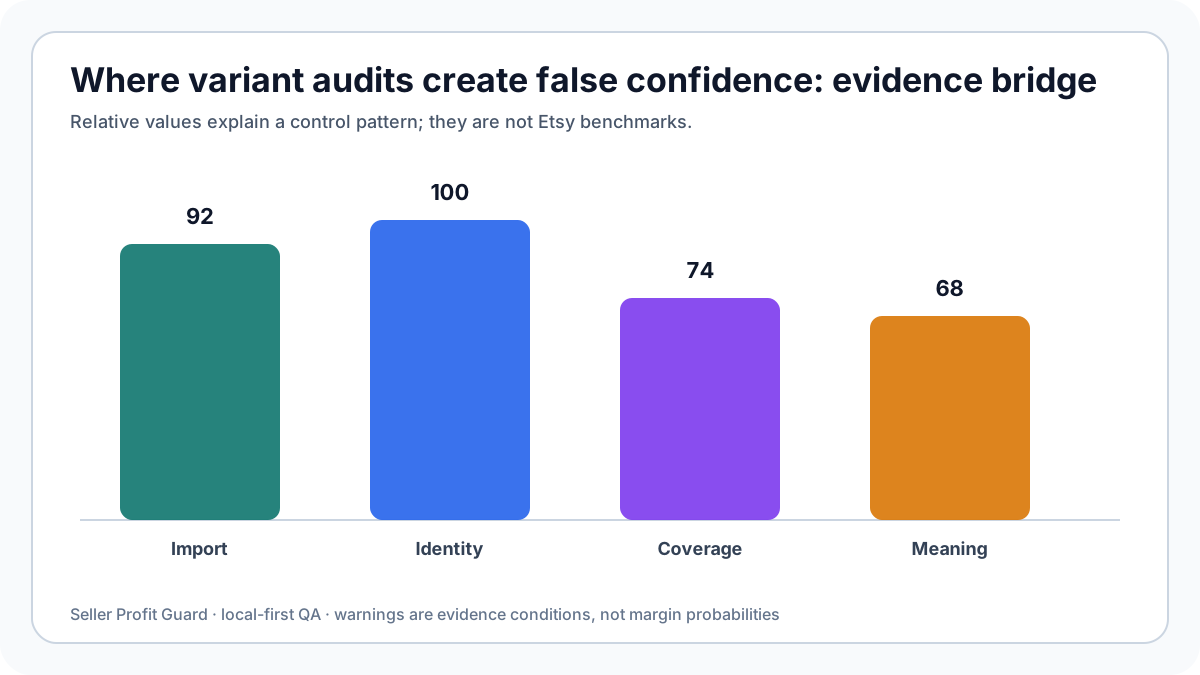
| Mistake | Failure mechanism | Control |
|---|---|---|
| Wrong header | Field meaning changes | Mapping fixture |
| Mixed source types | Different grain enters groups | Order-item filter |
| Malformed quantity | Volume becomes zero | Boundary fixture |
| Raw-file sharing | Private data exposure | Dummy reproduction |
Which identity mistakes manufacture or hide collisions?
Mistake five is over-normalizing semantic values. The checker intentionally normalizes case and spacing, not abbreviations, translations, colors, materials, or sizes. Converting `M` and `Medium` automatically may merge distinct source histories without evidence. Mistake six is reusing an old SKU for a new product or economically different variation because the code is convenient.
Mistake seven is deleting historical identifiers after a rename. That can make old orders look unmatched or attach them to current costs. Use stable identity, effective dates, and an explicit alias or replacement map. Never infer equivalence solely from title or option similarity.
Mistake eight is correcting only the CSV fix list. A downloaded report is evidence and a work queue, not the source of truth. Repair the listing, export mapping, SKU policy, or cost library, then rerun.

Which coverage and threshold mistakes distort priority?
Mistake nine is treating missing cost as zero. A high-volume missing-cost warning means the cost set lacks the normalized SKU; it does not estimate the amount. Mistake ten is raising the threshold until warnings disappear or lowering it without capacity to investigate. Both alter queue size without improving evidence.
Mistake eleven is using one average cost for every variation. A cheap small option can hide a heavy, wasteful, or labor-intensive option. Cost coverage is present only when the joined record is appropriate for that sellable identity and effective period.
Correct these with a documented review period, inclusive threshold test, SKU-level evidence register, variation extremes, and unresolved queue below the priority cut. Measure cost before pricing action.
Which interpretation mistakes create false assurance?
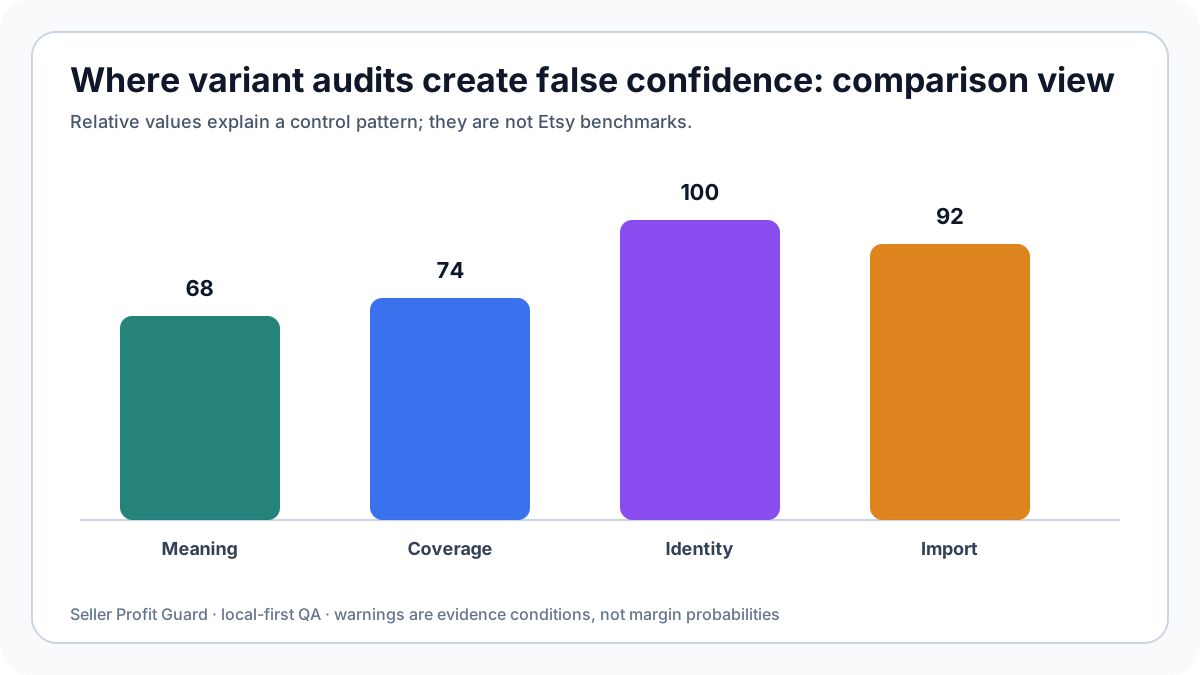
Mistake twelve is treating zero warning rows as proof of correct listings, complete inventory, or healthy margin. The checker tests five conditions on the supplied population. It does not validate every listing field, historical period, semantic alias, active inventory count, price, fees, shipping, advertising, returns, or accounting scope.
Another interpretation error is counting warning rows as independent root causes. One reused SKU can produce several grouped rows. Track root issue, affected groups, evidence, owner, action, and rerun separately. Report both counts so workload and impact remain understandable.
- Five warnings are bounded controls.
- Clean output is not a margin certificate.
- Rows and root causes are different counts.
- Threshold changes require justification.
- Upstream correction plus rerun closes a finding.
Variant-risk mistake questions
Should the checker merge abbreviations? No; semantic equivalence requires seller evidence.
Can a warning be a valid historical condition? Yes. Classify it and preserve history.
Does adding any cost row clear risk safely? Only if the SKU and effective cost are correct.
Can the report repair Etsy automatically? No. It is local operational QA.
What prevents recurrence? A stable SKU policy, mapping fixtures, negative controls, and review ownership.
Which evidence supports this variant-risk mistake review?
Use the Etsy order-item or sold-transaction export for observed item title, seller-added SKU, selected variation text, quantity, and transaction frequency. Use the active-listing export or Shop Manager for current listing, option, price, quantity, and SKU setup. Use the seller's private cost library for material, labor, packaging, fulfillment, and other cost coverage. These sources answer different questions and should not be silently merged into one truth table.
Preserve the export date, covered period, row count, detected headers, mapping version, normalization rule, cost-library fingerprint, and checker version. Verify at least one harmless dummy row from source fields through the exported fix list. A checksum can show that a file did not change; it cannot prove that the seller mapped the SKU, variation, quantity, or item columns correctly.
Classify findings by evidence: an empty SKU is observed in the selected export; one normalized SKU mapping to several normalized variation strings is a deterministic consistency warning; a high-volume SKU without a cost record is a coverage warning under the chosen quantity threshold. None of those findings alone proves accounting loss, listing-policy violation, inventory shortage, or buyer harm.
- Keep listing identity, sold-order observations, and private cost evidence separate.
- Record the period, mapping, normalization, threshold, and library fingerprint.
- Use seller-defined SKUs as identifiers, not universal marketplace product codes.
- Confirm findings in the current listing and relevant historical records before changing data.
- Treat tax, accounting, legal, and marketplace-policy questions as separate professional or official-source work.
Privacy and commercial sensitivity for variant-risk mistake review
The checker needs item, SKU, variation, quantity, and mapping context. Buyer names, email addresses, phone numbers, delivery addresses, private messages, personalization text, and payment credentials are unnecessary. Seller Profit Guard removes recognized private columns during parsing and performs the analysis in the browser, but the operator must still inspect unknown headers and avoid sharing raw exports.
Cost-library values, supplier terms, sell-through, variation mix, and exception lists can reveal commercial strategy even when buyer data is absent. Keep raw CSVs and detailed fix lists in controlled storage. Public reports should use dummy examples, aggregate counts, redacted identifiers, and non-reversible fingerprints. Never paste a private transaction row into an article, issue, analytics event, or community post.
How to apply this variant-risk mistake review in the Variant Risk Checker
Open Seller Profit Guard, load a recent Etsy order-item CSV or a public dummy fixture, confirm the detected item, SKU, variation, and quantity columns, and load the matching SKU cost library. The checker groups rows by item, SKU, and variation, normalizes case and spacing for comparison, then reports five bounded warning families: missing SKU, missing variation text, one SKU linked to multiple variation strings, one item-and-variation linked to multiple SKUs, and a high-volume SKU without a matching cost record.
Review the highest-impact warning with its source row and current listing. Correct the upstream listing, SKU policy, export mapping, or cost record; do not merely edit the downloaded fix list. Re-export a bounded period, rerun the same mapping and threshold, and compare the warning with the saved evidence. The tool is operational QA, not an Etsy connection, inventory system, accounting ledger, or guarantee of margin.
- Use a bounded export and confirm the detected mapping.
- Load or create the matching SKU cost assumptions locally.
- Review each warning code and its grouped quantity and order count.
- Verify the current listing and historical identity before making a correction.
- Rerun the same fixture and record the result, owner, date, and rollback.
Sources and further reading
- Etsy Help: How to Use SKU for Your Inventory: Official Etsy guidance on seller-defined SKUs, inventory identification, and practical SKU naming.
- Etsy Help: How to Add Variations for Your Listings: Official listing-variation workflow and controls for option-level price, quantity, processing profile, and SKU.
- Etsy Help: Processing Times, Profiles, and Ship-By Dates: Official definition of physical-item processing time and the current listing- or variation-level processing-profile workflow.
- Etsy Help: Download Sold Transaction Spreadsheets: Official order-item export workflow and confirmation that seller-added SKU numbers can appear in the downloaded data.
- Etsy Help: Download Your Listing Information: Official active-listing export fields, including price, currency, quantity, and seller-added SKU numbers.
- Seller Profit Guard calculation methodology: Definitions for editable assumptions, evidence hierarchy, local-first processing, contribution scope, and uncertainty.
Related Seller Profit Guard tools
- Open the Variant Risk Checker: Check order-item CSV rows for missing SKUs, inconsistent variation mapping, and high-volume SKUs without cost records.
- Use the SKU Cost Library: Create and reuse browser-local material, labor, packaging, fulfillment, and target-margin assumptions.
- Review the Etsy variation SKU checklist: Inspect listing setup before a variation or SKU mapping defect reaches sold-order data.
- Learn what an Etsy SKU is: Build stable seller-defined identifiers for products, variations, inventory, costs, and fulfillment.
- Read local-first CSV privacy: Understand which fields the checker needs and which buyer, address, and contact fields it removes.
- Etsy Variant Risk: 5 Checks Before Margin Review: Continue the variation identity, coverage, and evidence workflow.
- Etsy Size Variation Audit: One SKU, Two Labels: Continue the variation identity, coverage, and evidence workflow.
- Etsy Material Variations: One Label, Two SKUs: Continue the variation identity, coverage, and evidence workflow.
- Etsy Variant Audit Data: 6 Sources to Reconcile: Continue the variation identity, coverage, and evidence workflow.
- Etsy Variant Risk Thresholds: Use, Hold, Escalate: Continue the variation identity, coverage, and evidence workflow.
Next step: Open the Variant Risk Checker.
This is operational planning help, not tax, accounting, legal, financial, or platform-policy advice. Review the Terms and disclaimer, and verify current platform rules and fee assumptions before changing prices.