Safety stock audit checklist and reversible change log
Last updated: 2026-07-31
Written and reviewed by Seller Profit Guard Editorial Team.
A safety-stock audit records SKU-location scope, complete demand dates, zero-day and stockout treatment, comparable lead-time pairs, population averages and deviations, service target and z-score, both variance components, combined deviation, unrounded and rounded buffers, sensitivity, distribution-fit review, operating approval, monitoring, exceptions, and restoration without exposing private rows.
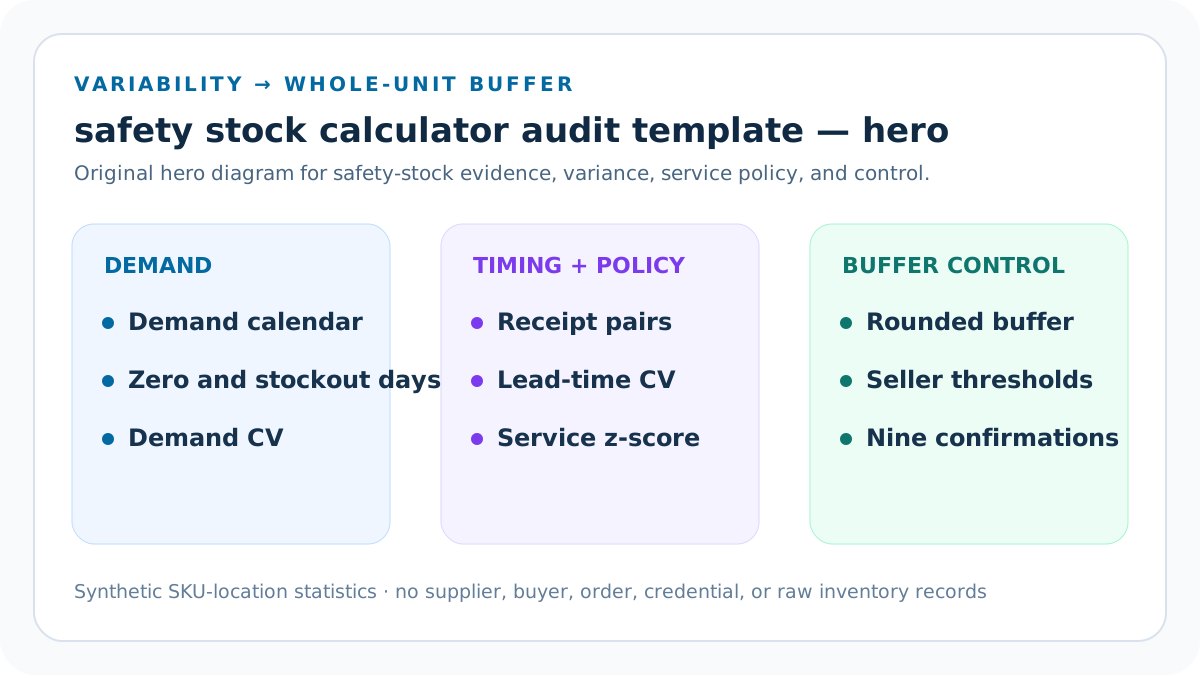
Audit scope and versions
Record item, location, units, dates, owners, and source signatures. The statistical buffer audit record records the exact source grain, calendar or receipt rule, unit, formula component, timestamp, owner, exception, approval, and preceding accepted value needed for a reproducible and reversible audit.
Use protected pointers. At review point 1, contrast the nine-unit stable fixture, the forty-one-unit timing-variation fixture, a stockout-censored series, a mixed-receipt defect, and a corrected packet. Identify which output is arithmetic and which conclusion still needs inventory-policy evidence.
Audit demand evidence
Reconcile calendar rows, zeros, stockouts, exclusions, mean, and deviation. The statistical buffer audit record records the exact source grain, calendar or receipt rule, unit, formula component, timestamp, owner, exception, approval, and preceding accepted value needed for a reproducible and reversible audit.
Retain raw rows privately. At review point 2, contrast the nine-unit stable fixture, the forty-one-unit timing-variation fixture, a stockout-censored series, a mixed-receipt defect, and a corrected packet. Identify which output is arithmetic and which conclusion still needs inventory-policy evidence.
Audit receipt evidence
Reconcile pair definitions, samples, holds, mean, and deviation. The statistical buffer audit record records the exact source grain, calendar or receipt rule, unit, formula component, timestamp, owner, exception, approval, and preceding accepted value needed for a reproducible and reversible audit.
Explain every exclusion. At review point 3, contrast the nine-unit stable fixture, the forty-one-unit timing-variation fixture, a stockout-censored series, a mixed-receipt defect, and a corrected packet. Identify which output is arithmetic and which conclusion still needs inventory-policy evidence.
Audit policy evidence
Record target, z-score, rationale, approver, and effective dates. The statistical buffer audit record records the exact source grain, calendar or receipt rule, unit, formula component, timestamp, owner, exception, approval, and preceding accepted value needed for a reproducible and reversible audit.
Policy is not inferred from output. At review point 4, contrast the nine-unit stable fixture, the forty-one-unit timing-variation fixture, a stockout-censored series, a mixed-receipt defect, and a corrected packet. Identify which output is arithmetic and which conclusion still needs inventory-policy evidence.
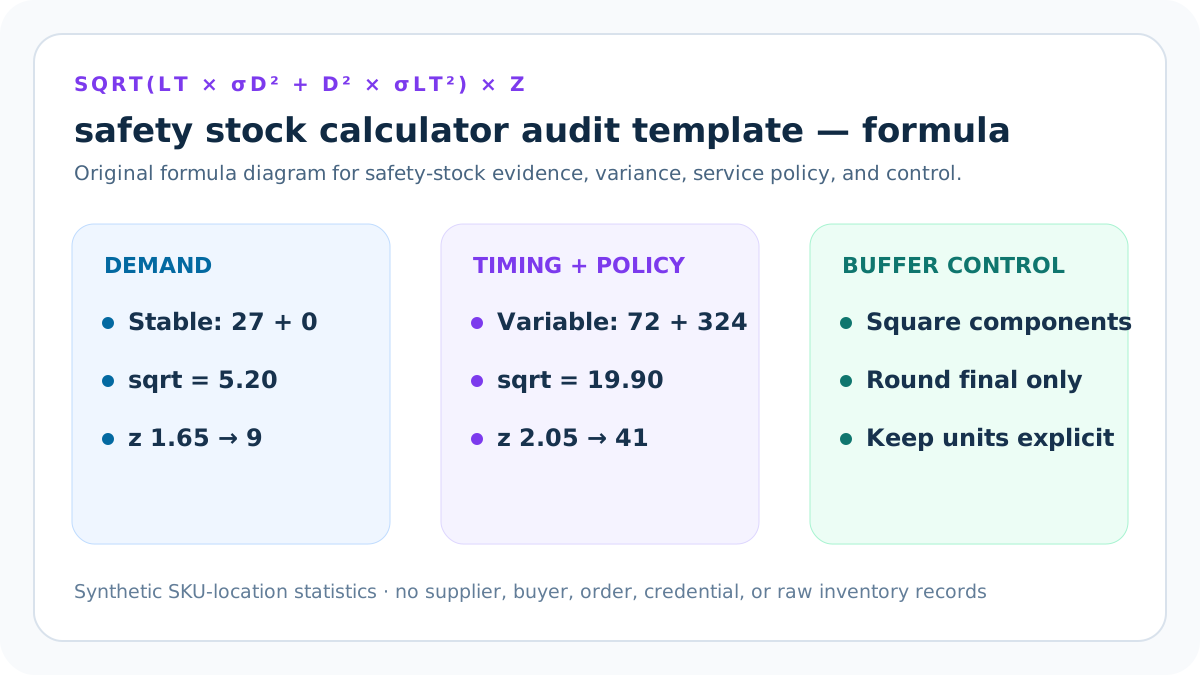
Audit formula outputs
Reperform variance components, square root, multiplication, and rounding. The statistical buffer audit record records the exact source grain, calendar or receipt rule, unit, formula component, timestamp, owner, exception, approval, and preceding accepted value needed for a reproducible and reversible audit.
Intermediate values must reproduce. At review point 5, contrast the nine-unit stable fixture, the forty-one-unit timing-variation fixture, a stockout-censored series, a mixed-receipt defect, and a corrected packet. Identify which output is arithmetic and which conclusion still needs inventory-policy evidence.
Audit operational approval
Record sensitivity, fit, constraints, alternatives, and replenishment integration. The statistical buffer audit record records the exact source grain, calendar or receipt rule, unit, formula component, timestamp, owner, exception, approval, and preceding accepted value needed for a reproducible and reversible audit.
Buffer does not authorize supply. At review point 6, contrast the nine-unit stable fixture, the forty-one-unit timing-variation fixture, a stockout-censored series, a mixed-receipt defect, and a corrected packet. Identify which output is arithmetic and which conclusion still needs inventory-policy evidence.
Audit monitoring and restoration
Record later error, exceptions, stop rules, prior value, and rollback. The statistical buffer audit record records the exact source grain, calendar or receipt rule, unit, formula component, timestamp, owner, exception, approval, and preceding accepted value needed for a reproducible and reversible audit.
Keep history append-only. At review point 7, contrast the nine-unit stable fixture, the forty-one-unit timing-variation fixture, a stockout-censored series, a mixed-receipt defect, and a corrected packet. Identify which output is arithmetic and which conclusion still needs inventory-policy evidence.
Safety Stock Audit and Change Log: population integrity control
Record one SKU-location, complete calendar, stable units, availability rules, and effective mappings. Control 1 declares a pass condition, independent reviewer, failure owner, correction deadline, sensitivity test, monitoring signal, and restoration trigger before the proposed buffer can enter a replenishment policy.
Mixed populations are blocked. Apply the control to the concrete statistical buffer audit record; keep uncertainty buffer separate from expected lead-time demand, reorder point, purchase quantity, and private supplier or order evidence.
Safety Stock Audit and Change Log: demand-distribution control
Retain zero days, stockout flags, exclusions, mean, population deviation, and pattern classification. Control 2 declares a pass condition, independent reviewer, failure owner, correction deadline, sensitivity test, monitoring signal, and restoration trigger before the proposed buffer can enter a replenishment policy.
Observed sales may be censored or non-normal. Apply the control to the concrete statistical buffer audit record; keep uncertainty buffer separate from expected lead-time demand, reorder point, purchase quantity, and private supplier or order evidence.
Safety Stock Audit and Change Log: receipt-pair control
Retain comparable start and usable-receipt events, sample count, exclusions, average, and population deviation. Control 3 declares a pass condition, independent reviewer, failure owner, correction deadline, sensitivity test, monitoring signal, and restoration trigger before the proposed buffer can enter a replenishment policy.
Supplier timing needs field-level evidence. Apply the control to the concrete statistical buffer audit record; keep uncertainty buffer separate from expected lead-time demand, reorder point, purchase quantity, and private supplier or order evidence.
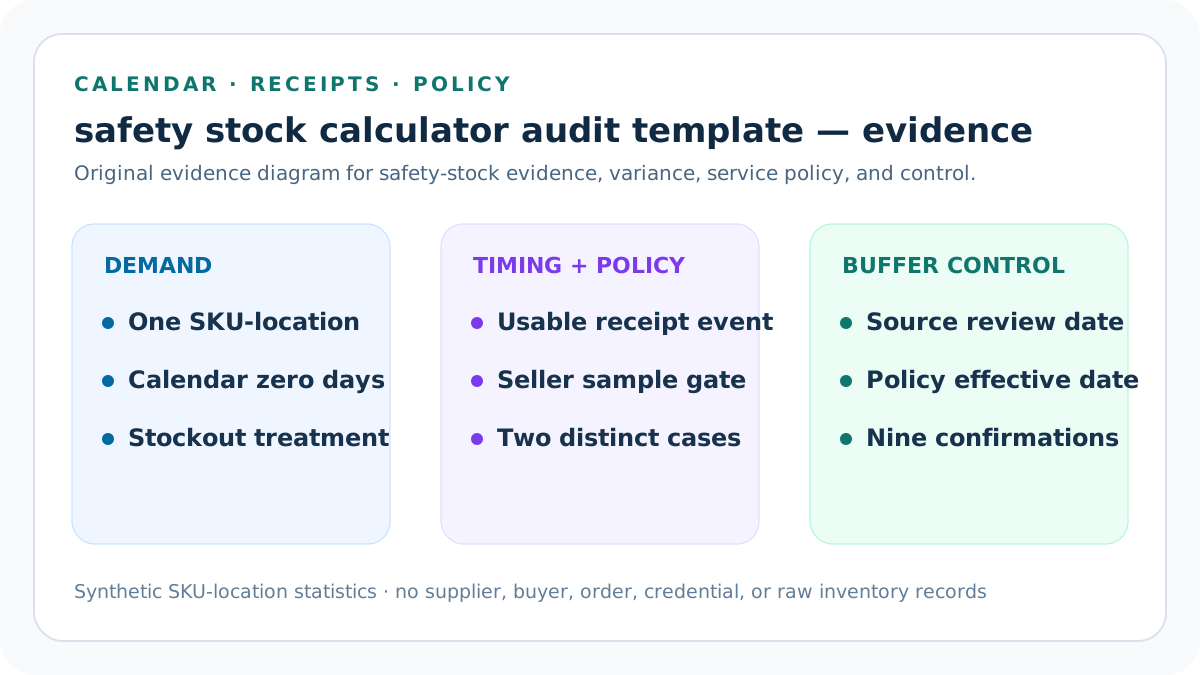
Safety Stock Audit and Change Log: service-policy control
Record the target, z-score mapping, rationale, approver, sensitivity range, and effective period. Control 4 declares a pass condition, independent reviewer, failure owner, correction deadline, sensitivity test, monitoring signal, and restoration trigger before the proposed buffer can enter a replenishment policy.
The tool does not optimize the target. Apply the control to the concrete statistical buffer audit record; keep uncertainty buffer separate from expected lead-time demand, reorder point, purchase quantity, and private supplier or order evidence.
Safety Stock Audit and Change Log: seller-threshold control
Record the minimum qualifying receipts for Ready and maximum equivalent buffer days; review both scenarios against the same dated policy. Control 5 declares a pass condition, independent reviewer, failure owner, correction deadline, sensitivity test, monitoring signal, and restoration trigger before the proposed buffer can enter a replenishment policy.
A threshold exception requires documented sensitivity rather than silent acceptance. Apply the control to the concrete statistical buffer audit record; keep uncertainty buffer separate from expected lead-time demand, reorder point, purchase quantity, and private supplier or order evidence.
Safety Stock Audit and Change Log: confirmation and masking control
Confirm all nine scope, calendar, stockout, receipt, service, method, pattern, privacy, and current-rule statements before calculation use. Control 6 declares a pass condition, independent reviewer, failure owner, correction deadline, sensitivity test, monitoring signal, and restoration trigger before the proposed buffer can enter a replenishment policy.
A failed confirmation blocks and masks every derived result. Apply the control to the concrete statistical buffer audit record; keep uncertainty buffer separate from expected lead-time demand, reorder point, purchase quantity, and private supplier or order evidence.
Safety Stock Audit and Change Log: recovery and privacy control
Keep raw demand and receipts private; retain the prior buffer, monitoring window, stop rule, and restoration authority. Control 7 declares a pass condition, independent reviewer, failure owner, correction deadline, sensitivity test, monitoring signal, and restoration trigger before the proposed buffer can enter a replenishment policy.
Public examples remain synthetic. Apply the control to the concrete statistical buffer audit record; keep uncertainty buffer separate from expected lead-time demand, reorder point, purchase quantity, and private supplier or order evidence.
Audit scope and versions: variability lab 1
Reperform the relevant output from the nine-unit and forty-one-unit synthetic cases. Record item, location, units, dates, owners, and source signatures. Change one variable only, preserve the remaining population and formula assumptions, list both squared components, and record the expected Block, Review, or Ready classification.
Use protected pointers. Test an omitted zero day, stockout interval, changed demand window, mismatched receipt, unsupported service target, intermittent pattern, and restored prior buffer. State the protected evidence and operating approval still required.
Audit demand evidence: variability lab 2
Reperform the relevant output from the nine-unit and forty-one-unit synthetic cases. Reconcile calendar rows, zeros, stockouts, exclusions, mean, and deviation. Change one variable only, preserve the remaining population and formula assumptions, list both squared components, and record the expected Block, Review, or Ready classification.
Retain raw rows privately. Test an omitted zero day, stockout interval, changed demand window, mismatched receipt, unsupported service target, intermittent pattern, and restored prior buffer. State the protected evidence and operating approval still required.
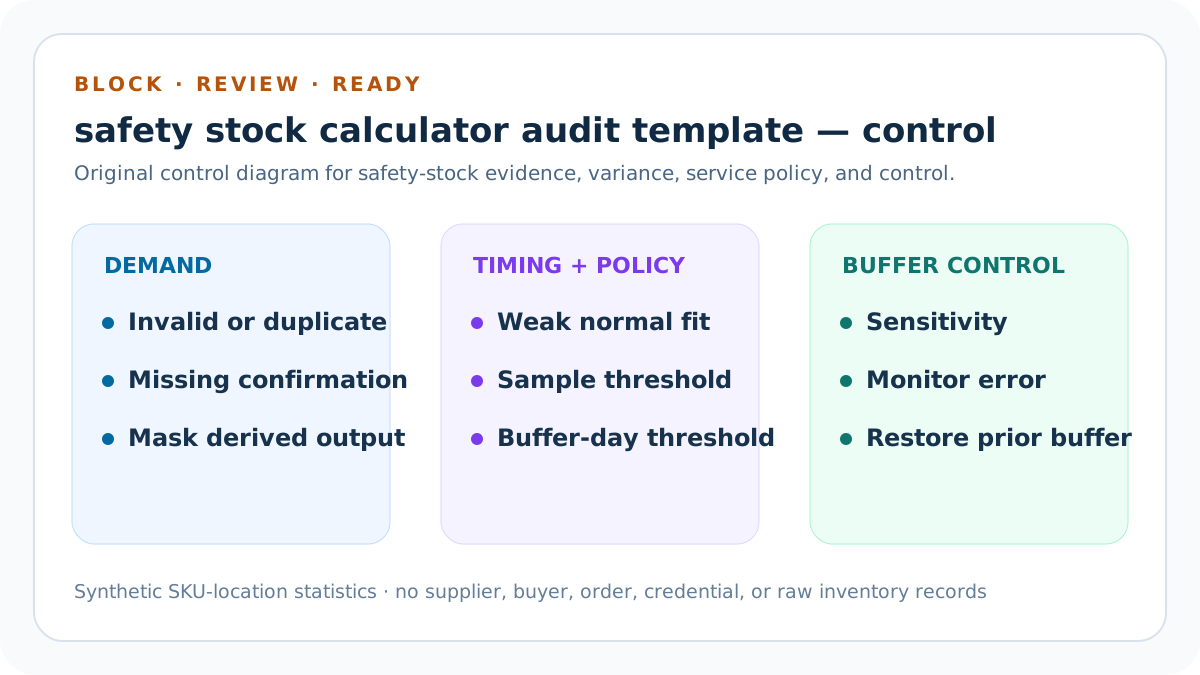
Audit receipt evidence: variability lab 3
Reperform the relevant output from the nine-unit and forty-one-unit synthetic cases. Reconcile pair definitions, samples, holds, mean, and deviation. Change one variable only, preserve the remaining population and formula assumptions, list both squared components, and record the expected Block, Review, or Ready classification.
Explain every exclusion. Test an omitted zero day, stockout interval, changed demand window, mismatched receipt, unsupported service target, intermittent pattern, and restored prior buffer. State the protected evidence and operating approval still required.
Audit policy evidence: variability lab 4
Reperform the relevant output from the nine-unit and forty-one-unit synthetic cases. Record target, z-score, rationale, approver, and effective dates. Change one variable only, preserve the remaining population and formula assumptions, list both squared components, and record the expected Block, Review, or Ready classification.
Policy is not inferred from output. Test an omitted zero day, stockout interval, changed demand window, mismatched receipt, unsupported service target, intermittent pattern, and restored prior buffer. State the protected evidence and operating approval still required.
Audit formula outputs: variability lab 5
Reperform the relevant output from the nine-unit and forty-one-unit synthetic cases. Reperform variance components, square root, multiplication, and rounding. Change one variable only, preserve the remaining population and formula assumptions, list both squared components, and record the expected Block, Review, or Ready classification.
Intermediate values must reproduce. Test an omitted zero day, stockout interval, changed demand window, mismatched receipt, unsupported service target, intermittent pattern, and restored prior buffer. State the protected evidence and operating approval still required.
Audit operational approval: variability lab 6
Reperform the relevant output from the nine-unit and forty-one-unit synthetic cases. Record sensitivity, fit, constraints, alternatives, and replenishment integration. Change one variable only, preserve the remaining population and formula assumptions, list both squared components, and record the expected Block, Review, or Ready classification.
Buffer does not authorize supply. Test an omitted zero day, stockout interval, changed demand window, mismatched receipt, unsupported service target, intermittent pattern, and restored prior buffer. State the protected evidence and operating approval still required.
Audit monitoring and restoration: variability lab 7
Reperform the relevant output from the nine-unit and forty-one-unit synthetic cases. Record later error, exceptions, stop rules, prior value, and rollback. Change one variable only, preserve the remaining population and formula assumptions, list both squared components, and record the expected Block, Review, or Ready classification.
Keep history append-only. Test an omitted zero day, stockout interval, changed demand window, mismatched receipt, unsupported service target, intermittent pattern, and restored prior buffer. State the protected evidence and operating approval still required.
Reperform the calculation as an independent audit
The reviewer begins from the retained aggregate inputs rather than copying displayed outputs. Recalculate each mean and population deviation, demand variance, timing variance, combined square root, mapped z-score, unrounded result, upward-rounded buffer, equivalent days, demand coefficient of variation, and lead-time coefficient of variation. Initial every reproduced value and log each discrepancy.
Then test the deterministic states: invalidate a date, remove one confirmation, duplicate the second scenario, lower a qualifying-receipt count beneath the seller threshold, raise equivalent buffer days above its limit, declare an intermittent pattern, and restore the accepted fixture. Expected Block outputs must remain unavailable.
Close the change record and restoration proof
The append-only change record identifies the requestor, evidence owner, formula reviewer, inventory-policy approver, implementation owner, monitoring owner, prior buffer, proposed buffer, effective timestamp, stop conditions, restoration command or workflow, and independent witness. Attach hashes for the calculation packet, tests, build, visuals, content audit, similarity audit, and live verification.
Closure requires a disposition for every exception plus proof that the previous accepted buffer can be restored without exposing supplier, buyer, order, credential, or raw inventory data. Later stockouts or quiet periods are monitoring observations, not retroactive proof that the approved calculation caused an outcome.
Evidence boundary for a reproducible and reversible audit
The packet can demonstrate entered means, population deviations, coefficients of variation, variance components, combined lead-time demand deviation, service z-score mapping, final multiplication, upward rounding, equivalent days, seller thresholds, nine confirmations, and sensitivity under synthetic inputs.
It cannot prove unconstrained future demand, inventory accuracy, normal-distribution fit, optimal service, supplier performance, carrying affordability, reorder timing, purchase quantity, or stockout prevention.
Release, monitor, and restore the statistical buffer audit record
Block invalid population, dates, evidence, amounts, samples, duplicate scenarios, service mapping, policy context, missing confirmations, privacy, or open conflicts and mask all derived outputs. Review weak distribution shape, extreme variation, too few receipts for the seller threshold, or excessive equivalent buffer days. Ready clears only the entered statistical worksheet.
Before indexing or operational use, preserve evidence and rollback artifacts, run typecheck, unit, integration, build, content, similarity, SEO, image, link, mobile, strict-route, deployment, and live checks, then compare later error without claiming same-period causality.
Safety Stock Audit and Change Log: concrete working record
Open a change record with identifier, SKU, location, unit, timezone, operator, reviewer, formula version, source snapshot signatures, proposed effective date, and prior accepted buffer. Attach protected pointers to the demand calendar, stockout log, receipt-pair register, service approval, calculation trace, sensitivity table, fit review, capacity and shelf-life assessment, decision, separate replenishment-policy reference, monitoring window, stop conditions, and restoration result. Reperform each intermediate value, document discrepancies, and close only after later observations and exceptions have dispositions.
Sources and further reading
- Seller Profit Guard methodology: Evidence, formula, privacy, correction, release, monitoring, and rollback rules.
- Seller Profit Guard data privacy: Local-first boundaries for SKU, supplier, receipt, order, buyer, and raw inventory data.
- NetSuite Help: Inventory Optimization Calculations: Official demand, lead-time, z-score, safety-stock, rounding, minimum-sample, and approximation formulas.
- NetSuite Help: Inventory Optimization: Official item-location demand, lead-time history, service-level, and planning-value boundary for inventory optimization.
- NetSuite Help: Lead Time and Safety Stock Per Location: Official receipt-derived lead time and location-specific safety-stock context.
- NetSuite Help: Inventory Count: Official inventory-count workflow clarifying why the statistical buffer does not verify on-hand quantity.
- Microsoft Learn: Safety stock fulfillment for items: Official safety-stock planning threshold and replenishment example.
- Microsoft Learn: Planning parameter best practices: Official distinction between safety-stock quantity and safety lead time.
- Microsoft Learn: Planning parameters: Official separation of safety-stock quantity, safety lead time, reorder timing, quantity, and order modifiers.
Related Seller Profit Guard tools
- Safety Stock Calculator: Estimate a statistical SKU-location buffer from demand and lead-time variability.
- Reorder Point Calculator: Use an approved buffer with expected lead-time demand to review a replenishment trigger.
- Variation SKU Generator: Create stable variation identities before location-level analysis.
- SKU Naming Generator: Define the canonical product-variant identity.
- CSV Import Validator: Review a redacted structure before protected data preparation.
- Methodology: Review evidence, formula, privacy, correction, release, and rollback.
- Data Privacy: Protect inventory, supplier, receipt, buyer, credential, and raw export data.
- Safety Stock Formula and Input Rules: Define SKU-location demand, variability, lead-time samples, service z-scores, population formulas, evidence windows, and rounding.
- Safety Stock Worked Example: Stable Lead Time: Calculate a nine-unit buffer from four daily units, 1.50 demand deviation, twelve-day lead time, zero timing deviation, and 95% service.
- Safety Stock Example with Variable Lead Time: Calculate a 41-unit buffer when six-unit demand, demand deviation, receipt timing deviation, and a 98% service target interact.
- Safety Stock Mistakes and Corrections: Correct missing zero days, stockout bias, mixed SKU locations, sample-vs-population errors, weak receipt pairs, z-score misuse, and double buffers.
- Safety Stock Data Sources and Lineage: Map demand calendars, stockouts, order-to-receipt pairs, locations, service targets, formula versions, and policy approvals to authoritative fields.
- Safety Stock Decision and Approval Gates: Separate population validity, statistical fit, service ownership, capacity, carrying exposure, replenishment integration, monitoring, and rollback.
- Stable vs Variable Lead-Time Safety Stock: Compare nine-unit and 41-unit buffers at the same SKU-location grain and isolate demand, receipt-timing, and service-target drivers.
- Weekly Safety Stock Review Routine: Run a repeatable SKU-location cycle for demand calendars, stockouts, receipt pairs, deviations, service policy, sensitivity, exceptions, and restoration.
- How to Interpret Safety Stock Results: Read variance components, combined deviation, z-score, rounded units, equivalent days, and status without claiming optimal service or protection.
Next step: Open Seller Profit Guard.
This is operational planning help, not tax, accounting, legal, financial, or platform-policy advice. Review the Terms and disclaimer, and verify current platform rules and fee assumptions before changing prices.