How to interpret Etsy contribution without false precision
Last updated: 2026-07-27
Written and reviewed by Seller Profit Guard Editorial Team.
Interpret an Etsy contribution result as a scoped operating estimate, not a universal profit fact. Read the included costs, evidence grade, calculation grain, currency, period, and uncertainty range; compare base and conservative cases with the seller's target; then choose a reversible action that remains valid if the weakest assumption moves.

What does an estimated contribution result actually mean?
Estimated contribution is seller-attributable revenue minus the platform, product, labor, packaging, fulfillment, promotion, advertising, software, and expected-loss layers included in the model. The number belongs to a defined order, item, SKU, listing, period, or scenario. It does not automatically include income tax, financing, owner compensation, general overhead, inventory adjustments, depreciation, or every accounting classification.
Read the scope before the amount. A $24 result can be strong evidence about one settled order with matched charges and current SKU costs, or a weak forecast based on broad averages. The displayed cents describe arithmetic, not certainty. The report should show source status, assumptions, target, and sensitivity so the seller can judge whether the next decision survives ordinary variation.

| Result label | What it can support | What it cannot prove |
|---|---|---|
| Matched order contribution | Retrospective operating review | Complete accounting or tax profit |
| SKU planning contribution | Price, promotion and cost scenario | Future demand or guaranteed outcome |
| Contribution rate | Relative cost pressure at stated grain | Adequate retained dollars or capacity |
| Target headroom | Tolerance for defined adverse change | Safety from unknown or excluded risks |
| Shop aggregate | Portfolio context | Economics of every variation |
How do known, private, estimated, and unknown inputs differ?
Known platform evidence includes matched order revenue and current account charges for the reviewed transaction or period. Private seller evidence includes current SKU invoices, bills of materials, time studies, packaging records, and label receipts. Estimated inputs include future ad attribution, return loss, software allocation, or shipping range. Unknown inputs lack usable evidence and should block decisions they can reverse.
Assign an evidence grade to the result. A high-confidence base case can still need a stress scenario. A medium-confidence planning case can support a limited test when the downside is capped. A low-confidence result should produce a research or hold action, not a price or scale recommendation. Improving one decision-critical input can be more valuable than adding several insignificant decimals.

How do you read base, optimistic, and conservative cases?
The base case uses the most representative current evidence. The conservative case changes a credible adverse driver such as a fee, shipping adjustment, labor range, attributed order, return loss, or recovery. An improvement case changes one controllable input such as packaging, process time, price, threshold, or coupon. Avoid an optimistic case that simply removes costs without an operational reason.
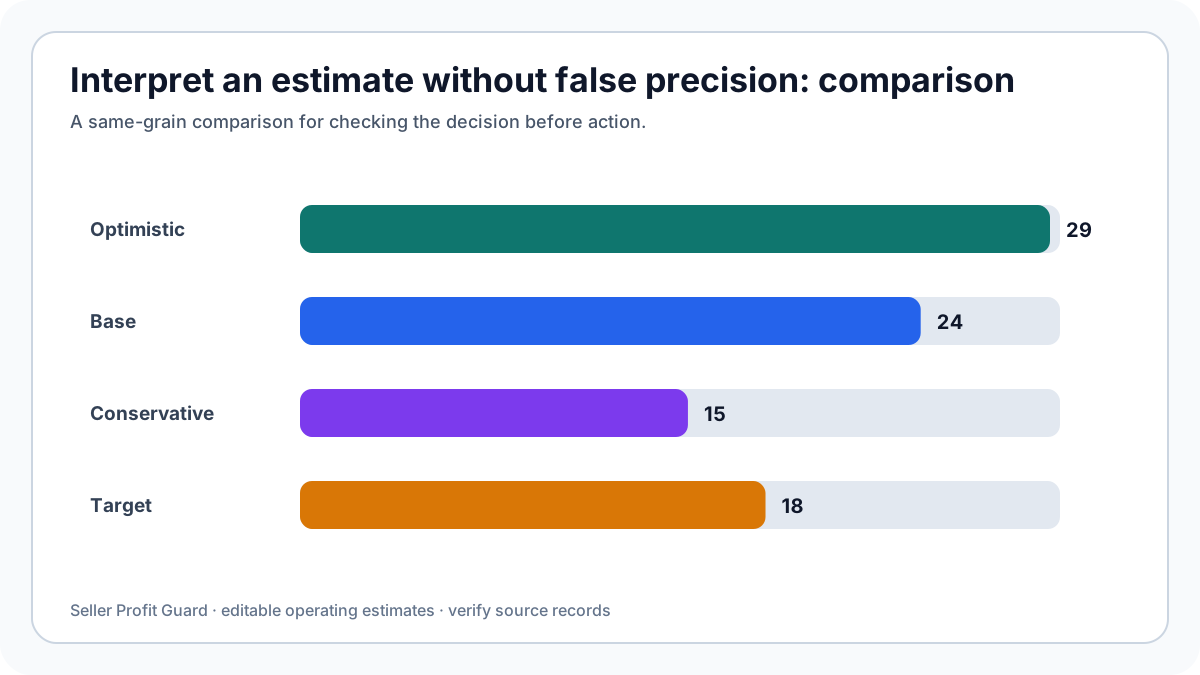
Suppose base contribution is $24, the seller's target is $18, and fee, labor, and return uncertainty can reduce the result by $9 in a credible combined case. Conservative contribution is $15, below target. The base case does not support broad expansion. It can support a bounded test, an evidence-improvement task, or a change that addresses the driver.
| Case | Contribution | Evidence interpretation | Action |
|---|---|---|---|
| Improvement | $29 | Requires a verified process change | Test only after change exists |
| Base | $24 | Representative current evidence | Compare with target and downside |
| Conservative | $15 | Credible adverse combination | Fails $18 target |
| Unknown core cost | Not reliable | Decision-critical evidence absent | Block and measure |
| Actual matured order | Recalculate | Use settled charges and outcome | Close or revise decision |
Which input deserves a sensitivity test?
Change one input at a time and record the contribution delta. Prioritize large uncertain drivers: price, seller-funded discount, product/provider cost, labor minutes, label cost, advertising, return rate, loss per return, and fixed-cost denominator. A variable that moves contribution by $0.20 does not deserve the same attention as one that changes the decision by $8.
Use realistic ranges and state their source. For labor, use observed low, representative, and high times. For shipping, use relevant package and zone evidence. For returns, separate frequency from unrecovered loss. For fees, use the seller's current country, program, currency, and fee base. A sensitivity table should expose the decision driver, not create arbitrary scenarios.
- Test the largest uncertain economic drivers first.
- Use ranges supported by seller or official evidence.
- Change one driver before combining credible interactions.
- Report contribution delta and threshold crossing.
- Measure the variable whose uncertainty blocks the action.
Why can cash, Payment Account, and contribution disagree?
Order contribution measures product economics in the defined model. Payment Account activity explains platform sales, charges, refunds, seller services, shipping, balances, reserves, and deposits. The bank statement records cash arrival. Inventory purchases, provider timing, card payments, reserves, deposit schedules, and other expenses can make cash movement differ from order contribution.
Do not use a positive contribution estimate to explain a missing deposit or use a large deposit to approve a product price. Reconcile the platform account and bank separately. Then connect the matched order charges and private costs to contribution. A seller can have profitable products and temporary cash pressure, or strong deposits from prior activity while current products are weak.
| Measure | Question answered | Timing boundary |
|---|---|---|
| Order revenue | What was economically sold? | Order and settlement context |
| Payment Account | How did Etsy activity change the balance? | Activity, availability and statement period |
| Deposit | What cash transfer was sent? | Deposit schedule and bank posting |
| Contribution | What remains after included order costs? | Defined order/SKU and assumption version |
| Accounting result | How is the business reported? | Professional and statutory process |
How should the result change a price or promotion decision?
Map result bands to predefined actions. Below break-even, verify the formula and stop repeated loss exposure. Above break-even but below target, do not scale; investigate price, cost, labor, shipping, promotion, or evidence. Above target but below stress-safe, use a capped test. Above stress-safe with current evidence, expansion is eligible but still depends on demand, inventory, cash, capacity, policy, and customer impact.
Choose a reversible action. A variation-specific price, smaller coupon, shipping threshold, ad cap, packaging test, or measurement task is easier to evaluate than a shop-wide rewrite. Record the baseline, changed variable, expected range, target, limit, owner, review window, and rollback. Do not move the target after seeing the result without recording a policy change.
- Confirm scope, grain, currency, period and cost layers.
- Grade evidence and mark decision-critical unknowns.
- Compare base and credible conservative cases with the target.
- Identify the variable that crosses the threshold.
- Choose one reversible action with a cap.
- Reconcile actual matured evidence and close the loop.
What language avoids misleading certainty?
Use estimated contribution, modeled contribution, planning scenario, matched charge, seller-entered cost, and expected unrecovered loss. State the period and grain. Avoid net profit when private, overhead, tax, accounting, or financing scope is incomplete. Avoid guaranteed, accurate for every seller, typical, or optimal unless current evidence actually supports the claim.
Explain limitations beside the result, not only in a distant disclaimer. If a fee is country-dependent, say so where it is entered. If return loss is estimated, show the rate and loss-per-return assumption. If a row is missing cost, block the positive interpretation. Clear language is a calculation control because it determines how the seller acts.
- Say estimated contribution rather than universal net profit.
- Name the grain, period, currency and included layers.
- Separate matched evidence from editable assumptions.
- Display unknowns and ranges near the result.
- Do not imply ranking, sales, profit, or approval guarantees.
Etsy profit interpretation questions
Is a positive contribution result enough to keep a product? No. Compare it with the retained target, evidence quality, capacity, cash, demand, inventory, policy, and downside case.
Why does the calculator show cents if inputs are estimates? Currency arithmetic uses cents, but the interpretation should use a range and evidence grade. Display precision is not evidence precision.
Can I compare two products by contribution rate? Yes for one perspective, but also compare retained dollars, labor or capacity use, risk, and evidence grain.
What if the conservative case fails but the base passes? Limit the decision, improve the weak evidence, or change the driver. Do not treat the base as stress-safe.
When does an estimate become actual? It can be updated with settled revenue, matched charges, final shipping, and known refund/recovery outcomes, but the result remains scoped operating contribution rather than automatic accounting profit.
Privacy and evidence limits for profit-result interpretation
A contribution review does not need buyer names, delivery addresses, private messages, payment credentials, marketplace passwords, or a public copy of the seller's order history. It normally needs a redacted transaction key, date, SKU, quantity, seller-attributable revenue, relevant fee evidence, and private cost assumptions. Keep the untouched export in controlled storage and work from a local copy.
Seller Profit Guard is designed to read supported CSV files in the browser. A report can still contain commercially sensitive prices, SKU economics, labor rates, and supplier costs, so treat exports as private operating records. For support, share column names and a made-up example row. If an account-specific reserve, fee, refund, or suspension determines the answer, use the authenticated Etsy record rather than a generic assumption.
- Do not upload buyer identity or address fields for a margin calculation.
- Do not paste raw order rows into public communities, support email, or AI prompts.
- Use public dummy data to reproduce mapping and formula issues.
- Store cost libraries, reports, and change logs as confidential business records.
- Escalate tax, accounting, legal, and account-policy questions to the appropriate official or professional source.
How to apply this profit-result interpretation in Seller Profit Guard
Open the Etsy CSV profit calculator with a recent, representative order-item export or the public dummy sample. Confirm the revenue, quantity, SKU, shipping, discount, fee, and transaction mappings before importing private cost assumptions. Review missing-cost and mapping warnings first; a precise result built on an empty or misidentified field is not decision-ready.
Run the relevant base and stress scenarios, export the private review list, and record the source period, assumptions, result, decision, owner, and next review date. The useful output is not a perfect score. It is a short, evidence-backed queue of listings or SKUs that need a price, cost, shipping, promotion, or data-quality action.
- Preserve the source export and record its shop, currency, period, and file type.
- Confirm every mapped field and keep missing values unknown rather than zero.
- Attach the correct SKU-level material, labor, packaging, fulfillment, and target assumptions.
- Run a base case plus the page-specific stress or comparison case.
- Inspect the rows that fail the target or evidence-quality gate.
- Record one reversible action and a dated follow-up instead of changing the whole shop.
Related resources
- Open the Etsy CSV profit calculator: Run a browser-local order and SKU contribution review with editable assumptions.
- Build an Etsy SKU cost library: Store material, labor, packaging, shipping, and target assumptions for repeat reviews.
- Reconcile Etsy Payment Account activity: Match order and statement evidence before interpreting cash movement as product economics.
- Review CSV data privacy: Keep raw buyer and order data out of public support and community posts.
- Read the editorial policy: See how sources, corrections, AI assistance, and update dates are handled.
Sources and further reading
- Seller Profit Guard calculation methodology: Calculation scope, editable assumptions, contribution terminology, privacy boundaries, and result limits.
- Etsy Help: Fees and Taxes for Selling: Official fee categories, fee bases, country-dependent processing charges, advertising fees, and Payment Account treatment.
- Etsy Help: Download Sold Transaction Spreadsheets: Official order items, orders, Etsy Payments sales, and Etsy Payments deposits CSV workflow.
- Etsy Help: Manage Your Payment Account: Official sales, fees, refunds, seller services, shipping, monthly statements, balance, and deposit context.
- Etsy Help: How Offsite Ads Work: Official attribution, participation, fee-rate, and order-cap context; verify current shop-specific status.
- Etsy Help: Issue a Full or Partial Refund: Official refund workflow and Payment Account impact reference.
Related Seller Profit Guard tools
- Open the Etsy CSV profit calculator: Run a browser-local order and SKU contribution review with editable assumptions.
- Build an Etsy SKU cost library: Store material, labor, packaging, shipping, and target assumptions for repeat reviews.
- Reconcile Etsy Payment Account activity: Match order and statement evidence before interpreting cash movement as product economics.
- Review CSV data privacy: Keep raw buyer and order data out of public support and community posts.
- Read the editorial policy: See how sources, corrections, AI assistance, and update dates are handled.
- Etsy Profit Formula: Inputs Small Sellers Must Track: Continue the Seller Profit Guard evidence and decision workflow.
- Etsy Profit Example: Trace a $74 Order Step by Step: Continue the Seller Profit Guard evidence and decision workflow.
- Etsy Discount Profit: Test Coupons and Free Shipping: Continue the Seller Profit Guard evidence and decision workflow.
- Etsy Profit Calculator Mistakes: 12 Cost Traps: Continue the Seller Profit Guard evidence and decision workflow.
- Etsy Profit Data Sources: Build a Defensible Record: Continue the Seller Profit Guard evidence and decision workflow.
Next step: Open the Etsy CSV profit calculator.
This is operational planning help, not tax, accounting, legal, financial, or platform-policy advice. Review the Terms and disclaimer, and verify current platform rules and fee assumptions before changing prices.