Where to get reliable ad attribution reconciliation data
Last updated: 2026-07-31
Written and reviewed by Seller Profit Guard Editorial Team.
Use the platform's closed attribution report and current documentation for model, window, precedence, shop scope, and report timing. Use authorized seller systems for aggregate order status, retained outcomes, source fields, and duplicate controls. Store raw IDs and timestamps privately; publish only counts, definitions, versions, and redacted pointers.
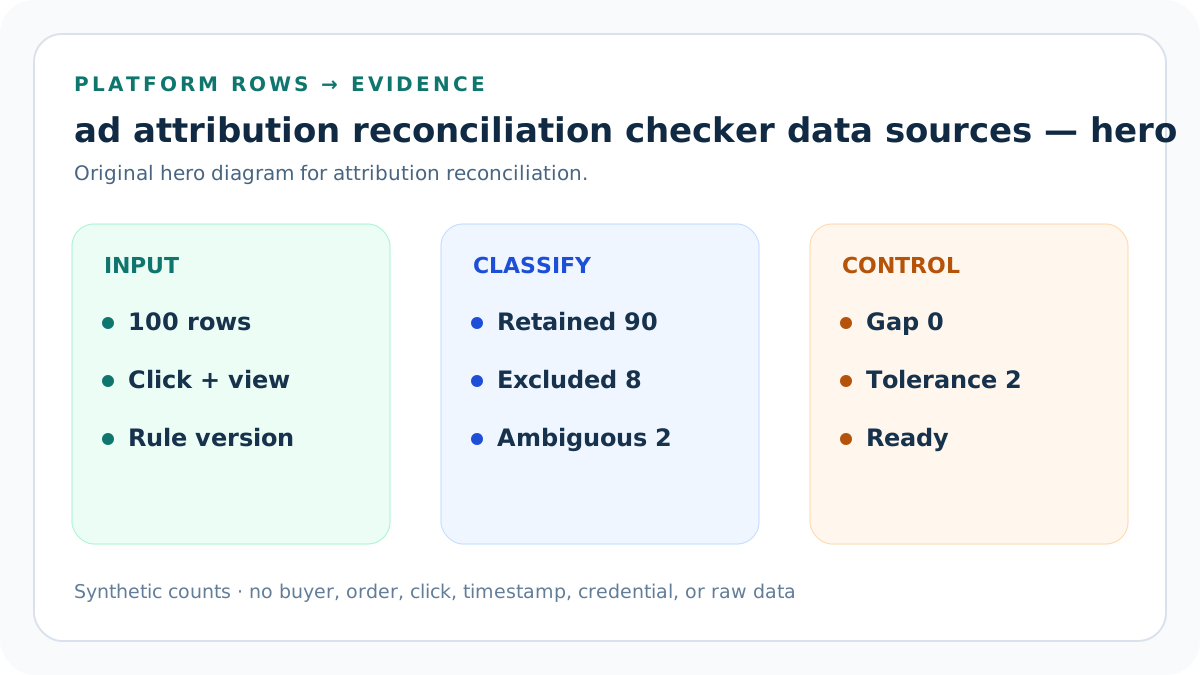
Source platform rows
Export or query the exact closed report scope. In the attribution source map, record the count, unit, source version, rule version, evidence date, maturity state, reviewer, and declared uncertainty. Recompute from aggregate synthetic or authorized private evidence before formatting a count, rate, or decision.
Store a protected hash and version. Topic 1 documents a supported packet, broken packet, correction path, and why the conclusion belongs to an evidence-backed reconciliation rather than a cross-platform or causal performance claim.
Source platform rules
Capture official documentation and account settings effective for the period. In the attribution source map, record the count, unit, source version, rule version, evidence date, maturity state, reviewer, and declared uncertainty. Recompute from aggregate synthetic or authorized private evidence before formatting a count, rate, or decision.
Rules can change. Topic 2 documents a supported packet, broken packet, correction path, and why the conclusion belongs to an evidence-backed reconciliation rather than a cross-platform or causal performance claim.
Source seller outcomes
Use authorized order, refund, return, dispute, and replacement records. In the attribution source map, record the count, unit, source version, rule version, evidence date, maturity state, reviewer, and declared uncertainty. Recompute from aggregate synthetic or authorized private evidence before formatting a count, rate, or decision.
Close the outcome window. Topic 3 documents a supported packet, broken packet, correction path, and why the conclusion belongs to an evidence-backed reconciliation rather than a cross-platform or causal performance claim.
Source timestamps
Use event and order timestamps under a documented timezone convention. In the attribution source map, record the count, unit, source version, rule version, evidence date, maturity state, reviewer, and declared uncertainty. Recompute from aggregate synthetic or authorized private evidence before formatting a count, rate, or decision.
Never publish raw timestamps tied to buyers. Topic 4 documents a supported packet, broken packet, correction path, and why the conclusion belongs to an evidence-backed reconciliation rather than a cross-platform or causal performance claim.
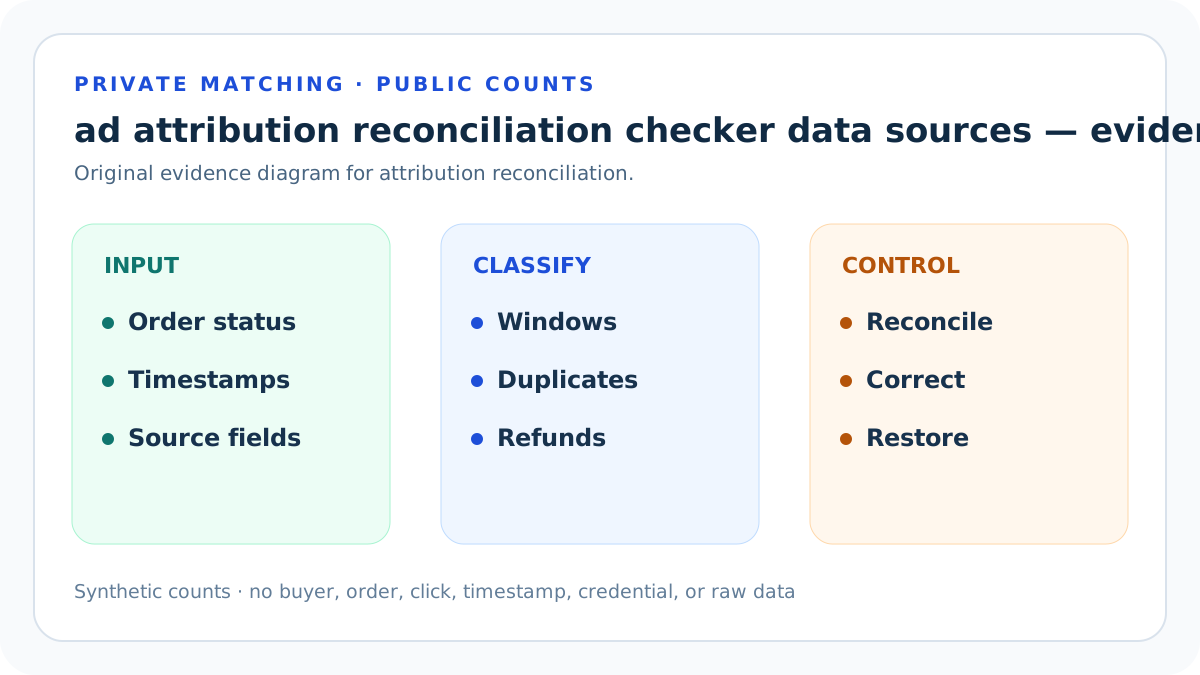
Source campaign fields
Reconcile source, medium, UTM, campaign, creative, shop, and product fields. In the attribution source map, record the count, unit, source version, rule version, evidence date, maturity state, reviewer, and declared uncertainty. Recompute from aggregate synthetic or authorized private evidence before formatting a count, rate, or decision.
Preserve conflicts. Topic 5 documents a supported packet, broken packet, correction path, and why the conclusion belongs to an evidence-backed reconciliation rather than a cross-platform or causal performance claim.
Source duplicate controls
Use stable private keys and versioned rules. In the attribution source map, record the count, unit, source version, rule version, evidence date, maturity state, reviewer, and declared uncertainty. Recompute from aggregate synthetic or authorized private evidence before formatting a count, rate, or decision.
Report aggregate duplicate counts only. Topic 6 documents a supported packet, broken packet, correction path, and why the conclusion belongs to an evidence-backed reconciliation rather than a cross-platform or causal performance claim.
Source corrections
Preserve late adjustments, restatements, and prior results. In the attribution source map, record the count, unit, source version, rule version, evidence date, maturity state, reviewer, and declared uncertainty. Recompute from aggregate synthetic or authorized private evidence before formatting a count, rate, or decision.
Do not overwrite history. Topic 7 documents a supported packet, broken packet, correction path, and why the conclusion belongs to an evidence-backed reconciliation rather than a cross-platform or causal performance claim.
Delayed measurement: ad attribution reconciliation data sources
Record indexability, impressions, clicks, engagement, tool states, and qualified intent at Day 0/7/14/28. Control 1 names the owner, review frequency, exception code, threshold, expiry trigger, correction condition, and prior restorable packet.
Do not call temporal movement causal proof. Apply it specifically to an evidence-backed reconciliation; separate official platform rules, account settings, seller evidence, matching logic, and editable tolerance by authority.
Privacy and access: ad attribution reconciliation data sources
Use aggregate counts, synthetic fixtures, redacted pointers, access controls, and retention rules. Control 2 names the owner, review frequency, exception code, threshold, expiry trigger, correction condition, and prior restorable packet.
Exclude raw IDs, timestamps, exports, credentials, tokens, and OAuth. Apply it specifically to an evidence-backed reconciliation; separate official platform rules, account settings, seller evidence, matching logic, and editable tolerance by authority.
Release and restoration: ad attribution reconciliation data sources
Require typecheck, unit, integration, build, content, similarity, SEO, images, browser, mobile, privacy, and rollback evidence. Control 3 names the owner, review frequency, exception code, threshold, expiry trigger, correction condition, and prior restorable packet.
Restore on formula, routing, privacy, accessibility, or health regression. Apply it specifically to an evidence-backed reconciliation; separate official platform rules, account settings, seller evidence, matching logic, and editable tolerance by authority.
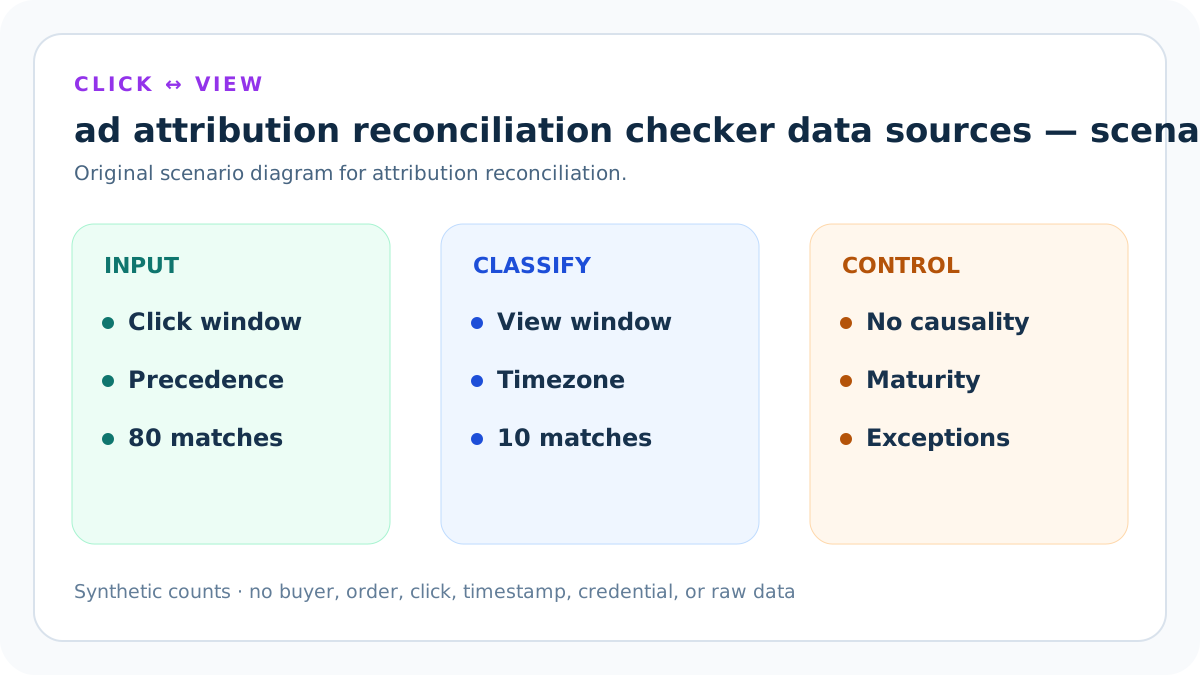
Maturity and timing: ad attribution reconciliation data sources
Close platform reporting and seller adverse-outcome windows. Control 4 names the owner, review frequency, exception code, threshold, expiry trigger, correction condition, and prior restorable packet.
Keep provisional rows explicit. Apply it specifically to an evidence-backed reconciliation; separate official platform rules, account settings, seller evidence, matching logic, and editable tolerance by authority.
Sensitivity and counterexample: ad attribution reconciliation data sources
Change one supported bucket while preserving the platform-row sum. Control 5 names the owner, review frequency, exception code, threshold, expiry trigger, correction condition, and prior restorable packet.
Retain failed and unfavorable fixtures. Apply it specifically to an evidence-backed reconciliation; separate official platform rules, account settings, seller evidence, matching logic, and editable tolerance by authority.
Source platform rows: reconciliation drill
Recreate “Source platform rows” from a clean synthetic 100-row platform packet. Export or query the exact closed report scope. Change one mutually exclusive bucket, preserve the original packet, show the classification sum, and attach the expected Block, Review, or Ready state to the attribution source map.
Store a protected hash and version. Drill 1 includes click-led, view-led, above-tolerance, nonzero-gap, immature, and corrected cases. Explain which row class moved, which denominator stayed fixed, and what evidence permits the next action.
Source platform rules: reconciliation drill
Recreate “Source platform rules” from a clean synthetic 100-row platform packet. Capture official documentation and account settings effective for the period. Change one mutually exclusive bucket, preserve the original packet, show the classification sum, and attach the expected Block, Review, or Ready state to the attribution source map.
Rules can change. Drill 2 includes click-led, view-led, above-tolerance, nonzero-gap, immature, and corrected cases. Explain which row class moved, which denominator stayed fixed, and what evidence permits the next action.
Source seller outcomes: reconciliation drill
Recreate “Source seller outcomes” from a clean synthetic 100-row platform packet. Use authorized order, refund, return, dispute, and replacement records. Change one mutually exclusive bucket, preserve the original packet, show the classification sum, and attach the expected Block, Review, or Ready state to the attribution source map.
Close the outcome window. Drill 3 includes click-led, view-led, above-tolerance, nonzero-gap, immature, and corrected cases. Explain which row class moved, which denominator stayed fixed, and what evidence permits the next action.
Source timestamps: reconciliation drill
Recreate “Source timestamps” from a clean synthetic 100-row platform packet. Use event and order timestamps under a documented timezone convention. Change one mutually exclusive bucket, preserve the original packet, show the classification sum, and attach the expected Block, Review, or Ready state to the attribution source map.
Never publish raw timestamps tied to buyers. Drill 4 includes click-led, view-led, above-tolerance, nonzero-gap, immature, and corrected cases. Explain which row class moved, which denominator stayed fixed, and what evidence permits the next action.
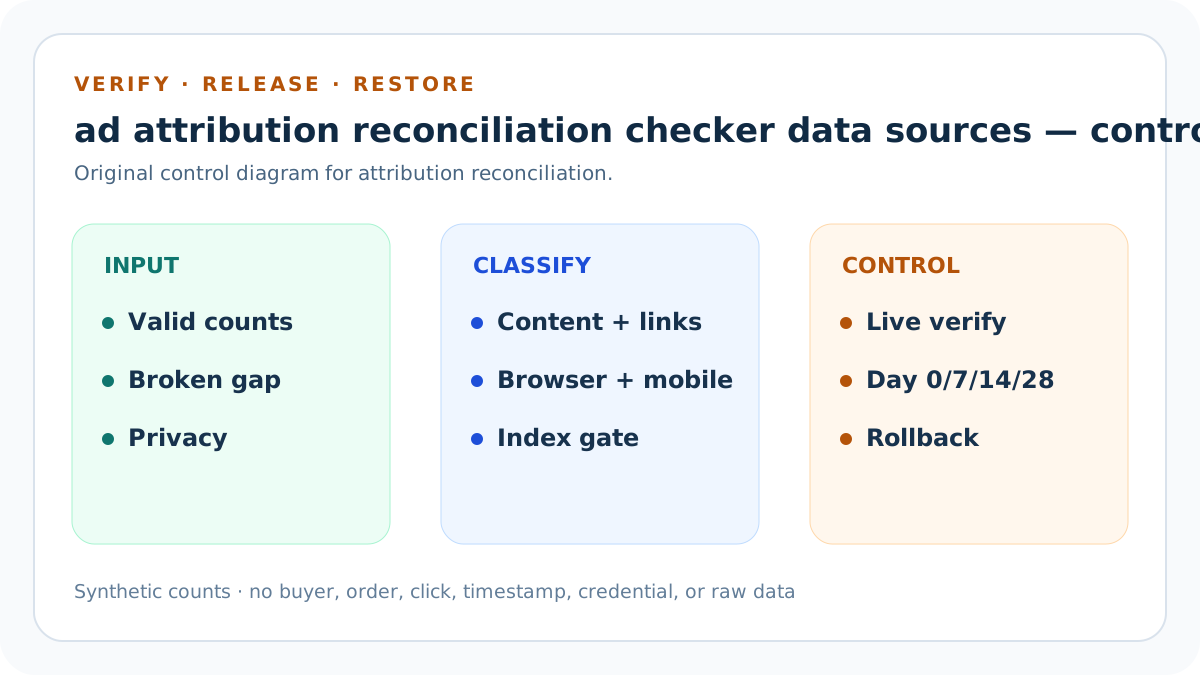
Source campaign fields: reconciliation drill
Recreate “Source campaign fields” from a clean synthetic 100-row platform packet. Reconcile source, medium, UTM, campaign, creative, shop, and product fields. Change one mutually exclusive bucket, preserve the original packet, show the classification sum, and attach the expected Block, Review, or Ready state to the attribution source map.
Preserve conflicts. Drill 5 includes click-led, view-led, above-tolerance, nonzero-gap, immature, and corrected cases. Explain which row class moved, which denominator stayed fixed, and what evidence permits the next action.
Source duplicate controls: reconciliation drill
Recreate “Source duplicate controls” from a clean synthetic 100-row platform packet. Use stable private keys and versioned rules. Change one mutually exclusive bucket, preserve the original packet, show the classification sum, and attach the expected Block, Review, or Ready state to the attribution source map.
Report aggregate duplicate counts only. Drill 6 includes click-led, view-led, above-tolerance, nonzero-gap, immature, and corrected cases. Explain which row class moved, which denominator stayed fixed, and what evidence permits the next action.
Source corrections: reconciliation drill
Recreate “Source corrections” from a clean synthetic 100-row platform packet. Preserve late adjustments, restatements, and prior results. Change one mutually exclusive bucket, preserve the original packet, show the classification sum, and attach the expected Block, Review, or Ready state to the attribution source map.
Do not overwrite history. Drill 7 includes click-led, view-led, above-tolerance, nonzero-gap, immature, and corrected cases. Explain which row class moved, which denominator stayed fixed, and what evidence permits the next action.
What an evidence-backed reconciliation can and cannot prove
It can prove that entered aggregate counts follow the declared platform rows, mutually exclusive classes, seller exception direction, tolerance, timing, and evidence version.
It cannot prove incremental sales, causal media impact, correct budget, customer identity, fraud, contract compliance, accounting profit, liquidity, tax treatment, or future performance.
Block, review, release, and restore attribution source map
Block invalid counts, nonzero gaps, private exposure, missing scope, or declared conflicts. Review valid packets above tolerance or before maturity. Ready means structure is complete and exceptions fit the dated tolerance.
Release only a reversible public model with synthetic defaults, explicit sources, original diagrams, accessible labels, canonical, schema, links, strict 404, correction policy, and rollback evidence.
Sources and further reading
- Seller Profit Guard methodology: Evidence versions, reconciliation, privacy, correction, release, and rollback.
- Seller Profit Guard data privacy: Local-first boundaries for buyer, order, advertising, payment, refund, and raw-record data.
- TikTok Business Help: TikTok Shop Ads attribution: Reviewed July 31, 2026: official TikTok Shop Ads attribution policy context for Shop ID scope, 7-day click and 1-day view windows, click precedence, and report-date treatment.
- Shopify Help: Marketing reports: Reviewed July 31, 2026: official attribution models, channel credit, report scope, and conversion context.
- Etsy Help: How Etsy's Offsite Ads Work: Reviewed July 31, 2026: official 30-day click window and attributed-order context.
Related Seller Profit Guard tools
- Ad Attribution Reconciliation Checker: Classify aggregate platform-attributed rows and seller exceptions.
- Break-Even ROAS Calculator: Apply economics after attribution evidence reconciles.
- Paid CPA Limit Calculator: Keep cost capacity separate from attribution classification.
- Creator Sample Payback Calculator: Use mature reconciled orders for campaign recovery.
- Payment Reconciliation: Reconcile settlements separately.
- Methodology: Review evidence, privacy, correction, release, and rollback.
- Data Privacy: Protect buyer, order, advertising, payment, and credential data.
- Ad Attribution Reconciliation Formula and Inputs: Classify platform-attributed order rows into retained, excluded, ambiguous, and gap outcomes with aggregate seller evidence.
- Ad Attribution Click Reconciliation Example: Follow 100 synthetic platform rows through click matches, view matches, exclusions, ambiguity, tolerance, and decision state.
- Ad Attribution View Reconciliation: Reconcile view-through attributed orders with shorter windows, precedence, source conflicts, and stronger interpretation limits.
- Ad Attribution Reconciliation Mistakes: Correct denominator, overlapping-bucket, window, timezone, refund, duplicate, source, report-date, and causal-claim errors.
- Safe Ad Attribution Reconciliation Thresholds: Set classification-gap, ambiguity, retained-rate, excluded-rate, maturity, correction, stop, and restoration controls for attribution evidence.
- Click vs View Attribution Reconciliation: Compare click and view attribution at the same report grain while preserving window, precedence, maturity, and ambiguity differences.
- Weekly Ad Attribution Reconciliation Routine: Run a repeatable cycle from platform report closure through seller matching, classification, correction, release, and rollback.
- Interpret Ad Attribution Reconciliation: Read retained, excluded, ambiguous, gap, click/view mix, and seller exceptions without false precision or causal claims.
- Ad Attribution Reconciliation Audit Template: Use a standalone checklist and dated change log for report scope, rules, buckets, exceptions, correction, release, and rollback.
Next step: Open Seller Profit Guard.
This is operational planning help, not tax, accounting, legal, financial, or platform-policy advice. Review the Terms and disclaimer, and verify current platform rules and fee assumptions before changing prices.