A weekly operating routine for Etsy production partner disclosures
Last updated: 2026-07-30
Written and reviewed by Seller Profit Guard Editorial Team.
Each week, review disclosures triggered by a changed design, specification, partner role, facility, public profile, listing association, fulfillment route, shipping origin, policy source, complaint, or inherited record. Refresh accountable evidence, run complete and failure fixtures, release one bounded set, verify applicable listings and the About section, and record closure or rollback.

disclosure maintenance control loop: scope and decision
A useful routine follows material changes instead of rewriting stable profiles for activity. Trigger review when the seller introduces a design family, changes a blank or specification, adds or removes a partner, changes production or packing, moves a facility, duplicates listings, changes direct dispatch, or discovers inherited ambiguity.
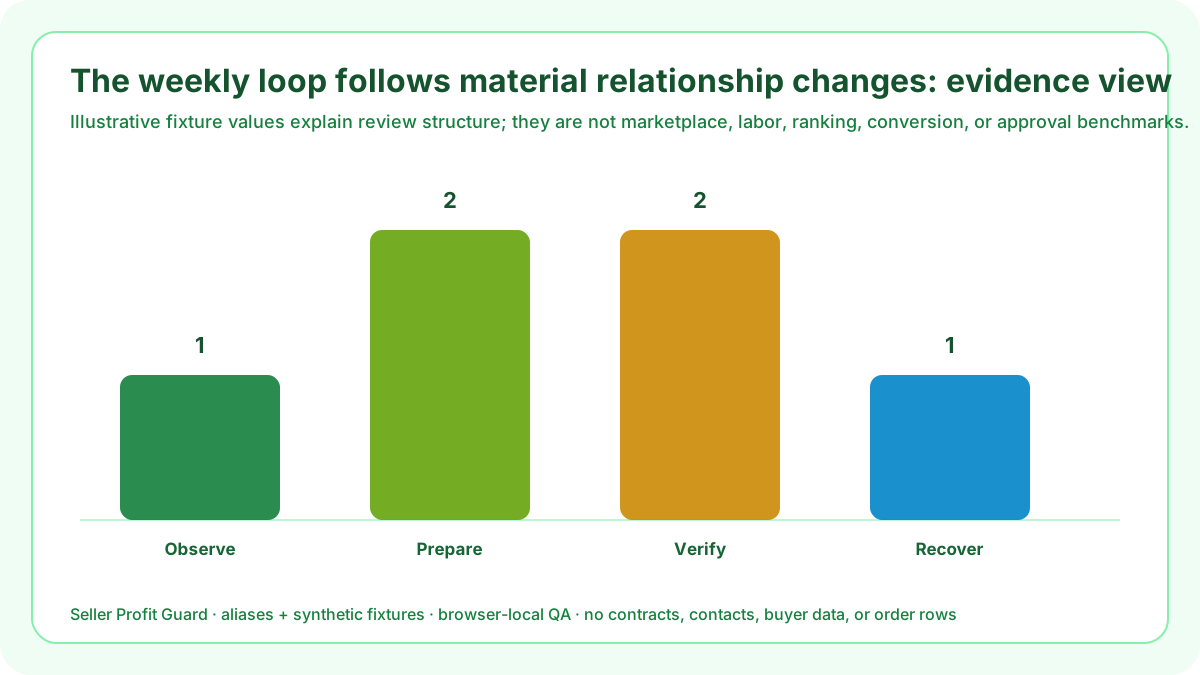
Observe first, classify consequence, select one bounded relationship set, refresh sources, run complete and deliberately broken fixtures, back up current values, release only when authorized, inspect public and seller paths, and restore on critical mismatch. A successful save is not completion.
Build the production relationship change register before analysis
The register stores aliases, versions, roles, locations, public text, listing statuses, origin summaries, decisions, and observations. It excludes private contracts, partner contacts, negotiated prices, bank or tax information, buyer data, order rows, messages, credentials, tokens, and raw exports.
Search signals are not required to correct an evidenced disclosure defect and cannot prove the disclosure caused later traffic or sales. Aggregate questions, cancellations, complaints, dispatch delays, and page landings can prioritize review, but source and public feedback close the operating decision.
Observe material relationship triggers
Compare design, product, sample, partner, facility, profile, listing, fulfillment, shipping, policy, and issue logs. Stable records remain monitored without forced changes.
Place “Observe material relationship triggers” in the weekly production relationship change register with a trigger, owner, source packet, complete fixture, failure fixture, release gate, public feedback, and recovery state. Sample partner facility move with updated dispatch when materially changed and retain stable profile with no material trigger as a stop test. Close only after a repeatable evidence-to-feedback maintenance decision is observed and the next review trigger is assigned.
Classify consequence before effort
Stop resale ambiguity, hidden outside production, wrong item role, wrong location, missing applicable listings, and wrong parcel origin. Queue wording improvements separately from critical representation failures.
Place “Classify consequence before effort” in the weekly production relationship change register with a trigger, owner, source packet, complete fixture, failure fixture, release gate, public feedback, and recovery state. Sample partner facility move with updated dispatch when materially changed and retain stable profile with no material trigger as a stop test. Close only after a repeatable evidence-to-feedback maintenance decision is observed and the next review trigger is assigned.
Select one bounded change set
Group one partner profile with the exact applicable listings and shipping records. Avoid mixing unrelated titles, tags, categories, prices, images, or second-partner changes that complicate rollback.
Place “Select one bounded change set” in the weekly production relationship change register with a trigger, owner, source packet, complete fixture, failure fixture, release gate, public feedback, and recovery state. Sample partner facility move with updated dispatch when materially changed and retain stable profile with no material trigger as a stop test. Close only after a repeatable evidence-to-feedback maintenance decision is observed and the next review trigger is assigned.
Refresh accountable sources
Open current design and product versions, production-role evidence, samples, partner profile, listing register, fulfillment path, official sources, and public pages. Record unresolved conflicts rather than choosing the newest screen.
Place “Refresh accountable sources” in the weekly production relationship change register with a trigger, owner, source packet, complete fixture, failure fixture, release gate, public feedback, and recovery state. Sample partner facility move with updated dispatch when materially changed and retain stable profile with no material trigger as a stop test. Close only after a repeatable evidence-to-feedback maintenance decision is observed and the next review trigger is assigned.
Run complete and failure fixtures
Use a complete POD or fabrication packet plus supplier, wholesaler, vague role, missing listing, stale location, wrong origin, no evidence, and declared-conflict cases. Store expected decision and reset behavior.
Place “Run complete and failure fixtures” in the weekly production relationship change register with a trigger, owner, source packet, complete fixture, failure fixture, release gate, public feedback, and recovery state. Sample partner facility move with updated dispatch when materially changed and retain stable profile with no material trigger as a stop test. Close only after a repeatable evidence-to-feedback maintenance decision is observed and the next review trigger is assigned.

Pass backup and release gates
Preserve partner name or title, location, description, internal answers, listing associations, About display, shipping profiles, delivery settings, source packet, approval, and rollback identifier.
Place “Pass backup and release gates” in the weekly production relationship change register with a trigger, owner, source packet, complete fixture, failure fixture, release gate, public feedback, and recovery state. Sample partner facility move with updated dispatch when materially changed and retain stable profile with no material trigger as a stop test. Close only after a repeatable evidence-to-feedback maintenance decision is observed and the next review trigger is assigned.
Verify public and seller paths
Inspect the applicable listings and About section on mobile and desktop, then verify partner associations and origin settings in the seller workflow. Safe-stop on account ambiguity or platform warnings.
Place “Verify public and seller paths” in the weekly production relationship change register with a trigger, owner, source packet, complete fixture, failure fixture, release gate, public feedback, and recovery state. Sample partner facility move with updated dispatch when materially changed and retain stable profile with no material trigger as a stop test. Close only after a repeatable evidence-to-feedback maintenance decision is observed and the next review trigger is assigned.
Measure and close honestly
Record verified release or rollback, unresolved issues, source refresh, owner, and next trigger. Do not claim ranking, conversion, revenue, refund reduction, policy approval, or AdSense causation.
Place “Measure and close honestly” in the weekly production relationship change register with a trigger, owner, source packet, complete fixture, failure fixture, release gate, public feedback, and recovery state. Sample partner facility move with updated dispatch when materially changed and retain stable profile with no material trigger as a stop test. Close only after a repeatable evidence-to-feedback maintenance decision is observed and the next review trigger is assigned.
Verification, release, and rollback controls
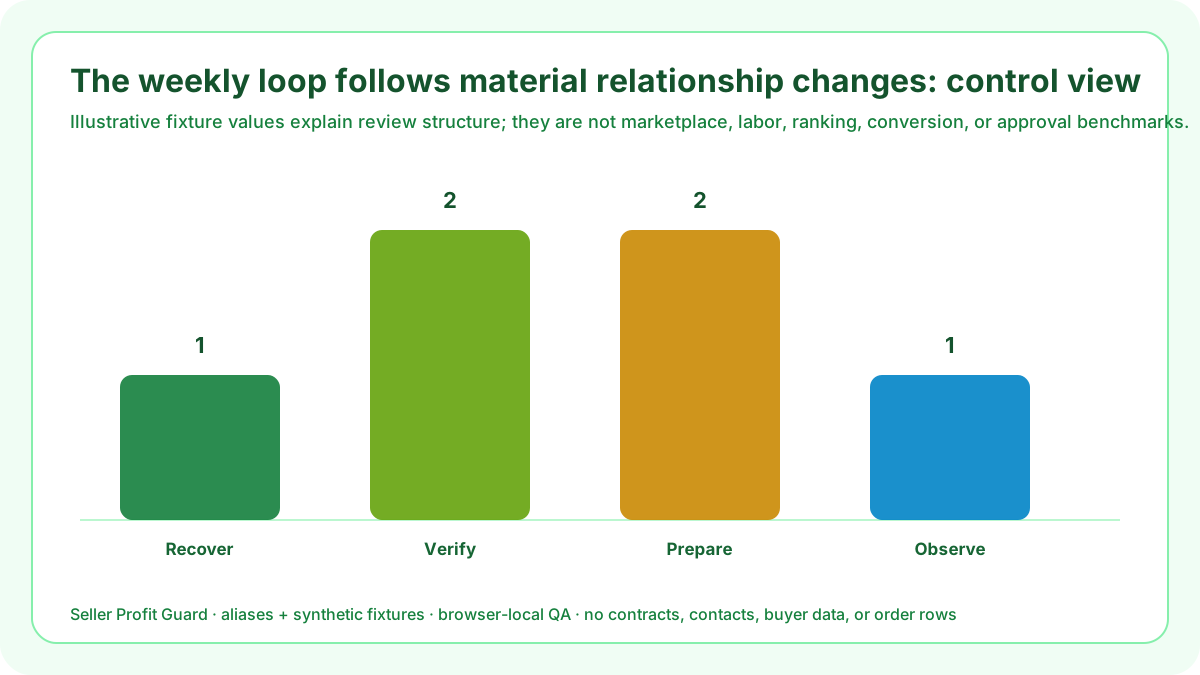
Before changing public records, preserve the production relationship change register, design and product versions, partner profile, relationship copy, internal answers, listing associations, About presentation, production and dispatch locations, shipping profiles, fixtures, approval, and rollback identifier. Confirm the correct account and target. Safe-stop on login or CAPTCHA ambiguity, a platform warning, wrong profile, missing target context, private data, or unexpected editor state.
After one bounded release, verify partner facility move with updated dispatch on mobile and desktop and deliberately revisit stable profile with no material trigger. Inspect the applicable listings, About section, partner profile, and origin settings. Restore the approved prior state when a critical path does not support a repeatable evidence-to-feedback maintenance decision. Search and conversion signals are later measurements, not release proof.
Limits, privacy boundary, and next action
This guide and checker use seller-entered summaries, internal aliases, and synthetic fixtures. They do not retrieve Etsy data, inspect protected designs or contracts, audit a facility, approve a partner, determine originality or eligibility, certify law or policy compliance, or predict ranking, clicks, conversion, sales, refunds, delivery, income, or AdSense approval. Seller Profit Guard is independent and unaffiliated with Etsy and provides operational QA rather than legal, labor, tax, customs, intellectual-property, accounting, privacy, fulfillment, search, or marketplace advice.
Keep private contracts, partner contacts, negotiated prices, bank and tax records, buyer names, emails, addresses, messages, order IDs, receipts, payment details, credentials, OAuth data, and raw CSV rows outside the production relationship change register. The next action is to repair the named source, rerun complete and crossed fixtures, release only the approved set, inspect public and seller paths, and record whether a repeatable evidence-to-feedback maintenance decision was verified or rolled back.
Sources and further reading
- Etsy Help: Working with Production Partners: Current partner definition, qualifying designed and buyer-personalized sourced paths, exclusions, profile fields, listing association, public description, location, About-section display, and shipping-origin guidance.
- Etsy Creativity Standards: Current made, designed, handpicked, and sourced item paths plus seller-design and production-partner disclosure boundaries.
- Etsy Seller Policy: Seller Policy effective July 9, 2026: accurately represent how, by whom, and where an item is made and dispatched and disclose partners on relevant listings.
- Etsy Listing Image Requirements: Current finished-product image rules for seller-designed products, printed designs, and buyer-personalized items made with production partners.
- Etsy ethical expectations for production partners: Current seller due-diligence expectations and Etsy's stated boundary that it does not audit or approve production partners.
- Etsy Help: How to Create a Listing: Current listing workflow and applicable production-partner association requirement.
- Seller Profit Guard methodology: Evidence hierarchy, privacy boundary, deterministic fixtures, uncertainty, bounded release, public feedback, and recovery.
Related Seller Profit Guard tools
- Open the Etsy Production Partner Disclosure Checker: Review item path, seller contribution, partner role, public profile, listing links, dispatch origin, issues, and evidence.
- Check Etsy category fit: Keep category and item-format review separate from production disclosure.
- Check Etsy description clarity: Reconcile buyer-facing product claims with the approved production record.
- Check Etsy photo coverage: Review actual-product and production-partner image boundaries independently.
- Check Etsy personalization instructions: Keep buyer-entered customization separate from seller and partner responsibilities.
- Read the local-first methodology: Use aliases, synthetic fixtures, evidence versions, public verification, and rollback.
- Etsy Production Partner Disclosure Inputs: Continue the role, evidence, scenario, decision, operating, interpretation, or audit workflow.
- Etsy POD Production Partner Example: Continue the role, evidence, scenario, decision, operating, interpretation, or audit workflow.
- Etsy Specialist Fabrication Partner Example: Continue the role, evidence, scenario, decision, operating, interpretation, or audit workflow.
- 13 Etsy Production Partner Disclosure Mistakes: Continue the role, evidence, scenario, decision, operating, interpretation, or audit workflow.
- Evidence Sources for Etsy Production Partners: Continue the role, evidence, scenario, decision, operating, interpretation, or audit workflow.
Next step: Open the Etsy Production Partner Disclosure Checker.
This is operational planning help, not tax, accounting, legal, financial, or platform-policy advice. Review the Terms and disclaimer, and verify current platform rules and fee assumptions before changing prices.