Seller Profit Guard · How it works · CSV privacy
Etsy SKU cost library
Create a browser-saved or exportable SKU cost table for material, packaging, labor, shipping, extra costs, and target margin so repeat profit checks do not treat missing costs as zero.
Maintained by Seller Profit Guard Editorial Team. Last reviewed: 2026-07-28.
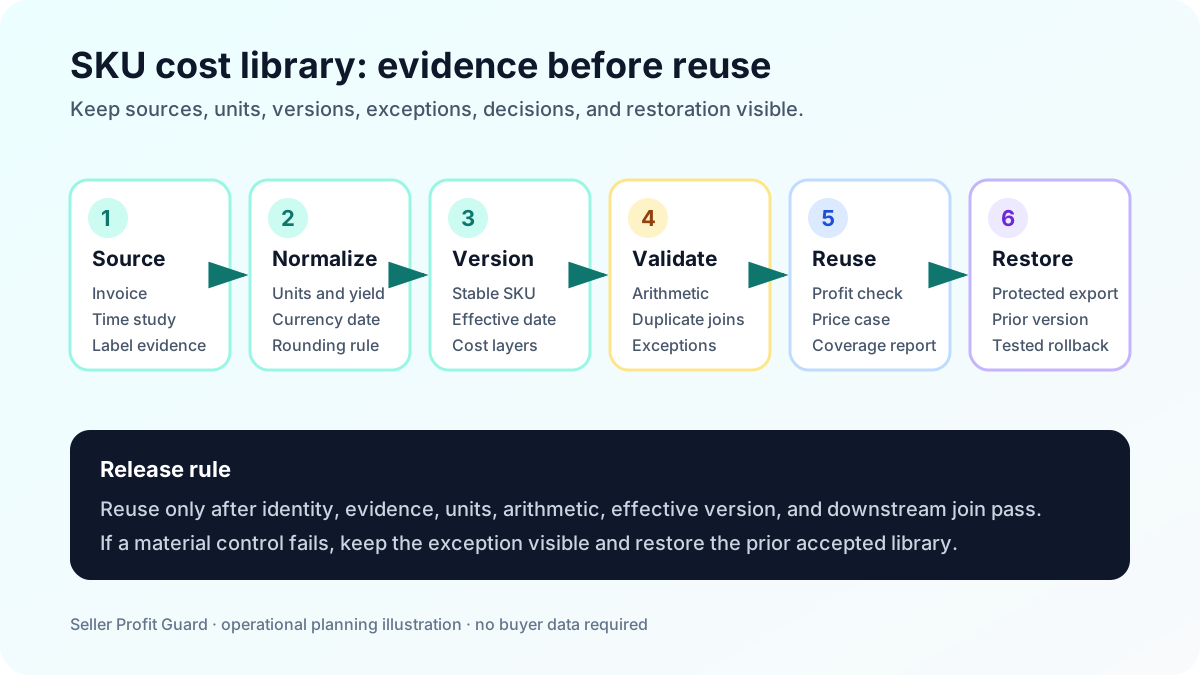
The cost fields worth maintaining
A useful SKU record separates material, packaging, labor minutes, labor rate, seller-paid shipping, extra transaction cost, other variable cost, and target margin. Combining every cost into one unexplained number makes supplier or workflow changes harder to diagnose.
Variation-level records matter when size, finish, personalization, weight, or bundle quantity changes the real cost. The cheapest variation should not silently supply the cost assumption for every order row.
- Use one stable SKU for each materially different variation.
- Update records when suppliers, packaging, weight, or labor time changes.
- Export a private backup before clearing browser storage.
- Treat the library as confidential business information.
How the library improves profit checks
A cost library turns missing-cost rows into visible exceptions. It also makes weekly checks faster because the seller does not need to re-enter the same assumptions for every CSV export.
The library is not an inventory ledger or accounting system. It is a practical source of editable assumptions for SKU-level contribution review.
Define one reproducible cost-record contract
A SKU cost record should identify the sellable SKU, currency, effective date, material cost, packaging cost, labor minutes, loaded labor rate, seller-paid fulfillment, other variable cost, expected loss, target margin, evidence source, status, owner, and last review. Decide whether the record represents one finished unit, one bundle, or another documented sellable quantity before entering values. The denominator must match the quantity used later by the profit calculation.
Keep direct cost layers separate because they react to different business changes. Material may change with a supplier invoice or usable yield. Labor changes with measured time and a loaded hourly rate. Packaging changes with the pack specification and per-shipment consumption. Fulfillment changes with destination, weight, service, and seller subsidy. An unexplained total cannot show which layer moved or whether the same cost was counted twice.
Target margin is a decision input rather than a cost. Expected return, damage, replacement, or non-recovery loss should remain a separate evidence-based risk layer. Do not inflate product cost to create a hidden cushion. Preserve a base record and show any uncertainty or risk allowance explicitly so another reviewer can reproduce, change, or remove it.
- Use one stable identifier for each materially different sellable variation.
- Store currency and units beside every source amount.
- Label values as observed, measured, allocated, estimated, or unknown.
- Reject a record that cannot join deterministically to the sold SKU.
- Keep target margin separate from the reusable cost total.
Normalize purchase units, usable yield, and currency
Carry the source unit through every conversion. Record purchase quantity, usable quantity, waste or yield assumption, per-SKU consumption, source currency, conversion source, rate date, rounding policy, and resulting record currency. If 500 grams of material cost $18 and the measured usable quantity after waste is 450 grams, a SKU consuming 30 grams uses $1.20 of material: $18 divided by 450, multiplied by 30. Dividing by the purchased 500 grams without documenting yield would understate the cost.
A package price is not automatically a per-unit cost. If twelve mailers cost $9.60 and one mailer is consumed per shipment, the packaging input is $0.80. Entering $9.60 would multiply the package cost twelve times. The same control applies to labels, inserts, bottles, findings, fabric length, machine batches, outsourced production minimums, and any other source whose purchase unit differs from the sellable unit.
Currency conversion should be applied once. Preserve the original invoice amount and currency, then store a dated converted planning amount. Supplier invoice conversion, marketplace settlement conversion, and the seller's reporting currency are different layers. Round only at a declared boundary; keep sufficient component precision for validation, then document whether the downstream order calculation multiplies before or after rounding.
- Identify the original package, quantity, currency, and source date.
- Measure usable yield and per-SKU consumption in compatible units.
- Apply waste and currency conversion exactly once.
- Retain unrounded component values for reconstruction.
- Compare reconstructed package totals with the source evidence.
Preserve effective-dated versions instead of overwriting
A current supplier price should not rewrite the cost attached to an older order. Create a new version when a source amount, unit conversion, labor method, packaging specification, shipping policy, currency treatment, or loss assumption materially changes. Give the new version an effective start date and preserve the prior record. Historical analysis can then select the version that was valid when the unit was produced, sold, or fulfilled under the seller's documented policy.
Avoid overlapping current intervals for the same SKU and policy. Flag gaps, future-dated records used early, and corrections that look like source changes. A correction repairs an error in evidence or logic; a source change represents new business conditions. Record the reason, approver, affected SKUs, affected periods, validation result, and restoration route for either case.
Inventory acquired at several prices may require an accounting costing policy beyond this lightweight operating tool. The library can hold dated planning records, but it does not determine formal inventory valuation, tax basis, or financial-statement treatment. Keep that boundary visible and consult an appropriate professional when the decision depends on accounting policy.
- Never delete the last accepted version before its replacement passes.
- Use explicit provisional, current, and retired statuses.
- Run a fixed historical dummy-order join after each version change.
- Restore the prior version when new evidence cannot be reproduced.
Reperform one complete SKU example
Consider an illustrative handmade variation with $4.80 of blank material, $2.10 of applied material, 25 minutes of work at a loaded $17.40 hourly rate, $1.60 of packaging, and $2.60 of seller-paid fulfillment. Labor is 25 divided by 60 multiplied by $17.40, or $7.25. The reusable unit-cost record is therefore $4.80 + $2.10 + $7.25 + $1.60 + $2.60 = $18.35 before marketplace fees, advertising, discounts, and any separately modeled expected loss.
Each component needs distinct evidence. Material uses invoices and measured consumption. Labor uses a timed sample and documented loaded rate. Packaging uses pack quantity and per-shipment usage. Fulfillment uses comparable recent labels or provider statements. The $18.35 result is reproducible because its intermediate arithmetic remains visible; it is not copied backward from a preferred selling price.
If the blank later rises from $4.80 to $5.40, create a new $18.95 version and attribute the $0.60 change to material. Do not reduce labor or packaging to preserve the old total. Re-run the downstream price or contribution case, retain the earlier version for its valid period, and record source, date, affected inventory, decision, monitoring trigger, and restoration.
| Component | Illustrative amount | Evidence |
|---|---|---|
| Blank material | $4.80 | Invoice and one-unit consumption |
| Applied material | $2.10 | Invoice, yield, and measured usage |
| Labor | $7.25 | 25 minutes at $17.40 per hour |
| Packaging | $1.60 | Pack receipt and shipment consumption |
| Fulfillment | $2.60 | Comparable seller-paid label evidence |
| Reusable unit cost | $18.35 | Reperformed sum of the five layers |
Validate identity, arithmetic, evidence, and joins
Validation is broader than checking whether a numeric field is present. A release-ready record needs a unique SKU, defined sellable quantity, compatible units, stated currency, evidence for material layers, a reproducible formula, a non-overlapping effective version, and a deterministic join to the product or variation used downstream. A real observed zero can be valid, but an empty field silently converted to zero is an exception.
Test positive and negative cases. Confirm that a known SKU selects the intended current version and a historical date selects the prior version. Confirm that an unknown SKU remains missing, a duplicate active SKU is blocked, an invalid date is rejected, and a pack-cost/unit-cost mismatch cannot pass. Compare row counts and exception counts with the prior accepted library so a cleaner-looking result does not hide deleted rows or weakened controls.
Sample high-volume, highest-cost, newest, renamed, personalized, and labor-intensive variations. A portfolio average must not replace option-level evidence. Report active variation combinations, unique SKUs, current records, missing joins, duplicate joins, provisional records, and downstream sales affected by gaps before calling the library complete.
- Block duplicate active records for one SKU and policy.
- Flag missing evidence, unit mismatches, stale sources, and version overlap.
- Run a synthetic join fixture after every import-rule change.
- Keep exceptions open until evidence and validation both close them.
- Do not infer an expensive option from a cheaper bestseller.
Keep browser-local imports and backups reversible
The interactive tool stores the working cost library in the browser and supports seller-controlled import or export. Import only the fields needed to construct cost records. Buyer names, delivery addresses, messages, payment credentials, complete order histories, and unrelated commercial data are not required. SKU and cost structure can still be commercially sensitive, so protect exports and use synthetic examples for public support.
Before a bulk import or correction, export the accepted library and record a checksum or another stable identifier. Validate column names, row counts, required values, units, currencies, dates, and duplicate keys before replacing browser-local state. If a material control fails, restore the prior export instead of manually patching many uncertain rows.
Browser storage can be cleared by a user, browser, device policy, or troubleshooting action. It is not a substitute for a controlled backup. This tool does not promise synchronization, multi-user access control, accounting-ledger behavior, or recovery from an unexported library. Record the protected storage location, owner, review date, and tested restoration as part of the operating process.
- Export and protect the last accepted library.
- Validate incoming schema without exposing private rows.
- Import into a bounded review state and count exceptions.
- Reperform sample arithmetic and current/historical joins.
- Accept the new version only after restoration is tested.
Run a weekly control loop and respect tool limits
A practical routine begins with backup, source intake, validation, exception assignment, approval, and archive. Review new supplier invoices, changed packaging, production-time samples, fulfillment evidence, currency treatment, newly created or renamed SKUs, and unresolved joins. Change one source layer or rule at a time so the effect remains attributable and reversible.
Measure coverage and control rather than record count alone. Useful measures include active sellable SKUs, current cost coverage, evidence coverage, provisional records, missing and duplicate joins, stale versions, exceptions by impact, and downstream sales affected by missing cost. Give material exceptions an owner and due date, and reopen a bounded sample after closure.
The library supports contribution and pricing review, but it does not access Etsy, verify invoices or banks, value inventory for accounting, determine tax, forecast supplier prices, or authorize a business decision. Results are bounded by the entered evidence, versions, conversions, and policies. Verify current official sources and obtain qualified advice when a decision exceeds operational planning.
- Stop when privacy scope, source identity, units, or version ownership is unclear.
- Change the import or validation rule when the same defect recurs.
- Preserve monitoring, decision, change, and rollback evidence.
- Use the ten linked guides for deeper formula, example, scenario, source, threshold, operation, interpretation, and audit work.
Sources and further reading
- Etsy Help: What are the Fees and Taxes for Selling on Etsy?: Official overview of listing, transaction, payment, advertising, and other seller fees.
- Etsy Help: How Etsy's Offsite Ads Work: Official Offsite Ads fee, attribution, and fee-cap reference.
- Etsy Help: How to Download a Spreadsheet of Your Sold Transactions: Official CSV export workflow for order items, orders, Etsy Payments sales, and deposits.
- Etsy Help: How to Manage Your Payment Account: Official Payment Account and monthly statement reference.
- Etsy Help: How to Issue a Full or Partial Refund For an Order: Official refund workflow and Payment Account impact reference.
Related Seller Profit Guard tools
- Etsy CSV profit calculator: Run a local order profit check with editable fee and SKU cost assumptions.
- Payment reconciliation tool: Compare order rows with statement activity and flag unmatched rows.
- SKU cost library: Save or import material, labor, packaging, shipping, and target margin assumptions.
- Variant risk checker: Find missing SKUs and variation cost risks before a listing scales.
- Etsy title checker: Review listing-title clarity, repetition, keyword chains, and mobile scanning.
- Etsy tag checker: Review all 13 tag slots for duplicates, repeated meaning, and truthful coverage.
- Free shipping threshold calculator: Estimate when a shipping subsidy can still meet a target margin.
- Return window loss estimator: Model expected reverse shipping, restock work, recovery, and replacement loss.
- Etsy Ads break-even calculator: Estimate target-safe Etsy Ads spend, ACOS, and ROAS after fees, fulfillment, and expected return loss.
- CSV data privacy: Understand what the local-first workflow needs and what it does not need.
- SKU Cost Formula: 8 Inputs Etsy Sellers Need: Build a reusable Etsy SKU cost record from materials, labor, packaging, fulfillment, variable extras, allocation, risk, and evidence dates.
- Etsy SKU Cost Example: A $18.35 Handmade Item: Trace an illustrative handmade SKU through material, labor, packaging, fulfillment preparation, overhead allocation, and target review.
- Etsy Variation Costs: Stop Averaging Every Option: Build separate cost records for size, material, personalization, weight, packaging, and fulfillment differences across Etsy variations.
- SKU Costing Mistakes: 12 Errors That Hide Margin: Fix pack-price, unit, labor, waste, shipping, overhead, duplicate SKU, version, and missing-cost errors in a reusable cost library.
- SKU Cost Data Sources: Invoice to Time Study: Map materials, labor, packaging, fulfillment, shipping, waste, allocation, and SKU identity to defensible seller-owned evidence.
- SKU Cost Confidence: When a Record Is Ready: Set evidence, freshness, coverage, unit, version, and stress thresholds before using a SKU cost record for pricing or margin decisions.
- Handmade SKU vs Variation Cost Library: Compare one handmade SKU with a multi-variation listing using the same material, labor, packaging, fulfillment, and version controls.
- Weekly SKU Cost Review: A 45-Minute Routine: Maintain an Etsy SKU cost library with weekly exception review, source refresh, version control, backups, and downstream join checks.
- Read SKU Cost Records Without False Precision: Interpret observed, measured, allocated, estimated, stale, missing, and versioned SKU cost layers before changing Etsy prices.
- SKU Cost Library Audit Checklist and Change Log: Audit SKU identity, units, sources, layers, versions, imports, joins, privacy, approvals, and rollback with a reusable template.
Use the interactive tool
Enable JavaScript to open the calculator and process browser-local inputs. The explanatory content and source links remain available without JavaScript.
Related guide: Read the SKU-level profit guide.
This tool provides operating estimates, not tax, accounting, legal, financial, or marketplace-policy advice. Verify current official sources and your own records before changing prices or operations.