When dimensional weight should Block, Review, or be Ready
Last updated: 2026-07-31
Written and reviewed by Seller Profit Guard Editorial Team.
Block blank, non-finite, nonpositive, or structurally invalid evidence; invalid units or rounding; an impossible source-review date; incomplete evidence confirmations; vague carrier rule, period, or shipment scope; or declared conflicts. Review dimensional weight above actual, primary billable weight above target, or dimension rounding that changes volume by more than the seller-entered maximum.
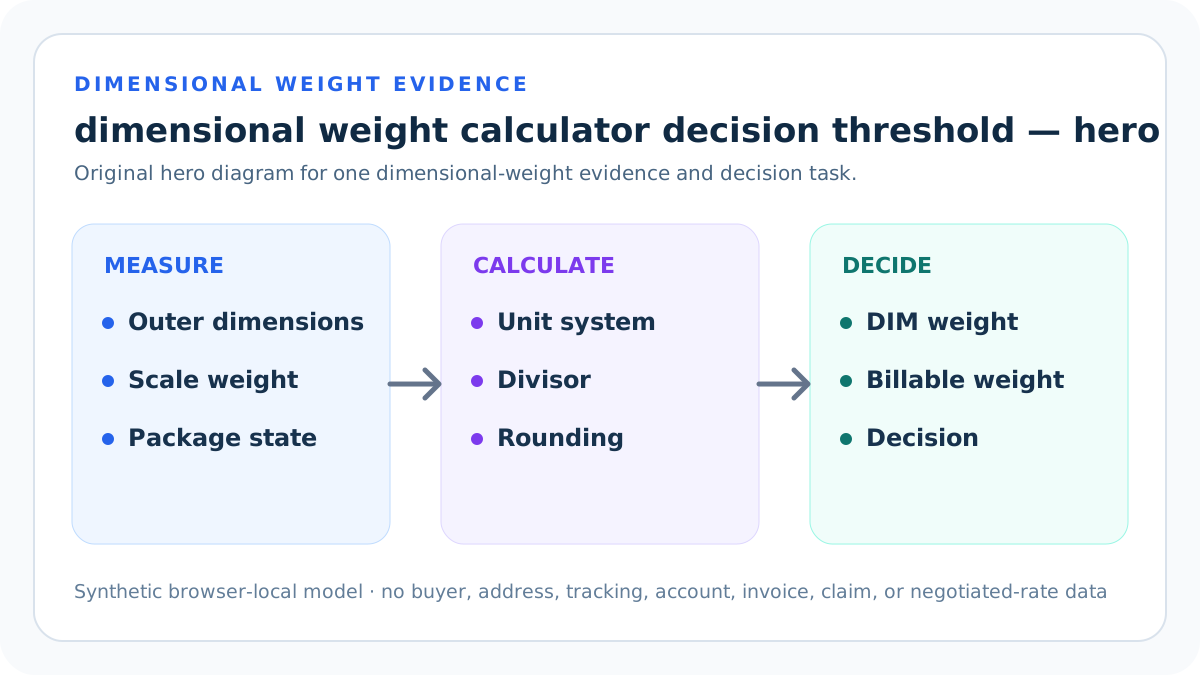
Gate 1: package identity
Gate control 1: Require finished package, measurement state, carrier, service, rate type, origin, package class, and period. The threshold page uses non-compensating logic so favorable headroom cannot override invalid physical inputs, units, rules, or conflicts. Save before value, full-precision value, display value, units, package state, carrier-rule version, reviewer, and review date.
Test the nearest valid boundary and nearest failure. State how a mismatch changes a non-compensating carrier-rule evidence decision, what evidence resolves it, who owns correction, and whether the packet must be blocked, reviewed, limited, superseded, or restored.
Gate 2: positive physical inputs
Gate control 2: Require all dimensions and actual weight above zero with explicit consistent units. The threshold page uses non-compensating logic so favorable headroom cannot override invalid physical inputs, units, rules, or conflicts. Save before value, full-precision value, display value, units, package state, carrier-rule version, reviewer, and review date.
Test the nearest valid boundary and nearest failure. State how a mismatch changes a non-compensating carrier-rule evidence decision, what evidence resolves it, who owns correction, and whether the packet must be blocked, reviewed, limited, superseded, or restored.
Gate 3: positive divisors and target
Gate control 3: Require primary, comparison, and seller maximum above zero with sources and ownership. The threshold page uses non-compensating logic so favorable headroom cannot override invalid physical inputs, units, rules, or conflicts. Save before value, full-precision value, display value, units, package state, carrier-rule version, reviewer, and review date.
Test the nearest valid boundary and nearest failure. State how a mismatch changes a non-compensating carrier-rule evidence decision, what evidence resolves it, who owns correction, and whether the packet must be blocked, reviewed, limited, superseded, or restored.
Gate 4: valid rule enums
Gate control 4: Require imperial or metric, nearest/ceiling/none dimension rounding, and ceiling/none billable rounding. The threshold page uses non-compensating logic so favorable headroom cannot override invalid physical inputs, units, rules, or conflicts. Save before value, full-precision value, display value, units, package state, carrier-rule version, reviewer, and review date.
Test the nearest valid boundary and nearest failure. State how a mismatch changes a non-compensating carrier-rule evidence decision, what evidence resolves it, who owns correction, and whether the packet must be blocked, reviewed, limited, superseded, or restored.
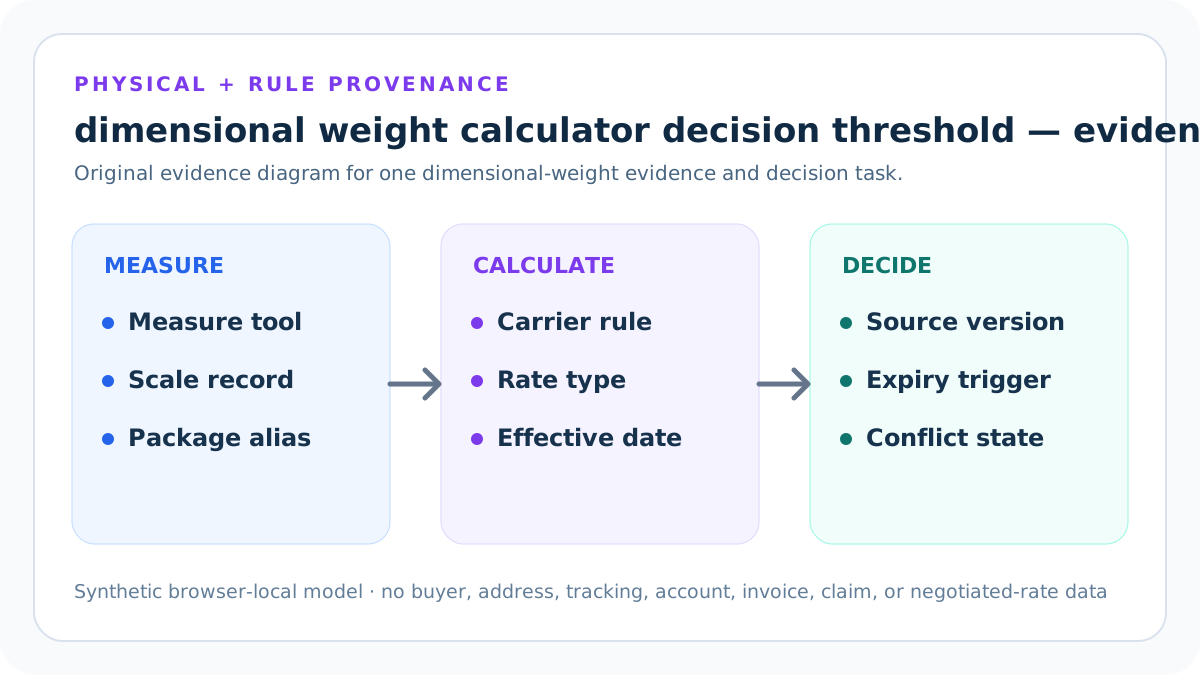
Gate 5: context validity
Gate control 5: Require a real YYYY-MM-DD source review date, carrier rule label, YYYY-MM period, adequate scope, all nine yes/no confirmations, and no unresolved declared issue. The threshold page uses non-compensating logic so favorable headroom cannot override invalid physical inputs, units, rules, or conflicts. Save before value, full-precision value, display value, units, package state, carrier-rule version, reviewer, and review date.
Test the nearest valid boundary and nearest failure. State how a mismatch changes a non-compensating carrier-rule evidence decision, what evidence resolves it, who owns correction, and whether the packet must be blocked, reviewed, limited, superseded, or restored.
Gate 6: dimensional-control Review
Gate control 6: Review when primary dimensional weight exceeds actual scale weight. The threshold page uses non-compensating logic so favorable headroom cannot override invalid physical inputs, units, rules, or conflicts. Save before value, full-precision value, display value, units, package state, carrier-rule version, reviewer, and review date.
Test the nearest valid boundary and nearest failure. State how a mismatch changes a non-compensating carrier-rule evidence decision, what evidence resolves it, who owns correction, and whether the packet must be blocked, reviewed, limited, superseded, or restored.
Gate 7: target Review
Gate control 7: Review full-precision primary billable weight above the seller planning maximum. The threshold page uses non-compensating logic so favorable headroom cannot override invalid physical inputs, units, rules, or conflicts. Save before value, full-precision value, display value, units, package state, carrier-rule version, reviewer, and review date.
Test the nearest valid boundary and nearest failure. State how a mismatch changes a non-compensating carrier-rule evidence decision, what evidence resolves it, who owns correction, and whether the packet must be blocked, reviewed, limited, superseded, or restored.
Gate 8: rounding-sensitivity Review
Gate control 8: Review when selected dimension rounding changes raw package volume by more than the seller-entered maximum percentage. The threshold page uses non-compensating logic so favorable headroom cannot override invalid physical inputs, units, rules, or conflicts. Save before value, full-precision value, display value, units, package state, carrier-rule version, reviewer, and review date.
Test the nearest valid boundary and nearest failure. State how a mismatch changes a non-compensating carrier-rule evidence decision, what evidence resolves it, who owns correction, and whether the packet must be blocked, reviewed, limited, superseded, or restored.
Use the dimensional weight decision contract with one protected package packet
Open the calculator only after the dimensional weight decision contract has one seller alias, package alias, finished-package state, measurement system, actual scale weight, carrier, service, rate type, origin, divisor sources, rounding rules, real source-review date, evidence month, target, sensitivity threshold, nine evidence confirmations, and unresolved-issue list. Use synthetic or aggregate values publicly.
Save raw and rounded dimensions, raw and rule volume, both dimensional weights, both billable results, premium, headroom, seller-entered sensitivity threshold, source date, confirmations, and decision at full precision beside display values. Preserve the prior packet whenever physical package or carrier rule changes.
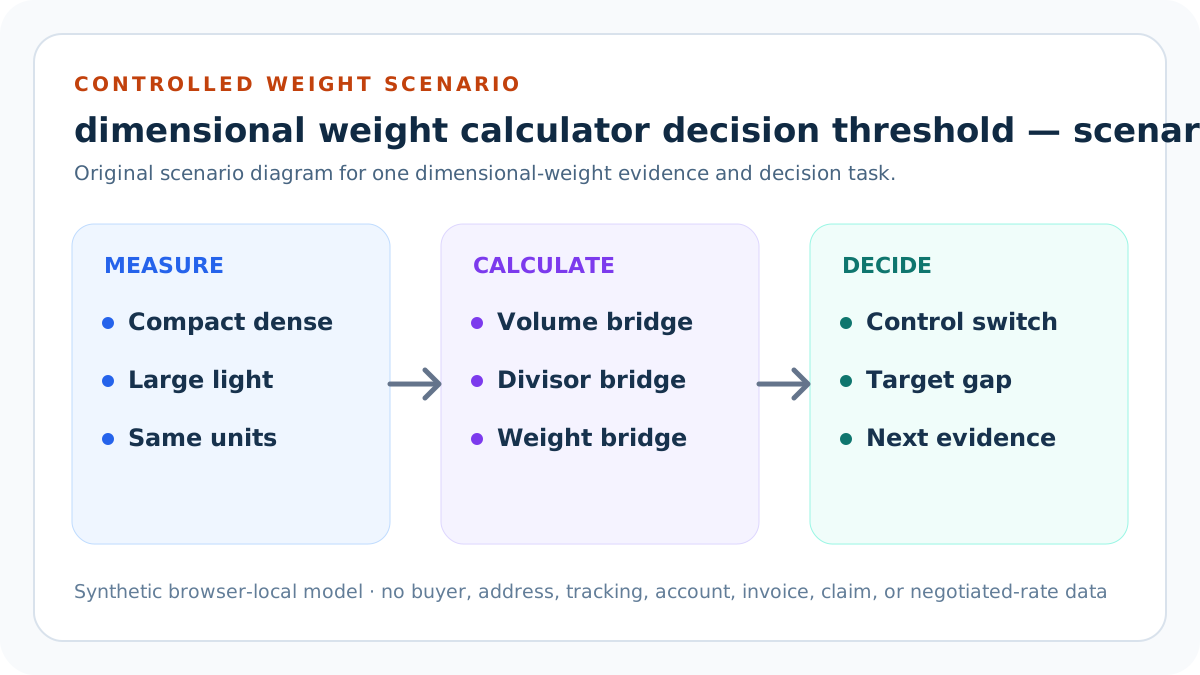
Apply physical and rule gates before a non-compensating carrier-rule evidence decision
Block blank, non-finite, nonpositive, or structurally invalid numeric evidence; invalid unit or rounding enums; an impossible source date; incomplete evidence confirmations; vague carrier rule, period, or scope; or declared conflicts. Review dimensional weight above actual, primary billable above target, rounding-volume change above the seller-entered maximum, stale sources, or incompatible package populations.
Ready confirms only a structurally valid weight scenario. It does not quote a rate, certify a carrier rule, accept a package, calculate a surcharge, promise delivery, set price, or determine shipping cost, tax, accounting profit, margin, demand, revenue, or income.
Model package and carrier-rule uncertainty explicitly
Change one dimension, actual weight, divisor, dimension rounding, billable rounding, service, rate type, origin, or target at a time. Keep compact, large-light, irregular, soft, oversized, international, multi-package, and carrier-adjusted cases separate whenever rules or evidence differ.
Record the before state, isolated change, rule volume, both dimensional and billable weights, controlling input, premium, target headroom, decision, confidence, owner, and next evidence action. Sensitivity identifies a driver; it does not choose a carrier or package.
Protect buyer, shipment, carrier-account, and negotiated-rate data
Public examples are synthetic. Keep buyer names, addresses, tracking numbers, labels, payment data, credentials, carrier account identifiers, negotiated rates, invoices, claims, disputes, and raw exports outside the dimensional weight decision contract.
Use package aliases, aggregates, ranges, redacted pointers, and access-controlled records. An independent reviewer should reproduce physical measurements, rule applicability, arithmetic, and decision without receiving personal or confidential commercial data.
Release, observe, correct, and roll back the dimensional asset
Before release, preserve narrow local and remote backups and a rollback identifier. Run typecheck, focused and full tests, integration, build, SEO and duplicate audits, static-route validation, mobile and keyboard QA, image and link checks, source review, and live calculator scenarios.
After release, verify status, canonical, indexability, schema, answer blocks, images, hub discovery, strict 404, sitemap policy, events, and production behavior. Record Day 0/7/14/28 evidence and restore the prior version if formula, privacy, accessibility, routing, content, or health regresses.
Prove the actual-dimensional crossover
Hold package volume and divisor constant while testing actual weight immediately below, equal to, and above dimensional weight. Repeat before and after billable rounding.
The decision log distinguishes dimensional-control Review from above-target Review. A parcel can be dimensionally controlled and still remain below the seller target.
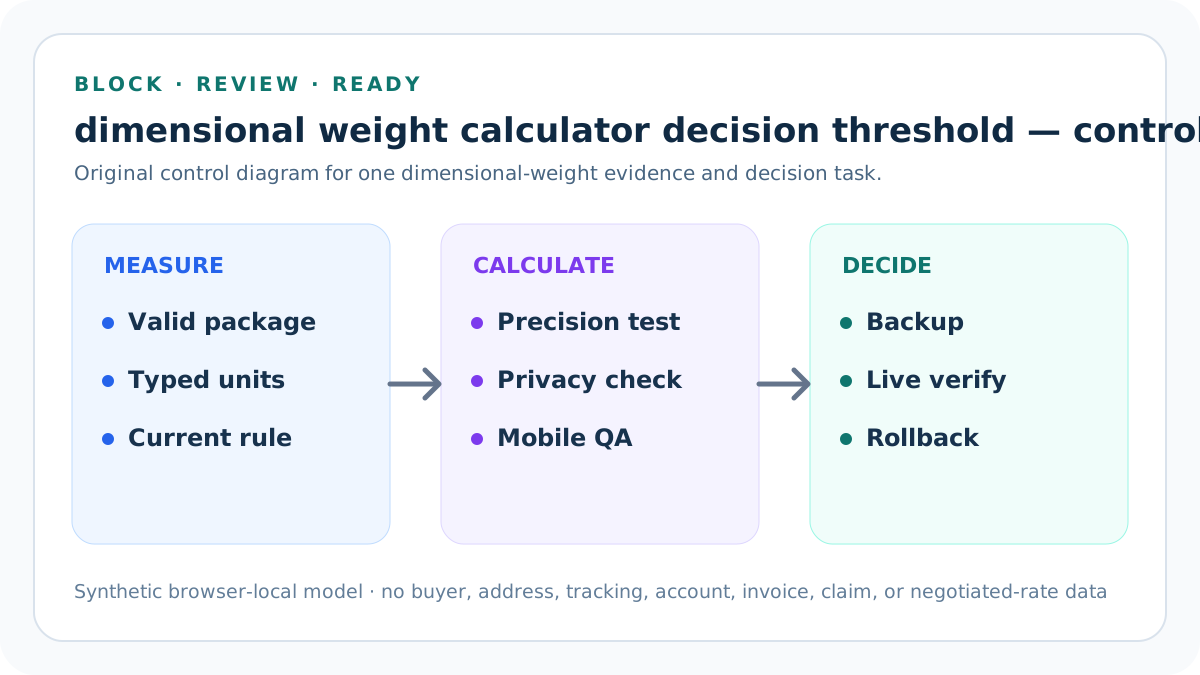
Prove the seller-entered volume-change boundary
Choose fractional dimensions producing raw-to-rule volume changes just below, exactly at, and just above the declared maximum. Preserve each rounded side, full-precision rate, threshold owner, purpose, effective date, and expiry.
Review asks for measurement and rule confirmation; it does not declare the rounded volume wrong or turn the threshold into a carrier allowance. Close with repeated outer measurements and a current carrier rule.
Prove the target boundary without moving the target
Test maximum planned billable weight immediately below, equal to, and above the full-precision primary result. Record displayed rounding separately.
An edited target opens a new policy version with owner and approval. It cannot retroactively make the original packet Ready.
Positive-input boundary
Test zero, negative, smallest accepted, and unusually large dimensions, weight, divisors, and target. Deep check 1 stores package alias, source version, protected pointer, full-precision transformation, display output, decision, reviewer, expiry condition, and correction route. Another reviewer must not guess package state, unit, divisor, rounding, service, rate type, origin, target, or formula order.
Find the closest counterexample and state why it invalidates or narrows a non-compensating carrier-rule evidence decision. Preserve competing physical, unit, carrier, service, rate, origin, threshold, rounding, or target evidence as named scenarios rather than blending uncertainty into one reassuring average.
Enum boundary
Test case, whitespace, valid names, unsupported aliases, and mixed unit systems. Deep check 2 stores package alias, source version, protected pointer, full-precision transformation, display output, decision, reviewer, expiry condition, and correction route. Another reviewer must not guess package state, unit, divisor, rounding, service, rate type, origin, target, or formula order.
Find the closest counterexample and state why it invalidates or narrows a non-compensating carrier-rule evidence decision. Preserve competing physical, unit, carrier, service, rate, origin, threshold, rounding, or target evidence as named scenarios rather than blending uncertainty into one reassuring average.
Target boundary
Test full-precision primary weight immediately below, at, and above maximum. Deep check 3 stores package alias, source version, protected pointer, full-precision transformation, display output, decision, reviewer, expiry condition, and correction route. Another reviewer must not guess package state, unit, divisor, rounding, service, rate type, origin, target, or formula order.
Find the closest counterexample and state why it invalidates or narrows a non-compensating carrier-rule evidence decision. Preserve competing physical, unit, carrier, service, rate, origin, threshold, rounding, or target evidence as named scenarios rather than blending uncertainty into one reassuring average.
Non-compensation proof
Prevent favorable headroom from overriding invalid physical or rule evidence. Deep check 4 stores package alias, source version, protected pointer, full-precision transformation, display output, decision, reviewer, expiry condition, and correction route. Another reviewer must not guess package state, unit, divisor, rounding, service, rate type, origin, target, or formula order.
Find the closest counterexample and state why it invalidates or narrows a non-compensating carrier-rule evidence decision. Preserve competing physical, unit, carrier, service, rate, origin, threshold, rounding, or target evidence as named scenarios rather than blending uncertainty into one reassuring average.
Release gate
Require backup, release mode, deploy, targeted purge, live verification, and rollback. Deep check 5 stores package alias, source version, protected pointer, full-precision transformation, display output, decision, reviewer, expiry condition, and correction route. Another reviewer must not guess package state, unit, divisor, rounding, service, rate type, origin, target, or formula order.
Find the closest counterexample and state why it invalidates or narrows a non-compensating carrier-rule evidence decision. Preserve competing physical, unit, carrier, service, rate, origin, threshold, rounding, or target evidence as named scenarios rather than blending uncertainty into one reassuring average.
Sources and further reading
- Seller Profit Guard methodology: Comparable-grain evidence, deterministic calculations, validation, correction, release, and rollback.
- Seller Profit Guard data privacy: Local-first boundaries for buyer, address, tracking, carrier-account, invoice, credential, claim, and raw export data.
- UPS: Shipping Dimensions and Weight: Official U.S. UPS explanation reviewed 2026-07-31 for outer dimensions, dimensional formula, divisor differences by rate type, and billable-weight rounding.
- FedEx: What Is Dimensional Weight?: Official U.S. FedEx explanation reviewed 2026-07-31 for dimensional weight, measurement rounding, divisor context, and actual-weight comparison.
- USPS Postal Explorer: Ground Advantage Retail: Official USPS context reviewed 2026-07-31 for extreme dimensions, cubic threshold, divisor, and whole-pound rounding within the named product scope.
Related Seller Profit Guard tools
- Open the Dimensional Weight Calculator: Compare actual and dimensional weight under two seller-entered rule scenarios.
- Shipping Subsidy Calculator: Use final postage evidence in a seller-funded shipping analysis.
- Packaging Cost per Order Calculator: Track package changes without losing direct packaging cost.
- Shipping Price Helper: Carry verified shipping cost into a broader buyer-charge scenario.
- Contribution Margin Calculator: Keep dimensional weight separate from contribution and profit.
- Methodology: Review evidence, privacy, formulas, tests, release, correction, and rollback.
- Dimensional Weight Formula and Inputs: Continue with a distinct dimensional formula, example, source, threshold, comparison, operating, interpretation, or audit task.
- Dimensional Weight Worked Example: Continue with a distinct dimensional formula, example, source, threshold, comparison, operating, interpretation, or audit task.
- Large Light Parcel Dimensional Weight: Continue with a distinct dimensional formula, example, source, threshold, comparison, operating, interpretation, or audit task.
- Dimensional Weight Calculator Mistakes: Continue with a distinct dimensional formula, example, source, threshold, comparison, operating, interpretation, or audit task.
- Dimensional Weight Evidence Sources: Continue with a distinct dimensional formula, example, source, threshold, comparison, operating, interpretation, or audit task.
Next step: Open the Dimensional Weight Calculator.
This is operational planning help, not tax, accounting, legal, financial, or platform-policy advice. Review the Terms and disclaimer, and verify current platform rules and fee assumptions before changing prices.