Free shipping threshold audit checklist and change log
Last updated: 2026-07-29
Written and reviewed by Seller Profit Guard Editorial Team.
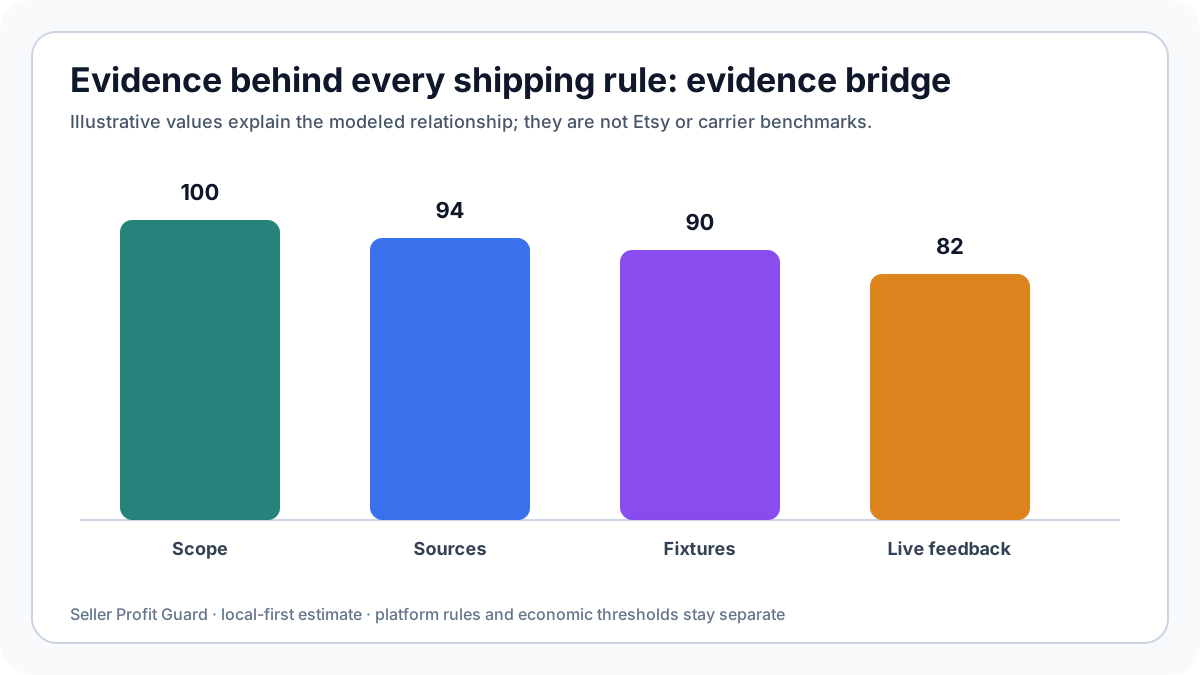
A complete threshold audit records purpose, offer mechanism, destination and product scope, formula version, six inputs, source dates and fingerprints, boundary and stress fixtures, cart-mix assumptions, platform configuration, reviewer approval, implementation time, live feedback, exceptions, corrective actions, and rollback. Checked boxes without traceable evidence do not prove the offer is safe.

What belongs in the scope and formula checklist?
Record audit purpose, seller market, currency, offer mechanism, buyer destination, eligible products, excluded products, service class, package cohort, upgrade treatment, analysis period, calculator version, formula, rounding rule, and decision level. State whether the offer is an Etsy guarantee, a shipping profile, a listing-level price design, or another bounded mechanism.
List product cost, shipping subsidy, packaging, fixed fee, percentage fee, and target margin with units, source, owner, effective date, and included boundaries. Record excluded labor, advertising, incidents, overhead, tax, currency conversion, or other costs. An exclusion is visible uncertainty, not zero.
Reperform the algebra and confirm contribution at the exact and rounded threshold. Preserve an impossible-denominator fixture, one-below and one-above boundary cases, and a public dummy scenario. A code or input change requires fixture rerun.
| Control | Required evidence | Failure response |
|---|---|---|
| Scope | Offer, destination, product, service | Re-scope |
| Inputs | Source, unit, date, owner | Hold calculation |
| Formula | Hand identity + version | Fix and retest |
| Boundary | Fail/pass fixtures | Block release |
| Stress | Adverse cart and package | Narrow or redesign |
| Rollback | Prior configuration | No bulk mutation |
Which source and privacy controls must pass?
Verify SKU or cart costs, label and adjustment samples, packaging bills, official fee rules, Payment Account reconciliation, target approval, cart mix, and current profile. Record population counts, exclusions, transformations, currency, and fingerprints. Challenge stale or suspiciously uniform sources.
Remove buyer identity, address, contact, order identifier, message, and personalization from the audit package. Use aggregate zones, public dummy examples, and controlled private evidence. Verify exported reports and analytics events contain no raw labels, orders, or customer data.
Confirm access is limited and retention is proportionate. Supplier terms, negotiated rates, and margin targets remain commercially sensitive. A public SEO article or community draft is never an acceptable evidence store.

How are configuration and live feedback audited?
Capture the before and after shipping profile or guarantee state, eligible listing set, threshold, related price edits, destination rules, effective time, operator, reviewer, and rollback steps. Verify the buyer-facing result with public or dummy context where possible. Confirm upgrades and excluded destinations behave as documented.
After release, compare actual qualifying carts with expected mix, product cost, parcel count, seller subsidy, packaging, fees, and contribution. Record representative and adverse cohorts separately. Investigate structural exceptions immediately instead of waiting for a blended average.
Link each material variance to a decision: accept with explanation, measure, correct data, repair package, narrow eligibility, revise price, revise threshold, pause, or roll back. Rerun the same fixtures and a bounded live sample after correction.
What belongs in the change log and approval statement?
For every version, record date, prior rule, new rule, reason, changed input or scope, evidence, calculator result, stress result, listings or profiles affected, operator, reviewer, expected outcome, feedback window, exception, and rollback. Preserve rejected alternatives and their failure reasons.
Approval is bounded: for example, 'a $30 domestic standard-service threshold for listed lightweight products passed formula, representative, and adverse fixtures under sources dated July 26.' It does not certify international orders, accounting net income, conversion lift, future carrier rates, or every SKU.
Close an issue only when the authoritative source or configuration changed as intended and rerun evidence confirms the expected result. If a warning is accepted, document why, for how long, and what trigger reopens it. Never rewrite prior results to match the latest policy.
- Version every rule.
- Name the changed assumption.
- Preserve rejected alternatives.
- Bound the approval statement.
- Require rerun evidence for closure.
Threshold-audit questions
Can the template replace accounting review? No. It controls a bounded operating estimate.
What blocks release? Failed fixtures, missing material evidence, unclear scope, configuration mismatch, or no rollback.
Can a platform guarantee pass while the economic audit fails? Yes; they answer different questions.
Who approves bulk changes? A second reviewer proportionate to risk.
What proves completion? Reproducible formula, traceable sources, configured scope, passing feedback, explained exceptions, and preserved rollback.
Which evidence supports this free-shipping threshold audit?
Use current carrier or Etsy label receipts for postage, adjustments, insurance, and services; packaging purchase records for mailers, boxes, inserts, tape, and protective material; product or SKU records for the cost of goods; and the Etsy Payment Account for fees tied to actual orders. Use shipping profiles and the current listing only to describe what the buyer is offered. A profile does not prove the seller's final label cost.
Record the analysis period, currency, destination cohort, package class, included costs, excluded costs, fee assumption, fixed fee, target margin, calculator version, and source dates. Reconcile a small public dummy example by hand before applying the result to a catalog. A file fingerprint proves that an input did not change; it does not prove that the input represents the next order mix.
Keep official platform rules separate from business assumptions. Etsy's US free-shipping guarantee can apply to qualifying US-bound orders of $35 or more after it is enabled, while the calculator derives a shop-specific economic threshold from entered costs and rates. Neither value proves conversion lift, tax treatment, carrier eligibility, or profit on every destination.
- Prefer actual labels and adjustments over advertised rate estimates.
- Segment heavy, remote, international, upgraded, fragile, and mixed-cart orders when costs differ.
- Treat fee percentages and target margin as explicit editable assumptions.
- Recalculate after carrier, package, fee, product-cost, or offer changes.
- Verify tax, accounting, legal, and platform-policy questions separately.
Privacy and commercial sensitivity for free-shipping threshold audit
The threshold calculation needs costs, rates, a package or cart scenario, and a target margin. Buyer names, email addresses, phone numbers, delivery addresses, order IDs, messages, personalization, and payment credentials are unnecessary. Use aggregate destination zones or public dummy locations rather than exposing a buyer's exact address. Seller Profit Guard runs this quick calculation in the browser and does not need an Etsy login.
Supplier prices, package dimensions, negotiated carrier rates, product mix, margin targets, and exception rules can reveal commercial strategy even without buyer data. Keep detailed worksheets in controlled storage. Public reports should use rounded dummy numbers, aggregate ranges, redacted product names, and non-reversible fingerprints. Never paste a private order row or label into an article, analytics event, ticket, email draft, or community post.
How to apply this free-shipping threshold audit in the calculator
Open the Free Shipping Threshold Calculator and enter product cost, seller-funded shipping, packaging, the combined percentage fee assumption, fixed fee, and target margin. The tool adds the four fixed-dollar costs, subtracts the fee and target-margin shares from one, and divides the cost total by the remaining revenue share. It reports no safe threshold when the denominator is zero or negative.
Round the result upward to a practical cart rule, then rerun at least a representative, adverse, and mixed-cart case. Confirm that the products likely to reach the threshold can actually produce the modeled cost mix. The output is a planning estimate, not an Etsy setting, carrier quote, conversion forecast, accounting profit statement, or promise that every qualifying order is profitable.
- Define one destination, package, product-mix, and offer cohort.
- Enter evidence-backed dollar costs and editable percentage assumptions.
- Hand-check the formula and round upward rather than down.
- Stress-test heavy, distant, upgraded, discounted, and mixed-cart cases.
- Publish only a bounded rule with owner, review date, exception, and rollback.
Sources and further reading
- Etsy Help: How to Offer Free Shipping: Official Etsy guidance for the US $35 free-shipping guarantee, shipping profiles, smart pricing, upgrades, and domestic versus international offers.
- Etsy Fees & Payments Policy: Official policy for transaction, payment-processing, Offsite Ads, regulatory, currency-conversion, shipping-label, and other seller charges.
- Etsy Help: How to Set Up Calculated Shipping: Official explanation of how origin, destination, package weight, dimensions, mail class, and package preferences affect calculated shipping.
- Etsy Help: How to Ship Your Items: Official shipping-profile, label, policy, and competitive-shipping overview for Etsy sellers.
- Seller Profit Guard calculation methodology: Definitions for contribution, editable assumptions, evidence hierarchy, local-first processing, uncertainty, and decision limits.
Related Seller Profit Guard tools
- Open the Free Shipping Threshold Calculator: Calculate the minimum order value that can absorb seller-funded shipping while preserving an editable target margin.
- Review Etsy shipping margin mistakes: Separate platform guarantees from economic thresholds and inspect funding, package, variation, replacement, and international cases.
- Calculate break-even ROAS and return loss: Add acquisition and expected incident loss after the shipping threshold is understood.
- Use the Etsy profit calculator: Validate the threshold against actual order revenue, fees, SKU cost, shipping, and margin evidence.
- Read the local-first methodology: Understand formulas, assumptions, privacy, evidence quality, and non-advice limits.
- Free Shipping Threshold Formula: 6 Inputs: Continue the free-shipping threshold evidence and decision workflow.
- Free Shipping Threshold: $26.32 Example: Continue the free-shipping threshold evidence and decision workflow.
- Mixed-Cart Free Shipping Threshold: $37.75: Continue the free-shipping threshold evidence and decision workflow.
- Free Shipping Threshold: 12 Costly Mistakes: Continue the free-shipping threshold evidence and decision workflow.
- Free Shipping Threshold Data: 7 Sources: Continue the free-shipping threshold evidence and decision workflow.
Next step: Open the Free Shipping Threshold Calculator.
This is operational planning help, not tax, accounting, legal, financial, or platform-policy advice. Review the Terms and disclaimer, and verify current platform rules and fee assumptions before changing prices.