SKU naming formula, inputs, and assumptions
Last updated: 2026-07-31
Written and reviewed by Seller Profit Guard Editorial Team.
A reversible SKU joins approved product-family, material, color, size, and stable sequence codes with one supported separator. Optional channel aliases prepend a mapped channel code to the same canonical core. Validate codebook coverage, uniqueness, maximum length, sequence format, evidence scope, and retired identifiers before reservation.
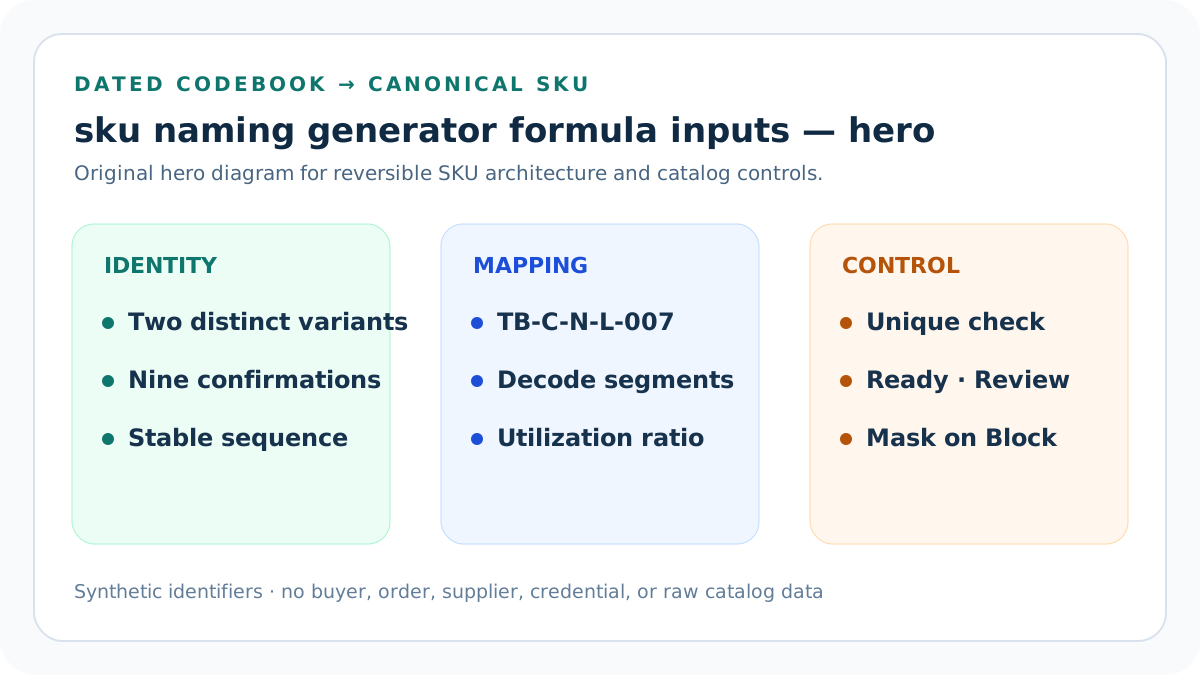
Define the variant grain
Identify one sellable product and option combination before assigning a code. In the SKU naming specification, record the exact attribute or identifier, declared type, source, codebook version, catalog grain, system, owner, reviewer, effective date, exception state, and expiry before using it for a reversible canonical SKU rule.
Do not encode orders or locations as product identity. Topic 1 preserves the original proposal, a defective case, the correction, and the reason the conclusion belongs to a reversible canonical SKU rule rather than product truth, inventory accuracy, barcode identity, platform compatibility, or migration approval.
Build a controlled codebook
Map every approved abbreviation to one explicit family, material, color, size, or channel meaning. In the SKU naming specification, record the exact attribute or identifier, declared type, source, codebook version, catalog grain, system, owner, reviewer, effective date, exception state, and expiry before using it for a reversible canonical SKU rule.
Conflicting meanings block decoding. Topic 2 preserves the original proposal, a defective case, the correction, and the reason the conclusion belongs to a reversible canonical SKU rule rather than product truth, inventory accuracy, barcode identity, platform compatibility, or migration approval.
Choose separator and order
Use a confirmed hyphen or underscore and place the most useful stable attribute first. In the SKU naming specification, record the exact attribute or identifier, declared type, source, codebook version, catalog grain, system, owner, reviewer, effective date, exception state, and expiry before using it for a reversible canonical SKU rule.
Target-system rules remain external evidence. Topic 3 preserves the original proposal, a defective case, the correction, and the reason the conclusion belongs to a reversible canonical SKU rule rather than product truth, inventory accuracy, barcode identity, platform compatibility, or migration approval.
Add a padded sequence
Reserve enough numeric width for future variants and never silently recycle a retired number. In the SKU naming specification, record the exact attribute or identifier, declared type, source, codebook version, catalog grain, system, owner, reviewer, effective date, exception state, and expiry before using it for a reversible canonical SKU rule.
Sequence is not an order identifier. Topic 4 preserves the original proposal, a defective case, the correction, and the reason the conclusion belongs to a reversible canonical SKU rule rather than product truth, inventory accuracy, barcode identity, platform compatibility, or migration approval.
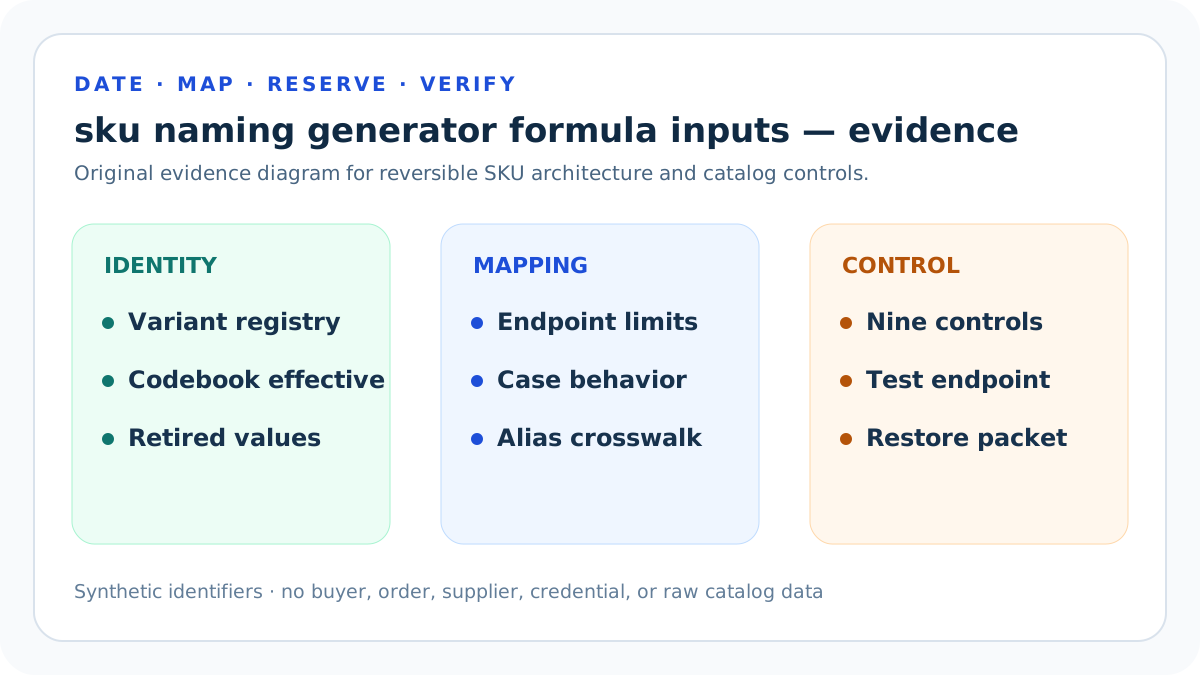
Generate canonical identity
Join family, material, color, size, and sequence after alphanumeric normalization. In the SKU naming specification, record the exact attribute or identifier, declared type, source, codebook version, catalog grain, system, owner, reviewer, effective date, exception state, and expiry before using it for a reversible canonical SKU rule.
The canonical core stays stable across mappings. Topic 5 preserves the original proposal, a defective case, the correction, and the reason the conclusion belongs to a reversible canonical SKU rule rather than product truth, inventory accuracy, barcode identity, platform compatibility, or migration approval.
Generate optional aliases
Prepend approved channel codes only when an endpoint cannot use the canonical value directly. In the SKU naming specification, record the exact attribute or identifier, declared type, source, codebook version, catalog grain, system, owner, reviewer, effective date, exception state, and expiry before using it for a reversible canonical SKU rule.
Aliases remain one-to-one mappings. Topic 6 preserves the original proposal, a defective case, the correction, and the reason the conclusion belongs to a reversible canonical SKU rule rather than product truth, inventory accuracy, barcode identity, platform compatibility, or migration approval.
Validate the packet
Check mappings, length, entered reservations, duplicates, ambiguous characters, scope, date, and declared conflicts. In the SKU naming specification, record the exact attribute or identifier, declared type, source, codebook version, catalog grain, system, owner, reviewer, effective date, exception state, and expiry before using it for a reversible canonical SKU rule.
No browser check reserves an external code. Topic 7 preserves the original proposal, a defective case, the correction, and the reason the conclusion belongs to a reversible canonical SKU rule rather than product truth, inventory accuracy, barcode identity, platform compatibility, or migration approval.
Identifier and variation control: sku naming generator formula and inputs
Record the canonical product-variant grain, option values, identifier owner, creation path, and source version. Control 1 names the authority, owner, frequency, uniqueness scope, case rule, length rule, exception code, stop threshold, tested endpoint, and prior restorable catalog packet.
An SKU cannot validate product truth. Apply the control specifically to a reversible canonical SKU rule; distinguish seller-controlled SKU identity, buyer-facing option labels, channel aliases, location quantities, barcodes or GTINs, platform behavior, and private source records.
Registry and alias control: sku naming generator formula and inputs
Compare active, archived, reserved, pending, and channel identifiers case-insensitively and preserve one-to-one mappings. Control 2 names the authority, owner, frequency, uniqueness scope, case rule, length rule, exception code, stop threshold, tested endpoint, and prior restorable catalog packet.
A partial export cannot prove uniqueness. Apply the control specifically to a reversible canonical SKU rule; distinguish seller-controlled SKU identity, buyer-facing option labels, channel aliases, location quantities, barcodes or GTINs, platform behavior, and private source records.
Privacy and restoration control: sku naming generator formula and inputs
Use synthetic examples, aggregate counts, redacted pointers, access controls, an old-to-new crosswalk, and restore evidence. Control 3 names the authority, owner, frequency, uniqueness scope, case rule, length rule, exception code, stop threshold, tested endpoint, and prior restorable catalog packet.
Do not publish private catalog rows. Apply the control specifically to a reversible canonical SKU rule; distinguish seller-controlled SKU identity, buyer-facing option labels, channel aliases, location quantities, barcodes or GTINs, platform behavior, and private source records.
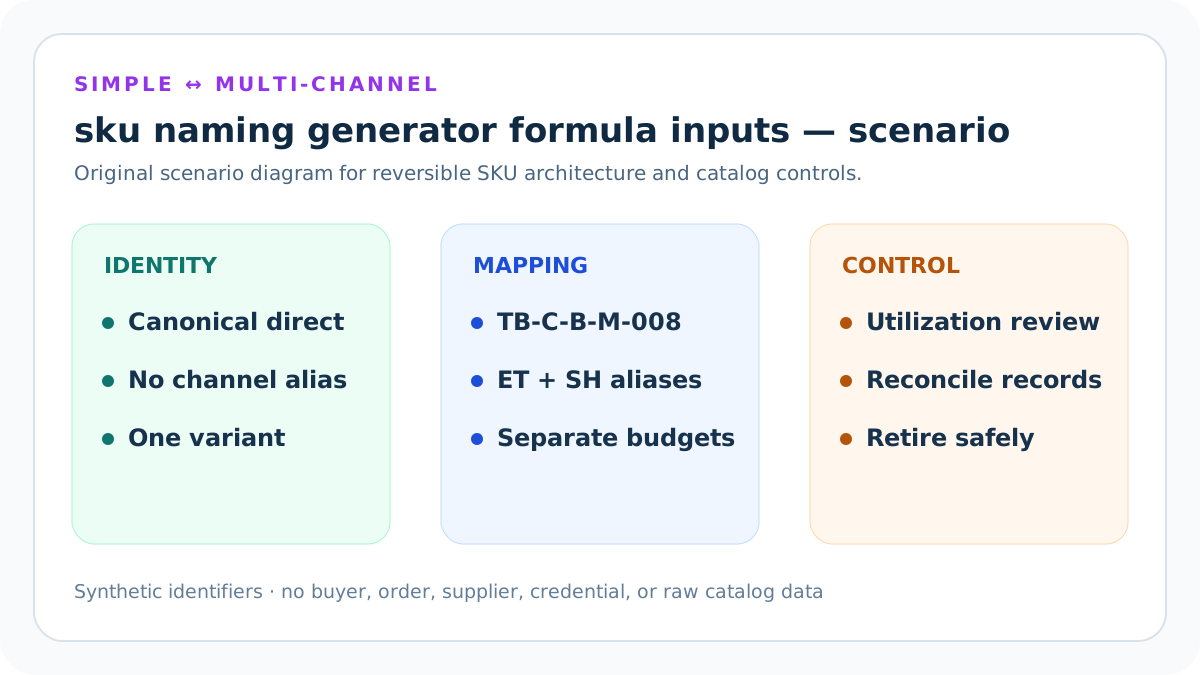
Codebook and sequence control: sku naming generator formula and inputs
Version codes, meanings, segment order, separator, sequence width, reserved ranges, retirement, and approval. Control 4 names the authority, owner, frequency, uniqueness scope, case rule, length rule, exception code, stop threshold, tested endpoint, and prior restorable catalog packet.
Never redefine historical codes. Apply the control specifically to a reversible canonical SKU rule; distinguish seller-controlled SKU identity, buyer-facing option labels, channel aliases, location quantities, barcodes or GTINs, platform behavior, and private source records.
Integration and physical QA control: sku naming generator formula and inputs
Test field constraints, imports, labels, printers, scanners, POS, ERP, 3PL, fulfillment, returns, and reports. Control 5 names the authority, owner, frequency, uniqueness scope, case rule, length rule, exception code, stop threshold, tested endpoint, and prior restorable catalog packet.
Text validity is not operational proof. Apply the control specifically to a reversible canonical SKU rule; distinguish seller-controlled SKU identity, buyer-facing option labels, channel aliases, location quantities, barcodes or GTINs, platform behavior, and private source records.
Define the variant grain: catalog scenario drill
Recreate “Define the variant grain” with the synthetic TB-C-N-L-007 and TB-C-B-M-008 packets. Identify one sellable product and option combination before assigning a code. Change one supported input, retain the prior proposal, decode every segment, and attach the expected Block, Review, or Ready state to the SKU naming specification.
Do not encode orders or locations as product identity. Drill 1 records the platform-source review date, codebook effective date, one relevant operating confirmation, and the canonical or alias length-utilization ratio for this exact “Define the variant grain” decision. Include a supported case, one hard failure whose proposed codes are masked, a corrected case, and the evidence that permits the next a reversible canonical SKU rule action.
Build a controlled codebook: catalog scenario drill
Recreate “Build a controlled codebook” with the synthetic TB-C-N-L-007 and TB-C-B-M-008 packets. Map every approved abbreviation to one explicit family, material, color, size, or channel meaning. Change one supported input, retain the prior proposal, decode every segment, and attach the expected Block, Review, or Ready state to the SKU naming specification.
Conflicting meanings block decoding. Drill 2 records the platform-source review date, codebook effective date, one relevant operating confirmation, and the canonical or alias length-utilization ratio for this exact “Build a controlled codebook” decision. Include a supported case, one hard failure whose proposed codes are masked, a corrected case, and the evidence that permits the next a reversible canonical SKU rule action.
Choose separator and order: catalog scenario drill
Recreate “Choose separator and order” with the synthetic TB-C-N-L-007 and TB-C-B-M-008 packets. Use a confirmed hyphen or underscore and place the most useful stable attribute first. Change one supported input, retain the prior proposal, decode every segment, and attach the expected Block, Review, or Ready state to the SKU naming specification.
Target-system rules remain external evidence. Drill 3 records the platform-source review date, codebook effective date, one relevant operating confirmation, and the canonical or alias length-utilization ratio for this exact “Choose separator and order” decision. Include a supported case, one hard failure whose proposed codes are masked, a corrected case, and the evidence that permits the next a reversible canonical SKU rule action.
Add a padded sequence: catalog scenario drill
Recreate “Add a padded sequence” with the synthetic TB-C-N-L-007 and TB-C-B-M-008 packets. Reserve enough numeric width for future variants and never silently recycle a retired number. Change one supported input, retain the prior proposal, decode every segment, and attach the expected Block, Review, or Ready state to the SKU naming specification.
Sequence is not an order identifier. Drill 4 records the platform-source review date, codebook effective date, one relevant operating confirmation, and the canonical or alias length-utilization ratio for this exact “Add a padded sequence” decision. Include a supported case, one hard failure whose proposed codes are masked, a corrected case, and the evidence that permits the next a reversible canonical SKU rule action.
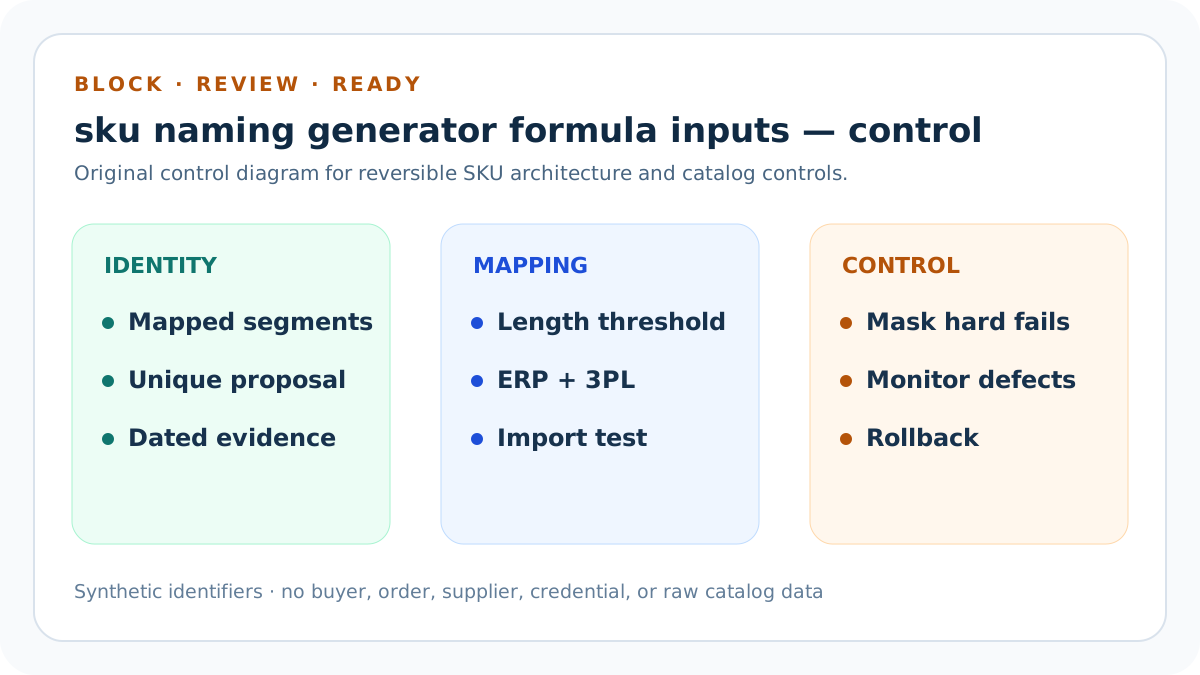
Generate canonical identity: catalog scenario drill
Recreate “Generate canonical identity” with the synthetic TB-C-N-L-007 and TB-C-B-M-008 packets. Join family, material, color, size, and sequence after alphanumeric normalization. Change one supported input, retain the prior proposal, decode every segment, and attach the expected Block, Review, or Ready state to the SKU naming specification.
The canonical core stays stable across mappings. Drill 5 records the platform-source review date, codebook effective date, one relevant operating confirmation, and the canonical or alias length-utilization ratio for this exact “Generate canonical identity” decision. Include a supported case, one hard failure whose proposed codes are masked, a corrected case, and the evidence that permits the next a reversible canonical SKU rule action.
Generate optional aliases: catalog scenario drill
Recreate “Generate optional aliases” with the synthetic TB-C-N-L-007 and TB-C-B-M-008 packets. Prepend approved channel codes only when an endpoint cannot use the canonical value directly. Change one supported input, retain the prior proposal, decode every segment, and attach the expected Block, Review, or Ready state to the SKU naming specification.
Aliases remain one-to-one mappings. Drill 6 records the platform-source review date, codebook effective date, one relevant operating confirmation, and the canonical or alias length-utilization ratio for this exact “Generate optional aliases” decision. Include a supported case, one hard failure whose proposed codes are masked, a corrected case, and the evidence that permits the next a reversible canonical SKU rule action.
Validate the packet: catalog scenario drill
Recreate “Validate the packet” with the synthetic TB-C-N-L-007 and TB-C-B-M-008 packets. Check mappings, length, entered reservations, duplicates, ambiguous characters, scope, date, and declared conflicts. Change one supported input, retain the prior proposal, decode every segment, and attach the expected Block, Review, or Ready state to the SKU naming specification.
No browser check reserves an external code. Drill 7 records the platform-source review date, codebook effective date, one relevant operating confirmation, and the canonical or alias length-utilization ratio for this exact “Validate the packet” decision. Include a supported case, one hard failure whose proposed codes are masked, a corrected case, and the evidence that permits the next a reversible canonical SKU rule action.
What a reversible canonical SKU rule can and cannot prove
It can prove that the entered synthetic attributes, approved codes, separator, sequence, length limits, reserved sample, alias mappings, evidence date, catalog scope, and formula version follow the declared local rule and produce a reversible proposal.
It cannot prove product attributes, complete external uniqueness, live inventory, warehouse location, marketplace acceptance, ERP or 3PL compatibility, barcode or GTIN validity, label readability, scanner behavior, historical-order safety, fulfillment readiness, or migration success.
Block, review, release, and restore the SKU naming specification
Block missing segments, unmapped or conflicting codes, invalid sequence, unsupported separator, duplicate or reserved proposals, fake dates, incomplete nine-control evidence, private exposure, or declared conflicts, then mask derived codes. Review readable ambiguity or utilization at the seller-set threshold. Ready means both distinct entered proposals pass the local structural checks.
Release only a reversible public model with synthetic defaults, first-party sources, original diagrams, accessible labels, self-canonical Article and Breadcrumb schema, contextual links, strict 404 behavior, correction policy, and rollback evidence. Keep private registries and imports outside public artifacts.
Sources and further reading
- Seller Profit Guard methodology: Evidence versions, formulas, privacy, correction, release, and rollback.
- Seller Profit Guard data privacy: Local-first boundaries for catalog, buyer, order, supplier, credential, and raw-record data.
- Shopify Help: Using SKUs to manage your inventory: Reviewed July 31, 2026: official uniqueness, short-code, separator, variation, location, case-sensitive matching, integration, and barcode-field guidance.
- Shopify Help: Exporting and importing inventory with CSV: Reviewed July 31, 2026: official product-variant and location identification context for private catalog operations.
- Etsy Help: How to Use SKU for Your Inventory: Reviewed July 31, 2026: official seller-defined SKU, shop search, multi-channel use, short-code recommendation, ambiguous-character warning, and comma or slash caution.
- Etsy Help: How to Add Variations for Your Listings: Reviewed July 31, 2026: official buyer-facing variation and variation-level inventory context; labels remain separate from internal identifiers.
- Square Support: Automatically generate SKUs: Reviewed July 31, 2026: official internal identifier, unique missing-variation generation, deleted auto-SKU non-reuse, and manufacturer-set GTIN boundary.
- Square Support: Create and edit item options and variations: Reviewed July 31, 2026: official option-set and item-variation operating context.
- Square Support: Bulk import items: Reviewed July 31, 2026: official variation-level import and pre-change export context for a reversible private catalog update.
- GS1: GTIN, barcode, EAN, and UPC differences: Reviewed July 31, 2026: official boundary between a globally assigned GTIN and the barcode data carrier that can encode it.
Related Seller Profit Guard tools
- SKU Naming Generator: Generate two canonical proposals and optional channel aliases.
- Etsy Variation Naming Checker: Review buyer-facing variation names separately.
- Listing Cost Library Calculator: Attach cost evidence to stable canonical variants.
- CSV Import Validator: Review a redacted structural sample before a private import.
- Methodology: Review evidence, formulas, privacy, correction, release, and rollback.
- Data Privacy: Protect catalog, supplier, buyer, order, credential, and raw-record data.
- SKU Naming Generator Worked Example: Follow a simple tote-bag variant from codebook and attributes to TB-C-N-L-007, decoding, uniqueness review, and approval evidence.
- SKU Naming for a Multi-Channel Catalog: Create one canonical variant code plus Etsy and Shopify aliases without duplicating the underlying inventory identity or counts.
- SKU Naming Mistakes and Corrections: Correct duplicate, unmapped, overlong, location-bound, channel-fragmented, ambiguous, recycled, and private-data SKU patterns.
- SKU Naming Generator Data Sources: Map product attributes, codebook, existing identifiers, aliases, platform limits, labels, integrations, and history to reviewable evidence.
- Safe SKU Naming Decision Thresholds: Separate blocking identity failures, readability review, target-system compatibility, uniqueness, mapping, migration, and release thresholds.
- SKU Naming: Simple vs Multi-Channel: Compare one canonical-only catalog with a canonical-plus-alias catalog at the same codebook, variant, sequence, length, and evidence grain.
- Weekly SKU Naming Operating Routine: Run a repeatable catalog review across missing codes, duplicates, mappings, aliases, retired values, labels, integrations, exceptions, and rollback.
- How to Interpret SKU Naming Results: Read canonical codes, aliases, mappings, lengths, reserved checks, and status without claiming catalog, barcode, or integration proof.
- SKU Naming Generator Audit Template: Audit variant identity, codebook, canonical codes, channel aliases, uniqueness, length, history, integrations, labels, migration, and restoration.
Next step: Open Seller Profit Guard.
This is operational planning help, not tax, accounting, legal, financial, or platform-policy advice. Review the Terms and disclaimer, and verify current platform rules and fee assumptions before changing prices.