How to interpret an international landed cost estimate
Last updated: 2026-07-31
Written and reviewed by Seller Profit Guard Editorial Team.
Seller-side landed cost supports a bounded scenario under the entered parcel, cost, fee, border-charge, responsibility, return, and currency assumptions. Buyer-side estimated charges remain separate. Neither output proves customs classification, official duty, tax liability, delivered buyer total, carrier eligibility, accounting profit, demand, or price.
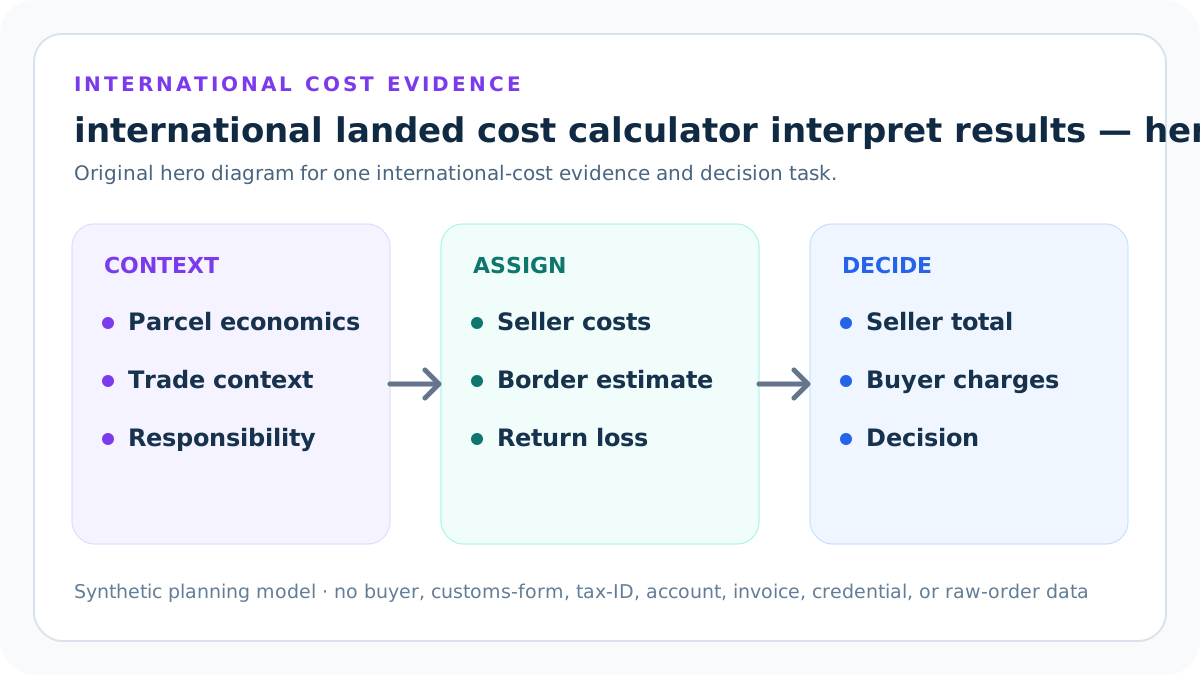
Interpret seller landed cost
Bound control 1: State included lines, currency, quantity, responsibility, period, and exclusions. This interpretation role separates supported planning statements from official or commercial conclusions. Save source state, full-precision value, display value, currency, responsibility, jurisdictional context, reviewer, and review date.
Test the nearest passing boundary and nearest failure. State how the mismatch changes a bounded statement with a driver-specific next action, what evidence resolves it, who owns correction, and whether the packet must be blocked, reviewed, limited, superseded, or restored.
Interpret buyer-side charges
Bound control 2: State estimated components and why they remain outside seller cost. This interpretation role separates supported planning statements from official or commercial conclusions. Save source state, full-precision value, display value, currency, responsibility, jurisdictional context, reviewer, and review date.
Test the nearest passing boundary and nearest failure. State how the mismatch changes a bounded statement with a driver-specific next action, what evidence resolves it, who owns correction, and whether the packet must be blocked, reviewed, limited, superseded, or restored.
Interpret per-item cost
Bound control 3: Use only across comparable product mix, route, service, and responsibility. This interpretation role separates supported planning statements from official or commercial conclusions. Save source state, full-precision value, display value, currency, responsibility, jurisdictional context, reviewer, and review date.
Test the nearest passing boundary and nearest failure. State how the mismatch changes a bounded statement with a driver-specific next action, what evidence resolves it, who owns correction, and whether the packet must be blocked, reviewed, limited, superseded, or restored.
Interpret non-product load
Bound control 4: Return to component lines before declaring avoidable cost. This interpretation role separates supported planning statements from official or commercial conclusions. Save source state, full-precision value, display value, currency, responsibility, jurisdictional context, reviewer, and review date.
Test the nearest passing boundary and nearest failure. State how the mismatch changes a bounded statement with a driver-specific next action, what evidence resolves it, who owns correction, and whether the packet must be blocked, reviewed, limited, superseded, or restored.
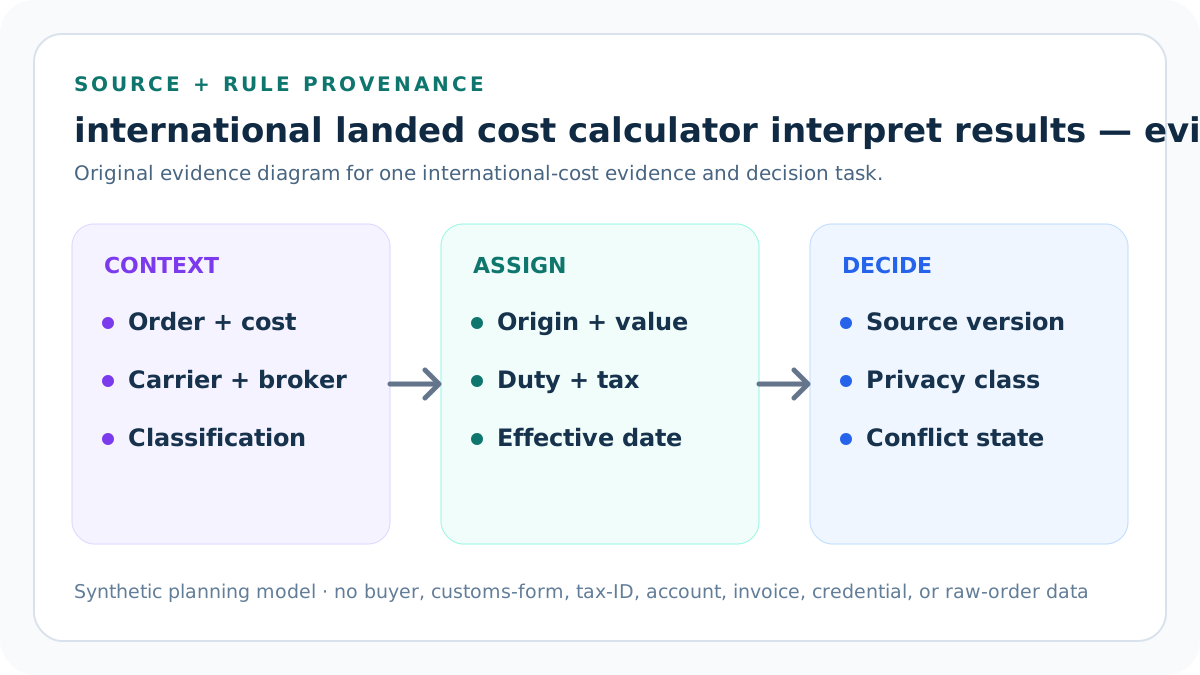
Interpret planning contribution
Bound control 5: Keep gross buyer amount and excluded costs visible. This interpretation role separates supported planning statements from official or commercial conclusions. Save source state, full-precision value, display value, currency, responsibility, jurisdictional context, reviewer, and review date.
Test the nearest passing boundary and nearest failure. State how the mismatch changes a bounded statement with a driver-specific next action, what evidence resolves it, who owns correction, and whether the packet must be blocked, reviewed, limited, superseded, or restored.
Interpret target headroom
Bound control 6: Name the internal owner and avoid customs-threshold language. This interpretation role separates supported planning statements from official or commercial conclusions. Save source state, full-precision value, display value, currency, responsibility, jurisdictional context, reviewer, and review date.
Test the nearest passing boundary and nearest failure. State how the mismatch changes a bounded statement with a driver-specific next action, what evidence resolves it, who owns correction, and whether the packet must be blocked, reviewed, limited, superseded, or restored.
Interpret Review
Bound control 7: Name target, responsibility, or return sensitivity as the exact driver. This interpretation role separates supported planning statements from official or commercial conclusions. Save source state, full-precision value, display value, currency, responsibility, jurisdictional context, reviewer, and review date.
Test the nearest passing boundary and nearest failure. State how the mismatch changes a bounded statement with a driver-specific next action, what evidence resolves it, who owns correction, and whether the packet must be blocked, reviewed, limited, superseded, or restored.
Interpret Ready
Bound control 8: Limit the claim to valid structure and the declared planning maximum. This interpretation role separates supported planning statements from official or commercial conclusions. Save source state, full-precision value, display value, currency, responsibility, jurisdictional context, reviewer, and review date.
Test the nearest passing boundary and nearest failure. State how the mismatch changes a bounded statement with a driver-specific next action, what evidence resolves it, who owns correction, and whether the packet must be blocked, reviewed, limited, superseded, or restored.
Use the international cost interpretation card with one protected parcel packet
Open the planner after the international cost interpretation card identifies seller alias, parcel alias, item quantity, prices, product cost, buyer shipping, outbound shipping, insurance, package and handling, fee convention, customs value context, classification, country of origin, destination, duty, tax, brokerage, responsibility, returns, currency, month, scope, target, and unresolved issues.
Save seller cost, buyer-side estimate, per-item cost, non-product load, contribution, margin, target headroom, decision, and issues at full precision beside display values. Preserve the prior packet whenever source, responsibility, or final invoice evidence changes.
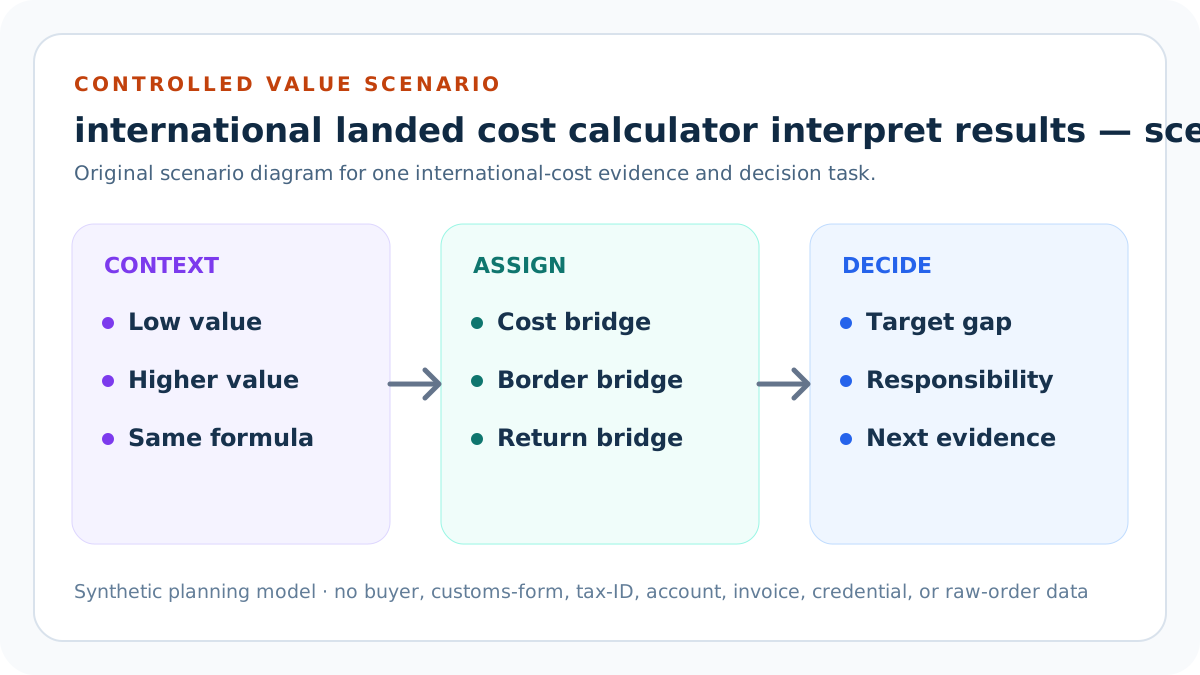
Apply source and responsibility gates before a bounded statement with a driver-specific next action
Block blank or non-finite numbers, fractional quantity, invalid positive or nonnegative values, rates, seller thresholds, currency, responsibility, trade context, period, real source-review date, scope, confirmations, or declared conflicts. After structure passes, Review cost above target, positive buyer-paid border estimates, border-charge share above its seller maximum, or expected-return-loss share above its seller maximum.
Ready confirms only a bounded seller-side planning scenario. It does not classify goods, determine customs value, establish duty or tax, choose an Incoterm, quote a carrier, promise clearance or delivery, calculate buyer total, determine accounting profit, or recommend price.
Version trade-rule uncertainty instead of averaging it
Change one quantity, price, cost, shipping, insurance, fee, customs value, classification, origin, destination, duty, tax, brokerage, responsibility, return, currency, or target field at a time. Store every source and applicability difference.
Record before state, isolated change, seller cost, buyer estimate, contribution, target movement, decision, confidence, owner, and next evidence action. Unknown, disputed, expired, or missing rule evidence is not zero.
Protect buyer, customs, tax, account, and invoice records
Public examples are synthetic. Keep buyer names, addresses, tracking numbers, customs forms, tax identifiers, private product classifications, marketplace and carrier accounts, negotiated rates, invoices, credentials, claims, messages, and raw orders outside the international cost interpretation card.
Use aliases, aggregates, redacted pointers, and access controls. An authorized reviewer should reproduce the planning scenario without public personal or confidential trade information.
Release, observe, correct, and restore the international asset
Before release, preserve narrow local and remote backups and a rollback identifier. Run typecheck, focused and full tests, integration, build, content and duplicate audits, SEO and static-route validation, source, image, link, mobile, keyboard, and privacy checks.
After release, verify status, canonical, indexability, schema, answer blocks, images, hub discovery, strict 404, sitemap policy, events, and production scenarios. Record Day 0/7/14/28 evidence and restore the prior version on formula, privacy, source, accessibility, routing, content, or health regression.
Write a supported result statement
State parcel, seller cost, buyer estimate, responsibility, components, per-item result, contribution, target, period, confidence, decision, and driver.
Follow with customs, tax, legal, carrier, accounting, delivery, demand, and pricing exclusions.
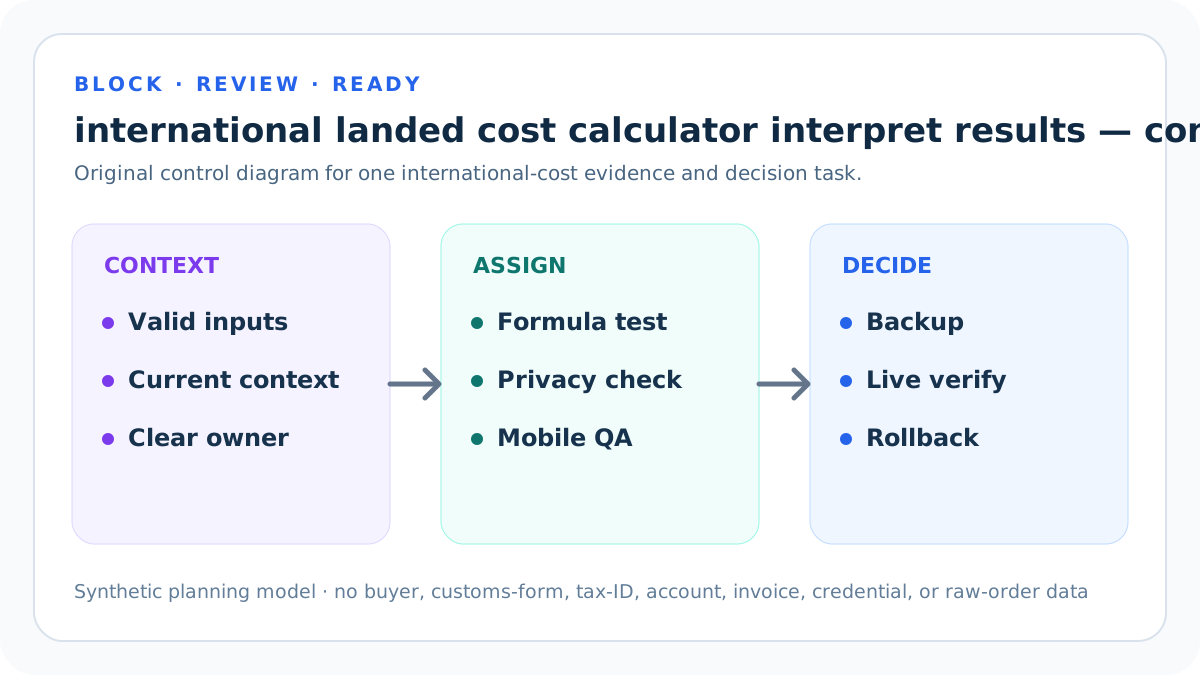
Write uncertainty by component
Name provisional classification, valuation, rate, tax, brokerage, carrier, fee, return, currency, or responsibility evidence separately.
Each uncertainty needs an owner, action, expiry, and decision effect.
Choose the next evidence action
Route classification and valuation to official or qualified review, carrier amounts to quotes or invoices, fees to platform records, and returns to comparable cohorts.
A calculator output narrows the next question; it does not authorize a cross-border policy.
Build a reader-specific interpretation matrix
Write separate bounded summaries for the cost analyst, fulfillment operator, customer-support owner, pricing reviewer, and release reviewer. Give each reader only the outputs, uncertainties, exclusions, and next evidence action relevant to that role.
Do not let an internal seller-cost estimate become customer-facing duty language. Customer communication requires verified current responsibility, marketplace display, carrier process, and approved policy wording.
Detect false-precision language
Flag phrases such as exact duty, guaranteed landed total, tax included, no fees on delivery, customs cleared, profitable order, safe price, or best carrier when the packet contains assumptions or excluded costs.
Replace each phrase with the measured planning output, source date, responsibility label, confidence class, and verification action. Preserve the rejected claim in review history so it does not return.
Build a result-to-action ladder
Map structural Block to evidence repair; buyer-paid Review to responsibility and disclosure verification; target Review to cost-driver analysis; return sensitivity to cohort review; and Ready to a reversible commercial review.
Every rung requires an owner, due date, evidence target, decision authority, expiry, and rollback condition. The calculator never skips directly from arithmetic to an irreversible international policy.
Claim matrix
Map each sentence to formula, source, and boundary. Deep check 1 stores parcel alias, source versions, protected pointers, full-precision transformations, assignment, output, decision, reviewer, expiry, and correction route. Another reviewer must not guess customs value, classification, origin, destination, responsibility, fee base, or formula sign.
Find the closest counterexample and state why it invalidates or narrows a bounded statement with a driver-specific next action. Preserve competing official, broker, carrier, marketplace, classification, valuation, responsibility, invoice, or return evidence as named scenarios rather than blending uncertainty.
Counterexample
Find a valid total under an invalid real-world rule assumption. Deep check 2 stores parcel alias, source versions, protected pointers, full-precision transformations, assignment, output, decision, reviewer, expiry, and correction route. Another reviewer must not guess customs value, classification, origin, destination, responsibility, fee base, or formula sign.
Find the closest counterexample and state why it invalidates or narrows a bounded statement with a driver-specific next action. Preserve competing official, broker, carrier, marketplace, classification, valuation, responsibility, invoice, or return evidence as named scenarios rather than blending uncertainty.
Denominator
Explain parcel, item, currency, and fee base. Deep check 3 stores parcel alias, source versions, protected pointers, full-precision transformations, assignment, output, decision, reviewer, expiry, and correction route. Another reviewer must not guess customs value, classification, origin, destination, responsibility, fee base, or formula sign.
Find the closest counterexample and state why it invalidates or narrows a bounded statement with a driver-specific next action. Preserve competing official, broker, carrier, marketplace, classification, valuation, responsibility, invoice, or return evidence as named scenarios rather than blending uncertainty.
Uncertainty
Separate observed, official, estimated, disputed, stale, and missing. Deep check 4 stores parcel alias, source versions, protected pointers, full-precision transformations, assignment, output, decision, reviewer, expiry, and correction route. Another reviewer must not guess customs value, classification, origin, destination, responsibility, fee base, or formula sign.
Find the closest counterexample and state why it invalidates or narrows a bounded statement with a driver-specific next action. Preserve competing official, broker, carrier, marketplace, classification, valuation, responsibility, invoice, or return evidence as named scenarios rather than blending uncertainty.
Action
Connect the driver to one reversible next step. Deep check 5 stores parcel alias, source versions, protected pointers, full-precision transformations, assignment, output, decision, reviewer, expiry, and correction route. Another reviewer must not guess customs value, classification, origin, destination, responsibility, fee base, or formula sign.
Find the closest counterexample and state why it invalidates or narrows a bounded statement with a driver-specific next action. Preserve competing official, broker, carrier, marketplace, classification, valuation, responsibility, invoice, or return evidence as named scenarios rather than blending uncertainty.
Sources and further reading
- Seller Profit Guard methodology: Comparable-grain evidence, deterministic scenarios, validation, correction, release, and rollback.
- Seller Profit Guard data privacy: Local-first boundaries for buyer, address, tracking, tax identifier, customs form, invoice, account, credential, and raw order data.
- Shopify Help Center: Duties and import taxes: Official Shopify guidance reviewed 2026-07-31 for customs fees, carriers, responsibility terms, HS codes, country of origin, duties, import taxes, and brokerage.
- Etsy Help: Custom Fees and Physical VAT Collection: Official Etsy guidance reviewed 2026-07-31 for destination-country charges, marketplace tax collection, seller responsibilities, customs forms, and market-specific processes.
- Etsy Help: Managing International Shipments: Official Etsy guidance reviewed 2026-07-31 for customs-form accuracy and variable tariff or duty collection by market, goods, and carrier.
- U.S. Customs and Border Protection: Commercial invoice value: Official U.S. CBP guidance reviewed 2026-07-31 for invoice value, additions, freight or insurance treatment, currency conversion, and supporting records.
- European Commission: Calculation of customs duties: Official EU guidance reviewed 2026-07-31 for tariff classification, customs value, origin, and ordered valuation methods.
Related Seller Profit Guard tools
- Open the International Landed Cost Planner: Model seller-side international cost under an explicit responsibility scenario.
- Combined Shipping Margin Calculator: Keep consolidation economics separate from border assumptions.
- Dimensional Weight Calculator: Model billable weight before entering evidenced postage.
- Shipping Subsidy Calculator: Inspect buyer shipping and seller-funded postage.
- Return Window Loss Estimator: Develop a detailed expected return-loss input.
- Contribution Margin Calculator: Carry labeled seller cost into a broader scenario.
- Methodology: Review evidence, privacy, formulas, tests, release, correction, and rollback.
- International Landed Cost Formula and Inputs: Continue with a distinct international cost formula, example, source, threshold, comparison, operating, interpretation, or audit task.
- International Landed Cost Worked Example: Continue with a distinct international cost formula, example, source, threshold, comparison, operating, interpretation, or audit task.
- Higher-Value International Landed Cost: Continue with a distinct international cost formula, example, source, threshold, comparison, operating, interpretation, or audit task.
- International Landed Cost Planner Mistakes: Continue with a distinct international cost formula, example, source, threshold, comparison, operating, interpretation, or audit task.
- International Landed Cost Data Sources: Continue with a distinct international cost formula, example, source, threshold, comparison, operating, interpretation, or audit task.
Next step: Open the International Landed Cost Planner.
This is operational planning help, not tax, accounting, legal, financial, or platform-policy advice. Review the Terms and disclaimer, and verify current platform rules and fee assumptions before changing prices.